Step-Up in Basis at Death: How Heirs Calculate Gains
Learn how the step-up in basis at death resets inherited asset values, how heirs calculate their gains, and which exceptions can cost money.

Daniel Anderson
Editor, The Money Maniac
November 13, 2026
14 min read

The folder shows up a few weeks after the funeral. Inside are a brokerage statement, a deed to a house your mother bought in 1978, and a sticky note in her handwriting that says "call the accountant." Nothing in it tells you what any of this is worth, or what you'll owe the moment you sell.
That second question is where the step-up in basis at death does its work. It's the most valuable rule in the tax code that most families never read about, and the one people misapply most often, usually by assuming every account gets the same treatment because it happens to be listed on the same statement.
Whether you're settling a parent's estate this year or rewriting your own plan so your kids don't inherit a tax problem, the arithmetic is identical. Basis goes in, sale price comes out, and a set of rules decides which number starts the calculation.
What a Step-Up in Basis Actually Does
Sell an asset and the IRS asks one question first: what did it cost you? That cost figure, your basis, is the price tag the tax system staples to every asset you own. Sale price minus that number is your gain, and for most of your life the number reflects what you paid. Stock bought in 1995 for $20,000 keeps a $20,000 basis decades later, even if the account statement shows a figure five times higher.
Death resets the starting number. Under Internal Revenue Code section 1014, property passing from someone who has died generally takes a basis equal to its fair market value on the date of death, as the IRS guidance on gifts and inheritances explains. The reset happens whether or not the executor files a federal estate-tax return, and it reaches stock, a house, a partnership interest, farmland, and most other capital assets titled in the decedent's name.
The mechanism fits on one page:
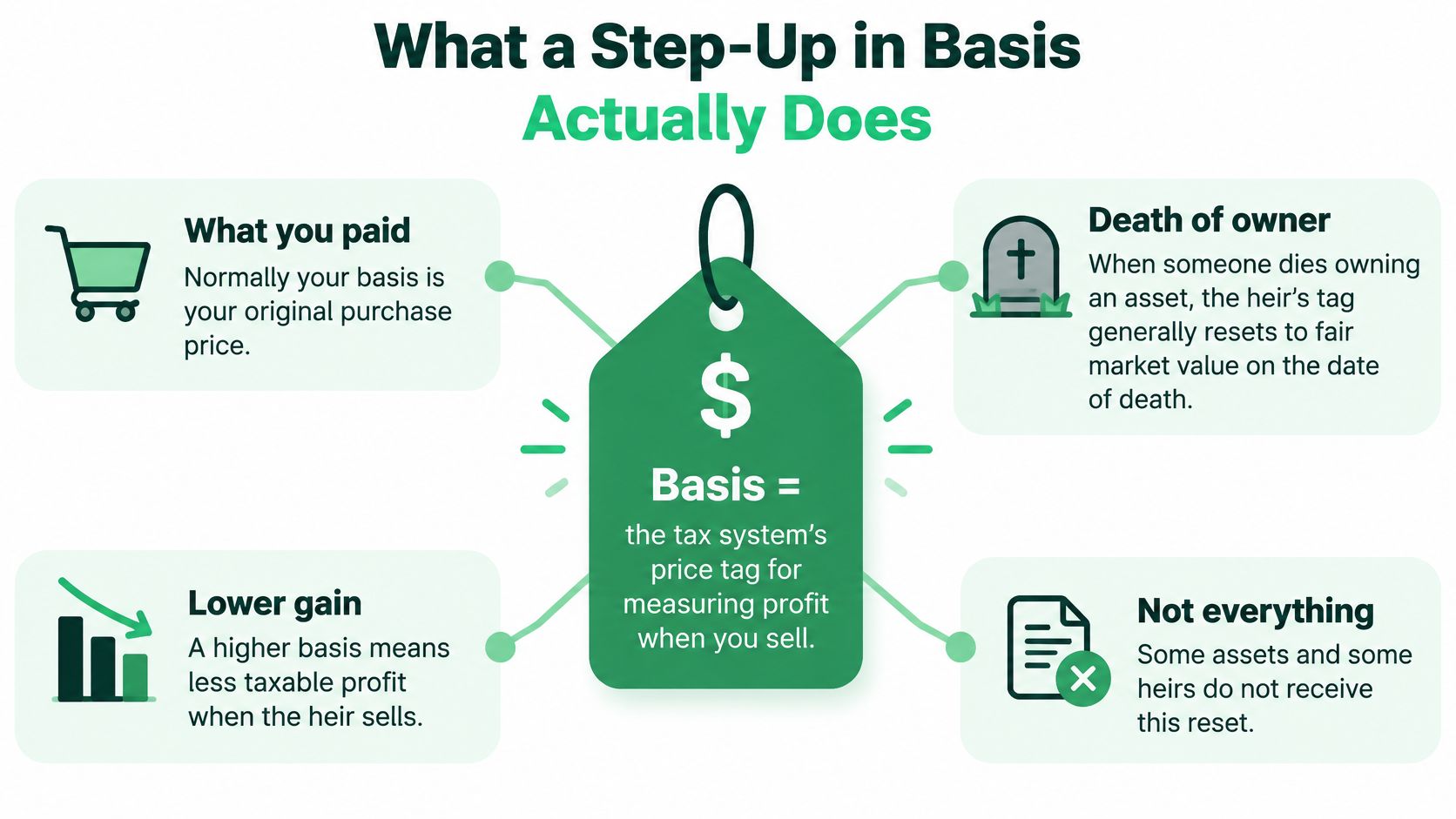
Run the same stock through the rule and the payoff is immediate. Bought for $20,000, worth $100,000 at death, sold soon after for $101,000: the heir reports roughly $1,000 of gain instead of $81,000. The $80,000 of growth that piled up while the original owner was alive is never taxed as capital gain at all. No election to make, no form to file for that outcome. The result is automatic, provided someone captured the date-of-death value in writing, because that written figure is the entire foundation of the heir's math years later.
Two taxes, two different checkbooks
The confusion starts because two unrelated taxes get tangled in the same conversation.
The federal estate tax is paid by the estate, on the total value of what you own at death. The step-up is an income tax rule, and it matters to the heir when the asset is eventually sold, a date that can arrive years after the funeral. Those rules travel separately, which is why an estate can owe nothing in estate tax and still hand over a full basis reset.
The Congressional Research Service's account of the estate and gift tax traces how the exemption climbed from $675,000 in 2001 to $3.5 million in 2009 under the Economic Growth and Tax Relief Reconciliation Act, while the top rate fell from 55% to 45%. For 2026, the basic exclusion is $15 million per person under the tax law enacted in 2025 and indexed for inflation from there, per the exclusion figures the IRS publishes.
The reset is generous, and it also has boundaries. Assets handed over during the owner's life keep the original basis, and money inside retirement accounts follows an entirely different set of rules, so two lines on the same brokerage statement can produce very different tax outcomes.
One test is worth memorizing: if the heir would otherwise owe tax on thirty years of growth, the step-up is the reason they may owe nothing.
How to Calculate the Gain Your Heir Owes
An heir sells inherited stock for $210,000. If its basis at death was $200,000, the taxable gain is about $10,000 before selling costs. The math is simple; the records that support each number deserve more care.
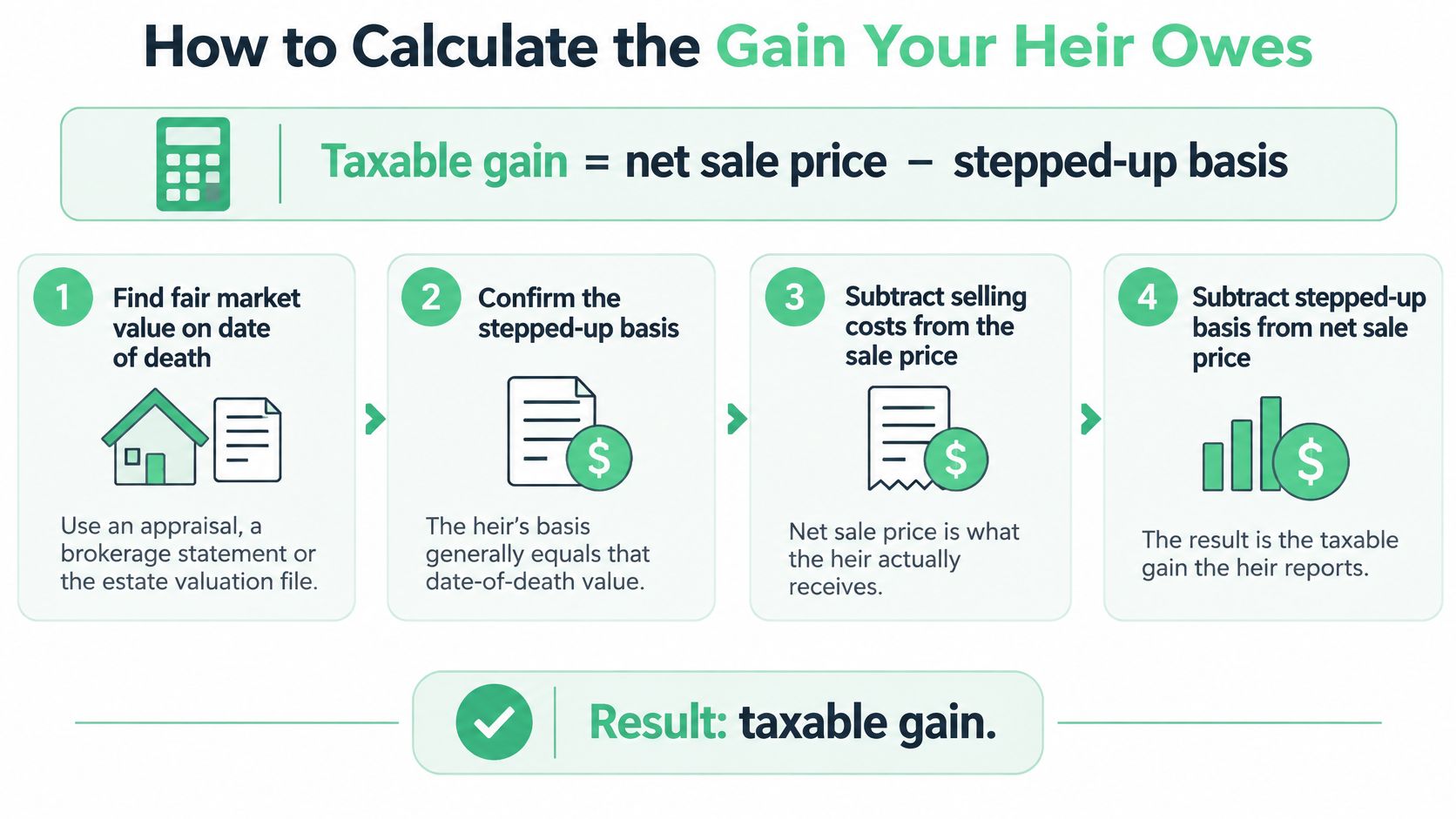
Taxable gain equals net sale price minus basis.
Use these five steps to work it out:
Five steps, and why each one exists
- Find the value on the date of death. Use the estate's valuation records, a qualified appraisal, or a brokerage statement for that date. This is the starting basis for the calculation.
- Calculate the net sale price. Subtract selling costs, such as commissions, closing fees, and transfer charges, from the sale price. The net amount is what you compare with basis.
- Subtract basis from the net sale price. A positive result is a gain; a negative result is a loss.
- Confirm the holding period. Inherited property is treated as long-term under IRC section 1223, regardless of how long the heir held it. That classification affects the rate applied to a gain.
- Apply the appropriate tax rate. For 2026, most filers pay 0%, 15%, or 20% on long-term capital gains, depending on taxable income and filing status. The 3.8% net investment income tax may also apply above $200,000 for single filers or $250,000 for joint filers. Check the IRS guidance on capital gains tax rates and the net investment income tax for the applicable rules and thresholds.
The same subtraction produces very different results depending on whether the inherited basis is used:
| Scenario | Gain without step-up | Gain with step-up |
|---|---|---|
| Stock bought for $20,000, worth $100,000 at death, sold for $101,000 | $81,000 | $1,000 |
| Home bought for $150,000 in 1990, worth $600,000 at death, sold for $620,000 | $470,000 | $20,000 |
| Stock bought for $50,000, worth $200,000 at death, sold for $210,000 | $160,000 | $10,000 |
Selling costs and state tax are left out to keep the comparisons focused on basis.
Practical rule: Keep the date-of-death valuation in the estate records before the first sale. Without documentation, the basis may be harder to establish later.
A negative result is a long-term capital loss. It can offset capital gains and, subject to annual limits, some ordinary income; unused losses may carry forward. Keep records showing both the basis and sale proceeds, since the loss depends on those figures.
Inherited real estate has another possible consideration: the Section 121 home-sale exclusion. An heir generally cannot use the deceased owner's years of residence to meet the ownership and use tests. To qualify, the heir generally must meet those tests personally, so a quick sale may not qualify. For a short holding period, the inherited basis may matter more to the calculation.
After a sale, consider how the proceeds fit with the rest of the portfolio. A scheduled review can help keep a large holding from dominating the allocation; how often to rebalance a portfolio explains calendar-based and threshold-based review approaches.
Valuation Choices That Set the Starting Number
Two elections can shift the starting number, and both belong to the executor rather than the heir. Neither comes free, and the IRS publication on basis of assets sets out the limits on each.
The alternate valuation date is the first. An executor can value the estate six months after death instead, but only by electing it on a timely filed estate-tax return, and the election has to cover every asset in the estate, so there is no picking only the holdings that fell. It makes sense only if it lowers both the gross estate and the estate tax, which means estates that owe nothing federally have no reason to touch it.
Special-use valuation is the second door, and it's narrow. It applies to qualifying farm property and closely held business real estate, valued on a use basis rather than a market basis for estate-tax purposes. The catch is that the heir's basis follows that lower figure, and recapture applies if the property leaves the family within ten years. A discount on the estate return becomes a smaller step-up on the income return.
| Valuation option | When it applies | What it sets for the heir |
|---|---|---|
| Date-of-death value | Default for every estate | Starting basis equal to fair market value on the date of death |
| Alternate valuation date | Only when an estate-tax return is filed and the election is made, six months after death | Basis taken from the alternate-date values for assets in the estate |
| Special-use valuation | Qualifying farm or closely held business real estate, when elected | Basis at the lower special-use value, with recapture if the property leaves the family within ten years |
The evidence that actually holds up
- Real estate and private businesses: a qualified appraisal from someone who does this for a living, dated as close to death as possible.
- Listed stock and funds: the average of the high and low trading prices on the date of death, which is the standard the IRS accepts for publicly traded shares.
- Cash and bank accounts: statements for the date of death, plus any accrued interest.
- The estate valuation file: the schedule, the appraisal, and the distribution records, kept together.
Original receipts for the decedent's home improvements stop mattering the day the step-up applies, because the date-of-death value replaces the old cost basis entirely. That's a strange feeling if you spent twenty years saving every contractor invoice. The file that now matters is the one that proves what the house was worth in the week someone died.
Estate tax and capital gains pull the appraisal in opposite directions. A higher defensible value cuts the heir's future gain and may raise estate tax. A lower value does the reverse. In states with their own estate tax, that second side of the ledger can matter for estates far below the federal exclusion, so the appraisal is a tax decision on two fronts at once. Keep it in the estate file anyway. An heir may need it a decade later, when the house finally sells and the custodian's records are long gone.
Who Gets a Step-Up and Who Does Not
The assumption that trips people up is that death itself triggers a fresh price tag on everything. It doesn't. What decides is the type of asset, how it's titled, and how it reached the heir, and none of those three things is visible on a bank statement.
The account type decides more than the balance does.
The community property bonus
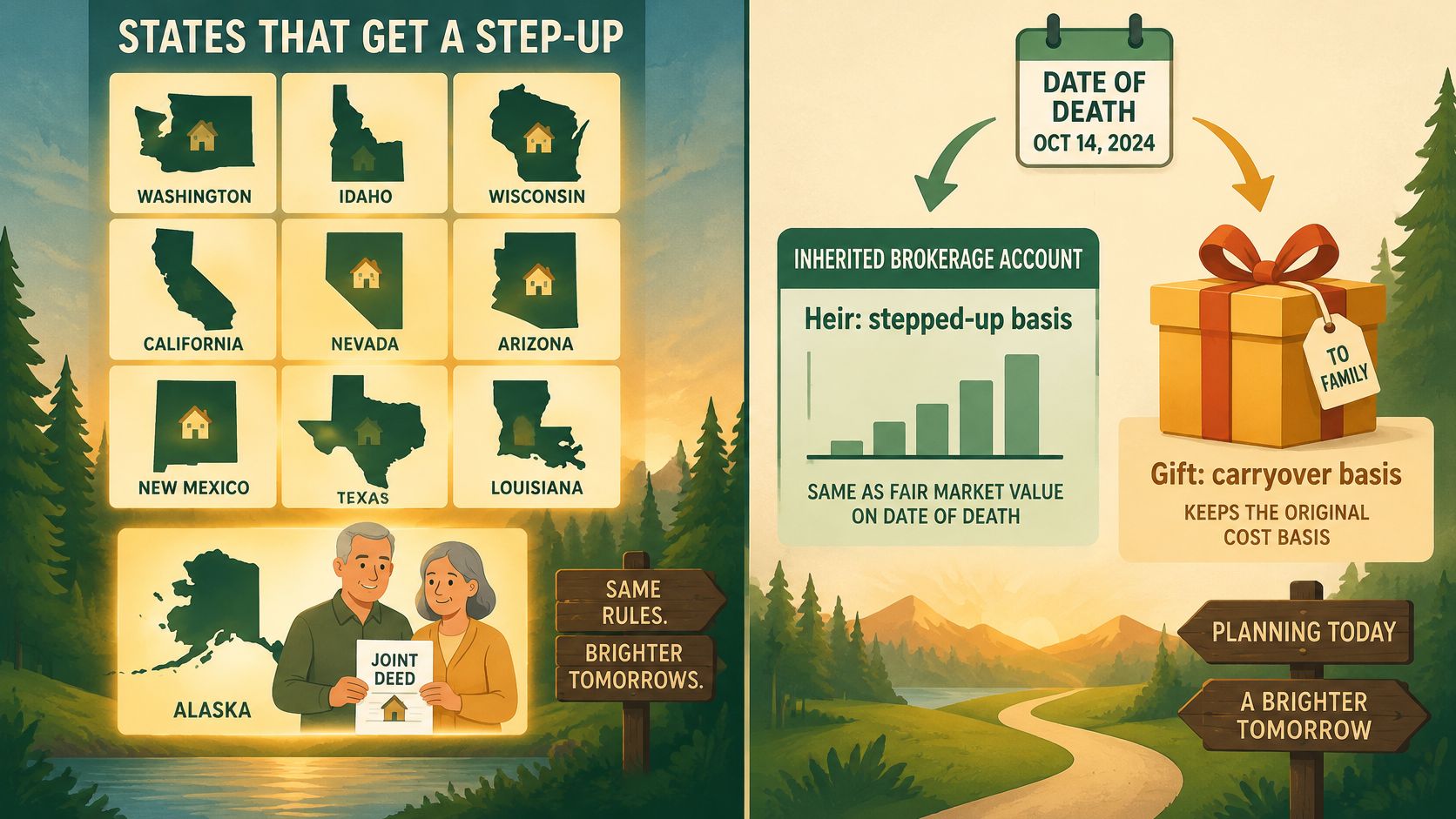
Arizona, California, Idaho, Louisiana, Nevada, New Mexico, Texas, Washington, and Wisconsin are community property states, and Alaska lets spouses opt in. There, a surviving spouse generally gets a step-up on both halves of community property, including the half they already owned. On a home bought decades ago for a modest sum and now worth many times that, the difference between a full reset and a half reset can run into six figures of avoided gain.
Outside those states, jointly owned property with someone who isn't your spouse resets only the decedent's share. Add a child to the deed of a rental property and you've created a joint tenancy where the inherited portion gets a new basis and the survivor's own share keeps whatever basis it had.
Where the reset never arrives
Lifetime gifts carry over the donor's basis. Hand a child appreciated stock while you're alive and the child inherits your old, low number.
The one-year rule closes a loophole. Under IRC section 1014(e), if appreciated property was given to the decedent within a year of death and passes back to the original donor, the step-up is denied and basis stays where it was.
Retirement accounts never get the reset. Withdrawals from a traditional IRA or 401(k) are ordinary income to the heir, because the money was deducted or never taxed going in.
Nonqualified annuities follow the same pattern. The earnings inside the contract come out as ordinary income, with no basis reset to soften the bill.
Put two accounts side by side and the point lands. A $300,000 brokerage account and a $300,000 traditional IRA look identical on a statement. Sell the first soon after inheriting and the gain is nearly zero. Withdraw the second and every dollar is taxed as ordinary income, at whatever rate the heir's bracket demands.
| Asset or transfer | Basis or tax result for the heir | What to remember |
|---|---|---|
| Stock or home held in the decedent's sole name | Fair market value at death | Full step-up |
| Community property in a community property state | Fair market value at death for both halves | Full step-up on both halves for a surviving spouse |
| Jointly owned property with a non-spouse | Stepped up for the decedent's share only | The other share keeps its original basis |
| Lifetime gift of appreciated property | Donor's original basis carries over | No step-up; larger future gain |
| Traditional IRA or 401(k) | Withdrawals taxed as ordinary income | No step-up because the money was never taxed |
| Nonqualified annuity | Earnings taxed as ordinary income when withdrawn | No step-up on earnings |
Before moving anything, sort what you own by account type and title. Our breakdown of how much generational wealth actually transfers is a useful reality check on what survives the handoff and what shrinks along the way.
Planning Moves That Protect the Step-Up
An owner who never needs to spend an appreciated asset has a straightforward default: hold it until death. That is the starting point for most families, even though it runs against the instinct to "get everything in order" by handing assets to the kids now. Good intentions, expensive paperwork.
A lifetime gift works like handing someone a baton along with your starting line. The recipient gets the asset and your original basis with it, so appreciation that built up during your working years gets taxed whenever they sell. Holding does the opposite. It moves the starting line to the date of death, and that single move is what makes patience so valuable here.
A gift is a decision about who pays the tax later. Holding is a decision about whether anyone pays it at all.
Where the alternatives land
| Strategy | Keeps the step-up? | Main tradeoff |
|---|---|---|
| Hold appreciated assets until death | Yes | Needs flexibility in case of illness or care costs |
| Lifetime gift of appreciated assets | No, donor's basis carries over | Recipient inherits a low basis and possibly a larger gain |
| Revocable living trust | Yes, assets remain in the estate for tax purposes | Helps with probate and incapacity planning, but offers no income-tax shelter |
| Irrevocable trust | Depends on how the trust is structured | Loss of control over assets; requires an estate attorney |
| Sell before death | Not applicable; gain is taxed to the owner | Tax at the owner's rate, with possible effects on Medicare premiums |
Trusts deserve their own conversation. A revocable living trust usually keeps assets inside your taxable estate, so the reset survives, and the trust earns its keep by simplifying probate and covering incapacity. An irrevocable trust can pull assets out of your estate entirely, and depending on how it is drafted, your heirs may receive a carryover basis instead of a stepped-up one. The drafting choices decide that outcome, not the label on the cover page. The Law Office of Bryan Fagan guidance on transferring property to family members is a sensible primer on how title changes affect what heirs receive.
When selling before death still makes sense
Sometimes you need the money, and no tax rule changes that. What planning controls is when the gain hits your return.
A sale in a low-income year can keep part of the gain in the 0 percent long-term capital gains bracket for 2026 under the IRS rules on capital gains and losses, which is real money if you are between paychecks, retired on modest income, or sitting out a market you do not trust. Realizing gains deliberately, in a year you choose, is the logic behind tax gain harvesting.
The catch is Medicare. A large realized gain raises your modified adjusted gross income, and under the Social Security Administration's Medicare premium rules, the income-related monthly adjustment amount on Part B and Part D premiums shows up two years after the income that triggered it. Check the current IRMAA brackets before assuming a gain is free, because those thresholds move.
Keep a running list of appreciated assets, the estimated basis for each, and who is expected to inherit what. Review it every few years and again after a move, a marriage, a divorce, or a death in the family. That list does double duty: it guides your hold-versus-sell decisions now, and it gives your heirs a head start on the numbers they will need later.
State Rules, Filing Duties and the Pre-Sale Check
A brokerage statement can show the wrong starting point for an heir's gain. Before selling or trading an inherited asset, check the filing duties and make sure the basis shown to the tax authorities matches the value used for the estate.
- Check for state-level taxes. Some states impose estate taxes, and others impose inheritance taxes paid by the heir. Review your state revenue department's current guidance to see which rules apply.
- Form 706 has a deadline. It is due nine months after death, with a six-month extension available. Filing is generally required when the gross estate plus adjusted taxable gifts exceeds the federal basic exclusion for the year of death.
- Form 8971 follows the return. When a Form 706 is filed, the IRS and each beneficiary receive a statement of the values used. The heir's reported basis must be consistent with that value.
- Check the basis on Form 1099-B. The form reports the cost basis the brokerage has on file, which may still reflect the original purchase price. Compare it with the date-of-death value and ask the custodian to correct an outdated figure.
- Keep the records together. Save the death certificate, appraisals, account statements, distribution records, and estate valuation with the estate documents. A single folder is easier to use than a shoebox hunt.
Do not sell an inherited asset until its basis is confirmed in writing.
Before a sale, compare the date-of-death value with the basis reported by the custodian. Also confirm whether the asset was community property or jointly owned, since ownership can affect the surviving spouse's basis. Retirement accounts and annuities generally do not receive the same basis reset; distributions may be taxable as ordinary income.
Ask a CPA or estate attorney for help if a Form 706 is being filed, the asset is a business or farmland, or a large gain could affect the tax bill. A supported valuation and properly filed return can prevent disputes over the starting basis. If you are planning your estate, organize the records while appraisals and account details are easier to obtain.
Get more posts like this
One short, useful email each Friday. Free, no spam, unsubscribe anytime.