Fixed Index Annuity Pros and Cons: Is It Worth It?
Fixed index annuity pros and cons - Weigh the zero floor, index caps, surrender charges, and tax treatment before you buy. Get a clear buyer checklist for

Daniel Anderson
Editor, The Money Maniac
November 19, 2026
16 min read

You're getting close to your last paycheck. The house has equity, you've built meaningful savings, and retirement finally looks affordable. Then you consider what a steep market drop could do just as you start taking income. Suddenly, an insurance agent's offer of market-linked growth with no market losses sounds appealing.
A fixed index annuity, also called a fixed indexed annuity or FIA, is an insurance contract that credits interest using an index's performance. You don't own the index or invest your premium directly in its stocks. The insurer applies a formula to determine what you receive.
My judgment on fixed index annuity pros and cons is straightforward. A contractual zero floor provides useful protection against negative index credits. You pay for that protection through restricted upside, limited access to your money, ordinary-income taxation of earnings, and dependence on the insurer's ability to pay.
Every illustrative rate below is a hypothetical dated 2026, not a current offer or a lasting market fact. Check actual rates against the insurer's current disclosure and distinguish them from contractual guarantees.
The decision starts with the floor, then the crediting formula, surrender charges, taxes, income riders, sales incentives, insurer strength, and renewal terms. Keep those features separate. An attractive income illustration shouldn't distract you from an expensive exit.
1. Protection From Market Losses (The Zero Floor)
A zero indexed-interest floor means a falling index won't produce a negative interest credit. For someone nearing or entering retirement, that can help limit the effect of a market decline early in withdrawals, a risk described in this guide to sequence-of-returns risk. The floor protects against negative index credits, not every possible loss.
Consider a 2026 hypothetical: you're 60, your contract starts at $200,000, credits annually, has a 7% cap, and has no withdrawals or charges.
- First contract year: The index rises 18%. The cap limits credited interest to $14,000, bringing the balance to $214,000.
- Second contract year: The index falls 25%. The zero floor credits no indexed interest, leaving the balance at $214,000.
- Direct-index comparison: Ignoring dividends, expenses, and taxes, a $200,000 investment in the index would rise to $236,000, then fall to $177,000.
The direct investment loses $59,000 in the second year, or $23,000 across both years. Those figures measure different things. The FIA's floor helps in this particular sequence, but two years do not establish which choice will work better over retirement.
The floor has limits. Investor.gov's annuity guide explains that surrender charges may leave you with less than you paid. Inflation can also reduce purchasing power, while rider charges and withdrawals can lower the contract value. A statement balance is not a promise that the same amount is available to take out.
Practical rule: Evaluate protection by the amount you could withdraw, not the account value printed on the statement.
Ask for the floor, crediting period, and protection terms in writing. Check whether the index excludes dividends, too. If your goal is protecting your principal from volatility, identify which risks the contract still leaves with you.
2. Limited Upside Without Unlimited Guesswork
A strong market year can produce a surprisingly modest annuity credit. The insurer's formula determines the result, and the index's headline performance is only the starting point.
The SEC's indexed-annuity bulletin explains caps, participation rates, and spreads, including that insurers may change these terms periodically within contractual limits. It also cautions that index-linked interest doesn't give you direct ownership, dividends, or unlimited appreciation.
The distinctions are easier to see together.
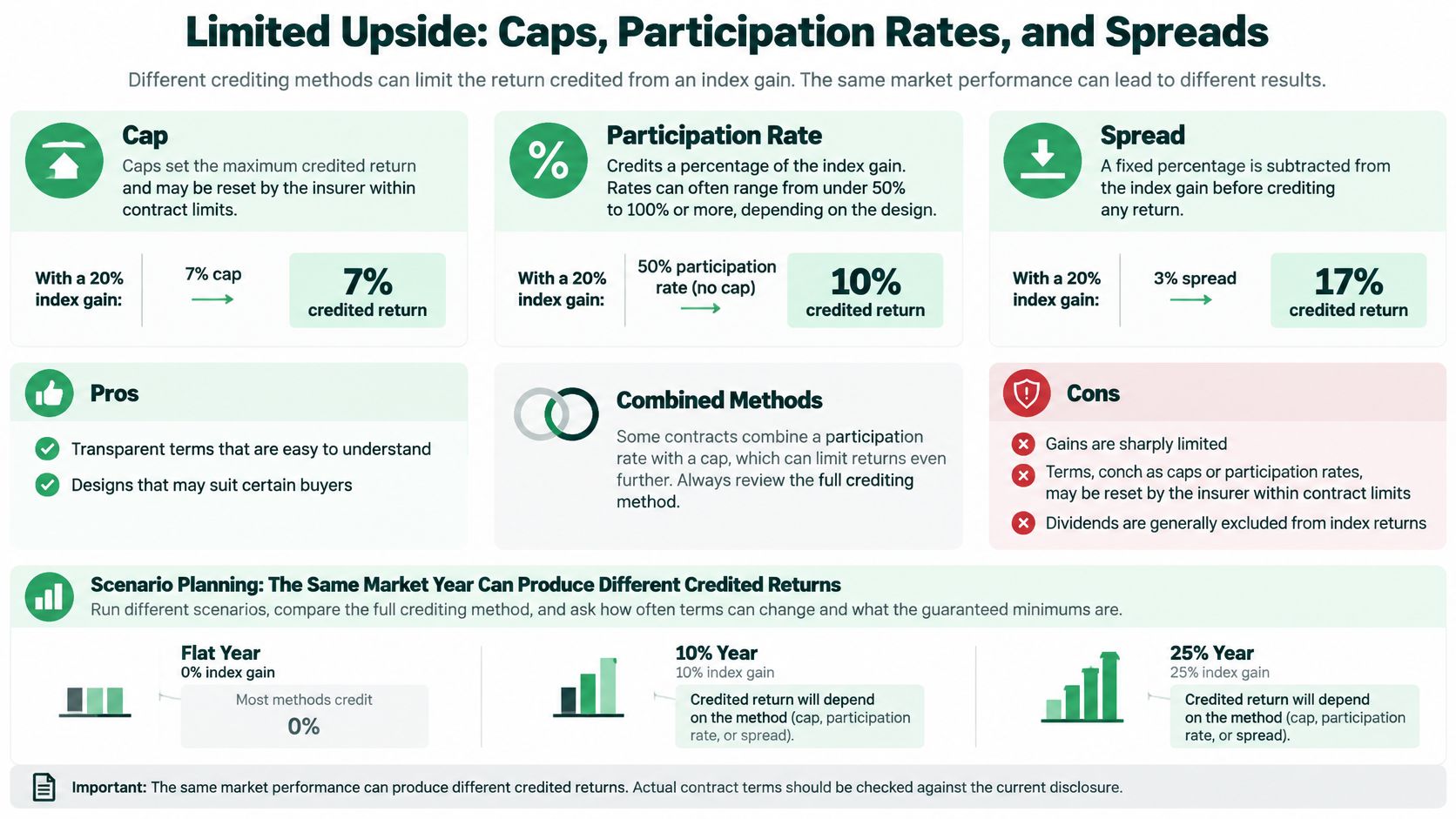
Same market, different credits
Use a 2026 hypothetical in which an index gains 20% and each alternative starts with $200,000:
- Cap only: A 7% ceiling credits $14,000, ending at $214,000.
- Participation only: A 50% participation rate credits 10%, or $20,000, ending at $220,000.
- Spread only: Subtracting a 3-percentage-point spread credits 17%, or $34,000, ending at $234,000.
These examples isolate each mechanism. A real contract may combine them, and the order of operations matters. An apparently generous participation rate can become much less impressive once a cap enters the calculation.
Have the agent write the complete formula on paper. Then apply it to a flat market, a modest gain, and a strong gain, including any averaging rules or unusual index design.
The defensible comparison is the whole crediting method versus alternatives with different risks. Comparing an FIA cap with an index fund's historical average return skips the floor, dividends, liquidity, and the timing of gains. Convenient math tends to be very good at selling things.
3. Surrender Charges and Lack of Liquidity
A $200,000 fixed index annuity can have a zero surrender value only in the sense that its index credit does not fall. Accessing the principal is a separate matter. A broken furnace, dental bill, or family emergency won't wait for a contract schedule.
Investor.gov's annuity investor bulletin explains that surrender charges often decline over time and contracts may allow some withdrawals without a charge. Read the terms closely: the allowance's size, calculation, and timing determine how much cash is available.
Calculate the emergency exit
Suppose a 2026 hypothetical $200,000 contract has a seven-year surrender schedule. The charge starts at 7% and drops by one percentage point each year. In the second contract year, you withdraw $50,000 beyond the free allowance. At the hypothetical 6% charge, that withdrawal costs $3,000, before taxes or other adjustments.
That example applies the charge only to the amount above the allowance. Your contract may calculate the charge differently or include a market value adjustment, which can change the amount you receive. Ask for a written surrender-value illustration showing both a partial withdrawal and a full exit.
- Protect your reserve: Keep money for emergencies and known repairs or medical costs accessible. A reserve that is locked inside an annuity cannot do its job when a bill arrives.
- Check the allowance: Confirm what amount it applies to, when it resets, and whether unused access carries forward.
- Check benefit reductions: A withdrawal allowed by the contract can still reduce future income guarantees.

Compare accessible savings options with this guide to high-yield savings accounts versus CDs. Home equity can support your finances, but a house is not an emergency checking account.
4. Tax-Deferred Growth and Taxation of Withdrawals
Suppose you are 62 in 2026 and hold $200,000 in a nonqualified fixed index annuity. Tax deferral means credited earnings can stay in the contract without an annual income-tax bill. The contract was funded with after-tax money, but its earnings are generally taxed as ordinary income when withdrawn.
Follow the earnings through the withdrawal
In this 2026 hypothetical, the contract has grown from $200,000 to $260,000. You withdraw $60,000 without annuitizing the contract. Under the earnings-first rule that generally applies to nonannuitized withdrawals, the full $60,000 is treated as earnings.
At an assumed 22% federal marginal rate, the simplified federal tax would be $13,200, leaving $46,800 before state taxes or other effects. The rate is only an arithmetic assumption, not a prediction of your actual tax bracket.
At age 62, this hypothetical withdrawal is after the age-59½ threshold. Earlier taxable distributions can face a 10% additional federal tax, subject to exceptions; see IRS Publication 575 for the applicable rules. The age threshold matters, but it does not erase ordinary income tax on earnings.
Tax deferral postpones the tax decision. Your withdrawal plan determines how expensive that decision becomes.
An annuity held inside an IRA does not add another layer of tax deferral. Ask a tax professional to model withdrawals alongside Social Security, required retirement-account distributions, and other income. A large distribution can affect more than the tax bill on that withdrawal.
- Check the distribution method: Regular withdrawals and annuitized payments can receive different tax treatment.
- Read the applicable guidance: IRS Publication 575 and Publication 939 address pension and annuity taxation. The rules vary by arrangement.
- Review exchanges first: Get tax advice before a proposed Section 1035 exchange, especially if ownership, payments, or cash received will change.
A lower future tax bracket can make deferral more valuable. Retirement approaching, by itself, does not guarantee a lower bracket.
5. Guaranteed Income Riders and Lifetime Payments
A 65-year-old with a $200,000 benefit base and a 5% lifetime withdrawal percentage would receive $10,000 a year under this 2026 hypothetical. That figure describes scheduled income, not investment return. Payments may include the return of the buyer's own money, while the rider's insurance value is the promise to continue eligible payments for life if contract conditions are met.
An optional income rider can provide lifetime withdrawals under specified rules. Its benefit base is generally an accounting value used to calculate income, not money available to cash out. The distinction matters: the benefit base can rise even while the contract's cash value falls.
Under an assumed 2.5% annual inflation rate, the $10,000 payment would buy approximately $6,100 worth of starting-year goods after twenty years. This is a planning assumption, not a forecast or a current inflation reading. A fixed payment can feel steady on paper while covering less over time.
Before choosing a rider, ask for these terms in writing:
- Cash value: How much could you receive if you withdrew or surrendered the contract?
- Benefit base: Which accounting value determines the lifetime payment?
- Rider charge: What is charged, which value is it based on, and can the charge change?
- Withdrawal rules: How would an excess withdrawal affect guaranteed income?
- Survivor terms: Does the income cover one life, or can it continue for a spouse?
A rising benefit base does not mean a rising cash value. Charges and withdrawals can reduce the amount available even as the figure used to calculate income increases. Ask for both projections side by side, including the cash value at year 10 and the benefit base at that point.
Then compare the rider's scheduled payments with your other sources of retirement income. Check your actual Social Security estimate and current SSA cost-of-living information separately. A private fixed payment does not automatically receive Social Security-style adjustments.

6. Complexity, Commissions, and Sales Pressure
A useful test is to explain the proposed contract to your spouse without the agent helping. If you can't explain how interest is credited, what you can withdraw, and what changes later, you're not ready to sign.
Agents are typically compensated by the insurer. That doesn't establish that a recommendation is bad, but it creates a reasonable question: How does this person's compensation change depending on what I buy?
The SEC's indexed-annuity investor alert emphasizes understanding these contracts' complicated terms, withdrawal consequences, and insurer-backed guarantees. A reassuring presentation doesn't replace that work.
Stress-test the illustration
In a 2026 hypothetical, a buyer sees a 7% cap beside a 6% rider payout on a $200,000 benefit base. The presentation highlights $12,000 of annual income and attractive accumulation projections.
Those numbers answer different questions. The cap limits potential indexed interest, while the rider percentage determines eligible income under separate rules. Neither establishes what the buyer could receive upon surrender.
Ask the presenter to show:
- Guaranteed-only results: Remove favorable assumptions about future crediting.
- Renewal stress: Use the least favorable permitted crediting terms.
- Early-exit values: Show actual surrender proceeds rather than account value.
- Compensation details: State commissions and other incentives in dollars where available.
- Replacement costs: Identify benefits forfeited and any new surrender period.
Sales-pressure test: If taking the contract home for an independent review supposedly ruins the opportunity, take the contract home anyway.
An independent fee-only fiduciary or CFP professional can help evaluate the proposal. Verify credentials through CFP Board and adviser registration through the SEC's investment adviser database.
Ask whether the professional is acting as a fiduciary for this recommendation. A credential, a friendly manner, and an excellent lunch don't answer that question.
7. Insurer Financial Strength and State Guaranty Limits
Assume your state caps coverage at $250,000 for annuities. A fixed index annuity's guarantee comes from the insurer, while the index determines whether the contract earns interest under its crediting rules.
An FIA is not a bank deposit and does not receive FDIC deposit insurance. State life and health insurance guaranty associations provide a separate, limited framework if an eligible insurer fails. Coverage depends on state law and the contract's eligibility.
Test a limit before treating it as protection
In a 2026 hypothetical, assume the applicable annuity limit is $250,000. This example does not state your own state's current coverage.
A $200,000 covered contract might initially fit within that ceiling. If its covered value later reached $280,000, $30,000 would exceed the limit, assuming the same coverage measure and no other applicable contracts. The limit may therefore matter more as a balance grows than it does on the day you buy.
A hypothetical $600,000 covered exposure under the same ceiling would leave $350,000 above the limit. That excess might still have recovery value through the insurer's resolution process, but full or prompt recovery should not be assumed. The guaranty framework is a backstop with limits, not a substitute for checking the company behind the contract.
- Confirm coverage: Consult the National Organization of Life and Health Insurance Guaranty Associations and your state association for applicable rules.
- Identify the issuer: Check the legal insurance company named in the contract, not just the marketing brand.
- Review financial strength: Examine ratings and rating history from AM Best, Moody's, S&P, and Fitch.
- Add your exposure: Include other relevant contracts with the same insurer when assessing concentration.
Splitting contracts across insurers may reduce concentration. Buying through different agents or in different states does not automatically create extra coverage. Eligibility and aggregation rules depend on state law, so confirm how they apply to your contracts.
For a separate explanation of deposit protection, see bank deposit safety limits explained. Deposit insurance and annuity guaranty arrangements are different protections.
Financial-strength ratings can help screen insurers, but they are opinions that may change. Use them alongside careful contract review, and do not treat a rating as a promise of recovery.
8. Interest Rate Dependence and Changing Crediting Terms
Your 9% introductory cap drops to 6% at renewal. That change can shrink credited interest even when the index rises enough to reach the cap. For a retirement plan built around a $200,000 balance, renewal rights and guaranteed minimum terms matter more than the opening quote alone.
Insurers set crediting terms partly in response to interest rates and the cost of supporting index-linked benefits. Those factors do not predict a specific contract's renewal cap. The contract still determines how much discretion the insurer has.
Model an unfavorable renewal
In a 2026 hypothetical, a contract starts with a 9% cap and a guaranteed minimum cap of 3%. At renewal, the insurer reduces the cap to 6%.
Suppose the account holds $200,000 at the start of a later crediting period, and the index gains enough to reach the applicable cap. At 9%, the cap allows $18,000 of interest. At 6%, it allows $12,000, before charges and other adjustments.
The guaranteed minimum cap sets the lowest cap the contract permits. It does not guarantee credited interest. If the index produces no eligible gain, a positive cap still results in no interest.
Write down these details and date the quote:
- Current terms: Cap, participation rate, spread, and crediting-period length.
- Contractual boundaries: Minimum participation and cap levels, maximum spread, and other permitted changes.
- Reset process: When the insurer announces new terms and which allocation choices are available.
- Exit cost: The cost of leaving if renewal terms disappoint.
Build the essential spending plan around contractual guarantees. Treat future index credits as uncertain.
For rate context, check the U.S. Treasury's current yield-curve information and Federal Reserve interest-rate releases. Neither source sets the cap your insurer must offer.
An original quote is only a snapshot. A replacement quote may offer a higher headline cap, but switching can bring surrender charges, a new restriction period, or lost benefits. Compare the full cost before moving.
What each fixed index annuity feature changes
A dated example makes the contract easier to judge. Suppose you are 60 and place $200,000 in a fixed index annuity on January 1. The figures below are hypothetical, not a forecast. Each row isolates one contract lever, so you can see what it might mean for the same starting balance.
| Contract lever | Dated example | What happens to the $200,000 |
|---|---|---|
| Zero floor | At the end of the first crediting period, the index is down. | The index loss does not directly reduce the balance under a 0% floor. The account may still be affected by contract charges or withdrawals, so the protected amount is not automatically the same as the amount you can take out. |
| Cap, participation rate, or spread | At the end of the next period, the index has gained 10%. The contract has a 6% cap. | The credited gain cannot exceed the cap, so $200,000 could become $212,000 before charges and other adjustments. A cap limits credited interest, not the index's actual return. |
| Surrender schedule | You need to withdraw money before the contract's surrender period ends. | A withdrawal beyond the free allowance may trigger a charge, reducing the amount available. The account value and the amount you can access are not always the same. |
| Tax treatment | You take a taxable withdrawal while the contract has accumulated gains. | For a nonqualified contract, gains are generally withdrawn first and taxed as ordinary income. Tax deferral postpones taxes; it does not erase them. |
| Income rider | You add a lifetime income rider, then later start payments. | The rider may charge a fee and use a benefit base to calculate income. That base is not necessarily cash you can withdraw, and payments can reduce the contract's cash value. |
| Commission and sales incentives | You review the recommendation before signing. | A commission-paid sale can create incentives that do not match your needs. The contract's costs and terms matter more than a polished presentation. |
| Insurer and guaranty limits | The insurer later cannot meet its obligations. | Contract guarantees depend on the insurer's ability to pay. State guaranty protection has limits and varies by state, so it is not a substitute for assessing the insurer. |
| Renewal terms | At the end of a crediting period, the insurer resets the cap or participation rate within the contract's rules. | The next period may credit less interest, even if the index performs similarly. If you leave, surrender charges may still apply. |
The table separates three amounts that are easy to confuse: the account value, the value used to calculate rider income, and the amount available after charges. A contract can protect one measure while limiting another. Check which number applies to the decision you are making, and compare the dated hypothetical with the contract's actual terms.
A Buyer's Checklist Before You Commit
A $200,000 balance can produce different results under different contract terms, even when the index gain is identical. Before signing, decide whether you need accessible savings, a market-loss floor, or lifetime income. An FIA may suit someone near retirement with adequate cash reserves who wants contractual protection, but it is a poor place for emergency money or funds needed during the surrender period. It may also be an expensive compromise for money intended mainly for long-term growth.
Owning a home does not remove the need for liquid cash. Maintenance, insurance, property taxes, health expenses, and family obligations still call for accessible dollars.
Test the numbers before signing
Use the same balance and index gain to compare crediting methods. These are simplified examples, not contract illustrations:
| Crediting method | Starting balance | Index gain | Credited rate | Interest credited |
|---|---|---|---|---|
| 8% cap | $200,000 | 12% | 8% | $16,000 |
| 60% participation rate | $200,000 | 12% | 7.2% | $14,400 |
| 4-percentage-point spread | $200,000 | 12% | 8% | $16,000 |
The spread example subtracts four percentage points from the index gain. Actual contracts may combine limits, apply different formulas, and exclude dividends from the referenced index calculation. Use the contract's definitions, not just the headline rate.
A surrender charge can make a partial withdrawal cost more than expected. For example, if $25,000 is subject to a 5% charge, the charge is $1,250 before taxes or other adjustments.
| Withdrawal input | Example | Result |
|---|---|---|
| Excess withdrawal | $25,000 | $25,000 |
| Surrender charge | 5% | $1,250 |
| Amount after charge, before taxes or other adjustments | $25,000 minus $1,250 | $23,750 |
Check whether a free-withdrawal allowance reduces the amount subject to the charge. Include any market value adjustment separately, since it can change the amount received.
Compare alternatives by purpose
CDs can serve predictable savings needs, subject to their withdrawal and coverage rules. Bonds may support planned income, with price and credit risks that vary. Index funds provide market participation and liquidity, but expose you to market losses. Variable annuities add insurance features alongside investment risk and potentially substantial expenses.
If lifetime payments are the main goal, price an income-focused annuity alternative separately. Complexity only earns its keep when it provides a benefit you need.
Use your own assumptions, confirm current IRS rules, check SSA benefit information, and date any Treasury rate comparison. Sign only when the guarantees, restrictions, and alternatives make sense on their own, without a sales pitch to translate the brochure.
Get more posts like this
One short, useful email each Friday. Free, no spam, unsubscribe anytime.