9 Sources of Retirement Income: Pros, Cons, and Tax Rules
Compare nine sources of retirement income, from Social Security and pensions to rentals and annuities, with tax timing, worked examples, and rules of thumb.

Daniel Anderson
Editor, The Money Maniac
November 4, 2026
15 min read

You're in your early 60s, the mortgage is paid off, and the 401(k) balance looks respectable on screen. Then you sit down with a notebook and realize you still don't know what next month's income would be if you stopped working. Which account do you touch first? When do you claim Social Security? What gets taxed, and at what rate?
That's the question behind planning your sources of retirement income. A balance is not a paycheck. Most households end up with several pieces arriving on different schedules, with different tax rules and different levels of reliability. My stance is simple. Build a guaranteed floor for essential spending first, draw from flexible savings second, and treat home equity as a backup instead of the main plan.
A note on perspective, so you know where I'm coming from. Daniel Anderson, who edits The Money Maniac, personally aims for fat FIRE, continuing to work and invest until a 3% to 4% withdrawal rate produces hundreds of thousands of dollars a year in passive income. You don't need that goal. The math below works at ordinary income levels too.
Every dollar figure here is dated to 2025 and drawn from primary sources such as the SSA, IRS, CMS, and the Federal Reserve. Limits and thresholds change yearly, so confirm 2026 numbers at ssa.gov, irs.gov, cms.gov, and hud.gov before you act. Examples are hypothetical illustrations, not predictions.
1. Social Security Retirement Benefits
Social Security serves as a basic source of income. The Federal Reserve's 2024 household survey found that 78% of all retirees reported Social Security income in 2024, rising to 91% among retirees aged 65 or older. It's funded by payroll taxes, adjusts for inflation, and lasts as long as you do. Very few private products offer all three.
Your check comes from your highest 35 years of earnings and your claiming age. You can start at 62, wait until full retirement age, which is 67 if you were born in 1960 or later, or delay to 70.
What waiting actually buys you
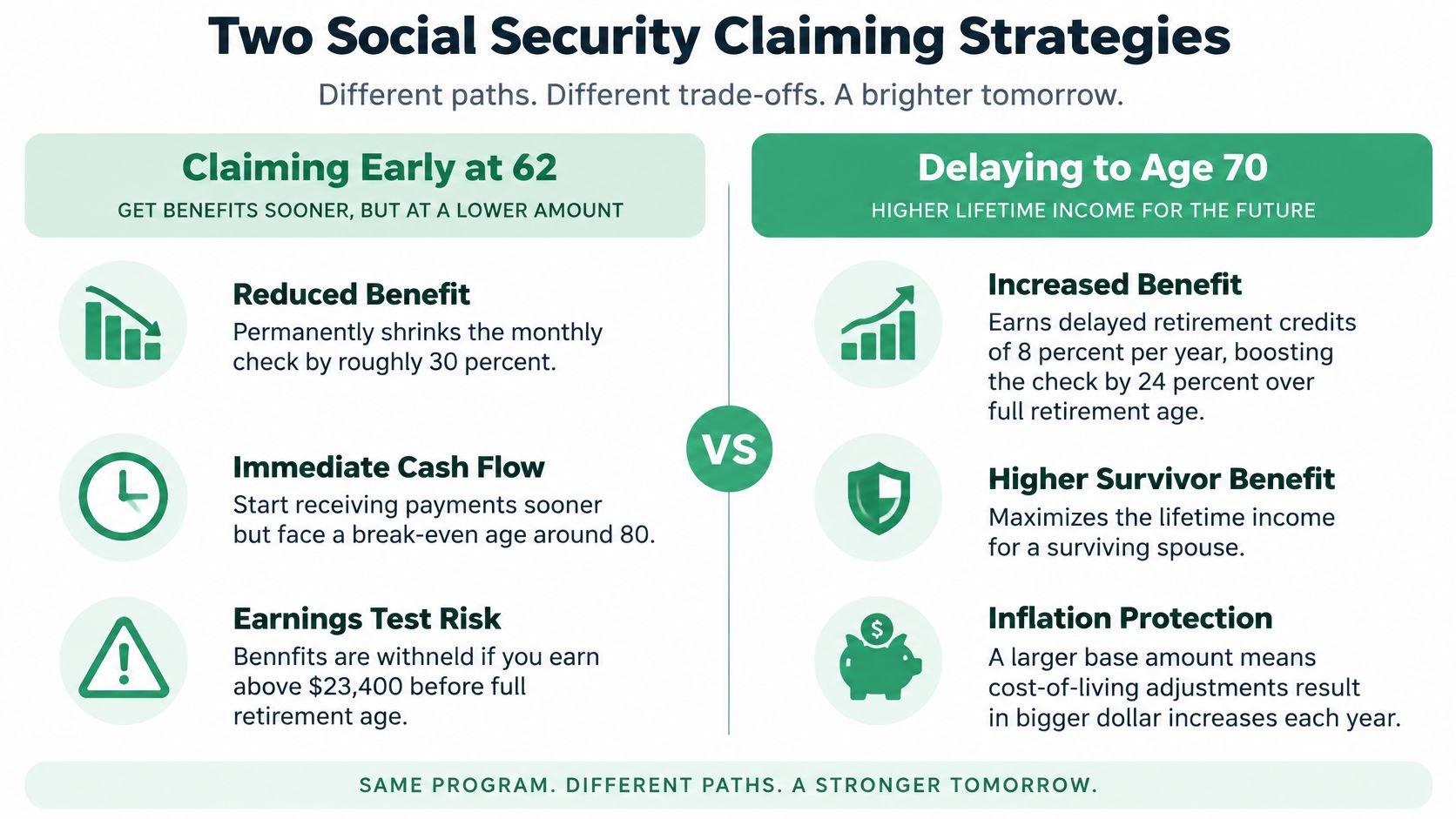
Say your full benefit at 67 is a hypothetical $2,000 per month under 2025 SSA rules. Claiming at 62 pays 70%, or $1,400. Waiting to 70 pays 124%, or $2,480. The early claimer collects $134,400 between 62 and 70. The delayer then gains $1,080 per month, so break-even lands around age 80 to 81, before taxes and inflation adjustments.
The Social Security Administration's delay guide confirms that delayed retirement credits add 8% per year after full retirement age for people born in 1943 or later, stopping at 70.
- Check your record: Open a my Social Security account at ssa.gov and verify your earnings history.
- Watch the earnings test: In 2025, SSA withholds $1 for every $2 earned above $23,400 before full retirement age, with a $62,160 threshold in the year you reach it.
- Think about your spouse: If you're the higher earner, delaying usually raises the survivor benefit too.
Our detailed walkthrough on when to take Social Security runs the break-even math for couples.
2. Employer Defined Benefit Pensions
Start with the math, because pensions hide their value. Say you worked 30 years under a formula paying 1.5% of final average salary per year of service, and your final average salary was $80,000. That's 30 x 1.5% x $80,000, or $36,000 per year, roughly $3,000 per month for a single-life payout in this hypothetical example. A joint-and-survivor option might pay closer to $2,700 per month, depending on the plan and your spouse's age.
A traditional pension promises that monthly payment for life. Your employer funds the plan and carries the investment risk, which is the opposite of a 401(k). Fewer private employers offer these plans now, but teachers, police officers, other government workers, and long-tenured employees at large companies often still have one.
People underestimate pensions because there's no balance on a statement. A $3,000 monthly lifetime check would take a very large savings account to replicate, especially with any inflation adjustment attached.
Decisions to get right
- Get it in writing: Request a benefit statement confirming the formula, your vesting status, and early retirement reductions.
- Price the survivor option: Compare the reduced joint payment against your spouse's own income and life expectancy.
- Scrutinize any lump sum: Compare it with the lifetime stream using current Treasury yields from treasurydirect.gov, and check PBGC guarantee limits at pbgc.gov if the employer looks shaky.
Our guide on how to value a pension shows a simple present-value comparison.

3. 401(k), 403(b), and Other Workplace Retirement Plans
A workplace plan can become a substantial source of retirement income, especially for someone who spent 20 or more years contributing through one employer. Traditional contributions grow tax-deferred and are taxed when withdrawn. Roth contributions are made after tax, with qualified withdrawals tax-free. The choice affects both your tax bill now and the income you can draw tax-free later.
Say you're 60 with a hypothetical $800,000 traditional 401(k) and withdraw 4%, or $32,000, in the first year. For a single filer using the 2025 standard deduction of $15,750, the taxable income would be $16,250. Assuming no other income or deductions, federal income tax would be about $1,700, leaving roughly $30,300 after federal tax. The 4% starting point is a historical reference, not a promise; William Bengen's research on the 4% withdrawal rule examined historical U.S. market data.
Practical rule: A large withdrawal can raise your taxable income and, in turn, your Medicare premiums two years later. Model both costs before deciding how much to take.
For 2025, income-related Medicare premium adjustments apply above $106,000 for single filers and $212,000 for joint filers. The standard Part B premium is $185.00 per month. These thresholds use modified adjusted gross income from two years earlier; check the CMS 2025 IRMAA brackets and Part B premium.
The IRS required minimum distribution rules generally require withdrawals from traditional IRAs and most workplace plans starting at age 73. Your first distribution is generally due by April 1 of the following year. RMDs count as taxable income even if you do not need the cash.
Use your 50s and early 60s to plan withdrawals before RMDs begin. Compare fund expense ratios, too: a higher fee reduces what stays invested. For a closer look at the tax trade-off, read this guide to traditional 401(k) versus Roth contributions.
4. Individual Retirement Accounts (Traditional and Roth IRAs)
An IRA is the account you open yourself, outside an employer. Traditional IRAs defer tax until withdrawal. Roth IRAs take after-tax money now and allow tax-free qualified withdrawals later. That difference sounds small. In retirement, when you're deciding which account to tap in a given year, it's the whole ballgame.
Here's a worked example using 2025 limits. A 55-year-old contributes the full $8,000, which is the $7,000 base limit plus the $1,000 catch-up, every year for 10 years. At a hypothetical 5% average return, she'd have roughly $106,000 at 65. Real returns bounce around and aren't guaranteed, so use that figure to understand compounding only.
Where IRAs earn their keep
IRAs matter most if you've changed jobs, lack a workplace plan, or want control over withdrawal timing. Many retirees roll a 401(k) into an IRA for broader investment choices. That can be smart, or it can raise your fees if the new products are expensive.
- Compare before you roll: Check fees and investment options in both places, plus any creditor protections you'd give up.
- Use direct transfers: A trustee-to-trustee move avoids the 60-day rule and mandatory withholding traps.
- Diversify by tax treatment: Holding both traditional and Roth money gives you a lever to manage your bracket each year.
Check current contribution limits and income phase-out ranges at irs.gov every year. They shift with inflation and legislation, and last year's number is a common source of avoidable mistakes.
5. Taxable Brokerage Accounts and Dividend Income
No tax wrapper, no contribution limit, no age restrictions. A taxable brokerage account takes after-tax money, and you pay tax each year on dividends, interest, and gains you realize. That sounds like a raw deal until you retire early and need income before Social Security or penalty-free retirement account access begins.
The tax treatment is better than expected. Long-term capital gains and qualified dividends get lower rates than ordinary income. For the 2025 tax year, the 0% long-term capital gains rate applies to taxable income up to $48,350 single and $96,700 married filing jointly under IRS published thresholds.
Say a retired couple has a hypothetical $60,000 of taxable income including $20,000 of long-term gains. Those gains fit under the $96,700 threshold, so they'd pay 0% federal tax on them. Compare that with pulling the same $20,000 from a traditional IRA at ordinary income rates. The gap can fund a lot of groceries.
Keeping this account useful
- Hold spending cash separately: Keep one to two years of expenses in cash or short-term Treasuries so a downturn doesn't force a sale.
- Track your cost basis: Reinvested dividends raise your basis, and sloppy records mean overpaying tax later.
- Harvest losses carefully: Offsetting gains can help, but read the wash-sale rule before you trade.
The OECD Pensions at a Glance overview puts average net retirement income at 63% of pre-retirement disposable income across OECD countries for a full-career average earner retiring in 2024. Taxable savings often fill the gap that benchmark leaves.
6. Annuities
An annuity is an insurance contract. You hand over a lump sum, and the insurer pays you monthly, for life or for a set period. A single premium immediate annuity starts paying soon after purchase. A deferred annuity starts later. You're trading liquidity and some growth potential for a check that doesn't depend on the stock market.
Some annuities are simple and priced fairly. Others layer on riders, surrender periods, and fees that would make a car salesperson blush. The label tells you almost nothing, so read the contract.
An annuity makes the most sense when it covers a specific monthly bill you cannot skip. It makes the least sense as a home for money you might need next year.
For illustration only, say a 65-year-old got a 2025 quote of $1,100 per month for a hypothetical $200,000 single-life immediate annuity. That's $13,200 per year, and it is not a current offer. Payouts move with interest rates at purchase, so check today's Treasury yields at treasurydirect.gov for context and get fresh quotes. At a hypothetical 3% inflation rate, that fixed check loses about half its purchasing power over 24 years.
- Get competing quotes: Check insurer financial strength ratings from agencies such as AM Best and Standard and Poor's.
- Demand the fee schedule: Ask for all charges and the full surrender timeline in writing.
- Know your backstop: State guaranty association coverage limits vary, so confirm yours before buying.
I'd only annuitize enough to close a gap in essential expenses. Keeping the rest liquid preserves your options.

7. Home Equity: Downsizing and Reverse Mortgages
Your house is probably your largest asset, and also the one you're most attached to. Both things belong in the decision. Equity can produce cash three ways, by selling and downsizing, by borrowing through a reverse mortgage, or by renting part of the property.
Run the downsizing math. Say a couple sells a hypothetical $600,000 home with a $200,000 mortgage and pays about 7%, or $42,000, in selling costs. Net proceeds are $358,000 before any capital gains tax. Buy a $350,000 condo and roughly $8,000 remains after closing and moving costs. The monthly savings may still be worth it, but the cash windfall is smaller than people expect.
A reverse mortgage lets older homeowners borrow against equity without a monthly mortgage payment, while interest and fees grow the balance. It can work as a standby line for someone who plans to stay put. It can also go wrong if property taxes or insurance lapse.
- Get counseling first: HUD-approved counseling is required for a HECM reverse mortgage, and you should compare origination fees, mortgage insurance, and interest over time.
- Model the full move: Include selling costs, movers, and property tax differences, not just sale prices.
- Stay current: Confirm FHA lending limits and HECM rules at hud.gov, since they change annually.
If you're weighing a move, it helps to compare selling your home versus renting on the same set of numbers.

8. Part-Time Work and Phased Retirement
Part-time work is the most underrated item on this list. Modest earnings cover real expenses, let your savings compound longer, and can fund a later Social Security claim. Reducing hours gradually also softens the abrupt shift from a full paycheck to none.
The EBRI 2026 Retirement Confidence Survey summary found only 64% of Americans were confident they'd have enough money to live comfortably throughout retirement. A bridge job is one honest response to that worry, though health and caregiving can limit it.
Watch the earnings test if you claim before full retirement age. Say a 63-year-old earns a hypothetical $24,000 from consulting in 2025. That's $600 over the $23,400 limit, so SSA withholds $300 per year, about $25 per month, since ($24,000 - $23,400) / 2 = $300. That's minor. At $50,000 of earnings, the withholding would be about $13,300 per year, which argues for waiting to claim.
Making phased work pay
- Ask before you resign: Your current employer may offer reduced hours to keep your experience.
- Price the claim timing: Model the earnings test with the tools at ssa.gov before you file.
- Don't overcommit: Budget as if the job could end earlier than planned, because sometimes it does.
Confirm current earnings thresholds at ssa.gov yearly. Withheld benefits aren't lost forever, since SSA recalculates at full retirement age, but the cash flow timing still matters.
9. Rental Income From Real Estate
Rent from a basement apartment, an accessory dwelling unit, or a second property can be steady, controllable cash flow. It also makes you a landlord, with tenants, repairs, and paperwork. Going in with clear eyes beats discovering that at 2 a.m. with a leaking pipe.
Here's a hypothetical worked example for 2025. You rent a basement unit for $1,400 per month, or $16,800 per year. Subtract 5% vacancy at $840, $2,500 for insurance and property tax allocation, $1,200 in repairs, and $1,500 for utilities and management. Net operating income lands near $10,760 per year before depreciation. Your local numbers will differ, possibly by a lot.
Rental income is taxed as ordinary income after expenses and depreciation. Residential rental property depreciates over 27.5 years, which shelters current income but can trigger depreciation recapture tax when you sell. That trade is usually fine. Just don't be surprised by it.
- Budget like a business: Set aside money monthly for vacancy, repairs, and capital reserves before counting rent as spendable income.
- Check the rules first: Confirm zoning, local rental regulations, and landlord insurance requirements.
- Keep clean records: Save receipts and mileage logs, and track depreciation separately from cash flow.
Before converting part of your home, review tax deferral options for landlords and talk with a tax professional about personal-use and recapture rules. The details are where rental plans succeed or lose money.
How the nine retirement income sources compare
| Item | Income Type | Inflation Protection | Main Tax Treatment | Best Known Limit or Rule |
|---|---|---|---|---|
| Social Security Retirement Benefits | Lifetime government benefit | Annual cost-of-living adjustments | Up to 85% may be federally taxable | Claim from age 62 to 70; delayed credits add 8% yearly after FRA until 70 |
| Employer Defined Benefit Pensions | Formula-based lifetime payments | Depends on plan; some include COLAs | Tax treatment varies by plan and circumstances | Benefits depend on service and salary; private-plan PBGC protection has limits |
| 401(k), 403(b), and Other Workplace Retirement Plans | Withdrawals from invested workplace account | Depends on investments; not guaranteed | Traditional withdrawals generally taxed as ordinary income; qualified Roth withdrawals are tax-free | 2025 employee limit is $23,500, with catch-up contributions available |
| Individual Retirement Accounts (Traditional and Roth IRAs) | Withdrawals from individual retirement account | Depends on investments; not guaranteed | Traditional withdrawals generally taxed as ordinary income; qualified Roth withdrawals are tax-free | 2025 contribution limit is $7,000, plus a $1,000 catch-up at age 50 or older |
| Taxable Brokerage Accounts and Dividend Income | Dividends, interest, and realized gains | Depends on investments; not guaranteed | Long-term gains and qualified dividends may receive preferential rates | No contribution limits or required withdrawals |
| Annuities | Contractual periodic payments | Fixed payments lose purchasing power unless inflation-adjusted | Tax treatment varies by contract and funding | Payments depend on contract terms and insurer; state guaranty coverage has limits |
| Home Equity: Downsizing and Reverse Mortgages | Sale proceeds or home-backed borrowing | Home value may change; no guaranteed income adjustment | Home sale may qualify for a capital-gains exclusion; borrowing treatment differs | Section 121 exclusion may be up to $250,000 single or $500,000 joint |
| Part-Time Work and Phased Retirement | Wages or self-employment earnings | Earnings may rise, but increases are not guaranteed | Generally taxable earned income | Before FRA, the 2025 earnings test reduces benefits above applicable thresholds |
| Rental Income From Real Estate | Rent remaining after expenses | Rents may rise over time | Net rental income is generally taxable; depreciation may be recaptured on sale | Residential rental property is depreciated over 27.5 years |
Build Your Mix Before You Need It
Retirement income works best in layers: guaranteed benefits for a floor, tax-flexible savings for planned withdrawals, assets that can produce cash, and earned income if you want or need to keep working. The Federal Reserve's 2022 household survey found that 79% of retirees had at least one private income source in 2022. Section 1 cites the 2024 survey for its separate figure that 78% of retirees received Social Security.
For a homeowner with limited savings and little or no pension, protecting basic expenses with Social Security and any pension is a practical starting point. A small annuity may add predictable payments, but its terms, inflation protection, and insurer matter. Taxable, traditional, and Roth accounts can then fund discretionary spending, with home equity and part-time work available as backup options.
Three hypothetical 2025 mixes show how household circumstances change the balance:
- Pension household: A $3,000 monthly pension plus $2,000 in monthly Social Security covers essential spending. IRA withdrawals fund travel and gifts.
- Savings-heavy household: A person claims $2,480 in monthly Social Security at 70, using taxable-account withdrawals to bridge ages 62 to 70. Afterward, $32,000 a year from an $800,000 portfolio uses 4% as a starting reference.
- House-rich household: $1,400 in monthly early Social Security, $10,760 a year in net rent and part-time earnings, and a home sale held in reserve for later-life needs.
A deliberate withdrawal order can help manage taxes. Use cash and taxable-account proceeds when they fit your tax picture, consider partial Roth conversions in lower-income years, and plan traditional-account withdrawals before required minimum distributions increase them. Roth savings can provide flexibility in high-expense years or be preserved for heirs. The right sequence depends on your income, tax bracket, and account balances.
For context on the $800,000 portfolio example, see the 4% rule discussion in Section 3.
Treat every figure here as a 2025 example, not a current quote. Confirm 2026 rules and limits at ssa.gov, irs.gov, cms.gov, and hud.gov. The EBRI 2026 Retirement Confidence Survey fact sheet reports that 89% of workers expect Social Security to provide at least some retirement income, while 66% of retirees call it a major source. Expectations and actual retirement budgets can differ. The Money Maniac's Compound Interest Calculator shows how lump sums and monthly contributions grow over time with compounding. Do your own research or consult a licensed professional before making investment decisions.
Get more posts like this
One short, useful email each Friday. Free, no spam, unsubscribe anytime.