How to Value a Pension: A Clear Step-by-Step Guide
Learn how to value a pension using present-value calculations, discount rates, and survivor options. A practical guide for everyday retirement planning.

Daniel Anderson
Editor, The Money Maniac
October 10, 2026
11 min read
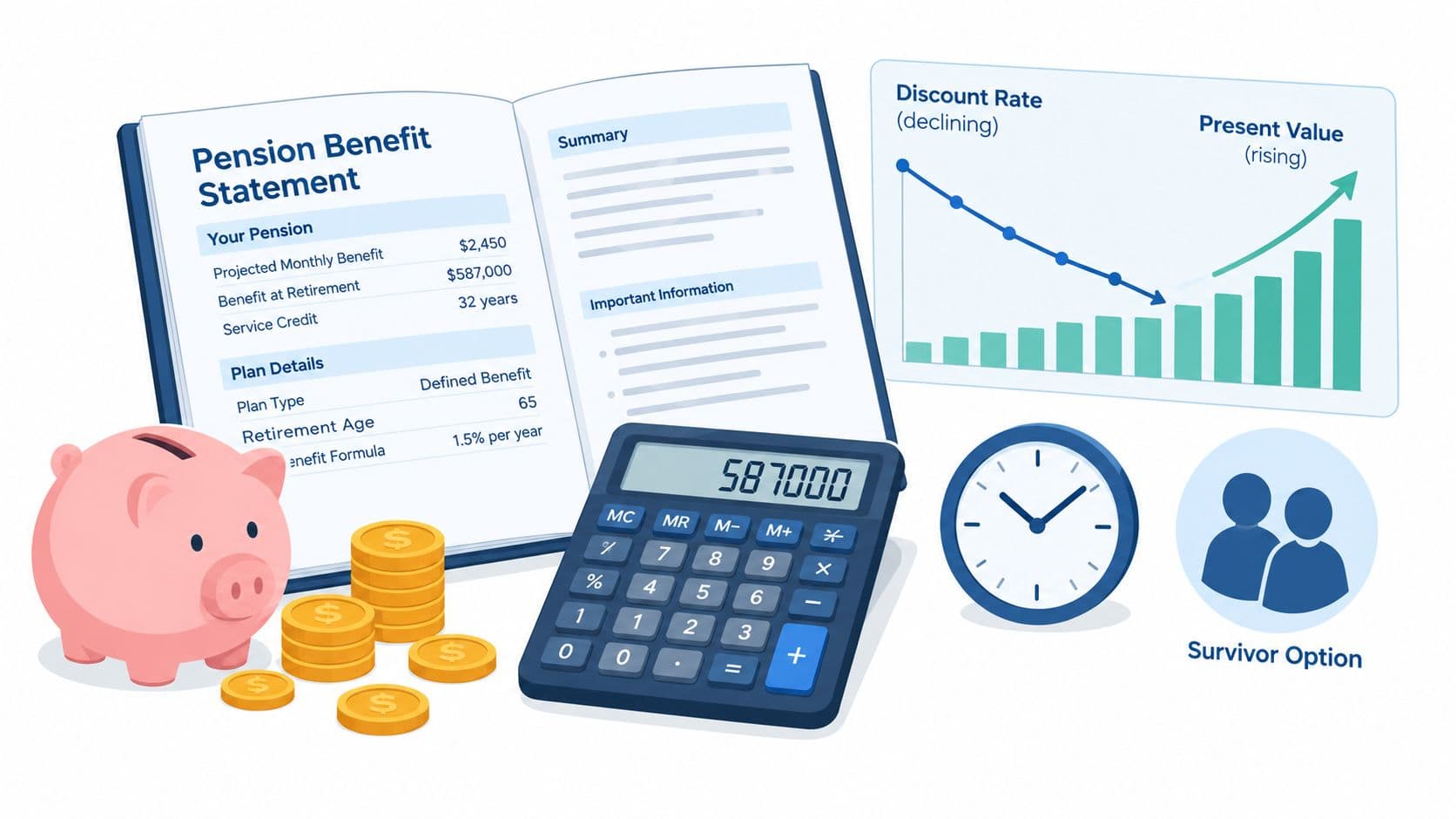
You're reviewing a pension statement and see a promised monthly payment, perhaps alongside a tempting lump-sum offer. The monthly figure feels concrete. The lump sum feels like a price tag. Yet neither number answers the question that matters: what are those future payments worth to you today?
Learning how to value a pension means separating the calculation from the decision. A pension can have one value for retirement-income planning, another for divorce negotiations, and another when you're comparing guaranteed income with liquid investments. The number only becomes useful after you identify the purpose behind it.
Why Pension Value Feels Like a Moving Target
Suppose Maria is approaching retirement. Her statement promises a lifetime pension, but it doesn't show the present value of that income. She wants to know whether the benefit is enough to support her household, how it compares with her spouse's retirement account, and whether accepting a lump sum would make sense.
Those are three different questions. A pension's value depends on when payments begin, how long they're expected to last, how they increase, what happens after the retiree dies, and which discount rate converts future dollars into today's dollars. The promised monthly payment is only the starting point.

One pension, several legitimate values
Consider the purpose before opening a spreadsheet:
- Retirement planning: How much guaranteed income will the pension provide, and what savings must cover the remaining expenses?
- Lump-sum comparison: What current amount would reasonably replace the future checks after accounting for investment, inflation, and longevity risk?
- Divorce valuation: What portion of the benefit represents marital property, and how should survivor rights and inflation protection be treated?
- Personal balance sheet: What present value helps you compare pension wealth with a brokerage account, home equity, or defined-contribution plan?
Official valuation guidance recognizes that defined-benefit calculations depend on discount rates, inflation protection, payment contingencies, retirement timing, and mortality. UK actuarial guidance on valuing defined-benefit pension wealth illustrates why a single generic multiplier can conceal important assumptions.
Practical rule: Never ask only, “What is my pension worth?” Ask, “Worth for which decision?”
That distinction prevents a common mistake. A higher quoted cash equivalent may look better, but it might reflect market discount rates rather than the amount your household needs to reproduce guaranteed income. A calculator should ideally produce a range, explain its assumptions, and identify the decision that range can support.
The Basic Present-Value Calculation Explained Simply
A pension is a stream of future cash flows. To value it today, you estimate each payment and discount it because a dollar available now can potentially earn a return before a future payment arrives.
The basic idea is straightforward:
- Estimate the payment amount and timing.
- Estimate the probability that the payment will occur.
- Discount each expected payment back to today.
- Add the discounted amounts together.
A pension paying $30,000 in twenty years doesn't have a present value of $30,000 today. At a 5% annual discount rate, that future payment has a present value of approximately $11,520. At 6%, its present value is approximately $9,423, a reduction of about 18% caused by a one-percentage-point change in the rate. The U.S. Government Accountability Office explains why discount rates are central to estimating pension liabilities.
Why the total of the checks can mislead
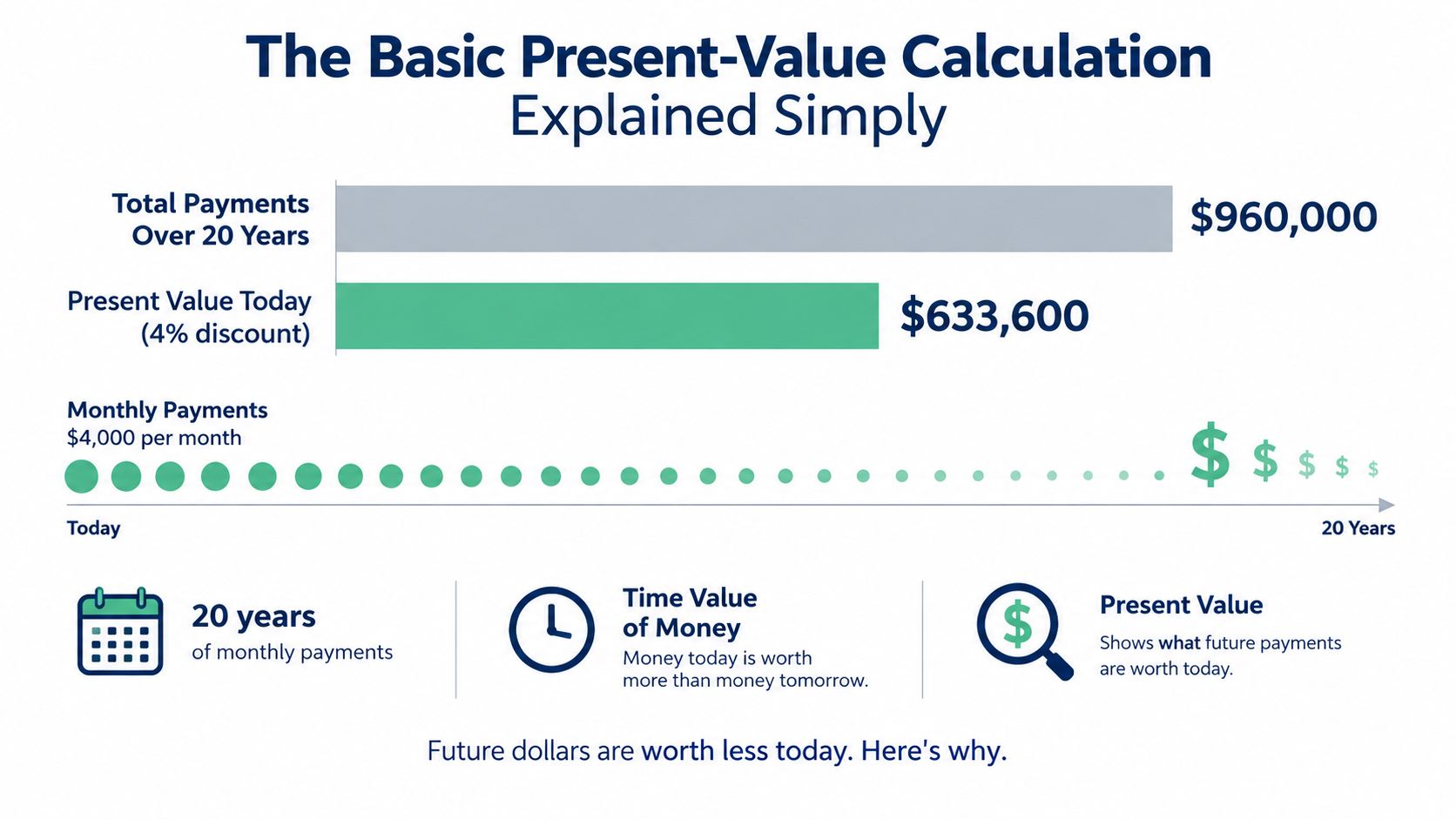
Imagine a pension paying $4,000 per month for twenty years. Ignoring investment returns and timing, the nominal total is $960,000. Discounting those payments at 4% produces a present value of approximately $633,600.
That difference isn't a trick. The first payment arrives sooner and receives little discounting. Payments far in the future receive much heavier discounting. A proper valuation therefore treats the pension as a schedule of individual payments, rather than multiplying one monthly amount by an assumed number of years.
If you want to refresh the underlying time-value concept, using Approved Experiences Traveler for time value can provide a plain-language explanation. For a related savings comparison, the compound interest calculator helps show how money available today can grow over time.
The calculation becomes more complicated when payments depend on survival, retirement timing, inflation adjustments, or a spouse's continued eligibility. That's why a pension statement can show a precise-looking number while leaving the machinery underneath largely invisible.
Key Inputs That Drive Your Pension Worth
The biggest valuation mistakes usually come from the assumptions underneath the math. Two people can use the same present-value formula and still end up with very different answers because they are valuing different cash-flow patterns for different purposes.
Longevity changes the payment stream
How long the pension is expected to pay has a huge effect on value. The OECD pension data reports average life expectancy at age 65 for women across OECD countries at 86.6 years in 2024, which implies about 21.6 remaining years after age 65.
That figure is a population average, not a personal prediction. Your own valuation may need to reflect age, health, country, occupation, sex where legally permitted, whether benefits continue to a spouse, and whether the plan uses older or newer mortality assumptions. The practical point is simple. A pension that starts at 65 can easily represent decades of payments, so small changes in expected duration can move the result a lot.
A quick example shows the scale. A level annual pension of $24,000 over 21.6 expected years adds up to about $518,400 before discounting. Using a 4% discount rate, the present value is approximately $338,000, before inflation features, survivor rights, or payment-timing adjustments.
The discount rate sets today's price
The discount rate is the input that often causes the widest swings. A higher rate pulls the present value down because future checks are worth less in today's dollars. A lower rate pushes the value up.
This works like pricing a stream of future paychecks. If you require a higher return to wait for the money, today's price falls. If you use a lower required return, today's price rises. That is why pension value is not a single fixed number. It changes with the purpose of the calculation, whether you are estimating economic value, comparing a lump sum to monthly income, or reviewing a plan-specific statement.
Plan rules matter too. IRS segment rates show why plan calculations can differ, because pension rules may apply specified interest-rate segments and mortality assumptions instead of the simpler rate you might use in a personal calculator.
Inflation and plan rules fill in the gaps
Inflation changes what those payments are worth in real life. A flat pension buys less over time. An inflation-linked pension may rise, but the valuation has to reflect the plan's actual increase formula, including any caps, floors, or conditions.
Other rules can matter just as much. Analysts valuing pensions often consider retirement timing, salary growth, termination before retirement, early-retirement reductions, death before or after commencement, and other payment contingencies. A pension is really a set of contingent cash flows, not just an annual benefit written on a statement.
How Payment Choices Change Pension Value
Payment form changes both the amount you receive and the risks your household carries. Two options can appear similar on a statement while producing very different outcomes after a death, market decline, or long retirement.
Single-life and joint-and-survivor income
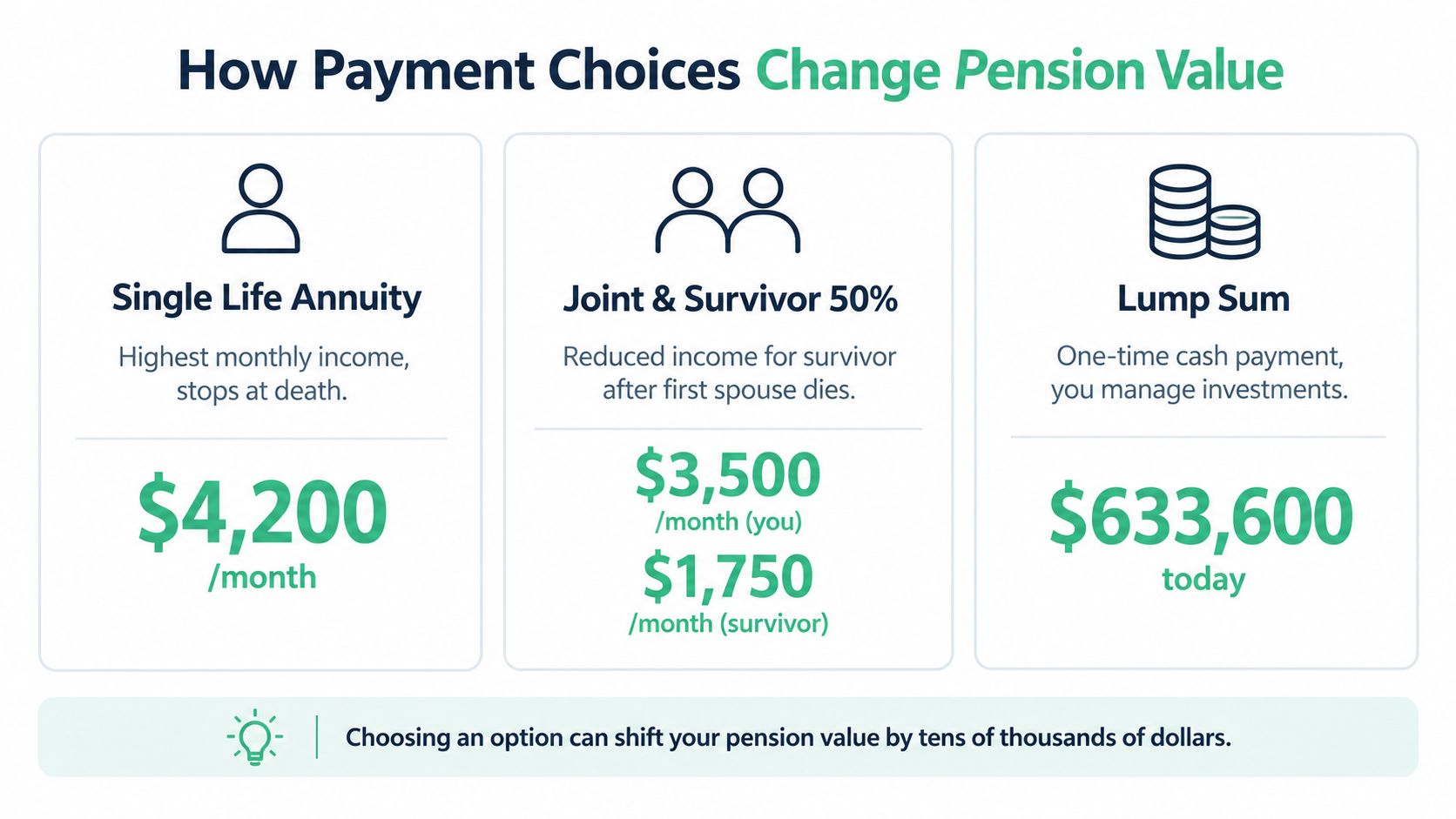
A single-life annuity generally pays more each month because payments stop when the retiree dies. A joint-and-survivor annuity pays less initially because it continues a specified portion to a surviving spouse.
The survivor percentage matters. A plan might continue 50%, 75%, or 100% of the original benefit, depending on its options. The correct comparison therefore asks how much income the household receives while both spouses are alive and how much remains for the survivor.
| Payment form | Main strength | Main trade-off |
|---|---|---|
| Single-life annuity | Higher retiree income | Little or no continuing income for a spouse |
| Joint-and-survivor annuity | Protects the surviving spouse | Lower initial payment |
| Lump sum | Flexibility and access to capital | Retiree assumes investment, inflation, and longevity risk |
A useful discussion of early claiming drawbacks for retirees also reinforces a broader planning point: the timing and structure of retirement income can matter as much as the headline amount.
Lump sum versus lifetime income
A lump sum gives you control over the money, but control comes with responsibility. You must decide how to invest it, how quickly to withdraw it, and how to protect against living longer than expected. A monthly pension leaves those risks largely with the plan, subject to the plan's financial strength and applicable protections.
The PBGC's explanation of payment forms and guarantee offsets illustrates how plan rules can affect the remaining guaranteed annuity. Its example uses a $3,000 lump sum and a 0.9 early-retirement factor, producing a $2,700 annuity equivalent that reduces the remaining guaranteed monthly annuity.
A lump sum may suit someone who values liquidity, has other guaranteed income, and can manage investment risk. Lifetime income may suit a household that prioritizes predictable cash flow and survivor protection. The right answer depends on the household's risks, not merely which option displays the larger number. For practical considerations around managing a cash payment, see this guide to lump-sum investing.
Step-by-Step Guide to Running a Pension Valuation
A solid pension valuation starts the way a home appraisal does. You need the exact property details before you can talk about value. For a pension, that means using the plan's rules and your actual benefit record, not a generic calculator.
Step one
Gather the plan details. Pull together your latest benefit statement, summary plan description, retirement estimate, and any lump-sum election forms. Then confirm the accrued benefit, earliest commencement date, normal retirement date, payment frequency, and whether the quoted amount is payable now or only later.
This step sounds basic, but it prevents a common mistake. Two estimates can show the same monthly benefit while referring to different start dates or payment forms, which makes them poor comparisons.
Check eligibility before you compare options. PBGC guidance on pension benefits explains that, in certain plan-termination situations, a lump sum may be available only when the benefit value is no more than $5,000 for plans terminating before 2024, or $7,000 for plans terminating in 2024 or later. Those thresholds apply to PBGC termination situations, not every ongoing employer plan.
Step two
Identify the variables. Ask the administrator which assumptions were used to produce the quote:
- Discount-rate basis: Which interest-rate segment or market-based rate was used?
- Mortality basis: Which mortality table and improvement assumptions apply?
- Payment form: Is the estimate single-life, joint-and-survivor, or another option?
- Inflation protection: Are increases automatic, capped, discretionary, or absent?
- Timing rules: What changes with early retirement, delayed retirement, termination, or death?
Here is the practical point. A pension value is not one fixed number sitting inside your statement waiting to be discovered. It changes with purpose, assumptions, and elections. IRS segment rates provide the official context for rates used in specified pension calculations, as noted earlier.
Step three
Choose the valuation purpose. If you are planning retirement income, start with the monthly payment and how it fits household spending. If you want a balance-sheet estimate, calculate present value. If the valuation is for divorce or a legal settlement, use the method required in that setting and get qualified actuarial advice.
Purpose comes first because it changes what “best value” means. The highest lump sum is not automatically the most useful outcome if the household mainly needs steady income or survivor protection.
Step four
Run a baseline calculation. Map the expected payment stream, discount each payment back to today, and include survivor and inflation features. A spreadsheet works well if every assumption sits in a visible input cell.
That visibility matters. A pension calculation works like a stack of tinted lenses. Change the rate, the start date, or the survivor election, and the final number shifts.
Step five
Stress-test the result. Recalculate using a lower and higher discount rate, an earlier and later retirement date, and different longevity assumptions. Then compare those results with the income your household would need to replace.
The valuation becomes useful here. Instead of one “correct” answer, you get a range. That range shows which inputs matter most and helps you see whether the pension still works if rates move, retirement timing changes, or a survivor option reduces the monthly amount.
Revisit the estimate after a plan amendment, a new retirement election, a major household change, or a material change in the quoted benefit. The goal is a calculator-ready decision range tied to a clear purpose.
Turning Pension Value Into Retirement Decisions
A present value becomes useful when it changes a decision. If the calculation says your pension is worth a substantial amount, that doesn't automatically mean your retirement is secure. You still need to ask whether the income arrives when you need it, keeps pace with expenses, protects a spouse, and fits alongside your liquid savings.
Start with the household cash-flow view:
- Guaranteed income: How much arrives from the pension and other reliable sources?
- Inflation exposure: Which payments rise, and which remain fixed?
- Survivor income: What does the surviving spouse receive?
- Liquidity: How much accessible money remains for emergencies, care, repairs, or family support?
- Tax treatment: How will withdrawals and pension income affect after-tax resources?
- Longevity risk: What happens if one spouse lives much longer than expected?
A pension with a lower present value can still be more useful than a larger liquid account if it supplies dependable lifetime income and strong survivor protection. Conversely, a large lump sum may offer flexibility that a household needs, especially when future expenses are uncertain. The comparison should measure after-risk household resources, not just nominal balances.
Care costs deserve a place in the model. Planning resources about how to pay for assisted living can help you think through liquidity needs without assuming that every retirement dollar will fund ordinary living expenses.
A practical review checklist
Before accepting a pension election, request the plan's assumptions in writing. Confirm the calculation date, payment age, interest-rate basis, mortality table, inflation treatment, survivor option, and any restrictions on changing the election.
Then run at least three views:
- Income view: What does each payment option provide while both spouses are alive?
- Survivor view: What income remains after the first death?
- Balance-sheet view: What present value can reasonably be compared with other assets?
Use the simple math behind early retirement as a broader reminder that retirement decisions depend on timing, savings, spending, and income durability together. The pension valuation is one important input, not the entire retirement plan.
Get more posts like this
One short, useful email each Friday. Free, no spam, unsubscribe anytime.