How Much Is Generational Wealth Actually Worth
Discover how much generational wealth really means for your family. We break down typical inheritance amounts, who receives them, and how to build your own.

Daniel Anderson
Editor, The Money Maniac
October 3, 2026
13 min read

The median total inheritance is approximately $1,900 to $3,000. The much-publicized wealth transfer measured in trillions describes money moving across an entire economy, not the amount most households will personally receive.
That distinction matters. A projected transfer can sound like a giant family payday, while the typical household may receive little or nothing after debts, healthcare costs, retirement spending, taxes, fees, and uneven family resources shape the final result. Generational wealth is real and economically important, but its benefits are distributed about as evenly as cookies at a meeting where one person brought the cookies.
What Is Generational Wealth Anyway
Generational wealth means financial resources that move within a family over time. That can include cash inherited after death, but it can also include a paid-off home, a family business, investment accounts, education funding, lifetime gifts, or a trust that holds property for future beneficiaries.
The common assumption is that generational wealth arrives in one dramatic moment, usually after someone dies. In practice, families can transfer financial advantages gradually. A parent might help with tuition, contribute toward a home purchase, pass along a business interest, or teach a child how to manage investments. Those forms of support may never appear as a large inheritance check, but they can still change a household's financial choices.
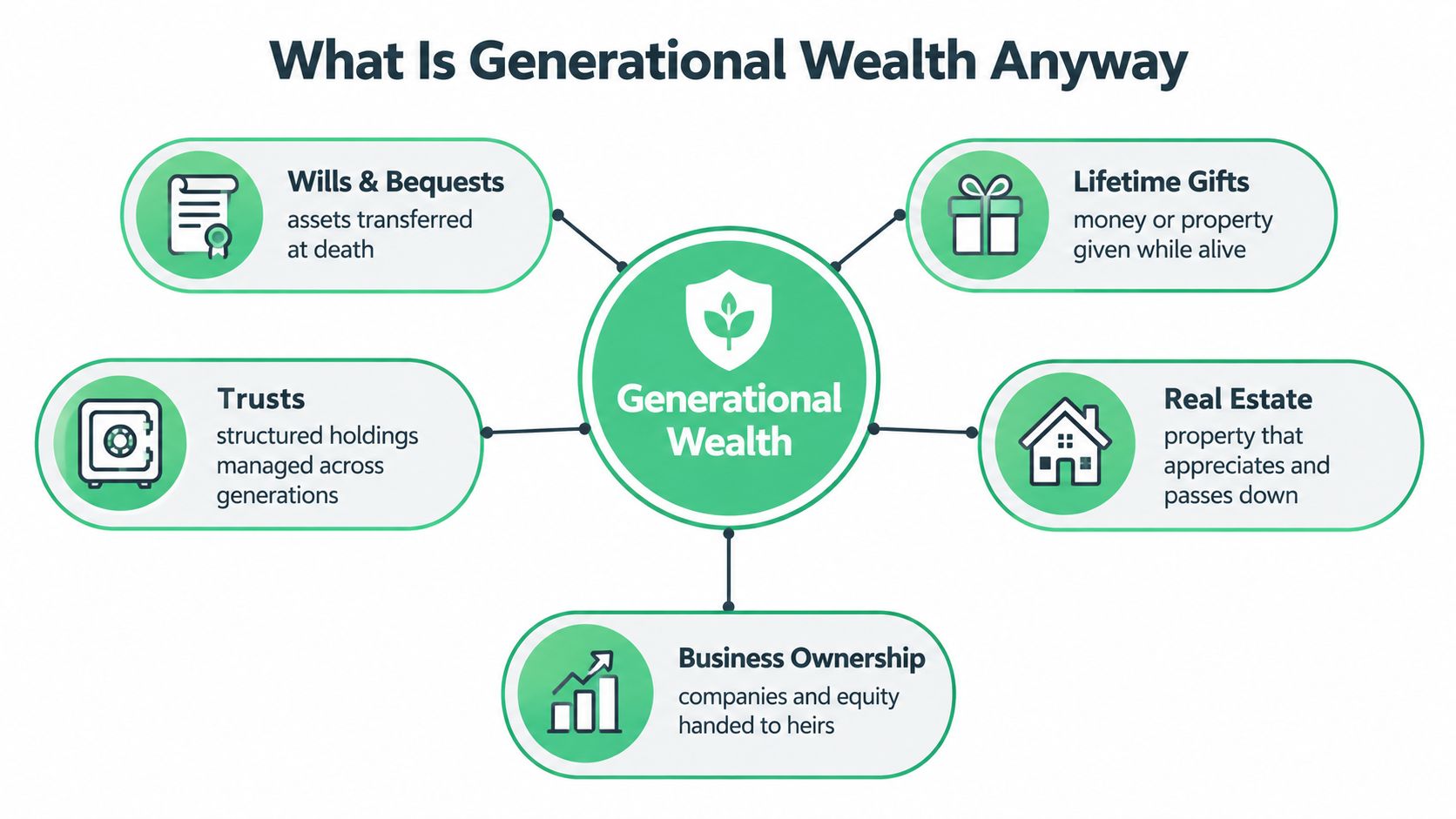
The five pieces families can pass down
Wills and bequests transfer assets at death. Those assets might include bank accounts, investments, property, or ownership in a company.
Lifetime gifts move money or property while the giver is alive. A contribution toward a home, help with a business, or payment for education can reduce the recipient's need to borrow.
Trusts hold and manage assets according to instructions. They can help organize ownership, timing, and responsibilities across generations, though the details depend on the family's circumstances and legal documents.
Real estate can provide a place to live, rental income, or an asset that remains in the family. A home with little or no debt gives descendants a different starting point from a household that must rent indefinitely or carry a large mortgage.
Business ownership can transfer an income-producing asset, but it can also bring operating risks, disagreements, and difficult decisions about who manages the company.
Why the definition matters
The Federal Reserve describes intergenerational wealth transmission as including inheritances and substantial lifetime transfers. Its research estimated that roughly 2 million U.S. households receive an inheritance or substantial gift each year, while annual inheritances plus lifetime transfers between living people averaged about $350 billion from 1995 to 2016, equal to around 3% of total household disposable personal income. The Federal Reserve's analysis of intergenerational wealth transmission also shows that a small share of households receives very large transfers, accounting for a disproportionate share of the total.
That last point is the foundation for answering how much generational wealth is worth. The average or headline total can be enormous while the typical household experience remains modest. To understand the actual effect, you have to ask three questions: How much moves, who receives it, and what remains after the family's obligations are paid?
How Much Wealth Actually Moves Between Generations
The largest headline projection comes from Cerulli Associates, which estimates that about $124 trillion could change hands by 2048, including roughly $105 trillion to heirs and $18 trillion to charity. Annual transfers are already estimated at around $1.5 trillion to $2 trillion, or approximately 1% of total household wealth each year, according to the wealth-transfer overview summarizing Cerulli's projection.
Those figures describe the total flow across many households and markets. They don't tell an individual reader what will land in a checking account. A national total can include valuable property, business equity, retirement assets, investment portfolios, and other holdings that may be divided among several heirs or sold to settle obligations.
Gross wealth is not spendable wealth
Suppose a household owns a home, retirement assets, and a small business. The gross value may look substantial on paper. The heirs may still face outstanding debt, selling costs, taxes, medical bills, charitable commitments, and years of retirement withdrawals before anyone knows what can be distributed.
Visa Business and Economic Insights modeled this distinction for the United States. Its estimate puts the spendable intergenerational transfer at about $36 trillion over 20 years, after subtracting liabilities, excluding the top 1% of households, and accounting for retirement drawdowns, charitable bequests, taxes, and fees. The estimate works out to roughly $515,000 per inheriting household. Visa's wealth-transfer analysis is useful because it focuses on what may remain available to heirs instead of treating every gross asset value as money ready to spend.
Even that figure is an estimate for households that inherit. It isn't a promise that every household will receive that amount, and it shouldn't be mistaken for a median inheritance. Averages can be pulled upward by large transfers, especially when a small group controls a large share of the assets.
The median tells a quieter story
Richmond Fed research found that the median total transfer in recent survey data was approximately $1,900 to $3,000. The same research reported that 13% of older households had given transfers to adult children and 6% had given transfers to grandchildren. The Richmond Fed's research on household transfers helps explain why the median is so much smaller than the headlines. Many families transfer modest amounts, while a smaller group transfers property, companies, or large investment portfolios.
A separate CFA Institute discussion notes that only about one in five Americans have received any inheritance, while longevity, debt, and medical costs reduce the amount that reaches heirs. The practical lesson is simple: don't build a financial plan around an inheritance unless you know the assets, liabilities, ownership structure, and family intentions. An inheritance you may receive someday is not an emergency fund you can use today.
Practical rule: Treat projected inheritance as uncertain upside. Build your budget, debt plan, and retirement savings as if your family transfer will be smaller, later, or unavailable.
For context, readers who are comparing their own finances with high-income households can review this explanation of how much the top 1% makes. The comparison reinforces why a national wealth-transfer number says little about the balance sheet of a typical family.
Who Gets Left Out of the Wealth Transfer Story
A trillion-dollar projection can hide a very ordinary problem: families don't begin with the same assets, obligations, or number of relatives able to provide help. If one household inherits a property and another helps an aging parent pay medical bills, both families are participating in intergenerational transfers, but their financial outcomes move in opposite directions.
The OECD's cross-country data illustrates the concentration. Across 27 OECD countries, the wealthiest 10% of households own about half of all household wealth on average, while the wealthiest 1% own about 18%. Reported inheritances also vary sharply by wealth level. Households in the bottom wealth quintile reported average inheritances of roughly USD 300 to USD 11,000, while the wealthiest 20% reported about USD 30,000 to USD 526,000. Broader OECD estimates suggest inheritances may represent 30% to 60% of overall wealth in Western countries. The OECD inheritance data summarized by the Tax Foundation shows why family transfers can amplify existing differences rather than erase them.
Race and kinship change the direction of money
Urban Institute analysis found that Black families received median inheritances roughly five to six times smaller than white families. It also found that upward transfers from adult children to aging parents are more common among Black and Hispanic families than among white families. The Urban Institute's analysis of intergenerational wealth transfer makes an important point: the direction of family support matters.
A family that receives help with a down payment can preserve income for saving and investing. A family that sends money to parents may be protecting loved ones, but it has less available for its own emergency savings, home purchase, or retirement account. Neither choice reflects a lack of discipline. The families face different balance sheets and different responsibilities.
Why the projection feels larger than real life
The projected global flow includes households with significant assets, households with moderate assets, and households with no transferable assets. It also includes wealth that may be split among several heirs, consumed during retirement, given to charity, or lost to liabilities and costs.
Planning readiness creates another gap. RBC-linked reporting says 68% of Americans over 65 have not discussed what children may inherit or when, and only 17% of Boomers say heirs are very well informed. Those figures appear in the Urban Institute discussion of the transfer challenge. Without communication, heirs may not know what exists, who owns it, where documents are stored, or what obligations come with it.
The better question isn't just, “How much is generational wealth?” Ask instead: What assets can this family preserve, who may receive them, and what support will each generation need before the transfer happens? That question produces a more honest plan.
Realistic Paths to Building Generational Wealth
A family doesn't need a spectacular inheritance to create a stronger starting point for the next generation. It needs assets that can survive ordinary setbacks, a system for reducing avoidable debt, and enough financial knowledge that the next person doesn't have to start from a blank page.
Consider two households with different starting points. One receives a substantial family gift and uses it to purchase a home. Another receives no inheritance but steadily builds an emergency reserve, contributes to retirement accounts, and eventually owns a modest home. The first household has a head start. The second may still create a meaningful asset base that helps its children with housing, education, or business formation.
Four practical routes
Home equity can build family wealth when a household buys a property it can afford, pays down the loan, and maintains the home. The result isn't guaranteed. Repairs, insurance, local conditions, borrowing costs, and a forced sale can weaken the outcome. A house also provides shelter, which may be its most valuable function, even when its market value changes.
Retirement accounts let households build ownership in diversified investments over a long period. The useful habit is consistency, not dramatic bets. Contributions should fit the household budget, and the account's investments should reflect the investor's timeline and ability to tolerate losses.
Education and skills can increase earning power, but education funding needs a careful return-on-cost question. Borrowing heavily for a path with uncertain employment outcomes can leave less money available for saving. A family can create educational wealth by funding training, teaching financial basics, and helping a child avoid expensive mistakes, not only by paying for a traditional degree.
Business ownership may pass an income-producing asset to heirs, but ownership doesn't automatically equal profit. A family needs records, succession planning, clear responsibilities, and an honest assessment of whether the next generation wants to operate the business.
Readers exploring long-term ownership can use this guide to buy and hold investing as a framework for thinking about patience, diversification, and the risks of selling based on short-term emotion. The approach still requires research and risk control. “Hold forever” isn't a substitute for reviewing whether an asset remains suitable.
A family plan should include knowledge
The money matters, but so does the handoff. A parent can leave an investment account to a child who doesn't understand its purpose, fees, tax treatment, or risk. The child may sell in a panic, spend the balance quickly, or fail to update ownership after a major life event.
A practical family conversation can cover:
- What exists: List homes, accounts, business interests, insurance, and debts.
- Who is responsible: Identify decision-makers and the people who need information.
- What the assets are for: Separate retirement income, housing, charitable intentions, and inheritances.
- Where documents live: Keep instructions and account details accessible to the people who may need them.
- What could go wrong: Discuss illness, job loss, caregiving, divorce, and a beneficiary dying first.
For families seeking assets that can produce income, this overview of income-producing assets can help organize the difference between an asset's value and the cash flow it may generate. Cash flow can support a household, but it also brings maintenance, market, and management risks.
Visa's estimate of approximately $36 trillion over 20 years and roughly $515,000 per inheriting household after adjustments shows the potential scale of usable transfers, but it also clarifies the limitation. The estimate excludes the top 1% and models liabilities, spending, taxes, fees, charitable bequests, and retirement drawdowns. A family building from ordinary income should focus less on matching a national estimate and more on creating one durable asset, then protecting it.
The Math Behind Making It Last Across Generations
Building wealth and preserving wealth require different habits. A household can accumulate an asset and still lose it through high-interest debt, poor records, forced selling, family conflict, inadequate cash reserves, or a lack of preparation among heirs.
The comparison below captures the tradeoffs without pretending that one route works for every family.
| Path | What can help | What can go wrong |
|---|---|---|
| Home ownership | Creates an asset and may reduce future housing pressure when debt is paid down | Repairs, insurance, borrowing costs, and a forced sale can reduce the benefit |
| Diversified investing | Allows regular contributions to participate in long-term market growth | Values fluctuate, and poor decisions during declines can damage the plan |
| Business ownership | Can transfer an operating asset and future income | The business may depend heavily on one owner, one market, or one skill set |
| Education and skills | Can improve earning capacity and financial judgment | High costs or unsuitable borrowing can delay wealth building |
| Cash reserves | Helps a family avoid selling investments during emergencies | Cash can lose purchasing power over time and won't provide the same growth potential as productive assets |
Compounding needs time and behavior
Compounding means returns remain invested and can themselves produce returns. The effect becomes more meaningful over long periods, but the result depends on contribution size, investment performance, fees, inflation, and withdrawals. No calculator can turn an uncertain return into a guaranteed outcome, which is why conservative assumptions are more useful than exciting ones.
The compound interest calculator can help a household compare a starting balance, regular contributions, time, and inflation-adjusted scenarios. Use it to test decisions, not to manufacture certainty. Try a lower-return assumption, a missed-contribution period, or a withdrawal during retirement. A plan that survives less flattering inputs deserves more confidence than one that works only under perfect conditions.
Preservation is partly administrative
The family that documents ownership and communicates expectations has fewer avoidable surprises. Beneficiary designations, account titles, passwords, insurance information, business records, and estate documents should be reviewed after major life changes. The exact legal and tax consequences depend on the assets and the family's situation, so complex estates need qualified professional advice rather than a clever internet shortcut.
Financial literacy also has a practical role. An heir who understands diversification, debt costs, cash flow, and basic investing is better positioned to make deliberate decisions. The family doesn't need a private investment office. It needs shared vocabulary and a willingness to discuss money before a crisis makes the conversation unavoidable.
A successful transfer gives heirs both an asset and enough context to use it responsibly.
The most durable approach usually combines a productive asset, accessible cash, clear instructions, and gradual education. That mix may look less glamorous than a dramatic inheritance story, but it has a better chance of surviving ordinary family life.
Your Next Steps Toward Family Financial Security
Start with a household balance sheet. List assets, debts, ownership, beneficiaries, and the people who know where the records are kept. This exercise can reveal that your family already has useful resources, or that a debt problem needs attention before investing more.
Then take these steps in order:
- Build a basic cash buffer: Set aside money for routine emergencies so a broken appliance, medical bill, or short work interruption doesn't force a sale of long-term assets.
- Control expensive debt: Create a payoff plan and direct extra cash toward the balances that cost the most. Reducing interest can make future saving easier.
- Invest consistently: Choose a diversified approach that fits your timeline and risk tolerance, then automate contributions at an amount your budget can sustain.
- Protect ownership: Review beneficiary designations, insurance, account titles, and basic estate documents. Update them after marriage, divorce, births, deaths, or major changes in assets.
- Talk with family: Explain what exists, what each asset is meant to do, and who should be contacted when help is needed. Silence is a poor estate-planning strategy.
- Teach the next generation: Discuss budgeting, borrowing, investing, and the difference between an asset's value and its cash flow.
Start by listing every asset and liability your household owns, then schedule one calm family conversation about what should happen to them. Small, documented decisions made consistently can create a more useful legacy than waiting for a headline-sized inheritance that may never arrive.
Get more posts like this
One short, useful email each Friday. Free, no spam, unsubscribe anytime.