Coast FIRE vs Barista FIRE: Which Path Suits You
Coast FIRE vs Barista FIRE compared side by side. See savings targets, income needs, tradeoffs, and which early retirement path actually fits your situation.

Daniel Anderson
Editor, The Money Maniac
September 18, 2026
12 min read

The popular advice on Coast FIRE vs Barista FIRE is too tidy. It presents two attractive lifestyle options, then assumes the hard parts will cooperate: markets will compound on schedule, a suitable part-time job will be waiting, and healthcare will somehow remain affordable. Retirement planning is less polite than that.
The useful comparison is a risk comparison. Coast FIRE puts more pressure on portfolio growth and delayed withdrawals. Barista FIRE puts more pressure on future wages, job availability, and benefits access. One path can fail while your paycheck remains healthy. The other can fail precisely when you're counting on work becoming easier.
| Criterion | Coast FIRE | Barista FIRE |
|---|---|---|
| Core milestone | Invested assets can grow to the retirement target without new contributions | Part-time income and portfolio withdrawals cover current spending |
| Work arrangement | Keep working, usually with reduced savings pressure | Leave full-time work and continue earning part time |
| Withdrawals | Delayed | Begin before full retirement |
| Main dependency | Portfolio growth and future spending discipline | Dependable work, wages, hours, and benefits |
| Main risk | Market sequence and lifestyle inflation | Labor-market disruption and benefit loss |
| Best fit | Stable earners with a long horizon | People who need time back and have a credible income bridge |
The clean labels are useful only after you stress-test what sits underneath them. Your age, spending, portfolio, withdrawal rate, health coverage, and ability to earn later matter more than the clever name.
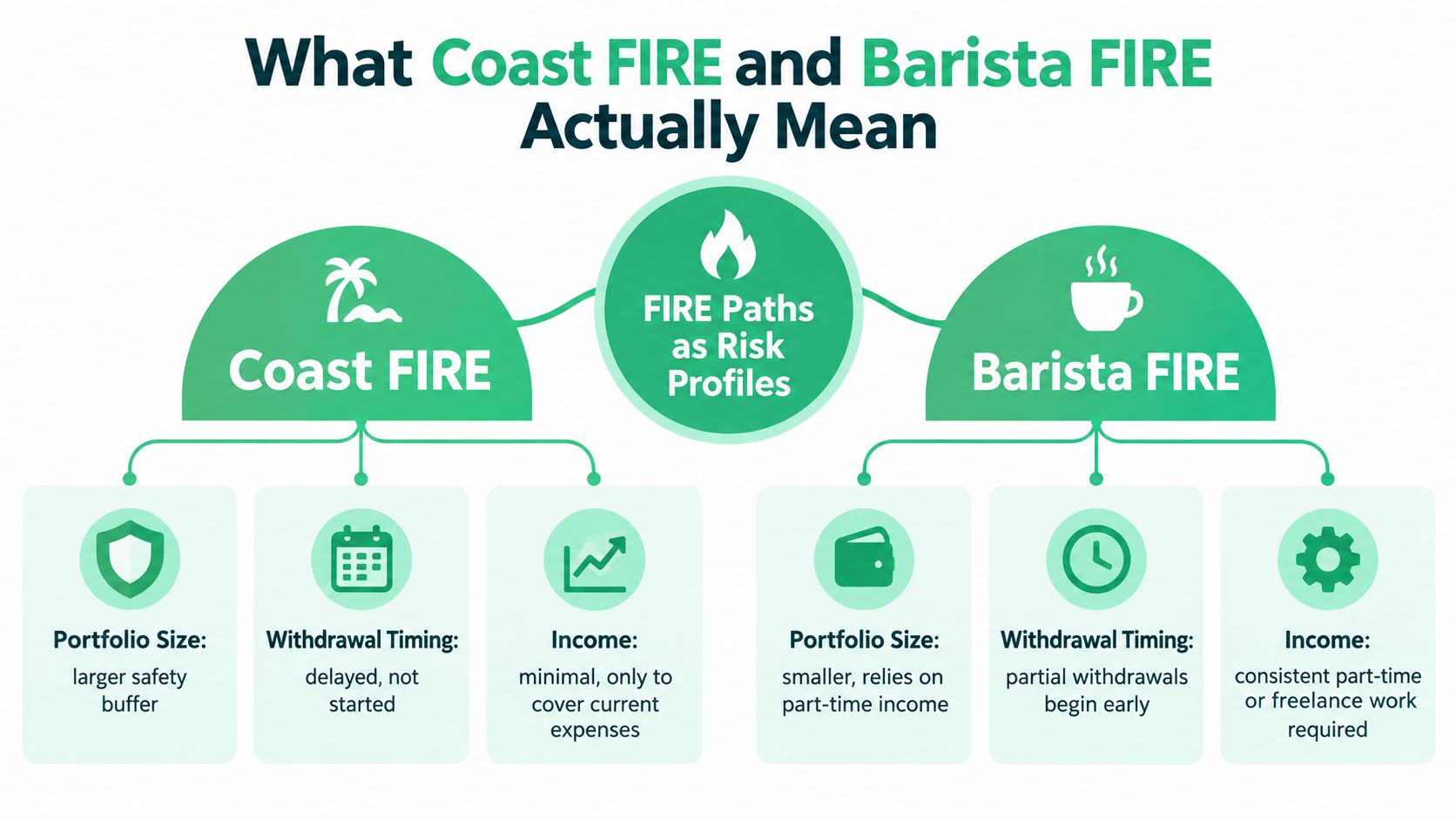
What Coast FIRE and Barista FIRE Actually Mean
Coast FIRE and Barista FIRE are not just lifestyle choices. They are different risk profiles. Coast FIRE depends on portfolio growth and delayed withdrawals. Barista FIRE depends on future wages, available work, and access to benefits. The path that looks easier can fail first when its key dependency breaks.
Coast FIRE means your existing retirement portfolio is large enough for compound growth alone to fund retirement by a target age, provided your return and spending assumptions hold. You stop retirement contributions, or reduce them sharply, while employment covers current expenses. Your investments remain untouched and continue compounding.
That makes Coast FIRE a “stop saving” threshold, not a retirement date. You are relying on future growth rather than spending from the portfolio today. The strategy is fragile to sequence-of-returns risk near the point withdrawals begin. It is also silent about lifestyle inflation. If spending rises, the retirement target rises with it.
Barista FIRE starts from a different position. You leave full-time work and use part-time income plus investment withdrawals to fund your lifestyle. The work could be a flexible job, freelance assignments, consulting, teaching, or another arrangement that produces predictable cash flow. “Barista” describes the structure, not a required occupation.
The broader FIRE movement is often associated with Vicki Robin and Joe Dominguez's 1992 book Your Money or Your Life, which helped popularize extreme saving and financial independence. Later variations include Coast FIRE and Barista FIRE. The distinction is straightforward: Coast FIRE lets assets compound while you keep working, whereas Barista FIRE combines reduced work income with withdrawals.
The labels hide different dependencies
A 28-year-old with $87,000 invested might be near a Coast FIRE threshold if retirement is decades away and the portfolio stays invested. That person still needs earned income for rent, food, transportation, and other recurring costs.
A 47-year-old with $700,000 invested might consider Barista FIRE. If part-time work covers ongoing bills and the portfolio supplies the gap, the plan can create immediate time freedom. However, withdrawals begin sooner, and the strategy is exposed to labor-market risk, reduced hours, wage changes, and lost benefits.
Practical rule: Name the income source paying today's bills, then name the source paying tomorrow's bills. If either answer is “I'll figure it out later,” the plan is unfinished.
The Savings and Income Mechanics Behind Each Path
Coast FIRE depends on reaching a portfolio threshold early enough for compounding to carry the remaining growth. Suppose the target is $1,000,000 at age 65, using a 7% real return assumption, or growth after inflation. At age 25, approximately $139,000 invested today could reach that target over four decades. At age 35, the required starting capital rises to approximately $331,000, because only three decades remain.
The calculation is:
Capital required today = Future retirement target ÷ (1 + real return)^years
That formula shows both Coast FIRE's strength and its weak point. Early capital reduces the need for future contributions, but stopping contributions makes the plan more dependent on returns, future spending, and the timing of market losses. A portfolio that falls near the start of withdrawals can force selling at the worst time. Lifestyle inflation creates a quieter problem: if retirement spending rises, the original target no longer covers the same life.
| Current Age | Years to 65 | Capital Required Today | Implied Monthly Contribution Stopped |
|---|---|---|---|
| 25 | 40 | Approximately $139,000 | The future deposits you no longer need under the assumption |
| 35 | 30 | Approximately $331,000 | The future deposits you no longer need under the assumption |
These figures are planning examples, not promises. Asset allocation must match the timeline. A portfolio with decades to grow still needs to withstand severe declines, while one approaching withdrawals needs enough stability to avoid heavy selling after a fall. Fees reduce invested capital, and taxes affect the order of withdrawals from taxable, tax-deferred, and tax-free accounts.
Test the assumptions with a FIRE calculator. Run lower-return and higher-spending cases. If the plan fails under modestly worse conditions, it is not Coast FIRE yet. It is a forecast that still requires saving.
Barista FIRE starts with the spending gap
Barista FIRE begins with cash flow rather than a future portfolio target. Subtract dependable work income from annual expenses, then fund the remaining gap from investments. If expenses are $60,000 and part-time work covers $40,000, the portfolio must provide $20,000. At a 4% withdrawal rate, that gap requires $500,000 invested.
The bridge job must cover the expenses assigned to it, including housing, food, transportation, insurance, taxes, and irregular costs. Benefits also belong in the calculation. If hours fall, wages change, or healthcare access disappears, portfolio withdrawals rise. Barista FIRE therefore trades some market exposure for labor-market and benefit risk. Its math works only while the job remains available and the spending gap stays controlled.
Side-by-Side Comparison Across the Criteria That Matter
The easiest way to compare Coast FIRE and Barista FIRE is to ignore the labels and inspect five variables: portfolio size, withdrawal timing, income dependence, benefits access, and market risk.
Coast FIRE generally requires less money today because withdrawals are delayed. You continue earning enough to cover current life, and the portfolio remains invested. Barista FIRE generally requires more usable capital than Coast FIRE because withdrawals begin earlier, even if part-time earnings reduce the amount withdrawn.
| Criterion | Coast FIRE | Barista FIRE |
|---|---|---|
| Portfolio requirement | Smaller current portfolio can work because growth has time | Larger portfolio is usually needed because withdrawals start early |
| Withdrawal timing | Delayed until the retirement target | Partial withdrawals begin during the work transition |
| Income dependence | Current employment covers spending | Part-time or freelance income covers a planned share |
| Healthcare and benefits | Often connected to ongoing employment | Must come from the bridge job, a household plan, or another solution |
| Sequence-of-returns risk | Meaningful if poor returns arrive near the withdrawal date | Present immediately, though work income can reduce withdrawals |
| Lifestyle inflation | Easy to overlook after contributions stop | Can increase both the income gap and portfolio withdrawals |
Consider a 32-year-old with $250,000 who has reached a Coast FIRE threshold. The portfolio may have a long runway, but the person still needs a job and must resist turning every paused contribution into a permanent spending increase. Coast FIRE fails when the target spending level rises while the portfolio target stays frozen.
Now consider a 48-year-old with $650,000 pursuing Barista FIRE. The person may have a stronger current portfolio, but withdrawals begin sooner and work income becomes part of the retirement architecture. A lost job, reduced hours, or missing benefits can force higher withdrawals at exactly the wrong time.
The risk profiles are asymmetric
Coast FIRE's central risk is sequence-of-returns risk, the danger that poor investment results arrive around the period when withdrawals begin. Long horizons help, but they don't erase the need to adjust spending or work longer if the portfolio falls short.
Barista FIRE's central risk is labor-market risk. The plan depends on a particular kind of work remaining available, adequately paid, and compatible with your health and schedule. Benefits access adds another dependency, especially in the United States.
The choice is therefore less about which lifestyle looks more relaxed on paper. Coast FIRE buys income independence with patience. Barista FIRE buys time independence with continued reliance on earned income.
How Each Path Plays Out in Real Life
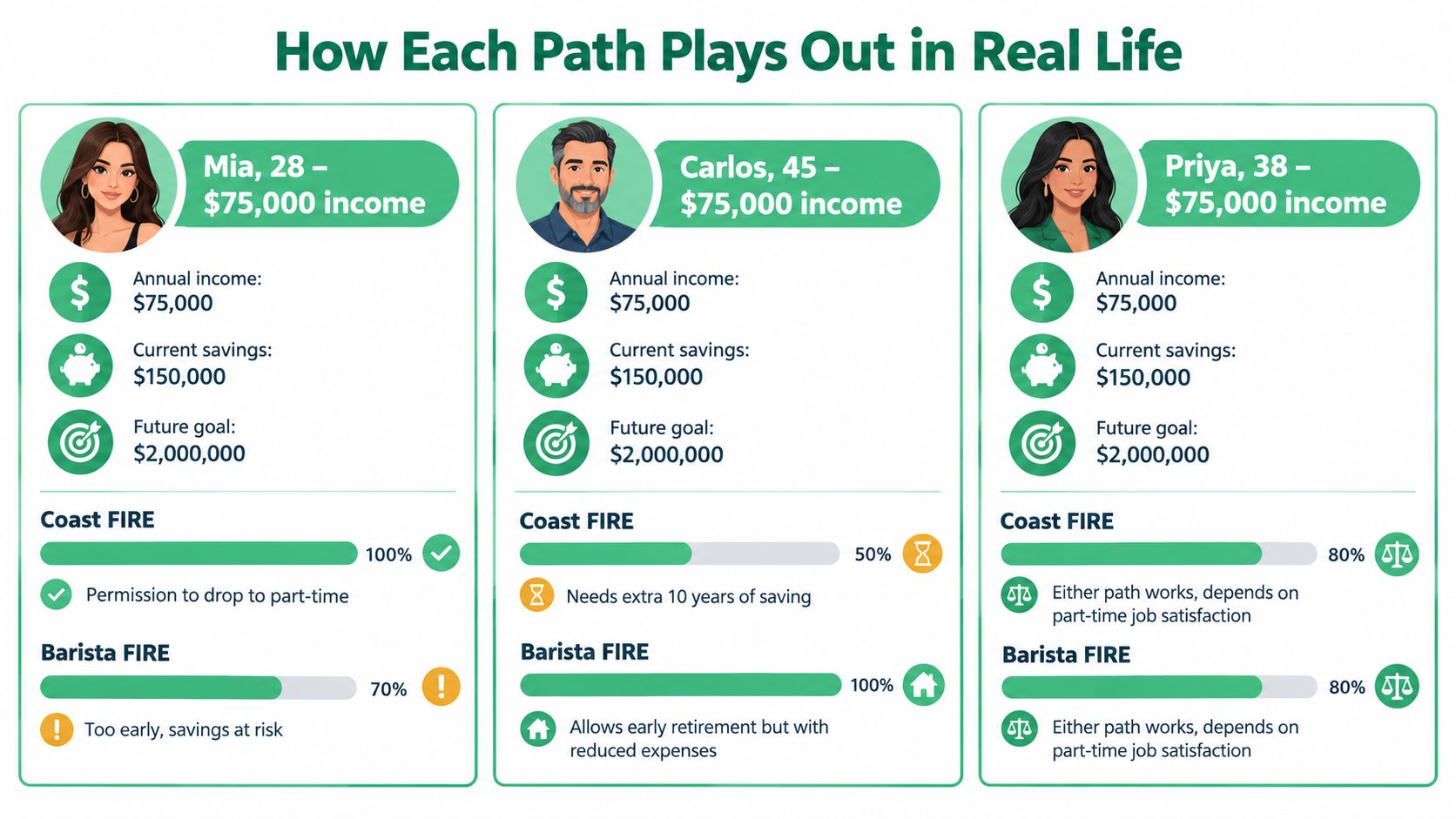
Mia is 28 and earns $75,000. She has built enough momentum to consider Coast FIRE, so she reduces retirement saving to 5% and spends more on travel. That can be a reasonable use of the milestone. Her long runway gives compounding time to work, and her job still pays current expenses.
Her danger is psychological rather than mathematical. Once contributions fall, lifestyle inflation can become invisible because the monthly investment transfer no longer provides a hard boundary. Mia needs an annual review of spending and projected retirement needs, not a ceremonial declaration that she has “won.”
Daniel is 41, has two children and a mortgage, and reaches the same Coast FIRE number. His situation is less forgiving. He still needs $28,000 a year for current expenses, and his time before needing the portfolio is much shorter than Mia's. A market decline near his target date could require renewed saving, a longer career, or lower spending.
Priya is 35 and burned out from technology work. She considers Barista FIRE through a café job paying $32,000 with benefits. In her case, the plan can work because the job addresses two problems at once, cash flow and healthcare. Her portfolio only needs to cover the remaining spending gap, and the benefits remove a major unknown.
The same financial milestone produces three different decisions because time, family obligations, and income reliability change the risk.
Match the path to the problem
- Mia's problem is pressure to save forever. Coast FIRE addresses that directly, provided she keeps spending under control.
- Daniel's problem is a large household budget with a shorter runway. Stopping contributions may be premature, even if the spreadsheet says he has crossed a threshold.
- Priya's problem is the structure and intensity of full-time work. Barista FIRE is more relevant because time, not merely savings, is the scarce resource.
A useful plan can change shape. Someone might Coast FIRE while retaining benefits, then move to Barista FIRE after the portfolio grows and the income gap shrinks. That transition is safer than quitting first and hoping the part-time job materializes later.
The Hidden Risk in Barista FIRE Most Articles Skip
Barista FIRE does not fail first because the portfolio is too small. It fails when the part-time income bridge proves less reliable than the spreadsheet assumes. “Get a part-time job” is not a withdrawal strategy. It is a labor-market assumption.
The labor market can offer fewer suitable roles for older workers, reduced hours, lower pay, unstable scheduling, or benefits that disappear when eligibility rules change. That creates a risk Coast FIRE handles differently. Coast FIRE is exposed to market timing and lifestyle inflation, while Barista FIRE depends on continued access to acceptable work and benefits.
Those risks affect the math directly. If work income falls, the portfolio must cover a larger spending gap. If spending rises unnoticed during the accumulation years, Coast FIRE may leave too little invested for the intended future target. Each path has a failure point, and neither label reveals it.
| Risk Factor | Barista FIRE Bridge Job | Coast FIRE Path |
|---|---|---|
| Job availability | Must find suitable part-time or flexible work | Current employment remains the primary income source |
| Hours | Can be cut or offered inconsistently | Usually governed by the existing role |
| Wage level | May be lower than planned | Full-time wages continue under the plan |
| Benefits | May depend on eligibility rules and hours | More likely to remain tied to ongoing employment |
| Layoff response | Portfolio withdrawals may need to rise | Contributions can be reduced without creating a new income gap |
| Re-entry risk | Returning to full-time work may take time | No work interruption is required |
Healthcare can decide the answer
A part-time role with benefits can make Barista FIRE workable. The same role without benefits may create a large, uncertain healthcare obligation that consumes the income intended to protect the portfolio.
Verify the benefit terms before leaving full-time work. Confirm eligibility, waiting periods, employee premiums, and what happens if your hours fall. Then test the plan against lower wages, fewer scheduled hours, and a period without work. A plan that succeeds only under perfect scheduling is fragile.
Coast FIRE needs its own stress test. Model a market decline soon after contributions stop, then increase planned spending for housing, travel, or family support. If either scenario forces an early portfolio withdrawal, the target is not yet secure.
Do the job test first: Identify the exact role, expected hours, net pay, benefit access, and backup income before treating Barista FIRE as achieved.
Retirement Withdrawal Rates and What They Mean for Your Number
The 4% rule is a starting point, not a finish line. It means withdrawing 4% of the portfolio in the first year, then increasing that dollar amount with inflation. A $1,000,000 portfolio would provide $40,000 in year one. With 3% inflation, the next withdrawal would be $41,200.
The original framework assumed a 30-year retirement. Early retirees need a longer runway, so using the rule without adjusting for time can make the target look safer than it is. The shockingly simple math behind early retirement shows why the spending target, withdrawal rate, and investment balance must be tested together.
For $50,000 of annual spending, the basic targets are:
| Withdrawal Rate | Portfolio Needed for $50K/yr | Best Suited For |
|---|---|---|
| 4% | $1,250,000 | A conventional planning benchmark |
| 3.9% | Approximately $1,282,000 | A slightly more conservative 30-year assumption |
| Higher rate with work income | Depends on the income bridge | Barista FIRE only when wages are dependable and spending can flex |
The difference between 4% and 3.9% is approximately $32,000, or about 2.4% of the 4% target. That may look small, yet it can determine whether a household reaches its threshold sooner or needs more savings.
Barista FIRE can support a higher withdrawal rate in years when wages cover part of the budget. That advantage depends on continued work. If the job disappears, the portfolio must absorb the missing income immediately, exposing the plan to labor-market risk and benefit loss. Coast FIRE has the opposite weakness: stopping contributions leaves the portfolio exposed to a poor market sequence, while lifestyle inflation can raise the eventual spending target.
Use a flexible withdrawal policy. Reduce withdrawals by 10% in down years and increase them by 10% in strong years, following later withdrawal guidance associated with William Bengen. The practical lesson is simple: a fixed spending promise gives you less room to respond when markets fall.
Coast FIRE should use the conservative end of the range. Barista FIRE can use income to reduce portfolio withdrawals, but only after testing a job loss, reduced hours, and higher spending. The rate is an input to the plan, not proof that either path is secure.
Which Path Fits You and What to Do Next
Coast FIRE wins for many high earners in their 20s and 30s who have stable employment, manageable spending, and a long horizon. Their biggest advantage is time. They can stop aggressively saving while keeping earned income, employer benefits, and the option to resume contributions if the numbers deteriorate.
Barista FIRE wins for people whose main problem is full-time work, especially mid-career switchers, parents who value schedule control, and workers whose current human capital is wearing thin. But it only wins when the bridge income and benefit plan are real, documented, and replaceable.
| Reader Profile | Better Fit | Deciding Factor |
|---|---|---|
| Early-career worker with stable income | Coast FIRE | Long compounding runway and continued benefits |
| Parent with substantial fixed expenses | Coast FIRE first, then reassess | Household cash flow and sequence risk |
| Burned-out career switcher | Barista FIRE | A verified part-time income and healthcare solution |
| Worker with uncertain future employability | Barista FIRE only with a strong backup | Ability to earn reliably after leaving full-time work |
| Person who wants work to become optional | Coast FIRE | Less dependence on a future bridge job |
Coast FIRE fails when you stop contributions too early, spend the freed-up cash permanently, or underestimate the portfolio needed for your eventual lifestyle. Barista FIRE fails when the bridge job disappears, hours fall, benefits don't materialize, or withdrawals rise to compensate.
Read how to become financially independent for the broader framework, then do one concrete exercise this week. Pull your last six months of spending, calculate annualized expenses, divide that amount by 0.039, and compare the result with the portfolio you'd need to stop contributing entirely. If the numbers disagree, believe the numbers before the label.
Get more posts like this
One short, useful email each Friday. Free, no spam, unsubscribe anytime.