If I Retire at 62 Can I Still Work in 2026
If I retire at 62 can I still work? Yes. In 2026, earnings above $24,480 can withhold Social Security until full retirement age.

Daniel Anderson
Editor, The Money Maniac
November 21, 2026
13 min read

Yes, you can work after claiming Social Security at 62. In 2026, if you're below full retirement age all year, the earnings limit is $24,480, and Social Security withholds $1 in benefits for every $2 you earn above it.
But are you watching the right cost? A withheld check can disrupt your budget, while an early-claiming reduction and a missed Medicare enrollment window can affect your finances much longer.
If you're asking, “If I retire at 62, can I still work?” separate leaving your career, starting Social Security, and arranging health insurance. You can make those decisions at different times. The sensible choice depends on what reaches your checking account after withholding, taxes, and insurance costs.
Yes You Can Still Work After Claiming at 62
Claiming retirement benefits doesn't prohibit paid work. The retirement earnings test determines how employment income affects your checks before full retirement age.
2026 Social Security retirement earnings test
| Situation | 2026 earnings limit | What is withheld | When it stops |
|---|---|---|---|
| Under full retirement age all year | $24,480 | $1 for every $2 over the limit | Applies for the full year |
| Calendar year full retirement age is reached | $65,160 | $1 for every $3 over, counting only earnings before that month | The month full retirement age is reached |
| From the full retirement age month onward | No limit | Nothing for work | The earnings test has ended |
| Special monthly rule in the first year of benefits | $2,040 in that month | A full check can be paid for a month at or under this amount if other rules are met | Only that first benefit year |
The Social Security Administration's working-while-retired rules establish the 2026 annual limits of $24,480 and $65,160, their respective withholding rates, and the end of the test beginning with your full-retirement-age month. The SSA retirement planner also explains the 2026 special monthly amount of $2,040 and gives an example in which $26,080 of earnings creates $1,600 of excess income and $800 of benefit withholding.
Calculate withholding before budgeting the checks
Start with expected wages and net self-employment income for the calendar year. Match your age situation to the correct table row, then calculate the excess rather than applying the withholding rate to your entire paycheck.
In the agency's example, only the earnings above the limit enter the calculation. You don't lose benefits because you have a job, and crossing the limit doesn't automatically eliminate every payment.
The payment schedule can still surprise you. Social Security may hold entire monthly payments until it has recovered the required withholding, rather than shave a small amount from every deposit.
Budgeting rule: Don't build an automatic mortgage payment around a Social Security deposit until you know which checks the agency expects to withhold.
A delayed check and a lost benefit are different
At full retirement age, Social Security adjusts the benefit calculation to account for months when benefits were withheld. That can increase the ongoing monthly amount. It doesn't mean you should expect an immediate lump-sum refund matching every dollar held back.
The special monthly rule can help someone who leaves a higher-paying job and starts benefits partway through a year. Earlier earnings may make the annual total look too high even though the person has stopped working or sharply reduced hours. Eligibility involves other requirements, particularly for self-employment, so confirm how the rule applies before relying on it.
Report your expected earnings accurately and update Social Security when your work plans change. Recheck the agency's while-working guidance each year because the dollar limits reset. A raise is welcome news, but the benefits office still needs the memo.
The Permanent Benefit Cut at Age 62
Early claiming lowers your starting monthly benefit for the long term. Continuing to work doesn't automatically erase that reduction.
For people turning 62 in 2026, full retirement age is 67, and claiming immediately produces a benefit about 30% lower, according to SSA's retirement benefits publication. That publication also explains the historical shift from full retirement age 65 for people reaching 62 before 2000, through two-month increments, to 67 for people reaching 62 in 2022 or later.
That history matters because advice from an older relative may reflect a different retirement timetable. Their claiming age and yours can produce different results.
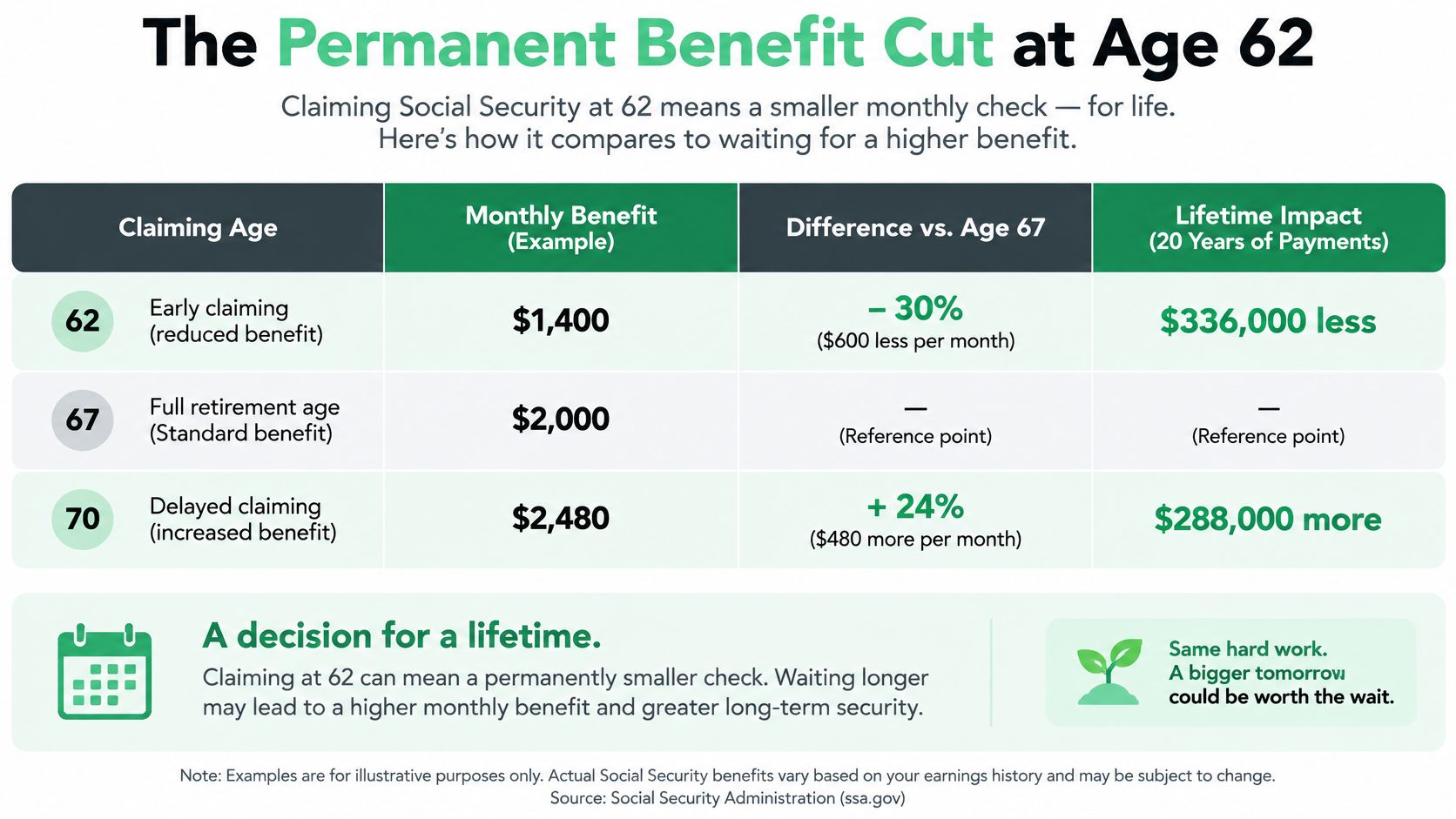
Translate the reduction into household dollars
Using the SSA's early-retirement explanation, an illustrative $2,000 monthly benefit at full retirement age becomes $1,400 when claimed at 62, or a calculated $16,800 annually before earnings-test withholding. The agency also explains that later earnings can replace lower years in the 35-year earnings record, and that delayed-retirement credits are available through age 70, with voluntary suspension generally available only after full retirement age.
The illustration gives you a comparison, not a personal quote. Your own earnings record determines your estimate.
Continued work can improve the underlying calculation when new earnings replace weaker years. Separately, Social Security credits qualifying months of earnings-test withholding when it recalculates the benefit. Neither adjustment guarantees that an early claimant ends up with the same check as someone who waited.
Decide which income problem you're solving
An early claim can make sense when the household needs dependable income soon and the available alternatives are unattractive. Health, job security, caregiving duties, and the strain of drawing down savings all deserve a place in the decision.
Waiting deserves serious consideration when your paycheck, pension, or savings can comfortably cover expenses. Home equity may make your balance sheet look strong, but it doesn't pay the grocery bill unless you have a practical way to use it.
- Pull your personal estimates. Compare the amounts shown in your my Social Security account rather than borrowing a neighbor's numbers.
- Compare spendable income. Include expected withholding, taxes, and insurance expenses.
- Test a longer retirement. Ask whether the smaller ongoing payment would remain comfortable if you need it for many years.
Our guide to when to take Social Security can help frame that household decision. The strongest reason to file early is a concrete need for the income, not the assumption that working will later undo the choice.
Pay That Counts and Pay That Does Not
Sort your income before comparing it with the earnings limit. Social Security treats a paycheck differently from a pension or investment distribution.
What counts toward the retirement earnings test
| Income | Counts toward the test | Why |
|---|---|---|
| Wages, bonuses, commissions, and vacation pay | Yes | Treated as wages |
| Net earnings from self-employment or consulting | Yes | Treated as earned income |
| Pension or annuity payments | No | Not wages or net self-employment |
| Interest, dividends, and capital gains | No | Investment income is excluded |
A part-time employee who also consults needs to combine wages with net consulting earnings. Looking at each job separately can understate the amount Social Security considers.
For consulting, distinguish gross receipts from net earnings. The money customers pay your business isn't necessarily the same amount that counts after legitimate business expenses.
Keep pension rules separate
Your workplace pension can have its own return-to-work restrictions. Some defined-benefit plans suspend or reduce payments when a retiree returns to the same employer, even though receiving the pension itself doesn't trigger Social Security's earnings test.
Before accepting the position, read the pension's summary plan description and request a written explanation of its reemployment provisions. Ask specifically about the proposed employer, job classification, and work schedule. A general assurance that retirees can return doesn't settle what happens to your particular pension.
Leaving an employer, collecting its pension, and working elsewhere can fit a retirement plan. Still, confirm the pension's rules before treating every promised dollar as available spending money.
Investment income can be excluded from the earnings test and still matter on your tax return.
Traditional IRA and workplace retirement-account withdrawals generally aren't wages or net self-employment earnings for this test. Required minimum distributions become a separate planning issue later; they don't turn withdrawals into employment income.
If your new job offers retirement contributions, check that plan's eligibility and contribution provisions. Being a Social Security beneficiary doesn't answer those plan-specific questions.
- Add earned income. Include expected employee wages and net self-employment earnings.
- Separate other receipts. Keep pensions and investment income out of the earnings-test tally.
- Read the pension booklet. Confirm any same-employer suspension rule before accepting the job.
Health Insurance From 62 to Medicare at 65
Starting Social Security doesn't automatically provide immediate Medicare coverage. Your health plan needs its own timeline, especially if you leave a job but keep working elsewhere.
Under the standard pathway, someone already receiving Social Security is generally automatically enrolled in Medicare Parts A and B at 65, and qualifying current-employment coverage can allow a later eight-month Special Enrollment Period, as described in SSA's retirement and Medicare planning guidance. Review the enrollment information you receive rather than assuming automatic enrollment matches your preferred coverage arrangement.
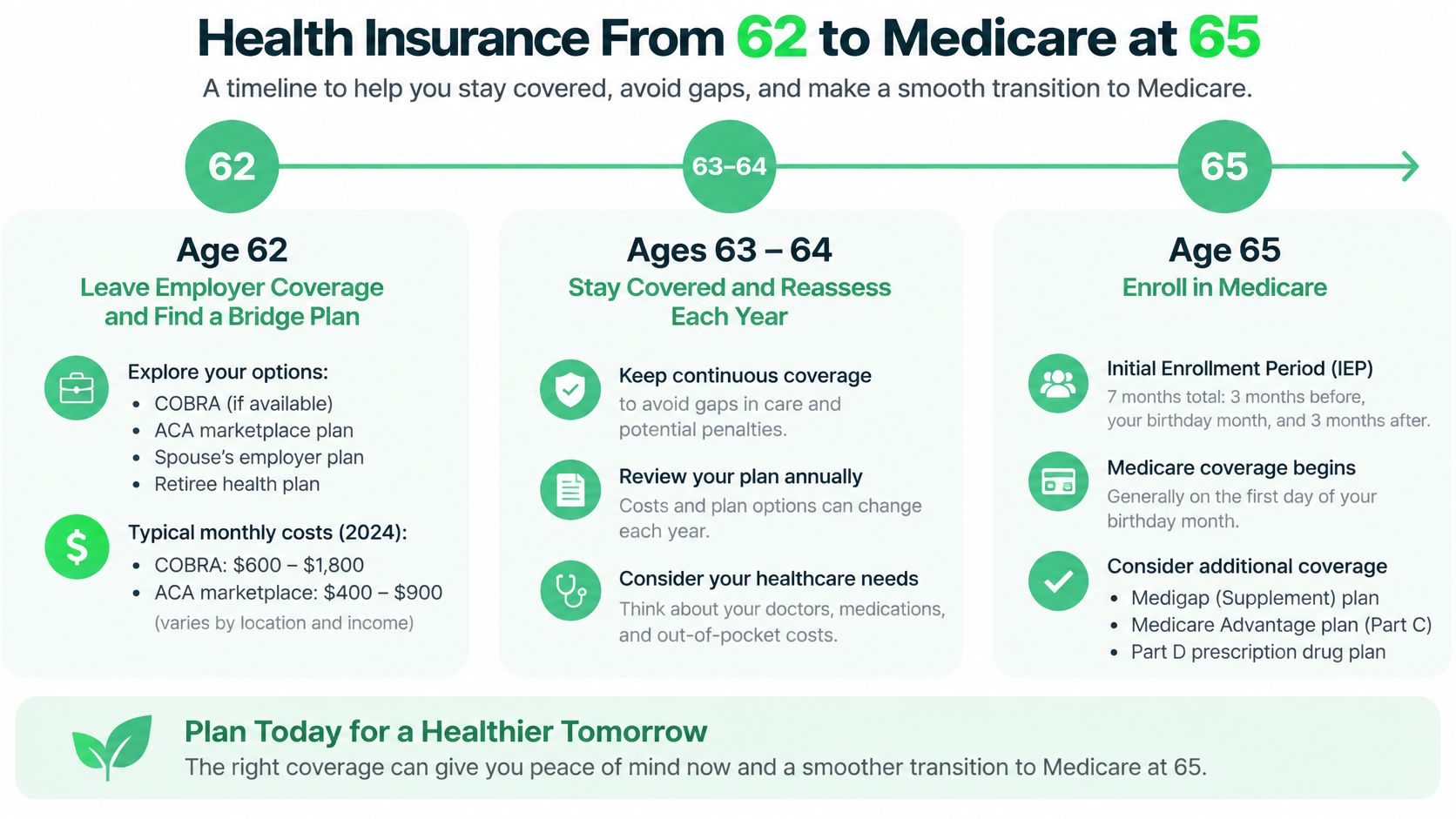
Follow the coverage, not the job title
The SSA explanation of employer coverage and Medicare distinguishes group coverage based on your or your spouse's current employment from COBRA, retiree coverage, Veterans Affairs coverage, and individual Marketplace coverage. Those alternatives don't qualify as current-employment coverage for delaying Part B under this rule.
Consider these situations in order:
- You keep a job with a group health plan. Ask the benefits administrator whether the coverage supports delaying Part B and which insurer would pay first.
- You're covered through your spouse's current job. Confirm the coverage is tied to active employment rather than a retiree arrangement.
- You take a part-time job without benefits. The paycheck doesn't create qualifying employer health coverage. Arrange insurance separately.
- You leave work before Medicare eligibility and receive a COBRA or retiree offer. That coverage may help bridge the gap, but don't assume it permits postponing Part B once you become eligible.
Employer size and coverage type can affect payment coordination. Talk with both the benefits administrator and Medicare before making the enrollment decision. Having an insurance card doesn't prove you've satisfied the enrollment rules.
Put the deadline in writing
Before your Medicare eligibility date, collect the details that control your next step:
- Plan name and type. Identify the actual coverage, not merely the insurer's name.
- Employment connection. Confirm whose current employment supports the plan.
- End dates. Record when employment ends and when qualifying coverage ends.
- Enrollment window. Mark the applicable deadline and confirm when Part B coverage can begin.
Our guide to health insurance for early retirement can help you organize the bridge between employer coverage and Medicare.
A manageable earnings-test withholding shouldn't distract you from a lasting enrollment mistake. A missed Part B window can bring penalties or coverage gaps. That paperwork deserves the same attention as your claiming application, even if it's considerably less exciting than handing back your office keys.
When a Paycheck Makes Benefits Taxable
The earnings test and federal income tax are separate calculations. A payment can escape earnings-test withholding and still affect how much of your Social Security enters taxable income.
The SSA's federal income-tax guidance defines combined income as adjusted gross income, tax-exempt interest, and one-half of Social Security benefits; its thresholds are $25,000 and $34,000 for single filers and $32,000 and $44,000 for married couples filing jointly, with up to 50% or 85% of benefits potentially taxable.
Federal combined-income thresholds for Social Security
| Filing status | Up to 50 percent may be included | Up to 85 percent may be included | What the percentage means |
|---|---|---|---|
| Single | Combined income over $25,000 and up to $34,000 | Combined income over $34,000 | That share of the benefit can be taxed at the ordinary rate, not taken as a flat tax |
| Married filing jointly | Combined income over $32,000 and up to $44,000 | Combined income over $44,000 | That share of the benefit can be taxed at the ordinary rate, not taken as a flat tax |
These are combined-income thresholds, not ordinary income-tax brackets. Use the current IRS Social Security benefits worksheet for the return you're preparing, and check your state's treatment separately.
Calculate combined income before guessing the tax
Consider the agency-style illustration: a single filer receives annual Social Security of $24,000 and has $30,000 of other adjusted gross income. Half the benefit is $12,000, producing $42,000 of combined income before tax-exempt interest.
That places the filer in the maximum inclusion range. The exact taxable amount still requires the worksheet.
Tax distinction: An inclusion percentage tells you how much benefit enters taxable income. It doesn't tell you how much tax you owe.
Your marginal tax rate applies to taxable income under the normal tax calculation. Deductions, filing status, other income, and the applicable tax rules affect the final bill. Treating the inclusion ceiling as a flat tax dramatically overstates what the government takes.
Portfolio withdrawals deserve attention here. An income source excluded from the earnings test may still increase adjusted gross income and expose more benefits to tax.
Before adding a part-time job, estimate the household's tax position both with and without the wages. A modest paycheck can push benefits into a higher inclusion range when pension income or retirement withdrawals already put the household near a threshold.
The job may still be worthwhile. You want to compare after-tax spending money, rather than a gross paycheck plus an assumed tax-free benefit.
A 2026 Paycheck and Benefit Example
Consider a hypothetical single homeowner who turns 62 in 2026, claims benefits, and works part time without a group health plan. Assume a full year of benefit entitlement for this simplified annual calculation.
The homeowner's illustrative full-retirement-age benefit is $2,000 a month. The early-claiming amount is $1,400 monthly, giving $16,800 annually before withholding. These are scenario amounts, not an estimate for every claimant.
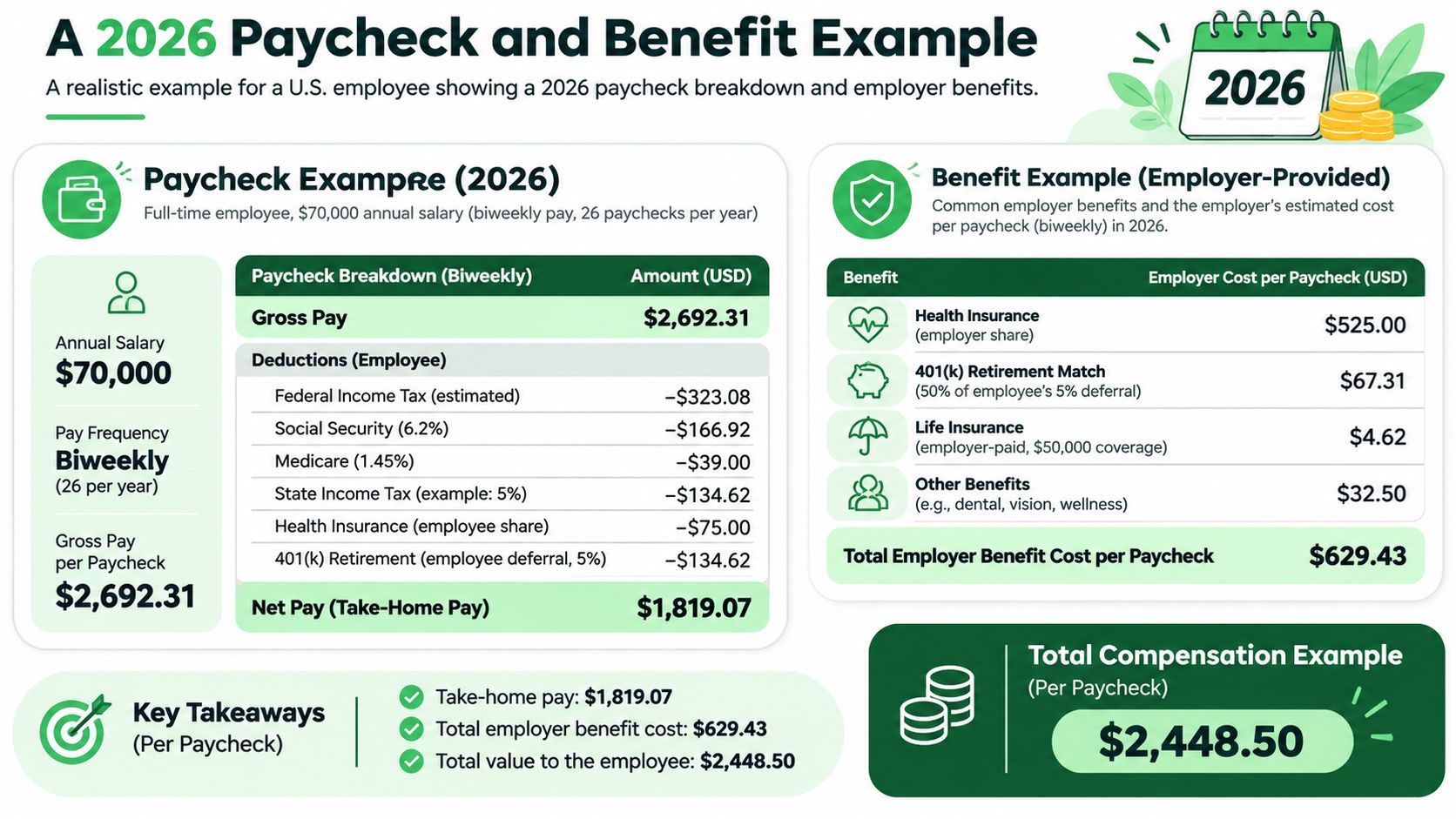
Separate withheld cash from taxable cash
Assume the job pays $36,000 annually. Applying the earnings-test rules gives this hypothetical household calculation:
| Calculation | Illustrative result | How to interpret it |
|---|---|---|
| Wages minus annual earnings limit | $36,000 − $24,480 = $11,520 | Earnings subject to withholding calculation |
| Half the excess | $11,520 ÷ 2 = $5,760 | Benefits withheld |
| Scheduled benefits minus withholding | $16,800 − $5,760 = $11,040 | Estimated annual cash benefits after reconciliation |
| Wages plus half the benefits paid | $36,000 + $5,520 = $41,520 | Combined income before tax-exempt interest |
| Maximum inclusion ceiling | $11,040 × 85% = $9,384 | Ceiling, not the actual taxable amount or tax bill |
The withholding equals a little more than four scheduled monthly checks. Because the agency may hold whole payments, the actual deposit pattern can differ from the annual subtraction shown here. Confirm payment timing and reconciliation before using the estimate as a monthly budget.
The tax calculation needs similar care. This household reaches the maximum inclusion range, but $9,384 is only the ceiling on potentially taxable benefits. The IRS worksheet determines the actual taxable amount, which can be lower.
Identify what lasts
The homeowner should label the effects correctly:
- Withheld. The earnings test reduces current benefit cash flow, with qualifying withheld months considered in the later recalculation.
- Possibly taxable. Some benefits received enter ordinary taxable income.
- Permanent early-claiming effect. The smaller starting benefit remains relevant, although later recalculations can change the amount.
- Separate insurance obligation. The job provides no group plan, so health coverage needs its own budget and enrollment schedule.
COBRA or Marketplace coverage may serve as a bridge before Medicare eligibility. Neither arrangement, by itself, supports delaying Part B under the current-employment exception.
The job adds spending money. The harder question is whether claiming adds enough useful cash now to justify starting the smaller benefit. If savings comfortably cover the gap, waiting deserves a serious comparison rather than an automatic dismissal.
Choose Claiming Plus Work or Waiting
Claim early when the reduced, potentially withheld check fills a real household need. Consider waiting when savings, pension income, or a spouse's earnings can cover spending without putting the household under strain.
A homeowner with meaningful savings should distinguish available cash from total net worth. Your house may provide security, but claiming decisions should reflect how you'll fund recurring expenses and unexpected repairs.
Complete these checks before applying
- Pull your personal benefit estimates. Compare your earliest claiming amount with your full-retirement-age amount in my Social Security.
- Total expected earned income. Combine wages and net self-employment earnings, then use the earnings-test rule for the calendar year you'll claim.
- Name your health coverage. Confirm whether it's based on current employment and record the Medicare enrollment dates that apply.
- Estimate combined income. Use the current IRS benefits worksheet rather than assuming Social Security will be tax-free.
- Read the pension's reemployment provisions. Get a written answer if you're returning to the same employer.
Then build a simple bridge budget. Compare essential spending with dependable income and calculate how much savings would need to supply if you postponed claiming. Test unexpected expenses and a longer period without employment, rather than assuming every year goes according to plan.
A broader mix of sources of retirement income can make that comparison more useful than looking at Social Security alone.
File early when the cash solves a specific problem at an acceptable long-term cost.
Working is allowed. Claiming should be a deliberate choice about the size and timing of income, with health coverage checked before the application goes in.
Get more posts like this
One short, useful email each Friday. Free, no spam, unsubscribe anytime.