When to Take Social Security: A Practical 2026 Guide
Wondering when to take Social Security? Our 2026 guide breaks down ages, taxes, break-even math, and spousal rules so you can claim on your terms.

Daniel Anderson
Editor, The Money Maniac
October 16, 2026
11 min read

Pat is 63, healthy enough to keep arguing with the thermostat, and staring at the same three choices a lot of near-retirees face, file now at 62, wait for full retirement age, or hold out until 70 because a friend swears that's the only sensible move. That friend is half right, which is how bad Social Security advice usually starts. When to take Social Security depends on your health, your cash flow, and which benefit you're claiming, not on a single magic age.
If you want a blunt answer, here it is. For a healthy single person with decent savings, delaying often wins. For someone with a tight budget, shaky health, or a spouse whose benefit changes the math, claiming earlier can be the smarter move. The useful question isn't “What age is best?” It's “What are you trying to maximize, monthly income now, lifetime income later, or survivor protection for the household?”
A lot of people get misled by broad advice that treats claiming like a one-size-fits-all test. It isn't. If you want a solid explainer on the risks of pushing every decision to the latest possible date, the risks of delaying retirement are worth reading in context.
The Decision Most Retirees Get Wrong
Pat's mistake isn't unusual. He's comparing ages in the abstract, while his real decision lives inside a household budget, a life expectancy guess, and the type of benefit on the table. One neighbor says, “Wait until 70.” Another says, “Take it at 62 and enjoy it while you can.” Both can be right, which is annoying but true.
Start with the right question
The claim age matters, but it's only part of the picture. Longevity, cash need, and benefit type do most of the work. If you're using Social Security to fill a gap before other income starts, early claiming can be rational. If you're trying to maximize a larger inflation-adjusted check for a long retirement, delay can make sense.
What I don't like is the lazy “always wait” line. That sounds disciplined, but it ignores real life. A person with a modest portfolio and rising medical costs may need income now more than a theoretical bump later. A couple with one much higher earner needs to think about survivor income too, which is where the standard advice often falls apart.
Practical rule: Don't ask whether 62, full retirement age, or 70 is “best” in the abstract. Ask which age best fits your household's cash needs, health, and the specific benefit being claimed.
The other trap is treating the decision as if it only affects your own check. It can affect taxes, spousal strategy, and what happens if one spouse dies first. That's why the right framework feels a little less tidy than the internet wants. Retirement planning rarely rewards tidy.
The Three Ages That Matter
There are really only three reference ages that matter here, 62, full retirement age, and 70. Social Security retirement benefits can generally begin at 62, but claiming before full retirement age, or FRA, permanently reduces the monthly benefit SSA fast facts, 2024.
Know your full retirement age
FRA is no longer 65 for anyone born in 1938 or later. The Social Security Amendments of 1983 raised it on a schedule that runs from 65 for people born in 1937 or earlier to 67 for people born in 1960 or later. Intermediate thresholds include 66 for births from 1943 through 1954, 66 and 2 months for 1955, and then two-month increases for each birth year through 1960 SSA fast facts, 2024.
That is why “take Social Security at 65” is sloppy advice. Someone born in 1958 reaches FRA at 66 and 8 months, while someone born in 1960 or later reaches it at 67. Age 65 may still matter for Medicare, but it is the wrong number for benefit math.
Your three reference ages
| Claim Age | Effect on Monthly Benefit | Who It Suits |
|---|---|---|
| 62 | Permanently reduced from FRA benefit | People who need income now or have shorter life expectancy |
| FRA | Full unreduced retirement benefit | People who want the baseline check without early-claim cuts |
| 70 | Highest monthly retirement benefit, because credits stop at 70 | People who can wait and expect a longer retirement |
For a worker whose FRA is 67, the difference between 62, FRA, and 70 is not cosmetic. It changes the baseline for the rest of retirement. Every future cost-of-living adjustment applies to the benefit you claim.
How Claiming Early or Late Changes Your Check
The math is simple. The consequences are not. For people born in 1943 or later, delaying retirement benefits after FRA earns delayed-retirement credits of 8% per year, or about 0.667% per month, until age 70 SSA Benefits page, 2024. Claiming before FRA cuts the monthly check permanently SSA publication EN-05-10024.
A worked example with real dollars
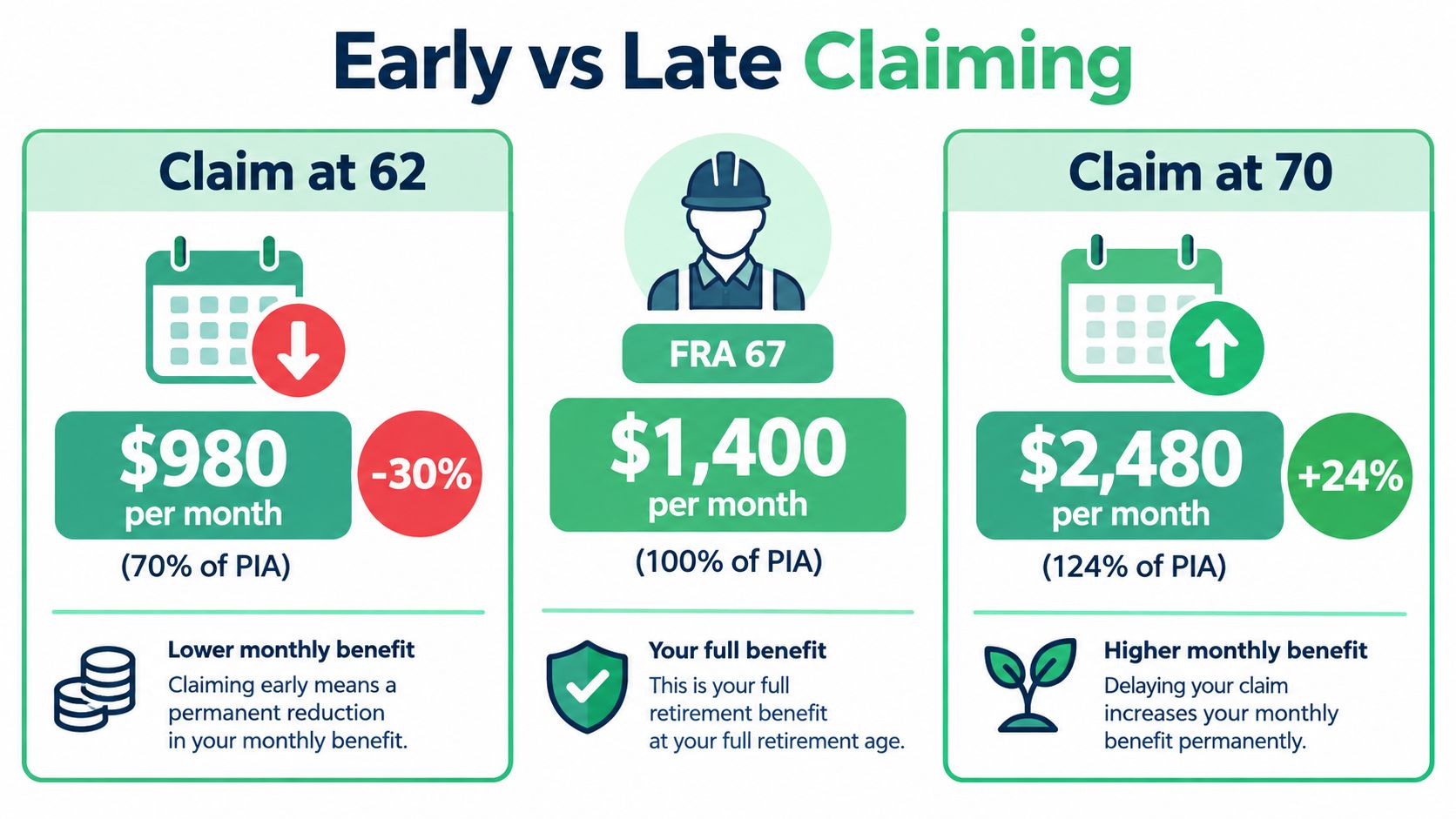
Take a worker whose FRA benefit is $2,000 a month. Claiming at 62 can reduce that to about $1,400, roughly 70% of the full amount, because the Social Security Administration says the reduction averages about 0.5% for each month benefits begin before FRA SSA publication EN-05-10024. Waiting until 70 can raise the monthly check to about $2,480, or about 124% of the FRA amount, using the standard 8% annual credit.
| Claim Age | Example Monthly Benefit | Relative to FRA |
|---|---|---|
| 62 | $1,400 | 70% |
| 67 | $2,000 | 100% |
| 70 | $2,480 | 124% |
These are permanent starting points, not temporary boosts. Every future cost-of-living adjustment applies to the benefit you claim, so a lower starting check stays lower for the rest of retirement, while a delayed claim compounds from a higher base. That is why the gap matters so much over a long retirement, especially once COLAs enter the picture.
A bigger monthly check helps only if you can afford the wait. If early retirement cash flow is tight, the larger later benefit may be the better long-term move, but the first payment date still has to fit your household balance sheet.
Break Even Math You Can Do on a Napkin
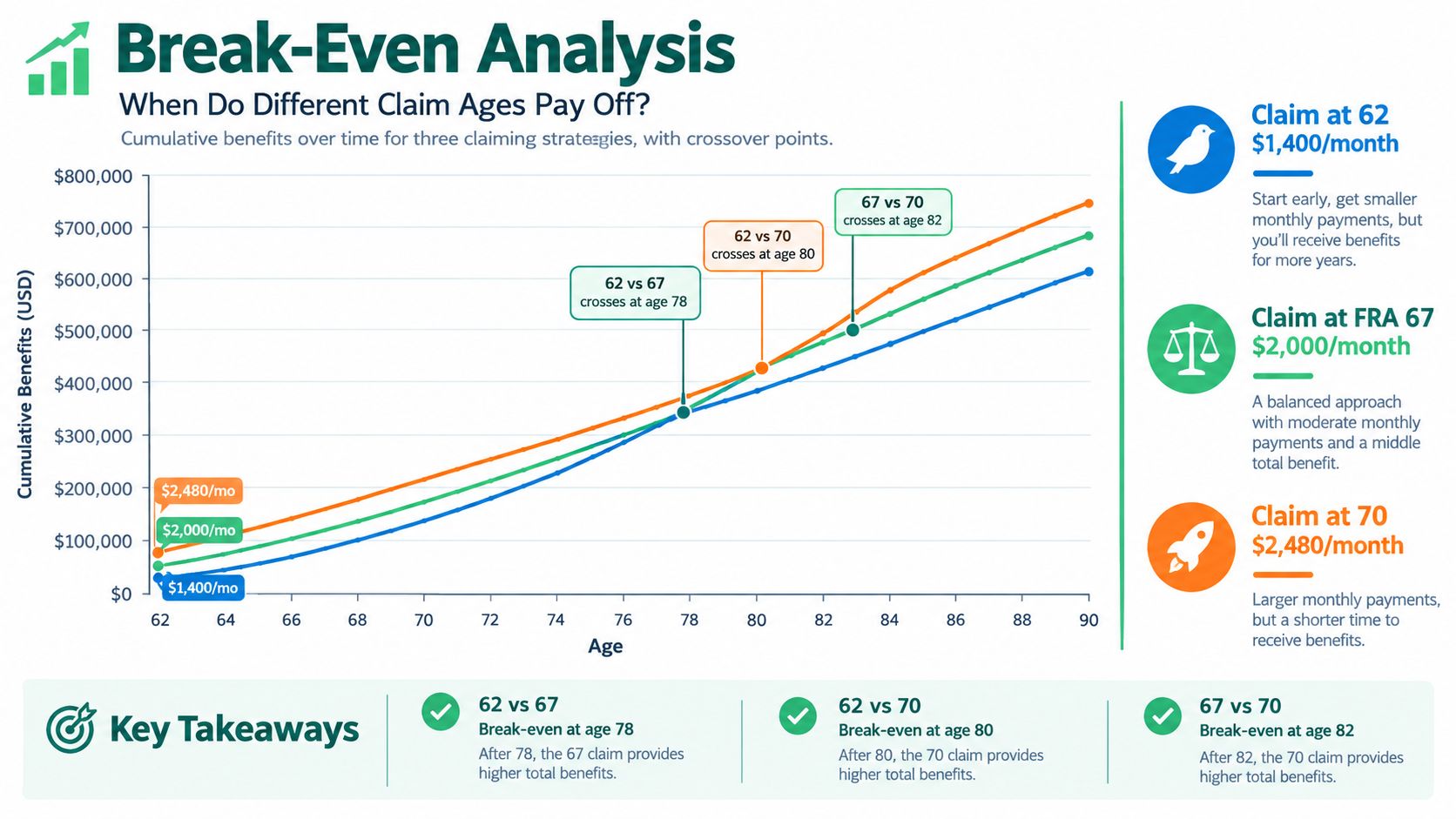
The simplest way to think about claiming is cumulative cash. The earlier filer gets more checks up front. The later filer gets fewer checks at first, then larger ones. Eventually, the bigger monthly check catches up. That crossing point is the break-even date.
A simple cumulative comparison
Using the same example, $1,400 at 62, $2,000 at FRA, and $2,480 at 70, here's what the lifetime cash picture looks like if monthly benefits stay level before cost-of-living increases.
| Age | Claim at 62 | Claim at FRA 67 | Claim at 70 |
|---|---|---|---|
| 70 | $134,400 | $72,000 | $0 |
| 75 | $218,400 | $192,000 | $148,800 |
| 80 | $302,400 | $312,000 | $297,600 |
| 85 | $386,400 | $432,000 | $446,400 |
| 90 | $470,400 | $552,000 | $595,200 |
Those numbers are simple, and that's the point. If you die before the crossover, early claiming wins on cumulative dollars. If you live past it, the delayed claim wins on lifetime income. The exact crossover age shifts with your benefit amounts, but the pattern doesn't.
For context, a healthy 62-year-old can still have a long runway ahead, and the SSA's life-table approach often points toward a retirement that extends well into the later decades for many people. That doesn't mean you should assume a long life. It means you should treat longevity as a real input, not a polite footnote.
If you want to sanity-check your retirement strategy against broader portfolio math, a simple S&P 500 return calculator can help you compare what a delayed Social Security check has to compete with inside your overall plan.
Taxes, the Earnings Test, and Working After You Claim
Claiming age does not stand alone. If you keep working or have other income, Social Security and the IRS both affect the size of your net check. That is why a retiree who says, “I'll file at 63 and keep working part-time,” can end up with less cash than expected.
The earnings test can shrink your check
In 2026, workers below FRA face an earnings-test threshold of $24,480, and Social Security withholds $1 in benefits for every $2 earned above that amount SSA publication EN-05-10003. In the year full retirement age is reached, the limit is $65,160 for earnings before the month FRA is reached, and the withholding rate changes to $1 for every $3 above that limit SSA publication EN-05-10003. Wages and self-employment income count, but investment income does not SSA policy article, 2019.
The withheld amount is not necessarily lost forever. Social Security recalculates the benefit at FRA and gives credit for months affected by the withholding SSA policy article, 2019. That does nothing for your cash flow right now, which is what matters when the furnace dies or the car needs work.
Benefits can also become taxable
The IRS uses provisional income, meaning modified adjusted gross income plus tax-exempt interest plus half of Social Security benefits, to decide when benefits become taxable IRS guidance. For single filers, the commonly cited thresholds are $25,000 and $34,000. For married couples filing jointly, the thresholds are $32,000 and $44,000 IRS guidance.
Cross the lower threshold, and up to 50% of benefits can be taxable. Cross the higher threshold, and up to 85% can be taxable IRS guidance. That does not mean an 85% tax rate. It means up to 85% of the benefit can be included in taxable income.
The same wage can hit both rules at once. A 63-year-old who claims early and earns $40,000 part-time can trigger the earnings test and the tax rules in the same year, so part of the benefit may be withheld and part may be taxed. Add IRA withdrawals and the result gets messier. Between the earnings test withholding and the provisional-income thresholds, the same $40,000 of wages can shrink the check and raise the tax bill in the same year. For readers who also handle caregiving costs, the practical overview of conditions et montants de l'aide helps frame what outside support can do for household cash flow.
If you are deciding where retirement withdrawals should come from, traditional 401(k) vs Roth gives the right framework. Traditional withdrawals can push provisional income higher, while Roth withdrawals usually do not create the same tax pressure.
Practical rule: If you are still working, run the earnings test and the tax calculation together. Looking at one without the other is how people get surprised by a smaller check and a bigger tax bill in the same year.
Spousal and Survivor Benefits Change the Answer
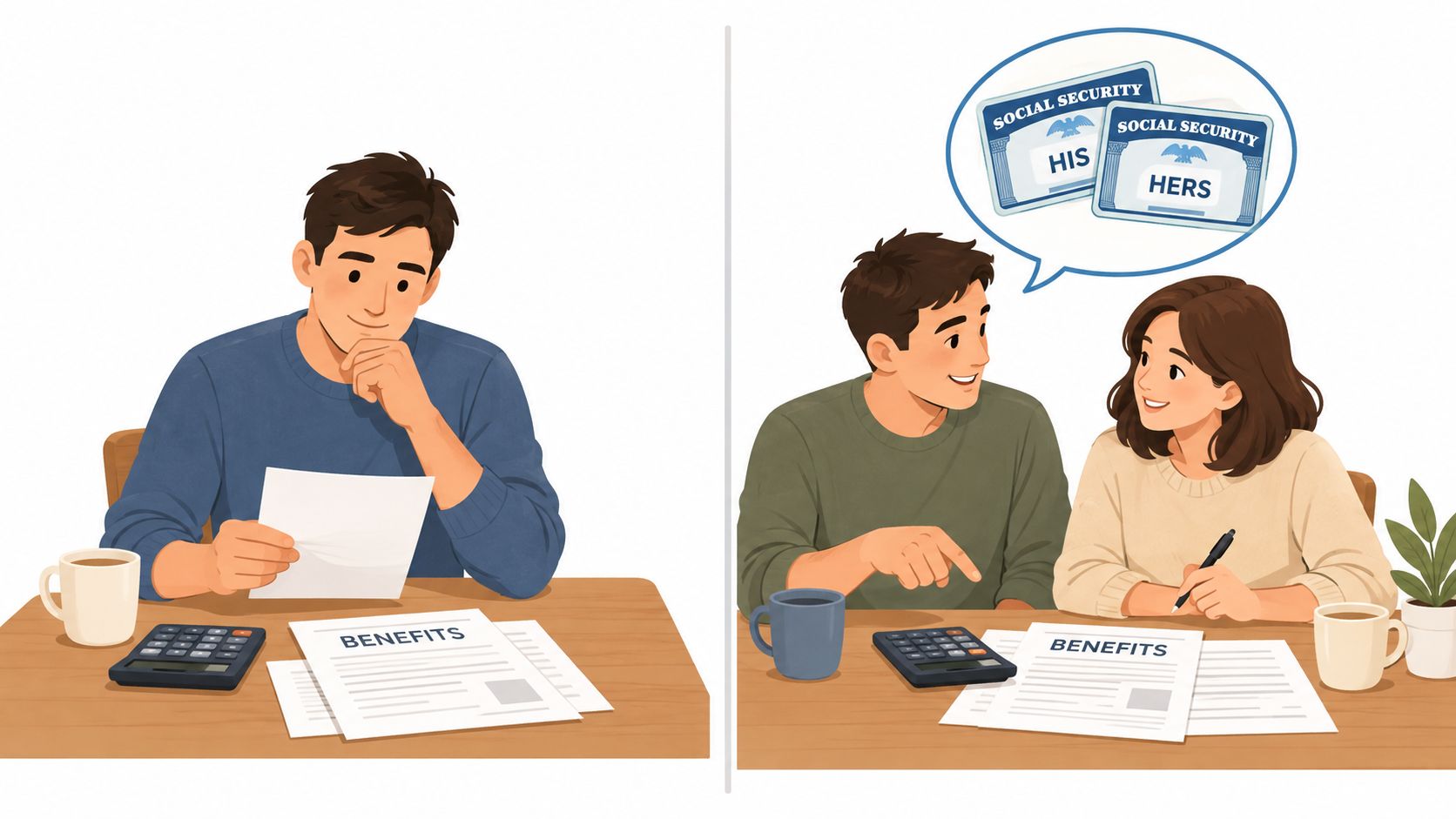
The clean “best age” answer falls apart once a household is involved. When to take Social Security is often a couple's decision, not a solo one. The right filing age for one spouse can be wrong for the other, especially once survivor benefits are part of the math.
Three cases, three different answers
A lower earner who may qualify for a spousal benefit should not make the same timing choice a single worker would. Married couples need to compare both retirement records, because one spouse's filing decision can shape survivor income later. A single filer with no dependent-benefit option has a simpler decision, but taxes and work income still matter.
Delaying a retirement benefit from full retirement age to 70 can raise that worker's own check, while family and survivor benefits generally reach their maximum at full retirement age and do not keep growing with later filing SSA retirement planning. That distinction matters. A higher retirement check for one spouse does not automatically mean the household has made the best lifetime choice.
The surviving-spouse move most people miss
A surviving spouse can generally start reduced survivor benefits at age 60, or at 50 if disabled, with full survivor benefits available at full retirement age SSA claiming rules. The SSA also lets a surviving spouse claim survivor benefits separately from their own retirement benefit, so one benefit can start first and the other can be taken later if that pays better.
That opens a useful strategy. A widow or widower can take survivor benefits early, let their own retirement benefit grow through delayed credits until 70, then switch if the larger payment makes sense SSA claiming rules. If the survivor is still working and below full retirement age, the earnings test can still reduce benefits.
For families dealing with dependent or survivor issues, a plain-English guide for Wisconsin families is useful background on how these benefits are structured and timed.
The same household logic applies if a pension is in the mix. A monthly check that looks good by itself may look weaker once survivor income, cash flow, and taxes are part of the picture. A clear way to value a pension helps you compare those trade-offs without guessing.
A Simple Framework for Your Own Decision
The best claim age usually falls out of four questions. Answer them, and the noise drops fast. Ignore them, and you'll end up arguing about ages like they're team colors.
Use these four questions
- How long are you likely to live? If you're healthy, active, and have a family history of longevity, waiting gets more appealing. If your health is poor, or your life expectancy is likely shorter, taking earlier can be perfectly sensible.
- What does your cash flow look like between now and 70? If delaying means scraping by, selling assets at a bad time, or draining savings you'd rather preserve, that cost matters.
- Are you married, and which benefit is the largest? The higher earner's timing can affect survivor protection. The lower earner may have a completely different optimal age.
- What does your tax return look like once Social Security is added? Wages, IRA withdrawals, Roth conversions, and other income can turn an apparently good claim age into a clunky after-tax result.
Default rule: If you're healthy, single, and have adequate savings, waiting to 70 is usually the stronger move. If money is tight, health is weak, or you need the benefit to make the budget work, claiming earlier is rational, not reckless.
Default decisions when you're not sure
| Situation | Default Move | Why |
|---|---|---|
| Healthy single person with savings | Wait until 70 | Higher monthly benefit usually makes sense if you can afford the delay |
| Poor health or short life expectancy | Claim earlier | Cash now can beat a bigger check later |
| Married couple, one higher earner | Coordinate both claims | Survivor income can matter more than one person's personal check |
| Still working below FRA | Run the earnings test first | Benefits may be withheld and taxed at the same time |
| High taxable income from withdrawals | Model taxes before filing | Social Security can become more taxable than expected |
The main point is simple. Don't make a Social Security decision in a vacuum, and don't let the oldest rule in the room bully the rest of the household plan. The right choice usually comes from a boring but honest spreadsheet, not a campfire story about who “got the most” out of the system.
Get more posts like this
One short, useful email each Friday. Free, no spam, unsubscribe anytime.