Traditional 401k vs Roth: A Clear 2026 Comparison
Traditional 401k vs Roth explained with real 2026 numbers. See how taxes, withdrawals, and RMDs differ so you can pick the right mix for your bracket.

Daniel Anderson
Editor, The Money Maniac
September 28, 2026
13 min read
You're staring at your employer's benefits screen, trying to decide which box to check before the deadline. Traditional 401(k), Roth 401(k), or some percentage in each? Many people copy the default, make a quick guess, and then leave the election untouched for years. That's an expensive way to choose a tax strategy.
The useful question in a traditional 401k vs Roth decision isn't just, “Will tax rates be higher later?” It's more practical: How much cash flow can you give up today, and when will each dollar most likely face taxation? Your current paycheck, career income curve, retirement withdrawals, and other taxable income all matter.
The mechanics come down to three stages: taxes when you contribute, taxes while money grows, and taxes when you withdraw. Once those stages are clear, choosing a full Roth allocation, a full traditional allocation, or a deliberate mix becomes much less mysterious.
The Open Enrollment Decision That Deserves More Than a Default
Your employer's enrollment window may give you only a few dropdowns, but those choices direct every future contribution. Payroll handles the mechanics behind the scenes, while the default option can pass for advice. Treat the selection as a cash-flow decision with long-term tax consequences.
Start with two questions:
- What does each contribution do to my paycheck today?
- What tax treatment do I want when I use the money later?
A traditional contribution is deducted before federal income tax, reducing current taxable income and preserving more cash in today's paycheck. A Roth contribution is deducted after tax, so today's paycheck takes the larger hit, while qualified withdrawals can be tax-free. Both contribution types share one employee savings limit. The timing of the tax bill changes.
That timing matters most when your income will rise. An early-career employee paying tax at a modest marginal rate may benefit from paying that rate now through Roth contributions, especially if future earnings become materially higher. A high earner in peak earning years may have a stronger case for traditional contributions, then withdraw the money in retirement when taxable income fits lower brackets. Your future tax rate decides the winner, but your present cash flow determines which strategy you can sustain.
Use a mix when both outcomes deserve room. A deliberate split can preserve current paycheck flexibility while building a pool of tax-free retirement money.
Practical rule: Treat your election as adjustable financial plumbing, not a permanent personality trait.
Review it after a promotion, marriage, relocation, career change, or major shift in retirement plans. A 401(k) checkup guide can help you inspect contributions and employer matching alongside the Roth-versus-traditional choice.
Choose the mix yourself. Do not let a benefits portal make a tax decision by default.
How Each Account Is Taxed at Every Stage
The tax decision starts in payroll and ends when you spend the money. Traditional 401(k) contributions generally use pre-tax dollars, lowering current taxable income. Roth 401(k) contributions use after-tax dollars, so the tax is paid before the contribution enters the account. Both options can operate within one employer plan and share the employee deferral limit.
For 2026, employees can contribute $24,500 across traditional and Roth 401(k) deferrals combined. The combined employee and employer annual limit is $72,000. Workers age 50 and older can add an $8,000 catch-up contribution, while workers ages 60 through 63 may qualify for an $11,250 super catch-up when the plan permits it. See the current 401(k) tax guidance for these limits.
| Stage | Traditional 401(k) | Roth 401(k) |
|---|---|---|
| Contribution | Made with pre-tax payroll dollars, generally reducing current taxable income | Made with after-tax dollars and included in taxable income for the contribution year |
| Growth | Investment growth is generally tax-deferred inside the account | Investment growth generally isn't taxed while it remains inside the account |
| Withdrawal | Distributions are generally taxed as ordinary income | Qualified distributions are generally tax-free |
| Employer contributions | Employer matching and other contributions may go into a traditional account | Your Roth election generally does not convert employer contributions into Roth money |
The IRS explains this distinction in its 401(k) resource guide for plan participants. Because employer money usually lands in a traditional bucket, understanding the defined contribution plan vs. pension distinction helps explain why the match follows different tax rules from your Roth election. A worker contributing 100% Roth can still hold both tax treatments automatically.
A simple contribution example
Suppose you contribute $1,000 per pay period for 25 years and the investments earn a hypothetical 7% annual return. The contribution stream grows to roughly $758,000 before taxes, assuming regular annualized contributions and excluding inflation, fees, and employer contributions.
Traditional contributions put the full gross amount into the account, but withdrawals are generally taxable. Roth contributions require tax upfront, so less reaches the account when you hold the gross budget constant. At a 22% tax rate, a $1,000 gross budget produces a $780 Roth contribution, while the traditional account receives the full $1,000. The comparison only works if you also invest the traditional tax savings.
Account statements often make traditional look stronger because its starting contribution is larger. Roth may deliver more usable money because qualified withdrawals avoid tax. After-tax spending power is the only fair comparison; the headline balance flatters the traditional side.
The deciding question is bracket timing: which tax rate applies to the dollars today, and which rate will apply when you withdraw them? That answer should drive the account mix, while the paycheck impact determines whether you can maintain it.
When a Lower Bracket Today Makes Roth the Clear Winner
For a younger worker earning roughly $50,000 to $130,000 in current wages as a single filer in 2026, Roth contributions often deserve the first look. That range can place a worker in the 12% to 24% federal brackets, depending on taxable income and filing details. Those bracket figures and income examples should be checked against a current tax-bracket explainer, because wages aren't the same thing as taxable income and state taxes also matter.
The strongest Roth case appears when today's marginal rate is lower than the rate you reasonably expect during peak earning years or retirement. Paying 22% today on Roth dollars can be attractive if those same dollars would otherwise face 32% taxation later. The spread doesn't guarantee a better outcome, because investment returns, deductions, filing status, and withdrawal patterns all affect the result. It does create a strong starting advantage for Roth when a worker is early in a rising career.
A high-earner early in a career can face the reverse choice. Paying 32% today through Roth contributions may be less appealing if retirement withdrawals are likely to fit within a 24% bracket. Traditional contributions can provide the larger immediate tax benefit, especially when the worker has substantial income and limited deductions.
Use lifetime tax, not a snapshot
Single-year bracket math is useful, but it can mislead. Retirement taxation unfolds across many years, and withdrawals may come from several sources. A traditional balance can also create taxable income that affects how much flexibility you have in a given year.
Your better estimate includes:
- Current marginal rate: Focus on the rate applied to the next dollar, not your average tax rate.
- Career trajectory: Promotions and compensation growth can move Roth from sensible to especially valuable.
- Retirement income: Include taxable withdrawals, pensions, business income, and other sources.
- State exposure: A high-tax state today and a lower-tax retirement location can strengthen the traditional case.
- Tax diversification: Roth money gives you a pool that can be withdrawn without adding federal taxable income when qualified.
A Roth conversion can also change the mix later, but it deserves careful planning around taxable income and available cash to pay the tax. Review the practical issues in Roth conversion planning before treating conversion as a magical undo button. It's a tool, not a time machine.
Withdrawals, Penalties, and RMDs Compared
The withdrawal stage is where the tax choice becomes real. Traditional 401(k) distributions are generally taxed as ordinary income, and withdrawing before age 59½ may trigger a 10% early-withdrawal penalty in addition to income tax. Exceptions can apply, including certain hardship situations, substantially equal periodic payments, disability, and a first-home exception, but exceptions have conditions. Don't build an early-retirement plan around a rule you haven't verified.
Qualified Roth 401(k) distributions can be tax-free when the account satisfies the five-year requirement and the participant is at least 59½, disabled, or deceased. Contributions and earnings follow different rules, so don't assume every withdrawal is automatically qualified just because the account is labeled Roth. The SEC's retirement-plan comparison lays out these distinctions.
| Factor | Traditional 401(k) | Roth 401(k) / Roth IRA |
|---|---|---|
| Tax treatment | Withdrawals are generally ordinary income | Qualified Roth 401(k) withdrawals are generally tax-free |
| Early access | Before 59½, income tax and potentially a 10% penalty can apply | Roth 401(k) earnings need qualified-distribution treatment for tax-free access |
| Five-year clock | No Roth qualification clock | Roth 401(k) qualified withdrawals generally require five years, plus an eligible event |
| RMDs | Required minimum distributions generally begin at age 73 for people born 1951 through 1959, or age 75 for those born 1960 or later | Roth 401(k)s don't require lifetime RMDs for the participant; Roth IRAs also don't require lifetime RMDs |
Traditional 401(k) RMDs can force taxable withdrawals even when you don't need the money. The applicable starting age is generally 73 for people born from 1951 through 1959 and 75 for people born in 1960 or later, according to the retirement distribution rules cited above.
Roth 401(k) money offers more control once qualified. Tax-free withdrawals can help you choose how much taxable income to recognize in a year, while traditional money can be useful when you intentionally want taxable income and the deduction today was valuable. The point isn't that Roth always wins. The point is that withdrawal flexibility has value, especially when your income sources are hard to predict.
Splitting Contributions Across Both Accounts in 2026
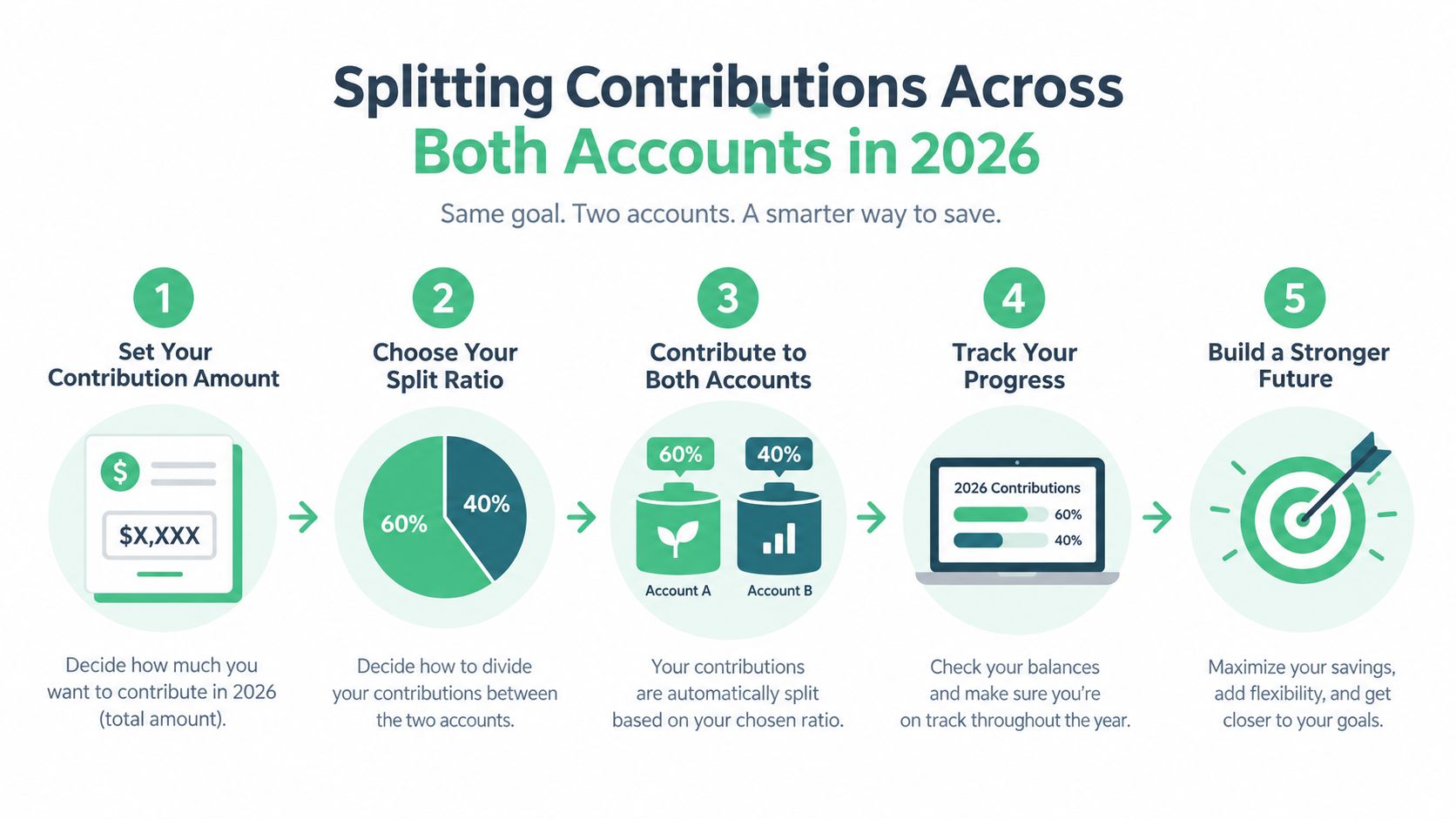
An employee can divide 2026 contributions between traditional and Roth 401(k) accounts without creating a second employee limit. Both sources share the $24,500 limit, so a 60/40 election sends 60% of each contribution to one account and 40% to the other while the combined amount counts toward the same IRS ceiling.
Payroll generally applies the elected percentages to each paycheck, and the plan tracks the total across both sources. A 50/50 split can suit someone who wants immediate tax relief and future tax-free income. A traditional-heavy split fits a household that needs more cash flow today. A Roth-heavy split makes more sense when current income is temporarily low or future earnings are likely to be materially higher.
The IRS record shows the shared ceiling rising from $19,500 in 2021 to $20,500 in 2022, $22,500 in 2023, $23,000 in 2024, $23,500 in 2025, and $24,500 in 2026 in its Roth comparison chart. Roth contributions add tax-choice flexibility inside the employer plan, not another employee savings limit.
Catch-up rules need a separate check
The catch-up amounts covered earlier still apply, but one SECURE 2.0 rule changes how some high earners must fund them. Beginning in 2026, employees age 50 or older whose prior-year FICA wages from the sponsoring employer exceeded $150,000 must make catch-up contributions on a Roth basis under the SECURE 2.0 high-earner catch-up rule. That requirement can reduce the ability to use catch-up contributions for an immediate deduction.
Check the actual payroll portal and summary plan description before relying on Roth deferrals. Some employer plans do not offer them. Confirm where matching contributions go as well, because your personal split does not necessarily determine the tax treatment of employer money.
Two Real Readers, Two Different Right Answers
Maya is 28, earns $78,000, sits in the 22% federal bracket, and already has $30,000 in a starter traditional 401(k). She expects her income to rise as her career develops and assumes a 7% growth rate over 35 years, with retirement withdrawals landing in a 24% bracket.
Her choices aren't economically identical. A 100% traditional election gives her the current deduction, but it also places more future spending power in a taxable account. A 50/50 split gives up some current tax relief and builds a tax-free bucket alongside the existing traditional balance. Under the stated assumptions, the Roth-leaning path has the stronger tax-timing logic because she pays at a lower current marginal rate than the projected retirement rate.
The exact winner still depends on what happens to the traditional tax savings. If Maya spends the current tax reduction instead of investing it, traditional loses an important part of its theoretical advantage. Her existing traditional balance also makes some Roth diversification more useful, even before anyone tries to predict future tax law.
Priya is 47, earns $245,000, sits in the 32% bracket, and contributes the regular $24,500 maximum plus an $8,000 catch-up. She expects retirement income to land in the 24% bracket. Her income is high now, and her traditional deduction applies during years when each dollar of tax relief can be valuable.
| Profile | Maya, 28, 22% bracket | Priya, 47, 32% bracket |
|---|---|---|
| Main tax timing | Pay at a lower rate today, potentially avoid a higher rate later | Deduct at a high rate today, potentially withdraw at a lower rate |
| Strong starting recommendation | Roth-leaning, with room for a blend | Traditional-leaning |
| Why keep the other bucket | Existing traditional balance and future flexibility | Protection against tax increases and income-management needs |
For Priya, traditional wins on pure tax-rate math under the assumptions. A Roth allocation can still hedge future tax increases, help manage taxable income, and reduce dependence on itemized deductions. The answer follows the profile, not a universal rulebook.
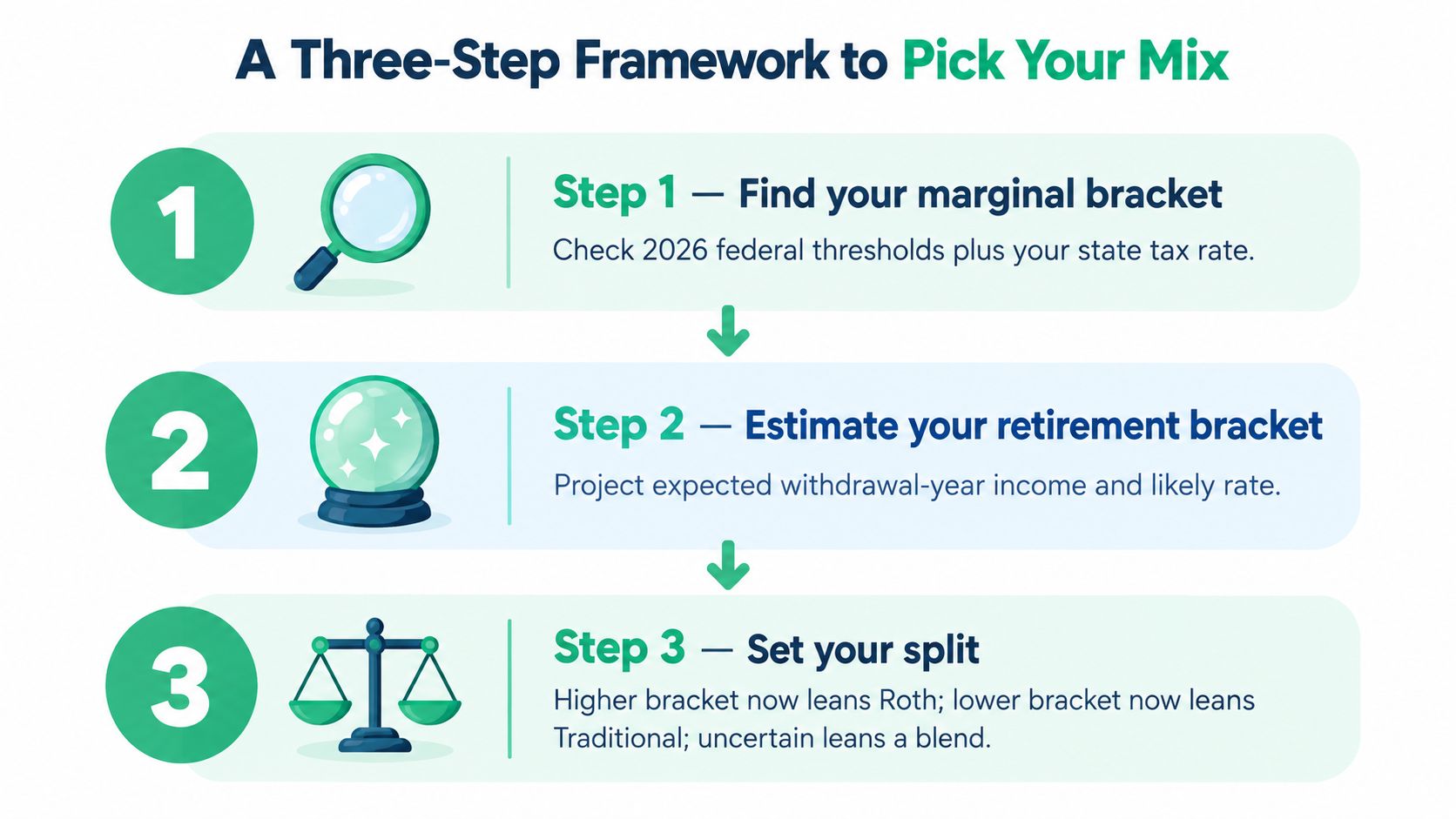
A Three-Step Framework to Pick Your Mix
Use this as a worksheet, not a personality test.
Step one, find today's marginal bracket
Look at the tax rate applied to your next dollar of taxable income. Use your filing status, deductions, and taxable income rather than relying on salary alone. Add state tax exposure to the picture, especially if you currently live in a high-tax state and expect to retire somewhere with lower or no state income tax.
Then ask how much the contribution changes your paycheck. Traditional usually creates more take-home pay than Roth for the same gross contribution because the traditional deferral reduces current taxable income. Roth requires you to absorb the tax bill now.
Step two, estimate your withdrawal bracket
List the income you expect to have from traditional retirement accounts, pensions, employment, rental activity, and other taxable sources around retirement. Include the possibility that withdrawals will be uneven, because a flexible withdrawal plan can produce a different tax result from a rigid one.
You don't need a fake precision forecast. A range is more useful than pretending you know the exact tax code decades from now.
Step three, test the split
Start with a 50/50 split if the answer remains unclear. Move toward Roth when your expected future bracket is higher than today's. Move toward traditional when today's marginal rate is meaningfully higher than the rate you expect during withdrawals.
Before changing the election, check:
- Plan availability: Confirm the employer offers Roth 401(k) deferrals.
- Match destination: Verify whether employer matching money goes into a traditional account.
- Vesting: Check when employer contributions become fully yours.
- Withdrawal features: Confirm whether the plan permits in-service withdrawals or other access options.
- Annual additions: If you use after-tax contributions, understand how employee and employer money interact with the $72,000 overall limit, as described in current 401(k) contribution-limit guidance.
For broader planning around savings, investing, and cash flow, investment planning tips can help you place the 401(k) decision inside the rest of your financial plan.
A Simple Next Move Before Your Next Paycheck
Choose all traditional when you expect a meaningfully lower tax bracket at withdrawal, need to reduce current adjusted gross income for purposes such as Affordable Care Act eligibility, student-loan considerations, or child tax credit calculations, or you're in a high-tax state now and expect to retire in a state without income tax. Those are cash-flow and tax-planning reasons, not signs that traditional is superior.
Choose all Roth when you're early in your career and currently in a lower bracket, expect your peak earning decades to arrive later, or want maximum control over taxable income in retirement. Roth money can help you avoid adding qualified withdrawals to taxable income and can reduce pressure from required distributions.
Split contributions when your bracket is uncertain, your compensation is rising through mid-career, or you already have substantial taxable and Roth assets that make diversification useful. A split also keeps you from making one giant prediction about tax law, career income, retirement spending, and your future address. That prediction is usually less reliable than people think, which is why tax diversification earns its keep.
Your five-minute action is straightforward. Log into your 401(k) portal today, note your current traditional-versus-Roth percentage, run a 50/50 split for one pay cycle, and compare the paycheck change with the projected tax diversification. Recalculate the same mix every January at minimum, so your allocation tracks your bracket instead of your original guess.
Get more posts like this
One short, useful email each Friday. Free, no spam, unsubscribe anytime.