Compound Interest Calculator Monthly Explained
Master your compound interest calculator monthly inputs and formulas. Learn how timing, inflation, and compounding frequency actually impact your wealth.

Daniel Anderson
Editor, The Money Maniac
October 13, 2026
13 min read
Many users trust a monthly compound interest calculator too quickly. They enter a starting balance, a monthly deposit, and an attractive annual return, then treat the ending balance as a forecast. That number is useful, but only as a mathematical illustration. It doesn't tell you what the money will buy, whether the rate will last, how taxes will reduce the result, or what happens when your income makes a contribution impossible.
A realistic calculation needs more than a large future balance. It needs contribution timing, inflation, taxes, fees, changing rates, and a clear split between your deposits and investment growth. Otherwise, the calculator may offer precision without much realism.
The Illusion of the Default Future Value
A monthly compound interest calculator can produce a precise-looking balance while hiding the assumptions that make it optimistic. Its formula may be accurate, but a fixed annual return and uninterrupted deposits rarely describe an entire working life. Contribution timing also matters: deposits made at the beginning of each month compound longer than deposits made at the end.
The displayed total is usually a nominal value, meaning the number of dollars in the account. It does not show what those dollars will buy. Inflation reduces purchasing power, while taxes, fees, and changing returns can reduce the amount you can spend.
Household finances make that distinction practical. Recent Federal Reserve data found that 58% of U.S. adults said price increases had worsened their financial situation, while 41% reported reducing savings. Those results show why a future balance needs context when rising costs can already affect how much a household contributes. The Federal Reserve household financial well-being report provides the underlying survey results.
The number that deserves skepticism
Suppose the calculator projects a large balance after years of monthly deposits. Check these points before treating it as a forecast:
- How much did I contribute? Separate deposits from investment growth.
- Which return assumption produced the result? A constant rate simplifies the calculation, but actual returns vary.
- What will the balance buy? Purchasing power after inflation matters more than the nominal total alone.
- When were deposits made? A calculator using end-of-month contributions can produce a different result from one using beginning-of-month deposits.
A useful calculator should display nominal balance, inflation-adjusted purchasing power, and after-tax balance. It should also support changing returns during the projection, rather than implying that a current yield will last for decades.
Practical rule: Treat the default output as a scenario, not a promise.
The most misleading result may be a large one that discourages you from testing assumptions. Compounding can build wealth, but the calculator's confidence comes from the inputs, not from the future.
Core Inputs for Monthly Compounding
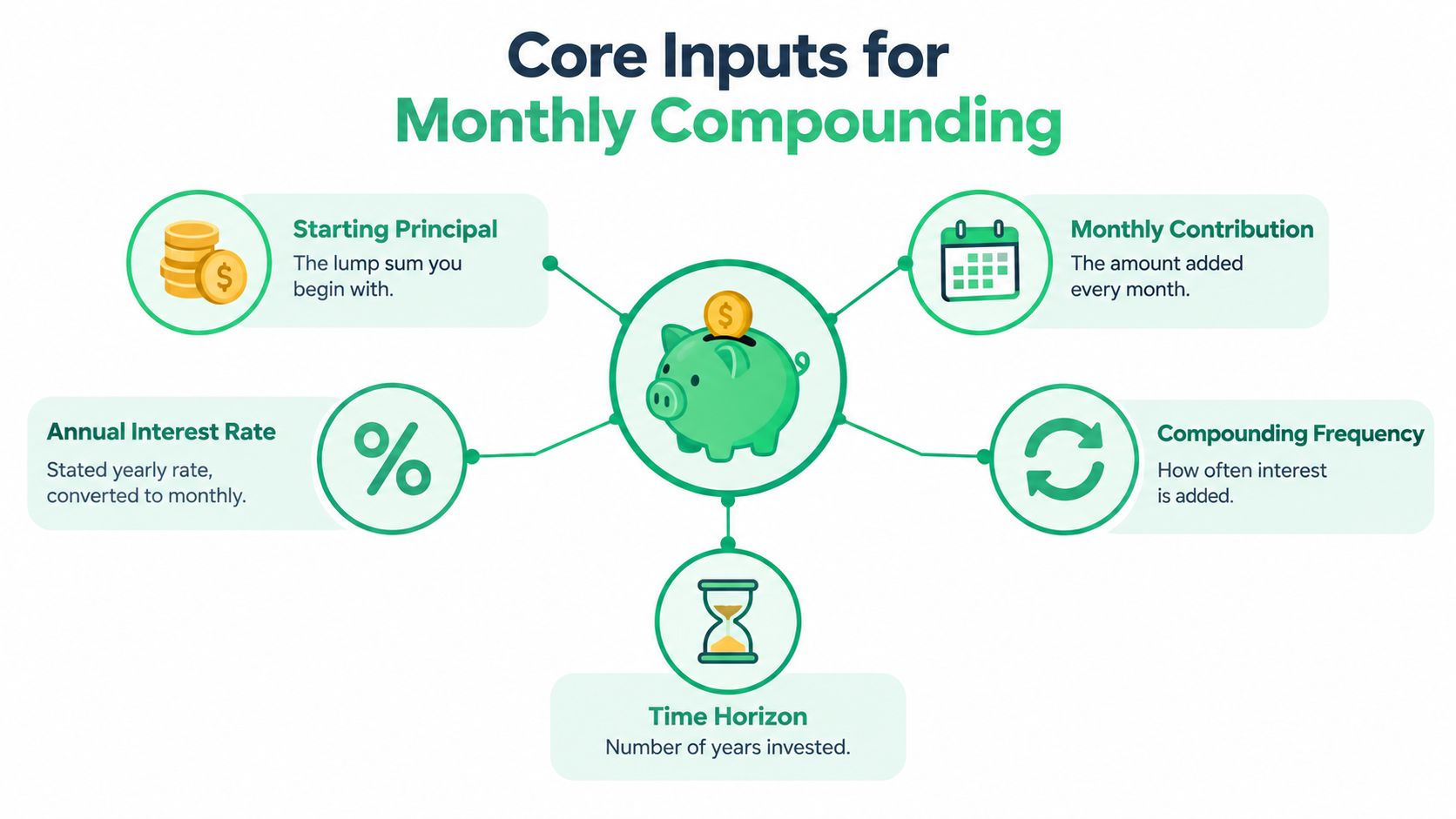
A monthly calculator is only as useful as the assumptions behind its fields. Before pressing calculate, define what each input means and decide whether it reflects your actual behavior.
Start with the money and the habit
Starting principal is the lump sum already invested or deposited. It gets the longest opportunity to compound, so entering an optimistic balance can distort the entire projection.
Monthly contribution is the amount you add. This input often matters more than hunting for a slightly higher advertised return because it reflects a decision you control. Use an amount that fits your budget after essential bills, high-cost debt payments, and a sensible cash reserve.
Annual interest rate is the stated yearly assumption. For a deposit account, an annual percentage yield can already reflect compounding. For an investment projection, an assumed return is uncertain and should be treated as a scenario rather than a guaranteed rate.
Compounding frequency determines how often the account adds earnings back to the balance. A monthly calculator converts the annual assumption into monthly periods, but the product's published rate may use a different convention.
Time horizon is the number of years the money remains invested. Longer periods give contributions more opportunities to grow, but they also give flawed assumptions more time to produce a misleading answer.
Test sensitivity instead of admiring one output
Run a conservative scenario, a middle scenario, and a stronger scenario. Then change one input at a time. If a small rate adjustment transforms the conclusion, your plan depends heavily on an assumption you may not control.
Avoid entering a return just because it makes the final balance look satisfying. The better question is, “Can my budget support this contribution, and can I tolerate the losses or lower returns that may occur along the way?”
How Compounding Frequency Changes the Math
Monthly compounding means the balance receives interest more frequently than with annual compounding. Interest earned earlier becomes part of the balance sooner, allowing later calculations to include that added amount.
The mechanical difference is straightforward. A nominal annual rate is divided across the compounding periods, and the resulting periodic rate is applied repeatedly. More frequent compounding generally produces a slightly higher effective annual yield when the stated annual rate and other assumptions remain the same.
That difference can be modest in the short run, while the repeated calculation matters more over a longer horizon. Still, comparing effective annual yield, rather than focusing only on the word “monthly,” is the cleaner way to compare account terms.
Compare the right fields
| Compounding Frequency | Effective Annual Yield | Final Balance over 10 Years |
|---|---|---|
| Annual | Depends on the stated rate | Depends on the starting balance, rate, and deposits |
| Quarterly | Depends on the stated rate | Depends on the starting balance, rate, and deposits |
| Monthly | Depends on the stated rate | Depends on the starting balance, rate, and deposits |
| Daily | Depends on the stated rate | Depends on the starting balance, rate, and deposits |
| Continuous | Depends on the stated rate | Depends on the starting balance, rate, and deposits |
The table intentionally avoids invented outputs. Without a specified principal, annual rate, contribution schedule, and rate convention, a dollar comparison would be decorative rather than informative.
For savings products, compare the published APY when available because it incorporates the effect of compounding. For an investment projection, focus less on whether the calculator uses monthly or daily periods and more on whether the assumed return, taxes, fees, and contribution schedule resemble your situation.
If you're weighing a one-time deposit against recurring deposits, the discussion in this guide to lump-sum investing adds the missing timing question. The frequency setting matters, but when money enters the account often matters more than a small difference in compounding intervals.
Contribution Timing and the Cost of Delay
A monthly deposit has no fixed effect until its arrival date is defined. A contribution made at the beginning of the month receives one additional compounding period compared with the same contribution made at month-end. In practical terms, a deposit made at the start compounds for (n) periods instead of (n-1), so each early deposit gets one extra month of growth.
The difference from one deposit is modest. Repeated across many deposits and a long investment horizon, the timing gap becomes more meaningful. Early contributions have more time to grow, while delayed money misses that period entirely. The contribution timing comparison explains the underlying mechanics.
Match the schedule to the cash flow
| Deposit schedule | What it assumes | Practical implication |
|---|---|---|
| Beginning of month | Money arrives before the monthly calculation | Each deposit receives the longest available growth period |
| Middle of month | Money arrives between the two common conventions | A useful approximation for irregular pay dates |
| End of month | Money arrives after the month's calculation | Each deposit starts compounding later |
Use the setting that reflects when money can enter the account. If a paycheck arrives near month-end, beginning-of-month deposits can make the projection look more favorable than reality. If cash is available earlier, delaying the transfer for an arbitrary date gives up time in the market.
A salaried worker can automate a transfer around payday. A freelancer or business owner may get better results from a rule such as transferring a percentage of each client payment, then recording the actual deposit dates instead of forcing every month into the same amount.
Missed deposits widen the gap
Skipping a contribution removes both the deposit and the future growth it could have generated. A later catch-up payment may recover part of the difference, but it cannot recreate the exact time that money remained outside the account.
A missed month does not invalidate the plan. It does show why a calculator should support beginning-, middle-, and end-of-month deposits, irregular contributions, skipped months, annual increases, and an “invest now” versus “invest monthly” comparison where available.
Check whether the result is nominal or adjusted for inflation. A timing improvement can raise the projected balance, while inflation still reduces what that balance can buy. The contribution target also needs to fit your income and expenses. The practical guide to how much to invest each month can help set a sustainable amount instead of one that repeatedly fails.
The Monthly Compound Interest Formula Explained
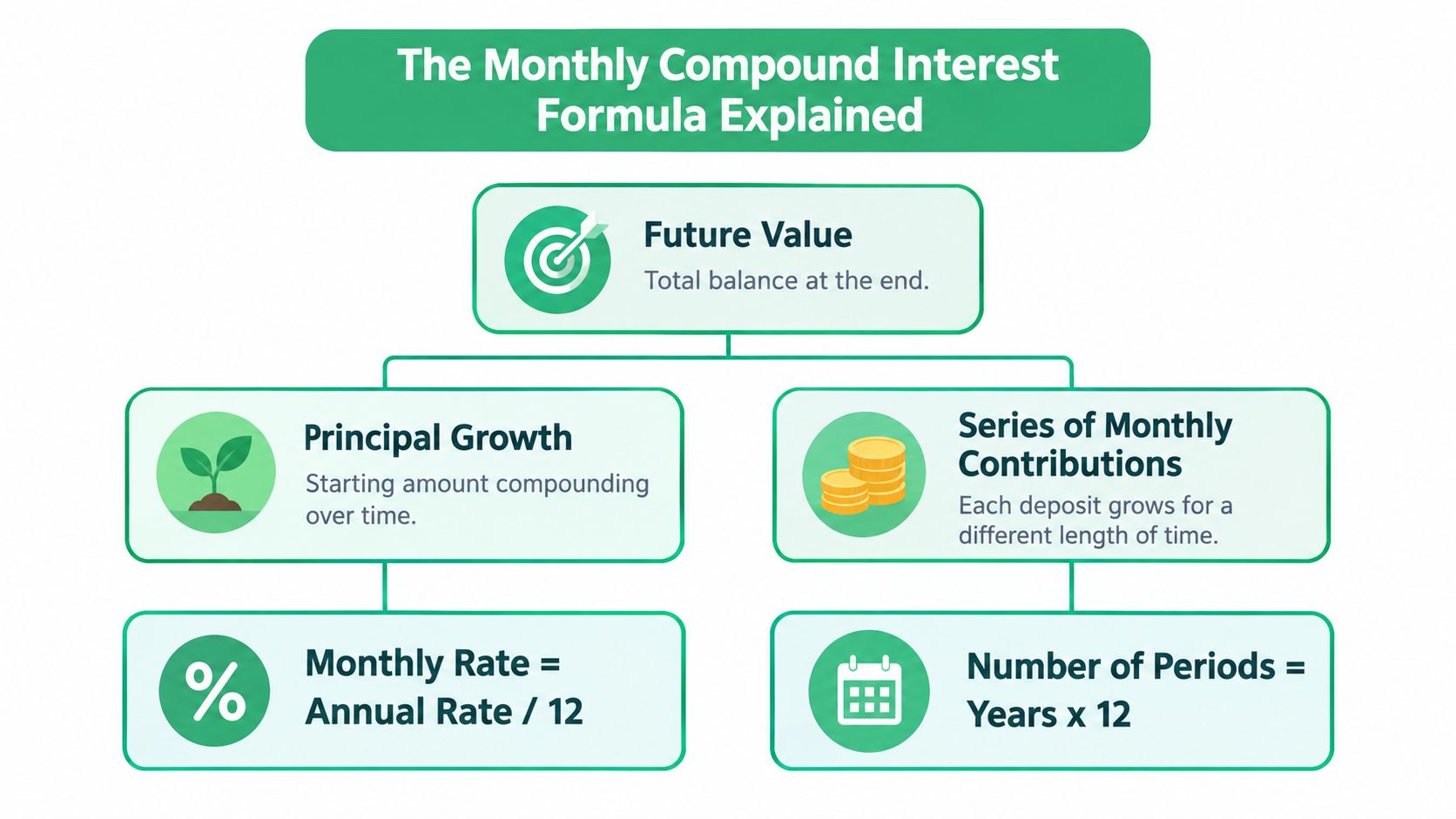
The calculator isn't performing financial magic. It applies a predictable formula to the starting principal and each contribution, with each deposit growing for a different number of months.
For a starting balance without recurring deposits, the familiar structure is:
Future value = Principal × (1 + monthly rate) raised to the number of months
For recurring end-of-month deposits, the contribution portion can be represented as:
Future value of deposits = Monthly contribution × [((1 + monthly rate) raised to the number of months) minus 1] ÷ monthly rate
Add the two pieces together to estimate the ending balance. A beginning-of-month schedule adjusts the contribution portion because each deposit receives an additional period of growth.
Map the formula to the calculator
- Principal is the amount you start with.
- Monthly rate is the annual assumption converted to a monthly rate, unless the product provides a different effective-rate convention.
- Number of months equals the investment period expressed in monthly periods.
- Monthly contribution is the recurring deposit.
- Future value is the balance before considering withdrawals, taxes, inflation, and fees.
The formula treats every deposit as a cash flow with its own time in the account. The first deposit compounds longer than the last one, which is why a recurring-contribution calculation isn't just the starting balance multiplied by one factor.
A formula can be exact and still be a poor forecast. It assumes the inputs behave as entered. If your return changes, your deposit arrives late, or you stop contributing, the math must be rerun with those facts included.
Adjusting for Inflation and Taxes
A calculator can show a higher balance while your future spending power barely improves. Inflation reduces what each dollar buys, while taxes and fees reduce the amount that stays invested. A useful projection therefore needs nominal, inflation-adjusted, and after-tax views rather than one headline total.
Use this relationship to estimate the return after inflation:
Real return = (1 + nominal return) ÷ (1 + inflation rate) minus 1
Run the calculator with your expected nominal return, then test a lower real-return assumption. Simple subtraction can provide a quick estimate, but the formula above is more accurate when the rates are substantial or the gap between them matters.
Inflation expectations can change the result before your contribution plan does. The Federal Reserve data on household expectations reported one-year-ahead inflation expectations of 3.4% in December 2025. It also reported a 23.4% perceived probability that savings-account interest rates would be higher in 12 months. These figures are a reminder to test changing prices and rates instead of treating today's assumptions as permanent.
Build a friction-aware scenario
For taxable investments, identify which earnings may be taxed and when. Retirement accounts can follow different rules, while taxable accounts may expose interest, dividends, or realized gains to taxation. Fees also reduce the ending balance, even when the calculator has no separate fee field.
Use three outputs:
- Nominal balance, the account value stated in future dollars.
- Purchasing power, the balance adjusted for an inflation assumption.
- After-tax balance, reduced by the tax and fee assumptions that apply to the account.
A practical explanation of how rising prices affect household budgets appears in this inflation and cost of living guide. Compare the adjusted result with the spending goal, not just the displayed total. A large nominal balance may fund less future spending than its unadjusted figure suggests. Recalculate when your tax treatment, fees, expected return, or inflation assumption changes.
Modeling Irregular Income and Skipped Months
A perfectly regular deposit schedule suits a stable paycheck. It doesn't describe every household. Freelancers, contractors, and small-business owners may save heavily after a strong invoice and nothing during a slow period.
Consider a freelancer who normally transfers money each month but pauses during a slow quarter. At year-end, the freelancer makes a larger deposit from accumulated cash. The calculator should record the skipped months as zero contributions, then place the year-end deposit in the correct month.

Use a cash-flow record
Create a simple monthly schedule with four columns:
- Month
- Actual contribution
- Deposit timing
- Reason for variation
The last column isn't part of the formula, but it helps you distinguish a deliberate seasonal pattern from a budget problem. If annual income rises gradually, model annual contribution increases rather than pretending the monthly amount remains fixed.
The important comparison is between the irregular plan and a regular plan with the same total contributions. The irregular version may end with a different balance because deposits arrive later and receive fewer compounding periods. That result doesn't mean irregular savers must force an artificial schedule. It shows the value of holding cash for planned deposits and transferring it when available.
Keep the model honest
Don't replace a missed deposit with an imaginary average. That smooths away the very cash-flow risk you're trying to understand. Use actual or reasonably expected deposit dates, then run a second scenario for a stronger income year or an emergency interruption.
A useful calculator should report total contributions separately from ending value. That lets you see whether a disappointing result came from lower deposits, delayed deposits, weaker returns, or a combination of the three.
Quick Reference for Calculator Outputs
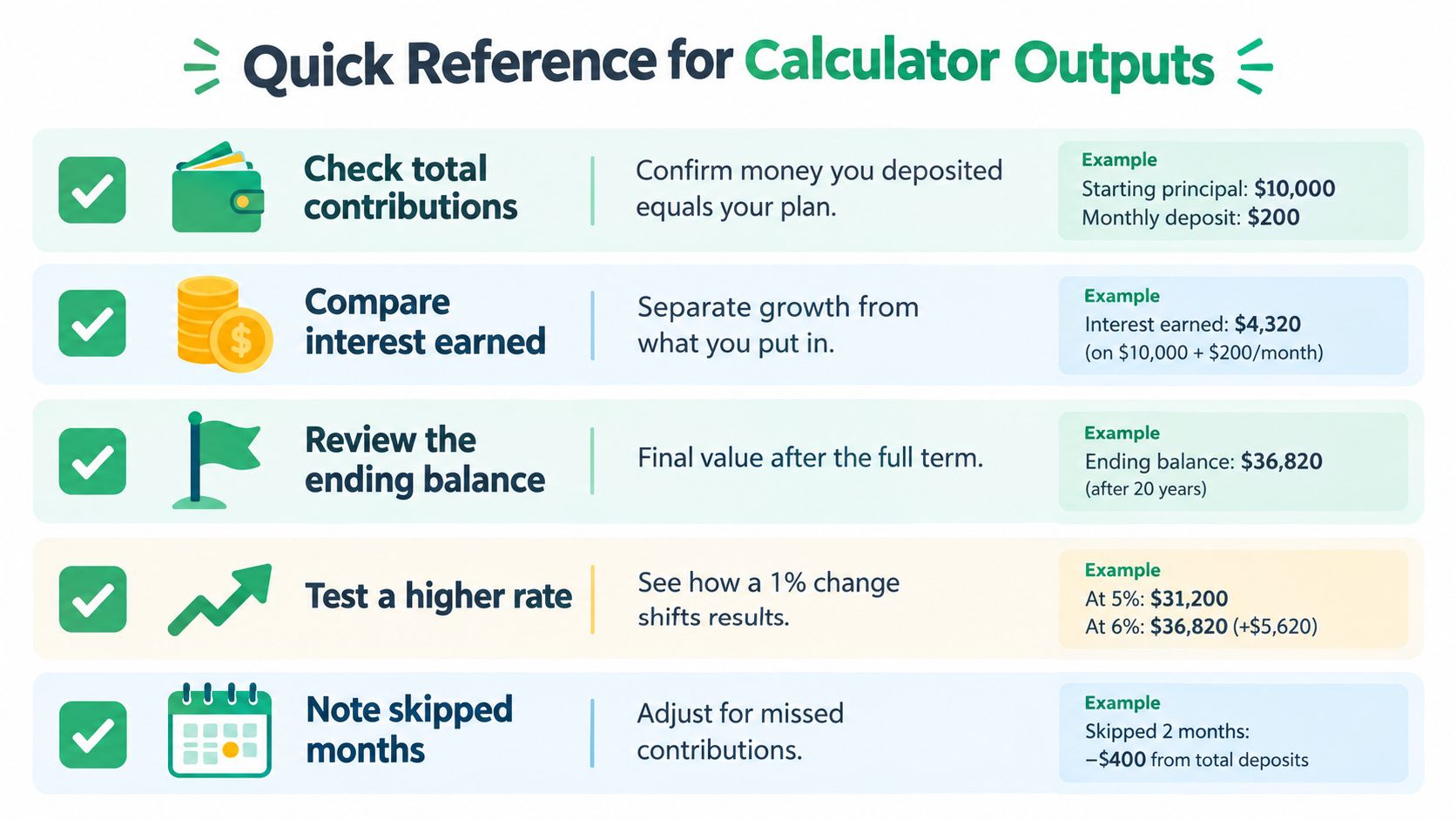
A calculator result becomes useful when it changes a decision. Before adjusting your budget or investment plan, inspect the output rather than accepting the ending balance as a verdict.
Five checks before acting
-
Check total contributions. Confirm that the amount deposited matches your actual plan. If the calculator assumes contributions you can't afford, the ending value has little practical meaning.
-
Separate growth from deposits. A future balance includes money you supplied and money the account earned. That distinction prevents you from mistaking a large total contribution stream for exceptional investment performance.
-
Review the ending balance in context. Ask whether the figure is nominal, inflation-adjusted, after tax, or none of these. Label the output clearly so you don't confuse different scenarios.
-
Test the rate assumption. Change the expected rate and observe how sensitive the result becomes. A plan that works only under an optimistic assumption deserves more caution.
-
Record skipped months. Enter missed contributions rather than hiding them inside an average. Timing and interruptions affect the amount of time each deposit can grow.
For a broader view of the mechanics, use The Money Maniac's compound interest calculator, which is designed to show contributions and growth alongside the projection. If debt payments compete with investing, a loan payment guide for bad credit can help you estimate repayment obligations before setting an aggressive savings target.
Common Calculator Questions Answered
Should I invest a lump sum or spread it across monthly deposits?
The answer depends on when the money is available, your risk tolerance, and the account or investment involved. Money invested earlier has more periods in which to compound, while monthly deposits spread the entry points across time. A calculator can compare both schedules using the same total contribution, but it can't decide which experience you'll tolerate better if prices move against you soon after investing.
What should I do if the interest rate changes?
Don't use one fixed rate when the account or investment has a variable return. Create separate periods with different assumptions, or run a conservative scenario that reflects a lower rate after the current offer ends. The calculator should show that the rate is an input, not a permanent feature of the future.
Is APY the same as APR?
No. APY generally reflects the effect of compounding over a year, making it useful for comparing deposit products. APR describes an annualized rate but may not present the same compounding effect, especially in borrowing contexts. Always check what the quoted rate includes before transferring it into a monthly calculation.
Does monthly compounding guarantee an investment return?
No. The formula guarantees only the arithmetic implied by the inputs. A savings account may have a stated rate subject to its terms, while market investments can fluctuate and lose value. Label investment projections as scenarios, include weaker-return cases, and keep the distinction between compound interest and an uncertain investment return visible.
What output should I trust most?
Trust the output that makes its assumptions easiest to inspect. You want the contribution schedule, rate treatment, inflation assumption, taxes, fees, and the split between deposits and growth. If a calculator hides those details behind one impressive balance, use it cautiously.
Get more posts like this
One short, useful email each Friday. Free, no spam, unsubscribe anytime.