Qualified vs Ordinary Dividends: 2026 Tax Rates
See qualified vs ordinary dividends under 2026 IRS rates, holding rules, Form 1099-DIV boxes, and a retiree tax example.

Daniel Anderson
Editor, The Money Maniac
November 20, 2026
12 min read

You and your spouse open the brokerage tax envelope at the kitchen table, set it beside the property-tax bill, and find two dividend amounts on the same form. Did you receive two payments, or has somebody counted the same money twice? Retirement was supposed to involve fewer forms.
The confusion is understandable. Qualified dividends are included within total ordinary dividends on the tax form, even though the qualified portion can receive a different tax rate. What you ultimately owe depends on the payment, your ownership dates, your taxable income, and the account holding the investment. The brokerage's label deserves attention, but it doesn't settle every question.
What Qualified and Ordinary Dividends Actually Mean
An ordinary dividend is generally a taxable distribution from a corporation or investment fund. A qualified dividend is the portion that meets the federal requirements for preferential tax treatment, including eligible-payer and holding-period tests.
There's a vocabulary trap here. In everyday tax discussions, people often use ordinary to mean nonqualified. On the tax form, however, total ordinary dividends include the qualified portion too. When comparing tax rates, nonqualified dividends is the clearer term for the amount taxed at ordinary income rates.
What qualified actually tells you
Qualified describes tax status. It doesn't tell you that the company is safer, that its dividend is larger, or that management will keep paying it. A familiar public company can pay a dividend that fails to qualify for a particular shareholder because that shareholder didn't meet the ownership requirements.
The distinction has a legislative history. According to the Congressional Research Service's explanation of dividend taxation, the Jobs and Growth Tax Relief Reconciliation Act of 2003 moved qualifying dividends from ordinary income taxation to preferential capital-gains treatment, with principal rates then of 15% and 5%. Congress intended to ease the tax burden on corporate profits taxed at the company level and again when distributed to shareholders.
Practical rule: Evaluate the investment's risk separately from the dividend's tax treatment. A favorable tax label doesn't protect your principal.
Start with the right category
Before comparing qualified vs ordinary dividends, make sure the payment is a dividend. Bank interest, corporate distributions, and fund payouts can look similar in a retirement spending account while following different tax rules. Our explanation of dividends versus interest helps separate those categories.
For a retiree living partly on investment income, the practical question is straightforward: How much of the distribution remains available to spend after tax? A higher advertised yield can lose some of its appeal when more of the payment goes to taxes.
The sensible sequence is to identify the payment, check its eligibility, and then calculate the tax. Starting with the yield and hoping the classification works out is an expensive way to do paperwork.
2026 Tax Rates Side by Side
Qualified vs ordinary dividends at 2026 federal rates
| Question | Qualified dividends | Ordinary dividends |
|---|---|---|
| 2026 federal rate | Preferential schedule of 0%, 15%, or 20%; use filing-year IRS instructions | Your marginal ordinary income rate; no automatic capital-gains-rate cap |
| 2026 single 0% / 15% ceiling | Use the single taxable-income cutoffs in the filing-year IRS worksheet | No preferential ceiling |
| 2026 married filing separately 0% / 15% ceiling | Use the married-filing-separately cutoffs in the filing-year IRS worksheet | No preferential ceiling |
| 2026 joint 0% / 15% ceiling | Use the married-filing-jointly cutoffs in the filing-year IRS worksheet | No preferential ceiling |
| 2026 head of household 0% / 15% ceiling | Use the head-of-household cutoffs in the filing-year IRS worksheet | No preferential ceiling |
| Tax on $10,000 at an illustrative retiree rate | $1,500 at an assumed 15% rate | $2,200 at an assumed 22% marginal rate |
| Where it is reported | Form 1099-DIV box 1b, also included in box 1a | Form 1099-DIV box 1a total |
| Extra 3.8% NIIT | Can still apply above NIIT thresholds | Can still apply above NIIT thresholds |
The IRS's 2025 Publication 550 describes the 0%, 15%, and 20% qualified-dividend rate structure, ordinary-income treatment for nonqualified dividends, and the potential additional investment-income tax. For a 2026 return, check the filing-year IRS instructions before using an income cutoff; the earlier publication shouldn't be treated as confirmation of later inflation-adjusted thresholds.
What the rate difference means in dollars
Consider the table's hypothetical dividend payment. At the assumed qualified rate, you multiply the distribution by the preferential rate. At the assumed ordinary rate, you multiply it by the ordinary marginal rate.
That produces a meaningful spending difference without any change in the underlying cash distribution. It also shows why comparing dividend yields alone leaves out part of the retirement-income calculation.
These examples assume the entire payment falls within the stated rate band. Your actual calculation can span bands, particularly when investment income pushes total taxable income across a cutoff. State income tax is separate, and the federal comparison doesn't include it.
The zero-rate opportunity for retirees
A retiree with relatively modest taxable income may have room for qualified dividends in the federal zero-rate band. That can make a taxable brokerage account surprisingly useful.
But taxable income includes the qualified dividends themselves. You can't look at your pension income, declare yourself below the cutoff, and then assume an unlimited amount of qualified dividends fits underneath it. Other income and capital gains use that room too.
This is also why tax-gain harvesting deserves coordination with dividend planning. Realizing a gain and receiving a qualified dividend can draw on the same preferential-rate capacity.
Before filing, use the current IRS qualified-dividend worksheet and the correct filing status. Don't substitute gross household income, account withdrawals, or the amount deposited into checking for taxable income.
And don't let an attractive rate settle the eligibility question. The preferential schedule applies only after the payment qualifies.
Holding Periods and Eligible Payers
Buying shares immediately before a dividend and selling them shortly afterward may generate cash, but it can fail the qualified-dividend holding test. The IRS cares about the ownership period, not how pleased you were to receive the deposit.
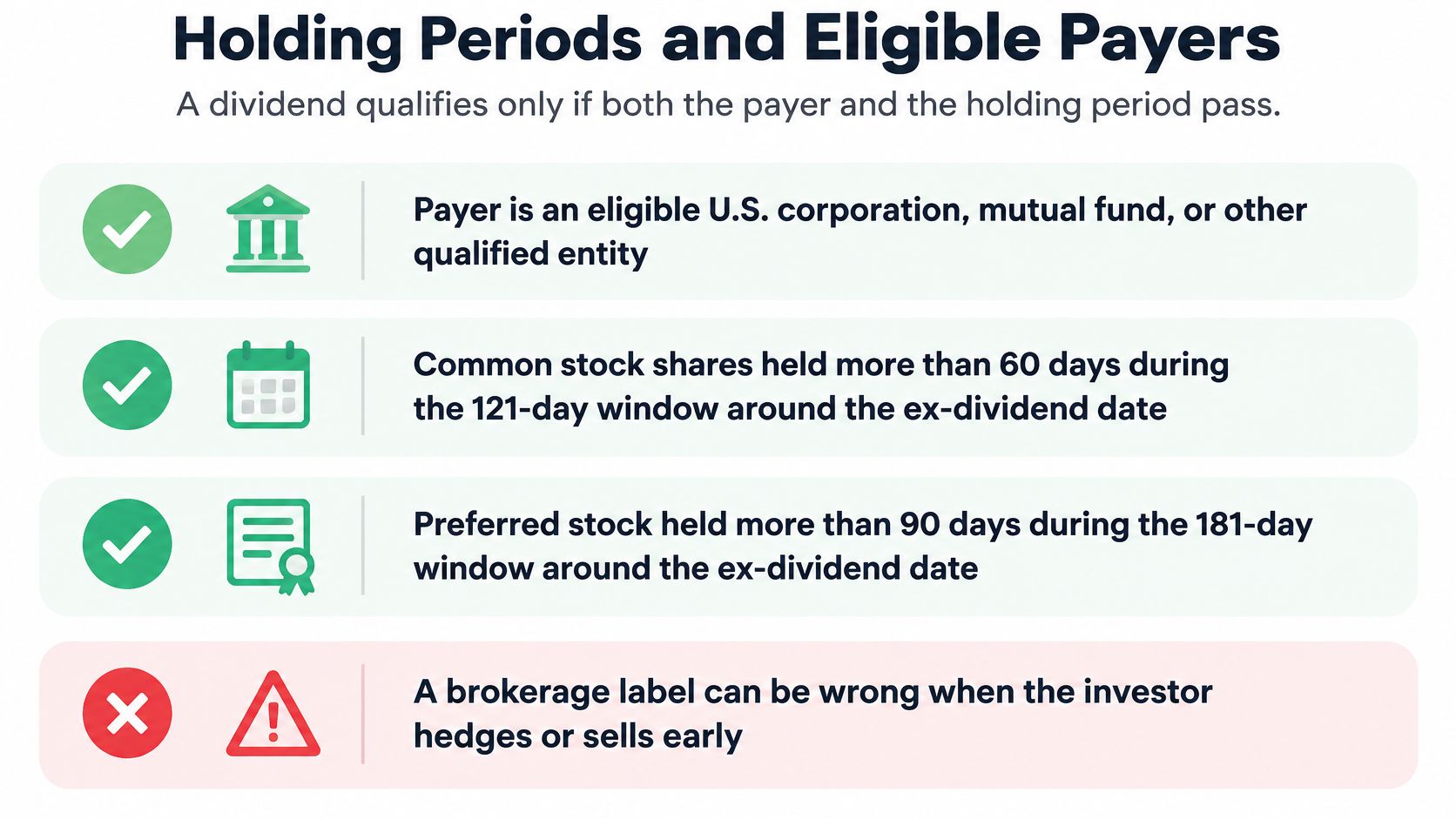
The checklist below shows the basic eligibility framework. Certain preferred-stock dividends require special treatment, so the preferred-stock line shouldn't be applied indiscriminately.
Check the ownership clock by tax lot
The holding-period explanation describes the common-stock requirement as more than 60 days within the 121-day period beginning 60 days before the ex-dividend date; certain preferred-stock dividends can require more than 90 days within a 181-day window.
The ex-dividend date determines which buyers are entitled to the upcoming payment. It also anchors the holding-period window. Receiving the dividend doesn't, by itself, prove that you owned the shares long enough.
Say you buy just before the ex-dividend date and sell shortly afterward. The payment can remain a dividend while failing the qualified holding test. That's why a dividend-capture trade needs more scrutiny than a long-held position.
Review each tax lot, meaning each separately purchased group of shares. Older shares and newly purchased shares of the same company can have different outcomes. Days during which options, short sales, or similar arrangements reduce your risk of loss may not count toward the requirement.
Reinvestment creates another ownership record
A dividend reinvestment plan, commonly called a DRIP, buys additional shares with your distribution. Those new shares have their own acquisition dates and holding periods.
Reinvestment doesn't restart the clock on shares you already owned. It does make recordkeeping more important if you later sell selected lots or trade around dividend dates.
Use this compact review before accepting the brokerage classification:
- Purchase date: Identify when you acquired the particular lot.
- Sale date or still held: Check how long ownership continued within the relevant window.
- Ex-dividend date: Use this date to establish the testing period.
- Security type: Determine whether common-stock or special preferred-stock rules apply.
- Hedging activity: Flag options, short positions, or arrangements that reduced your exposure to loss.
The payer must also be eligible, generally a domestic corporation or a qualified foreign corporation, and the payment must avoid excluded categories. An exchange listing alone doesn't answer every eligibility question.
If a lot fails the holding test, don't rely on a friendly-looking statement label. Ask the brokerage or your tax preparer how to reflect the adjustment. Equally, don't keep an investment you need to sell merely to preserve a tax preference. Market losses can overwhelm a tax saving.
Reading Form 1099-DIV and Running the Math
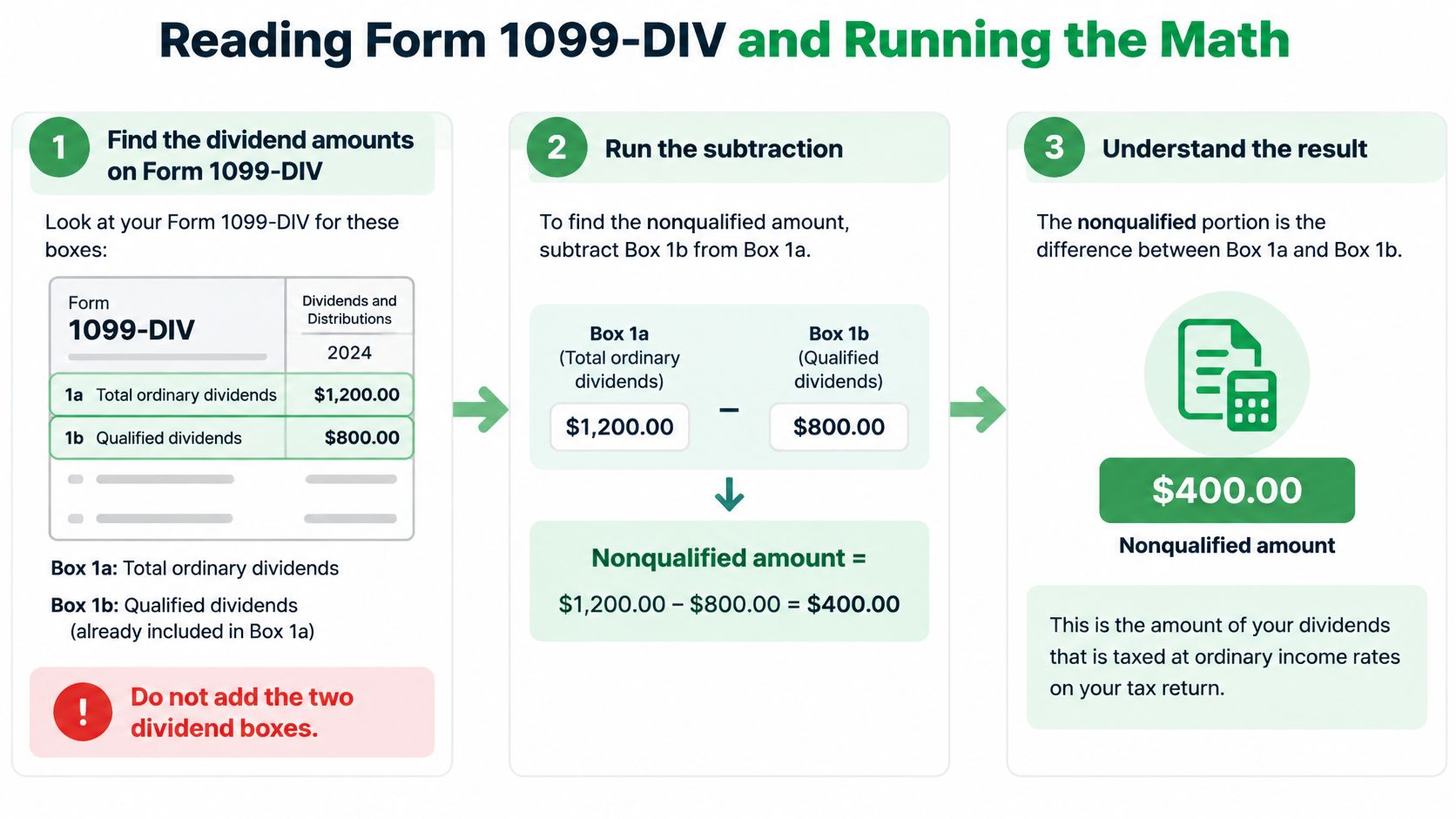
Don't add box 1a and box 1b. Box 1a reports total ordinary dividends, and box 1b identifies the qualified portion already included in that total.
The nonqualified portion is the difference. Also keep other distributions separate: capital-gain distributions appear in box 2a, while box 3 reports nondividend distributions. Treating every entry as another ordinary dividend will produce an impressively incorrect return.
A worked retirement example
Suppose a married couple, both aged 67, files jointly for 2026 and has $140,000 of taxable income before the additional dividend income. For this illustration, assume their qualified dividends fall entirely in the 15% band, and their nonqualified dividends face a 22% ordinary marginal rate. These are scenario assumptions, not a substitute for checking the couple's filing-year worksheet.
The IRS's investment-income guidance explains that eligible qualified dividends receive preferential treatment and that ownership requirements can change the classification. With those eligibility checks completed, the arithmetic is:
- Separate the amounts. Box 1a contains $10,000, and box 1b contains $8,000. The nonqualified portion is $2,000.
- Apply the assumed qualified rate: $8,000 × 15% = $1,200.
- Apply the assumed ordinary rate: $2,000 × 22% = $440.
- Add the results: $1,640 of federal dividend tax, before any applicable NIIT or state tax.
- Compare the alternatives: an entirely qualified payment would generate $1,500, while an entirely nonqualified payment would generate $2,200 under these assumptions.
The gap between the all-qualified and all-nonqualified cases is $700. The mixed case saves $560 compared with the all-nonqualified case. Those are tax comparisons, not investment returns.
Federal tax on $10,000 of dividends for a hypothetical 2026 joint return
| Case | Qualified amount | Ordinary amount | Federal tax | Rate used |
|---|---|---|---|---|
| Mixed 1099-DIV | $8,000 | $2,000 | $1,640 | 15% and 22% |
| All qualified | $10,000 | $0 | $1,500 | 15% |
| All ordinary | $0 | $10,000 | $2,200 | 22% |
| Same qualified dollars entirely inside the 0% joint band | $10,000 | $0 | $0 | 0% |
The final row is a separate, lower-income scenario. It assumes the entire qualified payment fits within the available zero-rate band.
Make a worksheet you can actually use
The subtraction is simple enough to keep beside your tax documents.
Write down the total ordinary amount, qualified amount, difference, applicable qualified rate, and ordinary marginal rate. Add a note identifying any lots whose brokerage classification needs adjustment.
A DRIP doesn't change the tax calculation merely because the cash bought additional shares. Keep the reinvestment records too, so the purchase cost is available when those shares are eventually sold.
The tax form's word “ordinary” describes a total that can contain a preferentially taxed portion. Tax terminology has never been accused of excessive hospitality.
When the Lower Rate Does Not Apply
There are separate reasons a dividend might produce a larger tax bill than you expected. The payment can fail to qualify, or it can qualify and still attract an additional federal tax.
Some payments follow different rules
Holding an investment for years won't cure an ineligible payment. Common trouble spots include ordinary distributions from real estate investment trusts, income distributions from many bond and money-market funds, excluded payments from certain tax-exempt organizations, and payments affected by hedging arrangements.
REIT ordinary dividends may be eligible for a separate deduction under their own rules. That possibility doesn't turn them into qualified dividends.
Partnership distributions need particular care. A cash distribution from a master limited partnership isn't automatically an ordinary dividend; partnership income, return of capital, and account-specific issues require their own analysis. Don't force a partnership statement into the dividend worksheet because cash arrived.
Qualified dividends can still face NIIT
The IRS's Topic 559 on Net Investment Income Tax explains that the 3.8% NIIT applies to the lesser of net investment income or the amount by which modified adjusted gross income exceeds the applicable threshold. Dividends can be included regardless of qualified status.
2026 NIIT thresholds on dividend income
| Filing status | MAGI threshold | NIIT rate | NIIT on $10,000 of exposed dividends |
|---|---|---|---|
| Single | $200,000 | 3.8% | $380 |
| Head of household | $200,000 | 3.8% | $380 |
| Married filing jointly | $250,000 | 3.8% | $380 |
| Qualifying surviving spouse | $250,000 | 3.8% | $380 |
| Married filing separately | $125,000 | 3.8% | $380 |
Check these statutory thresholds against the current IRS guidance when preparing the return. The table's final column assumes the full illustrated dividend amount is exposed to NIIT.
For example, a single filer with $220,000 of MAGI and $10,000 of dividends could have the full dividend amount subject to NIIT, producing $380 of additional tax. That surcharge sits on top of the regular dividend tax.
A qualified dividend facing a 15% regular rate plus the 3.8% surcharge has a combined federal rate of 18.8%, before state tax. The preferential treatment still helps, but the headline rate doesn't tell the whole story.
Before a Roth conversion, substantial realized gain, or large taxable retirement-account withdrawal, estimate the effect on MAGI, or modified adjusted gross income. A transaction can affect the NIIT calculation even when the transaction itself isn't investment income subject to that tax.
Where Retirees Should Hold the Income
Account location deserves attention before you chase a higher dividend yield. For a homeowner approaching or living in retirement, the useful question is which account leaves the household with more spendable income over time, after considering withdrawals and taxes.
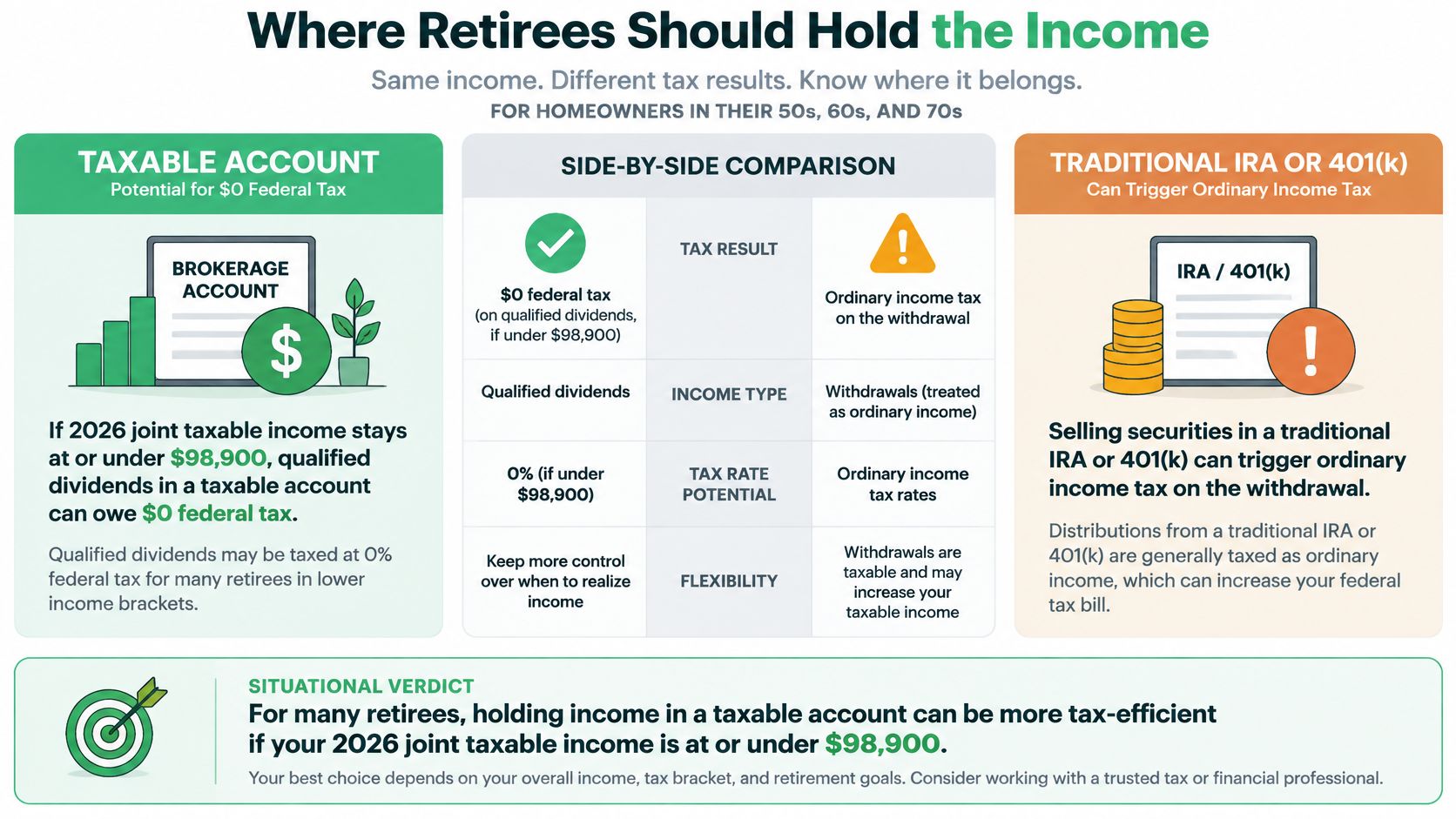
A taxable account can be a sensible home for investments producing qualified dividends, especially when the household has room in the preferential zero-rate band. Moving those holdings solely because they pay dividends can surrender an advantage you already have.
The comparison below highlights the account distinction. A sale inside a traditional retirement account generally doesn't itself create a current tax bill; the withdrawal from the account is the event that generally produces taxable income.
Favor tax efficiency without rearranging everything
When qualified dividends receive a lower rate than your ordinary income, keeping those holdings in taxable accounts can make sense. Investments producing structurally ordinary income are often stronger candidates for available tax-deferred space.
Our newsletter issue of December 30, 2024 recommended keeping growth-focused ETFs in taxable accounts and income-heavy assets in tax-advantaged accounts. That's a useful starting framework, subject to the household's tax situation and investment needs.
It isn't a command to sell everything this afternoon. Selling appreciated holdings in a taxable account can realize capital gains, and changing account location can create costs before it creates benefits.
- Taxable accounts: Favor tax-efficient holdings when they fit your diversification and spending plan.
- Traditional retirement accounts: Consider sheltering recurring ordinary income, while remembering that taxable withdrawals generally receive ordinary-income treatment.
- Roth accounts: Existing Roth space can shelter either income type, provided withdrawals satisfy the rules for qualified treatment.
- Partnership holdings: Get account-specific advice before placing them in an IRA. Their tax complications can extend beyond dividend classification.
Plan withdrawals alongside the holdings
A traditional account postpones tax; it doesn't guarantee a lower eventual rate. Withdrawals can also affect the taxation of Social Security benefits and income-related Medicare premiums, known as IRMAA.
Likewise, a Roth conversion can have consequences beyond the conversion's immediate tax bill. Consider the household's complete income picture, including a spouse's income, realized gains, required withdrawals, and upcoming spending needs.
Before moving an investment: Compare the immediate tax cost of selling, the expected ongoing tax treatment, and how you'll eventually withdraw the money.
A retirement bucket strategy can help organize near-term spending and longer-term investments. Account location should support that plan rather than leave you selling volatile assets at an inconvenient time just to pay routine bills.
The defensible starting position is to shelter structurally ordinary income first when practical, preserve useful taxable-account advantages, and avoid treating Roth space as automatically available. Risk, liquidity, estate goals, and future tax rates can change the answer.
Pull your latest dividend statement, identify the account holding each income-producing investment, and flag any recent sales or hedges. Then use the filing-year IRS worksheet to test the result. We advise readers to do their own research or consult a licensed professional before making investment decisions, especially when withdrawals or trading arrangements complicate the return.
Get more posts like this
One short, useful email each Friday. Free, no spam, unsubscribe anytime.