What Is a Roth Conversion Ladder: Rules, Math and Timing
Wondering what is a Roth conversion ladder? Learn the five-year rule, the tax math, a worked example and when to skip it.

Daniel Anderson
Editor, The Money Maniac
November 16, 2026
13 min read

A Roth conversion ladder is a planned series of yearly transfers from a traditional IRA into a Roth IRA, where each year's conversion must wait five tax years before its principal can come out penalty-free before age 59½.
The popular advice to convert the same amount every year deserves some skepticism. Your income changes, your tax room changes, and a conversion that looked sensible before a pension payment or capital gain might look expensive afterward.
Treat each year's conversion as a fresh tax decision. The useful question is how much you can move at an acceptable total cost, while keeping enough accessible money to pay your bills.
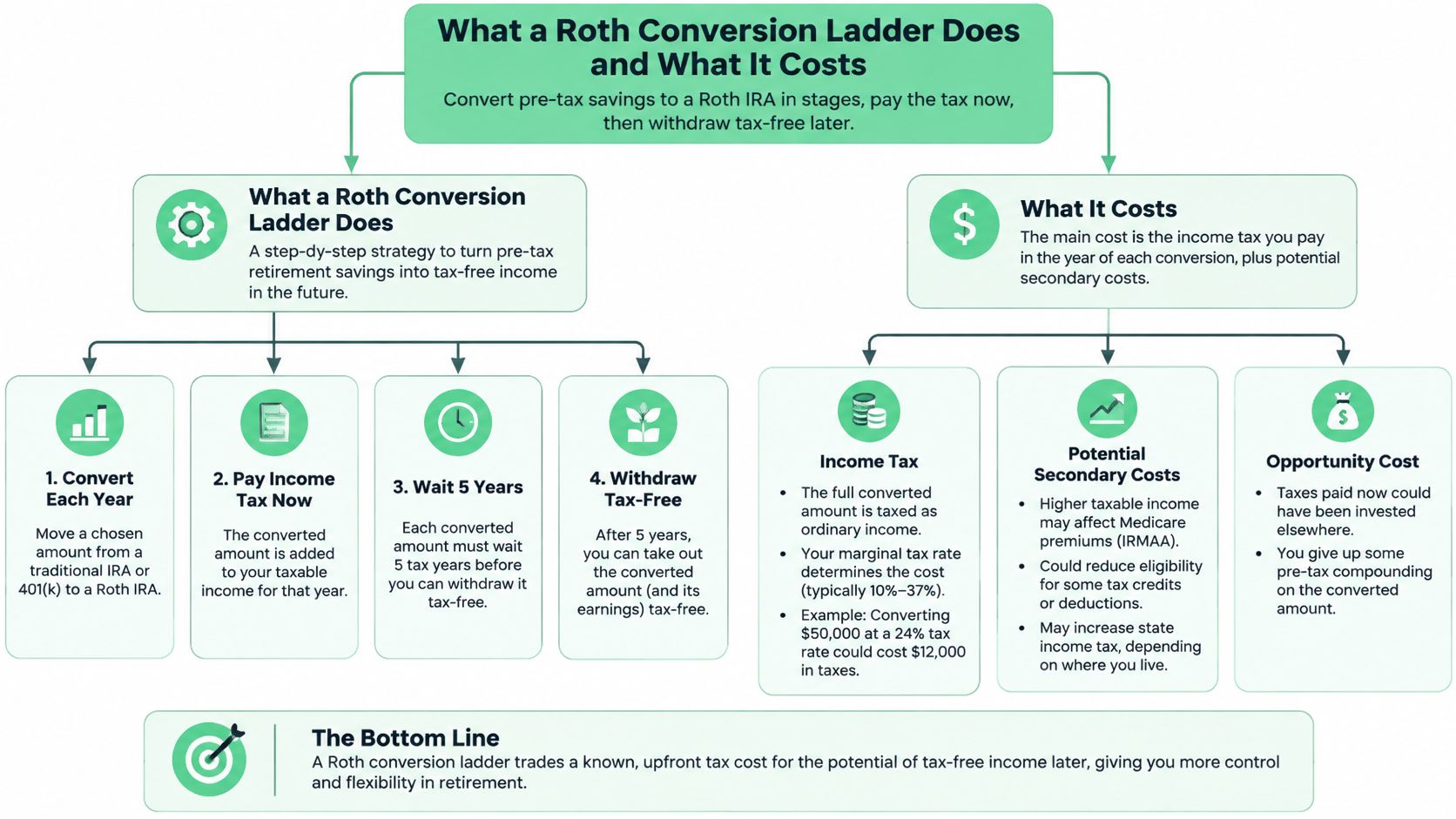
What a Roth Conversion Ladder Does and What It Costs
A Roth conversion ladder moves retirement money into a Roth IRA in separate annual batches, each with its own access timeline. Think of each conversion as a rung: you can spend an older, eligible batch while newer batches continue aging.
For someone who retires early, that creates a way to turn pre-tax retirement savings into future spending money. Eligible pre-tax workplace-plan money can also be part of the strategy, subject to the plan's distribution rules.
The arrangement works best when you have a low-income window and other money available for living expenses. A paid-off house helps your budget, but home equity doesn't automatically supply grocery money or pay the conversion's tax bill.
The tax bill arrives before the spending money
Suppose you convert $40,000 of entirely pre-tax IRA money in tax year 2026. That generally adds $40,000 to that year's taxable income, because the IRS retirement-plan FAQs explain that previously untaxed amounts become taxable when converted; eligible after-tax basis can reduce the taxable portion.
You choose the conversion amount, not the tax rate. Your other income, deductions, filing status, and applicable tax rules determine what that choice costs.
The trade is straightforward: accept a tax bill now in exchange for Roth treatment later, potentially at a lower lifetime tax cost. That potential saving depends on what you'd otherwise pay on future withdrawals. It isn't guaranteed because the destination account says Roth.
The same idea serves different retirement stages
For homeowners in their 50s through 70s, the purpose changes with age. Early retirees may need access to retirement principal; older retirees may want to move pre-tax savings during the gap between their last paycheck and larger retirement-income payments.
Required minimum distributions, or RMDs, are mandatory withdrawals from certain retirement accounts. Converting before those withdrawals and Social Security add to income may be worth evaluating, especially when today's income is unusually low.
Practical rule: A conversion earns its place in the plan only when its tax cost and your spending needs both make sense.
Keep the essentials separate: you're converting retirement assets, the tax belongs to the conversion year, and withdrawal eligibility requires its own review. Emptying an IRA in one enthusiastic afternoon can produce a very unenthusiastic tax return.
When Each Rung Is Spendable and What Early Withdrawals Cost
I size each rung as that year's bracket decision, not as a date you freeze for the whole ladder. Convert only what you can leave alone until the penalty window on that batch ends. Push past the bracket you meant to use and the conversion-year tax bill rises. Pull the same dollars out early and a second bill can sit beside it.
Under the five-tax-year rule in IRS Publication 590-B, each conversion has its own clock. The clock starts on January 1 of the conversion year. If you are still under age 59½ and no exception applies, that converted principal generally clears the 10% additional tax in the tax year that begins five years after that January 1. Each row below is that formula, applied to one rung.
| Rung | Five-year clock starts | Principal penalty-free from |
|---|---|---|
| This year's conversion | January 1 of the conversion year | The tax year five years after that January 1 |
| Next year's conversion | January 1 of that later conversion year | Five tax years after its own January 1 |
| Any later conversion | January 1 of its own conversion year | Five tax years after its own start |
| A conversion completed late in the year | January 1 of that same conversion year | Five tax years from January 1, including a late transfer |
| A conversion completed early in the year | January 1 of that same conversion year | The same five-tax-year count |
| Back-to-back conversion years | A separate January 1 for each year | A separate eligibility year for each rung |
A conversion completed on February 25, 2026, still starts on January 1, 2026. Count five tax years from that January 1. The day the custodian processes the transfer does not move the start.
An early withdrawal can still be expensive
Take a hypothetical $40,000 conversion in tax year 2026, withdrawn in tax year 2029 while the owner is under age 59½. IRS guidance on Roth IRA distributions explains why already-taxed conversion principal can avoid another income-tax bill and still incur the 10% additional tax, potentially $4,000, unless an exception applies.
That $4,000 is on top of the income tax you paid to convert. The penalty generally applies to the taxable conversion amount distributed inside its five-tax-year window. If the conversion included after-tax basis, measure the penalty against the taxable portion only.
Principal can already be free of income tax and still owe that 10% additional tax. After age 59½, the age-based exception in Publication 590-B generally removes this 10% tax on conversion principal. Check that your own facts match the exception before you spend the rung. Age matters most if you start the ladder close to ordinary retirement-account access: a five-tax-year wait and an age exception can land in different years.
Withdrawals follow a set order
Roth IRA withdrawals generally come out in this order under the IRS distribution guidance:
- Regular contributions first. These receive different treatment from conversions.
- Conversions and rollovers next. Older conversion batches generally precede newer ones, with additional ordering inside a batch.
- Investment earnings last. Their tax treatment depends on the qualified-distribution rules.
The ordering rules, applied to your Roth IRA records, fix the character of each dollar. A separate holding-period test decides whether earnings are a qualified distribution. Clearing one conversion's penalty window leaves earnings under that earnings test.
Match spending to rungs that have already cleared. Name which account pays ordinary bills, which account pays emergencies, and which conversion year is inside its penalty window. A roof repair will not wait for a tax clock. The account can also be smaller than the ledger balance: investments can fall, and earlier withdrawals reduce what is left to spend. Check both the penalty status and the cash the Roth can raise before you treat a rung as spendable.
Room to Convert Before the Next Bracket Starts
| Filing status (2026) | Taxable income before conversion | 22% bracket starts above | Room to convert at 12% |
|---|---|---|---|
| Single | $30,000 | $50,400 | $20,400 |
| Married filing jointly | $60,000 | $100,800 | $40,800 |
The table uses 2026 federal bracket thresholds from the IRS estimated-tax instructions. For 2026, that document lists standard deductions of $16,100 for single filers and $32,200 for married couples filing jointly, and the 24% bracket begins above $105,700 single and $211,400 joint.
These are taxable-income thresholds, after deductions, rather than gross-income limits. Don't subtract the standard deduction again if your starting figure is already taxable income.
A worked example that prices the overshoot
Using those 2026 IRS brackets, a hypothetical single filer with $30,000 of taxable income before converting has $20,400 of room before reaching $50,400. A fully taxable conversion filling that room costs approximately $2,448 in federal income tax, calculated as $20,400 × 12%, before credits and state tax.
For the hypothetical married couple filing jointly in the 2026 table, the calculation is $100,800 − $60,000 = $40,800 of conversion room. At 12%, the additional federal tax is approximately $4,896, before credits and state tax.
Now suppose the single filer instead converts $25,000 in tax year 2026. Using the same IRS schedule:
- Inside the lower bracket: The first $20,400 × 12% = $2,448.
- Above the ceiling: The remaining $4,600 × 22% = $1,012.
- Total conversion tax: $3,460, before credits and state tax.
The higher-rate slice costs $460 more than it would at 12%, a calculation from the 2026 rates above. Crossing the threshold doesn't reprice every dollar of income, but it does make the additional conversion dollars more expensive.
Bracket discipline: Crossing a bracket can be reasonable. Crossing it accidentally is poor planning.
Your real ceiling may be below the tax-bracket ceiling
Conversions can also affect income-tested benefits. IRS conversion guidance explains the income inclusion that makes it important to model marketplace health-insurance subsidies and other income-sensitive items alongside the tax bill.
For Medicare recipients, higher income can raise Part B and Part D premiums through IRMAA, the income-related monthly adjustment amount, generally using income from two years earlier. Before converting, have your tax professional check the applicable SSA and CMS premium thresholds, including which income year determines the premium year.
Your starting formula is:
Conversion room = chosen taxable-income ceiling − projected taxable income before conversion.
Then reduce the amount if health coverage, state taxes, credits, or cash needs impose a tighter constraint. Brackets change annually, so use the IRS schedule for the actual conversion year.
Finally, conversions and contributions are different transactions. For tax year 2025, IRS Publication 590-A sets combined traditional and Roth IRA contributions at $7,000, or $8,000 at age 50 or older; conversions don't consume that contribution allowance.
If you're still saving through work, our traditional 401(k) versus Roth guide explains the contribution-side decision. Keep that choice separate from how much existing retirement money to convert.
How to Set Up and Run Your Ladder Year by Year
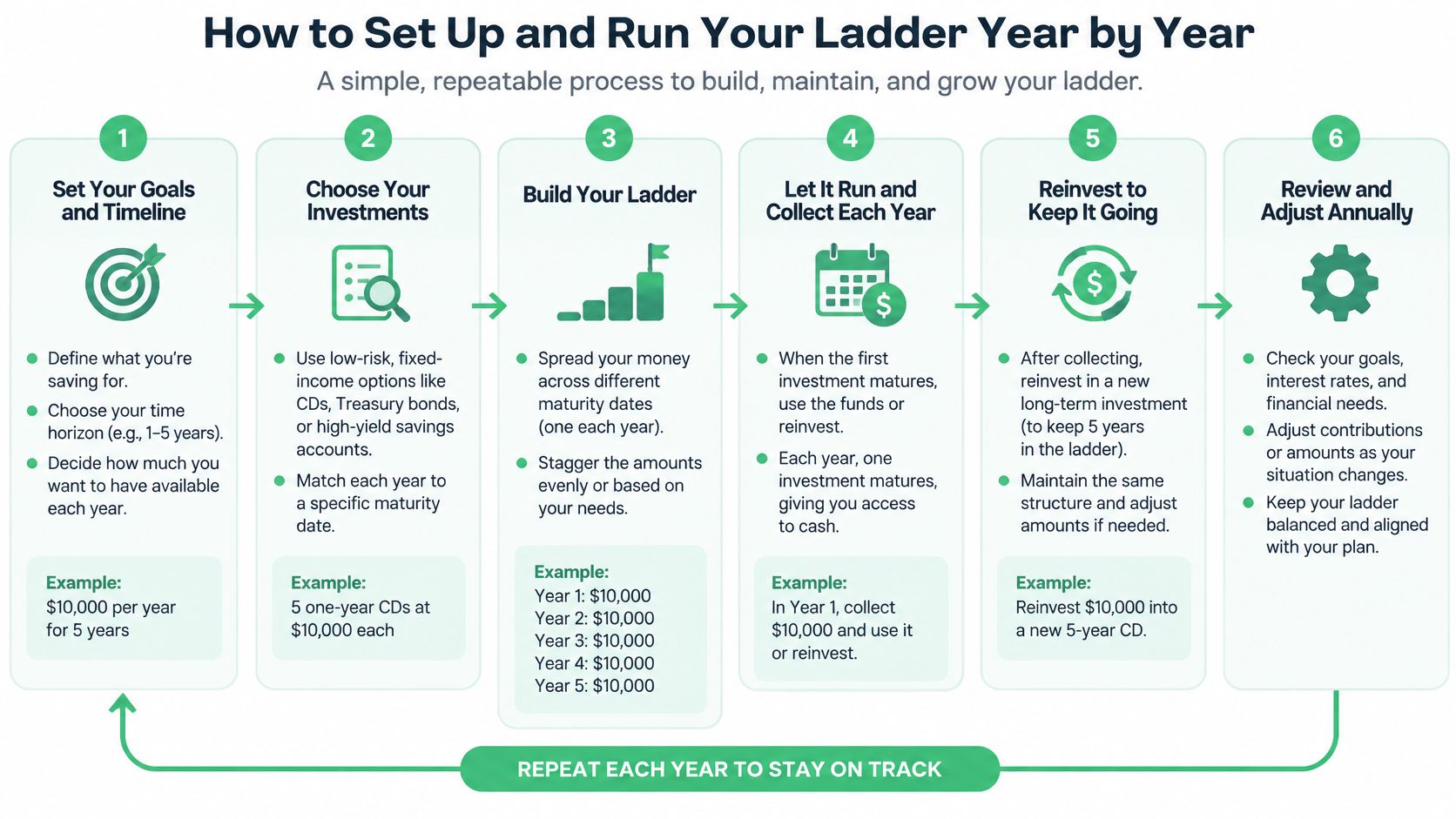
Treat each year as its own bracket decision. A standing conversion amount ignores this year's income, and dollars that cross the next bracket are taxed at that higher rate. Spending a rung before it is eligible can add an early-withdrawal penalty on top of ordinary tax. Price both costs before any assets move.
Start with a tax projection and a spending plan. The account transfer comes later, after you've decided what you can afford to convert.
A spreadsheet is sufficient if it separates projected income, conversion amounts, tax payments, and available spending money. Keep assumptions visible so your tax professional can check them.
Make the annual decision before moving assets
-
Project taxable income. Include pensions, interest, dividends, the taxable portion of Social Security, and expected capital gains. A one-time sale can consume conversion room even when your monthly income hasn't changed.
-
Write an income ceiling for this tax year, not a round target you reuse every January. Test whether benefit eligibility or insurance premiums force that ceiling lower. Leave room for income you can't yet estimate confidently. The extra tax on an overshoot is the bill to set beside the penalty for tapping a conversion too soon.
-
Apply the room formula from the bracket section to get the proposed amount. Then run the complete tax return both with and without the conversion. That comparison captures interactions that simple bracket multiplication misses.
-
Ask your custodian to convert a specific dollar amount in the intended tax year. Confirm which holdings will move, how the transaction will be valued, and the processing deadline. A transfer completed in December belongs to a different tax year from one completed the following January, so don't rely on a last-minute request.
Finish the tax work and protect your spending money
-
Arrange the tax payment. I would generally pay from money outside the IRA so more of the intended conversion reaches the Roth. Ask your preparer whether estimated payments using Form 1040-ES or an adjustment to other withholding is appropriate. Withholding from the IRA reduces what reaches the Roth and can create early-distribution consequences. Underpaying during the year can also produce a penalty.
-
When the custodian issues Form 1099-R, match it to your conversion ledger before you file. If the form and the ledger disagree, file from the form.
-
Review the plan each spring and before another conversion. Update income, spending, and available conversion principal. Fund expenses from eligible sources and confirm that the next conversion still meets your written ceiling.
Our retirement bucket strategy guide separates near-term spending money from longer-term investments. Use that split so the assets you're counting on for next year's bills aren't entirely exposed to market swings.
If the approved amount is more than your current room, cut it before the transfer, not after. An unexpected gain is a reason to shrink or skip the conversion. The calendar doesn't require you to manufacture another rung.
Ladder Versus SEPP and Other Early-Access Routes
| Route | Penalty-free early access | Flexibility | Main constraint |
|---|---|---|---|
| Roth conversion ladder | Yes, once each rung clears its five-year clock | High, you size each year | Tax on each taxable conversion and a five-year wait per rung |
| SEPP under IRC section 72(t) | Yes, from an IRA at any age if requirements are met | Low, prescribed payment schedule | Payments generally continue until five years pass or age 59½, whichever is later |
| Taxable brokerage bridge | Yes, no retirement-account penalty applies | High | Taxable dividends and realized gains can create annual tax |
| Roth contributions | Regular contributions can generally come out at any time | Limited by contribution room and existing contributions | Contribution limits; conversions follow separate rules |
The retirement-account distinctions and SEPP continuation rule are described in IRS Publication 590-B's distribution guidance.
Choose the route around the cash need
SEPP, substantially equal periodic payments under IRC section 72(t), can provide access without waiting for conversion batches to age. The price is a prescribed payment arrangement; changing it too early can trigger additional tax on earlier distributions, potentially with interest.
A ladder gives you more control over annual conversion amounts. That flexibility is valuable when consulting income, investment gains, or household spending varies.
A taxable brokerage bridge avoids retirement-account distribution restrictions. Selling investments may realize gains, and dividends may be taxable, but you don't owe conversion tax merely for using that account.
Regular Roth contributions offer another source of accessible principal. Roth workplace contributions and backdoor Roth strategies, however, primarily address getting money into Roth accounts rather than creating an early-retirement spending schedule.
Keep different countries' rules separate
If you also have Australian retirement savings, Wealth Collective's explanation of how early super withdrawals affect retirement provides context for that separate system. Australian superannuation access rules shouldn't be used to interpret a U.S. IRA.
For flexible withdrawals with an adequate bridge, I would usually evaluate the ladder first. For immediate, predictable income, SEPP deserves a specialist calculation. If taxable savings already cover the gap, a bridge may solve the access problem without adding another retirement-account arrangement.
Decide Whether the Ladder Fits Your Retirement
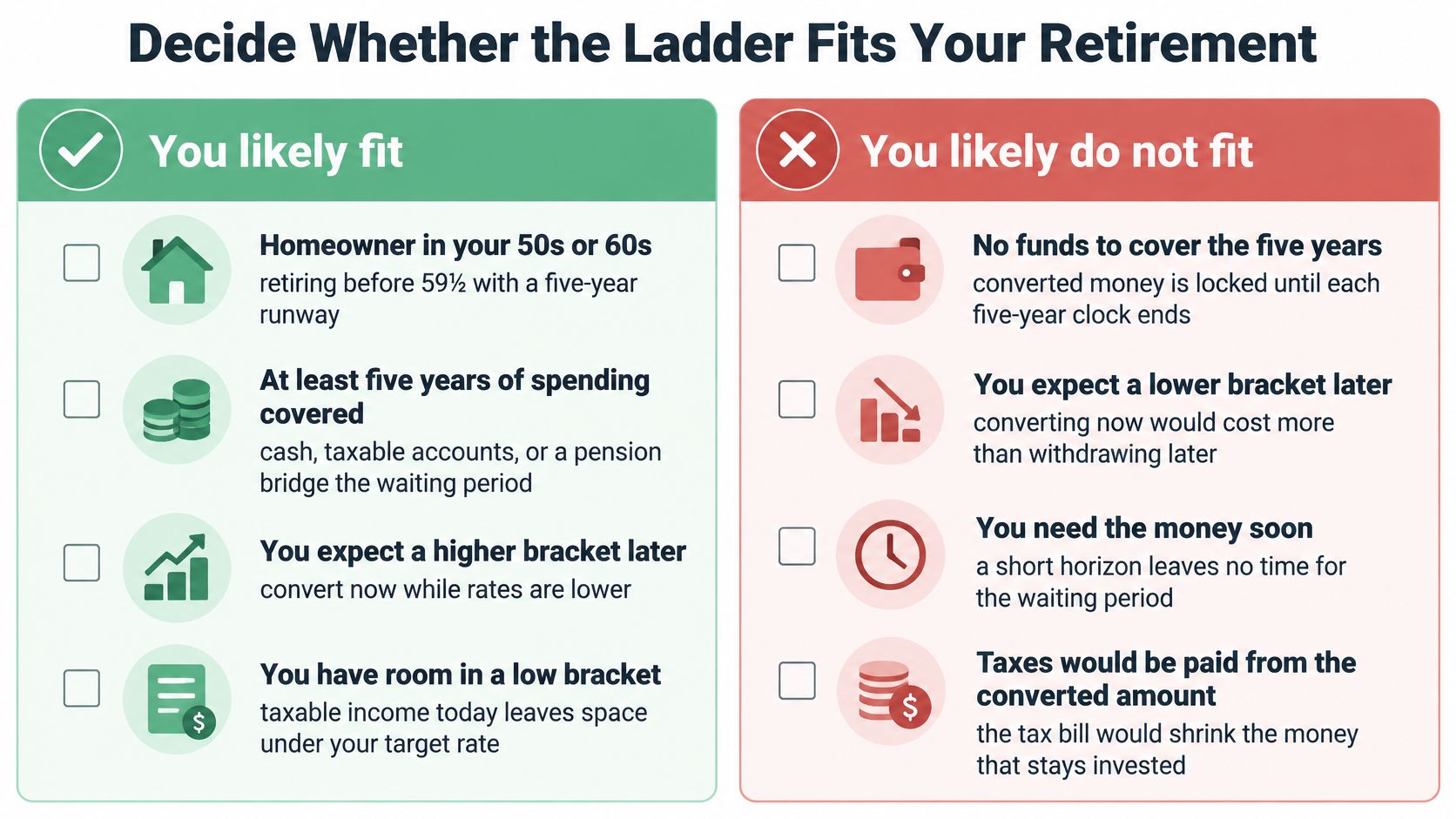
A ladder is a strong candidate when you have both a low-tax window and money to live on while you use it. Homeownership and a substantial IRA balance help describe your finances, but neither proves that converting will save tax.
For someone approaching retirement, the most persuasive case is a temporary drop in income before pensions, Social Security, and required withdrawals build up. For someone already beyond the early-withdrawal restrictions, the decision centers more directly on today's conversion cost versus future withdrawal costs.
Test the fit with your actual spending
- A bridge you can spend. Cash, taxable investments, or pension income should cover the waiting period without assuming favorable investment returns.
- An affordable tax bill. Paying tax shouldn't force you to sell assets earmarked for essential expenses.
- A credible later-tax comparison. Include future retirement income rather than assuming everyone pays less tax after retiring.
- Room below other thresholds. Insurance costs and income-tested benefits can outweigh a seemingly attractive federal rate.
A ladder is less appealing when you need IRA money soon, expect a lower tax cost later, or would sacrifice valuable health-insurance assistance. A small remaining balance and an approaching access milestone may also make a complicated early-access plan unnecessary.
Run a household scenario before committing
Consider a hypothetical 56-year-old in tax year 2026, with $700,000 in a traditional IRA, $200,000 in taxable accounts, and no expected earned income until age 62. These are scenario assumptions, not a forecast or a recommended savings target.
The immediate task is to estimate how long the taxable account can support spending and conversion taxes. Investment income still belongs in the projection even without a paycheck.
Next, compare a modest conversion plan with leaving the IRA alone. Model later withdrawals, likely retirement income, state taxes, and insurance costs under both approaches. If conversions merely prepay tax at a higher overall cost, leave the money where it is.
This month, write down a proposed annual conversion amount, start the ledger, and review the applicable IRS brackets and SSA and CMS premium thresholds with a tax professional. Approve the transaction only after you've identified both the tax payment and the account that will fund living expenses.
Get more posts like this
One short, useful email each Friday. Free, no spam, unsubscribe anytime.