What Is Index Fund Investing? Costs, Taxes and Portfolios
What is index fund investing? Learn how index funds work, why fees matter, how taxes apply, and sample portfolios for common goals.

Daniel Anderson
Editor, The Money Maniac
November 8, 2026
14 min read

An index fund is a mutual fund or ETF that holds the securities of a market index, such as the S&P 500, and follows the index's rules instead of a manager's stock picks.
But if two funds follow the same index, why might you end up with different amounts to spend?
The answer involves fees, taxes, account rules, and the benchmark you choose. Those decisions deserve more attention than the usual argument about active versus passive investing. Buying a sensible fund is useful. Putting it in an unsuitable account, or using it for money you'll need soon, can undo much of that good judgment.
What Index Fund Investing Actually Means
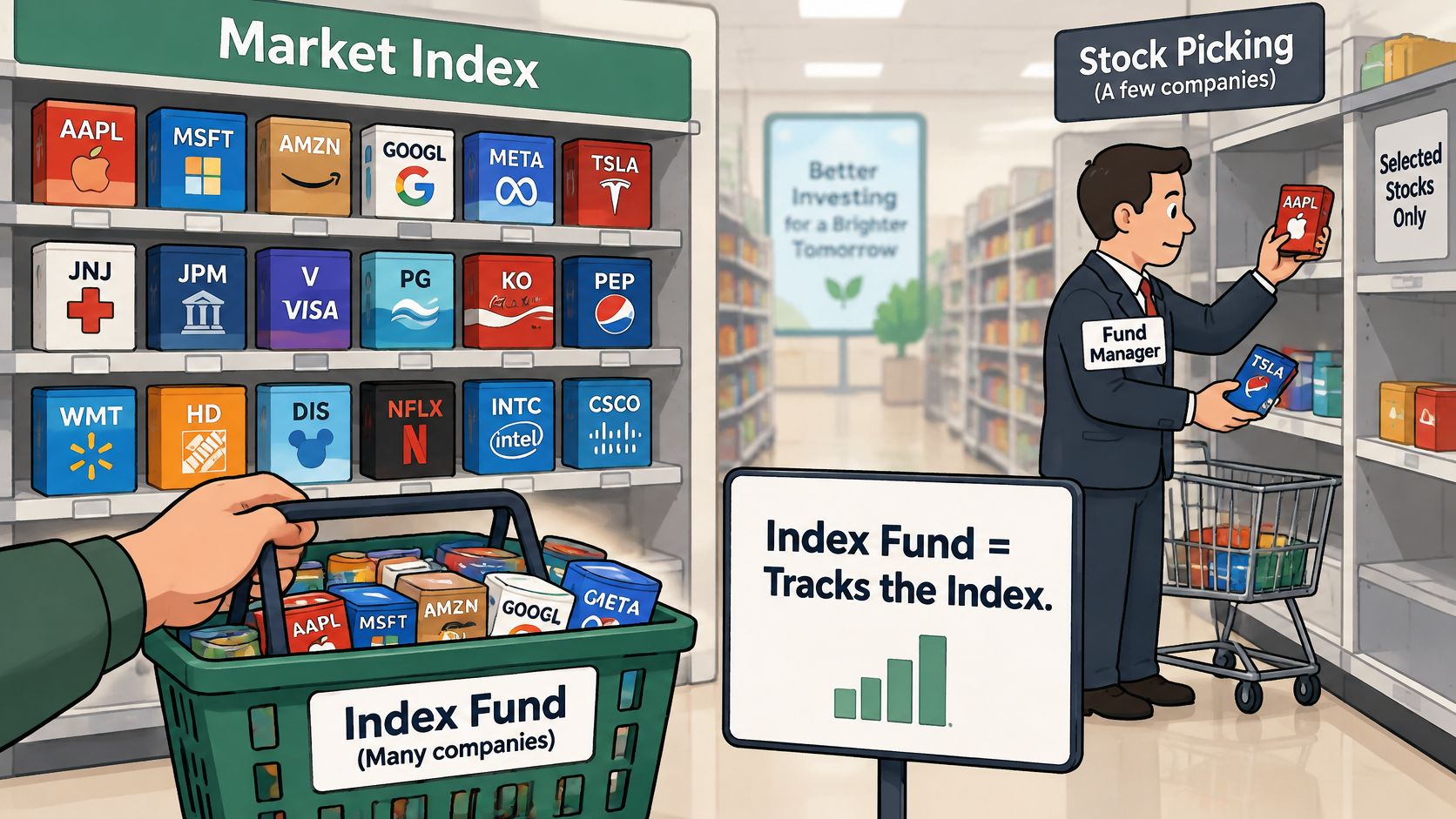
Think of buying a broad index fund as stocking the whole grocery store rather than guessing which aisle will sell best. You'll own the businesses doing well and the ones having a disappointing season. You don't have to identify tomorrow's winner before everyone else does.
The grocery comparison has a limit: the contents of your basket follow a particular list. An index defines which securities belong and how much weight each receives. A fund tracking that index buys all those securities, or a representative sample, in approximately those proportions.
What happens after you invest
Say you buy a broad U.S. stock index fund. Your money joins other investors' money in a portfolio of businesses, and you own shares of that pooled portfolio. You don't directly manage the underlying stocks or decide when a company should enter or leave.
The fund's staff still do real work. They process investments, manage cash, and adjust holdings when the index changes. Passive investing describes how securities are selected, not an office where everyone has gone fishing.
According to the Investment Company Institute's 2025 Fact Book, index mutual funds appeared in the 1970s, followed by index ETFs in the 1990s; by year-end 2024, worldwide index mutual funds and index ETFs held $16.2 trillion, representing 51% of long-term fund assets, up from 19% in 2010.
The benchmark sets the boundaries
An index can describe a broad market or a specialized corner of it. To see how an index concept can be applied outside mainstream stocks, you can explore the Rare Index example from Wine Labs. Treat that as an illustration of index construction, not evidence that specialized exposure belongs in a beginner's portfolio.
Keep the promises modest:
- No protection from market declines. The fund follows its holdings downward, too.
- No guaranteed market-beating return. Following a benchmark doesn't create an advantage over it.
- No perfect replication. Fees, taxes, transaction costs, and tracking differences can leave the fund behind its index.
The practical objective is to capture the chosen market's performance efficiently and consistently. Choosing that market remains your responsibility.
Index Funds, ETFs and Active Funds Compared
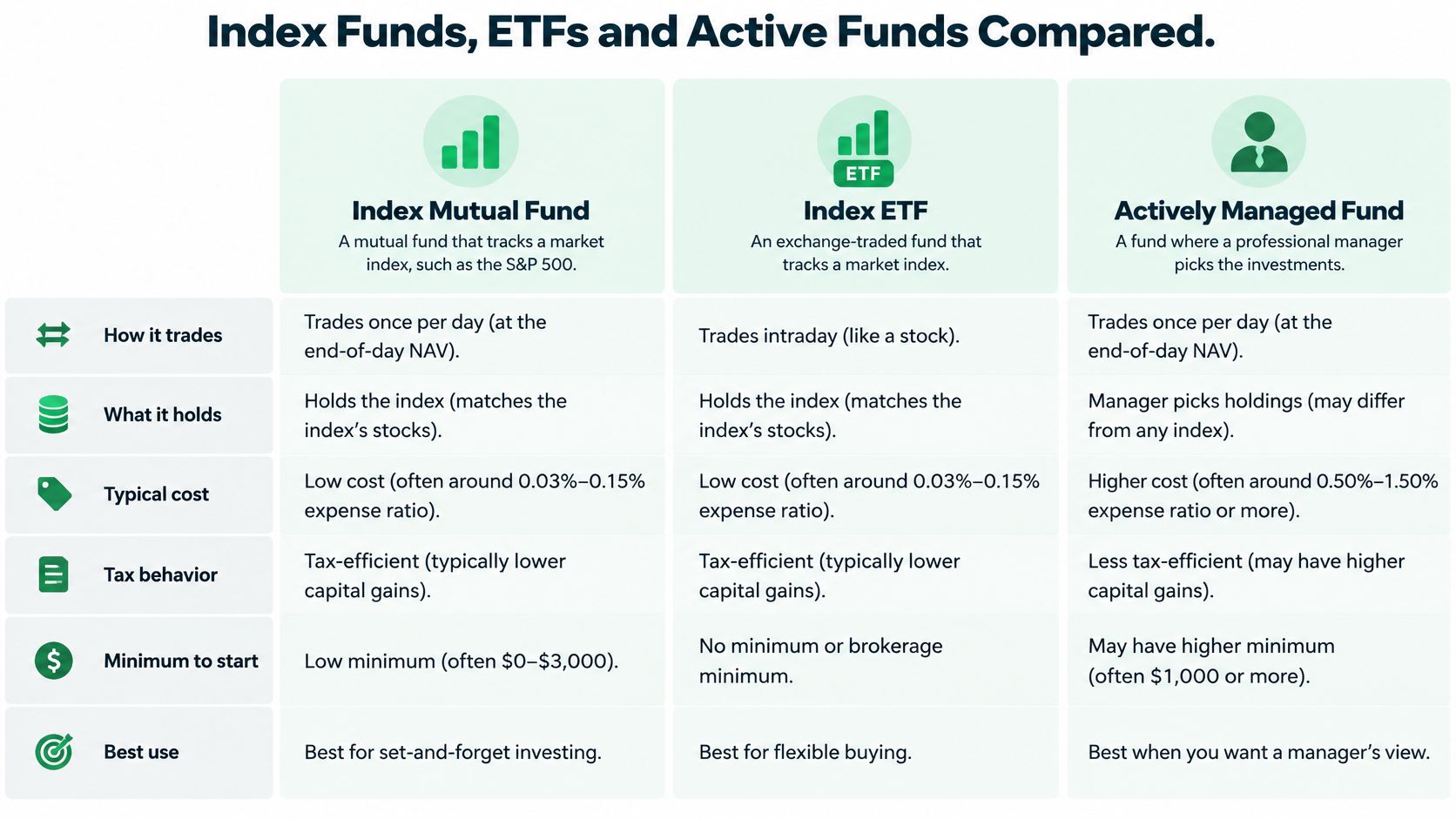
Index mutual funds, index ETFs and active funds side by side
| Feature | Index mutual fund | Index ETF | Actively managed fund |
|---|---|---|---|
| How it trades | Once a day at net asset value | All day at market price | Usually once a day at net asset value |
| What it holds | Follows a named index | Follows a named index | Manager picks holdings |
| Typical cost | Often very low for broad funds | Often very low for broad funds | Generally higher, with a wide range |
| Tax behavior | Low turnover; can distribute capital gains | Often fewer capital gains distributions; check the fund | Higher turnover can create taxable gains |
| Minimum to start | Fund's stated opening minimum; some have none | Price of a share, or a fractional purchase where available | Fund's stated opening minimum |
| Best fit | Automatic monthly investing | Taxable brokerage accounts and single-share buying | Investors who want a manager's process and accept its costs |
The labels describe different features that can overlap in one fund. ETF describes how shares are bought and sold, while indexing describes how investments are selected. An index mutual fund and an index ETF can follow the same benchmark and hold nearly the same investments.
The chart illustrates the broad distinctions. Actual minimums and tax treatment depend on the specific fund.
Trading convenience has practical consequences
A mutual fund processes purchases and redemptions at its next calculated net asset value, the value of its assets minus liabilities per share. You enter a dollar amount and receive the corresponding shares.
An ETF trades during the day. Its bid-ask spread, the difference between buyers' offers and sellers' asking prices, is a trading cost. A limit order sets the highest purchase price you'll accept, though it does not guarantee execution.
For recurring contributions, check what your brokerage supports. Mutual funds often make dollar-based automatic investing straightforward. ETF automation and fractional-share availability depend on brokerage rules.
Compare the whole setup, not just the label
The SEC's investor bulletin on index funds explains why costs matter. But choosing between an active fund and an index fund is only part of the decision. The benchmark determines what market exposure you get, while the account affects how that investment is taxed. Those choices can matter more to your result than whether the fund trades as an ETF or mutual fund.
For example, two index funds may both be low-cost, yet follow very different benchmarks. One may track a broad market; another may focus on a narrower slice. Likewise, holding the same investment in different account types can change its tax treatment. A fund's label alone cannot answer either question.
For a buy-and-hold investor, a sensible order is to choose the exposure first, check the account's tax treatment, then compare total costs and how easily you can contribute. ETFs can suit taxable brokerage accounts, while mutual funds can make automatic monthly purchases easier. Active management may suit investors who specifically want a manager's process and are willing to accept its costs. The wrapper matters, but it is only one piece of the decision.
How Fees Quietly Shrink Your Returns
Start with math you can check. Assume a $10,000 investment earns a hypothetical 7% annually before costs for 30 years, with no additional contributions or taxes.
Using the fee assumptions in the SEC's index fund guidance, subtracting a 0.20% expense ratio leaves approximately 6.80%, while subtracting 1.00% leaves approximately 6.00%; annual compounding produces about $72,000 versus $57,400, a difference of roughly $14,500.
Those are calculated illustrations, not forecasts. The arithmetic assumes identical gross returns and simplifies how expenses affect returns throughout the year.
The calculation behind the gap
The formula is:
Ending value = starting investment × (1 + annual net return) raised to the number of years
The expense ratio is the annual operating expense expressed as a percentage of fund assets. It's deducted within the fund, so you generally won't receive a separate bill. A quiet charge is still a charge.
Ending value of $10,000 after 30 years at different expense ratios
| Annual expense ratio | Approximate ending value | Gap versus 0.20% fund |
|---|---|---|
| 0.03% | About $75,500 | About $3,500 more |
| 0.20% | About $72,000 | Baseline |
| 1.00% | About $57,400 | About $14,500 less |
All table values are calculated using the hypothetical starting amount, gross return, and period above, with annual net return approximated as gross return minus the expense ratio.
The difference grows because money deducted for expenses can't remain invested. You lose the amount paid and whatever future return that amount might have earned. Over a long holding period, that second part becomes consequential.
Practical rule: Compare funds offering similar exposure before deciding whether a higher fee buys anything useful.
What the headline fee leaves out
A fund's expense ratio doesn't describe every source of reduced returns. Trading inside the portfolio can incur costs, and uninvested cash can cause cash drag when the benchmark rises. Sales loads, account charges, and investor taxes may add further costs.
Read the documents in this order:
- Find the expense ratio in the prospectus. Check whether a temporary waiver reduces the advertised figure and when it expires.
- Inspect the annual report and fee disclosures. Review turnover and disclosed transaction expenses; some trading costs aren't presented as a neat annual percentage.
- Compare equivalent funds. Match the benchmark, asset class, and share class before comparing prices.
A cheaper fund tracking a completely different market may be the wrong investment. But when the exposure is comparable, a lower fee gives you a smaller hurdle to overcome. That's a dependable advantage, even though it can't guarantee the better return.
Can Active Managers Beat the Index After Fees
79% of active large-cap U.S. equity funds underperformed the S&P 500 in 2025, compared with 65% in 2024, according to S&P Dow Jones Indices' U.S. SPIVA Year-End 2025 findings described in its SPIVA scorecard materials; the report characterized the result as the fourth-worst year for active large-cap managers in its 25-year history.
That's a strong reason to question the assumption that paying a professional automatically improves your investment outcome. The manager must deliver enough additional performance to overcome fees and trading costs before you receive an advantage over the benchmark.
Still, the finding concerns a particular fund category and period. It doesn't establish that every active fund loses, that every index fund wins, or that the same result applies to every bond or international strategy.
Give a manager a fair test
Some managers outperform. Identifying them beforehand, and sticking with them through disappointing periods, is the difficult part.
Evaluate an active fund using a consistent checklist:
- Use its appropriate benchmark. A small-company stock fund shouldn't be judged solely against a large-company index.
- Compare longer records. Examine five-year and ten-year periods when available, alongside shorter results.
- Use returns after fund expenses. Include any separate advisory or platform charges you'd pay.
- Inspect the risks taken. Concentration, borrowing, or a different investment style can explain apparent outperformance.
Don't confuse a higher return with proof of better judgment. A manager who owns riskier assets may outperform during favorable conditions and struggle badly when those conditions reverse.
Require a reason beyond the recent chart
The same evaluation habit applies to more speculative strategies. Copyfomo's guide to assessing crypto copy trading profitability provides a separate context for asking about costs and results, although crypto copy trading carries different risks and shouldn't be treated as a substitute for diversified investing.
A manager's strongest sales pitch should survive a comparison with a relevant, low-cost benchmark.
For broad market exposure, a low-cost index fund is a sensible default if you accept the underlying investment risk. Consider active management when you can explain the process, understand the risks, and justify the costs without relying on last year's leaderboard. That's a higher standard than recognizing a familiar face in a fund advertisement.
How Diversification Works and Where It Stops
Owning shares in many companies can reduce the effect of any one company's failure on a portfolio. The number of funds you own, though, does not show how many different investments you really hold. Indexes can overlap and give large weights to particular companies or sectors, as the SEC's guidance on fund diversification explains.
Check What the Fund Holds
Check a fund's holdings page and fact sheet. Look at the number of holdings, how much is invested in the largest ten positions, and which countries, sectors, or asset classes are absent. A broad U.S. total-market index and a narrow technology index may both be index funds, but they expose you to different concentrations.
A technology fund added to a portfolio that already leans heavily toward technology may increase the same exposure rather than diversify it. Three funds can also hold the same top ten companies, leaving you with more fund names but little additional variety. The overlap matters more than the paperwork.
The Vanguard 500 Index Fund reported $1,179,313 million in net assets and 514 holdings as of June 30, 2024, according to its SEC-filed shareholder report. Those figures describe a large fund, but the holdings count alone cannot show how evenly its money is distributed. Check the largest positions and compare them with what you already own.
Diversification has limits. A broad stock fund can still fall sharply when the stock market declines, because spreading investments among companies does not remove market-wide risk. Fund choice also affects the benchmark your returns follow: a broad-market fund and a technology fund are not interchangeable yardsticks. A suitable benchmark and a clear view of overlapping holdings can matter more than whether a fund is active or indexed.
For a concise explanation of how stocks and bonds differ, see this guide to stocks and bonds. Keep the focus here on what each fund adds to your existing exposure, rather than assuming a different name means a different investment.
Portfolio check: Add a fund when it supplies exposure you can identify, not merely because its name looks different.
How Taxes Change the Math for Index Funds
Taxable brokerage accounts, traditional retirement accounts, and Roth accounts can hold similar investments but produce different after-tax results. Choosing where to hold an investment can matter more than a small difference between funds.
In a taxable account, dividends and fund distributions may create a current tax bill, even if you reinvest them. Selling at a gain can also trigger tax. Traditional retirement accounts generally defer taxes, while qualified Roth withdrawals can be tax-free under applicable rules.
Tax treatment by account type
| Account | Dividends | Trading inside the account | Withdrawals |
|---|---|---|---|
| Taxable brokerage account | Generally taxable in the year received | Realized gains can be taxable when you sell | Moving cash out isn't itself taxable; sales and distributions determine tax |
| Traditional IRA or 401(k) | Generally no annual tax inside the account | Generally no current tax on internal trades | Generally ordinary income; after-tax basis can change treatment |
| Roth IRA or Roth 401(k) | Generally no annual tax inside the account | Generally no current tax on internal trades | Qualified withdrawals can be tax-free |
Account placement changes the usable result
Suppose a fund distributes $10,000 in a taxable account, and your hypothetical applicable tax rate is 20%. The tax would be $2,000, leaving $8,000 to reinvest. If the same distribution stays in a tax-advantaged retirement account, it can generally be reinvested in full without a current annual tax bill. The tax may still matter later: traditional account withdrawals are generally taxable, while qualified Roth withdrawals can be tax-free.
The calculation is straightforward:
Current tax cost = taxable distribution × your applicable tax rate
Use the distributions on your statement and your own applicable rate to estimate the immediate cost. Then consider the account's withdrawal rules as well. A dollar in a traditional account and a dollar in a Roth account may not represent the same after-tax spending power.
Put income and growth in context
Asset location means choosing which account holds each investment. Higher-yielding bond funds may merit consideration for tax-advantaged space, while broad equity index funds can fit taxable accounts. The right choice depends on your tax bracket, available account space, withdrawal plans, and the bond fund's tax characteristics.
Broad index strategies often have low turnover. ETF in-kind creation and redemption can also limit capital gains distributions, but neither feature eliminates taxes for investors.
Fund returns can differ from their benchmarks because of taxes, foreign dividend withholding, rebalancing, cash holdings, and transaction costs, as described in this SEC-filed fund disclosure.
Before realizing gains deliberately, understand how tax-gain harvesting works. Check current IRS Publication 550, retirement-account guidance, and state rules before acting. Eligibility, thresholds, and withdrawal conditions can change, so check current rules rather than relying on memory or an old rule of thumb.
Pick One Starter Portfolio and Open It
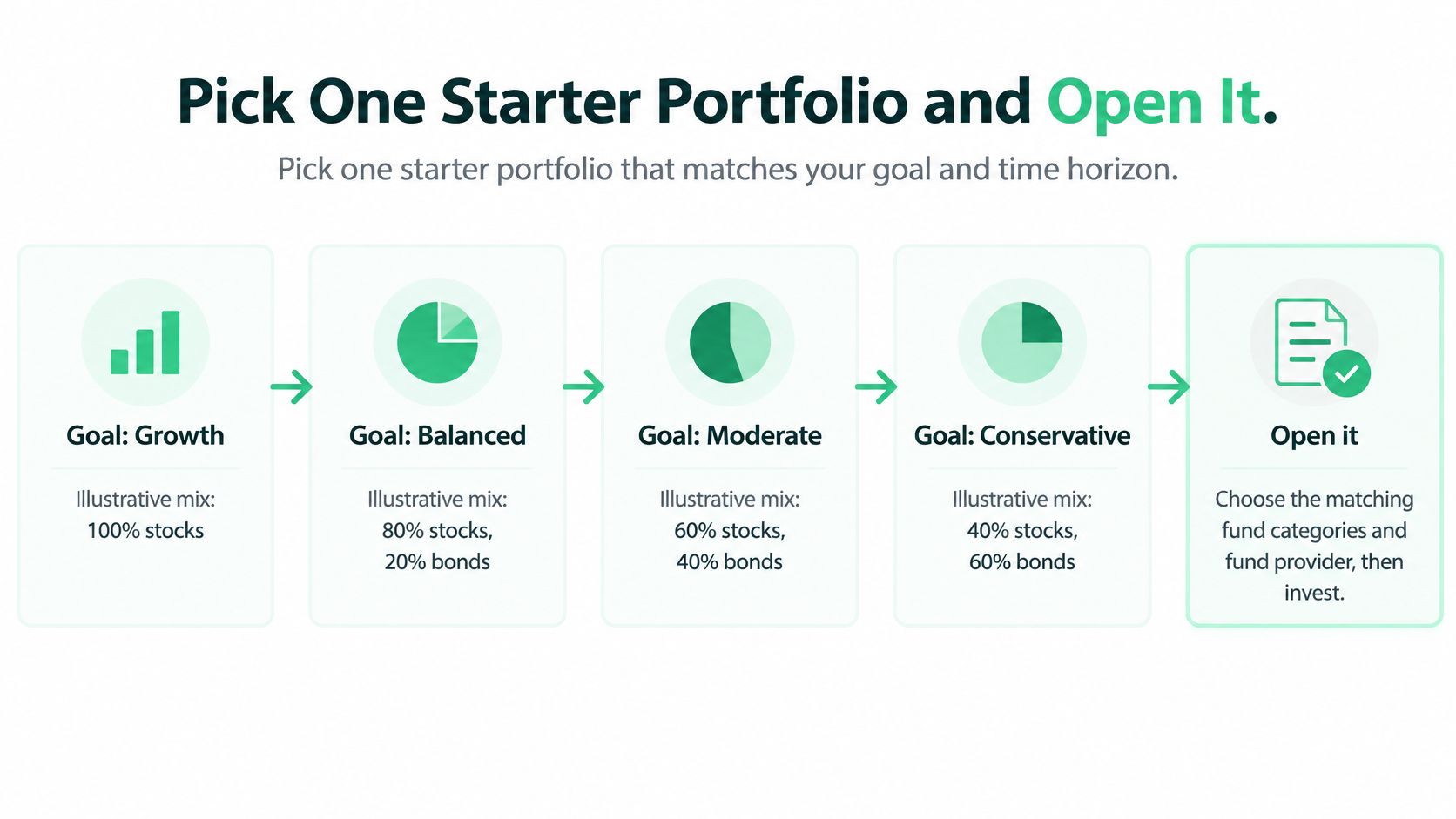
Choose a starter portfolio that matches your goal, then choose the account and funds. The stock allocation should reflect how much loss you can withstand and how long you can leave the money invested.
The following mixes are illustrative scenarios, not personalized recommendations. In particular, a near-term spending goal may call for cash rather than any stock allocation.
Illustrative starter portfolios by goal
| Goal | Time horizon | Example mix (stocks / bonds) | Fund categories to consider |
|---|---|---|---|
| Retirement decades away | 30 or more years | 90% / 10% | Total U.S. stock index, international stock index, total bond index |
| Retirement in 10 to 15 years | 10 to 15 years | 70% / 30% | Total U.S. stock index, international stock index, total bond index |
| Down payment in a few years | 2 to 4 years | 20% / 80% | Short-term bond index, Treasury fund, high-yield savings for cash |
| Long-term growth, no set date | 10 or more years | 100% / 0% or 80% / 20% | Total U.S. stock index, international stock index, optional bond index |
For the down-payment illustration, the defensive allocation can include cash instead of bonds. Bond funds can lose value and aren't substitutes for guaranteed access to a required dollar amount.
The graphic offers another way to think about stock-and-bond risk levels. Its labels describe illustrative allocations, not a promise that a conservative portfolio can't lose money.
Match the risk to the deadline
Consider a hypothetical 40% stock decline. Two years before a down payment, it could force you to postpone buying. Thirty years before retirement, it may be a setback you have time to work through, although recovery is never guaranteed.
Your ability to tolerate a loss also depends on employment stability, emergency savings, debt, and flexibility. A long horizon doesn't make an allocation suitable if you'll sell everything during the first severe decline.
Turn the choice into a routine
- Write down the goal and target date. Separate money for near-term bills and emergencies from long-term investments.
- Choose the account. Consider a workplace plan's available match first, then evaluate an IRA and taxable brokerage account against eligibility, fees, access needs, and tax treatment.
- Fill each portfolio slot. Choose a broad index fund or ETF for each required exposure. Read the benchmark description, expense ratio, and holdings before buying.
- Automate contributions. Set a monthly amount your budget can support, and confirm that deposits purchase investments rather than remaining in cash.
- Choose a rebalancing rule. An illustrative approach is an annual review or action when an allocation moves about five percentage points from target. Use new contributions where practical, and consider taxes before selling.
For a manageable starting amount, our guide to how to invest $1,000 can help translate those decisions into a first purchase.
Regular investing is often called dollar-cost averaging. The Coin Course offers a practical guide for UK crypto investors explaining that contribution approach in a different market; U.S. account rules and the suitability of crypto require separate evaluation.
Our Compound Interest Calculator shows how lump sums and monthly contributions grow over time with compounding. Test different contributions and hypothetical growth assumptions, treating the output as a sandbox rather than a forecast.
The answer to “what is index fund investing?” becomes useful when you can name your goal, benchmark, account, and contribution plan. Do your own research or consult a licensed professional before making any investment decisions.
Get more posts like this
One short, useful email each Friday. Free, no spam, unsubscribe anytime.