Inherited IRA RMD Rules Every Heir Should Know in 2026
Learn how inherited IRA RMD rules set your withdrawal deadlines, who must take annual payments, and how to avoid the 25% penalty on missed amounts.

Daniel Anderson
Editor, The Money Maniac
November 24, 2026
16 min read

Most non-spouse heirs must empty an inherited IRA within 10 years if the owner died after 2019. Surviving spouses and certain other beneficiaries get more breathing room, and some heirs also have to take annual required minimum distributions (RMDs) during that window.
Inherited IRA RMD Rules Begin With Your Category

Picture the account as a clock that starts ticking the day the owner dies. The balance matters less than who you are. The IRS sorts heirs into groups, and each group gets its own deadline.
The Four Beneficiary Categories
Your group sets your deadline, so that's the first thing to pin down. The table below gives you a starting point for 2026, but confirm the details in IRS Publication 590-B before you act.
Inherited IRA Withdrawal Rules by Beneficiary Type (as of 2026)
| Beneficiary Type | General Deadline | Annual RMDs Required? |
|---|---|---|
| Surviving spouse | Depends on the option you choose | Depends on the option you choose |
| Eligible designated beneficiary (disabled, chronically ill, not more than 10 years younger than the owner, or a minor child until age 21) | Payout over life expectancy | Yes |
| Designated beneficiary (adult child, sibling, friend) | Empty by December 31 of year 10 | Only if the owner died on or after the required beginning date |
| Non-designated (estate, most trusts, charity) | Five years if the owner died before the required beginning date | Only if the owner died on or after the required beginning date |
Most people find their row quickly once they know the basics. Spouses and minor children often have the most flexibility, while adult children and other individuals usually fall under the 10-year rule.
A few quick questions will usually place you:
- Are you a spouse, a minor child, or someone else?
- Did the owner die before or after the required beginning date?
- Is the beneficiary an individual, an estate, or a trust?
A Quick Worked Example
Imagine an owner dies in 2025 and leaves a $300,000 traditional IRA to an adult child. That child has until December 31, 2035, the end of the tenth year after the year of death, to empty the account. Every dollar withdrawn from a traditional IRA counts as ordinary income in the year you take it.
Whether the child also owes yearly withdrawals comes down to one question: had the owner already reached the required beginning date? For owners born 1951 through 1959, that age is 73 under current law (as of 2026).
The 10-year rule doesn't demand equal withdrawals each year. Waiting until the final year, though, can stack a large balance into one high-tax year.
An inherited IRA usually passes by beneficiary designation rather than through a will, which makes the paperwork on file important. If that form is out of date, a related guide on how outdated beneficiary forms trigger probate walks through what can follow.
Checking Your Category First
Before you run any math, confirm your category and the owner's age at death. Then pull the figures from IRS Publication 590-B for the year you need.
Most heirs fall into one of three groups, and that group matters more than most people expect. Surviving spouses get a separate set of choices, shown as the fourth row above. The SECURE Act of 2019 created this system for owners who died after 2019.
This diagram maps the three IRS beneficiary categories and the deadline attached to each one.
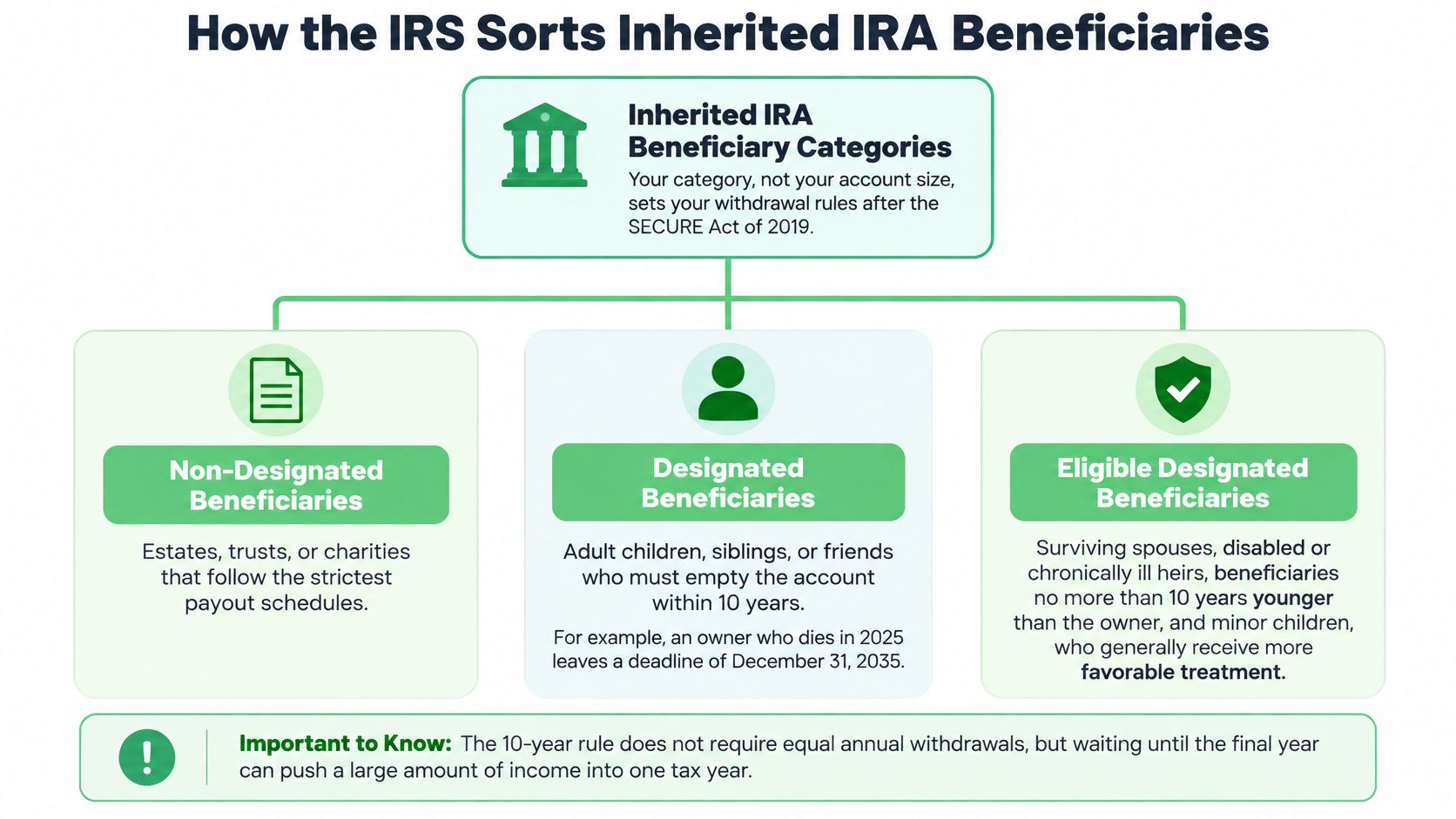
Your relationship to the owner sets your clock. Most adult children, siblings, and friends land in the 10-year group. Spouses and certain others get more room to work with.
Three Groups That Set Your Deadline
Picture the three groups as lanes on a highway, each with its own speed limit. Your lane decides how fast you have to travel, no matter how nice your car is.
- Non-designated beneficiaries include estates, most trusts, and charities. They face the strictest payout schedules.
- Designated beneficiaries are individuals such as adult children, siblings, or friends. They generally must empty the account within 10 years.
- Eligible designated beneficiaries include surviving spouses, disabled or chronically ill heirs, beneficiaries no more than 10 years younger than the owner, and minor children. They generally receive more favorable treatment.
How the SECURE Act Changed the Stretch
For owners who died before 2020, many non-spouse heirs could stretch withdrawals over their own life expectancy. That option let them take small annual payouts for decades. Under the SECURE Act (2019), it mostly disappeared for individual heirs.
Eligible designated beneficiaries can still use life-expectancy payouts in many situations. Most individual heirs, though, now get a 10-year window instead. The clock applies to owners who died after 2019, and the IRS finalized its detailed guidance in 2024.
The 10-Year Rule in Practice
Let's say the owner dies in 2025. The account must be fully emptied by December 31, 2035, the end of the tenth year after the year of death.
The rule doesn't require equal withdrawals. If the owner died before the required beginning date, you could legally wait until year 10 to take everything out. Waiting can be tempting, but it can also stack a large balance into one high-tax year.
Timing is flexible. The deadline is fixed. The 10-year cutoff applies no matter how you spread the money.
A quick example makes this easier to see. Split a $200,000 balance evenly across 10 years, and you would withdraw about $20,000 a year, before growth and taxes.
Classify Yourself in Three Steps
- Are you the owner's spouse or a minor child?
- Are you disabled, chronically ill, or no more than 10 years younger than the owner?
- If neither applies and you are an individual, you are a designated beneficiary.
Read also: estate planning documents checklist covers what to gather first.
A surviving spouse is the one heir who often gets to pick their path, and that choice can shift the tax bill by a wide margin. Each route also sets a different clock for when required minimum distributions (RMDs) begin.
Treating the Account as Your Own
Think of this route as moving into a house and making it yours. You transfer the money into an IRA in your name, and from that point the account follows your age, not the age of the spouse who died.
Under current law (SECURE 2.0, passed in 2022), RMDs generally begin at 73 for people born from 1951 through 1959, and at 75 for anyone born in 1960 or later, as of 2026.
The catch is access. If you pull money out before age 59½, you can owe the 10 percent additional tax on early distributions, on top of regular income tax.
Keeping It as an Inherited IRA
Here you leave the account titled as an inherited IRA and take distributions under the beneficiary rules, which work differently.
Those withdrawals are generally exempt from the 10 percent early distribution tax, even if you're under 59½. That alone makes this route appealing if you might need cash sooner.
If your spouse died before reaching RMD age, you can usually postpone RMDs until the year they would have reached it. Your divisor then comes from the Single Life Expectancy Table, which typically leads to a larger required withdrawal than the table owners use.
A Worked Example at Age 55
Let's say you're 55 in 2026 and inherit a $200,000 IRA from a spouse who died in 2025 at age 70. Soon after, you need $20,000 for a home repair.
Under the first path, that withdrawal could add $2,000 of early-withdrawal tax (10 percent of $20,000) on top of your income tax.
Under the second, the same money avoids that penalty. Your RMDs could also wait until the year your spouse would have turned 73, which is 2028 for someone born in 1955.
Moving the money into your own name is a one-way move. Once it's rolled in, you can't send it back to an inherited account.
Comparing the Two Paths
Side by side, the differences are easier to see:
| Feature | Treat as Your Own | Keep as Inherited |
|---|---|---|
| When RMDs start | Your age (73 or 75) | Deceased's RMD age, if applicable |
| Early withdrawals before 59½ | Usually 10% extra tax | Generally no 10% tax |
| Divisor | Uniform Lifetime Table | Single Life Expectancy Table |
Running Both Numbers Before You Sign
Before you commit, work through three steps:
- Confirm your birth year and the age your spouse was when they died.
- Estimate your taxable income for 2026, including Social Security and pension payments.
- Model a withdrawal under each path, then compare the total tax bills.
IRS Publication 590-B includes current tables. Tax rules change, so double-check the figures for the year you need.

Once you know which category you fall into, the math is less intimidating than most people expect. Nearly every annual RMD comes from the same basic formula, and you can run it yourself with a calculator and a recent statement from your custodian.
The Basic Formula Behind Every RMD
The formula is simple: take your prior year-end balance and divide it by a life expectancy divisor. The balance is the value of the account on December 31 of the previous year. The divisor comes from IRS tables and depends on your age.
It helps to think of the divisor as a countdown. It estimates how many years the IRS expects you to keep taking withdrawals. A smaller divisor means fewer years left, and that means a bigger required payment.
Working Through a $300,000 Example
Let's say you inherit a hypothetical $300,000 IRA, and the illustrative divisor for your age is 28.0. Dividing $300,000 by 28.0 gives a first-year RMD of about $10,714.
Those divisors are illustrations only. They aren't the real figures for any particular year, so pull the current tables from IRS Publication 590-B before you rely on a number.
Why Later Years Can Cost More
This part often surprises people. The divisor drops by one each year after the first. Since the divisor shrinks while the balance may stay the same, the required withdrawal grows, even if the account hasn't changed in value.
Imagine investment gains exactly offset your withdrawals, so the balance holds steady at $300,000. Dividing that balance by 27.0 gives a year-two RMD of about $11,111. Nothing in the account moved, but the required payment went up.
The annual RMD sets a floor. Under the 10-year rule, the full balance still has to reach zero by the end of year 10.
Here is how the same method plays out across the first two years, using the hypothetical figures above.
Hypothetical Inherited IRA RMD Calculation (Illustrative Figures)
This simplified example shows how a $300,000 inherited IRA balance and an illustrative divisor produce a first-year RMD. It also shows how the same method works in the following year. The divisors here are hypothetical, so replace them with current IRS table values before you act on any figure.
| Year After Death | Prior Year-End Balance | Illustrative Divisor | Estimated RMD |
|---|---|---|---|
| 1 | $300,000 | 28.0 | $10,714 |
| 2 | $300,000 | 27.0 | $11,111 |
The mechanics stay the same from year to year. Only the divisor and the balance change, so once you understand one row, you understand the whole schedule.
Your Step-by-Step Checklist Each December
Doing this once a year takes less time than most people fear. The routine:
- Pull the December 31 balance from your custodian's year-end statement.
- Find your age in the single life expectancy table in IRS Publication 590-B for the year in question.
- Divide the balance by that divisor to get your RMD for the year.
- Subtract one from the divisor for each later year, then repeat steps one and three.
- Take the withdrawal by December 31, starting the year after the owner died.
Watch Out for These Calculation Errors
Two mistakes show up again and again. The first is using the wrong balance. Only the December 31 value from the prior year counts, so a number from a random mid-year statement won't work. The second is using the wrong table. A surviving spouse who chooses a different set of rules may end up with a different divisor, and mixing them up throws off the whole calculation.
The other common slip is taking less than required. Under current law (as of 2026), a shortfall can trigger a 25 percent excise tax, which is painful when it arrives as a surprise. A quick check every year is far cheaper than fixing a missed withdrawal after the fact.
Knowing When to Ask for Help
Some situations change the math enough to justify a professional review. Multiple inherited accounts and a trust named as beneficiary are two common examples. When you sit down with an advisor, bring your balance statements, the owner's date of death, and your birth year. That gives them what they need to work through the details quickly.
Still, run the numbers yourself first. Once you can reproduce your own RMD each year, an advisor's answer becomes much easier to check, and you'll know right away if something looks off.
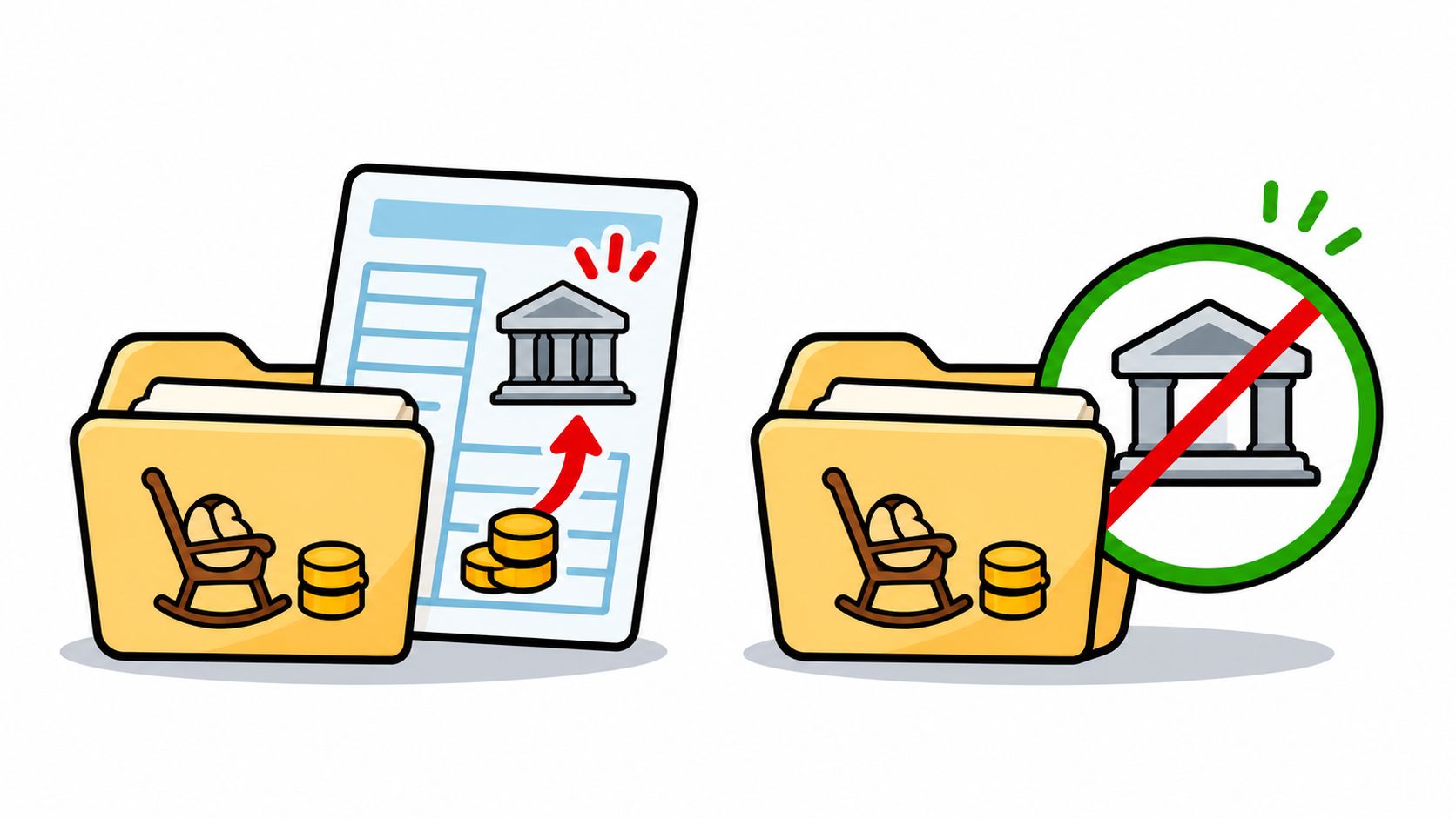
Two inherited IRAs can hold the exact same balance and still lead to very different tax bills. The deadline is identical for both. What changes is how the money gets taxed, and that depends on which type of account you're pulling from.
Traditional Withdrawals Are Taxed as Income
Money from a traditional inherited IRA is generally taxed as ordinary income in the year you take it. Think of each withdrawal as another layer stacked on top of your salary, pension, taxable Social Security, and anything else coming in that year.
Say you pull $50,000 from a $200,000 traditional account. That $50,000 becomes taxable income for the year. At an illustrative 24 percent federal bracket (a rate used only for this example, not a 2026 figure), you'd owe roughly $12,000 in federal tax before state tax enters the picture. Check IRS.gov and Publication 590-B for the brackets that apply to your situation.
Roth Withdrawals Often Arrive Tax-Free
Qualified distributions from an inherited Roth IRA are generally tax-free, as long as the account meets its required holding period. Pull that same $50,000 from a Roth, and it may add nothing to your taxable income. The key test is the five-year holding period, which generally runs from the owner's first Roth contribution.
Same balance, same deadline, different tax bill. Which account you draw from first can matter just as much as when you draw from it.
| Feature | Traditional Inherited IRA | Roth Inherited IRA |
|---|---|---|
| Typical tax on withdrawals | Ordinary income | Generally tax-free if qualified |
| Effect of a $50,000 withdrawal | Adds $50,000 to taxable income | Generally adds nothing |
Spreading Withdrawals Across the Window
The 10-year window gives you room to maneuver. Spreading withdrawals over several years can keep each year's income inside a lower bracket, instead of piling everything into year 10 and getting hit all at once.
Take $200,000 and spread it across 10 years, and you're looking at about $20,000 a year before growth. Your balance won't sit still, so your actual numbers will look different. The logic still holds.
Timing Withdrawals Around Income Events
Timing is where a lot of the real savings hide. A year you retire, sell a home, or take a long break from work can leave unused room in your bracket. That's often a good moment for a larger traditional distribution.
- Check your taxable income each year against the edges of your bracket.
- Take traditional withdrawals in lower-income years first.
- Leave Roth money for later, so tax-free growth has more time to work.
Where These Strategies Can Fall Short
Plans like these rest on assumptions. Your bracket, your state's tax rules, and future tax law can all shift the outcome. Congress may adjust rates, and your state may treat retirement income differently than federal law does.
Treat these ideas as starting points rather than guarantees. A tax professional can test your numbers against current IRS guidance and brackets.
Check out our guide on the Roth conversion ladder if you're weighing conversions for your own retirement savings.
Timing mistakes are where inherited IRA RMD rules bite hardest. The good news is that the penalty has shrunk, and fixing a miss is very doable if you move quickly.
The 25 Percent Penalty and How to Reduce It
Under SECURE 2.0, which passed in 2022, the IRS charges an excise tax of 25 percent on any RMD you miss, as of 2026. It works a bit like a parking ticket that gets cut in half if you pay it fast. Correct the miss within the correction window, and the rate drops to 10 percent.
Confirm the current window before you file. The details can change the outcome.
The window generally runs two years from the end of the year the RMD was due, but IRS guidance sets the exact terms, so don't rely on a rule of thumb alone. Let's put numbers to it. Say your year-two RMD is $11,111, using the illustrative figures from earlier, and you withdraw nothing:
- 25 percent penalty: $2,778
- 10 percent penalty after a timely fix: $1,111
Fixing the miss saves you about $1,667 in this case. You report the tax on IRS Form 5329, and you can also request a waiver by showing reasonable cause.
Edge Cases That Change the Timeline
Some heirs run on a different clock entirely, so check these before you assume the standard rules apply.
- Minor children: A child who is an eligible designated beneficiary takes annual payouts until age 21. After that, the 10-year clock starts. Confirm the switch date with your plan administrator.
- Disabled or chronically ill heirs: These beneficiaries can generally stretch payouts over their own life expectancy instead of following the 10-year rule. Ask your administrator what proof of eligibility they need.
- Trusts and estates: Most of these are non-designated beneficiaries. If the owner died before the required beginning date, the account generally must be emptied within five years.
When Several Heirs Share One Account
Shared accounts can get messy fast. Each share often runs on its own schedule, so if one sibling is disabled and another isn't, their payout timelines can look very different.
Ask your plan administrator how the split is documented. Also ask whether each heir's share sits in a separate inherited account, because that answer shapes your whole plan.
Estate planning and probate questions tend to pop up right when an heir is juggling an inherited account and its deadlines. For a practical overview, see Lein Law Offices estate planning.
Your Key Dates Checklist
Put these on your calendar, and set a reminder for late November each year. It's an easy habit to forget otherwise.
- December 31 of the year of death: The valuation date for calculating your first RMD.
- December 31 each year, starting the year after death: The RMD deadline for any year you owe one.
- Within the correction window, generally two years: The window to fix a missed RMD and qualify for the 10 percent rate.
- December 31 of the 10th year after the year of death: The final deadline to empty the account.
These are the dates that matter most, so check them against your statements every year.
Can I Wait Until Year 10 to Withdraw Everything?
It depends on when the original owner died. The required beginning date works like a starting gun for the payout schedule. If the owner died before reaching that date, you generally have no annual payments. You can empty the account by December 31 of year ten.
If the owner had already reached that date, the rules are stricter. You take yearly withdrawals in years one through nine, then clear whatever is left in year ten.
What Happens If I Miss an RMD?
Under current law (as of 2026), the IRS charges a 25 percent excise tax on the amount you should have withdrawn.
Missing a required withdrawal is easier than you'd think, especially when you're juggling several accounts. The good news is that it can often be fixed. If you take the shortfall out within the correction window, generally two years, the rate drops to 10 percent.
Let's put real numbers on it. Using the earlier illustrative figures, a missed $11,111 RMD payment would cost $2,778 at 25 percent, or $1,111 at 10 percent. That gap is a good reason to act quickly.
You report the shortfall on IRS Form 5329. You may also qualify for a waiver if the miss resulted from reasonable error.
Splitting an Inherited IRA Among Several Heirs
Think of one inherited account as a pie. When it passes to several heirs, each person gets a slice, and each slice can follow its own timeline. One heir might be bound by the ten-year rule, while an eligible heir can stretch payments over their life expectancy.
Ask your plan administrator whether each share sits in a separate inherited account. That detail matters, because it changes how each piece is tracked and reported.
When an heir dies without a will, the broader estate can get complicated fast. Understanding that process can help you frame better questions about retirement account transfers. For a closer look, see handling intestate estates in The Woodlands.
Where to Confirm Current Tables and Deadlines
Rules like these depend on tables and dates that get updated, so it pays to check the source. The current life expectancy tables and general deadlines live in IRS Publication 590-B, available on IRS.gov. Your plan custodian holds the account-specific details, such as your balance on December 31 and the payout options available to you.
Check out our guide on traditional 401(k) vs Roth tradeoffs.
Get more posts like this
One short, useful email each Friday. Free, no spam, unsubscribe anytime.