Estate Planning Documents Checklist: 9 Essentials for 2026
Estate planning documents checklist for homeowners over 50: nine papers to review, who needs each, what to gather, and where to store them.

Daniel Anderson
Editor, The Money Maniac
November 23, 2026
16 min read
You've paid down the mortgage, built retirement savings, and updated your will so your children inherit what's left. Then you open your IRA account and discover that the beneficiary form still names your former spouse. That old form may control who receives the account, regardless of what your newer will says.
For a homeowner approaching retirement, this is a practical place to begin: check beneficiary forms and account ownership before rewriting the will. Retirement accounts, insurance policies, and accounts with payable-on-death instructions generally follow their own beneficiary records, as this estate-planning overview from Financial Sense explains. Divorce, spousal rights, and state law can complicate the outcome, so an outdated designation deserves attention rather than assumptions.
This estate planning documents checklist organizes the paperwork around the failure each document helps prevent: money going to the wrong person, a house getting stuck in probate, bills going unpaid during illness, or relatives guessing about medical care.
Start with ownership: For every major asset, identify whose name is on it, who receives it at death, and which document actually controls the transfer.
You don't need every legal form on the internet. You need a coordinated set that fits your property, family, and state, with trusted people who can find and use it. For a state-specific example, these essential estate documents for Texas families illustrate why local requirements matter.
Start your actual review with beneficiary forms and your home's deed. Then work through the documents below.
1. Last Will and Testament
Failure it helps prevent: leaving probate property without clear instructions or someone authorized to settle it.
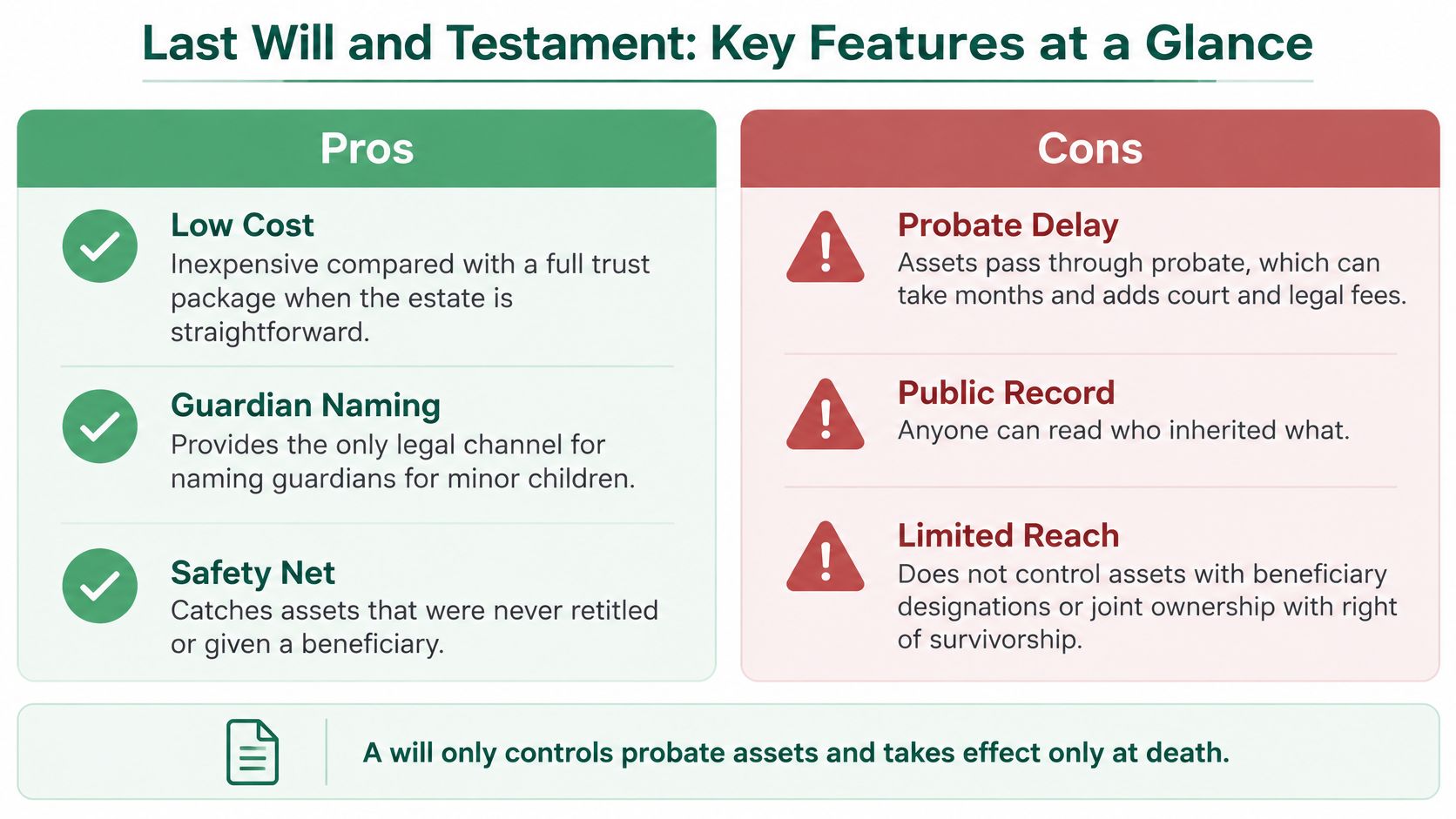
A will directs the distribution of property that passes through your estate. It names an executor, the person responsible for administering the estate, and can nominate guardians for minor children.
Probate is the court-supervised process for handling a deceased person's estate, including debts and property transfers. A will supplies instructions for that process; signing one doesn't automatically avoid it.
The distinction between a will and a complete plan matters. In its 2025 survey of 8,750 U.S. adults, Pew Research Center found that 32% reported having a will describing what should happen to their assets and belongings after death.
Treat the will as your backstop
Say your will leaves everything to your spouse, then equally to your adult children. If your spouse dies first and your home remains titled solely in your name, your executor may still need probate authority to transfer it, subject to your state's procedures.
A will also catches overlooked property, such as an individually owned account without a beneficiary. For a trust-based plan, an attorney may prepare a pour-over will directing remaining estate assets into the trust, though those assets may still require probate.
- Name a backup executor. Your first choice may become unavailable or decline the responsibility.
- Check signing requirements. State law determines the necessary signatures, witnesses, and other formalities.
- Locate the original. Tell your executor where it's stored and how to obtain it.
- Review after changes. Marriage, divorce, deaths, and relocation deserve a fresh look.
This comparison illustrates the will's role and limitations.
2. Revocable Living Trust
Failure it helps prevent: requiring court-supervised transfers or leaving assets without continuity of management.
A revocable living trust holds property under instructions you establish during your lifetime. You typically serve as trustee while you're able, retain the ability to amend it, and name a successor trustee to take over under the document's terms.
Properly funded trust assets generally avoid probate. A trust can also provide ongoing management for a surviving spouse or an heir who shouldn't receive an unrestricted inheritance.
The funding requirement deserves emphasis. A signed trust sitting beside an unchanged deed may leave your house outside the arrangement.
Pay for implementation, not just documents
Consider a retired homeowner who creates a trust but never transfers the house into it. After the homeowner dies, the successor trustee discovers that the deed still names the deceased owner individually. The family may need a court procedure that proper funding could have avoided.
A standard revocable trust doesn't automatically reduce income or estate taxes, and it generally doesn't protect your own assets from your creditors. Its value depends on probate rules, privacy preferences, management needs, and whether you'll maintain it.
For a plain-English explanation of that arrangement, Bryan Fagan's Kingwood trust guidance provides additional context.
- Confirm deeds and registrations. Get evidence that intended assets were transferred.
- Coordinate retirement accounts. Don't retitle an IRA into your living trust or name a trust as beneficiary without tax advice.
- Brief your successor. Explain where the trust, amendments, and asset list are stored.
Ask for a written legal-fee scope covering drafting, deeds, funding assistance, and later amendments. A cheaper package can become expensive if implementation is left unfinished.
The house deserves its own funding check.

3. Durable Power of Attorney for Finances
A hospital stay doesn't suspend property taxes, insurance premiums, or the electric bill. A durable financial power of attorney helps prevent those responsibilities from becoming an authority problem.
It authorizes an agent to handle specified financial matters. Durable means the authority survives your incapacity, subject to the document and governing law.
A trust may let a successor manage trust property, but someone may still need authority over assets and obligations outside it. Don't assume marriage alone gives your spouse access to every individually owned account.
Choose the agent before choosing the form
Suppose you're recovering from a stroke and can't communicate reliably. Your agent may need to pay insurance, handle a tax filing, and obtain financial records. The document must authorize the relevant actions, and the institutions involved must be able to process it.
Agent selection deserves as much care as drafting. In a 2024 Australian national survey of more than 3,000 adults, only 25% of people acting as appointed decision-makers felt they understood their responsibilities very well when they began, according to the Australian Human Rights Commission. Australian law differs from U.S. law, but the practical lesson travels well: explain the job before handing someone the paperwork.
- Set the start date deliberately. Immediate authority can be convenient but creates present-day misuse risk; incapacity-triggered authority can require additional proof.
- Confirm institutional procedures. Ask your bank and brokerage to review the document while you can resolve problems.
- Require records. Your agent should retain statements, receipts, and explanations of transactions.
- Name a successor. Reliability matters more than family seniority.
This document protects household continuity, including the home.

4. Health Care Power of Attorney
Failure it helps prevent: leaving medical decisions to someone you wouldn't have chosen.
A health care power of attorney, sometimes called a health care proxy, identifies who can make medical decisions when you can't, under the conditions established by state law and the document.
Your financial agent and health care agent don't have to be the same person. The child who maintains immaculate spreadsheets may struggle to question a physician or carry out a difficult treatment decision.
Terminology and signing requirements vary by state, as the estate-planning guide hosted by B.C. Lawyers explains. Use the form and execution process appropriate to your jurisdiction.
Have the difficult conversation while it's easy
Consider a retiree who names her daughter as agent after discussing ventilation, rehabilitation, and acceptable recovery. Following a surgical complication, the daughter can explain her mother's priorities to the medical team instead of trying to reconstruct them during a family argument.
Choose someone who can listen, ask direct questions, and follow your preferences rather than their own. Geographic proximity helps, but availability, judgment, and willingness to act matter more than a nearby address.
Your agent needs permission to make a hard decision that other relatives may dislike. Give that permission in conversation, as well as on paper.
Provide copies to the agent, backup agent, primary care practice, and relevant hospital system. Ask how the document will appear in your medical record, and include the agent's contact information in your phone's emergency details.
Revisit the appointment if relationships change or the agent becomes unable to serve. A familiar name on an old form isn't proof that the arrangement still works.
The conversation should accompany the paperwork.

5. Living Will (Advance Directive)
Your family may know that you value independence without knowing what that means during a medical emergency. A living will helps prevent them from having to guess about treatment preferences.
Despite its name, it doesn't distribute property. It records medical instructions for circumstances covered by the document and applicable law.
An advance directive may combine treatment instructions with the appointment of a health care agent. Don't assume that similarly named forms contain identical provisions, or that you need duplicate documents with conflicting language.
Describe outcomes, then discuss treatments
A person concerned about advanced dementia might want comfort-focused care if they permanently lose the ability to recognize loved ones. That preference needs a conversation with a clinician about prognosis, potentially reversible illnesses, and what different treatments would accomplish.
Avoid relying entirely on phrases such as “no heroic measures.” Relatives and clinicians may interpret them differently. Explain what abilities matter to you and when burdensome treatment would no longer serve your goals.
- Discuss specific situations. Ask about ventilation, artificial nutrition, dialysis, and treatment trials.
- Address uncertainty. Explain whether you'd accept temporary treatment while clinicians assess recovery.
- Include comfort priorities. Pain relief, family presence, and spiritual support deserve attention.
- Review with your physician. Confirm that your language communicates medically workable preferences.
A directive also isn't necessarily a portable medical order directing emergency responders to withhold resuscitation. Ask your clinician whether a separate medical order is appropriate for your condition and state.
For a typical use case, a retiree facing major surgery can review the directive with the surgeon and agent beforehand. That gives everyone a shared understanding before decisions become urgent.
6. HIPAA Authorization
Failure it helps prevent: avoidable obstacles when trusted people need health information.
A HIPAA authorization permits specified disclosures of protected health information to people you identify. It addresses information sharing; a health care power of attorney addresses decision-making authority.
The documents may overlap. A properly authorized health care agent may qualify for access as your personal representative, depending on their authority and the circumstances, and other permitted disclosures may also apply. A separate authorization can still clarify access for additional people.
The preparation gap is substantial. In a 2026 national survey of 5,000 U.S. adults, 10% reported having a HIPAA authorization, according to the LegacyGuard estate-planning readiness announcement.
Match access to the job
Suppose your spouse is your medical decision-maker, but your adult son coordinates appointments and insurance questions. An authorization can help him obtain the information needed for that supporting role without making him the person who decides your treatment.
That distinction can reduce confusion. It also lets you be deliberate about privacy rather than handing every relative the same access.
- Name recipients clearly. Use identifying details that distinguish people with similar names.
- Review scope and expiration. Understand which information may be disclosed, for what purpose, and for how long.
- Check provider requirements. Hospitals, specialists, pharmacies, and insurers may have their own authorization procedures.
- Keep copies accessible. Store them securely where your designated helpers can retrieve them.
Don't place detailed medical information in an openly shared family folder just because access would be convenient. Give the right people a reliable route to the records they need.
A signed release helps most when the provider has it on file before someone calls from a hospital corridor.
7. Beneficiary Designation Forms
Review these first, even though they appear later in the document list. An account-level beneficiary designation generally controls the transfer of that account rather than the distribution instructions in your will.
That makes these forms a high-priority check for retirees with substantial retirement savings. They're maintained separately from the will, often through an employer plan, insurer, or account custodian.
Retirement accounts, life insurance, annuities, and eligible payable-on-death or transfer-on-death accounts may all have their own records. Spousal protections, divorce rules, and plan terms can affect the result, so don't treat a general rule as a guaranteed legal outcome.
Verify what the custodian actually has
Consider a divorced account owner whose IRA still names a former spouse, while the will leaves the estate to the children. The discrepancy may create an unintended payout or a dispute. Updating the will alone hasn't resolved the account instructions.
Request confirmation of the current primary and contingent beneficiaries from each institution. A replacement form in your desk drawer doesn't establish that the custodian accepted it.
- Check allocation totals. Make sure the shares match your intended distribution.
- Name contingent beneficiaries. Decide who inherits if a primary beneficiary dies first.
- Flag special circumstances. Minors, beneficiaries receiving means-tested benefits, and trust beneficiaries need careful planning.
- Coordinate the whole estate. Equal account percentages don't necessarily produce equal after-tax inheritances.
Our explanation of traditional 401(k) versus Roth accounts helps clarify why the tax character of retirement money matters alongside the beneficiary's name.
Practical rule: After a marriage, divorce, death, or major family change, verify the institution's beneficiary record. Don't rely on memory or a marked-up copy of your will.
8. Transfer-on-Death Deed
Failure it helps prevent: sending the home through probate when an appropriate deed could provide a direct transfer.
Where state law permits it, a transfer-on-death deed, sometimes called a beneficiary deed, names who receives real estate at death. A valid arrangement generally lets the owner retain control during life without giving the beneficiary a current ownership interest.
Availability, signing rules, recording deadlines, and post-death procedures vary. Don't copy a deed from another state and assume the county recorder's acceptance proves that it accomplishes your plan.
Start with the existing deed
For a married couple, the first question is how they already own the property. Survivorship rights, a trust, or another ownership arrangement may already address the first spouse's death.
Suppose a couple wants their children to receive the home after both parents die. A local attorney should determine how the proposed deed interacts with existing ownership and what happens if a child dies first, the parents sell, or the family circumstances change.
This guide to passing your home to your children provides a Texas-specific discussion. Other states require their own analysis.
- Verify recording. Keep the recorded instrument and confirmation with your estate records.
- Consider the heirs' circumstances. Shared ownership can create disagreements over occupancy, expenses, and sale.
- Review long-term-care implications. Ask about Medicaid eligibility and estate recovery rather than assuming probate avoidance settles those questions.
- Check tax consequences. A deed choice should fit the broader inheritance plan.
Our guide to the step-up in basis at death explains a related tax concept to discuss before choosing how to transfer appreciated property.
Adding children to today's deed is a different transaction. Don't use it as a shortcut without understanding the consequences.
9. Letter of Instruction and Asset Inventory
A capable executor still can't administer an account they don't know exists. A letter of instruction helps prevent a scavenger hunt through statements, email, and locked drawers.
This is a practical, generally nonbinding document. It doesn't replace a will, amend a trust, or change a beneficiary designation.
The National Institute on Aging's getting-your-affairs-in-order checklist recommends gathering important papers and copies of legal documents in a place trusted people can locate. Accessibility belongs in the plan from the beginning.
Leave directions someone can actually follow
Consider a widower with accounts spread across former employers, banks, and insurers. An inventory identifying each institution, account type, contact route, and beneficiary status lets his daughter begin with an organized list rather than unopened mail.
Include the home's deed location, insurance information, recurring bills, debts, professional contacts, and instructions for locating originals. List pension or survivor-benefit contacts even when the benefit itself isn't an inheritable account.
- Separate inventory from credentials. Keep account identifiers in the inventory and sensitive access information in a secure credential system.
- State digital preferences. Identify accounts to preserve, transfer, close, or keep private.
- Use platform controls. Record available legacy-contact and recovery arrangements.
- Explain access. Tell your executor and agents how to retrieve the inventory lawfully and securely.
Digital planning deserves explicit attention. In a 2026 survey of 5,000 U.S. adults, 48% had no instructions for digital accounts and files after death, according to Trust & Will's estate-planning report announcement.
Handing over a master password doesn't automatically establish legal authority or protect privacy. Account instructions, authorized access, and secure storage need to work together.
How the nine estate planning documents differ in what they control, whether they skip probate, and what signing they require
| Item | What It Controls | Skips Probate? | Signing Requirements | Best For |
|---|---|---|---|---|
| Last Will and Testament | Probate assets, executor, and guardians for minor children | No; probate assets go through probate | Usually signed by you and two witnesses; rules vary by state | Naming guardians and providing a safety net for assets without other transfer instructions |
| Revocable Living Trust | Assets transferred into the trust and instructions for their management and distribution | Generally, for assets properly titled in the trust | State requirements apply; assets must also be retitled into the trust | Avoiding probate and arranging asset management during incapacity |
| Durable Power of Attorney for Finances | Financial and property matters handled by your chosen agent | No; it authorizes financial management, not asset transfers at death | Usually signed; notarization is required in many states | Choosing who manages finances if you cannot |
| Health Care Power of Attorney | Medical decisions made by your chosen agent if you cannot decide | Not applicable; it does not transfer property | Often requires one or two witnesses; some states require a notary | Naming someone to make medical decisions on your behalf |
| Living Will (Advance Directive) | Medical treatment preferences in specified end-of-life situations | Not applicable; it does not transfer property | Typically signed with witnesses; some states require a notary | Giving doctors and family guidance about end-of-life care |
| HIPAA Authorization | Who may access specified health information | Not applicable; it does not transfer property | Signed release; provider forms and requirements may vary | Allowing chosen people to obtain medical records |
| Beneficiary Designation Forms | Who receives funds from designated accounts or policies | Yes; designated assets generally pass directly to beneficiaries | Submit the account custodian's form; requirements vary | Directing retirement, insurance, and other designated assets to beneficiaries |
| Transfer-on-Death Deed | Transfer of real estate to named beneficiaries at death | Yes, if valid and properly recorded | Record with the county before death; state requirements vary | Passing a home outside probate while retaining control during life |
| Letter of Instruction and Asset Inventory | Information about accounts, property, debts, contacts, and preferences | No; it does not transfer ownership or override a will | No legal signing formalities; it is non-binding | Helping family and representatives locate assets and understand next steps |
Where to Start Before Your Next Birthday Passes
Begin with the paperwork most likely to contradict your intentions: beneficiary records and ownership documents. Pull the current beneficiary information for retirement accounts, insurance, and transfer-on-death accounts, then compare it with your will and trust.
Next, obtain the recorded deed to your home. Confirm how you own it, what happens when an owner dies, and whether a planned trust transfer or transfer-on-death deed was completed.
Put the remaining work in a practical order
- Refresh financial authority. Confirm that your financial agent and successor are willing to serve and that the document grants the authority your situation requires.
- Finish medical planning. Coordinate your health care agent designation, treatment preferences, and information releases.
- Write the operating instructions. Create the asset inventory and tell the right people how to find it.
- Schedule a local legal review. Bring the documents, deeds, account registrations, and beneficiary confirmations together.
Don't let federal estate-tax anxiety distract you from these basics. The IRS estate-tax FAQ lists a $15,000,000 basic federal estate-tax filing threshold for deaths in 2026, with the filing calculation also accounting for adjusted taxable gifts and the specific gift-tax exemption.
The same IRS guidance lists a $19,000 annual gift-tax exclusion per recipient for 2026; as a worked example, gifts of $19,000 to each of two children total $38,000, assuming the gifts qualify for the annual exclusion. That calculation concerns gift-tax treatment, not whether giving away the money is affordable or appropriate for long-term-care planning.
State estate or inheritance taxes can apply under different rules. Large gifts, business ownership, blended families, beneficiaries with disabilities, and property in multiple states all deserve individualized review.
Ask the attorney to identify what remains unfinished after signing. Deeds, accepted beneficiary changes, institutional reviews, and document delivery are concrete tasks, not administrative decoration.
Request a written explanation of fees and scope. Find out whether the quoted work includes trust funding, recording, amendments, and coordination with account custodians; there's no useful nationwide price that accounts for every state and family situation.
This material is educational information, not professional advice from a certified financial or legal expert. State rules vary enough to justify a coordinated review with a local estate attorney, particularly before changing real estate ownership or retirement-account beneficiaries.
Before your next birthday, aim to have accepted beneficiary instructions, verified home ownership, usable powers of attorney, and an inventory your trusted people can find. A smaller set of completed, coordinated documents will serve your family better than an impressive binder of unfinished intentions.
Get more posts like this
One short, useful email each Friday. Free, no spam, unsubscribe anytime.