Health Insurance for Early Retirement: Costs and Options
Health insurance for early retirement before Medicare: COBRA, ACA subsidies, retiree plans and a worked cost example, using 2026 figures and primary sources.

Daniel Anderson
Editor, The Money Maniac
November 17, 2026
17 min read

Your last paycheck lands on a Friday. By Monday you're on a health insurance website answering a question that HR used to answer for you, and the question is what you expect to earn next year. You don't know. That's more or less the definition of retiring.
The trap is simpler than it looks. Most early retirees compare monthly premiums, pick the cheapest plan, and stop. The premium is only one of three bills. Cost-sharing is the second, and the income tax you trigger by funding your life is the third. Both of those move when you change which account you spend from.
So price the bridge as a single number: net premium after any subsidy, plus expected out-of-pocket spending, plus the tax on each dollar you withdraw to pay for it. Three funding mixes for the same retiree can look identical on the premium line and differ by five figures over a decade. The rules that set those numbers change with each coverage year, and this article dates every figure for that reason.
Why Retiring Before 65 Creates a Coverage Gap
Medicare starts at 65 for almost everyone. Retire at 55 and you fund a full decade of coverage on your own. The Social Security Administration's Medicare enrollment guidance is clear on the age gate: the federal program generally will not cover you until then. An employer plan, an ACA Marketplace plan, Medicaid, or continuation through your old job has to carry those years. Leave that stretch unbudgeted and it will not stay small.
Price the gap as one number, not a monthly premium. Take the net premium after any subsidy, add the out-of-pocket spending you expect (the deductible, coinsurance, the annual maximum, and the drugs a formulary prices on their own), then add the tax on the withdrawals that pay those bills.
Run a plain case. $1,000 a month for ten years is $120,000, before a copay, a scan, or a refill. Cost-sharing and prescriptions sit on top of that. A 55-year-old who sets aside only the premium has already undercounted a six-figure bill, and the tax on the account used to pay it can add another layer the plan screen never shows.
Practical rule: Write down your retirement age, subtract it from 65, and multiply the years by a rough annual premium plus out-of-pocket spending. That product is your bridge budget. Park it in its own account, not in a spreadsheet tab you open twice a year.
Check one Medicare rule before you lock the date. Premium-free Part A generally depends on a long enough record of Medicare-taxed work. Years in a job that never paid into the system can leave you with a Part A premium at 65. Part B charges a premium either way, and higher-income beneficiaries pay income-related surcharges on top. Withdrawals at 58 can raise the Medicare bill at 68. Sequence is the point.
If the exit date itself is still in question, start with the simple math behind early retirement. The coverage bill only means something once the asset number can support it.
Your Pre-Medicare Coverage Options at a Glance
You leave work at 58. Six coverage options still exist. Match two or three rows to your job history and your income, then ignore the rest.
| Option | Who it fits | How it is priced | How long it lasts | Main catch |
|---|---|---|---|---|
| COBRA continuation | Employees leaving a job that had group coverage | Full premium plus up to a 2% administrative charge | Usually up to 18 months | You pay the whole premium your employer used to share |
| ACA Marketplace plan | Adults under 65 with no employer or Medicare coverage | Premium tax credits based on expected household income | Ongoing while eligible | Subsidy depends on modified adjusted gross income, which withdrawals can raise |
| Employer retiree plan | Former employees of firms that offer early-retiree coverage | Set by the employer, sometimes with retiree contributions | Until the employer changes or ends it | Benefits can be reduced or discontinued |
| Spouse or partner plan | Covered through a working spouse's or partner's employer plan | Added premium or dependent cost, set by the employer | As long as the primary plan allows | Dependent eligibility rules differ by plan, and the spouse's income can affect Marketplace subsidies |
| Medicaid | Low-income adults, with eligibility set by state rules | Often low or no premium | As long as eligibility continues | Income limits and state expansion status differ |
| Individual off-exchange or short-term plan | People who do not qualify for subsidies or need temporary coverage | Often lower premiums | Short term, typically a few months | Limited benefits, exclusions and state restrictions, so read the exclusions before buying |
You're in crowded company on the Marketplace
Roughly 24.3 million people used the Marketplace in 2025, more than double the 11.4 million enrolled in 2020, so it is the main route for most early retirees, according to KFF's Marketplace enrollment analysis. CMS counted more than 20 million people selecting Marketplace coverage for 2024 during open enrollment, per its 2024 open enrollment snapshot.
Medicaid depends on two things you have to verify locally: the income limit your state uses and whether your state expanded eligibility at all. Check your state Medicaid agency and HealthCare.gov for the current numbers rather than assuming last year's figures still apply.
Short-term and off-exchange plans deserve a specific warning. They can exclude pre-existing conditions, cover fewer services, and face state-level restrictions on how long they last. A low headline premium is not a bargain if the policy skips the care you already need. Read the exclusions before you buy.
How to use the table
Price every row you qualify for as one total for the same retiree: net premium after any subsidy, expected out-of-pocket spending, and the tax on each withdrawal that produces the income behind that premium.
If you left a job with group coverage in the past few weeks, COBRA and the Marketplace are both live. Put those two totals side by side. COBRA's full premium often loses once a subsidy cuts the Marketplace bill, unless your withdrawals push income high enough to erase the credit.
If a working spouse has employer coverage, confirm dependent eligibility in writing and compare that added premium with the Marketplace total. If your income will be low and you live in an expansion state, run Medicaid against both before you pay a premium you do not need.
Buy the row with the lower honest total, not the lowest sticker price.
How ACA Marketplace Subsidies Are Calculated
Stop working and the premium your employer used to share is gone. Price the bridge as one total for the same retiree: net premium after the subsidy, the out-of-pocket spending you expect to hit, and the tax each withdrawal creates. The premium tax credit is the biggest lever on that total. It runs on income, not on how much you have saved.
Eligibility uses annual household modified adjusted gross income (MAGI), family size, and the federal poverty level. Your job title stays out of it. So does the portfolio balance.

For 2026, the general federal rule allows the credit when household income sits between 100% and 400% of the applicable federal poverty level, as the IRS premium tax credit guidance explains, provided you enroll in a qualified Marketplace plan and don't have access to disqualifying coverage such as affordable employer insurance or Medicare. The credit is refundable, so a retiree with almost no regular tax liability can still collect it.
What actually moves your MAGI
MAGI starts with adjusted gross income and adds tax-exempt interest, untaxed foreign income, and certain non-taxable Social Security benefits. Traditional IRA withdrawals count in full. Roth conversions count in full, even when you are not spending the money. Realized capital gains, interest, and dividends count. Qualified Roth withdrawals generally don't count at all.
That last point is why the funding mix changes the whole bill, not just the tax line. Say a single retiree pulls $35,000 from a traditional IRA and converts another $30,000 to a Roth in the same year because income looks low. MAGI lands near $65,000, which is over the 400% line for a one-person household. The credit disappears entirely, and the premium returns to full price. The conversion also taxes money you did not spend, so put the full-price premium, the care costs you still expect to pay, and that extra tax on the same page before you call the year cheap.
The whole tax household is on the application
Household size and composition count as much as your own withdrawals. HealthCare.gov's household rules require the tax filer, a spouse, and tax dependents on the application, with everyone's expected income reported, including a dependent who doesn't need coverage. Married couples filing separately generally can't claim the credit, with narrow exceptions. Model the tax return and the insurance application together. A modest personal withdrawal can wipe out a subsidy you counted on.
Advance credits get settled on your federal return using Form 8962. Estimate low and you repay part of the credit. Estimate high and you collect the difference. Neither outcome is a disaster, but a repayment in April is a bad surprise in a year you're already managing cash flow.
Build one habit and keep it. Every enrollment season, look up the federal poverty guideline for your household size, multiply by four, and write that number at the top of your withdrawal plan. Then decide how much of your spending comes from accounts that don't touch MAGI. If you're mapping the income side of that decision, our guide to sources of retirement income sorts the accounts by how each one hits the tax return.
COBRA, Retiree Plans and Spouse Coverage
You quit in March with a surgery already booked. COBRA keeps the same doctors, the same deductible progress, and the same drug list, and it is usually the most expensive line on the bridge menu. Federal COBRA rules from the Department of Labor generally let eligible former employees and covered family members continue the group plan for 18 months after a qualifying event, and you pay the full premium your employer used to share plus an administrative charge of up to 2 percent. A family plan at $2,000 a month in total premiums is $24,000 a year, a serious bite out of a bridge reserve.
Pay that price for continuity, not for a bargain. The deductible is already met, the surgery is scheduled, or the specialist running your care sits in this network and in no Marketplace network near you. Eighteen months of the same plan can beat saving $300 a month on a plan that resets the deductible and drops the doctor.
A plan that saves you $200 a month and drops your cardiologist is a bad trade, no matter what the spreadsheet says.
Retiree coverage and the spouse route
Retiree health is narrower than a casual reading suggests. KFF's 2024 Employer Health Benefits Survey, cited in KFF's reporting on older adults and Marketplace coverage, found that among large firms offering retiree health benefits, 91% offered them to early retirees younger than 65, compared with 64% offering benefits to retirees at Medicare age, a share limited to firms that already offer retiree benefits. If you think you have this benefit, get the eligibility rules, your contribution, dependent terms, and any waiting period in writing, and ask directly whether the plan can be amended or dropped.
A working spouse's plan is often the cheapest bridge available. Confirm that spouses are eligible, what the added premium costs, and whether losing your own coverage opens a special enrollment window. Leave that plan later and household income still feeds any Marketplace subsidy you apply for next.
Put every deadline on one calendar
Missing a window is how early retirees end up uninsured for two months. Confirm each date below with the source listed. The election notice in your hands beats anything you read online.
| Event | Window | Where to verify |
|---|---|---|
| COBRA election | 60 days after the later of coverage loss or the election notice | Plan administrator and the U.S. Department of Labor EBSA |
| Marketplace special enrollment after losing job coverage | 60 days after coverage ends | HealthCare.gov |
| Marketplace open enrollment | Generally November 1 to January 15 in most states; verify for the current plan year | HealthCare.gov |
| Medicare initial enrollment | Seven months, starting three months before the month you turn 65 | SSA and Medicare.gov |
Before you elect, price one year of total cost for the same retiree, side by side. For COBRA, the retiree plan, the spouse plan, and a Marketplace plan, add the premium you pay (full group cost plus the admin charge, the spouse-plan increment, or the Marketplace premium net of any subsidy), expected out-of-pocket spending, and the tax on the withdrawal that funds the bill. Confirm your doctors and hospital are in network, and check the formulary for anything you take monthly. Write the decision down with the date you made it.
A Worked Example for a Single Retiree at 58
A single retiree at 58 needs $50,000 this year for living expenses. She has a traditional IRA, a taxable brokerage account, and a Roth IRA with contributions she can withdraw tax-free. Three mixes fund that same year. Treat the premiums, out-of-pocket amounts, and tax figures as one planning case you replace with your county's quotes and your own return.
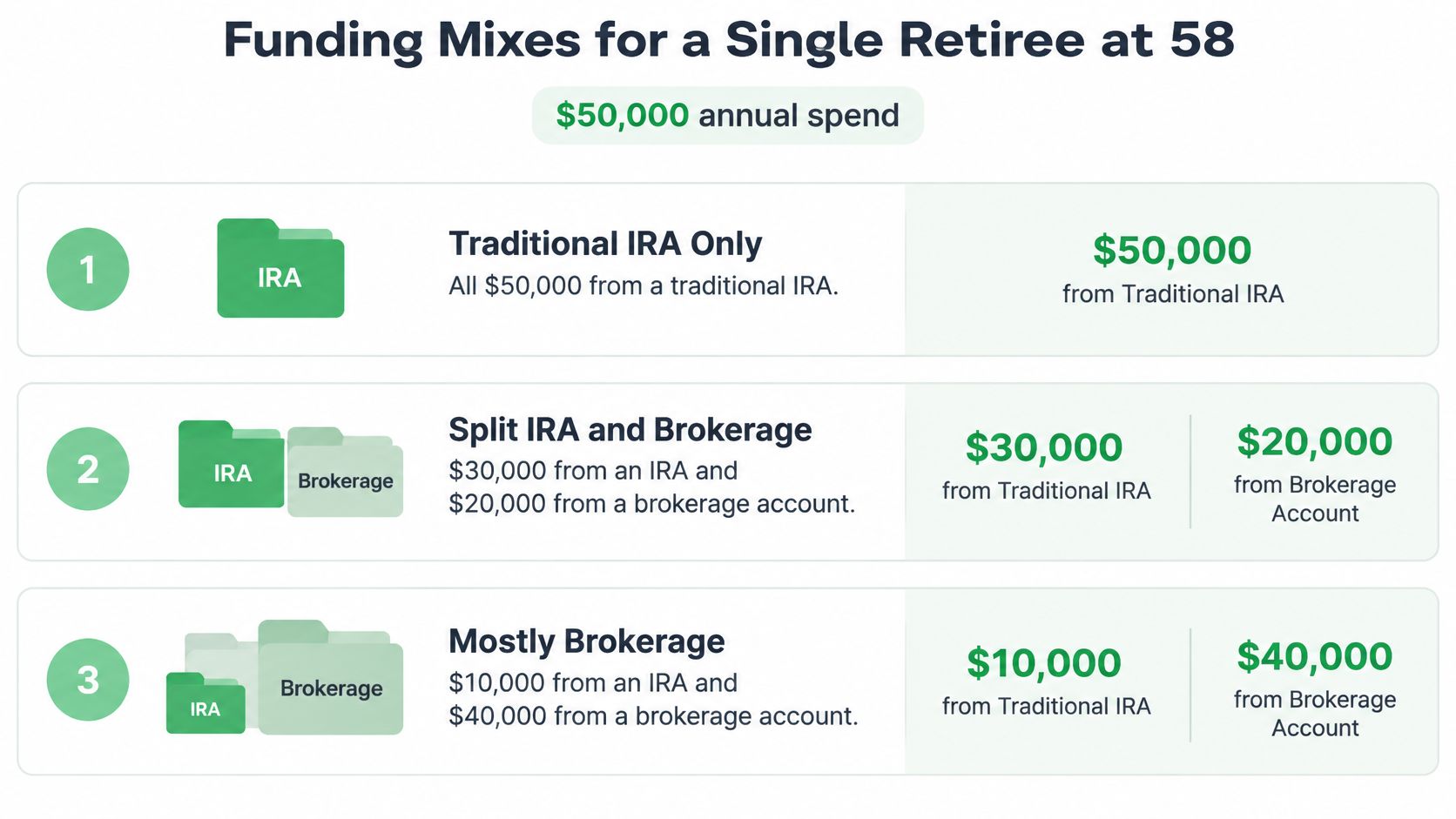
Score each mix on one line: net premium after the credit + expected out-of-pocket spending + tax on the withdrawals. Lowest total wins. Then stress-test the year that won.
Use a net premium after credit of $4,800 for the two mixes that keep modified adjusted gross income near $50,000, and $600 when income falls near zero. Expected out-of-pocket spending is $2,400 in a typical year on every mix. Tax is about $6,000 on a full $50,000 IRA withdrawal, about $6,600 when $30,000 comes from the IRA and $20,000 is realized gains, and $0 when the cash is Roth contributions plus taxable basis.
| Withdrawal mix | Estimated MAGI | Premium tax credit status | Total bridge cost |
|---|---|---|---|
| 1. All $50,000 from traditional IRA | About $50,000 | Eligible, under the $62,600 line (400% of the 2025 one-person guideline) | About $13,200 (premium $4,800 + out-of-pocket $2,400 + tax $6,000) |
| 2. $30,000 IRA plus $20,000 realized gains | About $50,000 | Eligible, same as mix 1 | About $13,800 (premium $4,800 + out-of-pocket $2,400 + tax $6,600) |
| 3. $50,000 from Roth contributions and taxable basis | About $0 | Larger credit, or Medicaid in an expansion state | About $3,000 (premium $600 + out-of-pocket $2,400 + tax $0) |
That $62,600 line is four times the 2025 federal poverty guideline for a household of one from the HHS ASPE poverty guidelines. Look up the current guideline for your household size and confirm the threshold on HealthCare.gov before you set a withdrawal target. The multiple moves every year.
Where the obvious answer breaks
Mix 3 wins this year's math by a wide margin. Roth contributions are finite. Burn them at 58 and you arrive at 63 and 64 with nothing left but the IRA, right when premiums are highest and MAGI has the least room to move. A clean year one and a painful year six is a bad bridge.
The floor is the second trap. If MAGI falls below the Medicaid threshold in an expansion state, you do not get a bigger subsidy. You move to Medicaid, and that network may not include the doctors you already use. Price all three mixes with your county's premiums, your drug list, and your tax return, then blend the withdrawals across the decade instead of optimizing a single year.
Taxes, HSAs and Bridging Strategies That Lower the Bill
You take an IRA withdrawal in November to pay a dental bill, and the Marketplace subsidy for the whole year disappears. That is the subsidy cliff in one decision. Enhanced premium tax credits expired for 2026 under current law, which restores the general 100% to 400% of poverty eligibility range for advance credits, as CMS's Marketplace enrollment materials describe. Above that band the credit does not taper. It ends.
Enrollment moved with that edge. Average monthly premium payments rose sharply from 2025 to 2026, and people between 400% and 500% of poverty accounted for a share of the enrollment drop far larger than their share of 2025 plan selections. A narrow band of income produced a disproportionate exit. Price the bridge as one total: net premium after the subsidy, expected out-of-pocket spending, and the tax on the withdrawal that paid for the year. Compare those totals for the same retiree before you choose the account.

The planning rule that follows: a withdrawal that adds a few thousand dollars of MAGI can cost more in lost subsidy than it saves in income tax. Put the tax and the premium in the same spreadsheet, on the same row, or you will keep picking the cheaper-looking account.
The accounts that help
A health savings account is the account built for the years before Medicare, with conditions. You must be enrolled in a qualifying high-deductible health plan to contribute. Contributions generally stop once you enroll in Medicare. Qualified medical expenses come out tax-free. Contributions also reduce the income the Marketplace counts, so the same dollar lowers both your tax and the MAGI that sets your credit. Confirm HSA eligibility for the specific bronze or silver plan in the plan documents and IRS rules before you contribute. Not every high-deductible plan qualifies. If a flexible spending account is also in the mix for prescriptions, read the FSA rules for compounded GLP-1 medications so an eligibility miss does not erase the tax break you counted on.
Three tactics that actually move the number
Build a healthcare reserve first. Size it to a full year of premiums plus the plan's out-of-pocket maximum, and hold it in cash or short Treasuries. A bad medical year then does not force an IRA withdrawal that kills the subsidy. The reserve is part of the total-cost math: it funds care without adding MAGI.
Spend from taxable accounts in threshold years. If MAGI is already close to the 400% line, take the next dollar from basis rather than from the IRA. A dollar of basis costs you nothing in subsidy. A dollar of IRA withdrawal can cost the full subsidy amount in a single year when it pushes MAGI over the line. Run both sources as the same three-part total: premium after subsidy, expected out-of-pocket, and tax on that withdrawal.
Time Roth conversions around the line, not through it. Convert in a low-income year. Stop the conversion before the extra income crosses the subsidy threshold, or you pay the conversion tax and lose the credit in the same year. Sequence the decade with the Roth conversion ladder, and cap each year's conversion at the MAGI that still keeps the credit.
Choose Your Bridge Plan and Recheck It Every Year
Open enrollment is a pricing problem. Put three plans side by side and score each one as a single total: net premium after the subsidy, expected out-of-pocket spending, and the tax on the withdrawals that produce the MAGI behind that subsidy. The lowest sticker premium often loses that comparison.
KFF found the average ACA Marketplace deductible rose from $2,759 in 2025 to $3,786 in 2026, a 37% increase, and that bronze plans made up about 40% of Marketplace enrollment in 2026 compared with 30% in 2025, a shift toward thinner coverage in the same year's enrollment mix, per KFF's Marketplace coverage tracking. Thinner coverage looks rational on the enrollment screen. It is expensive in the hospital.
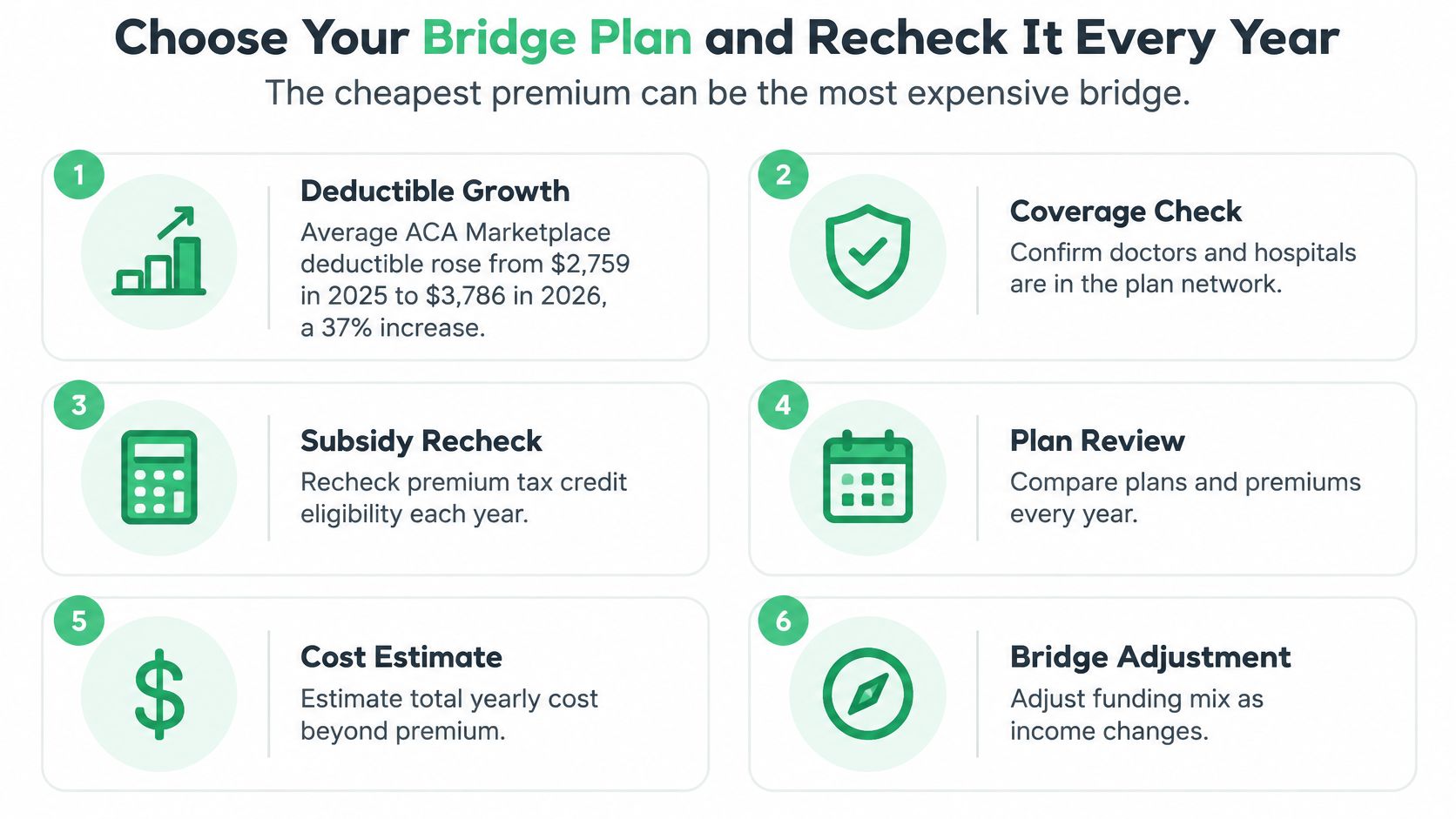
Price a bad year, not an average one
Ignore the monthly premium until you have the year's total. Build it in this order.
- Net annual premium. Monthly premium times 12, after the subsidy your expected MAGI produces.
- Plus the deductible, in full, because a bad year reaches it.
- Plus expected coinsurance on the care you realistically expect, based on last year's claims.
- Plus prescription costs at the plan's formulary tiers, not at retail.
- Capped at the plan's out-of-pocket maximum, which is the most the year can cost you in-network.
Then add the federal tax on the withdrawals that set that MAGI. A silver premium that only stays subsidized if you pull extra from an IRA can lose to a slightly higher premium funded in a way that keeps taxable income down.
Run the stack twice: once for an average year and once for a bad one with a surgery or a new chronic prescription. Compare bronze, silver, and gold on that full total. A gold plan with a $4,000 lower out-of-pocket maximum can beat a bronze plan by thousands in the year you get sick. That is the year this decision is for.
Buying the cheapest plan and hoping for a healthy year is a bet you make once a year and settle once a decade.
The five things to verify before you enroll
Provider network. Search each doctor and your preferred hospital by name in the plan's directory, then call the office and ask which plans they will accept next year.
Drug formulary. Look up every prescription by name and dose. Note the tier and any prior authorization requirement.
Prior authorization rules. Some plans require approval before imaging, procedures, or specialist visits. Read that list before you enroll, not after the scan is scheduled.
Deductible reset. Deductibles restart every calendar year, so a December surgery and a January surgery are two different bills.
Subsidy recheck. Run expected MAGI through the calculator again at each open enrollment. Poverty guidelines and subsidy rules both move, and last year's net premium is not this year's.
Then plan the exit at 65
Enroll in Medicare Part A and Part B during your initial enrollment period. Do not wait for a reminder. Part B can carry late-enrollment penalties if you delay after group coverage ends, and those penalties follow you for years. At 65, reprice the whole stack: Part B premiums, Part D drug coverage, and either a Medigap supplement or a Medicare Advantage plan. The bridge ends. The same total-cost math does not.
Your action this week is narrow. Take the three plans you are considering, price each one for a bad year with the five steps above, add the tax on the income that funds the subsidy, and pick the lowest expected total. Put a calendar reminder 60 days before open enrollment and run it again with current figures.
Get more posts like this
One short, useful email each Friday. Free, no spam, unsubscribe anytime.