Is 3 Million Enough to Retire? Run the Numbers First
Is 3 Million Enough to Retire? A 3.9% draw (2025 Morningstar) pays about $117,000 a year before taxes. Test it against your spending.

Daniel Anderson
Editor, The Money Maniac
November 6, 2026
12 min read

For a $3 million portfolio, Morningstar's 2025 base-case withdrawal rate of 3.9% supports about $117,000 a year before taxes over a 30-year retirement. Whether that's enough depends on how much you need the portfolio to cover after guaranteed income, housing, healthcare, and taxes.
The balance on a statement can feel decisive. The spending plan is more useful: $117,000 is a gross withdrawal, not a promise of $117,000 in take-home income, and it assumes a defined retirement horizon and investment mix. The question “Is $3 million enough to retire?” gets a more practical answer when you calculate the gap between your yearly expenses and the income you can count on.
What $3 Million Pays Out at Common Withdrawal Rates
The arithmetic is simple: $3,000,000 multiplied by the withdrawal rate equals first-year gross income. The hard part is deciding whether that income matches your household's actual spending.
Morningstar's 2025 retirement-income analysis estimates a 3.9% initial withdrawal rate for a 30-year retirement, with a 90% probability of avoiding portfolio depletion under the study's assumptions. It assumes inflation-adjusted withdrawals and a portfolio with roughly 30% to 50% stocks, with the rest in bonds and cash. It excludes Social Security, pensions, and other nonportfolio income. Applied to $3 million, the calculation is $3,000,000 × 0.039 = $117,000 in the first year, or about $9,750 a month before taxes. The Morningstar 2025 withdrawal-rate analysis describes the assumptions behind that estimate.
| Annual spending from portfolio | Withdrawal rate on $3M | How to read it |
|---|---|---|
| $75,000 | 2.5% | Wide margin for taxes, fees and bad years |
| $90,000 | 3.0% | Conservative, below the 3.9% base case |
| $117,000 | 3.9% | Morningstar 2025 base case, 30 years |
| $120,000 | 4.0% | Reasonable for 30 years, aggressive for longer retirements |
| $150,000 | 5.0% | Requires spending cuts after weak markets |
| $200,000 | 6.7% | Requires large cuts or a much shorter plan |
A 2.5% withdrawal gives the plan room to absorb taxes, fees, and difficult market years. At 6.7%, the portfolio has much less breathing room, so avoiding depletion may require substantial spending cuts or a shorter retirement. A flexible spending strategy can support a higher starting withdrawal, but the trade-off is that your income may need to fall when markets perform poorly. The Morningstar discussion of flexible withdrawal strategies explains why a higher initial figure comes with less income stability.
There's also a difference between Morningstar estimates published at different times. A separate analysis published in December 2024 put the highest starting rate for fixed, inflation-adjusted spending over 30 years at 3.7%, or $111,000 from $3 million. That estimate and the 2025 figure of 3.9%, or $117,000, are both 90% success estimates, not guarantees. The December 2024 Morningstar retirement-spending analysis provides the earlier estimate. Use the row closest to your portfolio-funded spending, rather than treating either figure as a universal rule. For a plain-language explanation of the widely used 4% framework, see our guide to the 4 percent rule.
How Retirement Length Changes the Answer
A withdrawal rate that may fit a 30-year plan can become aggressive when the portfolio must support 40 or 50 years. The longer the funding horizon, the more time the portfolio has to encounter bad markets, inflation, and unexpected costs.
| Retirement length | Starting withdrawal rate | First-year income from $3M | Source and year |
|---|---|---|---|
| 20 years | 5.5% | $165,000 | Morningstar, 2024, balanced portfolio |
| 35 years | 3.5% | $105,000 | Morningstar, 2025 |
| 40 years | 3.3% | $99,000 | Morningstar, 2025, a separate analysis gives 3.2% |
| 50 years | 2.9% | $87,000 | Morningstar, 2025 |
Morningstar's longer-horizon analysis puts the starting rate at 3.5% for 35 years, 3.3% for 40 years, and 2.9% for 50 years. Those translate to $105,000, $99,000, and $87,000 from $3 million, respectively, before taxes and other income. A separate Morningstar spending-shock analysis gives a 3.2% rate for 40 years, so check each estimate's year and assumptions instead of blending them into one supposedly exact number. The Morningstar horizon analysis lays out its longer-retirement estimates; a separate 2024 Morningstar analysis estimates a 5.5% initial rate for a balanced portfolio over 20 years.
Consider a 55-year-old planning to spend $120,000 a year from $3 million. That's a 4.0% first-year withdrawal. It may be workable against a 30-year horizon, but it's much more demanding if the money must last 40 years, to age 95. The same annual spending takes a larger bite from the portfolio relative to a longer plan's lower starting-rate benchmark.
The danger is sequence risk, the effect of poor returns early in retirement while withdrawals continue. If the portfolio drops 25% over its first two years, the retiree may have to sell investments at depressed prices to pay bills. Those sold shares can't participate when markets recover, leaving less capital to compound. That's why the order of returns matters, not just the average. For a fuller explanation, read our guide to sequence-of-returns risk.
Two practical safeguards are to hold several years of essential expenses in cash or high-quality bonds, and to set spending guardrails that trim discretionary costs after a major decline. Delaying Social Security can also reduce how much the portfolio needs to provide in later years, though the right claiming choice depends on your household. Those adjustments don't erase risk. They give you a plan for responding to it.
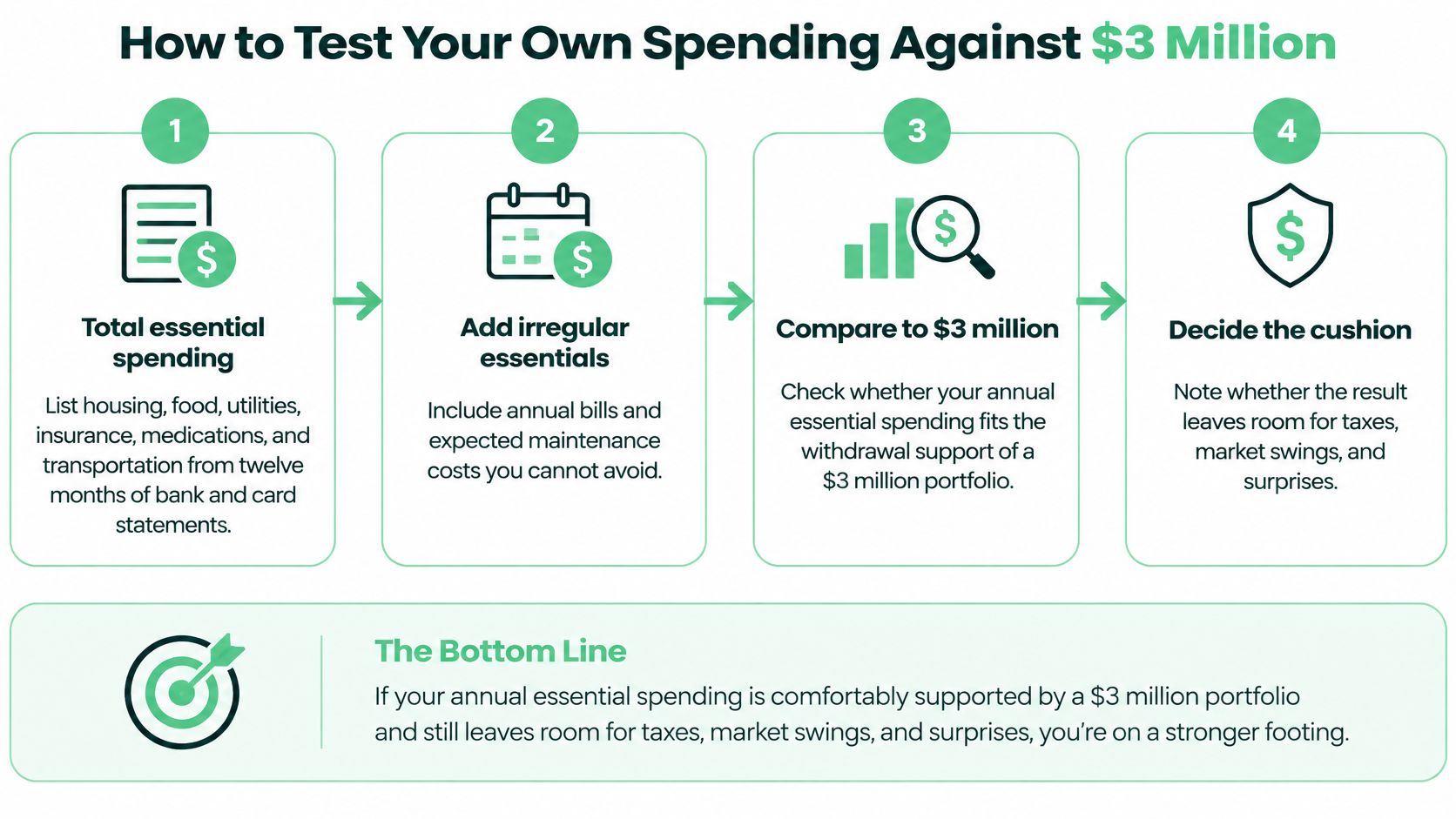
How to Test Your Own Spending Against $3 Million
Start with what leaves your accounts, not with a retirement-income target someone else picked. A useful calculation separates essentials from optional spending, then subtracts income you can reasonably count on.
-
Add up a normal year of essentials. Review twelve months of bank and card statements for housing, food, utilities, insurance, medications, and transportation. Memory is a poor budgeting tool, especially for bills that arrive once or twice a year.
-
Put discretionary costs on a separate line. Track travel, gifts, hobbies, and other optional spending apart from household necessities. That makes it easier to decide what you could trim after a weak market year.
-
Subtract guaranteed income. Use your Social Security estimate from ssa.gov and include any pension or annuity payment you already receive. Don't count an income source you're only hoping to have.
-
Divide the remaining need by $3 million. That gives you the withdrawal rate the portfolio must supply. If only part of the $3 million is investable, use the amount available for retirement spending instead.
-
Compare the result with the benchmark ladder. Check both the spending row and the retirement-length estimate. A rate that looks manageable for a shorter plan may be too high for a long one.
A worked example
Suppose a couple spends $150,000 a year, including $30,000 on travel, and expects $30,000 a year from Social Security. The portfolio must supply $120,000: $150,000 − $30,000 = $120,000. Divide that by $3 million and the required withdrawal rate is 4.0%.
Now suppose the couple cuts the $30,000 travel budget. Their spending becomes $120,000, and Social Security covers $30,000, leaving the portfolio to supply $90,000. That's a 3.0% withdrawal. A choice about discretionary spending moves the plan from a 4.0% draw to a meaningfully more conservative one. The point isn't that travel is wrong; it's that optional spending gives a plan room to adapt.
A basic spreadsheet is enough to run the test. Add input cells for annual spending, guaranteed income, and investable balance, then calculate the difference and divide by the balance. The output should show the required withdrawal rate and how far it sits above or below the benchmark that matches your horizon.
Where You Live and Whether the House Is Paid Off
A paid-off house can lower the amount your portfolio must provide, but it doesn't eliminate housing costs. Property taxes, insurance, utilities, repairs, and maintenance still belong in the budget. The mortgage is one line item, not the whole housing equation.
Take a couple near 65 whose home is paid off and whose annual spending is $90,000, including property tax, insurance, and upkeep. If Social Security supplies $30,000, the portfolio needs to provide $60,000. That's a 2.0% withdrawal from $3 million, below the 3.0% row in the spending table.
Now keep the same couple's Social Security income but change the housing situation: they still have a mortgage and live in a high-cost area, and their spending totals $150,000. The portfolio must supply $120,000, or 4.0%. That's a materially different plan, particularly if their retirement may extend beyond 30 years.
A single homeowner who sells and rents should rebuild the budget rather than assume the move automatically saves money. Add rent and likely moving costs, then remove the mortgage, property tax, and upkeep that no longer apply. The result depends on the actual rent, sale proceeds, and costs of the new arrangement. For a broader decision framework, read our guide to paying off a mortgage before retirement.
A paid-off house is not free. It changes the housing bill; it doesn't make the bill disappear.
Price your own location using current property-tax bills, insurance quotes, and rent comparisons. Date each quote so you know when to refresh it. Housing can move a household from the $90,000 spending row to the $150,000 row, and that changes the retirement math far more than a tidy account balance suggests.
How Taxes Shrink the Gross Withdrawal
The $117,000 figure is gross, meaning it's the amount withdrawn before taxes. The same gross withdrawal can leave very different amounts to spend depending on whether it comes from a traditional retirement account, a Roth account, or a taxable brokerage account. Morningstar's base-case withdrawal calculation excludes government benefits, while taxes reduce what's available for household expenses. The Social Security Administration's 2026 benefit update also lists an earnings limit for some people who claim benefits while continuing to work.
| Account type | General tax treatment | What it means for a $117,000 draw |
|---|---|---|
| Traditional 401(k) or IRA | Withdrawals are generally taxed as ordinary income | Spendable amount is lower than the gross draw |
| Roth IRA or Roth 401(k) | Qualified withdrawals are generally tax-free | Gross and spendable amounts stay closer |
| Taxable brokerage | Sales may create capital gains, with tax based partly on cost basis and holding period | The tax depends on the gains realized |
| Health Savings Account | Withdrawals for qualified medical costs are tax-free | Can serve as a dedicated healthcare reserve |
Here's a simplified illustration. If the entire $117,000 came from a traditional IRA and were taxed at a flat 22% for illustration, federal income tax would be about $25,700, leaving roughly $91,300 before considering any other taxes or adjustments. Real federal income tax is progressive, not a flat rate on every dollar, so use your actual tax situation rather than carrying that example into a plan.
The Social Security earnings test matters if you claim before full retirement age and keep consulting or running a small business. For 2026, the Social Security Administration lists a $24,480 earnings limit for people below full retirement age all year, with benefits reduced by $1 for every $2 earned above the limit. That's a benefit reduction rule, not a tax rate, and it should be considered separately from portfolio withdrawals.
Medicare premium surcharges, known as IRMAA, use income from two years earlier. A large withdrawal or other income spike can therefore affect future premiums. Model taxes account by account, and include the timing of withdrawals, rather than applying one percentage to the whole $3 million balance.
Healthcare Costs That Break the Simple Math
Medicare doesn't mean healthcare is free or fully covered. Fidelity's 2025 estimate is built around a single 65-year-old retiring in 2025, enrolled in Original Medicare Parts A and B plus Part D, with no employer-sponsored retiree health coverage. It includes premiums, copayments, coinsurance, deductibles, prescription-drug costs, and services Original Medicare doesn't cover. The Fidelity 2025 retiree-healthcare estimate has specific assumptions; a couple, someone retiring before 65, or someone needing substantial dental or vision care may face a different bill.
Build healthcare into the budget as its own set of expenses:
- Premiums: Include insurance premiums separately from routine spending.
- Cost sharing: Account for copayments, coinsurance, and deductibles.
- Prescriptions: Estimate regular medication costs, then consider how they might change.
- Excluded care: Budget for services not covered by Original Medicare, including most dental, vision, and hearing care, plus possible long-term care.
- Early retirement coverage: If you retire before 65, include bridge coverage. Marketplace premium subsidies depend on income, so withdrawals can affect the cost of coverage.
A useful stress test is to estimate premiums and out-of-pocket costs on separate lines, add a reserve for one unusually expensive year, and rerun the spending calculation with and without that year. That won't predict a health crisis. It shows how much flexibility the plan has if one arrives.
Healthcare costs can pressure households into delaying or skipping care. In 2025, 26% of U.S. adults reported going without some medical care because they couldn't afford it, down from 28% in 2024, according to the Federal Reserve's 2025 household economic well-being report. For readers comparing coverage needs before retirement, this guide to full-year health coverage statistics offers additional context. A health shock and a market decline can happen in the same year, which is precisely when a plan with no slack gets tested.
Stock Share the 3.9 Percent Estimate Assumes
Morningstar's 2025 base case uses a portfolio with roughly 30% to 50% stocks, with the remainder in bonds and cash. It pairs that allocation with a 30-year horizon and a 90% probability of avoiding depletion under its assumptions. That mix is an input to the estimate, not a guarantee that any portfolio inside the range will achieve the same result.
If your stock share is well below 30%, the portfolio may be less exposed to stock-market declines, but inflation can still erode what fixed-dollar withdrawals buy. The $117,000 starting withdrawal is designed to rise with inflation under the study's assumptions. A more conservative allocation doesn't automatically make that rising spending easy to support.
If your stock share is well above 50%, the withdrawal calculation remains 3.9% of $3 million, but the portfolio may take a deeper early loss in a stock-market decline. That matters most when withdrawals are already coming out and the plan hasn't had time to recover. Neither allocation guarantees a 90% outcome, and a withdrawal rate is not a promised return.
The Money Maniac recommends a stock-allocation formula of 110 minus your age, with the rest in bonds. Treat that as a separate rule of thumb, not as the allocation Morningstar used in its estimate. If you track digital assets alongside traditional investments, a dashboard to track multiple crypto wallets can help keep those holdings visible, but it doesn't replace checking your overall allocation and risk.
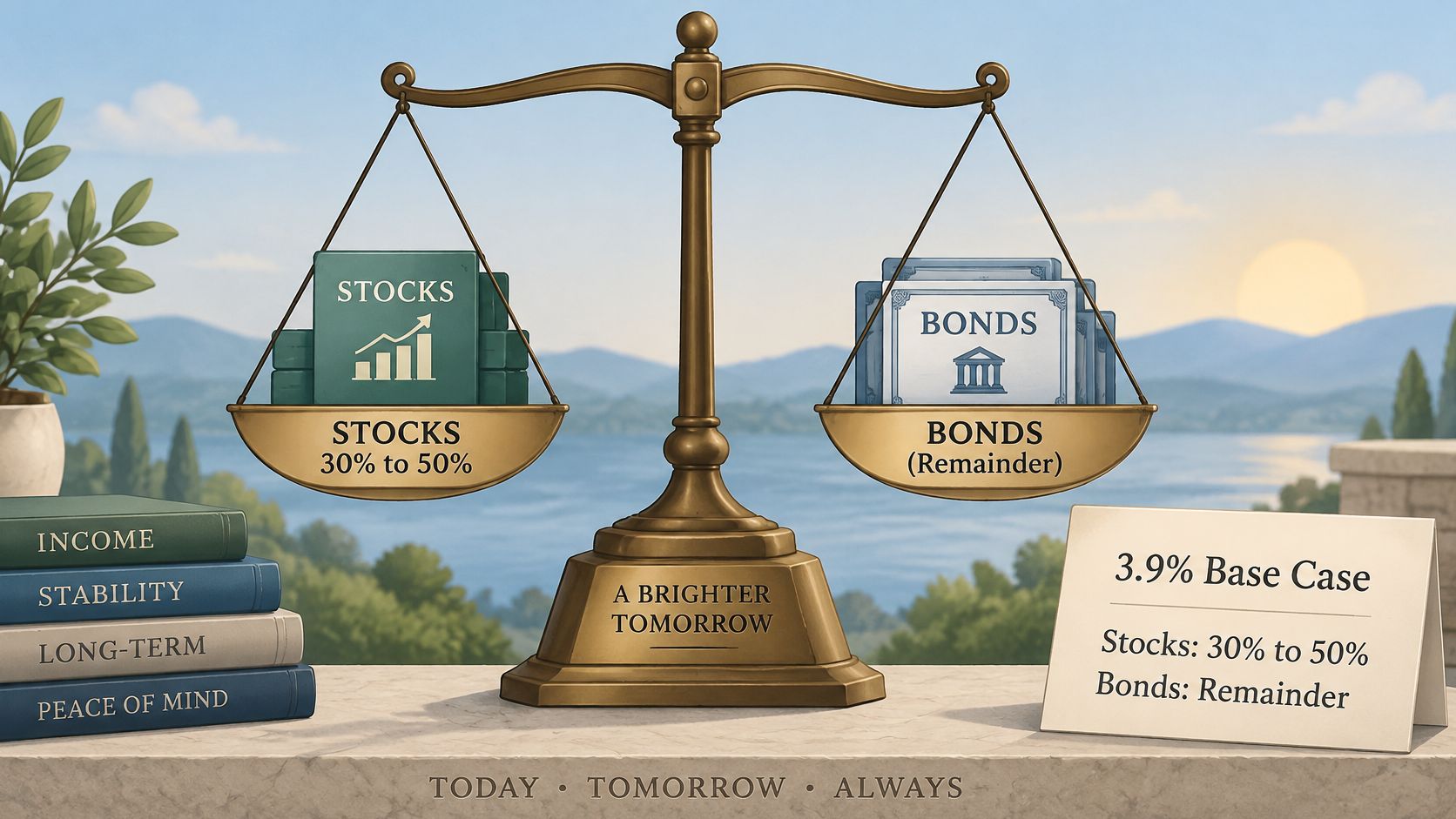
Check whether your stock allocation falls inside the range used for the 3.9% estimate. If it doesn't, rerun the spending test with assumptions that reflect your actual portfolio. Don't treat bond yields as permanent inputs: date any yield you use in an example and check the current figure at Treasury.gov.
Decide Whether $3 Million Covers Your Retirement
For many households retiring near 65, $3 million can support a comfortable plan when portfolio spending stays near or below $90,000 before Social Security. That's a 3.0% withdrawal, below Morningstar's 2025 30-year base-case rate of 3.9%. The case is stronger when essential expenses are manageable and you're willing to cut discretionary spending after a poor market year.
The answer is more borderline if you need $100,000 to $120,000 a year from the portfolio, or expect a retirement lasting 35 years or more. Taxes, Medicare premiums, and the lower starting rates associated with longer horizons can shift the result. A need for $150,000 or more from the portfolio, with little guaranteed income, is a much harder fit. So is a fixed, inflation-adjusted lifestyle stretching 40 to 50 years, when the longer-horizon benchmarks are near 3.2% to 2.9%.
Work through these steps before treating the balance as a green light:
- Total a year of actual spending, including housing and healthcare, then subtract the Social Security estimate available through ssa.gov.
- Divide the remaining need by $3,000,000 and compare the result with the benchmarks for your retirement length.
- Recalculate your available spending after taxes, account by account.
- Check Medicare costs at Medicare.gov and current Treasury yields at Treasury.gov, dating any rate you use.
- Have a licensed professional review the tax and healthcare details.
The practical verdict is clear: $3 million is enough for many retirees, but the portfolio-funded spending gap and the time horizon decide whether it's enough for you. The examples here are hypothetical, and past study results are not promised returns. Do your own research or consult a licensed professional before making investment decisions.
Get more posts like this
One short, useful email each Friday. Free, no spam, unsubscribe anytime.