What Is the 4 Percent Rule for Retirement: A Guide
What is the 4 percent rule for retirement? Discover how this withdrawal guideline helps you plan savings and avoid running out of money.

Daniel Anderson
Editor, The Money Maniac
October 17, 2026
11 min read

The most popular retirement advice in America is also one of the easiest to misunderstand. The 4 percent rule doesn't mean you withdraw 4 percent of your current balance every year, and it doesn't guarantee your savings will last. Treat it as a starting hypothesis built from historical market data, then adjust your plan for the length of retirement, your spending needs, and your ability to cut back when markets fall.
The 4 Percent Rule in Plain English
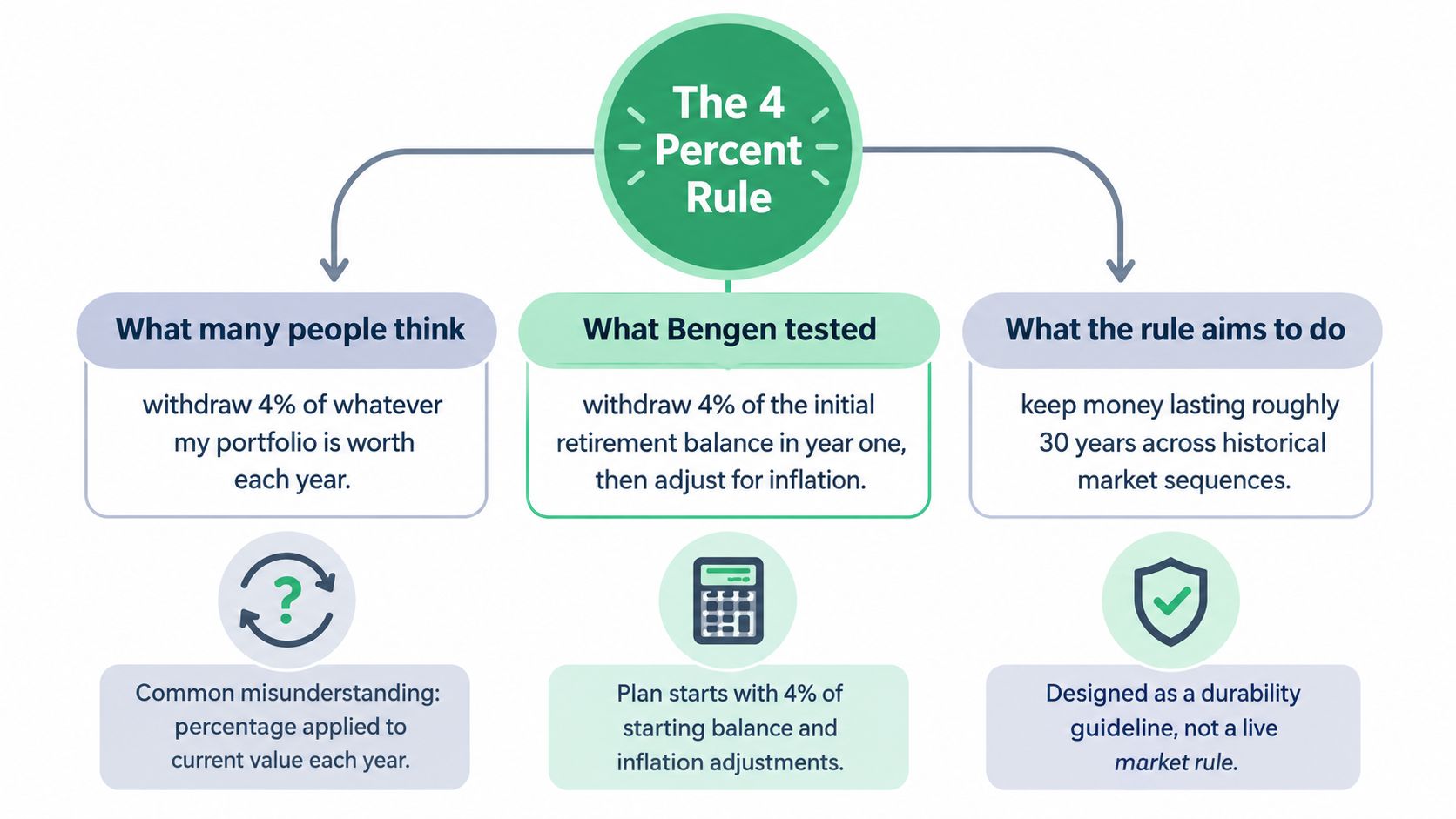
Many people hear “4 percent rule” and assume they should withdraw 4 percent of whatever their portfolio is worth each year. That approach would make withdrawals rise and fall with the balance. The classic rule works differently: you take 4 percent of your starting portfolio in the first year, then increase that original dollar amount with inflation in later years.
For example, a $1 million portfolio starts with a $40,000 withdrawal. If inflation is 3 percent, the next year's target is $41,200. That target doesn't automatically change just because the portfolio has grown or declined. The rule aims to keep spending power steadier, but that consistency can put pressure on a portfolio after a market drop.
What the rule assumes
The rule was built around a roughly 30-year retirement, a portfolio holding stocks and bonds, and historical U.S. market performance. It's a way to estimate an initial withdrawal level under those assumptions, not an instruction to follow blindly or a promise that the money will last.
Taking 4 percent of the current balance each year is a different strategy. It can help prevent withdrawals from overwhelming a falling portfolio, but the income it produces can drop sharply when the balance declines. The classic rule instead prioritizes a more stable, inflation-adjusted dollar amount.
If you're also weighing pension income, start by understanding what that income is worth in your plan. This guide to valuing a pension can help frame that question.
The headline figure
William Bengen's original research found a rate near 4.15 percent in its historical tests. He rounded it down to 4 percent, a cleaner planning number that became the rule's enduring shorthand. The practical takeaway is simple: think of 4 percent as a first-year spending estimate, not a percentage you recalculate against your current balance every year.
Where the 4 Percent Rule Came From
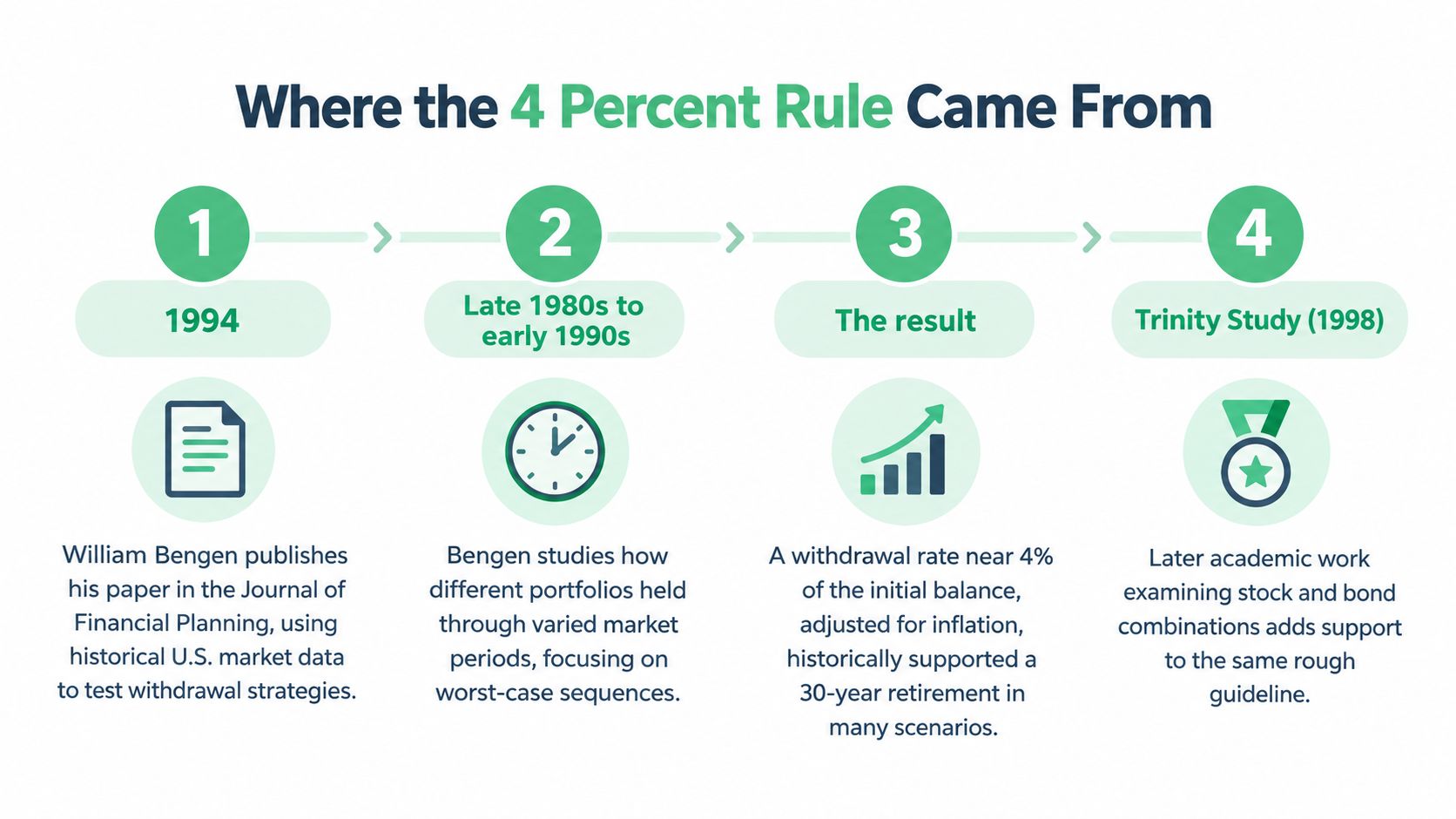
William Bengen was trying to answer a practical question: how much could a retiree initially withdraw from a portfolio without exhausting it during difficult historical market periods? His research, published in the October 1994 issue of the Journal of Financial Planning, tested historical U.S. returns and inflation rather than forecasting what future markets would do.
The portfolio in his analysis was split roughly equally between large-cap U.S. stocks and intermediate-term government bonds. Bengen examined 30-year retirements, looking closely at the hardest historical periods for retirees who kept increasing their withdrawal in line with inflation. His result, about 4.15 percent, was a historical stress-test finding, not a mathematical guarantee. He later revised his estimate upward, while the rounded 4 percent figure stayed in common use. (Background on Bengen's original research)
A benchmark, not a forecast
Later research kept the debate alive by changing the assumptions and asking related questions. The important point isn't that one later estimate definitively replaces Bengen's result. It's that the answer moves when projected returns, bond yields, stock valuations, inflation, portfolio allocation, and the definition of success change.
For example, Morningstar's 2024 research estimated a 3.7 percent starting withdrawal rate for an inflation-adjusted 30-year retirement with a 90 percent probability of having money left at the end. Its estimate had been 3.3 percent in 2021, 3.8 percent in 2022, and 4.0 percent in 2023. Its later 2025 research put the comparable estimate at 3.9 percent for a balanced portfolio with roughly 30 to 50 percent equities.
That movement is a feature of assumption-based planning, not evidence that there's one magic number waiting to be discovered. Bengen's work remains useful because it asks how a portfolio held up through ugly historical sequences. Its limits matter just as much: the analysis used U.S. history, a particular stock-and-bond mix, and a 30-year horizon. Your portfolio, taxes, country, spending flexibility, and retirement length may differ.
How the Math Actually Works
Start with your portfolio balance on the date you retire. Multiply it by 4 percent to estimate the first year's portfolio withdrawal, then adjust that dollar amount for inflation each year.
With $1 million, the first-year withdrawal is $40,000. At 3 percent inflation, the second-year target becomes $41,200, whether the portfolio rose or fell in the meantime. That illustration shows the classic method, not a forecast of portfolio performance. (The classic inflation-adjusted withdrawal example)
| Classic 4% Rule on a $1M Portfolio (3% Inflation Example) | |||
|---|---|---|---|
| Year | Starting Balance | Inflation-Adjusted Withdrawal | Portfolio After Withdrawal |
| 1 | $1,000,000 | $40,000 | Starting balance minus withdrawal |
| 2 | Not specified | $41,200 | Starting balance minus withdrawal |
| Later years | Depends on investment returns and prior withdrawals | Previous withdrawal adjusted for inflation | Depends on investment returns and withdrawal |
The table deliberately doesn't invent the account's future balance. To calculate that, you'd need to specify investment returns, fees, and when returns occur. Those details are precisely why a withdrawal rule can't tell you in advance what your balance will be.
The shortcut, and its limit
The rule also gives you a quick way to estimate a portfolio target: multiply desired first-year portfolio withdrawals by 25. If your planned first-year withdrawal is $40,000, the corresponding starting portfolio is $1 million under the 4 percent framework.
Keep the calculation focused on the amount your investments need to provide. If a pension or Social Security covers part of your spending, the portfolio may need to fund only the remaining gap. And if your spending estimate leaves out taxes or health costs, the result can look reassuring while answering the wrong question.
Two withdrawal methods, two kinds of paycheck
With the classic method, the dollar withdrawal is adjusted for inflation. That supports steadier spending, but it doesn't automatically shrink after a poor market year. Withdrawing a percentage of the current balance does respond to market conditions, but it can produce a much smaller paycheck after losses.
Neither method makes market risk disappear. Before choosing, decide which trade-off your household can live with: more stable withdrawals that put greater demands on the portfolio in weak markets, or more variable withdrawals that may require real spending changes.
The Risk Nobody Wants to Talk About
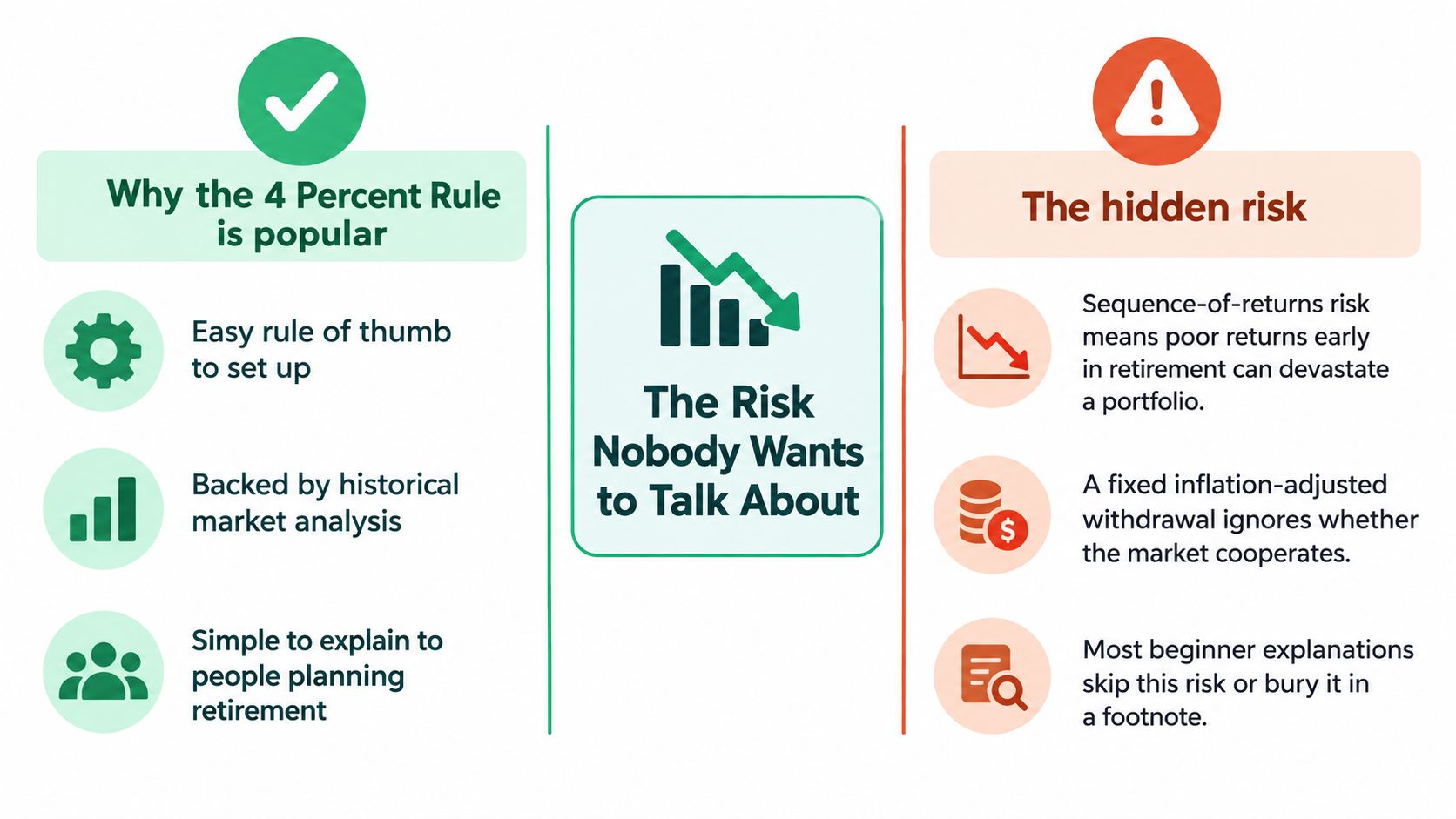
A retiree can start with a sound plan and still face a punishing sequence: markets fall early, but the bills keep coming. If the retiree sells investments to fund the planned withdrawal while prices are depressed, they sell more shares to raise the same amount of cash. Fewer shares remain invested for a recovery.
That's sequence-of-returns risk. The order of investment gains and losses matters when someone is withdrawing money. Poor returns early in retirement, combined with fixed inflation-adjusted withdrawals, can permanently impair a portfolio even if long-run average returns look fine. (Explanation of sequence-of-returns risk)
Why timing changes the damage
A 30 percent drop in year two can be more harmful than the same drop in year twenty because the retiree has a longer stretch of withdrawals ahead and may have to sell during the decline. A later drop can still hurt, of course, but the portfolio has already had more time to recover from previous market cycles. A retirement plan has no control over the order in which returns arrive.
This is why a plan that works on average returns can fail under an unlucky sequence. And it's why “I'll just stay invested” is easier to say before a market decline than while watching an account balance fall and monthly expenses continue.
Build a decision before you need one
Decide in advance what you'll do if your portfolio falls substantially. One practical response is to pause inflation increases or trim optional expenses temporarily rather than insist that every withdrawal rise on schedule. That's a judgment call, but making it while markets are calm is usually clearer than improvising under stress.
For a closer look at the mechanics and ways to protect your retirement portfolio, read about sequence-of-returns risk before you're forced to confront it. The goal isn't to predict the next downturn. It's to know which spending you can adjust if one arrives early.
What If Retirement Lasts Longer Than 30 Years
The standard 30-year assumption is a poor fit for someone retiring early or planning for a retirement that may run longer. The right withdrawal rate depends partly on the length of time the portfolio needs to support spending. A rule built for three decades shouldn't be treated as a default for a five-decade plan.
Recent reporting cites a revised historical methodology that puts a 30-year starting rate near 4.7 percent, but the rate falls to approximately 4.2 percent for a 50-year retirement. These figures come from a particular methodology, not a universal answer for every portfolio or retiree. (Reporting on withdrawal rates over longer horizons)
| Starting Safe Withdrawal Rates by Retirement Horizon | ||
|---|---|---|
| Retirement Horizon | Indicative Starting Rate | Year-One Income on $1M |
| 30 years | Near 4.7% under the cited revised historical methodology | Near $47,000 |
| 40 years | No specific rate provided in the cited data | Not specified |
| 50 years | Approximately 4.2% under the cited methodology | Approximately $42,000 |
The available figures don't establish a specific rate for a 40-year horizon. Don't fill that gap by guessing or by treating the two other estimates as a formula. A proper estimate needs assumptions about the portfolio, spending pattern, returns, and what counts as success.
Name the goal before choosing the number
A portfolio intended to fund spending for a defined horizon faces a different job from one that must also preserve an inheritance. Those goals can point toward different spending decisions. So can the difference between essential expenses and optional ones: it may be easier to adjust discretionary spending than housing, utilities, or healthcare.
Early retirees should be especially cautious about applying a 30-year benchmark without extending the planning horizon. A lower initial withdrawal, delayed retirement, part-time income, or a plan that allows discretionary spending to move with market conditions can reduce pressure on the portfolio. The best starting rate is the one that matches the length and purpose of the plan, not the one with the friendliest headline.
Rigid Rules vs Flexible Spending
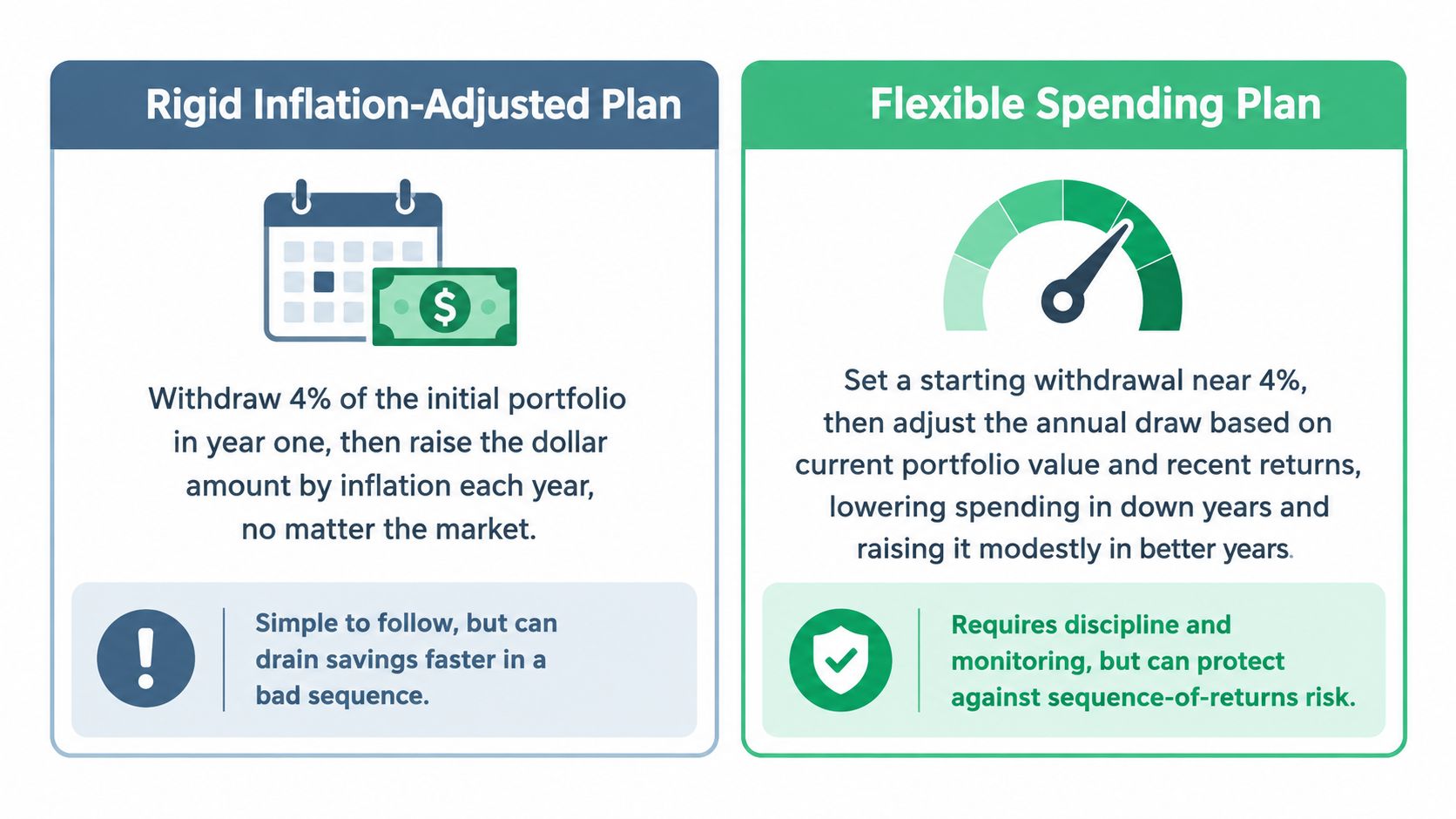
The classic rule favors predictable withdrawals. A flexible plan gives up some paycheck stability in exchange for the option to reduce portfolio pressure after weak returns. That flexibility can matter more than the difference between two headline percentages.
PGIM research finds that retirees with greater spending flexibility can sustain withdrawal rates approximately 25 percent higher on average than retirees following more conservative, inflexible spending patterns. That result is an average finding, not a guarantee for an individual household, and it depends on the spending approach being compared.
A practical side-by-side
| Rigid inflation-adjusted plan | Flexible spending plan |
|---|---|
| Start with a withdrawal based on the initial portfolio, then raise the dollar amount with inflation. | Start with a planned withdrawal, then revisit spending as portfolio conditions change. |
| Strength: Easier to budget around a more stable dollar amount. | Strength: Allows a household to ease back on optional spending when the portfolio is under strain. |
| Trade-off: The schedule doesn't automatically adapt after market declines. | Trade-off: Income can vary, and the household needs clear guardrails and the discipline to follow them. |
Useful guardrails don't need to be elaborate. You might skip an inflation increase after a major market decline, reduce discretionary withdrawals, or use a percentage of the current balance for optional spending while protecting an essential-spending floor. The specifics should fit your household and be written down before a difficult year arrives.
A 2024 simulation study found that adaptive withdrawals tied partly to investment performance can improve sustainability. It also found that changing withdrawal frequency itself doesn't meaningfully affect success; the timing of withdrawals should mainly match when expenses occur. In plain English, deciding whether to take money monthly or annually is less important than deciding whether your spending can adjust when the portfolio struggles.
For a household whose baseline expenses rely partly on future benefits, understanding when to take Social Security can help clarify how much income the investment portfolio may need to supply. Treat any benefit as part of the full income picture, not as a substitute for stress-testing the withdrawal plan.
Applying the Rule to Your Own Numbers
A useful plan begins with your spending gap, not with a percentage pulled from a headline. Work through these steps and keep the assumptions visible.
- Estimate first-year spending. Include essential costs, discretionary goals, taxes, healthcare, and known large expenses. Separate what you must spend from what you could reduce.
- Subtract dependable income. Account for income such as Social Security and pensions. The remaining gap is what the portfolio may need to fund.
- Choose a starting rate that fits your horizon. Consider how long the portfolio may need to last and whether you can adjust spending after poor returns. Don't assume the standard 30-year framework fits an early retirement.
- Check the portfolio assumptions. Bengen's original analysis used a particular U.S. stock-and-bond mix. If your investments, fees, or taxes differ, say so in your model rather than pretending the rule covers those differences.
- Stress-test bad sequences. Ask what happens if weak returns arrive early, inflation raises expenses, or a major cost appears. Decide which discretionary withdrawals you'd reduce before that situation occurs.
A calculator can help with arithmetic, but it can't make unrealistic inputs honest. The Money Maniac's FIRE calculator is one way to test a target against your assumptions; use it alongside a written spending plan and scenarios for poor early returns. Revisit the result when your expected retirement date, income, or spending changes.
A Clear-Eyed Takeaway
The 4 percent rule is still a useful historical benchmark. It's also over-quoted and under-examined when people treat it as a promise, apply it to a longer retirement without adjustment, or forget that fixed inflation-adjusted withdrawals can strain a portfolio after early losses.
My recommendation is to use 4 percent as a first calculation, then challenge it. Match the horizon to your actual plan, include dependable income and taxes in your spending picture, and set a specific response to market declines. This week, write down your estimated first-year portfolio spending and the optional expenses you'd cut first if returns are poor. That's a more useful retirement plan than just circling a percentage.
Get more posts like this
One short, useful email each Friday. Free, no spam, unsubscribe anytime.