Retirement Bucket Strategy: How It Works and When It Pays
Retirement bucket strategy explained: how cash, bond and stock buckets fund spending, with sample sizes, trade-offs and tax rules.

Daniel Anderson
Editor, The Money Maniac
November 5, 2026
14 min read

The most popular bucket advice is also the laziest. Park five years of spending in cash, put the rest in stocks, and relax. That sounds prudent until you price it. Five years of cash can mean hundreds of thousands of dollars earning little, losing ground to inflation, and still leaving you with the hardest question unanswered. When do you refill it, and from what?
My view is simple. A retirement bucket strategy can be worth building, but the labels on the buckets matter far less than your refill rule. Get the refill wrong and you can do worse than a plain diversified portfolio with a written withdrawal rule. Get it right and you gain something valuable, though modest. You gain a system that stops a bad market month from turning into a panicked stock sale.
What a Retirement Bucket Strategy Is and Why It Exists
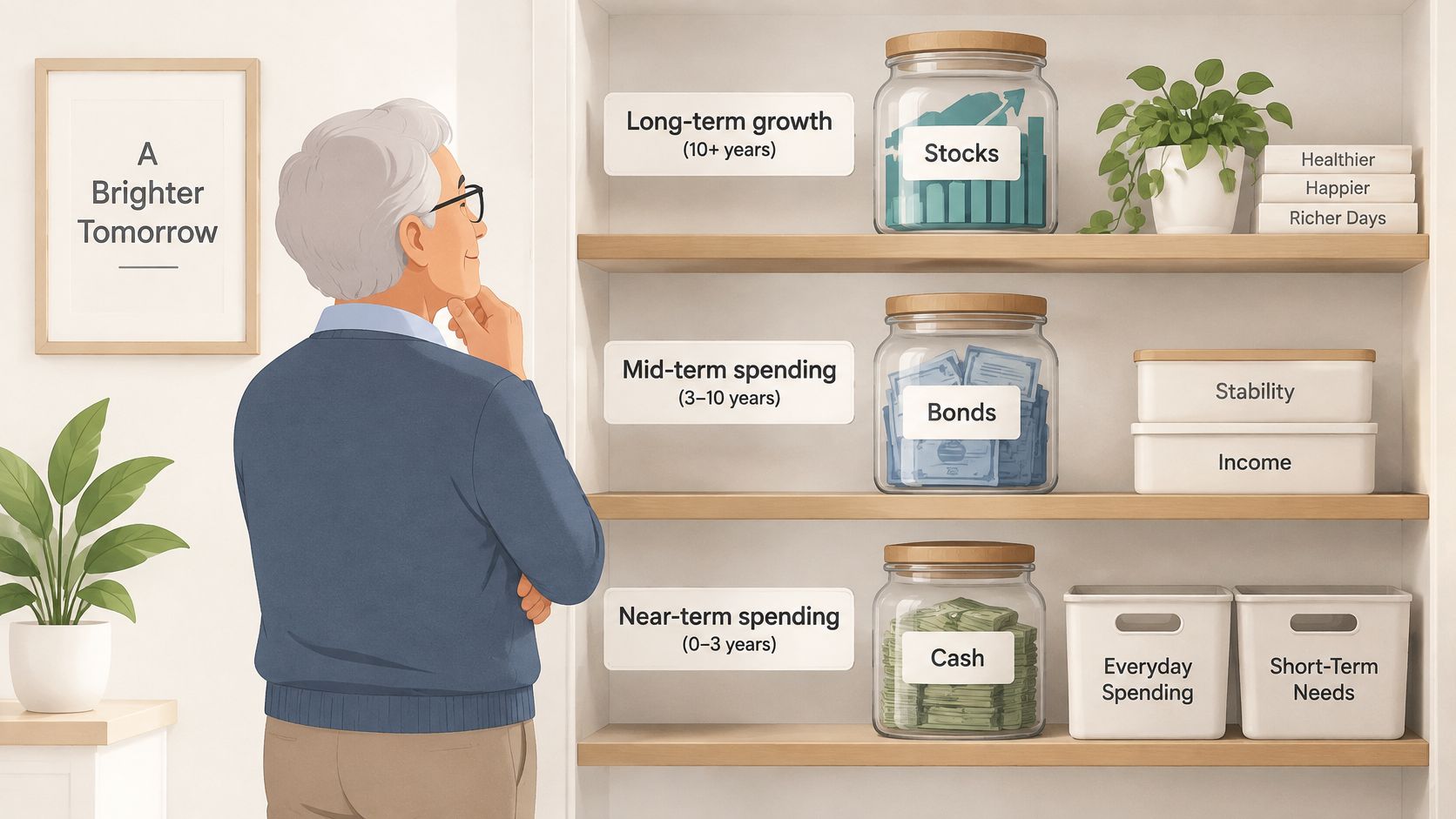
Think of a pantry with shelves labeled by when you'll eat what's on them. This week's food sits up front. Food for later this year sits in the middle. The long-life staples go in back. A retirement bucket strategy sorts money the same way, by spending horizon. Near-term spending goes in cash, mid-range spending goes in high-quality bonds, and money you won't touch for years stays in growth assets like stocks.
The Risk Buckets Are Built For
The target is sequence-of-returns risk. Two retirees can earn the same average return over 30 years and end in very different places. If your losses arrive early, while you're also withdrawing money for bills, you sell more shares at low prices to raise the same dollars. Those shares never recover because you no longer own them. Losses late in retirement hurt less because fewer withdrawals remain.
Cash up front attacks that problem directly. You spend the cash during a decline and leave the stock bucket alone. That reduces forced sales. It doesn't stop markets from falling, it doesn't guarantee income, and it doesn't fix a withdrawal rate that's too high for the portfolio.
Practical rule: Buckets organize the timing of your spending. They don't create extra return out of thin air.
Where the Idea Came From
Wealth manager Harold Evensky developed his "now versus later" framework in 1985, and Capital Group's description of the bucket strategy for retirement income describes the original approach as a two-segment system, with cash for near-term needs and investments for long-term growth. In that original design, the cash segment held approximately five years of living expenses.
Run the arithmetic on a common example. A retiree spending $60,000 a year in total might reserve about $300,000 in cash or short-term assets for five years, leaving the rest invested. That's the classic picture, and it's useful for understanding the concept.
Hold onto one distinction, because it changes every number that follows. That $60,000 is total annual spending. In practice, you should size your buckets from the smaller amount your portfolio has to fund after Social Security and any pension. The two questions worth answering carefully are how big each bucket should be and how refilling works once you start spending.
Sample Bucket Sizes for a $40,000 Annual Gap
A bucket sized to total spending can hold far more cash than the portfolio needs to provide. Start with the portfolio-funded gap: annual spending minus reliable income from Social Security, pensions, and annuities. For example, if spending is $85,000 and reliable income covers $45,000, the gap is $40,000. Use that gap to size the buckets.
Bucket sizes for a $40,000 annual portfolio-funded gap
| Approach | Cash bucket | Fixed-income bucket | Growth bucket |
|---|---|---|---|
| Original two-segment approach | $200,000 (5 years) | None held separately | Remaining assets invested for growth |
| One-year-plus-two-years example | $40,000 (1 year) | $80,000 (2 years) | Remaining assets invested for growth |
| Three-bucket layout | $80,000 (2 years) | $200,000 to $320,000 (5 to 8 years) | Remainder, dominated by globally diversified equities |
Reading the Three Rows
The original two-segment approach holds five years of the gap in cash: $200,000 here. That is straightforward, but it leaves more money out of growth investments, which can carry a long-term opportunity cost.
The one-year-plus-two-years example holds $40,000 in cash and $80,000 in fixed income. Vanguard's retirement spending guidance describes keeping one year of living expenses in savings after emergency savings, then another two years in relatively stable fixed income, such as certificates of deposit, Treasury notes, or municipal bonds.
The three-bucket layout holds $80,000 in cash and $200,000 to $320,000 in high-quality fixed income. Morningstar's guide to generating retirement income describes its first bucket as about two years of net spending in cash, its second as roughly five to eight years in fixed income, and its third as a globally diversified portfolio dominated by equities.
Treat cash as a reserve for near-term bills, not a return-seeking investment. A larger reserve can reduce the need to sell investments during a downturn, but it also leaves more of the portfolio exposed to inflation.
The Withdrawal Rate Underneath It All
A bucket arrangement cannot make an unsustainable withdrawal rate sustainable. William Bengen's 1994 analysis found that withdrawing 4% of the initial portfolio in the first year, then increasing the dollar amount with inflation, survived every 30-year period in U.S. data extending back to 1926. In Wade Pfau's Journal of Financial Planning paper on withdrawal rates, international research covering 21 countries and 115 years from 1900 through 2014 found that a 5% withdrawal rate failed in 22.5% of U.S. cases, while 4% failed in 0%.
A 2024 bucket backtest covering 749 start dates found that a conventional bucket plan funded a 4% annual withdrawal for 30 years in 96.0% of start dates. Treat those results as context, not a promise. Fees, taxes, and asset mix affect what a portfolio can support.
Set the cash reserve according to the income gap and the time you can leave investments untouched. If Social Security and a pension cover at least half of your spending, one to two years of the remaining gap in cash is often enough.
Time-Based, Laddered and Core-Satellite Setups Compared
The bucket labels matter less than the rule for turning investments into spending money. A time-based setup organizes assets by when you expect to use them. A bond ladder schedules principal repayments. A core-satellite setup pairs a spending-oriented core with a smaller growth allocation.
Bucket variations compared
| Variation | How the buckets are set | Best fit | Main drawback |
|---|---|---|---|
| Time-based buckets | Cash for the next 1 to 2 years, bonds for the following years, growth assets for later spending | Retirees whose Social Security covers most fixed bills and whose remaining spending is fairly predictable | Needs a written refill rule and can carry cash drag |
| Bond ladder | Bonds that mature each year to match planned spending | People who value known maturity dates | Less flexible if spending changes; exposed to reinvestment and inflation risk |
| Core-satellite | A stable core covers spending; a smaller satellite holds growth assets | Retirees who want simple management and some upside | The satellite can be sold at a bad time, and the core can still lose value |
How Each One Behaves in Practice
Time-based buckets sort money by when you plan to spend it. Cash handles near-term withdrawals, bonds cover later spending, and growth assets are reserved for money you expect to need further out. The arrangement is easy to explain, but it needs a written rule for replenishing cash. Otherwise, the buckets are just labeled piles.
A bond ladder uses bonds that mature in consecutive years, returning principal on a schedule. That makes cash arrivals easier to plan around. The trade-offs are reinvestment risk, since a maturing bond may need to be replaced at a lower yield, and inflation risk, which can reduce what each dollar buys. For near-term holdings, our guide to high-yield savings accounts versus CDs explains the liquidity and rate trade-offs.
Core-satellite can look like a bond fund covering $40,000 in annual spending alongside a stock index fund held for growth. The core is intended to support withdrawals; the satellite provides growth potential. Selling the satellite after a market drop can lock in losses, while bonds in the core can also fall in value when interest rates rise.
Labels don't reduce risk. The decision about what you sell, and when, does the actual work.
Choose time-based buckets when spending is predictable and you can follow a clear refill rule. Choose a ladder if scheduled maturities matter more to you than flexibility. Choose core-satellite if you want a simple spending core with a separate growth allocation. In every setup, the refill rule determines whether you sell after a market decline, wait for a recovery, or use maturing assets instead.
How to Build and Refill Your Buckets Step by Step
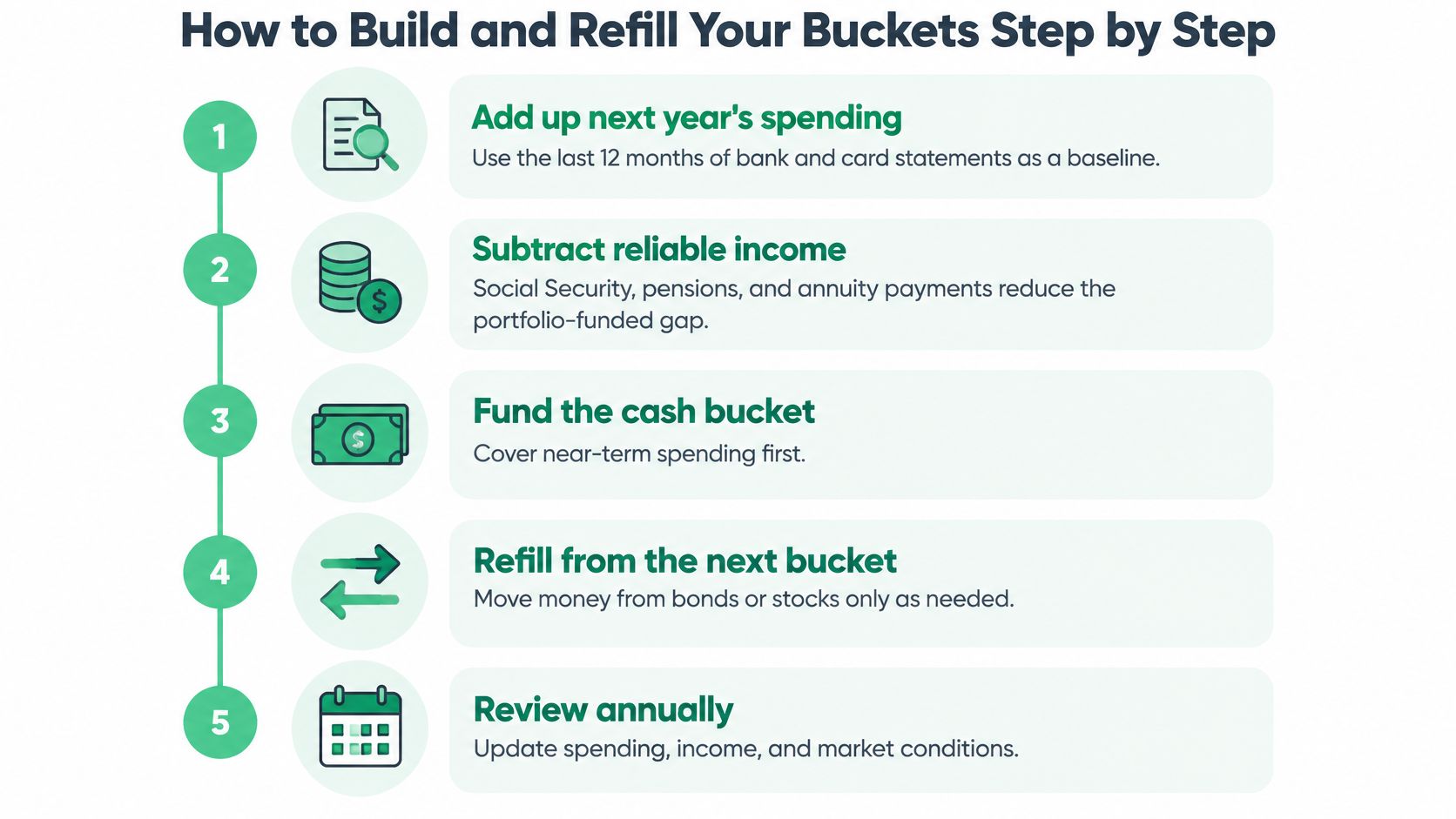
A bucket plan is only as useful as its refill rule. Set up the cash flow first, then decide how much maintenance you can realistically keep doing.
The Seven Steps
-
Add up next year's spending. Use the last 12 months of bank and card statements as your baseline, then adjust for changes you already know about. Start with actual outflows, not the budget you hope to follow.
-
Subtract reliable income. Check your my Social Security account at ssa.gov for your estimate before doing the math. Include Social Security, pensions, and annuity payments you can count on. The remainder is the amount your portfolio must cover.
-
Choose your cash and bond years. Use the sizing table from the earlier example, then match the reserve to your spending gap and reliable income. One to two years of cash suits many retirees. Five years may be excessive if you have substantial guaranteed income, so don't copy another retiree's target without checking your own numbers.
-
Move one year of the gap into cash. Vanguard's guidance on setting up retirement withdrawals describes moving one year of planned withdrawals into a money-market fund at a time. Treat the cash yield as temporary. Rates change, so check current Treasury bill and money-market yields at TreasuryDirect or your bank, and date any figure you record.
-
Transfer one month of spending to checking each month. This is your paycheck from the portfolio. Bills get paid on schedule, without a monthly decision about whether it is a good week to sell stocks. Avoid taking a large lump sum just because the cash is available.
-
Write down the refill rule before you need it. After a positive year, refill cash from interest, dividends, or planned sales of appreciated holdings. Avoid large equity sales during a deep decline. Selling stocks immediately after a fall can lock in losses and leave fewer shares to participate in a recovery.
-
Rebalance once a year. Bring each bucket back toward its target. Cash that grows well beyond its intended role can drag on long-term returns, while too little cash may force sales at an inconvenient time. Choose the target and stick to it unless your spending needs change.
Keep Lumpy Costs Out of the Buckets
Healthcare, a roof, a car replacement, and long-term care do not arrive as smooth monthly bills. Set aside money for these irregular costs separately, so one expensive year does not consume the reserve meant to cover routine spending. A 2026 report citing a 2025 estimate put average healthcare needs for a U.S. 65-year-old retiree at $172,500, up 4% from the prior year. A six-figure lifetime cost is not a routine two-year cash reserve. Plan for it separately.
Step 6 carries the design: the refill rule determines what gets sold, and when. Set that rule in advance, while markets are calm, rather than improvising during a decline.
How Taxes and Required Withdrawals Change the Plan
Buckets determine when money gets spent. Account types determine the tax bill. Treat those as separate decisions: a tidy bucket plan can still cost more in taxes than necessary.
Withdrawals from traditional IRAs and 401(k)s are generally taxed as ordinary income. So if your portfolio must cover a $40,000 gap, withdrawing exactly $40,000 from a traditional account may leave you short after taxes. Use your current federal tax bracket to estimate the gross withdrawal you'll need; tax brackets change over time.
Required Minimum Distributions Set Part of Your Schedule
Under current law, required minimum distributions generally begin at age 73 for people born 1951 through 1959 and at 75 for people born 1960 or later, according to the IRS rules for required minimum distributions. The annual amount is calculated using your prior year-end account balance and an IRS distribution-period factor. IRS Publication 590-B explains IRA distributions in detail. A different table applies when a spouse more than 10 years younger is the sole beneficiary.
The first distribution has a timing choice. You can delay it until April 1 of the year after you reach the starting age, but the second distribution is still due by December 31 of that year. Taking the first distribution in the year you reach the starting age avoids two taxable withdrawals in one calendar year, which could push some income into a higher bracket.
Account types and bucket roles
| Account type | Tax on withdrawals | Role in the buckets |
|---|---|---|
| Traditional IRA or 401(k) | Generally taxed as ordinary income | Source for required distributions and planned withdrawals; a required distribution can fund the cash bucket |
| Roth IRA | Qualified withdrawals are generally tax-free | Potential source for growth; the original owner has no required distributions during life |
| Taxable brokerage account | Gains are taxed at capital gains rates | Can fund cash through planned sales of appreciated holdings |
| Cash savings or money-market fund | Interest is generally taxed as ordinary income each year | Cash bucket; compare after-tax yields, not headline yields |
Treat required distributions as scheduled cash flow and account for them when choosing which account funds your spending. The sources of retirement income overview can help you list the income streams that affect the gap your portfolio must cover. For withdrawal sequencing, review the Allied Tax Advisors retirement tax guide alongside your own figures. Have a tax professional review your account-to-bucket mapping before making changes. A tax-efficient withdrawal plan depends on the whole picture, not just the account with the most convenient balance.
A Worked Example Through a Bad Market Year
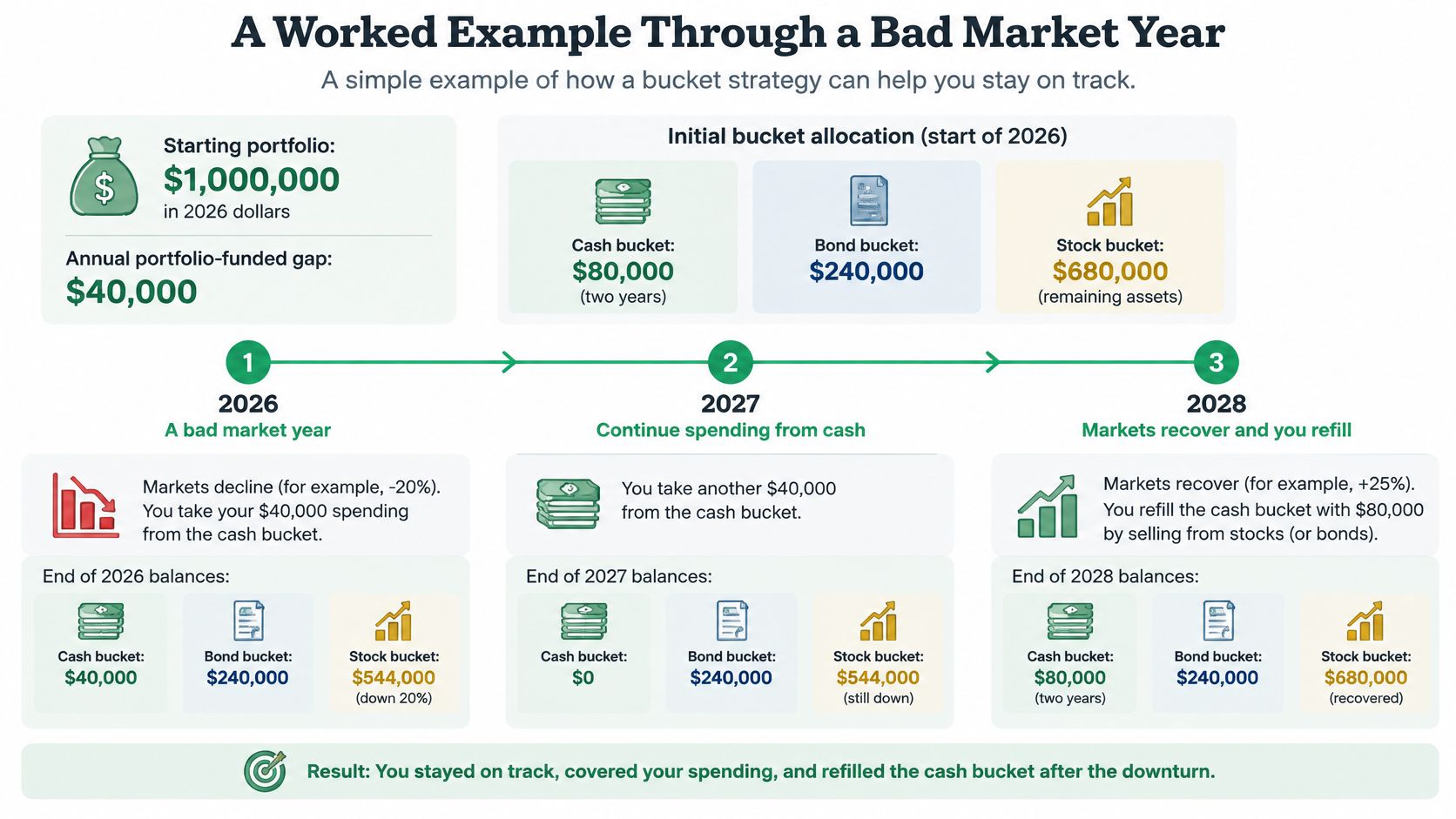
Numbers make the trade-off concrete. Say a retiree starts 2026 with $1,000,000 and a $40,000 annual portfolio-funded gap. The buckets hold $80,000 in cash (two years), $240,000 in bonds (six years), and $680,000 in stocks.
Year-one bucket plan compared with a stock-funded withdrawal
| Stage | Cash | Bonds | Stocks |
|---|---|---|---|
| Start, 2026 dollars | $80,000 | $240,000 | $680,000 |
| After a 25% stock drop | $80,000 | $240,000 | $510,000 |
| Bucket plan, $40,000 withdrawn from cash | $40,000 | $240,000 | $510,000 |
| Stock-funded alternative, $40,000 sold from stocks | $80,000 | $240,000 | $470,000 |
| After stocks recover to $680,000 and $40,000 moved to cash | $80,000 | $240,000 | $640,000 |
What the Bad Year Actually Looks Like
In year one, stocks fall 25%. The stock bucket drops from $680,000 to $510,000. Under the bucket plan, the retiree withdraws $40,000 from cash and sells no stocks, leaving $40,000 in cash and the full $510,000 still invested.
Compare that with funding the same withdrawal from stocks. Selling $40,000 from a $510,000 bucket means parting with about 7.8% of the depressed holdings ($40,000 divided by $510,000). Those shares are gone before any recovery begins. This is the mechanism behind sequence of returns risk, and it's the whole reason the cash bucket exists.
Recovery math is unforgiving. A 25% drop needs roughly a 33% gain to get back to $680,000. The bucket plan gives the stock bucket time to make that climb with all its shares intact. Once stocks recover, the refill happens. Move $40,000 from the growth bucket into cash, restoring the two-year reserve. Notice the bond bucket wasn't touched in year one. That's a refill-rule choice, not an accident.
The bucket didn't make the decline smaller. It changed what the retiree had to sell while prices were down.
Now the caveats, because they matter. This scenario is hypothetical. It ignores fees, taxes, and inflation. It assumes bond and cash returns stay flat, which real markets rarely allow. Today's cash yields differ from any past period, so check current Treasury bill and money-market yields before sizing your own cash bucket. Even with those limits, the takeaway holds. The retiree paid the same bills, sold nothing at the bottom, and kept the recovery working on a larger base.
Refill Rules and Whether a Bucket Plan Fits You
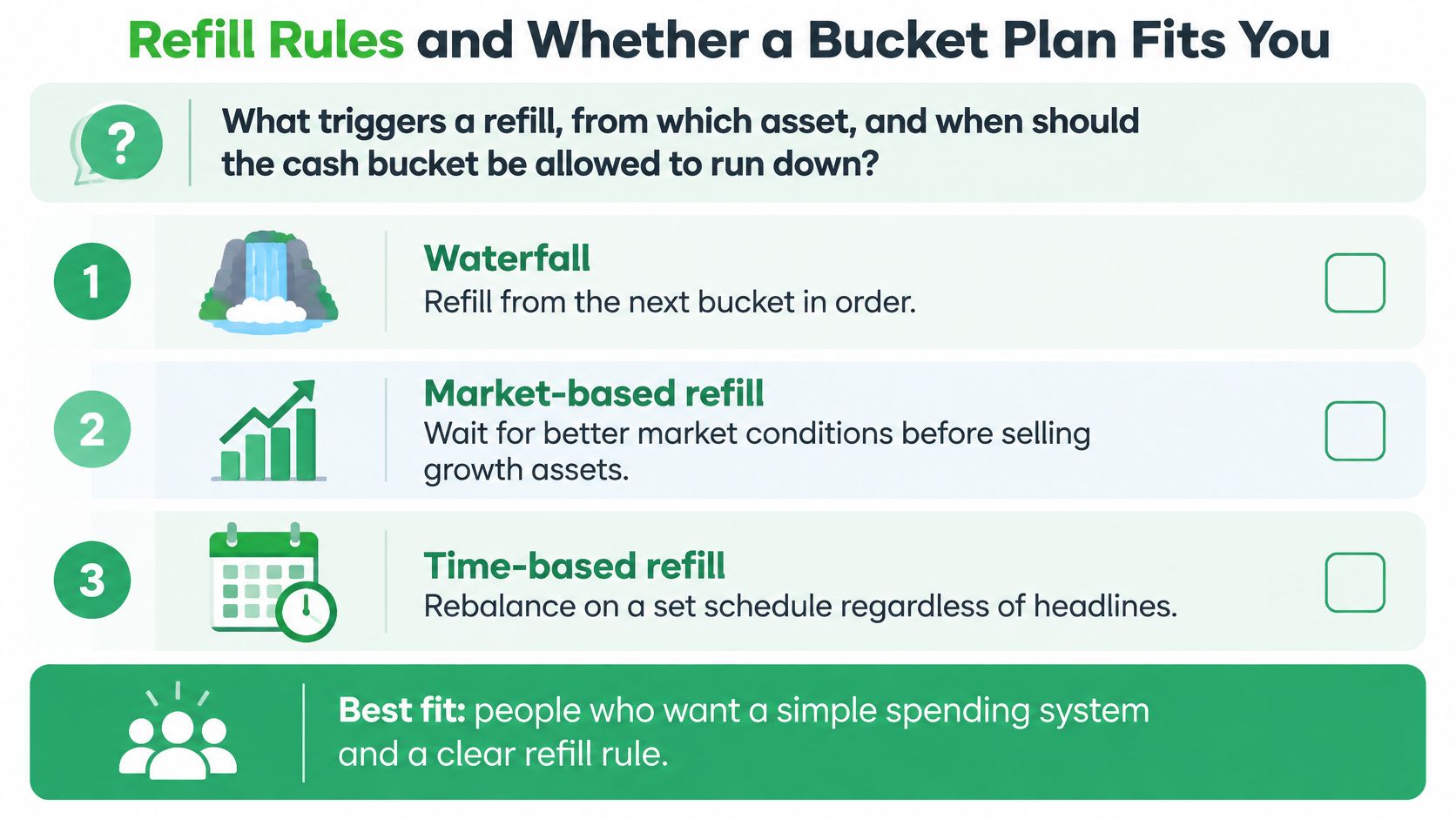
Bucket labels don't tell you when to sell. Your refill rule does. Decide in advance what triggers a transfer, which assets fund it, and how low you'll let cash fall before changing course. Without those decisions, a bucket plan is just an allocation with extra labels.
Three Refill Approaches
- Waterfall: Refill cash from bonds, then replenish bonds from stocks, following a set schedule.
- Performance-based: Refill cash after a positive return year. During downturns, let the cash reserve shrink rather than sell depressed assets.
- Sequential: Spend safer assets first without automatically replenishing them. Over time, equities make up a larger share of what remains.
These labels aren't used consistently, so check what a calculator or guide means by each one. The practical difference is the trigger: a calendar date, a market return, or no scheduled refill at all.
A historical analysis of 973 overlapping 30-year retirements from 1915 through 2025 found that two refill-based approaches had lower portfolio-survival rates than a single-pot 60/40 portfolio, especially during poor return sequences. A separate claim about international research lacks a specific study to assess, so don't rely on it to settle the debate. A bucket can make downturns easier to handle if it stops you from panic-selling. That behavioral benefit does not prove better investment returns.
Test It Yourself Before You Commit
Use a spreadsheet to compare year-end balances under three hypothetical scenarios. Start with the same balance, annual spending gap, and refill rule in each case:
- Bear market: Stocks fall 25% in year one.
- High inflation: Your annual gap rises 4% each year.
- Strong market: Stocks rise 15%.
Compare what each rule asks you to sell and how much remains in the growth bucket. The Compound Interest Calculator can show how lump sums and monthly contributions grow over time, helping you check the growth assumptions in your spreadsheet. Check current yields before setting the cash reserve; cash returns change over time.
Then use this checklist. Does guaranteed income cover less than your full spending? Would you otherwise sell stocks during a downturn? Can you trim spending or delay a purchase for a few years? Will you follow a written refill schedule? Three or more yes answers make a bucket plan worth considering. With fewer, a diversified portfolio and a written withdrawal rule may do the job with less fuss.
Choose a specific trigger before building the buckets. For example, refill cash only after a positive return year, and set a minimum reserve that tells you when to review spending instead of selling stocks automatically. Build buckets if the rules will help you stay calm and stick to your plan. Skip them if maintaining the buckets adds work without changing how you'll respond to a downturn.
Before moving money, calculate your annual spending gap and test your chosen rule against a bad first year. The Money Maniac offers step-by-step guides on earning, budgeting, planning, and investing, along with free calculators such as the Compound Interest Calculator, which shows how contributions grow over time. Write down your spending gap and refill trigger now, so a falling market doesn't force you to improvise.
Get more posts like this
One short, useful email each Friday. Free, no spam, unsubscribe anytime.