Best Age to Retire: Break-Even Math for Social Security
Find the best age to retire by weighing Social Security break-even math, lifespan, health coverage and bridge years. Worked examples inside.

Daniel Anderson
Editor, The Money Maniac
November 25, 2026
13 min read

62.7 years was the average ideal retirement age Nigerians named in a 2024 survey, the highest among the countries surveyed by Pew Research Center. That's an opinion about when work should end, though. Your bank balance, health insurance and future Social Security check may suggest different dates.
My recommendation for Americans approaching retirement is straightforward: choose your work-exit date and your Social Security claiming date separately. If you have adequate savings and reasonably good health, give delayed claiming serious consideration. But don't drain your emergency reserves or endure damaging work to reach a birthday.
Retirement Ages and the Claiming Ladder
Your retirement age is when you stop working. Your claiming age is when you start Social Security. Two separate levers, and pulling them on different schedules gives you more flexibility than automatically filing for benefits the day you hand in your keys.
The following illustration assumes a $2,000 monthly benefit at full retirement age, with no adjustments for future inflation or changes in earnings. Use it as a planning example; pull your own Social Security statement for figures that apply to you.
Claiming Ladder on a $2,000 Full-Retirement Benefit
For workers whose full retirement age is 67, the early-claim reductions produce these illustrative amounts:
| Claiming age | Percent of full benefit | Monthly amount on a $2,000 benefit |
|---|---|---|
| 62 | 70% | $1,400 |
| 64 | 80% | $1,600 |
| 65 | Approximately 86.67% | Approximately $1,733 |
| 66 | Approximately 93.33% | Approximately $1,867 |
| 67 | 100% | $2,000 |
| 70 | 124% | $2,480 |
Treat these as planning illustrations, then replace them with the amounts on your own statement, and check what future earnings the estimates assume.
The early reduction works monthly: the rules cut benefits by 5/9 of 1% for each of the first 36 months claimed early, then 5/12 of 1% for each additional month, per the SSA's claiming-age rules. That math produces the 30% haircut at age 62, and the reduction stays in your benefit base for the rest of your life. Filing early deserves more thought than grabbing the first available appointment.
Full retirement age is 66 for people born from 1943 through 1954, rises gradually for later birth years and reaches 67 for those born in 1960 or later, and delayed retirement credits add 8% for each full year after full retirement age, stopping at 70, according to the SSA's retirement-benefits guide.
What the Ladder Means for Your Decision
The 8% credit is valuable, though it works differently from an investment return. You trade a stretch of skipped payments for a permanently larger check, and whether that trade pays off depends partly on how long you live.
For a healthy homeowner with meaningful liquid savings, stopping work before claiming is often a reasonable move. The savings act as a bridge, covering spending while the eventual benefit grows into a larger foundation for later life.
A paid-off house lowers housing costs, yet equity alone won't cover the grocery bill. Keep accessible investments and cash separate from the value of the roof over your head unless you have a concrete plan to tap that equity.
Practical rule: Don't accept a permanently smaller benefit merely because you dislike drawing down savings. Compare the whole retirement plan, including the larger future payment.
Earlier claiming can still be the right call when health is poor, income is urgently needed, or delaying would force you into uncomfortable investment risk. Nobody hands out a prize for maximizing a monthly check while making the years before it miserable.
Write three figures on paper before doing anything else:
- Your preferred work-exit age. When would you leave if money weren't the obstacle?
- Your affordable work-exit age. When can accessible assets realistically support the transition?
- Your full retirement age. Use your birth year rather than a friend's experience.
The gap between those two exit dates is the planning problem: funding the years in between.
Break-Even Math for Waiting Until 70
Start with a simple comparison of cumulative benefits. You're asking how long the larger delayed payment takes to catch up with the payments you passed up.
For people born in 1960 or later, claiming at 70 provides 124% of the full-retirement benefit, according to the SSA's delayed-retirement planner. Using the illustrative claiming amounts, the calculation below compares an early claim with a delayed claim, before taxes, investment returns and future benefit adjustments.
A Worked Example You Can Repeat
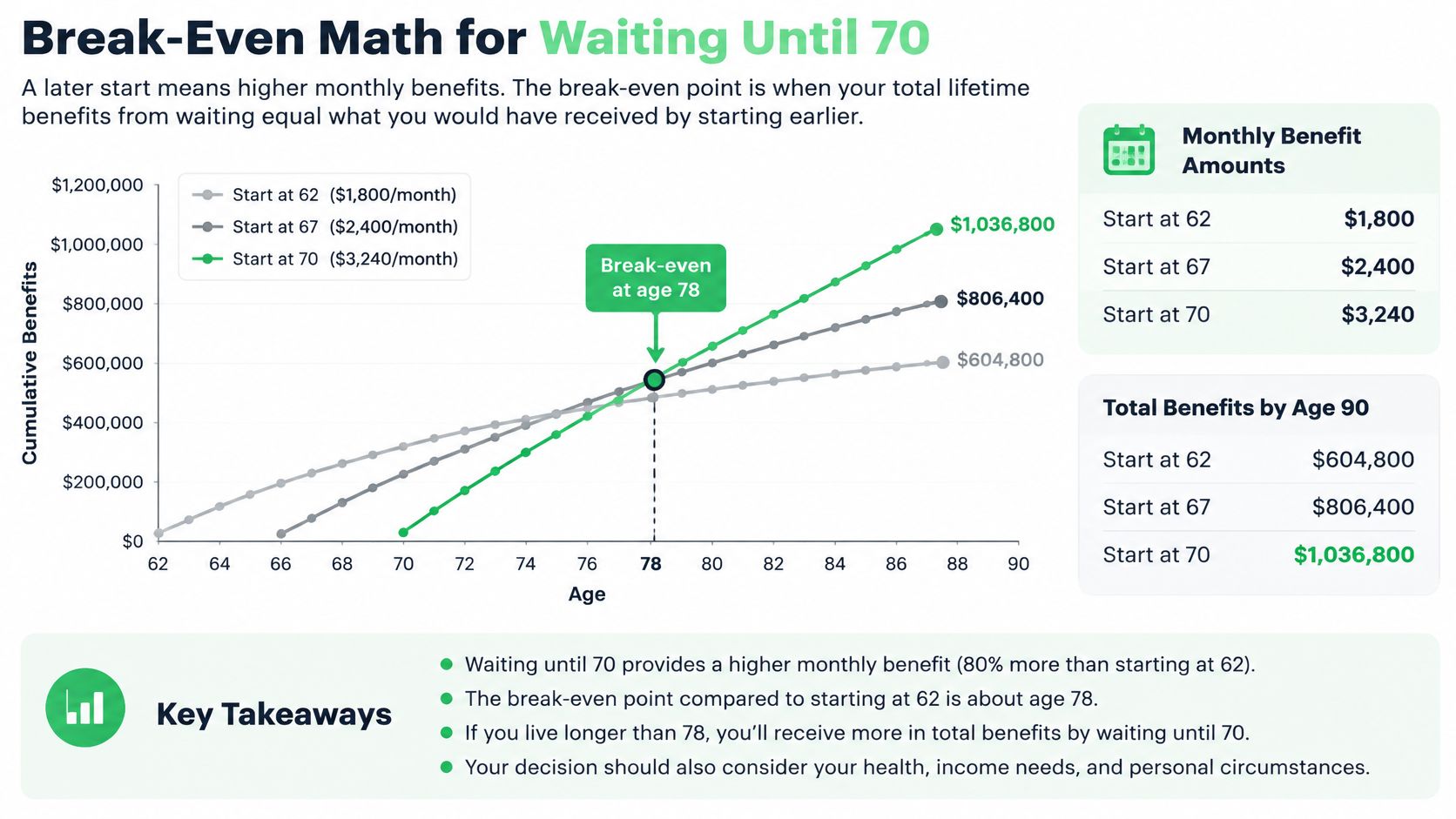
Suppose your choice is $1,400 monthly starting at 62 or $2,480 starting at 70. Here's the arithmetic for that hypothetical worker:
| Calculation | Result |
|---|---|
| Early checks received before the delayed claim begins | $1,400 × 96 months = $134,400 |
| Additional monthly income after delaying | $2,480 − $1,400 = $1,080 |
| Time needed to recover forgone checks | $134,400 ÷ $1,080 = approximately 124.4 months |
| Simple break-even age | Approximately 80 years and 4 months |
The result is a simple break-even near age 80 to 81 for this illustration. It doesn't tell you when you'll die, which remains an inconvenient omission from every retirement calculator.
The cumulative-payment comparison looks like this:
Adjust the Math Before Making the Decision
Earlier checks can cover expenses that would otherwise require portfolio withdrawals. If you invest those checks instead, the outcome depends on actual returns, fees and taxes, not the return you hope to earn.
Compare after-tax household income, too. Social Security taxation and withdrawals from retirement accounts can change the spending money each strategy produces, so a gross-benefit comparison is only a starting point.
For married households, consider the survivor as well as the original claimant. A larger higher-earner benefit can strengthen the surviving spouse's income, subject to the applicable survivor-benefit rules and the survivor's own claiming circumstances.
Use this sequence with your actual estimates:
- Get comparable benefit estimates. Check the earnings assumptions behind each estimate.
- Write down the spending gap. Identify what savings must cover while you wait.
- Total the forgone payments. Use the actual interval between proposed claiming dates.
- Divide by the monthly increase. Then convert the result into a break-even age.
- Evaluate the household outcome. Consider your health, your spouse's longevity and the value of dependable later-life income.
Break-even is a calculation, not a guarantee. Delaying can be attractive even without maximizing total lifetime dollars if your priority is reducing the risk of insufficient income late in life.
Lifespan, Health and Readiness for Work
Retiring near the traditional retirement birthday can mean financing a substantial stretch of life. Across OECD countries in 2024, average remaining life expectancy at 65 was 18.5 years for men and 21.6 years for women, according to the OECD's Pensions at a Glance 2025.
Those averages imply ages of approximately 83.5 and 86.6, respectively. They describe populations across OECD countries, not your personal expiration date, and planning only to an average leaves you exposed if you live longer.
Protect the Early Withdrawal Years
A long retirement also means living through disappointing markets. Sequence-of-returns risk describes the damage that can occur when you withdraw money during an early market decline.
Consider a hypothetical $500,000 portfolio that falls 20% before a $20,000 withdrawal. The decline leaves $400,000, so that withdrawal consumes 5% of the remaining balance, compared with 4% of the starting balance.
The arithmetic doesn't forecast a loss. It shows why selling investments to pay bills after a decline can make recovery harder: you have fewer assets left to participate when prices recover.
The health and work-capacity questions deserve equal attention:
- Your own health assessment. Are you tired after a difficult week, or increasingly unable to recover?
- Chronic conditions. What do your clinicians expect those conditions to mean for your ability to work?
- Physical demands. Could reduced hours or different duties make employment sustainable?
- Caregiving obligations. How much control do you have over your schedule?
Among non-employed people aged 55–64, 17% left their last job because of illness or disability, according to the OECD Employment Outlook 2025. Your plan needs an early-exit route even if you enjoy your work.
Test the Life You're Planning to Fund
For readers exploring structured health assessments, Telomyx health and performance testing is a resource to examine alongside a conversation with a qualified clinician. Don't treat any test result as a reliable forecast of lifespan or a substitute for medical advice.
Health and work readiness extend beyond a spreadsheet:
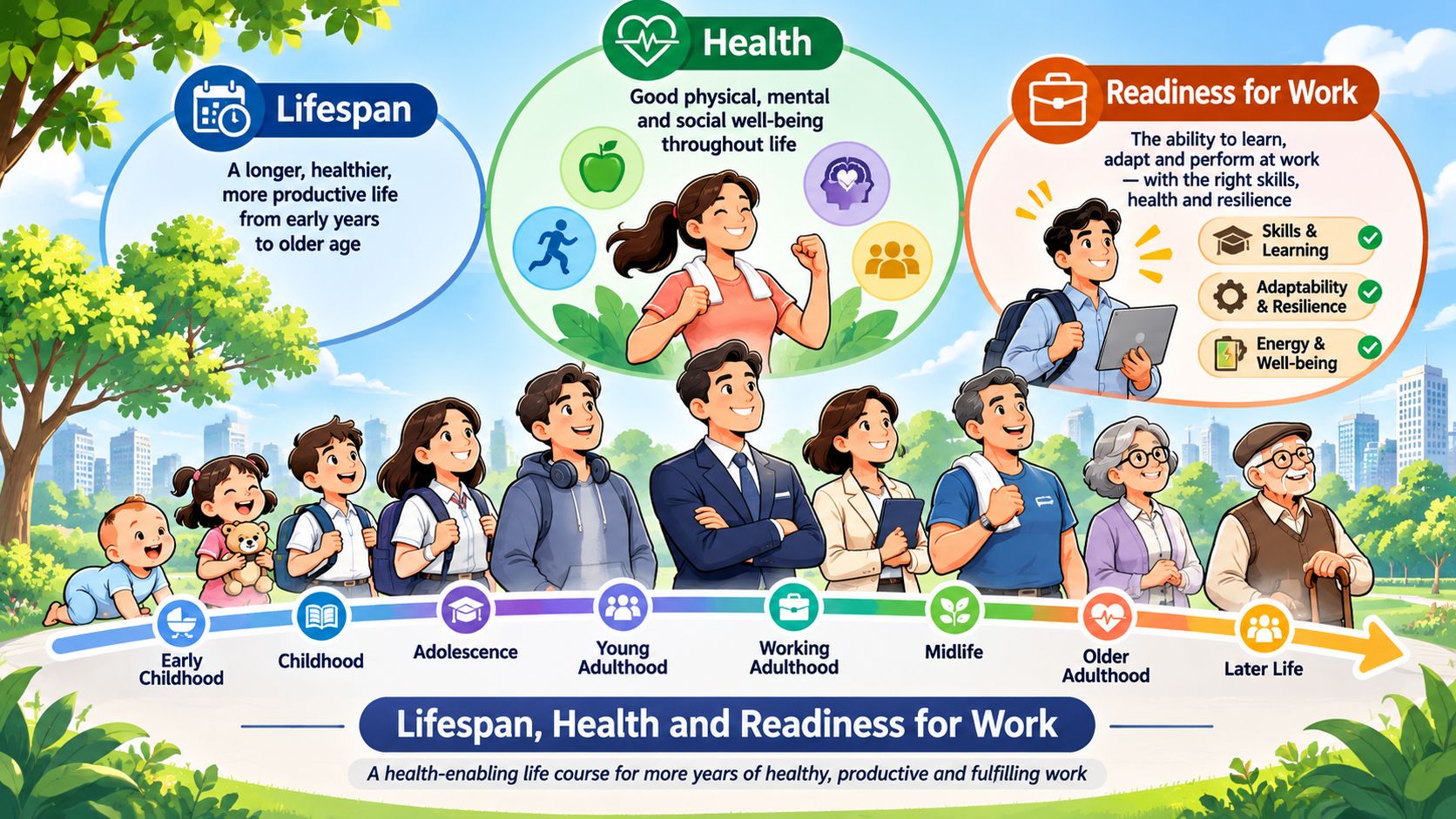
Try a month of your proposed retirement routine while you still have the option to adjust. Put social contact, exercise, caregiving and purposeful activity on the calendar.
A retirement budget can be balanced while the retirement itself feels empty. Test both.
Health Insurance and Medicare Timing Before 65
Price your replacement coverage before leaving your employer. An affordable retirement budget can become uncomfortable quickly when you add premiums, deductibles and a change in doctors.
Coverage and Deadlines by Retirement Timing
| Retirement timing | Coverage available | Deadline or cost to watch |
|---|---|---|
| Retire at 62 to 64 | A spouse's employer plan if eligible, COBRA continuation, or an ACA Marketplace plan | Confirm continuation duration and full premium; Marketplace assistance depends on household income |
| Age 65 | Medicare Part A and Part B; initial enrollment window | Check enrollment dates, Part B premiums and potential late-enrollment penalties |
| Working past 65 under a large employer plan | Employer coverage; Part B may be deferred when coverage qualifies | Confirm how Medicare coordinates with the plan and when special enrollment applies |
Medicare eligibility typically begins at 65, and the initial enrollment period generally begins three months before your birthday month, includes that month, and ends three months afterward, according to the SSA's Medicare enrollment guidance. That's a seven-month window, and Part B has a separate premium and enrollment decision.
Some people already receiving Social Security are automatically enrolled in premium-free Part A when eligible. Don't assume that means every coverage decision has been handled.
Get Written Answers Before You Leave
- Confirm your employer coverage. Ask the benefits administrator how the plan coordinates with Medicare and whether your active-employment coverage lets you delay Part B without penalty. Have the administrator explain how employer size affects that answer.
- Calendar your enrollment window. Record when your employer coverage ends and when replacement coverage starts. A resignation date and an insurance termination date aren't necessarily identical.
- Budget the whole cost. Include premiums, deductibles, prescriptions and any supplemental coverage you choose.
If you're considering COBRA, confirm its duration rather than assuming it lasts until Medicare begins. Also, don't assume continuation coverage protects your Medicare enrollment rights in the same way qualifying coverage through current employment does.
Marketplace assistance requires a separate income review. Wages earned before retirement, investment income and planned withdrawals can affect the comparison, so obtain estimates for the year you leave and the following year.
Our guide to health insurance for early retirement can help you organize those choices. Resolve the coverage dates before you resign, because paperwork errors can create both uncovered expenses and ongoing premium consequences.
Bridge Years, Part-Time Work and Withdrawal Rates
The bridge years are the period between leaving work and starting benefits. Build an annual cash-flow plan for that period before deciding that delayed claiming is affordable.
The SSA's guide to additional retirement considerations explains that delaying beyond 70 produces no additional retirement-benefit increase. In an illustrative bridge from 62 to 70, needing $40,000 annually from savings means funding up to $320,000 in gross withdrawals, before taxes, investment gains, losses or other income.
Build the Bridge in Order
-
Calculate the actual annual gap. Start with spending, including insurance and irregular home repairs. Subtract reliable earnings, pension income and other household income available during the bridge.
-
Identify accessible funding. Consider sustainable part-time income, cash and taxable investments, then evaluate retirement-account withdrawals. Choose the account order based on your tax situation and coverage needs rather than a rigid rule.
-
Set aside a spending reserve. Keep money for near-term planned withdrawals separate from volatile investments. Don't count the same dollars as both bridge spending and your emergency cushion.
-
Choose a withdrawal assumption you can defend. Divide the annual portfolio draw by the assets supporting it, then test that draw under weak returns and higher expenses. A familiar percentage isn't evidence that your particular bridge will work.
-
Check the interaction with paid work. If you claim before full retirement age while earning wages, review the current Social Security earnings-test rules before counting every benefit dollar as spendable income.
A bridge withdrawal rate may be higher than the later retirement rate because benefits eventually replace part of the draw. That can be reasonable, but only when the remaining portfolio still supports the years afterward.
The timing matters as much as the total:
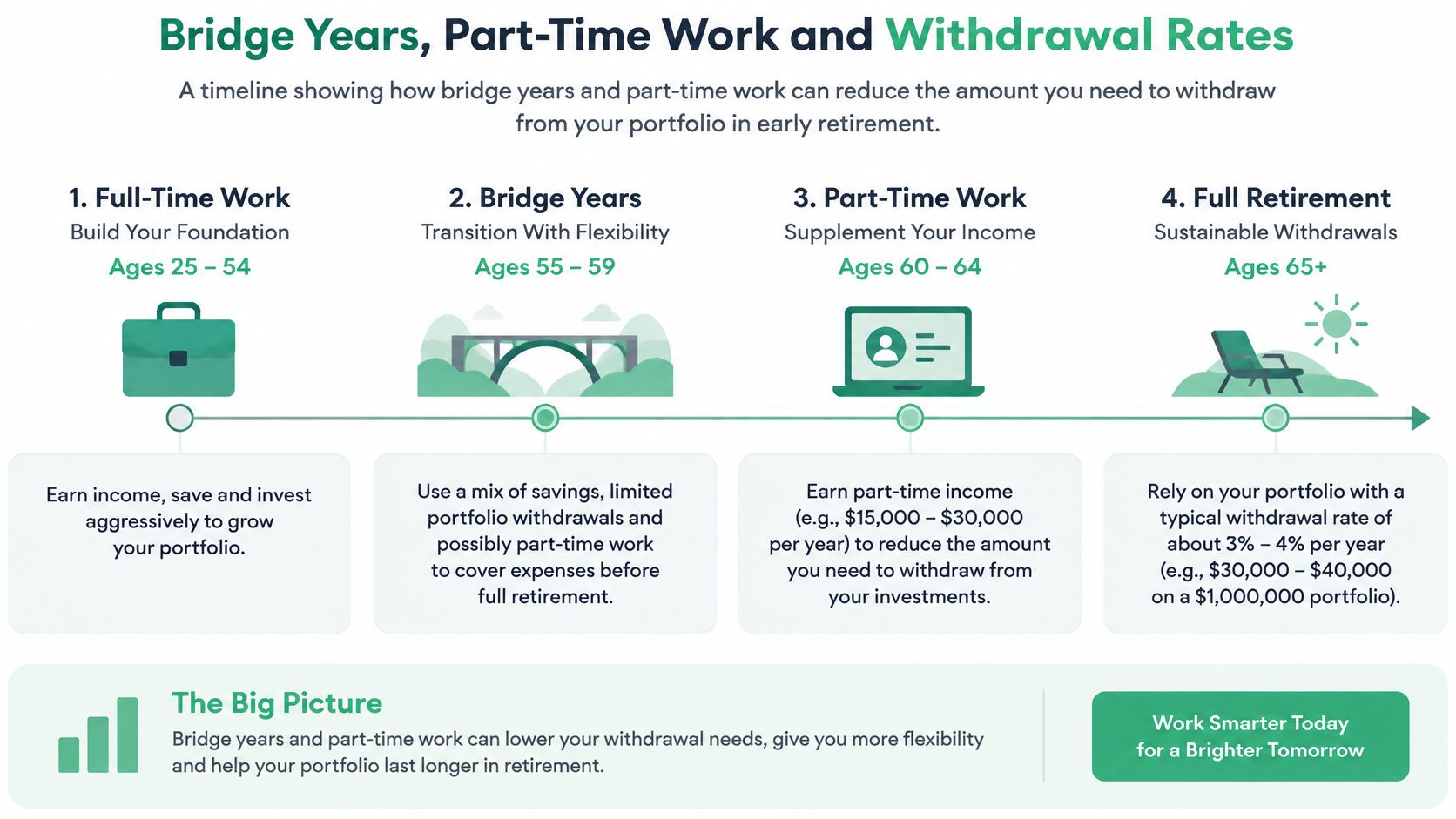
Give Part-Time Work a Specific Job
Use part-time earnings to reduce planned withdrawals, pay insurance premiums or preserve the emergency reserve. Don't assume consulting income will appear just because you've printed business cards.
Our explanation of working after retiring at 62 addresses the questions to resolve before combining employment with benefits.
Bridge test: The plan should survive a disappointing market and less paid work than you hoped to find.
Your timeline should name each funding stage explicitly: stop full-time work, fund the bridge, begin benefits, reassess the ongoing portfolio draw.
Three Reader Profiles With Real Numbers
These hypothetical profiles hold spending and benefits constant and exclude taxes and investment returns to separate the work-exit decision from the claiming decision.
A Single Homeowner With No Pension
With annual spending of $40,000 and a full-retirement monthly benefit of $2,000, claiming later reduces the ongoing savings draw.
Annual Savings Draw for a Single Retiree With a $2,000 Benefit and $40,000 Spending
| Claiming age | Social Security per year | Savings draw per year |
|---|---|---|
| Claim at 62 | $16,800 | $23,200 |
| Claim at 67 | $24,000 | $16,000 |
| Claim at 70 | $29,760 | $10,240 |
Stopping work before claiming means funding spending from other resources first. Choose the later benefit only if the portfolio supports that bridge and the remaining draw as costs change.
A Married Couple Protecting the Survivor
Use the same higher-earner schedule and assume the other spouse receives $16,800 annually. If the higher earner claims at 67, combined benefits are $40,800 a year. Waiting until 70 raises that total to $46,560 once both collect.
If the higher earner then dies, assume the survivor qualifies for that higher benefit instead of keeping both checks. Annual household benefits become $24,000 under the first choice or $29,760 under the delayed choice.
Compare those amounts with the survivor's spending needs. Delaying buys more survivor income, but the couple must fund the intervening years. Confirm household-specific survivor estimates and consider both spouses' health.
Evaluate any pension survivor election separately using how to value a pension.
A Worker Whose Health Ends Employment Early
Stopping at 60 with $40,000 annual spending and no other income requires $80,000 to reach 62, before taxes or unexpected expenses.
Calculate the bridge as $80,000 minus total available household income or approved disability support during those years. Each dollar received reduces the savings draw by a dollar.
Secure an affordable spending floor and price insurance before postponing benefits. Health-driven retirement leaves less room for optimistic earnings assumptions.
Set Your Own Best Retirement Age in Five Steps
My default recommendation is to delay claiming when you have adequate bridge assets, average or better health, and a strong need for dependable later-life income. If that requires spending your emergency cushion or taking risks you can't tolerate, use full retirement age as the starting alternative. Claim earlier when health or essential cash flow makes that the more sensible choice.
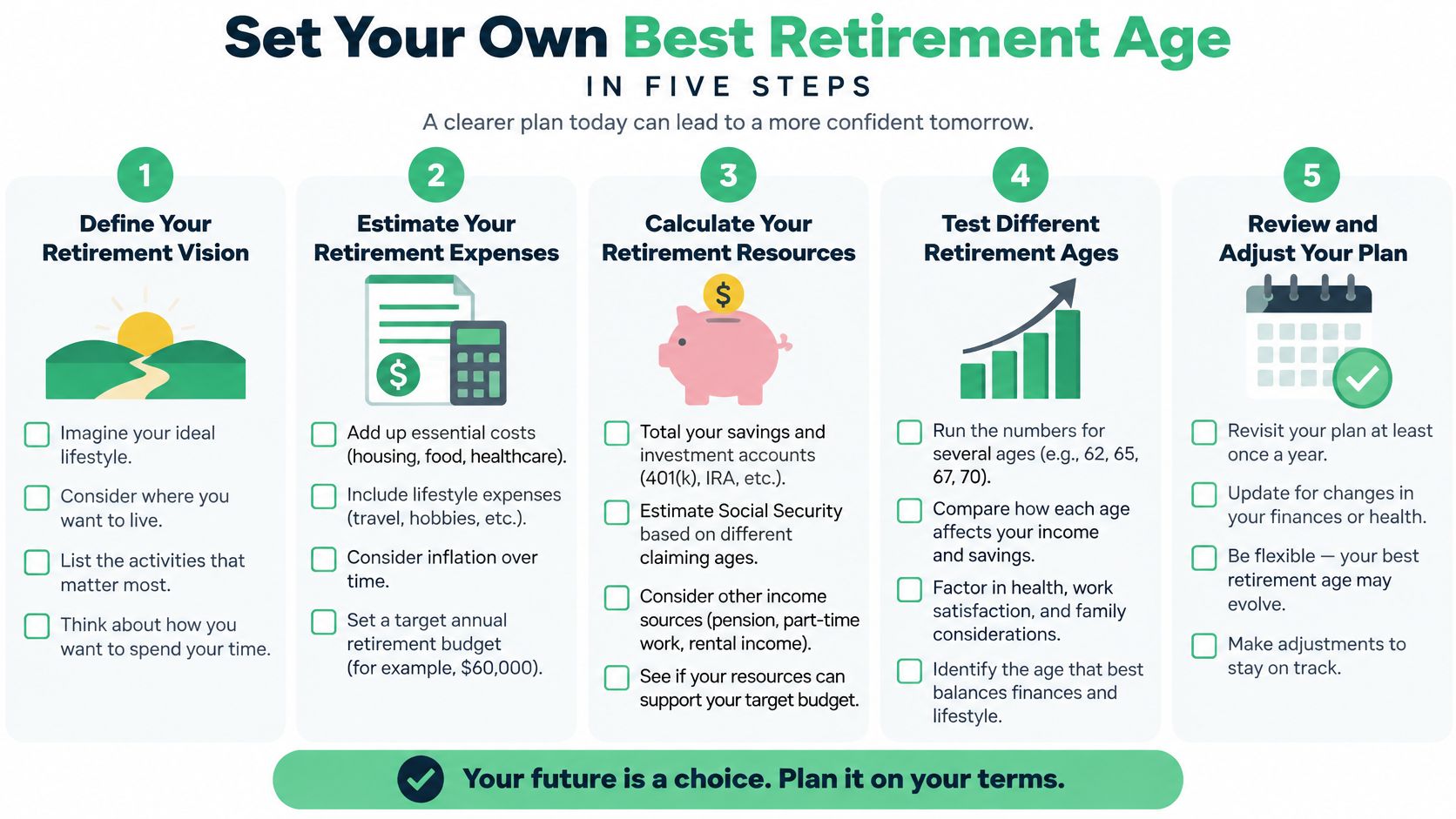
Your Retirement Decision Checklist
-
Find the earliest affordable exit. Map annual spending against accessible assets and reliable income. Keep the emergency reserve outside the planned bridge.
-
Mark your insurance transition. Put coverage termination, replacement coverage and Medicare enrollment dates on the same calendar as your proposed departure.
-
Run an involuntary-exit scenario. Remove future wages earlier than expected. If the plan fails, identify spending reductions and possible support before you need them.
-
Choose a household claiming strategy. Use actual benefit estimates and after-tax spending needs. For couples, weigh both lifespans, especially the possibility that the lower earner survives the higher earner.
-
Test a phased departure. Try reduced hours or less demanding work if available. Confirm that the income, schedule and health tradeoffs work in practice.
Use this checklist to organize the decision:
Favor Sustainable Work Over More Work
An analysis of 2,956 workers in the U.S. Health and Retirement Study found that each additional year of retirement age was associated with an 11% lower all-cause mortality risk among healthy retirees, as reported in the Journal of Epidemiology & Community Health. That's an association, not proof that postponing retirement extends life; healthier people may both work longer and live longer.
The defensible conclusion is to preserve sustainable work when it helps you, not to remain in harmful employment for a supposed longevity benefit.
Put your actual benefit estimates, bridge withdrawals and ongoing savings draws into a spreadsheet. Test each draw against your chosen withdrawal assumptions and verify that your emergency reserve remains intact. The best age to retire is the earliest age that supports a durable plan and a life you want to live.
Get more posts like this
One short, useful email each Friday. Free, no spam, unsubscribe anytime.