High Yield Savings Account vs CD in 2026
Compare a high yield savings account vs cd with October 2026 FDIC rates, penalty math, taxes, and a ladder for retirement cash.

Daniel Anderson
Editor, The Money Maniac
November 2, 2026
12 min read

You've got money set aside, a roof that's getting older, and a property-tax bill that arrives with impressive punctuality. Some of that cash needs to be available whenever life gets expensive. The rest could sit untouched until a date you can put on the calendar.
That's the useful starting point for high yield savings account vs CD decisions. My recommendation is straightforward: keep your spending reserve accessible, and consider locking up only the money whose spending date you can reasonably predict. Then compare what you'll keep after penalties and taxes, rather than letting the largest advertised yield make the decision.
High Yield Savings and CDs Side by Side
A high-yield savings account is a bank deposit without a fixed commitment period, usually offering flexible access at a rate the bank can change. A certificate of deposit, or CD, is a time deposit whose rate is generally fixed for its term; the FDIC's deposit-account guide describes terms of about three months to five years or longer, with early withdrawals often costing some or all accrued interest.
High-yield savings versus a CD
| Point to compare | High-yield savings | Certificate of deposit |
|---|---|---|
| Access | Usually on demand | Locked until the term ends |
| Rate | Variable; the bank can reprice it | Generally fixed until maturity |
| Early exit | No term penalty | Often a penalty or forfeited interest |
| Typical term | None | About 3 months to 5 years or longer |
| Insurance | FDIC if the bank is insured, within limits | Same FDIC rules for time deposits |
| Best cash job | Emergency and near-term spending | A dated expense that matches maturity |
Emergency reserves belong in savings; a CD earns consideration only when its maturity fits your spending date and its penalty is acceptable.
Both are deposit products, rather than market investments. You're choosing between easier access and greater rate certainty, not deciding how much stock-market excitement your plumbing budget needs.
Check the account details
Before moving money, check maintenance fees, minimum opening deposits, minimum balances needed to earn the advertised yield, and withdrawal rules. For savings, also check transfer timing. Accessible money still needs a practical route to your checking account.
If another deposit-account category is on your shortlist, our money market account versus high-yield savings comparison can help clarify the account features.
Practical rule: Give every cash balance a job before giving it a term.
National Rates as of October 2026
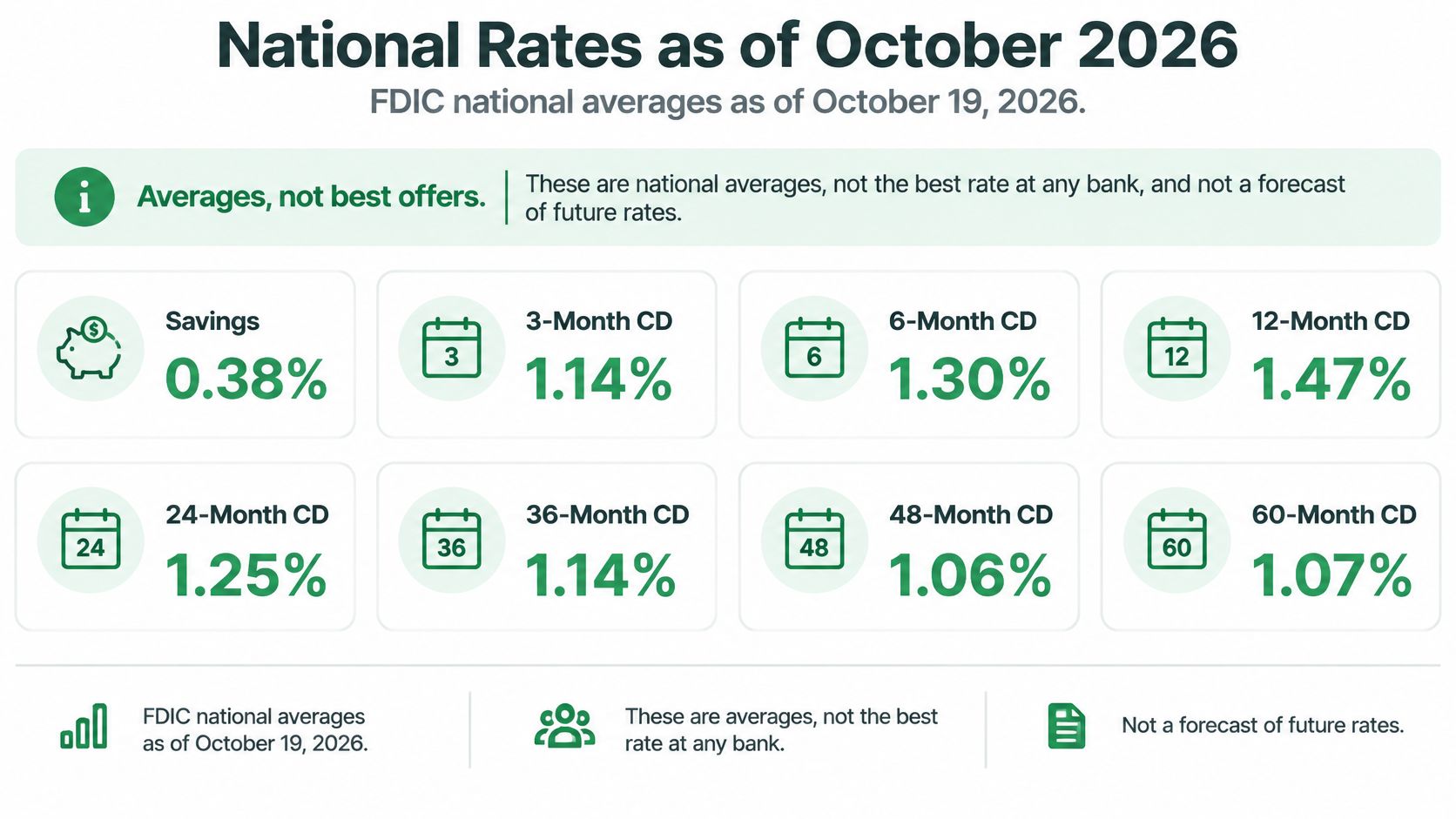
The October 19, 2026 figures below should be treated as an illustrative comparison, not a verified current rate report. Check the FDIC National Rates and Rate Caps page for the published reporting period and rates before using them to make a deposit decision.
National averages are useful benchmarks. They aren't the best available offer, a quote you can accept, or a forecast of what your savings account will pay throughout the coming year.
Illustrative national-rate comparison dated October 19, 2026
| Product | National rate used in illustration | Annualized interest on $10,000, before tax |
|---|---|---|
| Savings account | 0.38% | $38 |
| 3-month CD | 1.14% | $114 |
| 6-month CD | 1.39% | $139 |
| 12-month CD | 1.76% | $176 |
| 24-month CD | 1.55% | $155 |
The interest column uses balance × annualized rate, without penalties or taxes. Short-term CD figures are annualized comparisons, not the dollars earned during their shorter terms; longer-term figures aren't total earnings through maturity.
The accompanying graphic is a visual reference, but its CD figures differ from this table. Don't use it as a bank quote or a substitute for the FDIC's published figures.
Put the difference in dollars
Using the illustration, a hypothetical $10,000 held for a full year would earn approximately $176 before tax in the CD and $38 in savings. That leaves an approximate $138 premium for accepting the CD's restrictions, assuming the savings rate stays unchanged and no penalty applies.
That premium deserves consideration. It doesn't deserve automatic obedience.
The illustrative longer-term CD rate is also lower than the shorter annual term. A longer commitment doesn't automatically earn a better rate. Compare each maturity separately rather than assuming the bank pays more for every additional month.
Compare accounts you can actually open
A national savings average doesn't specifically measure the high-yield account you're considering. Online banks may offer materially higher yields, so comparing a competitive CD against a national savings average can exaggerate the benefit of locking up your money.
Build your personal comparison from:
- The actual savings disclosure. Record its APY, balance requirements, fees, and the date checked.
- The actual CD disclosure. Record its APY, maturity date, penalty, and renewal terms.
- A matching holding period. Compare interest over the period you expect to hold the money.
A headline yield gives you the opening number. Your likely withdrawal date determines whether you'll collect it.
The Real Cost of Needing the Money Early
Ask a blunt question before opening a CD: How much extra interest can I lose before savings would have been the better choice?
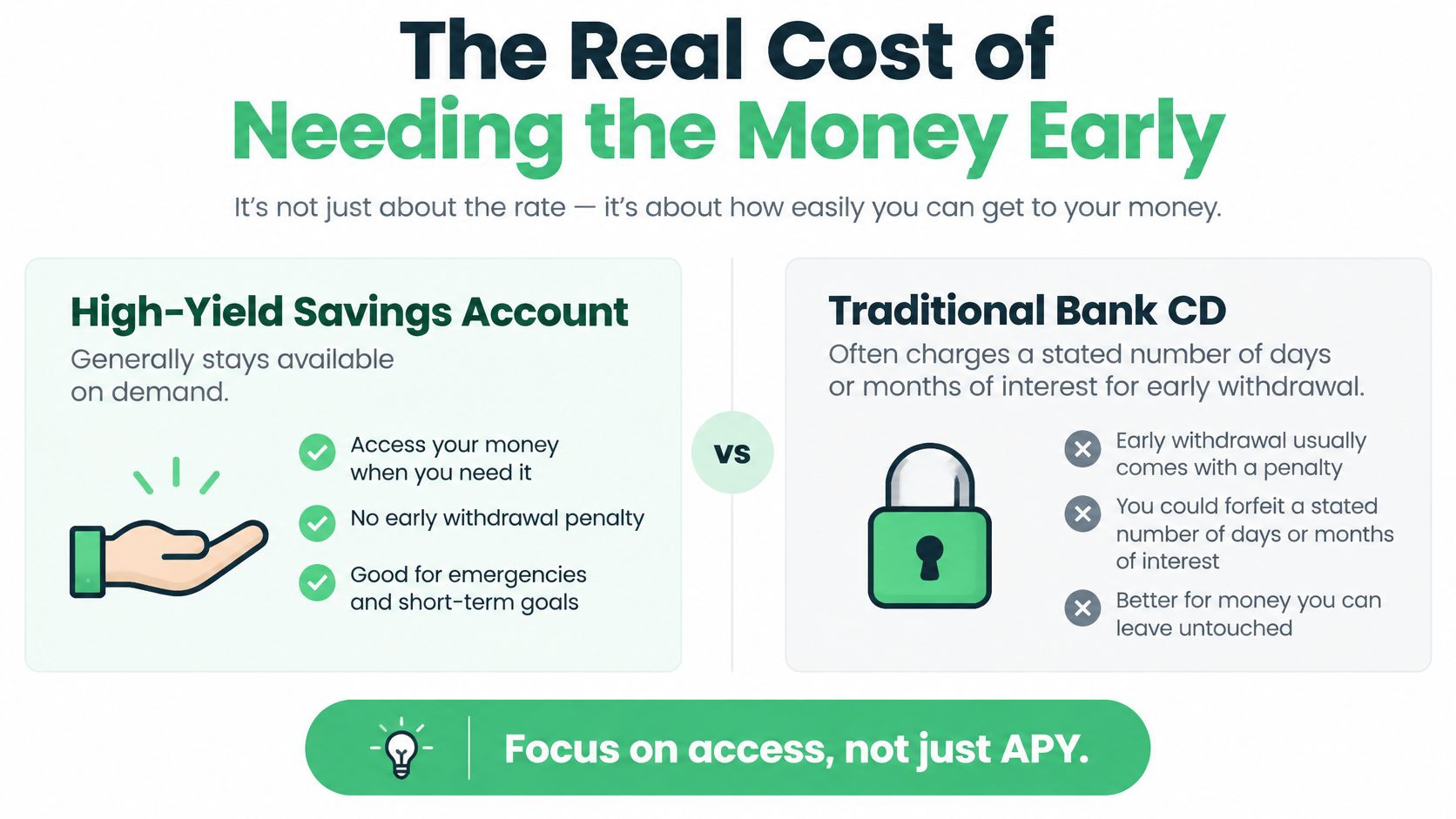
A traditional bank CD may charge a stated number of days or months of interest for early withdrawal. Read the actual formula, including whether the bank calculates the charge on the withdrawn amount or requires you to close the entire deposit.
Test the same deposit under different outcomes
Use the dated illustration above: a hypothetical deposit held for an annual term at its illustrative CD yield. Its approximate full-term pretax interest is $176. For this exercise, assume a three-month interest penalty of about $44, or a six-month penalty of about $88.
Those are hypothetical contract terms, not a claim about what a particular bank charges.
| Scenario | What happens | What to check |
|---|---|---|
| No withdrawal | You receive the full-term interest | Confirm the rate and interest-payment terms |
| Partial emergency withdrawal | The withdrawn portion incurs a penalty, if partial withdrawals are allowed | Whether the rest can remain open |
| Full liquidation | You receive interest earned to the withdrawal date, less the applicable penalty | Whether the penalty can exceed earned interest |
The partial-withdrawal case needs special care. Don't assume you can remove only the repair bill and leave everything else undisturbed. If the contract requires full closure, the economics change considerably.
For full liquidation halfway through the hypothetical annual term, approximately $88 of interest would have accrued under simple arithmetic. A penalty equal to that amount would leave no net interest before considering taxes. Comparing a penalty against full-year earnings would hide that result.
Treat the rate premium as dependable only when you can leave the money until maturity.
Keep brokered CDs separate
The SEC's brokered-CD bulletin explains that brokered CDs generally don't use traditional early-withdrawal penalties. Instead, selling before maturity can expose you to a market-price loss.
That's a different exit mechanism, and it deserves a separate evaluation. A savings withdrawal doesn't require finding a buyer willing to pay an acceptable price.
My stance: keep money for an unpredictable roof repair, medical bill, or possible market purchase liquid. A planned roof replacement with a firm payment schedule can qualify for a matched CD, but an aging roof hasn't signed that schedule.
Before opening any CD, confirm whether it renews automatically, what rate applies at renewal, and how long the contractual grace period lasts. Put the maturity reminder on your calendar immediately.
Taxes Compounding and Inflation on Cash
Your usable interest is the amount left after taxes and any withdrawal costs. For cash held outside a tax-advantaged account, neither ordinary savings nor a conventional CD gives you a general exemption from income tax.
IRS Publication 550 explains that interest credited and available for withdrawal is generally taxable when it becomes available, even if you leave it deposited. It also explains that a CD with a maturity longer than one year can require annual interest reporting before final maturity.
Calculate the dollars you keep
Take the earlier hypothetical CD earnings and apply an illustrative 22% federal marginal tax rate. This is a calculation assumption, not a statement about your tax bracket or personalized tax advice.
| Illustrative interest | Approximate federal tax | Approximate amount left |
|---|---|---|
| $176 of CD interest | $39 | $137 |
| $38 of savings interest | $8 | $30 |
The approximate after-federal-tax advantage is smaller than the pretax difference. State tax, where applicable, can reduce what you keep further.
An early-withdrawal penalty also requires careful reporting. Report the total interest paid or credited rather than subtracting the penalty from the interest figure; handle the penalty separately under the applicable tax rules.
Tax check: Money can be taxable before you move it into checking. Leaving it alone doesn't necessarily postpone the tax bill.
Use APY without double-counting compounding
Annual percentage yield, or APY, incorporates compounding into the annual comparison. Don't take an advertised APY and add another compounding bonus to it.
Savings accounts often credit interest monthly, while a CD's contract determines whether interest compounds, gets paid out, or is paid at maturity. Check whether the advertised yield assumes that interest remains deposited.
Our monthly compound interest calculator lets you explore how a balance grows under your own assumptions. Use consistent inputs, and remember that a calculator won't predict future savings rates.
Protect the spending plan from inflation
A positive account balance doesn't guarantee preserved purchasing power. If prices rise faster than your after-tax interest, your cash buys less despite the higher dollar balance.
No current inflation reading is used here because an independently verified, publication-date figure isn't available in the cited material. The decision still holds: cash reserves serve safety and spending timing, and neither account should be assumed to beat inflation.
For broader context, Carat 24 - Trusted Gold Experts offers inflation protection insights for Boise gold buyers. Treat that as a separate discussion of inflation-sensitive assets, not a reason to replace your emergency deposit with gold.
There's also a tax nuance worth considering in high-tax states: U.S. News' savings-rate discussion notes that Treasury interest is federally taxable but exempt from state and local income taxes. That can justify including Treasury bills in a broader after-tax comparison, while keeping their mechanics separate from insured bank deposits.
Run the Numbers Before You Lock a Term
You can make this decision with a bank disclosure, your spending calendar, and a calculator. You don't need an interest-rate forecast, which is fortunate because forecasts don't pay early-withdrawal penalties.
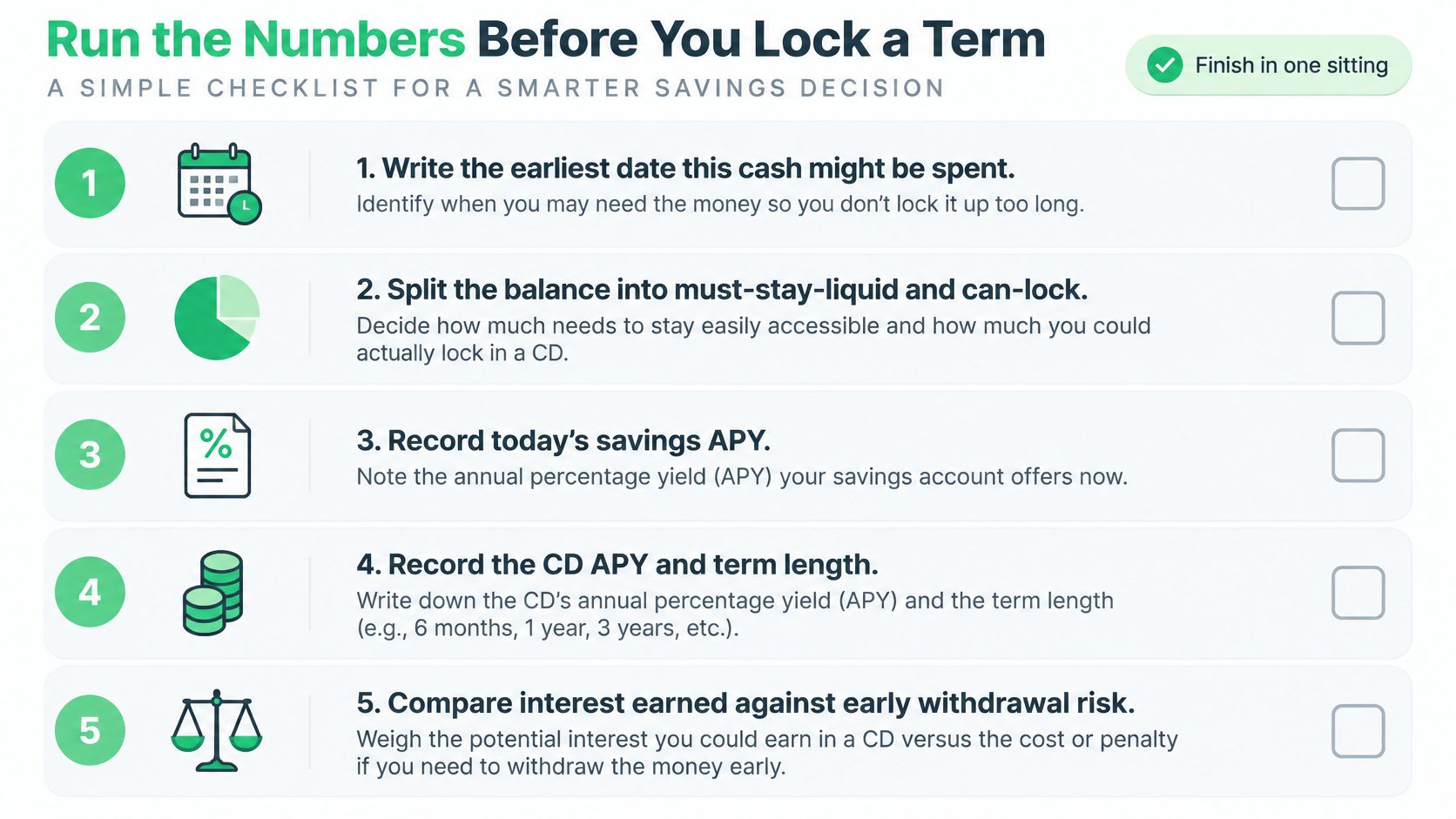
Use this checklist to turn the advertised yield into a spending decision.
Make the comparison in one sitting
-
Write the earliest possible spending date. Use the earliest plausible payment date, not the date you'd prefer. Contractors and medical offices rarely build their schedules around your CD.
-
Separate liquid cash from lockable cash. Keep enough outside the CD to handle the expense arriving early or another bill arriving alongside it.
-
Record both actual APYs and the date checked. Save the bank disclosures and compare their reporting date with the FDIC national-rate page. Include fees and any balance conditions.
-
Estimate pretax interest. For a rough comparison, multiply the balance by the annual yield and the fraction of a year held. Treat this as an approximation, especially for terms shorter or longer than a year.
-
Translate the penalty into dollars. Use the contract's calculation basis. Check whether partial withdrawals are allowed and whether the charge can exceed accrued interest.
-
Estimate after-tax interest. Apply your marginal federal tax rate and state tax where relevant. Keep penalty reporting separate rather than assuming the bank's net payment equals taxable interest.
-
Stress-test the savings rate. As a hypothetical exercise, lower its assumed yield by a percentage point, without taking it below zero. Also test a rate increase and ask whether the CD premium still compensates you for losing flexibility.
Watch the penalty consume the advantage
Consider a hypothetical $25,000 deposit for an annual term using the October 19, 2026 illustration. Approximate full-year interest would be $440 for the CD versus $95 for savings, a pretax gap of $345.
A hypothetical penalty equal to six months of CD interest would be approximately $220, about two-thirds of that full-year gap. But that comparison alone understates the cost of an early exit.
If you closed halfway through the term, approximately $220 would have accrued before that penalty. Under these simplified assumptions, the penalty would absorb all accrued interest. You wouldn't receive the full-year earnings first and then deduct the fee.
Our Compound Interest Calculator shows how lump sums and monthly contributions grow over time with compounding. Use your own balance and disclosed yields, then calculate the contractual penalty separately.
If you can't identify a period during which the money can safely remain untouched, leave it in savings.
Match Each Cash Job to an Account
For most homeowners approaching retirement or already retired, the sensible arrangement includes both accessible reserves and deliberately scheduled cash. You don't need to force every dollar into the same account.
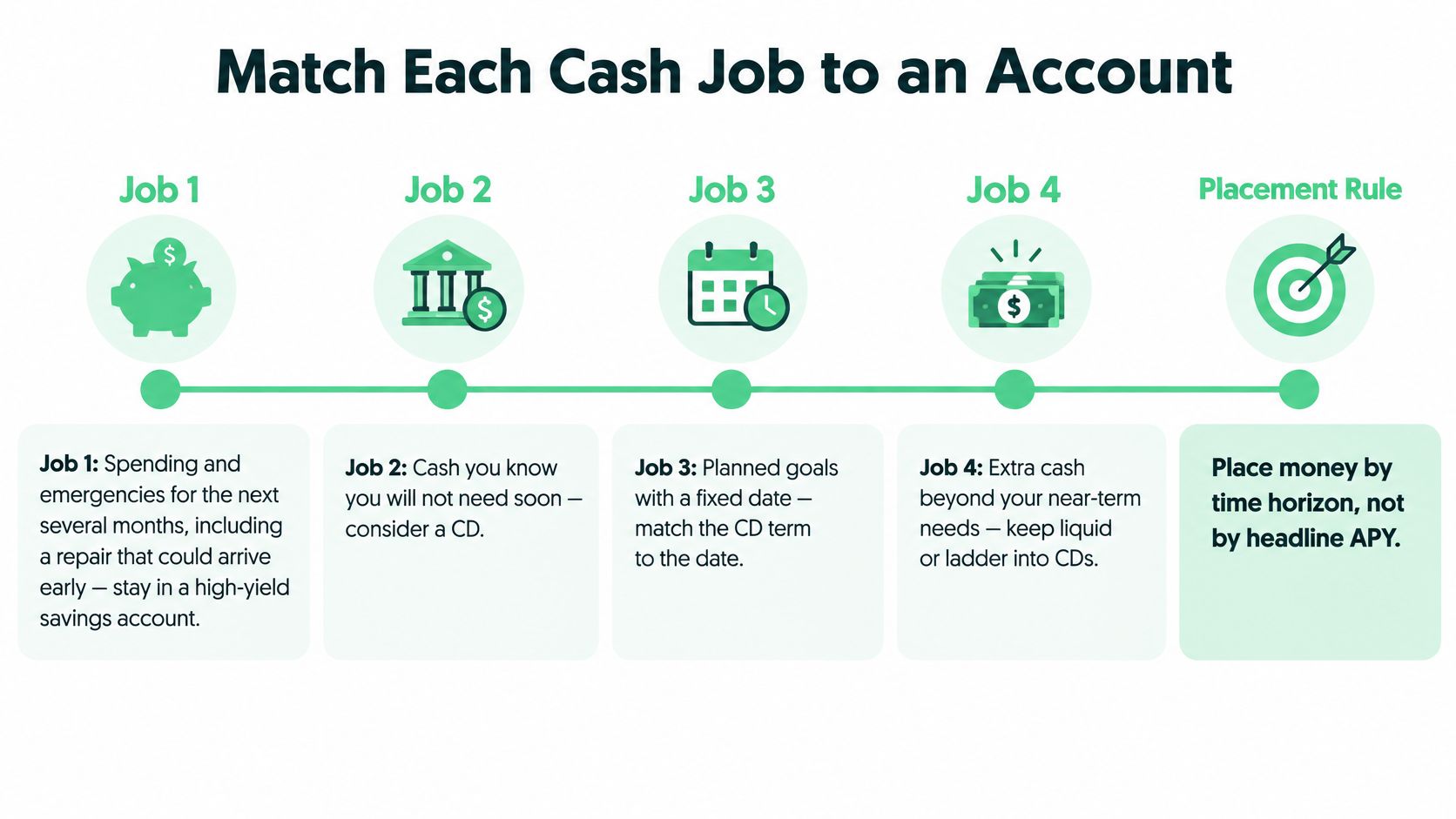
The placement rule is simple: match access to the earliest plausible spending date. Then check insurance across the entire bank relationship before transferring a large balance.
Give each cash job a verdict
Spending and emergencies belong in savings. That includes ordinary upcoming bills and repairs that could arrive ahead of schedule. If you're unsure how much to keep accessible, work through our guide to how big your emergency fund should be before shopping for a CD.
Our December 30, 2024 newsletter recommended parking emergency funds in high-yield savings accounts or short-term Treasury bills. For this bank-deposit comparison, savings is the straightforward choice for money that might be needed unexpectedly.
For a broader emergency-funding discussion, the Idaho Pawn & Gold Exchange cash guide offers additional context. Build the accessible reserve before an emergency forces you to evaluate other ways of raising cash.
A dated bill can fit a matched CD. A property-tax set-aside or planned purchase may qualify when the CD matures before payment is due. Leave time for the proceeds to reach the account you'll use to pay.
Money reserved for a possible market purchase stays liquid. If you want discretion over when to invest, don't put that same money behind a contractual withdrawal cost. Also decide in advance how much you're willing to invest, so a market decline doesn't turn your emergency reserve into an impromptu investment account.
Build a calendar for several spending dates
A larger reserve with staggered needs can use a CD ladder, meaning separate CDs that mature at different times.
For a hypothetical $40,000 ladder, the calendar could look like this. Each rung uses the actual APY offered when opened, not an assumed national-average yield.
Worked $40,000 ladder calendar
| Rung | Amount | Action at maturity |
|---|---|---|
| 6 months | $10,000 | Spend or roll forward |
| 12 months | $10,000 | Spend or roll forward |
| 18 months | $10,000 | Spend or roll forward |
| 24 months | $10,000 | Spend or reinvest |
When a rung matures, use it for its assigned expense or reinvest it at the long end of the ladder. Falling rates affect the reinvested rung while the remaining fixed-rate deposits continue under their contracts.
If rates rise, scheduled maturities let you reinvest portions without breaking the entire arrangement. However, a ladder doesn't make every rung immediately accessible, and early-withdrawal rules still apply to CDs that haven't matured.
Add up insurance before moving the money
The FDIC's deposit-insurance guidance states that coverage generally reaches $250,000 per depositor, per insured bank, per ownership category, including principal and accrued interest within the applicable limit. Its example of $200,000 in savings plus $100,000 in a CD at the same insured bank and in the same ownership category produces $300,000 on deposit but only $250,000 covered.
Opening another account at that bank doesn't create a separate allowance. Different insured banks or qualifying ownership categories, including eligible joint accounts, can provide additional coverage under FDIC rules.
List your cash by the month it might be spent, keep the near months liquid, and verify the bank's insurance status. Then check the FDIC deposit-insurance and national-rates pages alongside the actual account contracts before transferring funds.
Get more posts like this
One short, useful email each Friday. Free, no spam, unsubscribe anytime.