How to Protect Savings from Inflation: A 2026 Playbook
Learn how to protect savings from inflation with I Bonds, TIPS, Treasury bills and cash ladders, plus the tax traps and math to check first.

Daniel Anderson
Editor, The Money Maniac
November 3, 2026
13 min read

Leave $10,000 sitting in checking for 20 years while inflation runs at 2% a year, and you've still got $10,000 on the screen. It'll only buy about $6,730 worth of today's groceries, rent, and gas. That's the whole problem with how to protect savings from inflation. Your balance can look perfectly safe while your purchasing power walks out the door, one grocery run at a time.
How Inflation Shrinks a Cash Balance
Start with $10,000 in a checking account earning nothing. In 2024, the Federal Reserve's Monetary Policy Report noted the Federal Reserve's longer-term inflation objective remained 2%, and professional forecasters expected average PCE inflation of 2% over the five-year period beginning five years later. At that 2% pace, your $10,000 buys about $9,057 of today's goods after five years, $8,203 after ten, and $6,730 after twenty.
That's the optimistic row. Consumer prices ran well above 2% for stretches in the early 2020s, so run 3% and 4% too before you decide idle cash is harmless.
Purchasing Power of $10,000 in Cash
| Inflation rate | After 5 years | After 10 years | After 20 years |
|---|---|---|---|
| 2% a year | $9,057 | $8,203 | $6,730 |
| 3% a year | $8,626 | $7,441 | $5,537 |
| 4% a year | $8,219 | $6,756 | $4,564 |
At 4%, you lose more than half your buying power in twenty years without spending a dime. That's not a market crash. That's just arithmetic doing its slow, unglamorous work.
Run Your Own Number in 60 Seconds
The formula is straightforward. Buying power equals your balance divided by (1 + inflation rate) raised to the number of years. Suppose you have $25,000 and want to see its value over ten years at 3%. Divide $25,000 by 1.03 ten times, or by about 1.344, and you get roughly $18,600 in current dollars.
Pick a rate you think is realistic, not one that flatters you. Then compare that result with what your account earns. If you want to check whether your return is keeping up over uneven periods, use our guide on how to calculate annualized returns and put the two numbers side by side.
A 2% target is a policy goal. It isn't a promise printed on your bank statement.
Your job from here is simple to state and harder to do. Earn enough on each dollar to beat this drag, and match the tool to the date you'll need the money.
Match Each Dollar to the Right Tool
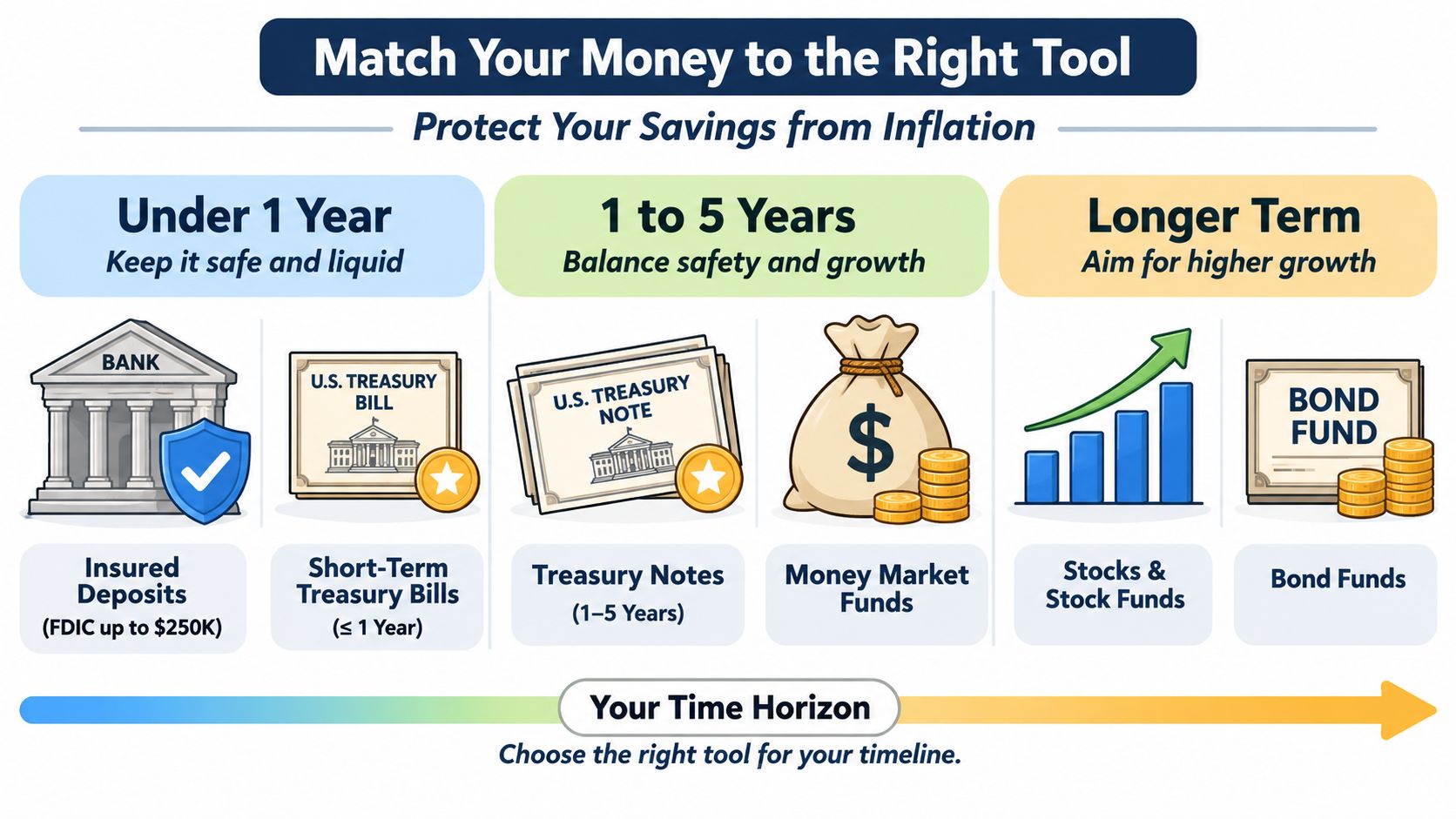
The date you need the money picks the tool. That's my verdict, and it applies to every row below. Write down when each chunk of cash has a job to do, then find its row. If you can't name a date, you don't have a savings plan yet. You've got a pile.
Money needed in under a year belongs where you can grab it without drama. Money with a known date one to five years out can accept some lockup in exchange for inflation help. Money you won't touch for a decade or more can take market swings, because you've got time to recover from an ugly year.
Inflation-Protection Tools by Time Horizon
| Money horizon | Tool | Inflation link | Access and risk |
|---|---|---|---|
| Under 1 year, emergency fund | High-yield savings account | Rate moves with market rates; no direct inflation link | Instant access; FDIC insured up to $250,000 per depositor, per bank, per ownership category |
| Under 1 year, known bill | Short Treasury bills | Rate set at auction; no direct inflation link | Sell before maturity at market price, or hold to maturity; backed by the U.S. government |
| 1 to 5 years, known date | Certificate of deposit | Fixed rate; no inflation link | Early withdrawal penalty; rate locked for the term |
| 1 to 5 years, inflation hedge | Series I savings bonds | Fixed rate plus an inflation rate reset every May and November | $10,000 per person per calendar year electronic purchase limit; 12-month lockup; lose three months of interest if you cash out before five years |
| 5 to 30 years | TIPS | Principal adjusts with CPI-U | Market price can fall before maturity if rates rise |
| 10 years or more | Broad stock index funds | No direct link; historically outpaced inflation over long periods | Can fall sharply; no guarantee of protection |
Read the table from left to right. The horizon comes first, the product second. Too many people reverse that order because a rate looked appealing in an ad.
Where Each Row Earns Its Place
For the longest bucket, broad stock index funds have historically outpaced inflation over long periods, but there's no inflation guarantee and they can fall sharply in a bad year. Don't put next year's tuition there and call it brave. Real estate investors face the same horizon question when scaling your rental property portfolio, since rental income and property values play out over years, not weeks.
Taxes will change the ranking for some rows, and we'll get to that. For now, judge each tool on access, limits, and whether its payout moves with prices.
Keep Cash Safe Without Falling Behind
Forget the headline rate for a second. The number that matters is real yield, your savings rate minus inflation. Say a high-yield savings account pays a hypothetical 4% while inflation runs at 3%. You're ahead by roughly 1% before taxes. That's progress, but it's thinner than the marketing suggests.
Now drop that account rate to a hypothetical 2% with the same 3% inflation. You're losing about 1% a year in buying power, and taxes on the interest make the result worse. Federal and state tax get paid on the nominal interest, even when inflation ate the gain. Check current rates on each bank's own site before you move money, because teaser rates have a habit of expiring.
If you're weighing a savings account against locking money up, our breakdown of high-yield savings accounts versus CDs walks through the access tradeoff in detail.
Insurance Protects Dollars, Not Buying Power
The FDIC's guide to safeguarding savings puts the key limit at $250,000 per depositor, per FDIC-insured bank, per account ownership category, covering principal and accrued interest through the bank's closing date. A single account generally gets $250,000 per owner, a joint account can receive $250,000 per co-owner, and certain retirement accounts such as IRAs have a separate $250,000 limit per owner.
Here's where people trip. Split $300,000 between two savings accounts at the same bank in the same ownership category, and those balances add together. Only $250,000 is insured. Opening a second account at the same bank bought you a second login, not extra coverage.
- Spread large balances across banks: Move the excess to a separately insured bank so each balance fits its own limit.
- Use ownership categories properly: A joint account or an IRA can qualify for separate coverage where the rules allow.
- Count accrued interest too: Coverage includes interest through the closing date, so leave a little headroom under the cap.
Practical rule: A fully insured account can still lose real value every single year. Insurance guards against bank failure. It does nothing about inflation.
A Useful Comparison for Idle Cash
Short Treasury bills in 4-week to 26-week terms give you a clean benchmark for cash you can leave alone for a few months. Compare their yield with your savings account after tax, then compare both against inflation. Recheck every few months. When the gap between your account rate and inflation narrows to nothing, move the cash. Loyalty to a bank that pays you poorly is an expensive personality trait.
Tax and Risk Traps That Shrink Returns
TIPS carry the trap that surprises people most. The inflation adjustment to principal is taxed as federal income every year, even though you don't receive that principal until maturity. You can owe tax in a year when no cash landed in your account. People call it phantom income, and the bill is very real even if the income feels imaginary.
That's why holding TIPS inside an IRA or 401(k) often makes more sense than holding them in a taxable account. The tax shelter lets the inflation adjustment compound without an annual bill. The same asset-location logic applies elsewhere, which is why it's worth understanding whether municipal bonds are tax-free before you assume any bond income escapes tax entirely.
How Each Tool Is Taxed
| Tool | Federal tax | State and local tax | When tax is due |
|---|---|---|---|
| High-yield savings account | Ordinary income | Taxed | Each year as interest is earned |
| Certificate of deposit | Ordinary income | Taxed | Each year as interest is earned |
| Treasury bills | Ordinary income | Exempt | When the bill matures or is sold |
| Series I savings bonds | Ordinary income | Exempt | When redeemed, or at final maturity if deferred |
| TIPS | Ordinary income, including inflation adjustment | Exempt | Each year on the inflation adjustment, even though principal is paid at maturity |
I Bonds sit at the friendly end of this table. You can defer federal tax until you redeem the bond or it reaches final maturity at 30 years, and the interest is exempt from state and local tax. Treasury bill interest is also exempt from state and local tax, though federal tax applies when the bill matures or you sell it. Savings account and CD interest get taxed yearly at both levels, with no deferral and no exemption.
The Risk Side Nobody Puts in the Ad
- Selling TIPS early can cost you: If real interest rates rise, a TIPS sold before maturity can fetch less than you paid.
- I Bonds punish impatience: Cash out before five years and you forfeit the last three months of interest, on top of the first-year lockup.
- CDs charge for changed plans: An early-withdrawal penalty can erase months of interest if you break the term.
Before you buy anything, answer three questions in writing. Which account will hold it, taxable or tax-advantaged? When exactly do you need this money? How far could the price fall before that date, and could you wait it out? If you can't answer all three, you're not ready to buy.
Build a Ladder and Set Your Mix
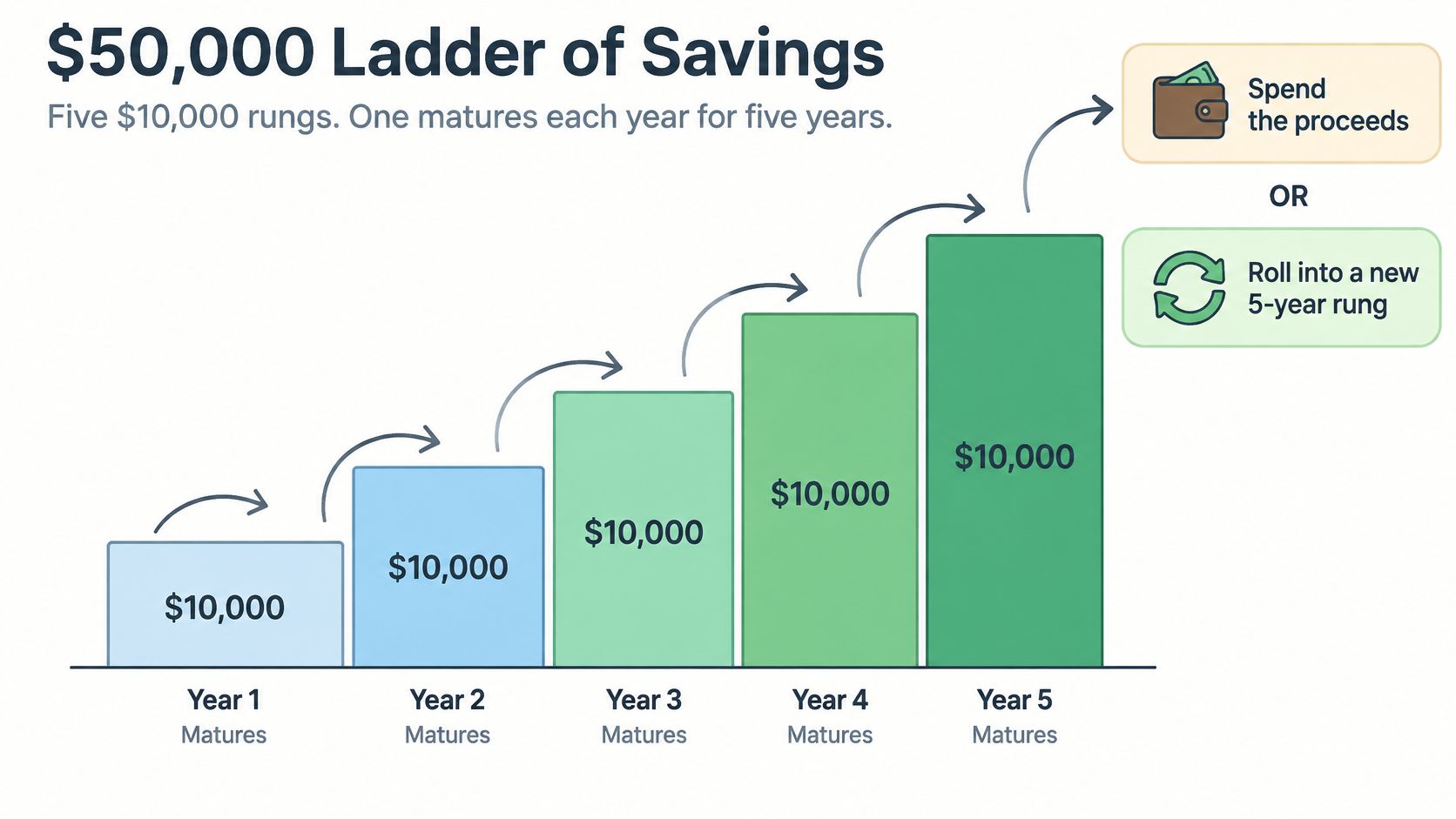
A ladder turns one big timing guess into a series of small, manageable dates. Say you've got $50,000 earmarked for spending over the next five years. Split it into five $10,000 rungs, with one rung maturing each year. When a rung comes due, you either spend it as planned or roll it into a new five-year rung at the far end.
That structure means you're never forced to sell everything in a bad market to pay one bill. Each year, one slice of money arrives. It's boring in the best possible way.
Size Rungs From Spending, Not Habit
Equal rungs are a starting point, not a law. If you expect to pull about $4,000 a year from this pool, five identical $10,000 slices overshoot your actual need. A two-rung structure sized to your spending may match the timing better and leave the rest invested for longer goals. Build each rung from a number you can defend, such as a tuition bill, a property tax payment, or a planned car purchase.
Set the Mix by the Job of the Money
The FDIC's deposit insurance overview supports a setup where inflation protection is matched to the time horizon and the job of the money, with near-term spending in insured deposits verified against the $250,000-per-bank, per-category limit and inflation-linked government securities considered for money intended to remain invested longer. Treasury's TIPS formula links principal directly to CPI-U, while FDIC coverage protects the nominal dollar balance from an insured-bank failure up to the applicable limit. Neither mechanism guarantees purchasing power in every period.
That last point deserves respect. A bank account can stay fully insured yet lose real value when its rate trails inflation. An individual TIPS or TIPS fund can fluctuate in market value before you need the money. Each tool guards against a different risk, so stop asking one account to do every job.
For the longest money, a common rule of thumb holds stocks at 110 minus your age, with the rest in bonds. Treat it as a first draft. A 40-year-old gets a 70% stock starting point, then adjusts for actual spending needs, income stability, and how they'd behave in a sharp drop. Broad stock index funds belong only in that longest bucket, where a bad year can be waited out rather than sold into.
Rebalance once a year, and sooner if the date you need the money changes.
Your spending, your timeline, or your income will shift eventually. When one of them does, rebuild the rungs around the new dates instead of defending a ladder built for a life you no longer have.
How to Buy I Bonds and TIPS Step by Step
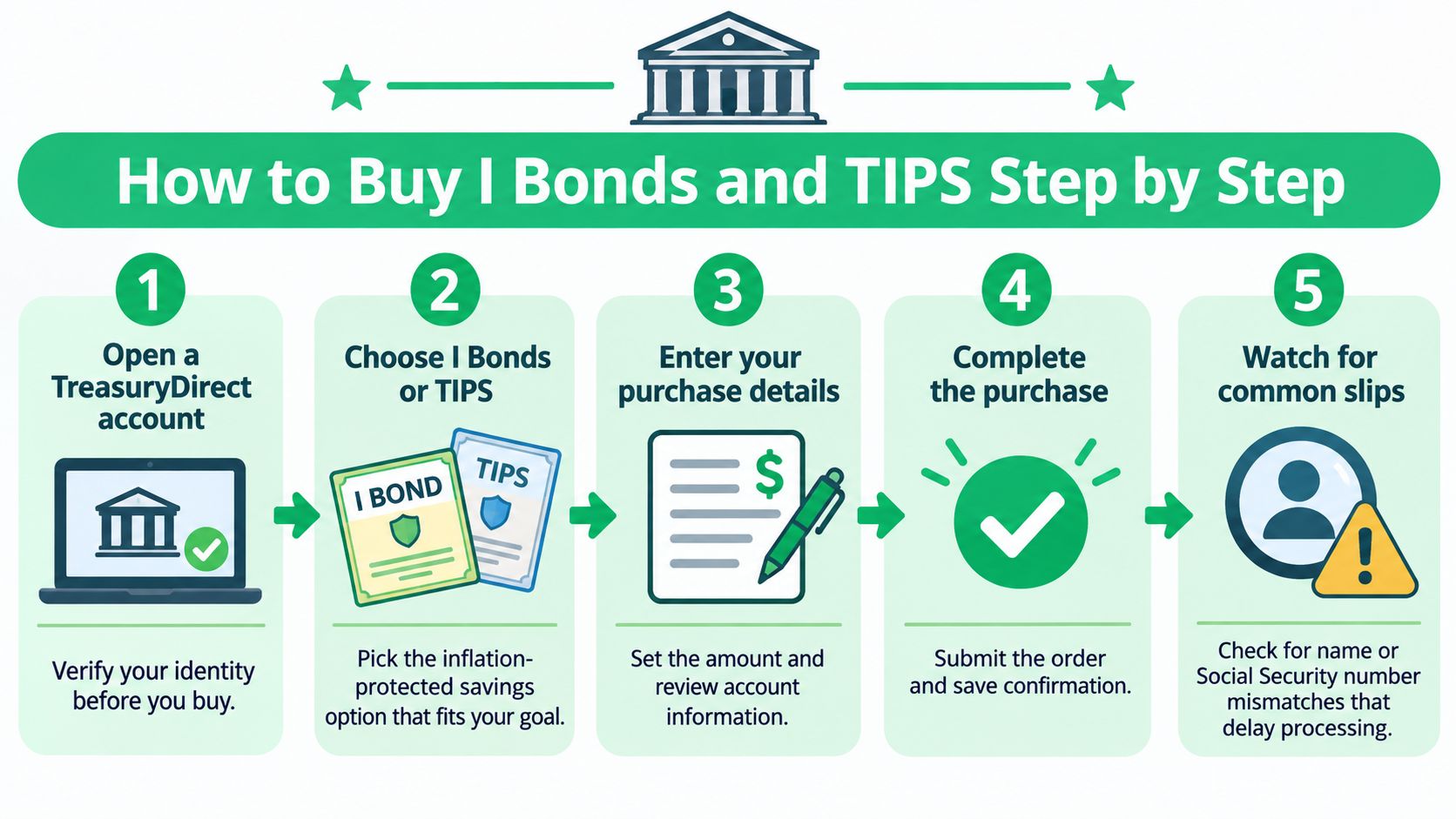
Before step one, check the current I Bond rate on TreasuryDirect and look at the latest TIPS auction results. Both change, and any rate printed in an article goes stale. You're buying today's terms, not the terms from whenever someone wrote about them.
The Purchase Process
-
Open a TreasuryDirect account and verify your identity. You'll need your Social Security number and bank details. The common slip is a mismatch between the name on your application and your official records, which can delay the account by days while you sort out paperwork.
-
Link a bank account for purchases and redemptions. The purchase money comes from this account, and redemption proceeds are deposited here. Use an account you plan to keep, because changing bank information later involves extra verification steps you'd rather not meet during an emergency.
-
Choose the tool based on your holding period. Pick I Bonds for money you can lock away for at least 12 months. Pick TIPS for money you plan to hold to a specific maturity date. Choosing first and checking your timeline second is how people end up selling at a loss.
-
For I Bonds, enter your amount in $25 increments. The electronic purchase limit is $10,000 per person per calendar year. The slip couples make is forgetting that a spouse has a separate limit and a separate account, so a married couple can buy up to $20,000 combined electronically each year.
-
For TIPS, bid at a Treasury auction or buy through a broker. At auction on TreasuryDirect, you accept the rate the auction sets. On the secondary market through a broker, you pay the market price, which may sit above or below the face amount. Know which route you're taking before you click anything.
-
Record the purchase date, maturity date, and rate. I Bonds earn interest from the first day of the purchase month, which is a small gift if you buy late in the month. Screenshot or save the confirmation. Future you will not remember these details, no matter how confident present you feels.
How the TIPS Math Actually Works
The TreasuryDirect page on TIPS explains that the Treasury recalculates principal using the Consumer Price Index for Urban Consumers, dividing the current CPI-U level by the CPI-U level at issuance to create an index ratio that's applied to the original principal. The fixed coupon rate then applies to that adjusted principal, so each semiannual interest payment can rise when inflation increases the principal.
Say your bond's principal adjusts from $1,000 to $1,050. Your coupon rate hasn't changed, but it's now calculated on $1,050, so the dollar payment grows. That's the protection working as designed.
At maturity, the Treasury pays the inflation-adjusted principal if it's higher than the original amount. If deflation pushed the indexed value down, you receive at least your original principal. Hold to maturity and that floor protects you. Sell early, and you get whatever the market offers that day, which can be less than face value if interest rates have risen.
Records Worth Keeping
- Purchase confirmations: Save the date, amount, and security details for every buy.
- Rate and maturity notes: Write down when each holding can be redeemed without penalty.
- Account access details: Store login recovery information somewhere secure that a trusted person could find if needed.
Pick Your First Protection Move Now
Put the money you need soonest into insured, liquid tools first, then add an inflation hedge only for money with a date you can hold. That sequence matters more than squeezing out an extra fraction of a percent. Our December 30, 2024 newsletter made the same call, recommending high-yield savings accounts or short-term Treasury bills for emergency funds.
- List every balance with its date. Write down each account and when you'll need that money.
- Park money needed within a year. Use a high-yield savings account or short Treasury bills, and compare real yield each quarter.
- Run the return math after inflation. Use our Compound Interest Calculator, which shows how lump sums and monthly contributions grow with compounding, then subtract your inflation assumption by hand.
- Check FDIC coverage at each bank. Move any excess to another bank or a qualifying ownership category.
- Consider I Bonds for lockable money. For cash you can leave alone at least 12 months, open a TreasuryDirect account and check the current rate before buying up to the annual limit.
- Set calendar reminders. Mark the May and November I Bond rate resets so you review terms before each purchase.
Nobody knows future inflation, and rates can change quickly. Pick one short-term goal first, such as paying off a credit card or building a down payment fund, and build the plan around it before adding anything else. Review the whole setup whenever your timeline changes.
Get more posts like this
One short, useful email each Friday. Free, no spam, unsubscribe anytime.