Money Market Account vs High Yield Savings Account
Compare money market account vs high yield savings account rates, minimums, access, and FDIC coverage, with worked examples and a simple decision test.

Daniel Anderson
Editor, The Money Maniac
October 24, 2026
12 min read

Your checking balance keeps growing, but the interest barely registers. Meanwhile, you've seen ads for money market accounts and high-yield savings accounts, and you're wondering where to move the cash you might need for a roof repair, a tax bill, or an unexpected expense.
My default recommendation is straightforward: use an insured high-yield savings account for cash that mainly needs to sit and earn interest. Choose a money market deposit account when its payment features solve a real problem. Before chasing either rate, make sure your money is fully insured and reachable on your schedule.
Why Money Market and High Yield Savings Accounts Get Mixed Up
If you're in your fifties through your seventies, retired or getting close, the question probably feels different than it did earlier in life. You may have meaningful savings, a paid-off or nearly paid-off home, and less appetite for finding out that accessible cash requires an inconvenient transfer.
Consider a familiar situation: you've let cash accumulate in checking because it's convenient. You know some belongs in savings, but moving it raises practical questions. Can you pay the contractor directly? Will the transfer arrive before the bill is due? Does opening another account add protection?
Give each pile of cash a job
The money market account vs high yield savings account decision gets easier when you stop treating all your cash as one pile. Money for next month's bills needs different access than money reserved for a future home project.
I'd evaluate an account in this order:
- Protection: Confirm that you're opening an insured bank deposit account and that your household's combined balances fit the coverage rules.
- Access: Decide how quickly you'll need the money and which withdrawal methods matter.
- Earnings: Compare the applicable yield after fees, balance requirements, and introductory terms.
That order is deliberate. A slightly better rate doesn't compensate for uninsured exposure or money that arrives after you need it.
Practical rule: Decide what the money must do before deciding where it should earn interest.
Every example rate below is a dated 2026 illustration, not a live offer or a promised return. Deposit rates change, and the same account may look more or less attractive when you check again. The useful part is the decision method, which you can apply to current disclosures.
For homeowners approaching or living in retirement, I'd put particular weight on simplicity. An account should make your cash easier to manage, without creating another balance threshold or transfer deadline you have to remember.
What Each Account Is and Where They Overlap
A high-yield savings account, often shortened to HYSA, is a savings deposit account with a variable annual percentage yield, or APY. It generally emphasizes saving and electronic access rather than paying bills directly.
A money market deposit account, sometimes called an MMDA, is also a bank deposit account. It may add check-writing or debit-card access and may use balance tiers to determine the rate you receive. The Federal Reserve's savings deposit guidance explains the regulatory overlap between conventional savings deposits and money market deposit accounts.
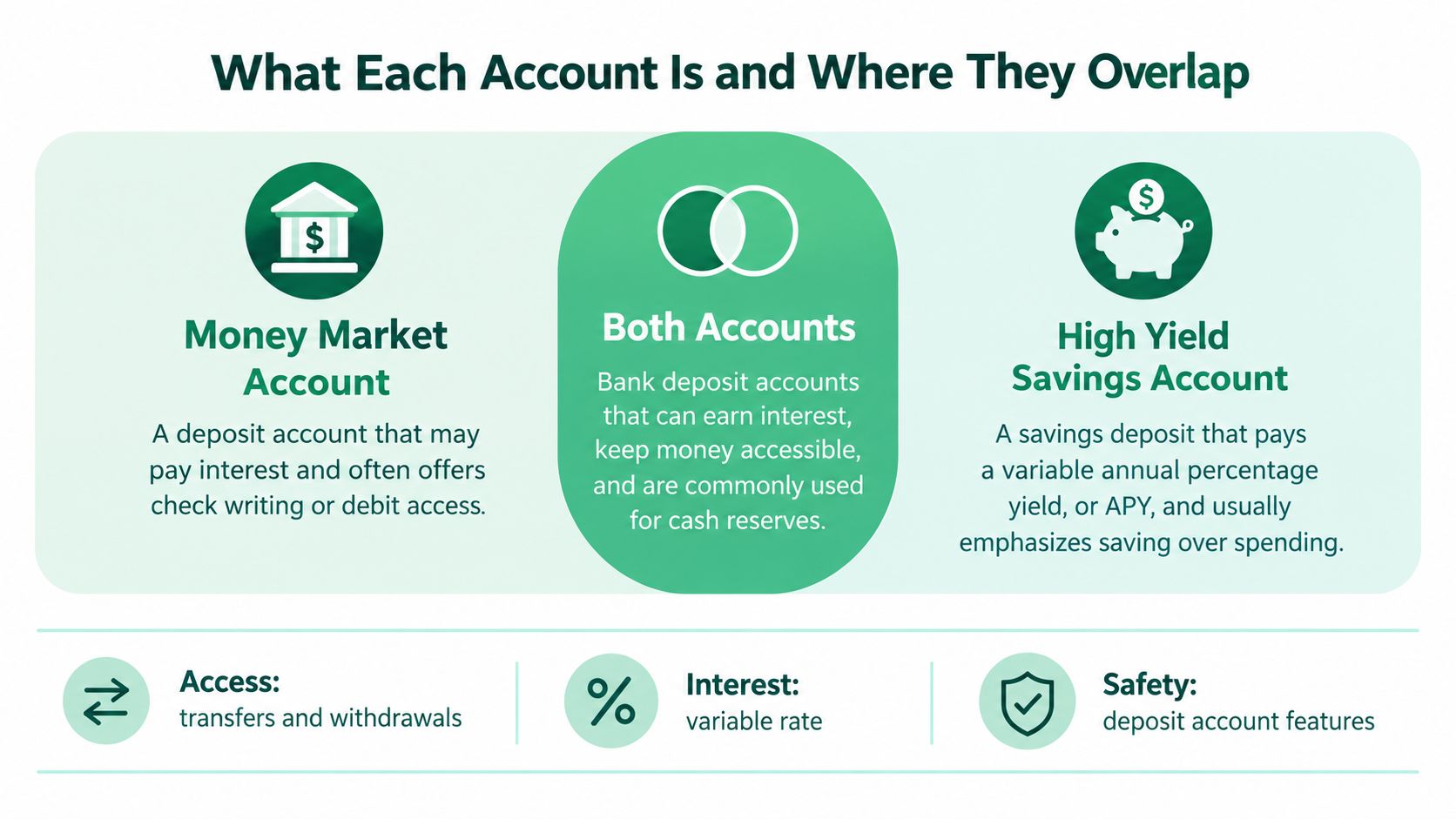
Regular savings and high-yield savings aren't interchangeable comparisons
The FDIC's educational description, used as a 2026 reference, says money market accounts usually pay more than regular savings accounts and often require a higher minimum balance, giving $1,000 as an example. It also describes savings accounts as allowing deposits while potentially limiting fee-free withdrawals, according to the FDIC's deposit-account educational material.
That comparison doesn't establish that a money market account beats a competitive HYSA. A bank can offer an appealing rate on either product, so the account label alone tells you little about its value.
Keep these distinctions straight:
- Savings deposit: A bank account used to hold cash and earn interest.
- Money market deposit account: Another bank deposit account, potentially with additional payment features.
- Money market mutual fund: An investment product that requires a separate safety assessment.
The last distinction deserves special attention. A brokerage money market mutual fund isn't covered by FDIC deposit insurance, even though its name resembles a bank account, as the FDIC's overview of covered deposits explains.
While you're tidying up household cash, Compass+’s automated monitoring for refunds owed is a separate resource to consider. Keep that task separate from choosing where your savings belongs.
Read the product description and applicable APY before the marketing copy. Banking terminology already supplies enough confusion without giving the advertisement the final vote.
Comparing Rates, Fees and Minimum Balances
Compare APY rather than the stated interest rate. APY expresses annual yield with compounding reflected, which makes it the more useful starting point for comparing deposit offers. Then check whether that APY applies to your entire balance, a particular tier, or an introductory period.
Money Market Deposit Account vs High Yield Savings Account at a Glance (2026 Examples)
| Feature | Money market deposit account | High yield savings account |
|---|---|---|
| APY, August 2026 competitive examples | About 3.40% | About 3.65% |
| Minimum balance | May require a higher balance or use rate tiers | Check opening, earning, and fee-waiver requirements |
| Monthly fees | Check the fee and waiver conditions | Check the fee and waiver conditions |
| Transaction limits | Set by the account agreement | Set by the account agreement |
| Check or debit access | More likely to be available | Commonly emphasizes electronic transfers |
The rate row comes from a dated August 2026 rate comparison, which reported national averages of 0.63% for money market deposits and 0.38% for savings, alongside competitive-account averages of about 3.40% and 3.65%, respectively. These are historical examples for comparison, not rates you should expect to receive today.
The national savings average also describes a broader category than competitive high-yield accounts. Don't compare a carefully selected HYSA offer with a broad money market average and assume you've established a permanent winner.
Run the break-even test
Using those dated examples, a hypothetical $10,000 held for a year at 3.40% versus 3.65% produces a difference of about $25 before tax, assuming the balance and APYs remain unchanged. That calculation uses the rates and spread in the linked comparison above.
The practical formula is:
Expected benefit from moving = balance × APY difference × portion of the year, minus additional fees.
For a quick estimate, express the APY difference as a decimal. This is a screening calculation, not a substitute for the bank's actual interest calculation.
A small rate advantage deserves a small amount of effort. Don't turn it into a second job.
Now consider the minimum-balance problem. You choose an account for its attractive headline yield, then withdraw cash for a repair and fall below its required threshold. If that triggers both a lower rate and a monthly charge, the account can lose its advantage precisely when you need to use it.
Before moving money, check:
- Your applicable tier: Confirm what your balance earns.
- The ongoing APY: Find out what happens after any promotion ends.
- The minimum you can maintain: Use your likely balance after withdrawals, not your opening deposit.
- The cost of switching: Include fees and your willingness to manage another account.
Check current figures in each bank's rate disclosure and the FDIC's published national averages. Use national averages as context, not a shopping target. Banks change their offers as market conditions change, so today's winner may lose its edge later.
Access, Transfers and Check Writing Features
A savings account can look excellent until you need to get money out of it. For retirement cash, I'd evaluate the exit route with the same care as the rate.
Money market deposit accounts may let you write a check or use a debit card directly. A HYSA may require moving money to checking first. Those are common patterns, but the bank's agreement determines what your account permits.
The old withdrawal rule needs updating
The Federal Reserve removed the federal six-per-month limit on convenient savings transfers and withdrawals in April 2020. Banks can allow unlimited convenient transactions, but they don't have to, and they can retain account-level restrictions or fees under their agreements, according to the Federal Reserve's rule change.
Don't accept a blanket statement that every savings account still has the old federal cap. Don't assume the rule change guarantees unrestricted access, either.
Ask practical questions before you deposit:
- Transfer timing: When will money sent to your checking account become available to spend?
- Payment methods: Are checks, debit purchases, or ATM withdrawals available?
- Transaction counting: Which outgoing transactions count toward any bank-imposed limit?
- Consequences: Can repeated activity trigger fees, conversion, suspension, or closure?
- Withdrawal size: Will your usual transfer limits accommodate a major household expense?
Test the account against an actual bill
Suppose your property-related bill comes due on a fixed date. Direct check-writing could be useful if it avoids an extra transfer step. But confirm the account's rules and payment process before relying on it.
For money you might need within a few days, work backward from the payment deadline. A high APY offers little comfort while you're waiting for transferred cash to become spendable.
Access check: Make a small test transfer before trusting a new account with an urgent expense.
I'd also keep an intentional operating balance in checking rather than transferring money for every household payment. Our guide to how much to keep in checking helps separate routine spending from reserves.
The goal is a cash setup you can use comfortably during an already stressful week. Extra payment features earn their place when they reduce friction you'll encounter.
How Deposit Insurance Covers Large Balances
Opening another account at the same bank doesn't automatically give you more insurance. For households with substantial cash, this matters more than a modest yield difference.
Under the FDIC standard used for this 2026 comparison, coverage is $250,000 per depositor, per insured bank, per ownership category. A hypothetical $300,000 held at the same bank in the same ownership category leaves $50,000 uninsured, even if you divide it between savings and a money market deposit account, as explained in the FDIC's deposit-insurance guidance.
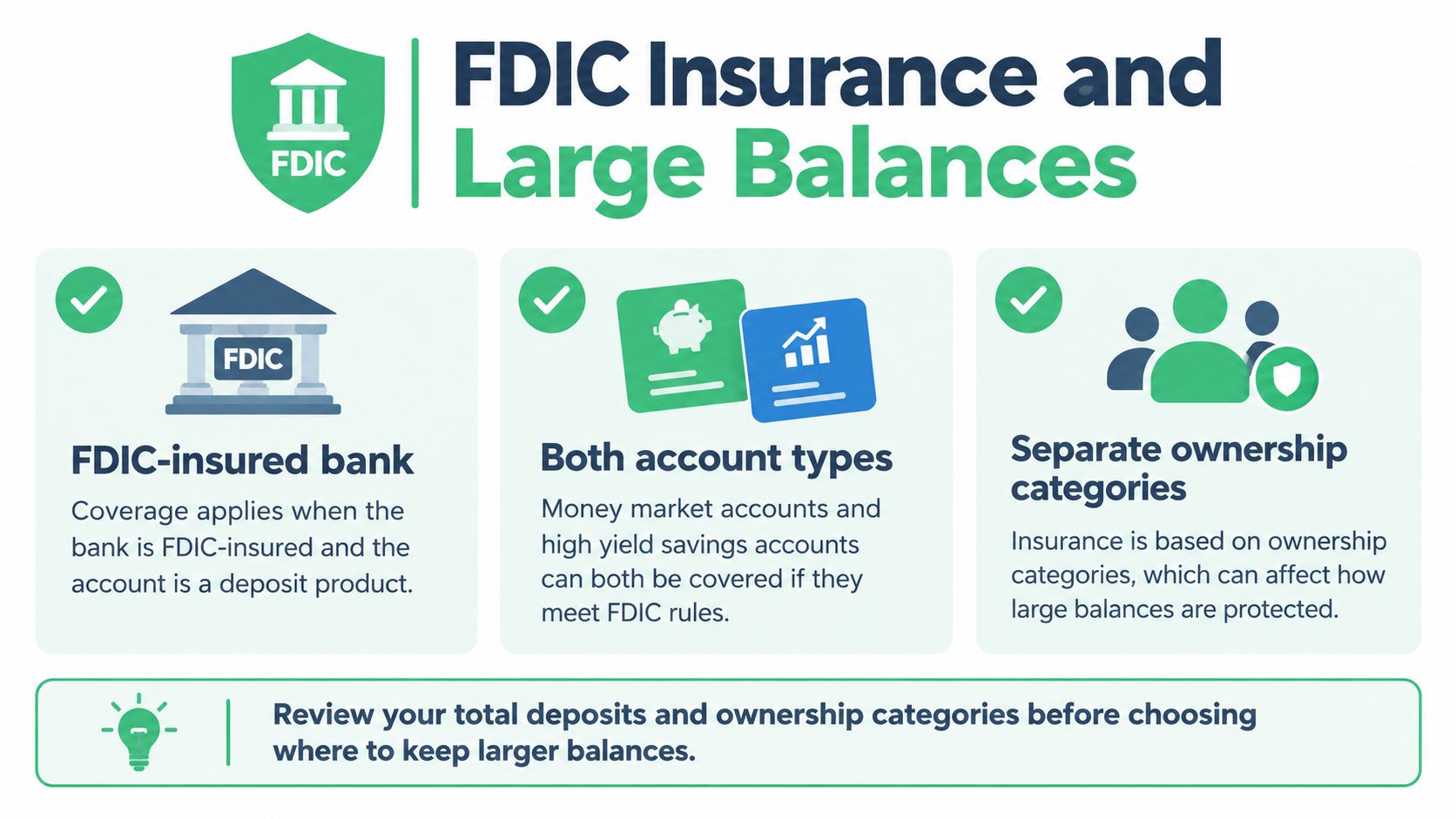
Map the bank behind the account
The legal bank matters more than the logo. Accounts marketed under different brand names can belong to the same insured institution and share coverage.
Build a simple worksheet before moving a large balance:
| Worksheet field | What to record |
|---|---|
| Legal bank name | The insured institution holding the deposit |
| Ownership category | The category that applies under FDIC rules |
| Deposit balance | Your qualifying deposits at that institution |
| Accrued interest | Interest that also counts toward coverage |
| Amount above coverage | Any exposure after applying the relevant rules |
FDIC protection includes principal and accrued interest, so leave room for interest rather than treating the coverage ceiling as a target balance. The FDIC's insured-deposit brochure explains how qualifying accounts are combined and how ownership categories affect protection.
Separate coverage deliberately
Spreading funds across separately insured banks can reduce concentration. Different qualifying ownership categories may also provide additional coverage, but eligibility matters. Renaming an account doesn't create a new category.
For homeowners temporarily holding proceeds from a sale, a down payment, or a large reserve, I'd complete the worksheet before comparing rates. Verify the current coverage limit directly with the FDIC and check the total across all relevant accounts.
The product distinction matters here too. A bank money market deposit account can receive deposit insurance; a brokerage money market mutual fund doesn't receive that protection. The fund requires an investment-risk assessment instead of the bank-deposit coverage calculation.
Get the insurance structure right before optimizing yield. A little extra interest is poor compensation for accidentally leaving cash outside the protection you expected.
Choosing an Account for Emergency Funds and Short-Term Goals
Cash needs a purpose before it needs an account. These hypothetical situations show how I'd match the account to the job without recommending a particular institution or product.
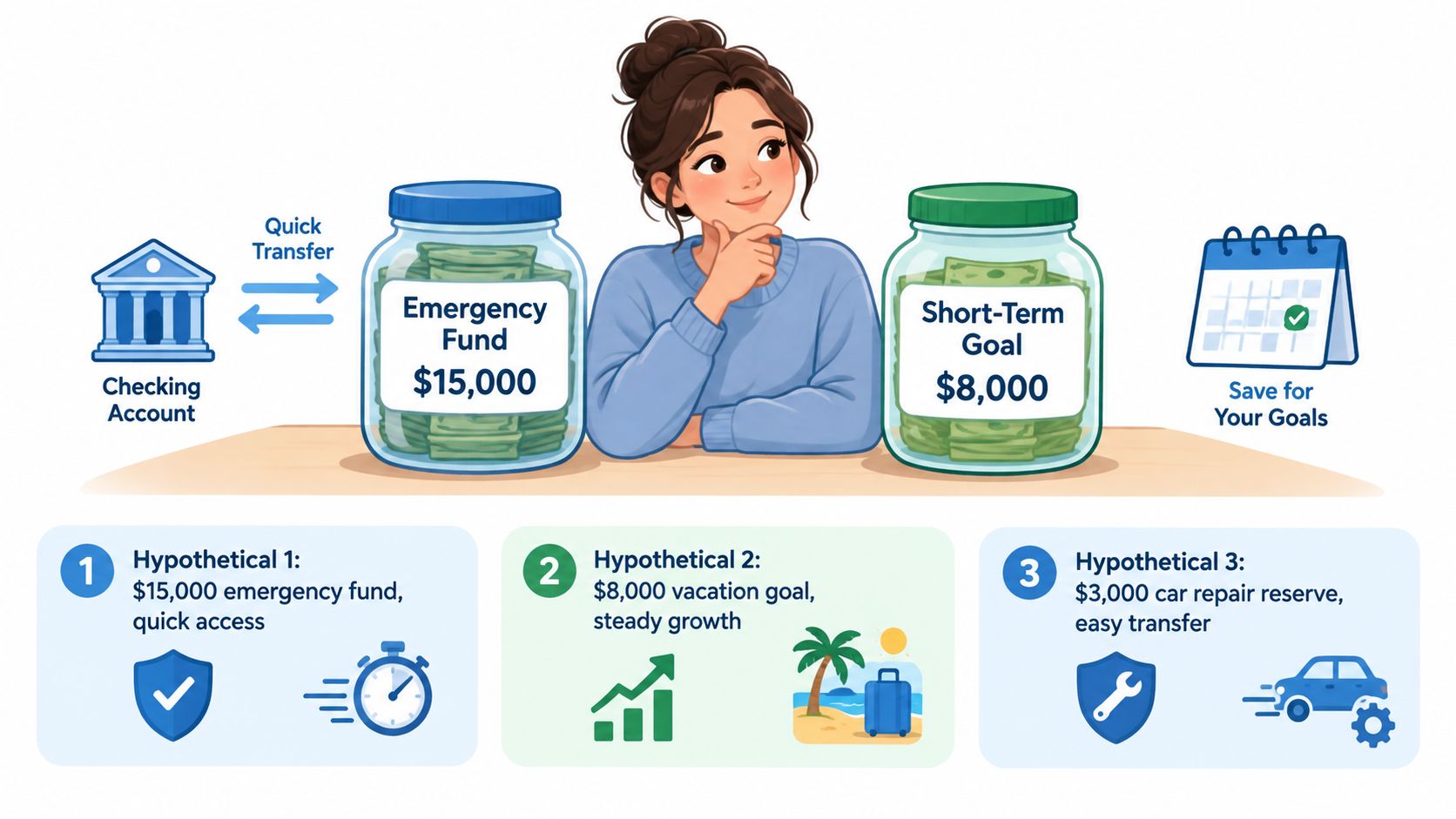
A hypothetical $15,000 emergency fund
You want quick electronic access, don't need to write checks from the account, and expect to leave the money alone unless something goes wrong.
I'd favor an insured HYSA with competitive net yield and reliable transfer access. There's little reason to manage payment features you won't use, particularly if they come with balance conditions.
Start with the amount you need available. Our guide to how big an emergency fund should be can help you evaluate the reserve before choosing its home.
If your money market deposit account already meets those needs and pays more after fees, keeping it is perfectly reasonable. Moving money solely to change the account label accomplishes nothing.
A hypothetical $30,000 down payment in 18 months
Here, the expected purchase date changes the questions. You need to understand what happens when the balance falls, how large transfers work, and how to get the money into position before closing.
I'd compare the accounts using the expected withdrawal pattern, not just the starting balance. A tiered account may look attractive while fully funded but become less appealing after you use part of the money.
Before opening it:
- Check the lower tiers: Understand the yield after a partial withdrawal.
- Plan the final transfer: Confirm the process before committing to a closing deadline.
- Avoid unnecessary complexity: Choose an account you can manage confidently when the purchase becomes busy.
Our December 30, 2024 newsletter recommended choosing a specific short-term goal, such as building a down payment fund or paying off a credit card. That remains useful planning advice: assign the money a job before shopping for its account.
A hypothetical $10,000 brokerage cash sweep
For this hypothetical, don't start with the sweep's advertised yield. Identify where the idle cash goes: a bank deposit or a money market mutual fund.
If it goes to a bank deposit, include that destination bank in your insurance worksheet. If it goes to a fund, evaluate it as an investment rather than assuming the protections of a savings account.
Our December 30, 2024 newsletter also recommended high-yield savings accounts or short-term Treasury bills for emergency money. Those are distinct choices; the recommendation doesn't make every cash-management arrangement interchangeable.
My implementation rule is simple: use a money market deposit account when occasional direct payments are useful. Put other emergency and near-term cash in the insured account offering the best combination of net yield and usable access.
How to Choose Between Them and Take Your Next Step
For most emergency reserves, an insured HYSA is the cleaner starting point. It matches the basic job: hold cash, earn a competitive variable yield, and let you transfer money when needed.
A money market deposit account deserves the spot when its check-writing or debit access improves your household's cash management, or when its overall terms are better. You don't need to pay, in fees or lost interest, for features that merely look convenient.
Make the decision in the right order
Use a short checklist before opening or switching:
- Confirm the product: Establish that it's the kind of account you intend to hold.
- Map the protection: Identify the legal bank, ownership category, and combined exposure.
- Specify access: Write down how you'll withdraw money and when it must arrive.
- Compare current terms: Read the applicable APY, balance tiers, fee schedule, and promotional conditions.
- Calculate the benefit: Apply the break-even test to your expected balance and holding period.
The earlier rate example shows why this last step matters. If the annual benefit is modest, a familiar account with dependable access may be worth keeping. If the difference is meaningful and switching doesn't weaken protection or liquidity, moving can make sense.
Use calculators without mistaking estimates for terms
The Money Maniac's Compound Interest Calculator shows how lump sums and monthly contributions can grow with compounding. It runs in your browser without an account, so you can test assumptions without creating another login.
Use it to explore possibilities, then return to the bank's disclosure. A calculator can't tell you whether a variable rate will remain competitive or whether you'll qualify for a particular tier.
For cash with a firmer timeline, our guide to how to invest in CDs offers another comparison to consider. Keep money needed for unpredictable expenses separate from decisions that require more attention to access terms.
Our weekly market and money notes provide context for financial decisions, not a verdict on any particular account. This week, pull the current APY, minimum balance, and fee schedule for each account you're considering, verify coverage with the FDIC, and calculate the benefit before moving your money.
Get more posts like this
One short, useful email each Friday. Free, no spam, unsubscribe anytime.