How Big Should My Emergency Fund Be: A Real-World Guide
Learn how big should my emergency fund be with a step-by-step calculator approach. Covers single, dual, variable, and layoff scenarios with real numbers.

Daniel Anderson
Editor, The Money Maniac
October 11, 2026
12 min read

Most advice answers “How big should my emergency fund be?” with “three to six months of expenses,” then walks away. That rule is easy to remember and often wrong. It treats a sudden car repair, an uncovered medical bill, and a long layoff as if they're the same problem requiring one undifferentiated pile of cash.
A better answer has two parts: build a small shock buffer for immediate, non-income emergencies, then add a separate income-replacement reserve based on your household's actual risk. Your target should reflect essential spending, job stability, income volatility, dependents, insurance, debt, and access to backup resources. A generic multiplier can't do that work for you.
Why the Three-to-Six-Month Rule Falls Apart
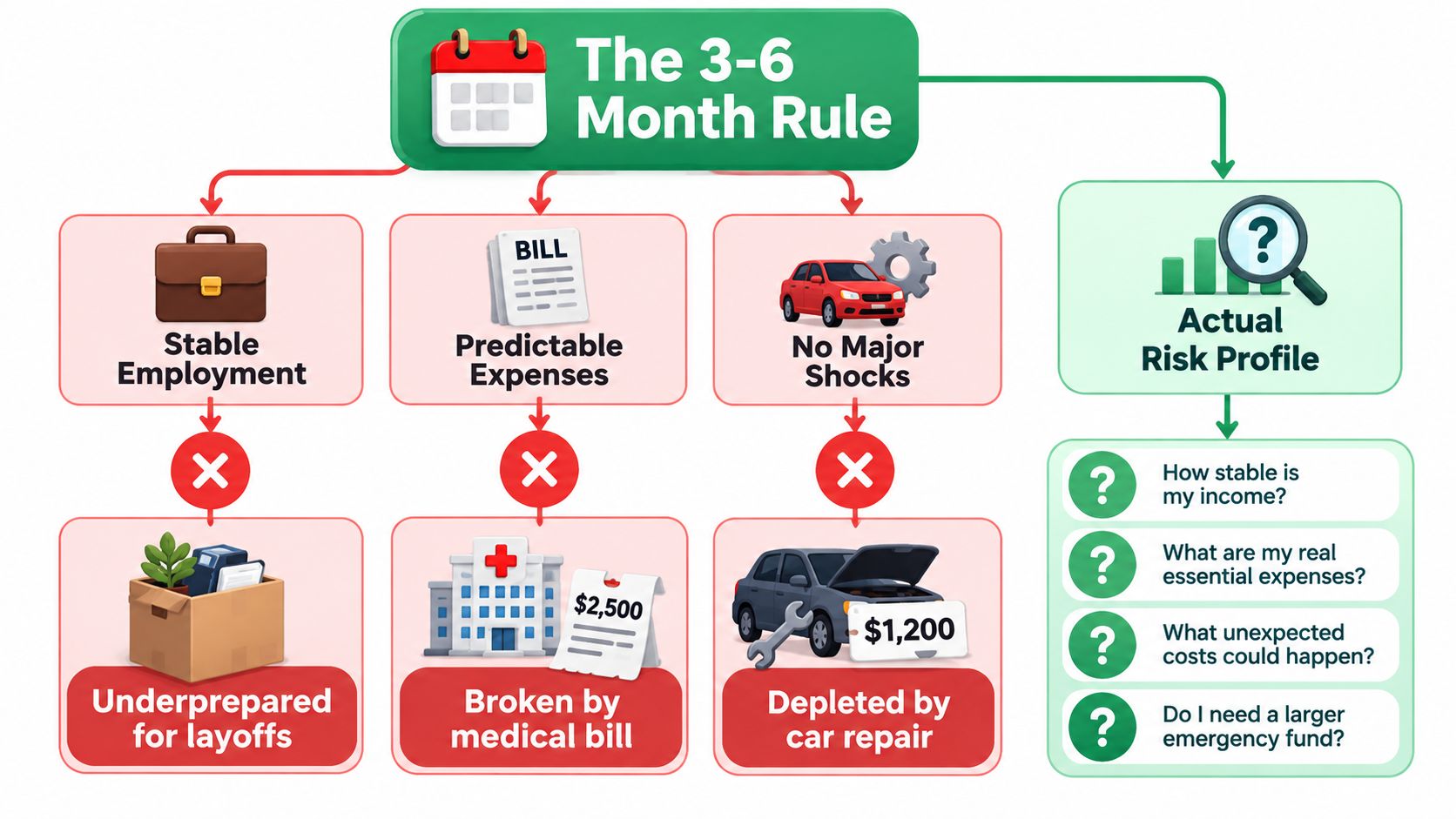
The three-to-six-month rule implies a fairly tidy household: stable employment, predictable expenses, manageable debt, decent insurance, and enough access to credit to bridge a short disruption. Plenty of people don't live inside that spreadsheet. A single earner with children, a freelancer with irregular invoices, and a renter whose car is essential for work face very different risks.
The core mistake is treating emergency savings as one balance with one job. A fund that can cover lost income for three months may still be wiped out by a major repair before the layoff arrives. Conversely, someone with two stable incomes and low fixed costs may not need to hold six months of expenses in cash immediately.
What the data actually tells us
In the Federal Reserve's 2024 survey, 55% of U.S. adults reported having savings sufficient to cover three months of expenses, up from 54% in 2023 but below the 59% recorded in 2021, according to the Federal Reserve's household financial well-being data. That makes three months a useful benchmark, not a universal finish line.
The benchmark answers one narrow question: can you keep paying essential bills after losing your primary income? It doesn't tell you whether your household can absorb a broken vehicle, an insurance deductible, or a major medical cost without raiding that reserve.
My rule: Separate the money that handles a bad Tuesday from the money that handles a bad six months.
Start by asking what could hurt you first. If your biggest realistic shock is a necessary car repair, your first target should handle that event. Then calculate the income-replacement reserve separately. Readers who work remotely, travel often, or earn across locations may also find the practical budgeting guidance in this finance hub for digital nomads useful, particularly when income and expenses don't arrive in a neat monthly pattern.
Step One Is Your Real Monthly Burn Rate
Before choosing a number of months, find the monthly cost of keeping your household functioning. Call this your essential burn rate. It isn't your salary, your average spending, or the amount you wish you could spend during a crisis.
The Federal Reserve measures whether people could maintain three months of expenses after losing their primary income source, using monthly must-pay expenses multiplied by the number of months of protection desired, rather than a percentage of salary, as explained in its household expense methodology.
Build the number from the bottom up
Pull recent bank and card statements, then sort each payment into one of three groups:
- Keep running: Housing, basic utilities, groceries, insurance, transportation needed for work, healthcare, minimum debt payments, and necessary dependent expenses.
- Pause during disruption: Dining out, entertainment, optional shopping, subscriptions, travel, upgrades, and accelerated debt payments.
- Plan separately: Annual premiums, tax bills, gifts, vehicle maintenance, and other predictable irregular costs.
The first group forms your monthly burn rate. The second group can be cut if income stops. The third group belongs in sinking funds unless it represents a genuine emergency. A sinking fund for known costs keeps those bills from masquerading as surprises.
For a budgeting worksheet, use this 50-30-20 budget spreadsheet as a starting point, then replace broad spending categories with your own must-pay figures. The popular percentage split can organize a budget, but it shouldn't decide your emergency target.
Use a realistic bare-bones budget
Suppose you earn $5,000 per month but need $3,200 to keep the household operating. A six-month reserve based on essential spending is $19,200, not $30,000. That difference matters because using gross income can create an unnecessarily large target.
The opposite mistake is just as dangerous. If you strip the budget so aggressively that it excludes insurance, minimum debt payments, healthcare, or transportation to work, you produce a comforting number that won't survive an actual disruption. Your emergency budget should be lean, not fictional.
Write down the final figure and review it after major changes such as a move, a new dependent, a job change, or a large debt payoff. Your emergency fund should replace necessary cash flow, not preserve every convenience you currently enjoy.
Layer a Shock Buffer Before the Big Reserve
An emergency fund that handles a flat tire isn't automatically large enough to replace a lost paycheck. Keep those jobs separate.
In the Federal Reserve's 2025 survey, 59% of U.S. adults reported at least one major unexpected expense during the previous year. The most common were major vehicle repair or replacement at 30%, home or appliance repair at 22%, and major medical expenses at 21%, according to the Federal Reserve's 2025 economic well-being report.
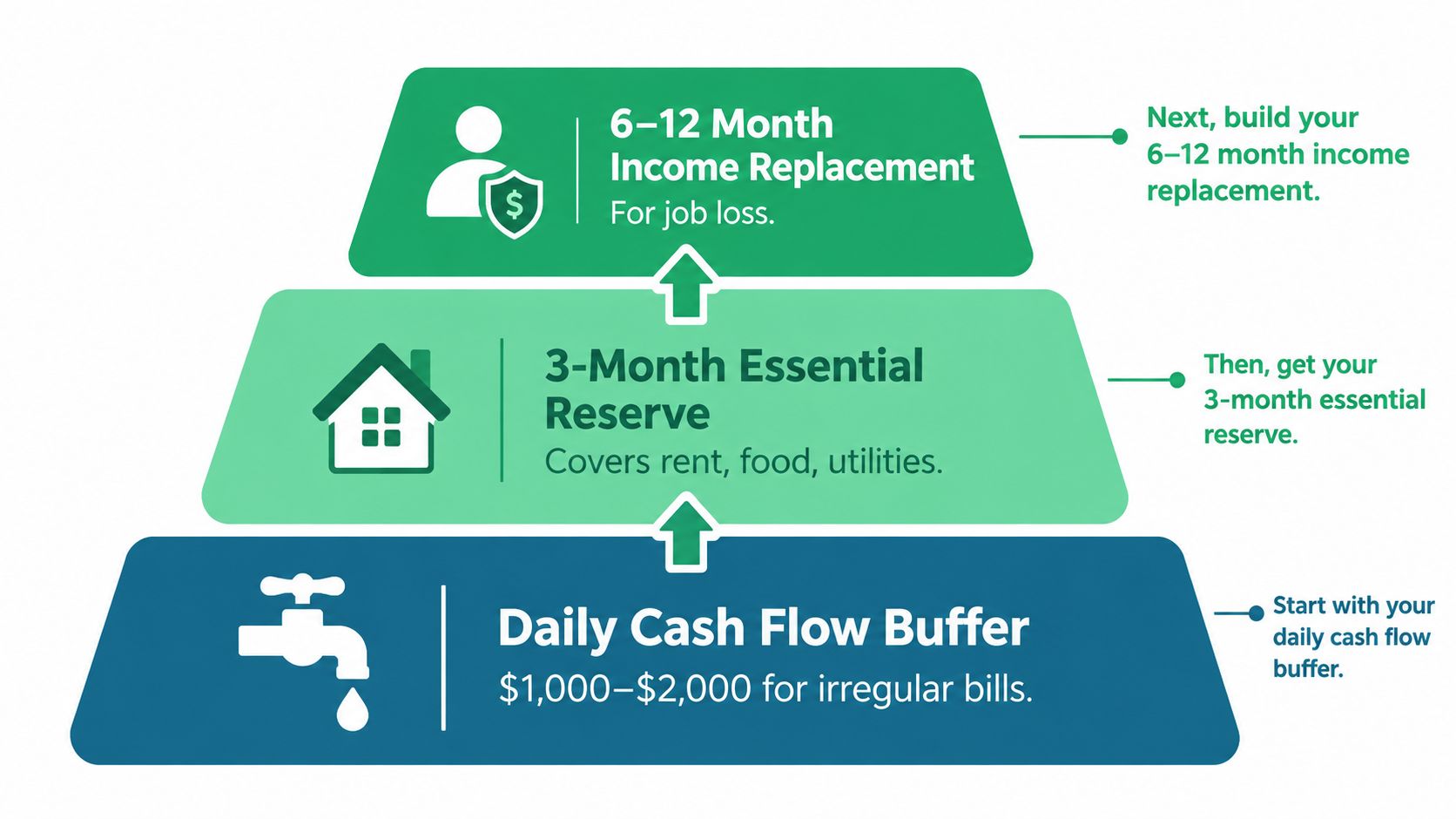
That pattern supports a two-bucket structure:
- Shock buffer: Immediately accessible cash for the largest plausible urgent expense.
- Income-replacement reserve: Essential monthly spending multiplied by the number of months your income risk requires.
Size the first bucket by exposure
A shock buffer should reflect your household's most likely expensive interruption. A renter who relies on an older car may prioritize vehicle access. A homeowner may need to account for a high insurance deductible. Someone with recurring medical needs may need more liquid cash than a healthy household with strong coverage.
The point isn't to guess the largest imaginable catastrophe. That's how savings goals become so intimidating that people never start. Choose the expense that could force you into high-cost borrowing if it arrived next week.
A $1,000 to $2,000 starter buffer is a practical range for many households, but your actual target should follow your risk. The Federal Reserve found that 18% of adults could handle less than $100 using savings alone, while 13% could handle $100 to $499 and 69% could pay an expense of at least $500 from current savings, as reported in its survey release on emergency expenses.
Medical costs deserve their own review because insurance coverage, deductibles, and exclusions can change the size of a plausible shock. A practical guide to protect your savings with My Policy Quote can help you think through that exposure before choosing a buffer.
Once the shock bucket is full, direct new savings toward income replacement. Don't spend three months building one pile only to use most of it on one repair. That leaves you exposed to the original job-loss risk.
Adjust the Target for Your Actual Risk
After calculating essential spending and a shock buffer, choose the number of months for income replacement. Your household's risk profile matters more than internet tradition.
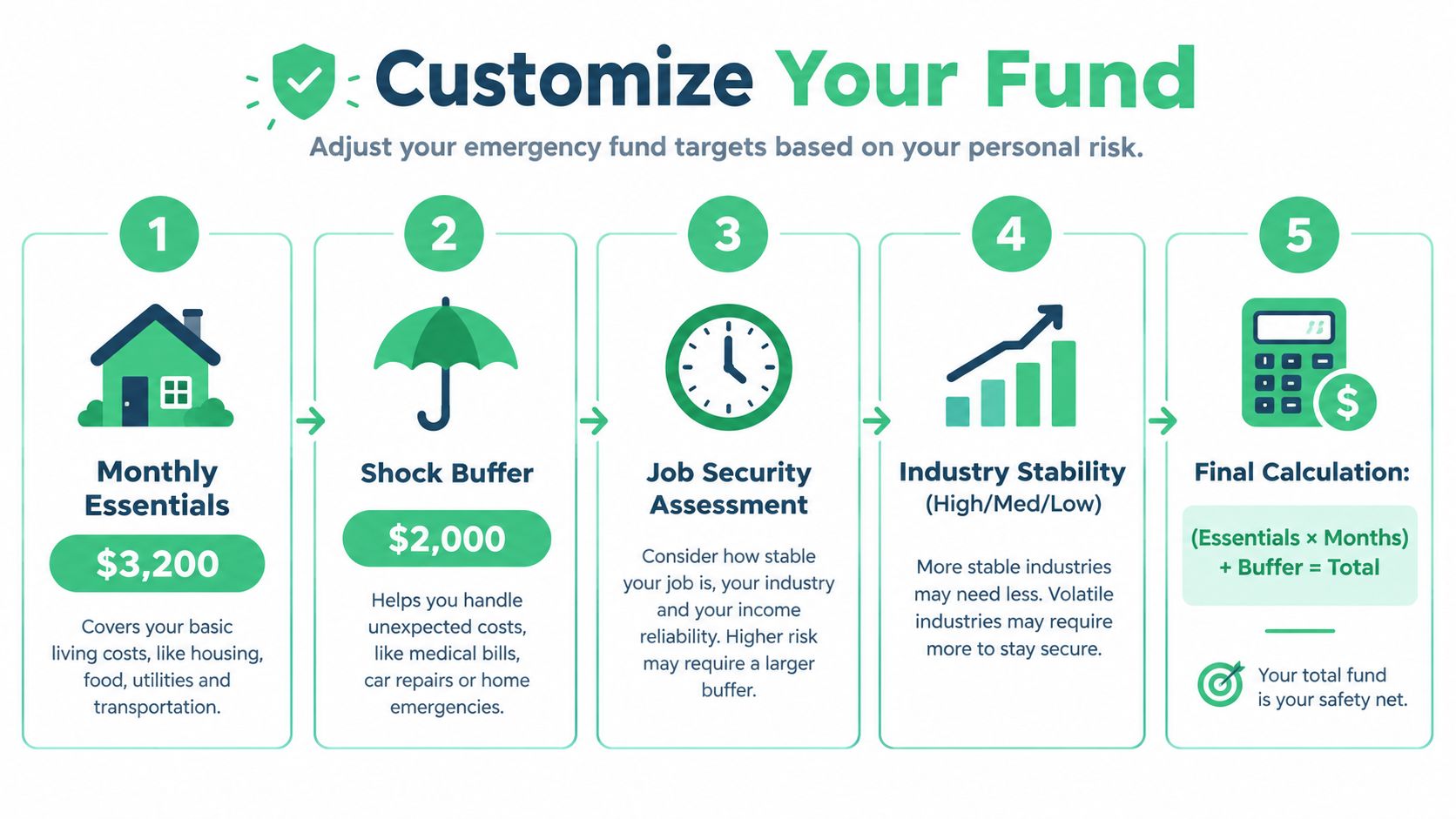
Use the base formula:
Total emergency target = essential monthly expenses × protection months + shock buffer
Then adjust the months according to the conditions below.
Reasons to hold more
A single earner should usually hold more than a comparable dual-income household because one job interruption can affect the entire income stream. Dependents raise the cost of interruption, and specialized work can lengthen the time needed to find a replacement role.
Variable compensation deserves extra caution. If commissions, freelance invoices, seasonal work, or client payments make up a meaningful share of income, calculate the reserve from essential expenses and choose a longer protection period. Don't assume a strong recent month will repeat itself during a downturn.
Increase the target when you have:
- One household income: There isn't another paycheck absorbing the fixed bills.
- Variable pay: Your income can fall even when your work effort doesn't.
- Specialized employment: A narrow field may limit replacement opportunities.
- Dependents: Children or other necessary dependents reduce your ability to cut spending.
- Large deductibles or recurring medical costs: One health event can consume the shock bucket quickly.
- Limited credit access: You have fewer ways to bridge a temporary gap safely.
- Predictable large bills without sinking funds: Taxes, annual premiums, and maintenance can collide with a job interruption.
Reasons you may start lower
Two incomes, strong employer coverage, low fixed costs, and reliable backup support can justify a smaller initial income reserve. That doesn't mean you need no cash. It means the probability and cost of a total household income interruption may be lower.
A stable worker with two incomes, strong insurance, and low fixed expenses may begin with one month of essential spending, then progress toward three months. A single earner with dependents, specialized work, and weak backup resources may reasonably target six months or more. Someone with highly variable income may need a still longer runway.
Be careful with credit as a substitute. A credit line can provide flexibility, but lenders can reduce limits or deny access when your finances deteriorate. Treat credit as backup capacity, not as the foundation of your emergency plan.
Four Real Scenarios Through the Formula
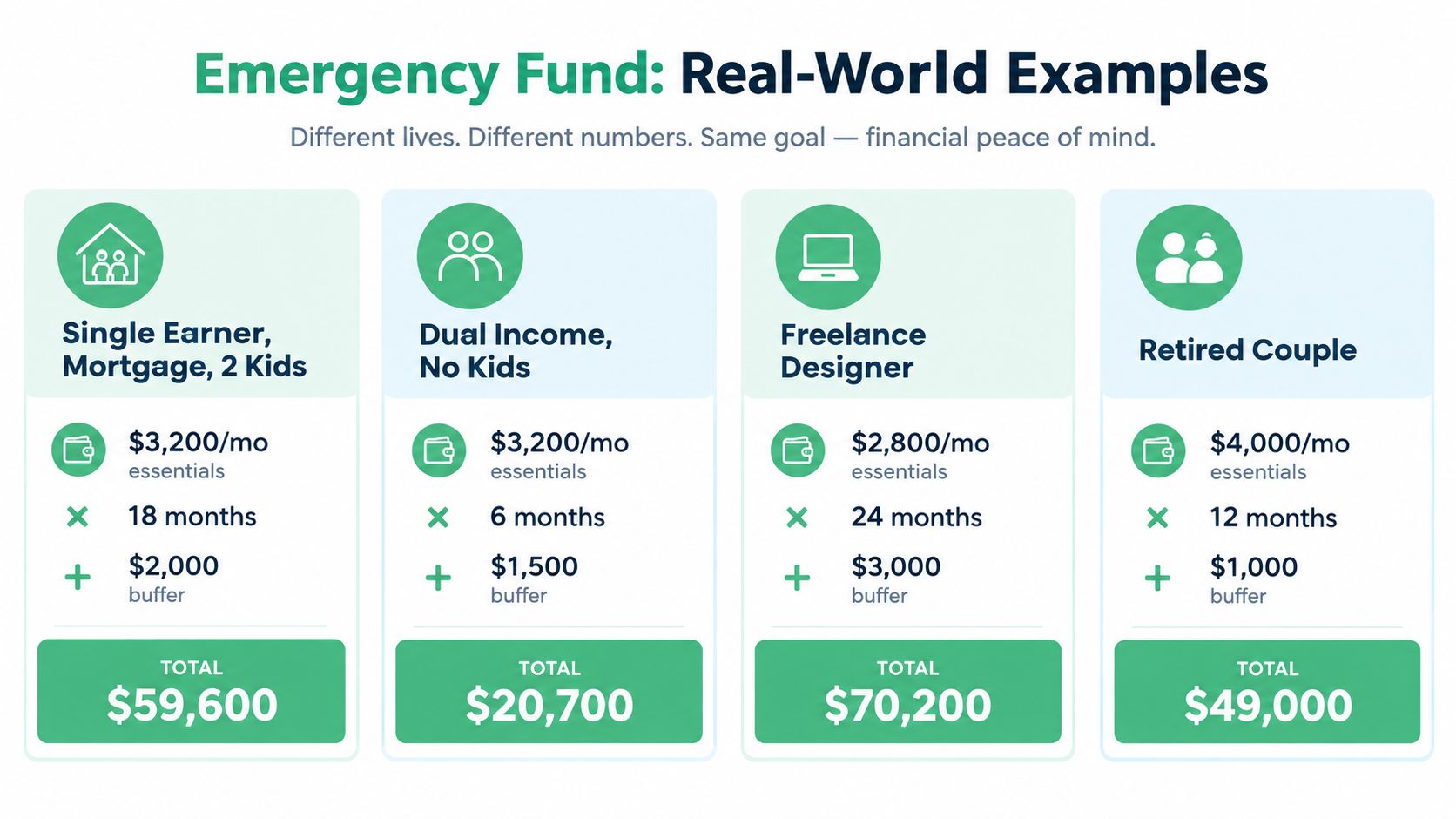
The formula becomes useful when it produces a number you can challenge. These examples use different risk profiles, so the months change even when the household expenses look similar.
Single income with a mortgage and children
Assume essential expenses of $3,200 per month, a $2,000 shock buffer, and 18 months of income replacement because the household depends on one earner, carries a mortgage, and supports two children.
$3,200 × 18 + $2,000 = $59,600
That target is large because the exposure is large. A single earner shouldn't copy the reserve of a dual-income household just because both households spend the same amount each month.
Dual income with no children
Now take a couple with two stable jobs, no children, and the same essential spending of $3,200 per month. With a $1,500 shock buffer and six months of income replacement, the calculation is:
$3,200 × 6 + $1,500 = $20,700
This household still needs cash. Both earners could face trouble at the same time, and repairs don't check the household's employment arrangement before arriving. The lower target reflects shared income and fewer dependent obligations, not invulnerability.
Freelancer with uneven cash flow
A freelance designer may have essential expenses of $2,800 per month, a $3,000 shock buffer, and 24 months of income replacement. That produces:
$2,800 × 24 + $3,000 = $70,200
The longer runway accounts for delayed invoices, client concentration, taxes, and the possibility that finding replacement work takes longer than expected. A freelancer should also keep business cash-flow needs distinct from personal emergency savings. Mixing the two makes both accounts look healthier than they are.
Layoff-prone technology worker
A worker in an industry with frequent layoffs might spend $3,200 per month, keep a $2,000 shock buffer, and choose 12 months of income replacement:
$3,200 × 12 + $2,000 = $40,400
That target sits between the other examples because the employment risk is higher, but the household may have no dependents or a second income. Job stability should influence months directly. It shouldn't be hidden inside vague anxiety or ignored because a salary happens to be high.
Research summarized by Vanguard found that having at least $2,000 in emergency savings was associated with 21% higher financial well-being than having none. Only 15% of people with at least $2,000 reported rising financial stress, compared with 51% among those without emergency savings, according to the Federal Reserve's report summarizing that research.
Build the Fund in Stages That Match Your Cash Flow
Trying to leap from zero to a fully customized reserve is a reliable way to abandon the plan. Use milestones that protect you sooner and make the next target visible.
Stage one is the starter buffer
The FDIC recommends setting aside $500 to $1,000 as a starter buffer because that amount can cover many unexpected expenses, and it advises rebuilding the fund after withdrawals before pursuing a full three-to-six-month reserve, according to its financial education materials on emergency savings.
If your largest plausible immediate shock is higher, use that as your first target. A $500 buffer won't do much for a necessary repair that costs more. The point is to stop every minor crisis from becoming new expensive debt.
Stage two is one month
Once the shock buffer is intact, build one month of essential expenses. This gives you room to handle a short income delay while preserving the separate repair reserve.
Suppose your essential burn rate is $3,200 and you can save $400 per month. The first month of essential spending takes eight months of contributions if you start from zero. That arithmetic may feel slow, but it gives you a clear path instead of a motivational slogan.
Stage three is three months
Three months is a meaningful benchmark because it begins to address a broader income interruption. At this point, direct unexpected annual bills into sinking fund categories rather than repeatedly raiding the emergency account for expenses you could have predicted.
Stage four is your risk-adjusted ceiling
After reaching three months, decide whether your job, income, household, and insurance justify more. If your target is six months and your essential burn rate is $3,200, the income-replacement portion is $19,200. If you can save $800 per month, that portion requires 24 months of contributions after earlier milestones and withdrawals are accounted for.
Debt changes the order, but not the need for liquidity. The Consumer Financial Protection Bureau reports that about half of households are financially fragile, meaning they're unsure they could come up with $2,000 within 30 days, according to its emergency savings guidance. Build a starter buffer before sending every spare dollar to high-interest debt. Once the buffer exists, compare the debt's interest cost with the value of building more cash, while preserving enough liquidity to avoid borrowing again.
Where to Keep It and How to Spend It Without Guilt
Your emergency fund should be safe, liquid, and separate from everyday spending. A dedicated savings account is the straightforward choice. A money market deposit account may offer convenient access, though account rules and terms vary. A high-yield savings account can be useful when it remains readily accessible and low-risk.
I wouldn't use a taxable brokerage account for the core reserve. Investments can lose value when you need the money, which defeats the purpose of income replacement. I bonds can have a role for money you won't need immediately, but they aren't the right home for the first dollars of your shock buffer because access restrictions and timing matter. Review current terms before using them, including the information in this guide to what I bonds are paying now.
Automate the boring part
Set a recurring transfer after payday, then keep enough checking-account cash to avoid overdrafts. Variable earners can use a base transfer during weak months and add a defined share of unusually strong payments. Windfalls, refunds, or extra project income can accelerate the next milestone without forcing an unrealistic monthly commitment.
Use the fund for an unexpected and necessary expense, a genuine income interruption, or an urgent cost that can't reasonably wait. Don't use it for predictable annual bills, optional purchases, routine subscriptions, or ordinary lifestyle upgrades. Those belong in the budget or a sinking fund.
Spending rule: If the expense is necessary, unplanned, and time-sensitive, use the fund. Then refill it before increasing discretionary spending or investing more.
A withdrawal isn't a failure. The account did its job. Rebuild the shock buffer first, then restore the income-replacement balance according to your risk target. The goal is accessible protection during a bad month, not a perfect balance that never gets touched.
Get more posts like this
One short, useful email each Friday. Free, no spam, unsubscribe anytime.