How to Save $5,000 in a Year
Learn how to save $5,000 in a year with a realistic monthly plan, budget tactics, income boosts, and automation tips that actually work.

Daniel Anderson
Editor, The Money Maniac
September 26, 2026
12 min read

You open your banking app after payday and discover that the money you meant to save has already been assigned to groceries, rent, a few “small” purchases, and one delivery order that somehow cost the same as a respectable lunch. Saving $5,000 in a year can sound simple until the target collides with real income, irregular expenses, and the general creativity of modern spending.
The arithmetic is easy. The useful question is harder: can your current budget support the target without relying on wishful thinking? The answer determines whether you need spending cuts, extra income, better timing, or all three.
The Math Behind Saving $5,000 in 12 Months
You check your budget and find that rent, groceries, bills, and ordinary spending already claim most of your income. The target is not impossible, but it is not automatically sensible either. Start by testing whether your cash flow can support it.
Saving $5,000 over 12 months requires $416.67 per month, about $192.31 every two weeks, or roughly $13.70 per day, based on standard budgeting arithmetic and Fidelity's guide to saving $5,000. Those figures define the assignment. They do not prove that your budget has the capacity to complete it.
Current saving conditions make that distinction important. The U.S. personal saving rate was 3.0% in July 2026, down from 4.6% a year earlier, while the euro area household saving rate was 14.3% in the first quarter of 2026. Saving $5,000 should not be treated as a universal baseline. If essentials already consume most of your take-home pay, a flat monthly target can create cash-flow problems instead of progress.
Pressure-test the target
Use monthly take-home pay, not your salary before taxes. At $4,000 per month, the target consumes 10.4% of take-home pay. At $6,000 per month, it consumes 6.9%.
| Cadence | Amount Needed | % of $4,000 Monthly Income | % of $6,000 Monthly Income |
|---|---|---|---|
| Daily | $13.70 | 0.3% | 0.2% |
| Biweekly | $192.31 | 4.8% | 3.2% |
| Monthly | $416.67 | 10.4% | 6.9% |
| Annual | $5,000 | 125.0% of one month | 83.3% of one month |
A renter with little monthly margin may need both spending cuts and additional income. A dual-income couple can split the target, provided both people treat the transfers as a shared obligation. A gig worker should use a variable contribution rule rather than a rigid transfer, because a slow month can turn automation into an overdraft machine.
Keep this goal separate from investing. A compound interest calculator can show how money may grow over time, but returns are uncertain and cannot rescue a savings target due within a year.
Practical rule: If the target works only when every month goes unusually well, it is not a workable plan. Base contributions on your lowest dependable income, then use stronger months to build a cushion.
Match the strategy to the gap. Households with room can rely more on automation. Households with little room need meaningful spending changes or more income. Expecting everyone to find $417 in loose change is not a strategy. It is decorative financial advice.
Breaking the Year Into Weekly and Monthly Milestones
A yearly target works only when it has a schedule. Split $5,000 by 12, and you get $416.67. Round that to $417 for the monthly target, then track the running total instead of treating every transfer like a courtroom exhibit.
Use a running balance
| Month | Target Contribution | Cumulative Balance | Viability Note |
|---|---|---|---|
| Month 1 | $417 | $417 | Set up transfers before routine spending expands. |
| Month 2 | $417 | $834 | Check whether the first transfer caused cash-flow strain. |
| Month 3 | $417 | $1,251 | Use any surplus to build a small cushion. |
| Month 4 | $417 | $1,668 | Review recurring bills and cancel obvious waste. |
| Month 5 | $417 | $2,085 | Keep the system intact before summer expenses arrive. |
| Month 6 | $417 | $2,502 | Midyear review. Repair the plan, don't abandon it. |
| Month 7 | $417 | $2,919 | Travel and irregular costs can create a temporary gap. |
| Month 8 | $417 | $3,336 | Replace missed contributions gradually. |
| Month 9 | $417 | $3,753 | Protect the target from seasonal spending creep. |
| Month 10 | $417 | $4,170 | Start planning for holiday costs before they appear. |
| Month 11 | $417 | $4,587 | Maintain the transfer even if discretionary spending rises. |
| Month 12 | $413 | $5,000 | Finish the target, then decide where the next dollar goes. |
This table assumes rounded monthly contributions for most of the year, with a smaller final contribution to land exactly at $5,000. In practice, strong months can carry extra weight and weak months can pull less, as long as the running total stays on pace.
Weekly framing works better for people who budget around paychecks instead of calendar months. The target is roughly $104 per week. Weekly transfers feel more visible, especially for households paid frequently or in smaller bursts. Biweekly transfers of about $192 are another workable cadence.
A progress display helps when the savings account itself is boring by design. A simple Pretty Progress goal visualization gives you a visual record of contributions, which is useful when you want the numbers to do the talking.
Front-load the uncomfortable part
If you can contribute extra in the first month, do it. A cushion reduces pressure from travel, holidays, repairs, and the other surprises that always arrive with perfect timing. You do not need a heroic opening month, but starting above the minimum gives the rest of the schedule more breathing room.
Finding the Money in Your Current Budget
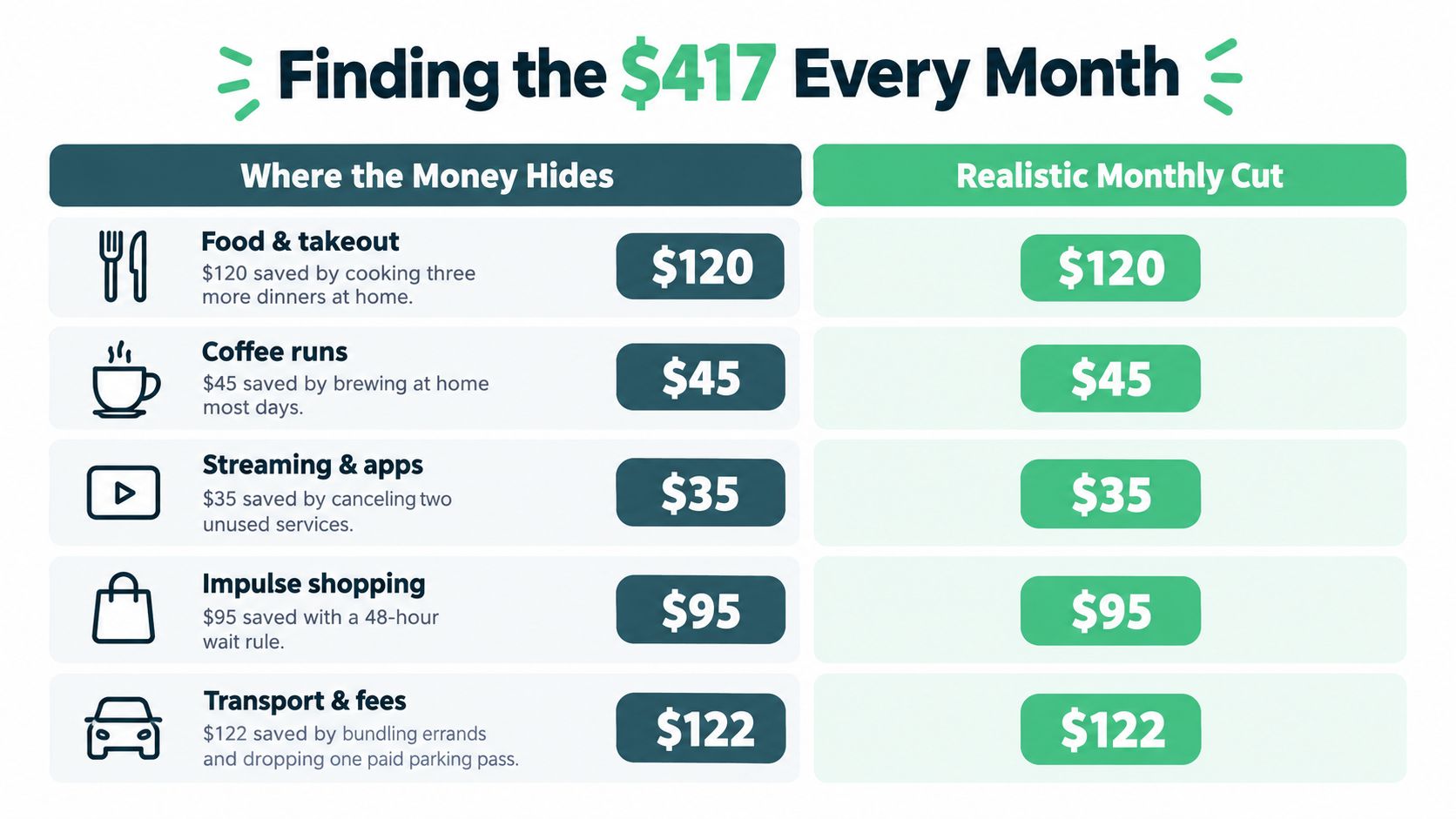
The $417 usually comes from several ordinary decisions, not one dramatic act of financial suffering. Start with the categories that are flexible and frequent. Leave rent, insurance, debt minimums, and essential medical costs alone unless you have a genuine restructuring option.
Audit the repeat offenders
Food is an obvious place to look because small decisions happen often. The plan notes for this target use roughly $1,000 per month as a representative household food budget, and trimming $75 to $100 can be plausible when takeout, convenience purchases, and unused groceries are visible. Practical budget-friendly meal planning tips can help turn that cut into a routine rather than a short-lived declaration of war on restaurants.
Subscriptions are easier. Review every recurring charge and cancel one service you don't use enough to justify. A single cancellation might return $10 to $20 per month, depending on the service.
Transportation deserves a separate audit because convenience fees hide in plain sight. Combining errands, avoiding occasional paid parking, and replacing one restaurant lunch per week can produce meaningful savings. The point isn't to turn every trip into a logistical puzzle. It's to identify charges you make because the default is convenient.
A sample stack might look like this:
- Food and takeout: Save $90 by cooking several additional dinners at home.
- Subscriptions and apps: Save $20 by removing unused services.
- Coffee and convenience purchases: Save $45 by preparing drinks at home most days.
- Impulse shopping: Save $95 by waiting 48 hours before nonessential purchases.
- Transportation and fees: Save $122 by bundling errands and dropping an avoidable parking expense.
- Remaining gap: Cover the balance through automation or added income.
The exact figures are planning examples, not promises. Your budget may have no coffee habit and a spectacular weakness for online shopping instead. Use three months of statements to find the categories that repeat, then choose cuts you can sustain.
A spending-only strategy often won't cover the entire target, especially for households with high fixed costs. Treat cuts as one portion of the solution, then use automation to protect the money and income increases to close the gap. A 50/30/20 budget spreadsheet can help organize the trade-offs without pretending every household has identical needs.
Putting Your Savings on Autopilot
Automation protects your savings before discretionary spending gets a chance to absorb it. The simplest setup sends part of each paycheck directly to a separate savings account through direct-deposit splitting. That requires an employer with split-deposit capability, as explained in federal consumer guidance on automatic savings.
Match the method to your income
| Method | Best For | Watch Out For |
|---|---|---|
| Payroll split | Steady W-2 income | Your employer may not support split deposits. |
| Scheduled transfer | Consistent income on a variable schedule | Bad timing can create cash shortages. |
| Round-up app | Supplemental saving for irregular earners | Small amounts rarely cover the full target. |
Payroll splitting is usually the cleanest choice for steady W-2 income. The money reaches the goal before it lands in the account used for everyday spending. If your income arrives predictably without payroll splitting, schedule the transfer for the day after payday, when the deposit is available.
Use an FDIC-insured high-yield savings account for the reserve and give it a specific name, such as “$5,000 by December.” A label will not create discipline, but it makes an accidental withdrawal feel like sabotage rather than a harmless transfer.
Round-ups can supplement the plan, but they should not carry it. Set a deliberate transfer that matches the gap identified in your budget, then treat round-ups as extra progress.
Automation has limits. Research on automatic enrollment found that retirement-plan participation increased by 26 to 91 percentage points after one year, while the average long-run lift from automatic enrollment plus automatic escalation was about 0.8 percentage points of income. The same research found that the habit effect can disappear when workers change jobs. Research on automatic enrollment supports the practical point: defaults help, but they do not replace an active plan.
Check the account after transfers. Keep enough money in checking for bills, and change the transfer when income changes instead of canceling the system whenever spending gets tight. Automation is a commitment device, not a substitute for review.
Adding Income to Close the Gap Faster
When the budget can't produce the full target, income is often the cleaner lever. Cutting another essential purchase can damage your quality of life, while one suitable side-income lane may close the gap with less disruption.
The ranges below are planning estimates from the editorial framework for this goal, not guaranteed earnings. Taxes, fees, demand, equipment, and local conditions can change the result.
- Freelance services, $200 to $600 per month: Writing, design, coding, bookkeeping, or another existing skill can fit into a few focused hours each week. The trade-off is that finding clients takes effort before the work becomes regular.
- Local gig work, $150 to $400 per month: Delivery, rides, errands, and task work can fit around evenings or weekends. Vehicle wear, fuel, insurance, and platform fees reduce what reaches your savings account.
- Reselling and flipping, $100 to $350 per month: Sell unused household goods first, then consider carefully chosen inventory. Storage, unsold items, and time spent listing can erase the apparent margin.
- Tutoring and lessons, $150 to $500 per month: A small number of weekly sessions can work well if you already have a teachable skill. Scheduling conflicts and preparation time are the main costs.
- Pet sitting and care, $100 to $300 per month: This can fit around an existing schedule, but availability, responsibility, and travel time matter more than the headline payment.
Pick one lane. Three half-maintained side hustles create three sets of messages, fees, scheduling problems, and unfinished tasks. One reliable offer is easier to measure and easier to stop if the return on time is poor.
The side-hustle guide from The Money Maniac can help you compare ideas by effort and earning potential. Keep the accounting separate: record gross income, deduct direct costs, set aside money for taxes where appropriate, and transfer the savings portion only after those obligations are covered.
Earned income should shrink the gap, not excuse a broken base budget. If your spending rises every time income rises, the extra work will produce fatigue instead of progress.
What $5,000 Actually Means for Your Bigger Safety Net
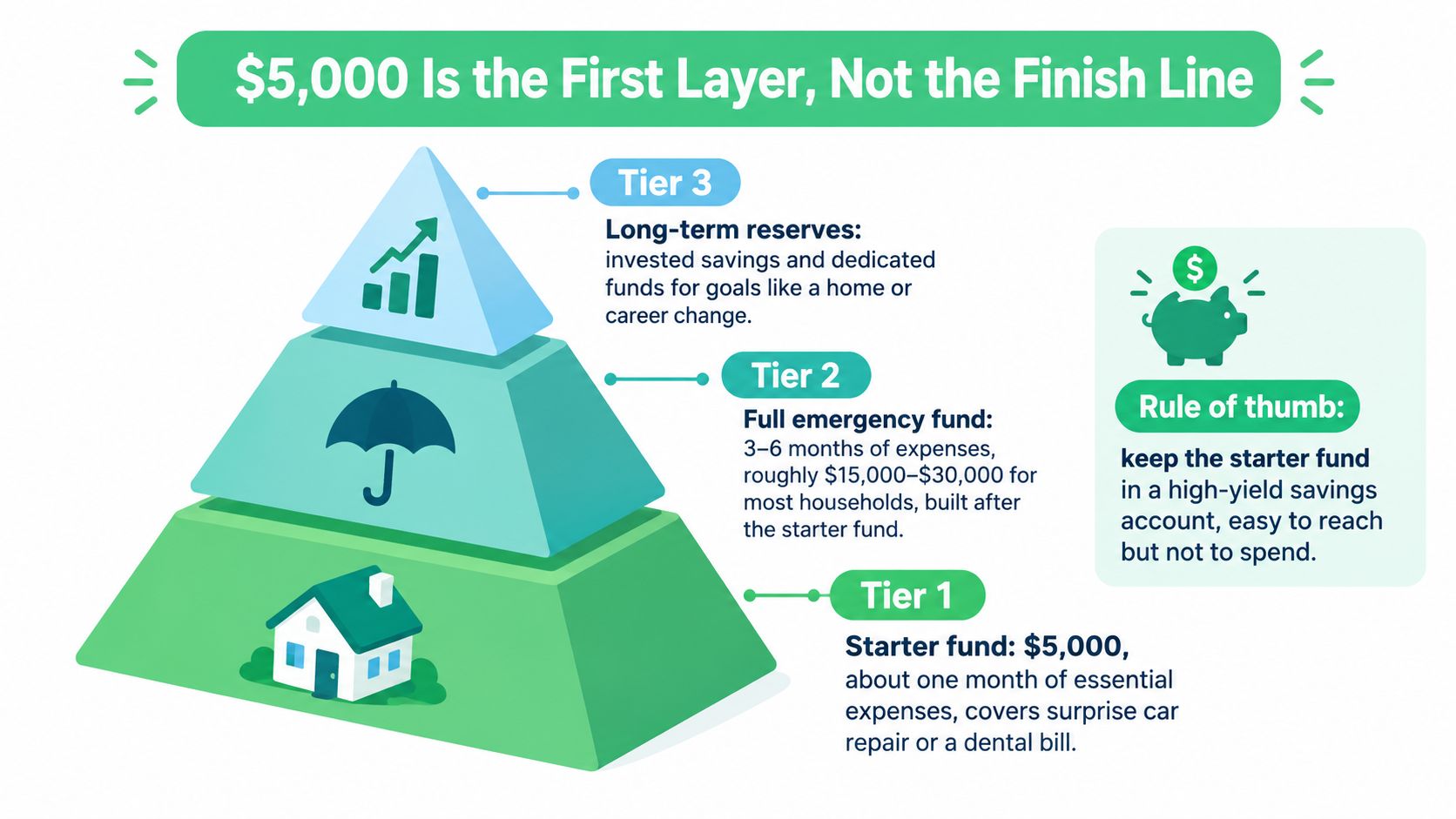
You reach $5,000 just as the car needs a major repair. That balance can keep the bill off a credit card, but it may not qualify as a complete emergency fund. Standard guidance often points to three to six months of household expenses, as outlined in this emergency-fund overview. Your target depends on essential costs, income stability, dependents, insurance, debt, and how quickly you could replace lost income.
For a single renter with modest essential expenses, $5,000 may cover a meaningful stretch of basic bills or absorb a large repair. For a household with children, one income, expensive housing, or substantial medical and transportation costs, that same balance can disappear quickly. The number is useful, but the household behind it determines its reach.
Treat the goal as a layer
Use the account in stages:
- Starter reserve: Accessible cash for a common shock, without reaching for a credit card.
- Full emergency reserve: Several months of essential expenses, sized to your household's actual obligations.
- Long-term reserves: Separate savings and investments for retirement, housing, career changes, and other goals.
The first layer needs a clear job. Keep it accessible, stable, and separate from money intended for travel or shopping. A high-yield savings account can suit that purpose, but its rate can change. Do not treat it as risk-free growth capital for long-term goals.
Your next target should come from your own monthly necessities, not from another tidy round number. If those expenses require more than $5,000, continue the same transfer schedule after a brief review. The method has worked when you can repeat it, not merely when a statement displays a satisfying balance.
A $5,000 balance also exposes the pressure points in your plan. It shows which expenses keep returning, how much strain your budget can handle, and whether your income strategy is dependable. Use that evidence to set the next reserve deliberately. A larger cushion should reflect your actual risks, not a generic milestone.
Your First-Week Checklist and Final Word
Saving $5,000 in a year is doable for many households, but it requires a decision within seven days: one cut, one automation, and one income add. If you spend a month designing a perfect plan, the plan will remain beautifully theoretical.
Seven days, three commitments
Day 1: Pull three months of bank and credit-card statements. Mark recurring bills, food purchases, transport costs, online shopping, and transfers. Don't estimate from memory. Memory is a talented defense attorney for bad spending.
Day 2: Choose one expense to reduce. Cancel one subscription, remove one convenience habit, or set a hard rule for impulse purchases. The first cut should be specific enough to verify.
Day 3: Select a separate, FDIC-insured savings account for the target. Give it a name that makes the purpose obvious and keep it outside your normal spending flow.
Day 4: Schedule the first automatic transfer for the day after payday, or arrange a payroll split if your employer supports it. Start with an amount your cash flow can survive, then build toward the required pace.
Day 5: Set a weekly checkpoint. Record the balance, upcoming bills, and any transfer that failed or needs adjustment.
Day 6: Choose one income lane. Update a service profile, list unused goods, contact a potential tutoring client, or apply for one suitable part-time opportunity.
Day 7: Send the first offer, listing, application, or client message. A plan becomes real when another person can respond to it.
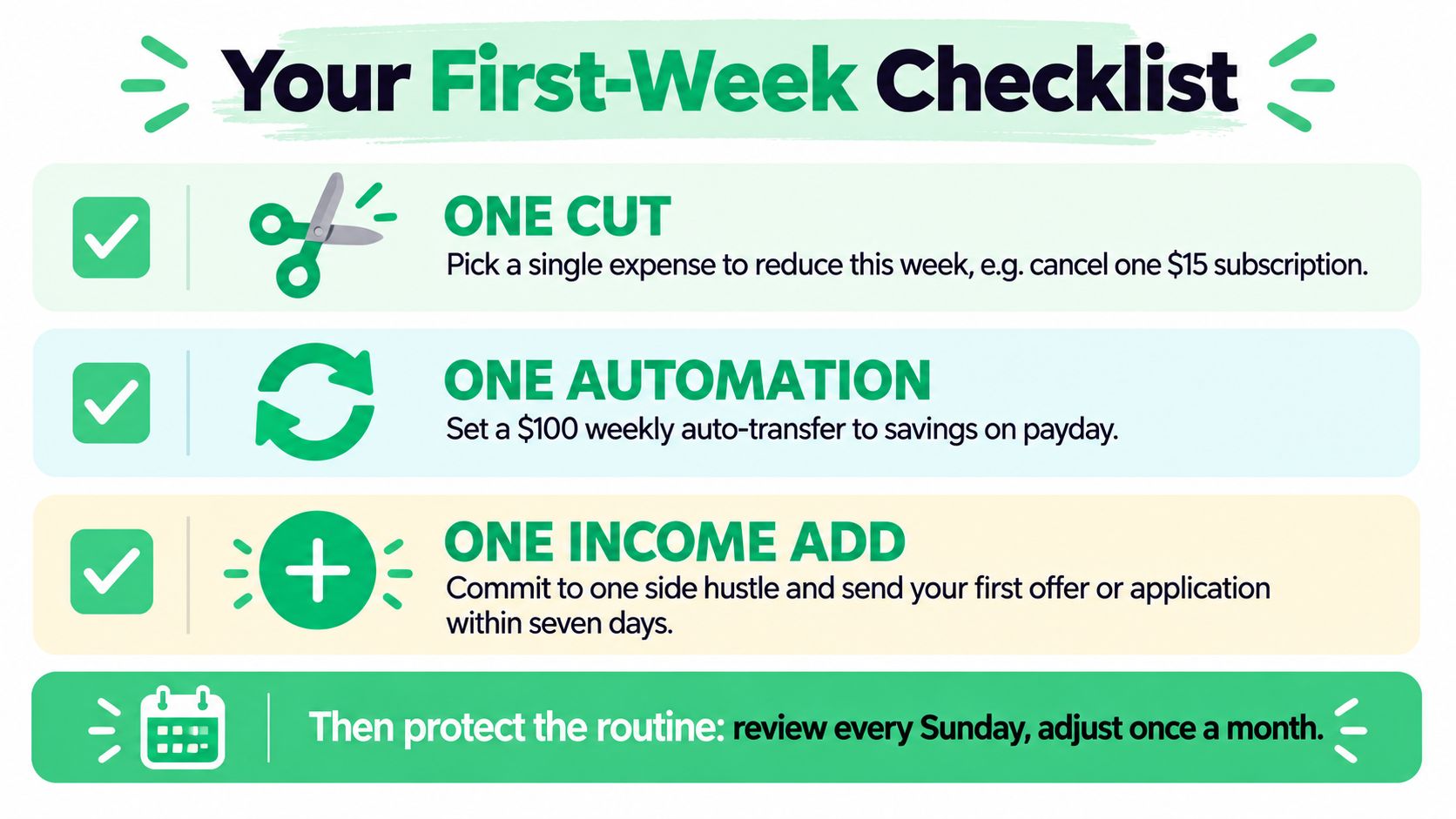
Review the system every Sunday and make one monthly adjustment when the numbers demand it. Don't cancel the entire plan because one month went badly. Reduce, reschedule, or replace the contribution, then recover the shortfall without pretending it never happened.
People who reach the target usually don't rely on superior motivation. They set up a repeatable transfer, remove a recurring leak, and give every extra dollar a job.
My judgment is simple. Start today with one cut, one automatic transfer, and one income action, then protect those three choices for the next seven days.
Get more posts like this
One short, useful email each Friday. Free, no spam, unsubscribe anytime.