How to Make Money With a Side Hustle That Actually Pays Off
Learn how to make money with a side hustle using a proven framework to pick, validate, and scale ideas that fit your time, costs, and income goals.

Daniel Anderson
Editor, The Money Maniac
September 20, 2026
15 min read

The first number you should care about isn't some flashy “earn up to” claim. It's this: Bankrate's 2025 survey found a median side-hustle income of just $200 per month, while the average was $885 (Bankrate side hustle survey).
That gap tells you almost everything. A handful of people are doing very well. Others are earning something closer to coffee money, grocery money, or one annoying utility bill. Useful? Sure. Life-changing? Usually not.
If you want to make money with a side hustle in real life, stop ranking ideas by fantasy earnings. Rank them by three things that matter: income stability, time to first dollar, and startup cost. That's how adults make money decisions. Hype is free. Your time isn't.
Why Most Side Hustles Earn Less Than You Expect
The average side hustle story is usually a lousy planning tool.
You already saw the number that matters most: the gap between average and median monthly income is wide. That gap exists for a reason. A small group earns very well. A much larger group earns far less, earns inconsistently, or quits before the side hustle becomes reliable.
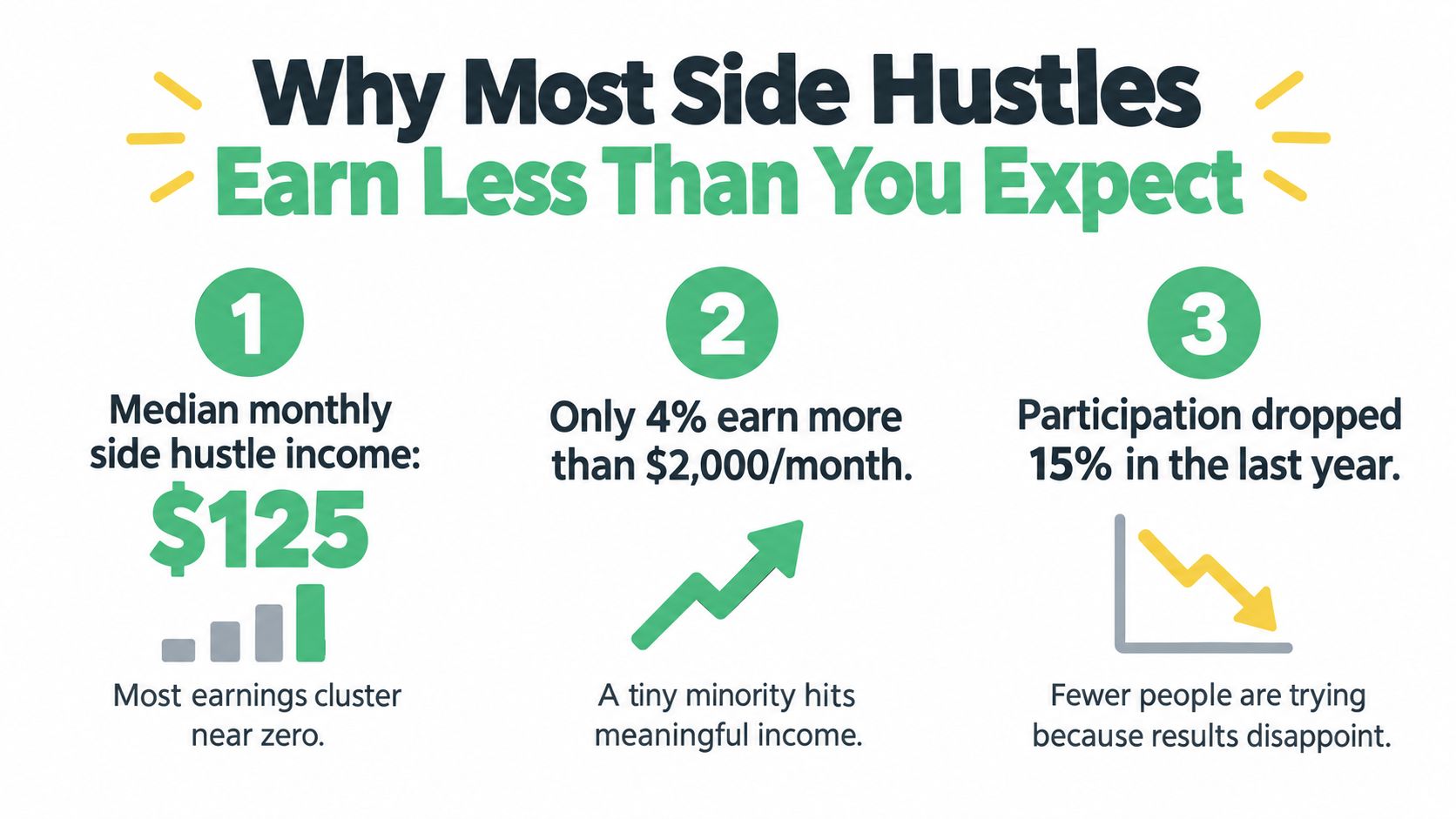
Average income is the wrong number to plan around
Average income gets inflated by outliers. Median income shows what a more typical person is bringing in. If you build your budget around average earnings, you are budgeting around someone else's lucky month.
That mistake gets expensive fast. People buy equipment, pay for software, order inventory, or sink 40 hours into setup because a headline promised strong earnings. Then they learn the ugly part. Plenty of side hustles pay late, pay unevenly, or pay less than expected once you count refunds, dry spells, and your own time.
Use a harsher filter. Ask three questions:
- How stable is the income week to week?
- How fast do you get to the first paid job or sale?
- How much cash do you have to risk before demand is proven?
Those questions matter more than the fantasy number in the thumbnail.
Stability beats headline upside
A side hustle that pays modestly and predictably is usually better than one that looks impressive on paper and behaves like a slot machine.
That is why service-based work often beats trendier models for beginners. If someone hires you to clean, write, edit, tutor, design, organize, or handle admin tasks, you can usually reach first dollar faster and with less money upfront. Selling products can work, but crowded categories punish beginners who confuse interest with demand. Popular is not the same as profitable. It often just means more people are fighting over the same customer.
Here's the ranking logic I'd use:
- Income stability first. Predictable demand beats occasional spikes.
- Time to first dollar second. Fast proof beats long setup.
- Startup cost third. Low-risk testing beats buying your way into a maybe.
This is not glamorous advice. Glamour does not pay your credit card bill.
The real reason earnings disappoint
Low side hustle income usually comes from one of four problems.
- The idea takes too long to produce cash.
- The work depends on irregular demand.
- The startup costs eat the early profits.
- The hourly return looks decent until you count all the unpaid admin work.
That last one gets ignored constantly. A hustle that brings in $300 sounds fine until you realize it took 18 hours, required supplies, and left you answering messages at 10 p.m. Congratulations, you bought yourself a demanding part-time job with worse payroll systems.
The right goal for your first side hustle
Your first side hustle has one job. It needs to prove that the model works in your actual life.
That means proving three things:
- People will pay you
- You can deliver without wrecking your schedule
- The money left after costs and time is still worth it
If an idea fails one of those tests, it is not a side business yet. It is an experiment. Treat it that way before you spend serious time or money.
How to Pick a Side Hustle That Fits Your Life
Don't fail because you picked a bad idea. Fail because you picked a bad fit.
A parent with six fragmented evening hours per week should not choose the same side hustle as someone with open weekends and a portable professional skill. If you want a side hustle that sticks, match it to your actual life, not the fantasy version where you wake up cheerful at 5 a.m. and enjoy customer messages during dinner.
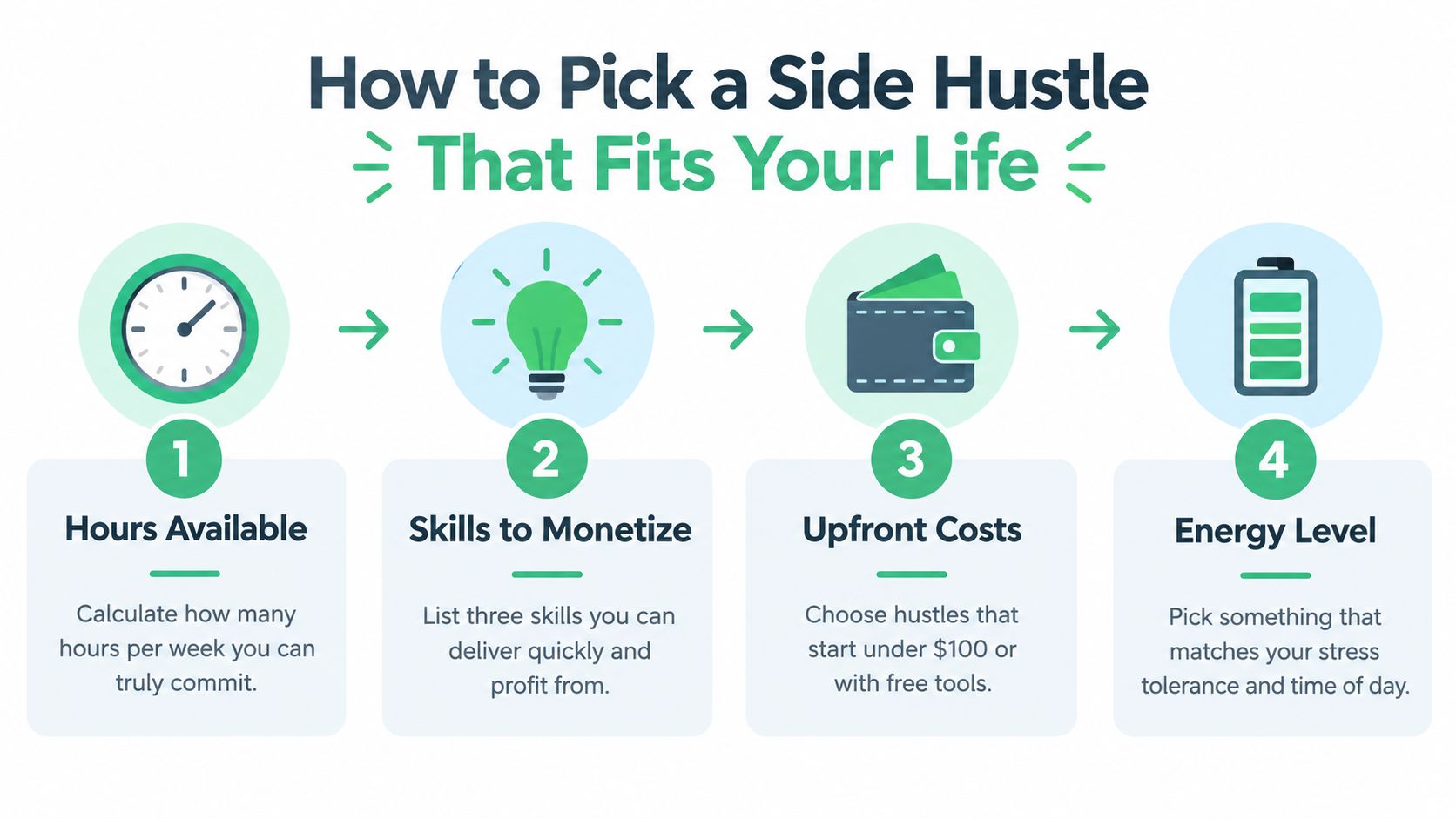
Use a simple three-part filter
I'd narrow every idea through these filters before you spend a dollar.
- Time to first dollar: Can this produce money quickly, or does it require weeks of setup before anyone pays you?
- Schedule fit: Can you do the work in the hours you control, not the hours you wish you had?
- Startup friction: Does it require inventory, training, equipment, or ongoing costs before you even know if people want it?
This is why service work often beats content-heavy or product-heavy ideas for beginners. If you already know how to write, teach, organize, design, edit, coach, bookkeep, research, or handle admin work, you can usually test demand without buying much.
Score your options before you get attached
Don't overcomplicate this. Give each idea a simple rating of low, medium, or high on the things that matter most:
| Filter | What you want |
|---|---|
| Time to first dollar | Low delay |
| Startup cost | Low cost |
| Income stability | Medium to high |
| Energy drain | Manageable |
| Skill overlap | High overlap with what you already know |
Then shortlist only the ideas that score well in at least three categories.
Practical rule: Pick the idea you can test with the least money and the least rearranging of your life.
If you need examples to jump-start your shortlist, The Money Maniac has a useful roundup of side hustle apps for building a second income stream. Don't use a list like that as your decision-maker. Use it as a menu, then apply your filter.
Start with assets you already own
The easiest side hustle to launch is usually built on one of these:
- A skill you use at work: admin support, writing, spreadsheets, research, customer communication, design, bookkeeping, training.
- A local advantage: knowledge of your area, community relationships, access to nearby buyers or clients.
- Stuff you can sell or resell: unused household items, specialized gear, niche collectibles, furniture, tools.
- A repeatable personal strength: teaching, planning, troubleshooting, editing, accountability, or explaining confusing things.
Notice what's missing. “Passion.” Passion is nice. Paid demand is nicer.
Two bad picks that trap beginners
Some side hustles look easy because the barrier to entry is low. That's exactly why they become crowded fast.
First trap: any hustle that depends on a giant audience before it pays. If you need traffic, followers, or long-term content output before money shows up, understand what you're signing up for. That's a slower business model, not quick side income.
Second trap: any hustle that rents your time at a mediocre rate after expenses. If the work requires travel, supplies, back-and-forth messages, and dead time between jobs, your effective pay can sag fast. The gross number looks fine. Your calendar tells a sadder story.
Comparing Popular Side Hustles by Time Cost and Pay Stability
Average side hustle income stories create bad expectations. Averages get pulled up by a small group doing unusually well. The median result is usually much less exciting, which is why your first filter should be stability, speed to first dollar, and startup cost. Headline earnings come later.
A side hustle that pays a little less but pays predictably is usually the better bet for someone with a full-time job. You are not building a fantasy spreadsheet. You are trying to add real cash without turning every weeknight into a second shift.
Side Hustle Comparison by Effort and Earning Pattern
| Side Hustle Type | Startup Cost | Time to First Dollar | Income Stability |
|---|---|---|---|
| Skill-based services | Low | Fast | Higher with repeat clients and referrals |
| Tutoring, teaching, coaching | Low | Fast to moderate | Fairly steady once you fill recurring slots |
| Reselling | Low to moderate | Fast if you already have items | Uneven, depends on sourcing and sell-through |
| Ecommerce | Moderate to high | Slower | Volatile, with margin pressure and more moving parts |
| Rideshare or delivery style work | Low to moderate | Fast | Inconsistent and directly tied to hours worked |
| Local task-based labor | Low | Fast | Moderate if demand is repeatable in your area |
My ranking, based on real-world usefulness
Here is the order I would recommend for someone who already has a day job:
- Skill-based services
- Tutoring, teaching, or coaching
- Reselling
- Gig-style labor
- Ecommerce for beginners without a tested niche
That ranking is less exciting than social media makes it sound. It is also a lot closer to how money shows up.
Why services usually come out on top
Services win because they can produce cash faster and hold up better week to week. If you solve a specific problem, clients care less about novelty and more about whether you can fix the thing that is bothering them. That is a much better market position than competing with a hundred interchangeable sellers.
Skill-based work also has a cleaner path to repeat business. A bookkeeping client, a writing client, or a student you tutor weekly can keep paying you without forcing you to find a brand-new buyer every single time. That matters more than theoretical upside.
Tutoring, teaching, and coaching sit just below broader service work for the same reason. They can become steady once you fill recurring slots, but your calendar is still the ceiling. Good income. Limited scale. Fine tradeoff for a side hustle.
Why reselling beats ecommerce for many beginners
Reselling is rarely glamorous. It is often practical.
If you already own items you can sell, or you know a category well enough to spot underpriced inventory, you can get to first dollar quickly. You also learn fast: what sells, how long it sits, what buyers ask, and where your margins disappear. That feedback is useful.
Ecommerce asks for more before it gives much back. Inventory, packaging, returns, customer service, product research, pricing pressure, and marketing all show up early. Beginners get distracted by big revenue screenshots and ignore the ugly part. Revenue is not take-home pay. Margin, refund rates, and time count too.
Where gig-style labor fits
Gig-style local work has one clear strength. It can create cash quickly.
That makes it useful for short-term cash flow, especially if you need money this month, not six months from now. If you want options in that lane, this list of side hustles that pay weekly is a good place to scan ideas.
The tradeoff is blunt. If you stop working, the income stops. Pay can also flatten once you factor in travel, downtime, supplies, and the general annoyance of waiting around for the next job. It is a decent cash tool. It is usually a weak long-term business.
The practical takeaway
Choose the side hustle with the strongest mix of low startup cost, short time to first dollar, and repeatable demand. That means selling a skill first, teaching second, reselling third, and treating gig labor as a backup option.
Save ecommerce for later, after you have a tested niche or proof that people already want what you plan to sell. Starting there is how beginners buy themselves a second job with worse odds.
Validate and Launch Your Side Hustle Without Wasting Money
The fastest way to kill a side hustle is to “invest in it” before anyone has paid you. New logo, paid software, domain, upgraded gear, fancy packaging. Very moving. Still no customer.
Start smaller. You don't need a business empire. You need evidence.
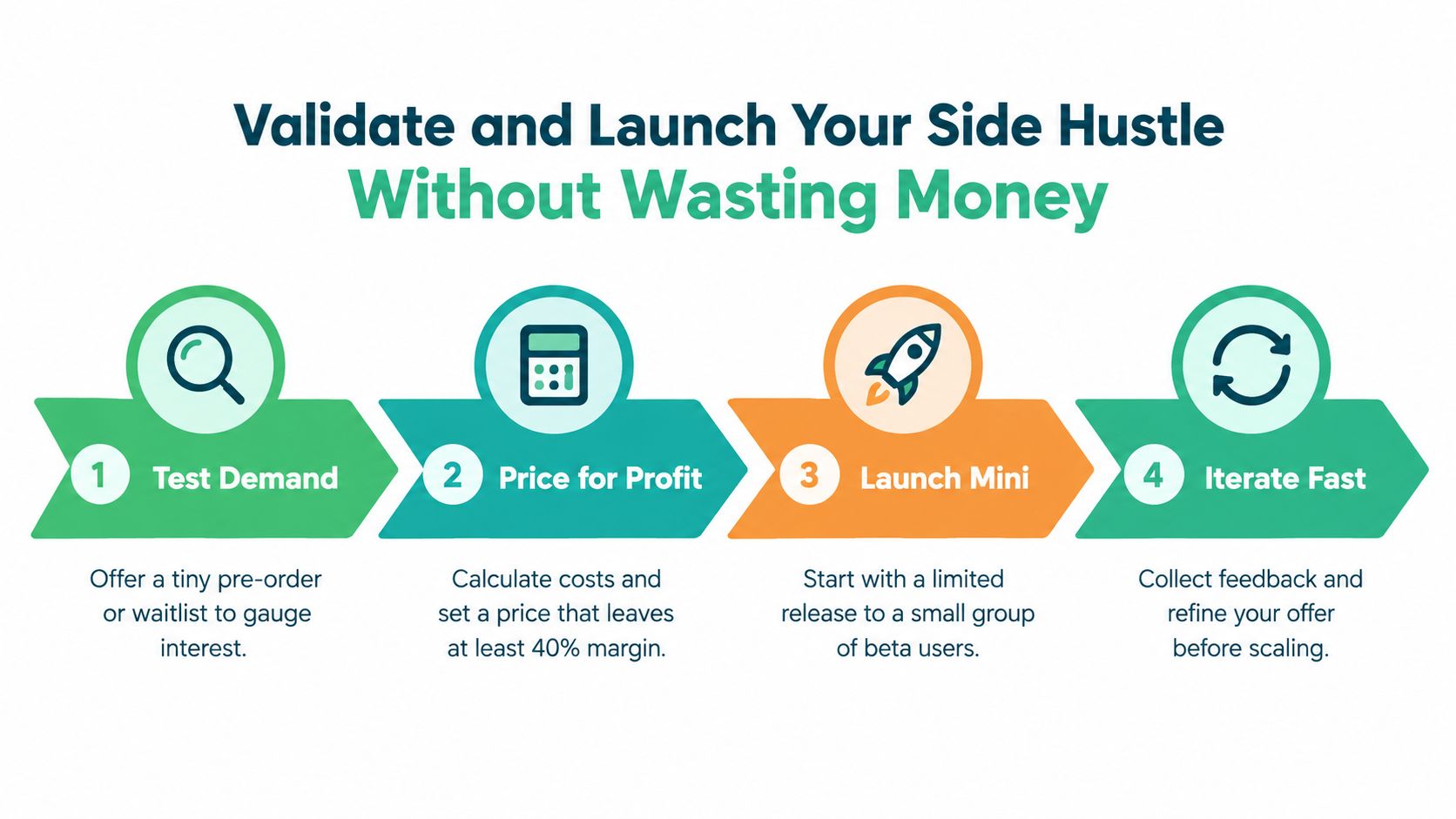
Test demand before you build anything
If you want to know whether an idea can make money, offer a small, clear version of it first.
For a service, that might mean a fixed-scope starter package. For reselling, it means listing a few items before sourcing more inventory. For tutoring or coaching, it means opening a limited number of trial spots with a narrow outcome. Keep the offer simple enough that a buyer can say yes without needing a committee meeting.
Use direct outreach, your existing network, local groups, or one-to-one conversations. Ask for a sale, not vague “feedback.” People are generous with opinions when they aren't paying.
Small-launch rule: If nobody buys the tiny version, the bigger version won't rescue it.
Price for reality, not ego
A side hustle fails when the price covers materials but not your time. That's common, especially in product-based work and underpriced services.
Use a dead-simple pricing check:
- Estimate direct costs
- Estimate total time, including admin and follow-up
- Decide the minimum amount that makes the work worth doing
- Test whether buyers will accept that price
If the price needed for decent economics feels “too high,” that's useful information. It may mean the market is weak, your offer is too generic, or the hustle only works after you get faster.
A lot of local service businesses obsess over this same issue. The sales process matters because speed, clarity, and follow-up often decide who gets paid first. If you want a practical example of how response time affects booked work in a service business, this guide on speed to lead for HVAC plumbers is worth reading even if your side hustle isn't in home services. The principle carries over.
Track actual hourly return
Don't guess at your earnings. Track them.
Write down three things for every job or sale:
- Money collected
- Direct costs paid
- Time spent from start to finish
Do that for a few weeks and patterns show up fast. Some tasks produce decent money but eat your schedule with messaging, prep, cleanup, or revisions. Others look modest on paper but turn out efficient and repeatable.
Scale only after proof
Once people are buying, then you can improve the machine.
Try this sequence:
- Tighten the offer: simplify what's included and remove custom work that slows you down.
- Collect proof: save testimonials, before-and-after examples, or repeat bookings.
- Raise rates carefully: if buyers say yes quickly and the work is filling your available hours, test a higher price.
- Reinvest only in bottlenecks: spend money where it saves time or reduces obvious friction.
A side hustle becomes a business when you can repeat the sale without reinventing the process every time.
That's the standard. Not “I launched an account and feel entrepreneurial now.”
How to Scale Your Side Hustle While Keeping Your Day Job
Launching and scaling are different jobs. Launching is about proving demand. Scaling is about building a repeatable system without letting your main job suffer.
That matters because your day job is still paying the bills. Don't sabotage your stable income for a side hustle that hasn't earned that kind of drama.

Protect your calendar first
Most side hustlers don't need more ambition. They need tighter boundaries.
Set fixed work blocks each week and stick to them. If your side hustle spills into work hours, sleep, or family time every day, it will either stall or create damage somewhere else. Neither outcome is efficient.
The easiest scaling move is batching. Answer messages at set times. Group similar tasks together. Use templates for repetitive communication. Build one simple workflow that cuts friction.
Reinvest in systems, not vanity
Early profits should go toward things that save time, reduce mistakes, or support delivery. Don't blow them on cosmetic upgrades.
Good reinvestment usually looks like:
- Cleaner operations: better invoicing, tracking, scheduling, or record-keeping
- Delivery support: templates, checklists, standard packages, reusable materials
- Customer retention: a better follow-up system or easier repeat booking
If you want a grounded read on building a business while holding a full-time job, this piece on Business Lending Blueprint startup advice is useful because it treats time and discipline as the key constraints. That's the adult version of entrepreneurship.
Raise rates before you add more hours
A lot of people try to scale by cramming in more work. That's often the dumbest option available.
If clients are happy, your process is smoother, and demand is holding up, test a higher rate on new work first. Rate increases are cleaner than adding another exhausted night to your week. They also force you to sharpen the offer.
One more thing. Favors don't scale. Discounts don't scale. Endless customization definitely doesn't scale.
When your side hustle grows, simplicity becomes a profit tool.
Choose durability over trendiness
Some side hustles get wrecked by saturation faster than others. The ones with the best staying power usually have a few traits in common: clear customer pain, skill-based delivery, and room for repeat business.
That's why I'd still lean toward tutoring, accounting help, marketing support, consulting, admin support, and niche service work over generic commodity gigs. Buyers keep paying for competent help with real problems. Trend-chasing is less reliable.
Keep More of What You Make With Smart Tax and Money Habits
A side hustle with decent revenue can still pay badly once taxes, sloppy records, and random spending eat the margin. That average-versus-median gap shows up here too. A few organized operators keep far more of what they earn, while everyone else wonders why the extra work barely moved their bank balance.
Profit is the number that matters. Revenue is vanity if half of it leaks out through avoidable expenses, missed deductions, and tax surprises.
Gig income must be reported and taxed, whether or not you get a form for every dollar. Treat that as a basic operating rule, not a seasonal surprise. If you want a practical list of expense categories worth tracking, the Allied Tax Advisors deductions guide is useful.
Know what actually gets taxed
For a small side hustle, the starting point is simple. Tax is generally based on net profit, which is your income after ordinary business expenses.
That makes recordkeeping a money habit, not an admin hobby. If you mix business purchases with groceries, gas, and late-night impulse buys, you create your own audit puzzle and usually miss write-offs.
Self-employment tax can also show up faster than people expect. Once your net side income clears the usual filing threshold for self-employment tax, part of what felt like extra cash was never really yours to spend. The rate includes Social Security and Medicare, and the Medicare portion does not stop just because you are tired of paying it.
Three habits that keep more cash in your pocket
You do not need fancy bookkeeping. You need a system you will still use in October.
- Separate business money: Use one account or card for side-hustle income and expenses.
- Track expenses weekly: Save receipts, log mileage if it applies, and write down the business purpose while you still remember it.
- Set aside tax money as you get paid: Move a percentage of each payment into a separate savings bucket so tax season does not hit like a prank with legal consequences.
One more opinionated recommendation. Pay yourself based on profit, not deposits. If $800 lands in your account but $250 of it belongs to taxes and another chunk covers expenses, you did not make $800. You just held it briefly.
If your side hustle starts producing steady profit, business structure can affect how much you keep. This breakdown of S corp vs C corp differences is a good next read before you file paperwork for the sake of feeling official.
A side hustle should improve your finances in real life, not just look good in a gross-income screenshot.
Get more posts like this
One short, useful email each Friday. Free, no spam, unsubscribe anytime.