Budgeting Methods That Actually Work
Compare the most popular budgeting methods, including zero-based, 50/30/20, envelopes, and pay-yourself-first, with clear pros, cons, and how to choose one.

Daniel Anderson
Editor, The Money Maniac
September 30, 2026
12 min read

Most budgeting advice starts with the wrong question: Which method is mathematically optimal? The better question is, which system still works when your income changes, your attention runs out, and an inconvenient bill arrives on a Tuesday?
A clean spreadsheet can organize your intentions. It can't make you open the spreadsheet. Recent surveys show a gap between budgeting interest and budgeting practice. Pen and paper remains the most common approach at 37%, followed by spreadsheets at 27%, while mobile apps account for 22%, even though 38% say they'd most like to try apps, according to Debt.com's 2026 budgeting survey. Another survey found that 69.1% of Americans budget at least sometimes, while 30.8% never budget, and a separate study found that only 47% report creating a monthly budget, as detailed in household budgeting statistics.
The popularity of a method doesn't prove that people can maintain it. This guide tests four major budgeting methods against irregular income, automation fatigue, and real human behavior. The winner is the method you can follow when you're tired, busy, or mildly annoyed at your bank account.
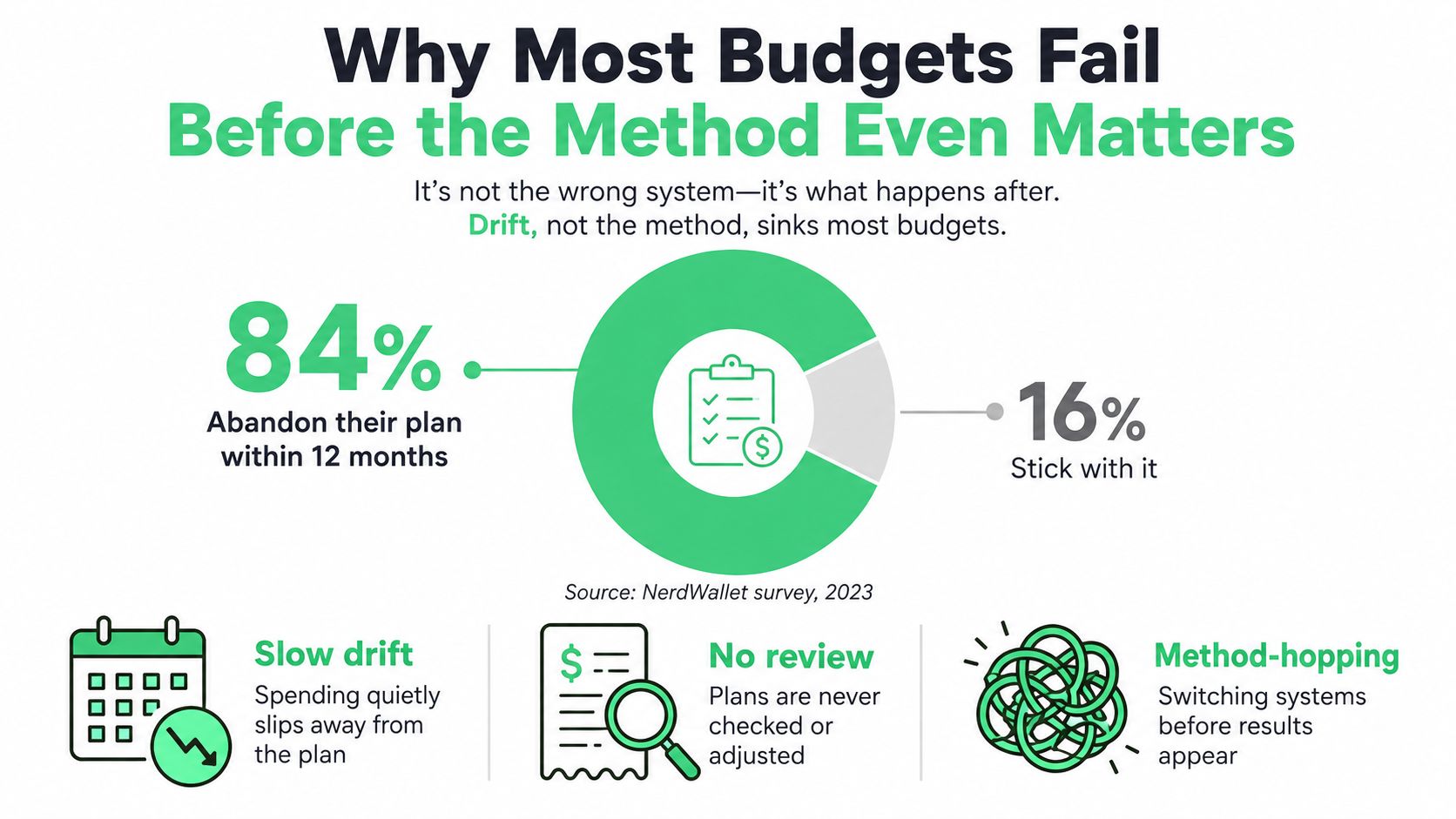
Why Most Budgets Fail Before the Method Even Matters
The usual response to a failed budget is to add detail. More categories, better formulas, color coding, perhaps a dashboard with enough tabs to qualify as a small municipal planning department. That approach confuses information with behavior.
Here's the revised paragraph with the flagged phrase removed:
The common reason a budget fails isn't that subtraction is too difficult. It fails because the system demands too much upkeep, assumes every month will be predictable, or offers no practical reaction when income arrives late. A method that requires constant attention will eventually have to compete with work, family, errands, and the simple human wish to relax without making financial choices.
The real stress tests
Irregular income exposes rigid plans first. A fixed monthly budget built around an expected paycheck becomes fragile when a client pays late, a commission arrives early, or a side-hustle month is unusually quiet. The method needs a way to prioritize essentials without pretending future income is already in the account.
Automation creates a different problem. Automatic transfers and categorization can reduce effort, but too many alerts, rules, and account movements create automation fatigue. When you stop trusting the system, you stop checking it. A budget should remove decisions, not manufacture a new administrative hobby.
Then life breaks the plan. A medical bill, repair, family obligation, or unusually expensive month forces a trade-off. Systems that treat deviation as failure encourage people to quit. Strong budgeting methods make the adjustment visible and give you a clear next move.
Practical rule: Judge a budget by how quickly you can recover from a bad week, not by how attractive it looks on payday.
Zero-based budgeting offers maximum control. The 50/30/20 rule offers a quick guardrail. Envelope budgeting uses hard limits to interrupt overspending. Pay-yourself-first prioritizes saving before spending begins. Each solves a different behavioral problem, and none deserves loyalty for its own sake.
Zero-Based Budgeting and the Every-Dollar Rule
Zero-based budgeting, or ZBB, assigns every dollar a job before the budget period begins. Income minus planned expenses and savings equals zero. That doesn't mean your bank balance must reach zero. It means no money sits without a stated purpose, as explained in this definition of zero-based budgeting.
Suppose your monthly take-home pay is $4,200. You might assign money to housing, bills, food, transportation, debt, savings, and discretionary spending. The important part is the final allocation, not the category names. Every dollar gets directed somewhere, including a buffer and a longer-term goal.
A sample monthly allocation
| Category | Amount | Type |
|---|---|---|
| Rent | $1,500 | Fixed need |
| Utilities | $180 | Variable need |
| Groceries | $450 | Variable need |
| Transportation | $200 | Variable need |
| Debt minimum | $250 | Required payment |
| Savings | $600 | Financial goal |
| Dining | $180 | Discretionary |
| Subscriptions | $40 | Discretionary |
| Buffer | $400 | Flexible reserve |
| Sinking funds or extra goal | $400 | Planned reserve |
| Total | $4,200 | Fully assigned |
The buffer matters because a zero-based budget without flexibility becomes a tiny bureaucrat living in your phone. If utilities come in under budget, you don't treat the difference as invisible free money. You can move it to savings, debt payoff, a sinking fund, or another category that needs room. If dining runs over, you decide where the replacement dollars come from.
That process makes trade-offs obvious. It also exposes legacy costs, subscriptions, and habits that survive merely because last month's budget carried them forward. The method has historical roots in spending reviews, and its modern corporate form emerged in the early 1970s after Peter A. Pyhrr's widely cited 1970 Harvard Business Review article, according to McKinsey's history of zero-based budgeting.
Where the method earns its keep
ZBB is strongest when cash flow is tight and you need to make deliberate choices. It works particularly well for someone attacking debt, rebuilding savings, or trying to understand why a reasonable income keeps disappearing. Research describes its main advantage clearly, it surfaces legacy spending and redirects resources toward current priorities, while also increasing the planning workload because each cycle must be rebuilt in this analysis of budgeting approaches.
The cost is attention. You must record transactions, review categories, and adjust the plan when reality changes. If you dislike detailed tracking, ZBB can turn every coffee into a referendum on your character. For stable paychecks and a detail-oriented personality, it may be worth the effort. For irregular income, build the budget from money already received, not money you hope will arrive.
For a broader planning framework, readers preparing for a major housing project may also find these budgeting steps for a new home useful. The same principle applies, list the obligations, assign priorities, and leave room for costs that refuse to behave.
The 50/30/20 Rule as a Coarse Guardrail
The 50/30/20 rule divides take-home pay into 50% for needs, 30% for wants, and 20% for savings or debt payments above the minimum. That structure is consistently described by financial education sources, including this explanation of the 50/30/20 budget.
Applied to a $4,200 paycheck, the math looks like this:
| Bucket | Percentage | Amount | Examples |
|---|---|---|---|
| Needs | 50% | $2,100 | Rent, utilities, groceries, insurance, minimum debt payments |
| Wants | 30% | $1,260 | Dining, streaming, hobbies, travel |
| Savings and extra debt payments | 20% | $840 | Savings, extra debt payments, retirement contributions |
| Total | 100% | $4,200 | Full paycheck assigned |
This method is useful because it gives beginners a fast reality check. If you have no structure, three broad buckets are far better than letting every purchase compete equally with rent and savings. It also makes saving a planned part of the month instead of an act of optimism performed after the money has vanished.
The problem is that broad buckets conceal detail. The wants category can absorb repeated overspending while still looking respectable in aggregate. The needs category can expand around high housing costs, insurance, or debt minimums without showing which obligation deserves attention. A percentage target describes the shape of your spending, but it doesn't tell you which subscription to cancel or which bill arrives before your next deposit.
Use it as a diagnostic, not a dashboard
The rule also ignores cash-flow timing. A person can be within the monthly percentages and still run short before payday because bills cluster at the beginning of the month. Someone with irregular income faces an even bigger issue, a percentage of expected income is not cash currently available to spend.
Use 50/30/20 for a first pass, an annual checkup, or a simple conversation with yourself about priorities. Don't use it as your daily operating system if you regularly overspend in specific categories or need to coordinate several due dates.
A simple spreadsheet can make the three buckets visible while preserving room for your own categories. This 50/30/20 budget spreadsheet is relevant for readers who want the broad framework translated into a working worksheet. The judgment is straightforward: 50/30/20 is the best starting method for a beginner who needs a guardrail, not the best control system for a complicated financial life.
Envelope Budgeting and the Power of Hard Limits
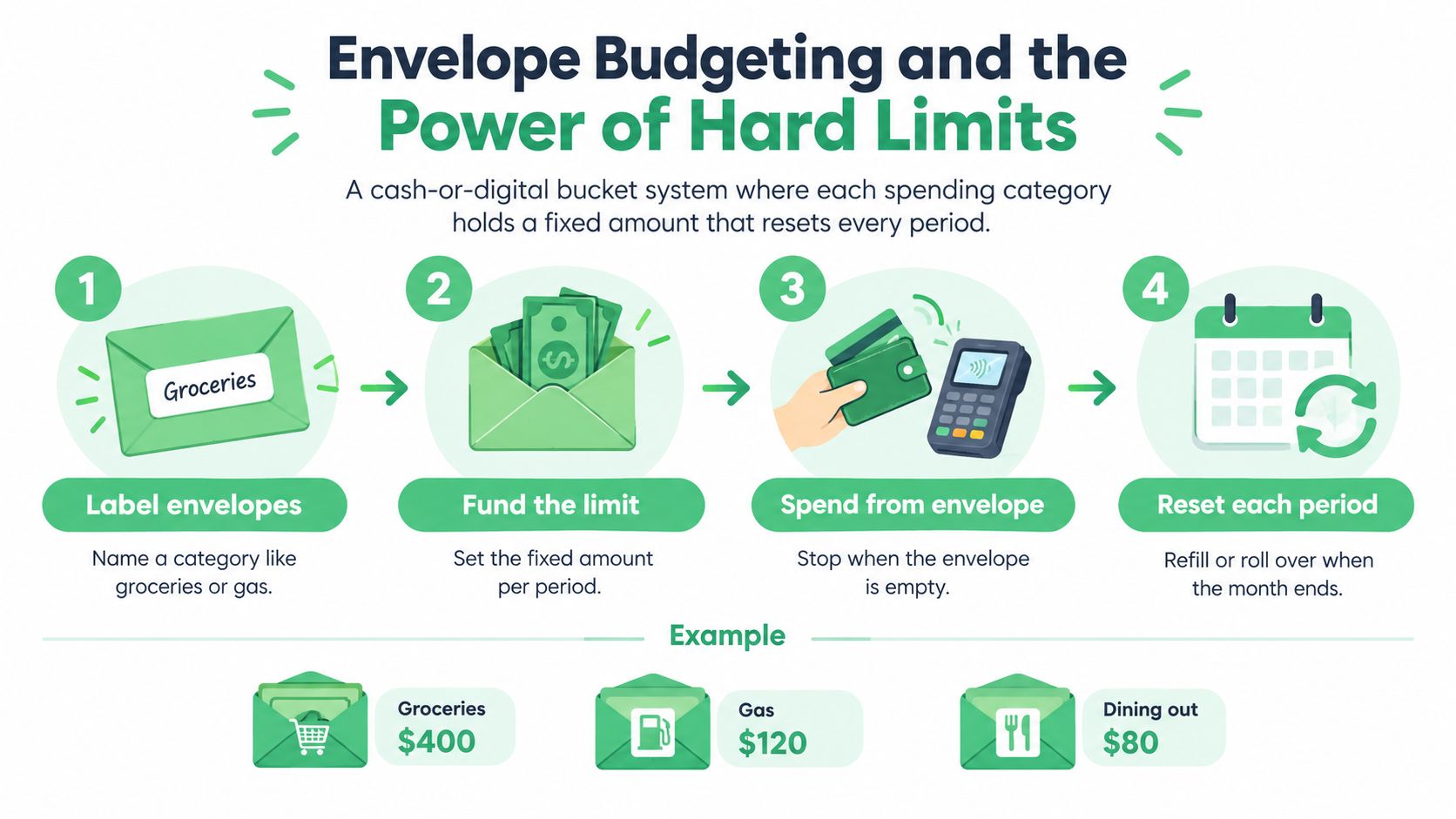
Envelope budgeting gives each spending category a fixed amount for the period. You might create envelopes for groceries, gas, dining, entertainment, and a buffer, then spend only from the relevant category. The system can use physical cash, digital balances, or a spreadsheet that behaves like a set of separate buckets.
The setup is simple:
- Label envelopes. Name the categories where spending tends to drift.
- Fund each limit. Put a fixed amount into every envelope on payday.
- Spend from the matching envelope. Groceries come from groceries, dining comes from dining.
- Stop at zero. If an envelope is empty, spending stops or you deliberately move money from another category.
- Reset at the period's end. Refill the categories and decide how unused money should be handled.
Why the limit changes behavior
The envelope system works because it makes depletion visible. A spreadsheet can tell you that dining is over budget, but an empty envelope creates an immediate decision. You either stop, transfer money from another category, or admit that the original limit was unrealistic. That friction forces a trade-off that passive tracking often fails to create.
The cash envelope budgeting approach can be physical or digital. With physical cash, withdraw the planned amounts, place them in labeled envelopes, and leave the debit card at home for those categories. Digital versions use separate balances or virtual categories, which makes them more practical for online purchases and recurring transactions.
A sample setup could look like this:
- Groceries: $400
- Gas: $120
- Dining out: $80
The amounts are examples, not universal targets. Your limits should reflect your income, obligations, and priorities. The method's strength comes from enforcing the limit, not from copying somebody else's numbers.
Where envelopes become awkward
Physical cash is inconvenient for subscriptions, online shopping, and bills paid electronically. Digital envelopes solve some of that friction but can become too easy to bypass if transferring money feels painless. The system also works poorly for irregular bills unless you create a separate reserve for them.
The strict no-transfer version is powerful because overspending has consequences. If you allow yourself to borrow casually from every category, the envelopes become decorative labels. A no-rollover rule can also feel harsh when a category has a legitimate uneven rhythm. Use hard limits for problem spending categories, and use separate reserves for expenses that arrive irregularly.
Choose envelopes if your main problem is impulse spending in visible categories, especially food, shopping, and entertainment. Choose something else if your main problem is coordinating bills, variable income, or long-term savings.
Pay Yourself First as a Priority Order
Pay-yourself-first is an ordering rule. Before you plan discretionary spending, direct a fixed amount or percentage of each paycheck into savings, investments, or debt repayment. You then pay bills and live on what remains.
That makes it different from the other three methods. Zero-based budgeting assigns every dollar. The 50/30/20 rule divides money into broad proportions. Envelopes impose limits on categories. Pay-yourself-first only insists that the priority leaves the account before ordinary spending begins.
Make the first move automatic
The clean version uses automation:
- Split direct deposit. Send part of each paycheck directly to a savings or investment account.
- Schedule payday transfers. Move a chosen amount as soon as income arrives.
- Use percentages for variable pay. A percentage adapts when a freelance payment or commission changes.
- Leave the remainder alone. Pay bills and spend from the money that stays in checking.
This approach reduces monthly maintenance because the most important action happens before temptation gets involved. It can suit freelancers, commission earners, and side-hustlers especially well when a fixed savings amount would be too aggressive during a lean month. It also works for busy professionals who can tolerate limited spending visibility but want progress to happen without repeated decisions.
The weakness is obvious. You can save consistently while spending the remainder without a plan. If the savings rate is too low, lifestyle creep consumes every raise and better month. Pay-your-self-first needs at least a light review of bills and discretionary spending so you don't protect savings by creating expensive chaos elsewhere.
Business owners can apply the same priority logic to distributions and operating cash. This discussion of Florida CPA on profit distribution offers useful context for separating personal compensation from business money. The underlying lesson carries over, priorities need a place in the flow of money before leftovers determine them.
Pair this method with a spending-control system. Use pay-yourself-first as the savings engine, then add zero-based categories or envelopes if spending is the part that keeps getting away from you. A practical savings target can be modeled with this guide to saving $5,000 in a year, but the amount should fit your actual cash flow rather than a motivational poster.
Which Budgeting Method Fits Your Actual Life
The best budgeting methods solve different problems. Compare them by the work they demand, how naturally they automate, and what happens when income or expenses refuse to cooperate.
| Method | Maintenance | Automation Fit | Irregular Income | Best For |
|---|---|---|---|---|
| Zero-based budgeting | High | Moderate | Weak unless rebuilt around received income | Detail-oriented planners with steady paychecks |
| 50/30/20 | Low | High | Moderate, but timing remains a problem | Beginners who need a broad guardrail |
| Envelope budgeting | Moderate | Moderate | Moderate for spending categories, weak for irregular bills | People who chronically overspend in cash categories |
| Pay-yourself-first | Low | High | Strong when based on a percentage of each payment | Freelancers, commission earners, and busy savers |
The winners by situation
For a steady paycheck and a debt-payoff goal, zero-based budgeting wins. You need visibility, trade-offs, and a place for every dollar. The added work is justified when the margin is tight or the goal is urgent.
For a beginner with no system, 50/30/20 wins. It gets you started without forcing you to classify every small purchase. Use it long enough to identify the category causing trouble, then add detail only there.
For chronic overspending on food or shopping, envelopes win. A hard limit changes the moment of purchase. You don't need a philosophical breakthrough at the checkout counter. You need to know that the category is empty.
For irregular income, pay-yourself-first wins. A percentage-based transfer adjusts with each payment and doesn't require you to predict a month that hasn't happened yet. Keep essential bills organized separately, and build a cash reserve for lean periods.
For a busy professional who hates maintenance, pay-yourself-first wins again. Automate the priority, then use a light 50/30/20 review to catch lifestyle creep. A first-apartment renter may also benefit from this practical guide to budgeting for your first apartment, especially when fixed bills are arriving for the first time.
The strongest setup is often hybrid. Pay-yourself-first handles savings, zero-based budgeting handles the full plan, and envelopes control the two categories that repeatedly misbehave. You don't need one method to perform every job.
Pick One, Run a 30-Day Trial, Then Decide
Method-hopping feels productive because every new system arrives with fresh optimism. It rarely gives you enough evidence to know what failed. Pick one method and run it for 30 days before judging it.
A useful four-week trial
Week 1, track without judgment. Record every expense. Don't change your behavior yet. The purpose is to see where money goes, including the purchases you would rather classify as “miscellaneous” and forget.
Week 2, assign the money. Choose the framework that matches your main problem. Give every dollar a job with zero-based budgeting, set broad targets with 50/30/20, fund category limits with envelopes, or automate your priority with pay-yourself-first.
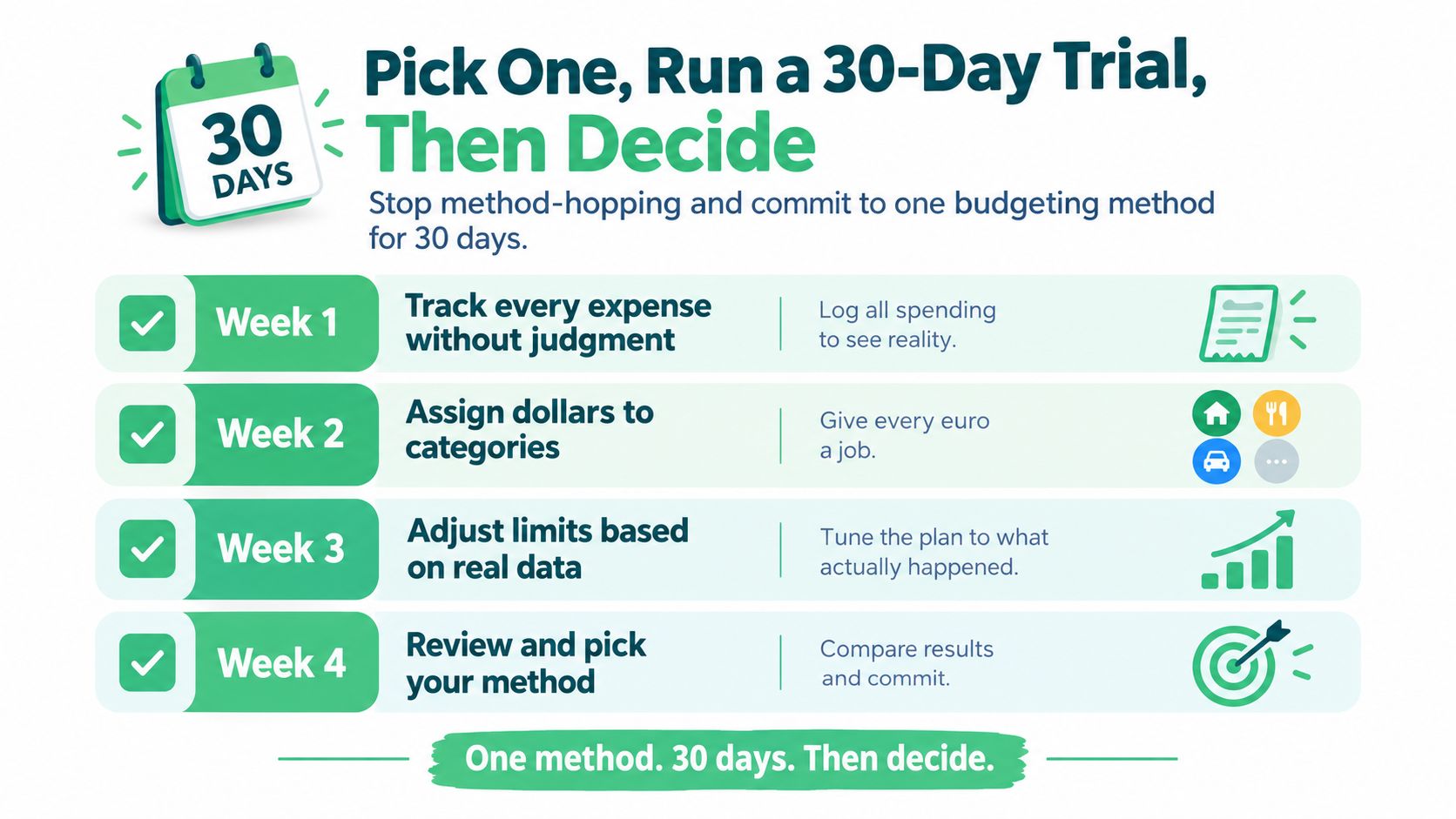
Week 3, test one disruption. Let the plan face an unexpected bill, a lower-income week, or a category that runs out early. Watch how easily you can adjust. A budget that survives a disruption teaches you more than one that works only during a quiet week.
Week 4, review the behavior. Compare planned and actual spending. Look for repeated overspending, missed transfers, neglected categories, and moments when the system felt too cumbersome to use. Awkwardness that fades after the first part of the trial is normal. A system you stop opening is not.
Switch methods when: you repeatedly overspend in the same categories, can't manage the system after several attempts, or have no engagement with it after three weeks.
Stay with the method when the friction is teachable, the adjustments are clear, and you can see your decisions improving. Don't switch because one category needed recalibration. Budgets are plans, not prophecies.
My final judgment is direct. Pay-yourself-first is the best default for irregular income and busy professionals. Zero-based budgeting is the best tool for tight paychecks and aggressive debt payoff. Envelope budgeting is the best intervention for repeated discretionary overspending. The 50/30/20 rule is the best first step for beginners.
Start with one today, run the trial, and let your behavior decide what stays.
Get more posts like this
One short, useful email each Friday. Free, no spam, unsubscribe anytime.