Grocery Shopping on a Budget for Two
Practical grocery shopping on a budget for two, with weekly budgets, meal plans, price-per-serving math, and sample baskets you can copy.

Daniel Anderson
Editor, The Money Maniac
September 23, 2026
12 min read
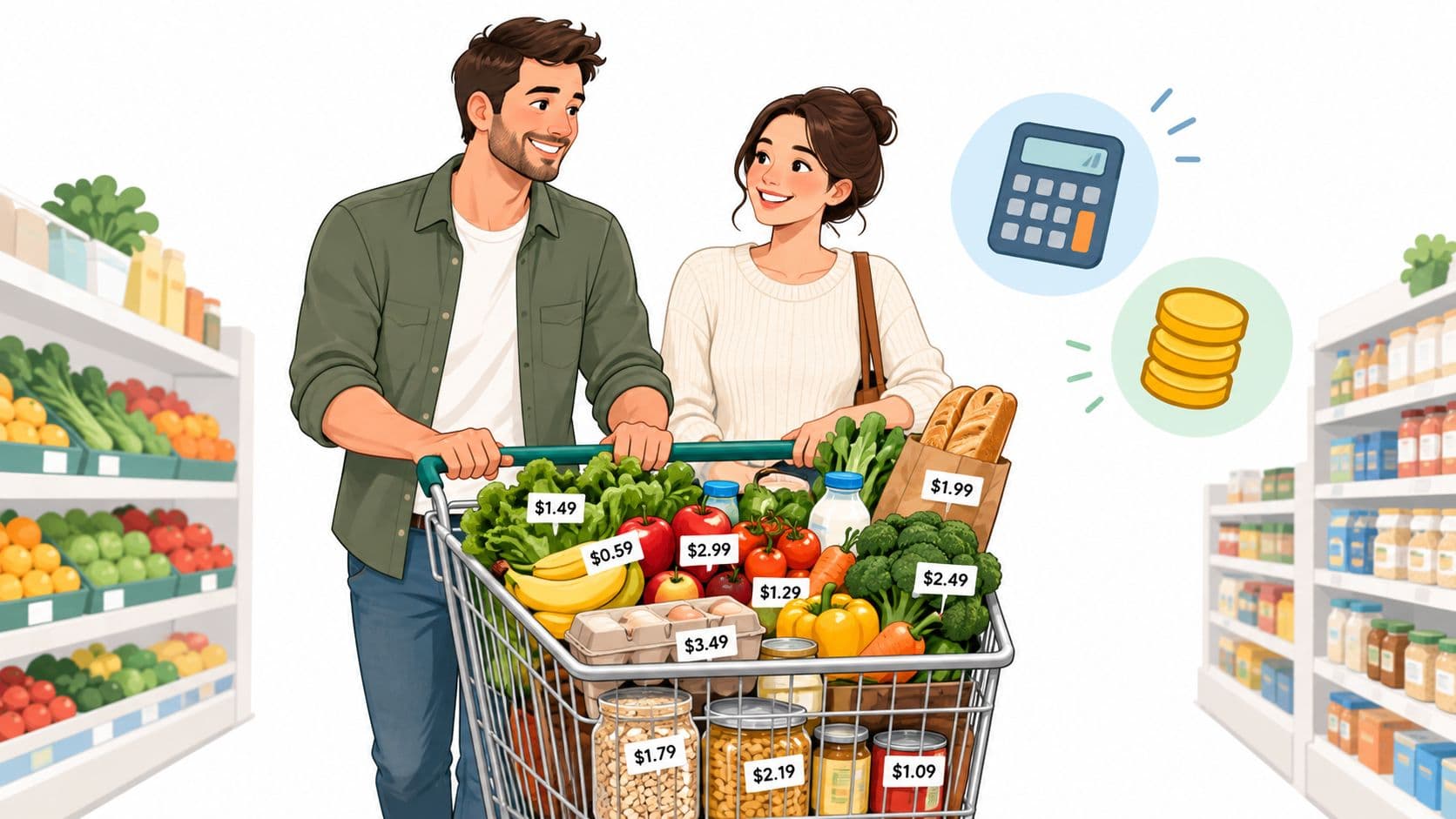
You get home with two bags of groceries, a receipt longer than expected, and a sinking feeling that dinner still needs ingredients. Then, three days later, half a bag of spinach turns limp in the refrigerator. Grocery shopping on a budget for two usually fails in that small gap between what looked like a good deal and what gets eaten.
The fix is a system, not heroic self-control. Set a realistic spending tier, build five or six dinners around shared ingredients, compare unit prices, and treat waste as a bill you can eliminate.
What a Realistic Two-Person Grocery Budget Looks Like
A couple in a mid-cost region might spend $95 to $125 in one ordinary week, then discover that part of the purchase never became food. The half-bag of spinach is a useful warning. The problem wasn't necessarily the spinach. The problem was buying it without assigning it a meal and a deadline.
USDA-aligned estimates place a realistic monthly range for two adults at roughly $550 to $900, depending on the plan level and household assumptions. A separate USDA-based estimate places two-person spending at about $507 per month, while a 2025 summary cites approximately $558 to $706 depending on the plan. These figures aren't contradictory. They show why a couple needs a target range rather than one supposedly perfect number. See the USDA-based household grocery spending estimates for the underlying comparisons.
| Tier | Weekly Budget | Monthly Budget | Shopping Style |
|---|---|---|---|
| Thrifty | About $140 | Roughly $550 to $620 | Home-cooked staples, limited extras, careful waste control |
| Low-cost | About $175 to $195 | Roughly $700 to $780 | Mostly basic ingredients, some convenience and variety |
| Moderate | About $195 to $225 | Roughly $850 to $920 | Broader choices, more flexibility, fewer hard substitutions |
| Liberal | Above $225 | Roughly $1,050 to $1,150 | Premium choices, frequent convenience items, less price pressure |
Three decisions determine the final number:
- Tier: Your target should reflect your income, diet, and priorities.
- Basket composition: Proteins, produce, dairy, and pantry goods behave differently at the checkout.
- Waste: Food that spoils costs the same as food you eat.
Couples also fall into predictable traps. Bulk packages may be priced for four people, and doubling a recipe doesn't help if nobody wants the leftovers. A two-person household needs shared ingredients in useful quantities, not a warehouse club's idea of romance.
Practical rule: Treat the budget as a math problem. Share ingredients across meals, check unit prices, and assign perishables to specific days.
If you're building a broader household plan, the 50/30/20 budget spreadsheet can help place groceries alongside housing, debt, saving, and discretionary spending. You can also try ThriveXDNA's budget tool when you need to test a grocery target against household income rather than choosing a number in isolation.
Choosing the Right Spending Tier for Your Household
The four USDA food-plan tiers give couples a useful starting framework: Thrifty, Low-Cost, Moderate-Cost, and Liberal. For two adults, the USDA applies a 10% household-size adjustment to the combined individual food costs, so the result isn't one adult's budget multiplied by two. Shared staples and preparation reduce the per-person cost, although two people don't receive the same economies as a larger household. The USDA's monthly Cost of Food reports explain that calculation.
| USDA Tier | Monthly (2 Adults) | Per Person | Best Fit For |
|---|---|---|---|
| Thrifty | Roughly $550 to $620 | Roughly $275 to $310 | Debt payoff, strict savings, highly planned cooking |
| Low-Cost | Roughly $700 to $780 | Roughly $350 to $390 | Couples seeking control without maximum restriction |
| Moderate | Roughly $850 to $920 | Roughly $425 to $460 | Dual earners wanting variety and practical flexibility |
| Liberal | Roughly $1,050 to $1,150 | Roughly $525 to $575 | Households prioritizing convenience and premium choices |
The tier should match the household, not your pride. A young couple paying down debt may comfortably use the Thrifty plan if both people cook and accept repetition. A dual-income couple with no dietary restrictions may find Moderate more sustainable because it leaves room for variety and occasional convenience. Liberal spending can be reasonable, but it shouldn't be the default because the cart fills quickly.
Age and sex assumptions also shift the target. One USDA-based breakdown estimates a Moderate plan of $767.91 per month for one man and one woman, with Low-Cost at $619.85 and Liberal at $955.90. The same guidance notes that a 30-year-old man eats 800 more calories than a 30-year-old woman on the Moderate plan, which can change how a couple divides its internal food costs. Review the USDA-based grocery budget breakdown for two adults for the assumptions behind those figures.
Ask three questions before choosing:
- What are you spending now? Use recent receipts, not an idealized memory.
- What are your debt and savings goals? A grocery dollar has an opportunity cost.
- How often do you eat out? Fewer home meals may justify a smaller grocery basket, while cooking nearly every meal requires enough food to avoid rebound takeout.
My recommendation for most mixed-age households is the Low-Cost tier as a starting point, followed by a month of tracking. Move toward Moderate if the plan creates repeated shortages or wasteful emergency purchases. Move toward Thrifty if the household can maintain nutrition and satisfaction without relying on takeout.
Building a 5-6 Dinner Week on Shared Ingredients
Start on Friday with an inventory. Check the refrigerator, freezer, pantry, sauces, grains, and spices before writing a shopping list. That five-minute scan prevents the classic purchase of a second rice bag while the first one sits behind three cans of tomatoes.
Choose two protein anchors for the week. One should usually be a cheaper, flexible cut. The other can be a faster-cooking option for a busy night. Then select produce that appears in multiple meals, rather than buying one specialty ingredient for one ambitious recipe.
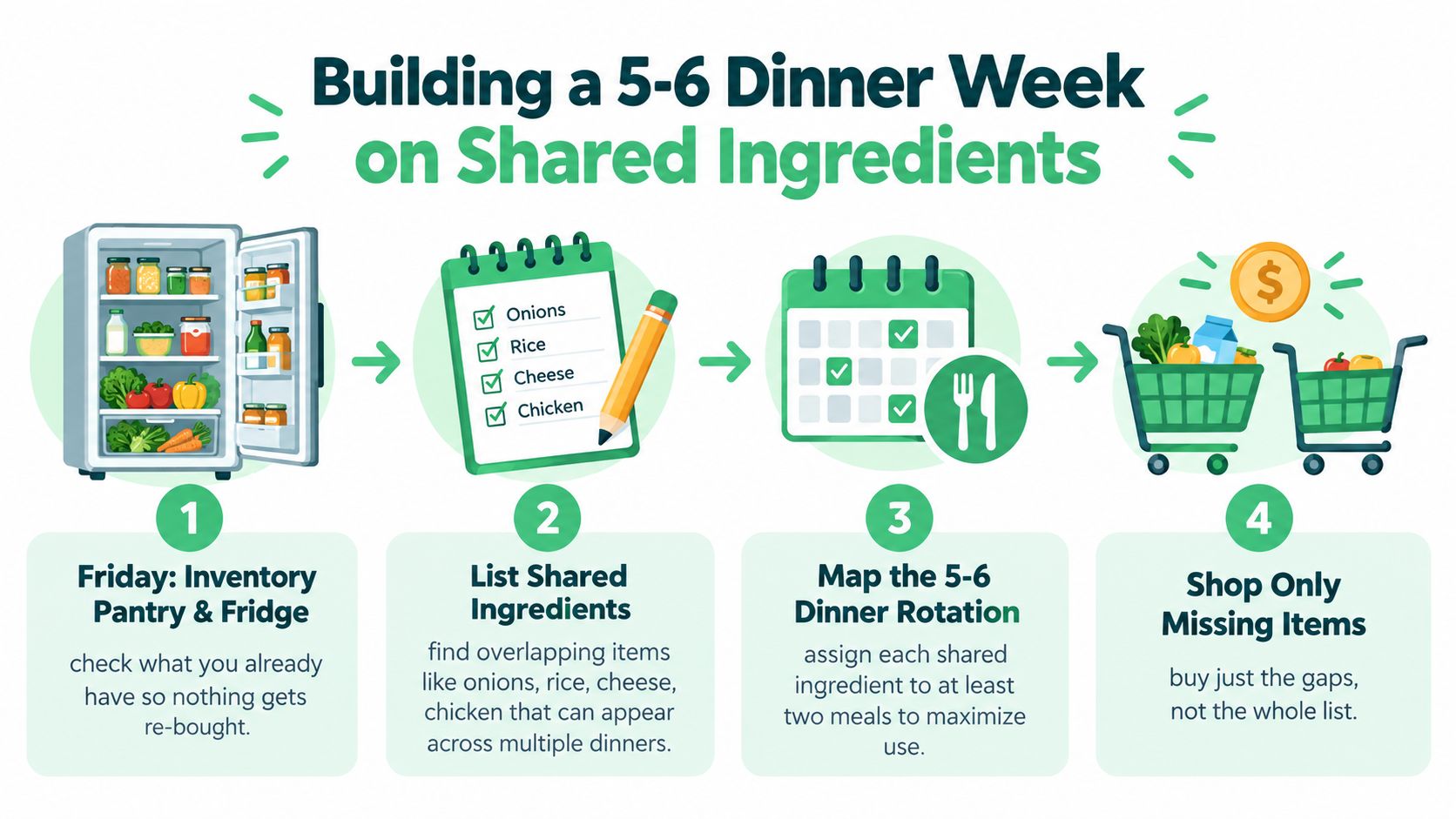
A practical example uses one pound of pork shoulder and a dozen eggs:
- Dinner one: Pork stir-fry with onions, carrots, and rice.
- Dinner two: Sheet-pan pork with potatoes and a sturdy vegetable.
- Dinner three: Pork grain bowls using the remaining meat, rice, greens, and sauce.
- Dinner four: Egg fried rice with leftover vegetables.
- Dinner five: Omelets with potatoes, cheese, and any produce that needs attention.
- Dinner six: A pantry backup, such as beans, tomatoes, and rice, if leftovers don't cover the night.
The point isn't culinary excitement. It's ingredient utilization. One onion should have several jobs, and a sauce should work across more than one meal.
Use a substitution ladder
When a sale changes the protein choice, don't rebuild the entire menu. Move through a ladder from cheapest to priciest:
- Beans or lentils.
- Eggs or tofu.
- Chicken thighs or canned fish.
- Ground meat.
- Premium cuts or prepared proteins.
Choose the lowest option that fits the meal and the household's nutrition needs. Recalculate by serving, not by package price.
Schedule perishables aggressively. Anything likely to wilt within four days belongs in the first half of the week. Frozen vegetables, canned tomatoes, dried grains, and beans can carry the back half. Food-waste reporting cited in budget meal-planning coverage estimates that U.S. consumers discard roughly 35 million tons of food annually, representing about $259 billion in purchased calories, while a Penn State analysis found the average household wastes about 31.9% of the food it buys, with about two-thirds of that waste caused by food spoiling before use. The shared-ingredient meal-planning analysis provides that context.
Two Sample Shopping Trips and What They Reveal
Take the same five-dinner plan and run it through two shopping styles. The first couple checks the pantry, compares unit prices, and buys only the gaps. The second starts with the same intention but adds attractive extras that don't have a place on the menu.
| Category | Planned Trip ($) | Impulse Trip ($) | Difference ($) |
|---|---|---|---|
| Proteins | 32 | 45 | 13 |
| Produce | 24 | 42 | 18 |
| Dairy | 14 | 25 | 11 |
| Pantry | 18 | 27 | 9 |
| Extras | 7 | 36 | 29 |
| Total | 95 | 175 | 80 |
The planned basket covers the protein anchors, overlapping vegetables, eggs, dairy, grains, and one backup dinner. The shopper checks the shelf tag, chooses store-brand staples where the quality is equivalent, and leaves with a clear job for every perishable item.
The impulse basket adds a bakery stop, a pre-cut fruit tray, a deli upgrade, and a pile of snacks bought because the labels say “sale.” None of those purchases is automatically foolish. They become expensive when they sit outside the meal plan and compete with food already in the refrigerator.
The small upgrades do the damage
The second basket didn't require one dramatic splurge. It broke through the target through four to six small upgrades: prepared fruit instead of whole fruit, a premium deli version instead of a basic ingredient, bakery items, and extra snacks. Each decision felt minor. Together, they changed the basket's purpose from feeding two people to entertaining every passing craving.
The fixed list beats willpower because it makes the decision before you enter the store.
The practical lesson is simple. Write the dinners first, group ingredients by aisle, and check the unit price before placing an item in the cart. If an extra makes the trip, remove something else or record it as a deliberate tradeoff. A budget works when the basket has boundaries, not when shoppers hope they'll feel disciplined near the checkout.
Price per Serving and How to Read a Shelf Tag
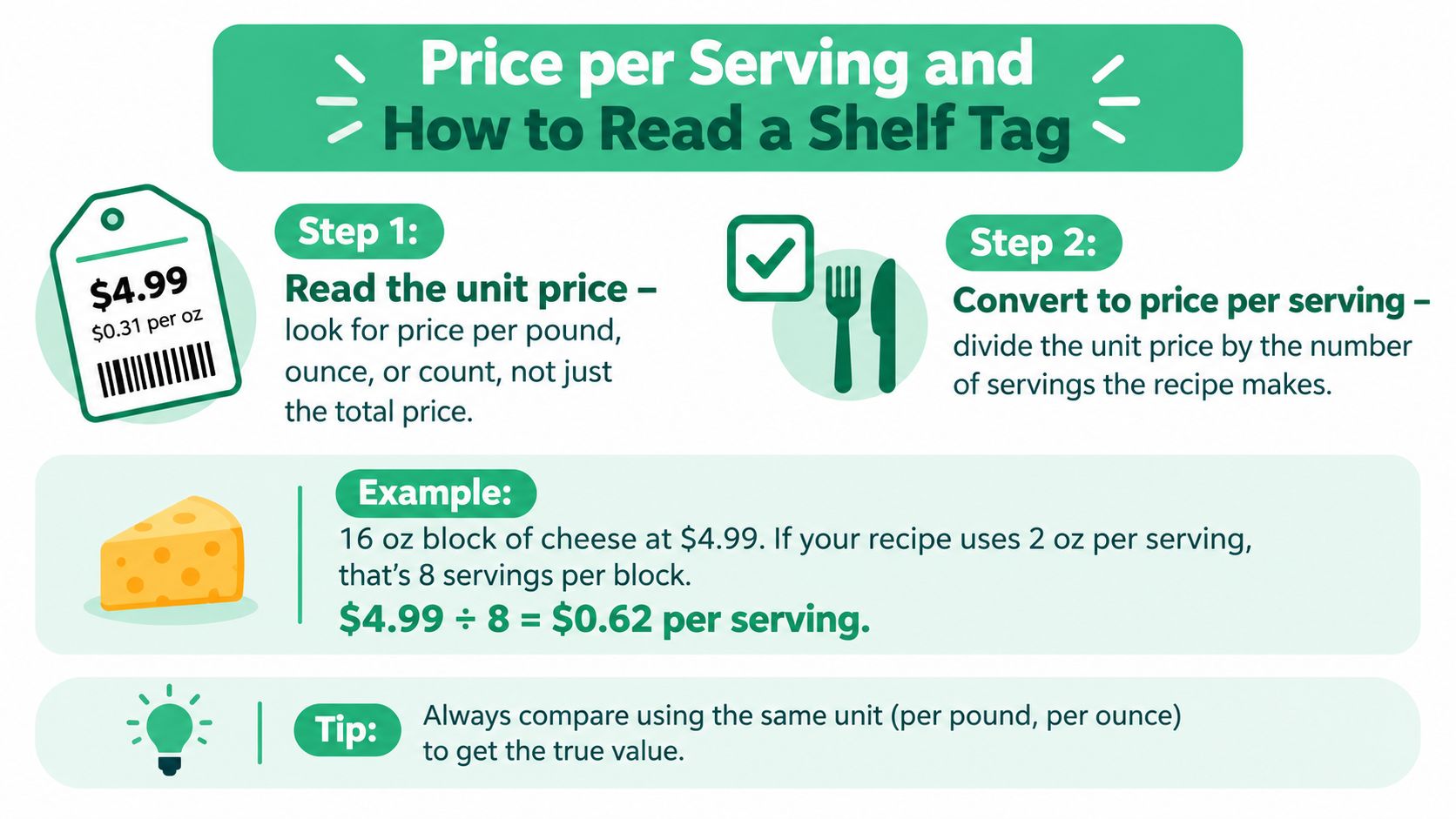
The large number on a package tells you what leaves your account. The smaller unit-price line tells you what the food costs. Read the price per ounce, pound, or count, then convert it into a serving cost using the amount your recipe uses.
Suppose a 16-ounce block of cheese costs $5.99, while a 24-ounce block costs $8.49. If your household uses 2 ounces per serving, the smaller block provides 8 servings and costs about $0.75 per serving. The larger block provides 12 servings and costs about $0.71 per serving. The larger package wins on serving price, but only if you'll use the extra cheese before it dries out.
That last condition matters more than shoppers admit. A smaller package can be the better purchase when the unit-price gap is narrow and spoilage is likely. Bulk isn't a bargain if half the package becomes refrigerator archaeology.
Compare the channel, not just the package
Fresh, frozen, and canned foods solve different budget problems:
- Fresh vegetables: Best when you'll cook them soon and the price per usable serving is competitive.
- Frozen vegetables and berries: Useful when you need a longer shelf life and predictable portions.
- Canned tomatoes and beans: Strong pantry backups, especially when a recipe doesn't depend on fresh texture.
Don't compare a fresh package with a frozen package by sticker price. Compare edible servings after accounting for trimming, cooking, and waste. For berries, frozen may protect the budget when fresh fruit spoils before breakfast. For tomatoes, canned may be the sensible default for sauces and soups. A nutrition-label reading guide can also help you compare serving sizes and nutrients instead of treating package claims as the whole story.
Run this 30-second aisle check:
- Read the unit price.
- Confirm the package size matches your recipe.
- Estimate servings from the recipe yield.
- Check whether the food will be used before spoiling.
- Compare fresh, frozen, and canned alternatives.
- Put it back if it has no assigned meal.
When the Smartest Move Is Substitution, Not Sacrifice
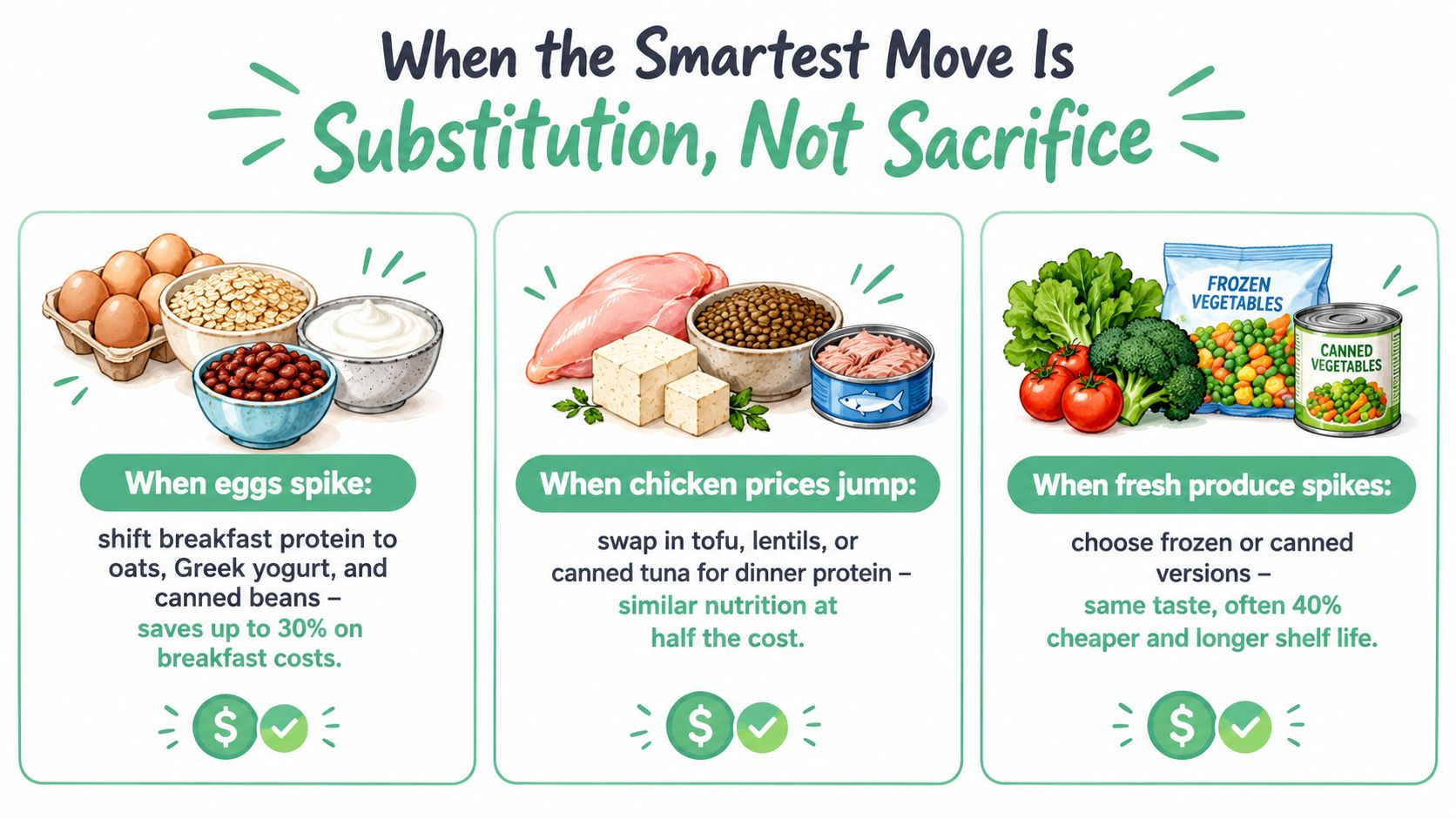
A flat weekly cap is useful, but it can be too blunt. Grocery inflation doesn't hit every category evenly. Recent reporting places food-at-home inflation around 2.7% year over year in mid-2026, with fruits and vegetables up about 5.1% in one comparison, while eggs were still rising in some retail trackers. The recent grocery price category comparison shows why a couple should adjust the basket instead of stubbornly buying the same list at any price.
If eggs spike, change the breakfast mix. Use oats, Greek yogurt, and bean-based dishes to preserve protein and calcium while reducing dependence on one category. Keep eggs for meals where they add the most value, such as a quick dinner or a planned breakfast, rather than making them the automatic answer for every meal.
When fresh produce rises, shift part of the basket to frozen or shelf-stable alternatives. Frozen vegetables can go into stir-fries, soups, and grain bowls without creating a midweek spoilage deadline. Canned tomatoes and beans can support the back half of the meal plan while fresh greens and herbs get used early.
Ground beef creates the same decision. If the price jumps, compare chicken thighs, canned tuna, eggs, and legumes by serving cost. A higher package price doesn't automatically mean a higher meal cost, and a cheaper package doesn't help if the recipe uses more of it than expected.
Use a substitution ladder during the shop
For each category, decide the acceptable swaps before you arrive:
- Eggs: Oats, yogurt, beans, or tofu.
- Fresh produce: Frozen vegetables, frozen berries, canned tomatoes, or sturdy root vegetables.
- Ground beef: Chicken thighs, tuna, eggs, lentils, or beans.
- Fresh proteins: Canned or dried alternatives when the meal can support them.
The plan notes a possible 25% to 40% category jump as a stress test. You don't need to pretend prices won't move. Reassigning meals toward available substitutes can keep the total week inside its spending band without cutting the number of dinners.
Channel flexibility is more powerful than coupon collecting. Fresh, frozen, canned, and dry ingredients give you multiple ways to feed the same meal pattern.
The best substitution is the one that preserves the meal's function. Frozen vegetables can replace fresh in a soup. Lentils can replace meat in a bowl. Oats can replace an egg-heavy breakfast. For more ideas beyond the grocery aisle, see these creative ways to save money.
Your Weekly Two-Person Grocery System
A good grocery system gives each day a small job. That keeps planning from becoming a Sunday-night crisis and makes the shopping trip a controlled purchase rather than a wandering tour of every tempting aisle.
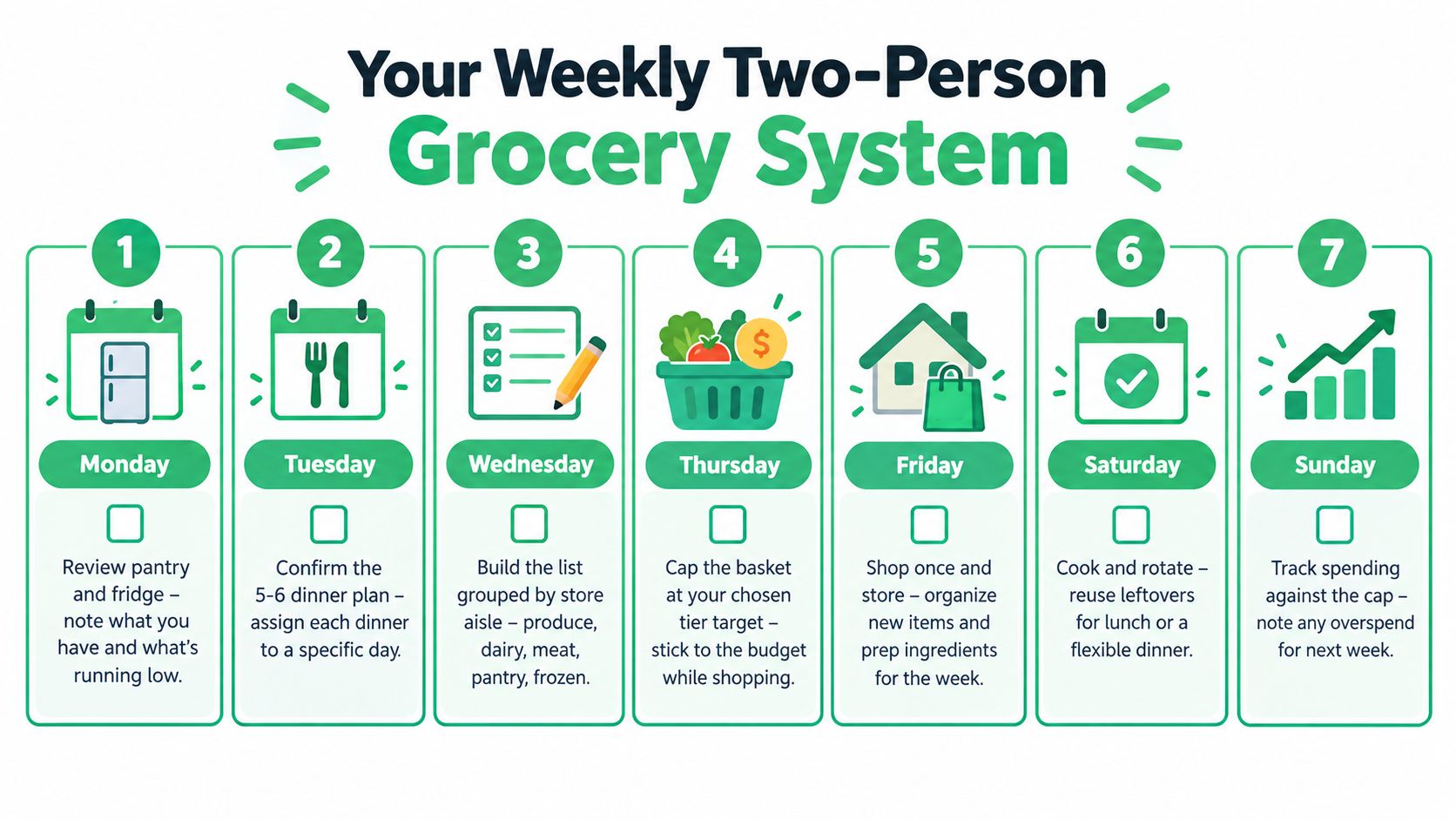
- Monday, review the kitchen: Check the pantry, refrigerator, and freezer. Write down ingredients that need to be used first.
- Tuesday, confirm dinners: Choose five or six dinners and assign each to a day. Put delicate produce early in the week.
- Wednesday, build the list: Group the missing items by produce, dairy, meat, pantry, and frozen. A list generator can save time when you're turning recipes into an aisle-ready list.
- Thursday, set the cap: Choose the spending tier target and remove anything that pushes the basket beyond it unless you deliberately trade out another item.
- Friday, shop and store: Shop once, unpack promptly, and place foods that need attention where you'll see them.
- Saturday, cook and rotate: Use leftovers for lunch or make the flexible backup dinner.
- Sunday, check the result: Compare the receipt with the cap. Record the category that caused an overspend and adjust next week's substitutions.
For most mixed-age couples, I'd start with the Low-Cost USDA-aligned tier, then adjust after observing real receipts and real waste. The single habit that protects the budget more than coupon hunting is a fixed list anchored by unit prices and per-serving math. Coupons can reduce the price of an item. A disciplined list prevents the wrong item from entering the cart in the first place.
If cash creates a useful boundary, the cash-envelope budgeting method can give groceries a dedicated limit without mixing the category into everyday spending. The method matters less than the behavior: decide the cap before shopping, and make the basket obey it.
Start this week with one inventory, two protein anchors, and five dinners. Don't wait for a perfect month. A workable plan with shared ingredients will beat an ambitious plan that leaves spinach, leftovers, and money in the trash.
Get more posts like this
One short, useful email each Friday. Free, no spam, unsubscribe anytime.