How to Budget with Irregular Income: Floors and Buffers
Learn how to budget with irregular income using an income floor, a cash-flow calendar, buffer months and tax set-asides, with worked examples.

Daniel Anderson
Editor, The Money Maniac
October 30, 2026
12 min read

A client payment finally lands, your checking balance looks healthy, and rent suddenly feels manageable. Then you remember the insurance bill, the unpaid tax reserve, and the project that won't pay until next month. The balance on your banking screen is doing a poor job of telling you what you can spend.
Learning how to budget with irregular income starts with choosing a conservative spending limit and checking when cash will arrive. Keep the tax portion out of reach, carry strong-month money forward, and give yourself clear rules for lean months. You shouldn't have to redesign your financial life every time someone pays an invoice.
Pick a Monthly Income Floor You Can Live On
Say your last three months brought in $6,000, $2,000, and $3,000. That averages about $3,667 a month, but committing that much to recurring expenses would leave you scrambling during the weaker months.
Your income floor is the amount you use to set routine spending commitments. For self-employed work, calculate it from money available after business costs and tax reserves. Gross client receipts can make your personal budget look much healthier than it is.
Income variation is common among gig workers. In 2024, 41% of U.S. adults who performed gig work in the prior month said their income varied at least occasionally from month to month, compared with 26% of adults who didn't perform gig work, according to the Federal Reserve Board.
Three ways to set your income floor
The following methods use the hypothetical earnings above. With only that short history, any longer-term result remains provisional.
| Method | How to calculate | Example result |
|---|---|---|
| Lowest recent month | Smallest monthly total in the last 6-12 months | $2,000 in the available sample; check the longer history |
| Share of average | Use 70-80% of average monthly income | About $2,567-$2,933 |
| Rolling average | Mean of 6-12 months of income | $3,667 for the available three months; extend the history before relying on it |
I'd start with the lower of the lowest recent month and the discounted average for most readers. In this example, that means budgeting from $2,000. It limits the temptation to turn a strong month into permanent obligations.
A rolling average becomes more useful when your client base, workload, and seasonal pattern are reasonably consistent. It's less useful after losing a major customer or changing careers.
Reality check: Can the floor cover rent, utilities, insurance, food, essential transportation, and minimum debt payments?
If it can't, the floor is the first problem to solve. You may need more dependable work, lower fixed costs, or a deliberate seasonal reserve. Rearranging the spending list won't close a persistent income gap.
Map Income and Bills Month by Month
A profitable month can still include a week when you can't pay rent. Record payment dates alongside bill dates so you can see that gap before it becomes an overdraft.
The Consumer Financial Protection Bureau's planning tool recommends recording anticipated changes in income, benefits, and spending by month, then adding those changes to a cash-flow budget. A spreadsheet or paper calendar works, provided you keep it current.
Build the calendar around arrivals
-
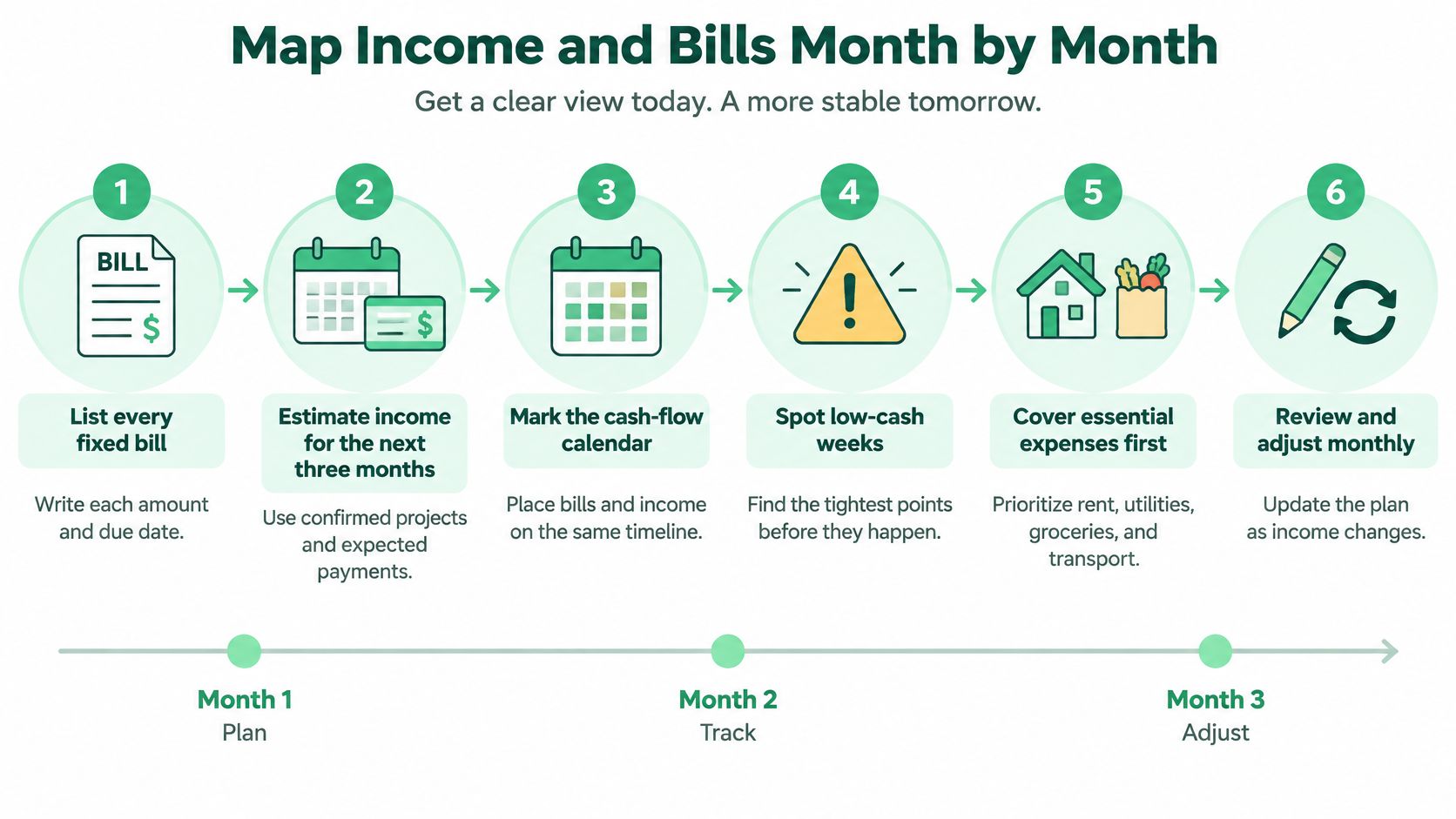
List every fixed bill. Write down its amount and due date, including housing, insurance, utilities, and minimum debt payments. Add realistic allowances for groceries and transportation so the calendar doesn't show an imaginary surplus.
-
Estimate income for the next three months. Use confirmed projects, scheduled shifts, and outstanding invoices. Record when you reasonably expect payment to arrive, not when you'll finish the work.
-
Subtract bills from each month's arrivals. Place the individual payments and bills on their actual dates before calculating the monthly total. A positive month-end balance won't help with a bill due before the payment clears.
-
Carry the surplus forward. Treat unspent cash as funding for future bills until the calendar shows you can release it. Don't reset your available balance to zero at each month-end.
-
Cover shortfalls from the carried balance. Flag any month when that balance would turn negative, then inspect the weeks within it. Moving a bill's due date may solve a timing gap, but it won't solve an ongoing shortage.
-
Review every Sunday. Update the calendar when a client pays late, a project moves, or an expense changes. Keep uncertain work separate from confirmed income so optimism doesn't pay the electric bill on paper.
Use this visual as a reminder of the calendar-building process.
Watch what happens after a strong month
Suppose bills total $2,400 monthly and income arrives as $6,000, $2,000, and $2,000. The first month leaves $3,600 to carry forward. Each following month runs $400 short, reducing that balance to $3,200 and then $2,800.
The average is about $3,333, but the later months still receive only $2,000 each. Spending the first month's surplus would remove the cash needed to cover those gaps.
A healthy calendar has a carried balance that never drops below zero, including between payment dates. Ideally, your lowest-income month also covers core bills on its own. When it doesn't, identify exactly how much saved cash you're depending on.
Build a Buffer Sized in Months
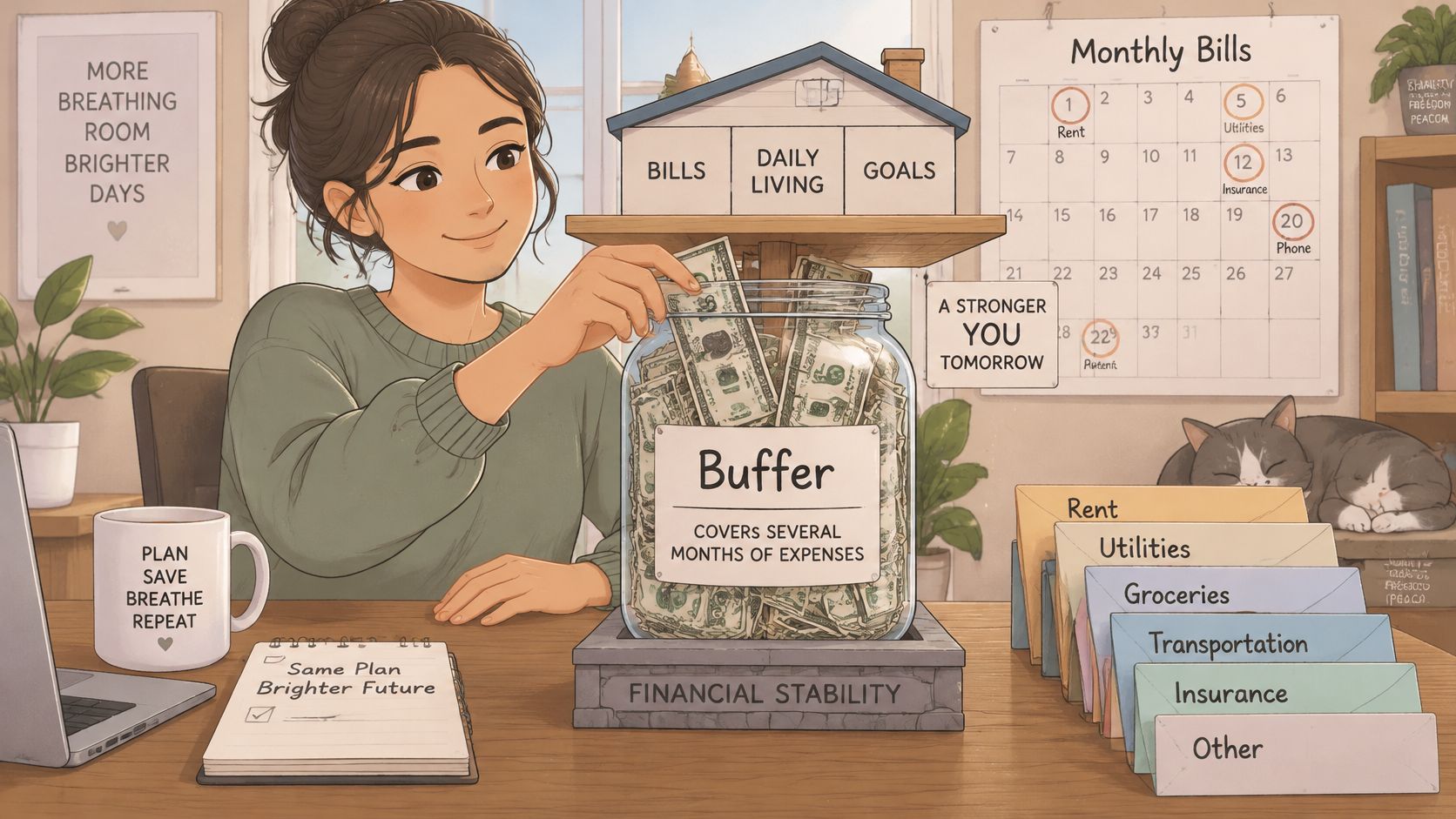
Your buffer makes a conservative budget usable when payments arrive unevenly. Size it against essential expenses, because that tells you how long you can keep the household running without normal earnings.
In 2024, 55% of U.S. adults reported having money set aside to cover three months of expenses, according to the Federal Reserve's household financial well-being survey. That's a useful benchmark, not a deadline or proof that the same target suits everyone.
Give the reserve a measurable target
For a hypothetical household with $2,400 in monthly core expenses, I'd use these stages:
| Stage | Coverage | Example target |
|---|---|---|
| Starter buffer | One month of core expenses | $2,400 |
| Working reserve | Three months of core expenses | $7,200 |
| Higher-volatility reserve | Six months of core expenses | $14,400 |
Start with the starter buffer rather than waiting until you can fund the whole reserve. Seasonal work, long payment delays, or reliance on a single customer are reasons to consider the larger target.
There's a trade-off: cash held for stability can't also pay down debt or fund other goals. Our guide to choosing an emergency fund size can help you weigh those competing needs.
Keep the reserve separate from the account that pays everyday bills.
Set the fill and draw rules in advance
For example, you might direct 15% of income above your floor into the buffer until you reach your target. That's a planning choice, not a universal savings prescription. Choose a contribution you can sustain after taxes and essentials.
For routine income smoothing, draw only when earnings fall below the floor, and withdraw only what you need to cover essential spending. Rebuild the reserve when income recovers before restoring optional goals.
Keep predictable annual bills in their own savings categories. Insurance renewals and planned maintenance shouldn't repeatedly empty the reserve you're depending on for weak months.
A buffer can cover a temporary gap. It can't make permanently unaffordable bills sustainable.
Unexpected expenses deserve room too. The car repair won't check your income statement before it arrives.
The common mistake is counting the buffer as spendable income whenever the balance looks reassuring. Once those dollars have a job, don't assign them another one.
Split Each Deposit Before You Spend It
Starting split for each deposit
| Bucket | Starting share of each deposit | Notes |
|---|---|---|
| Taxes | 25-30% | Planning starting point; adjust quarterly |
| Giving (tithing) | 10% if you give | Set aside before other non-tax buckets |
| Buffer | 10-20% | Stop once the target is reached |
| Goals and debt | 5-15% | Shift to debt payoff after the buffer is full |
| Core living costs | Remainder | Must cover essentials from the floor |
These are illustrative starting shares, not a ready-made budget. Don't automatically choose the top of every range. Check that the remainder can support your household.
Take taxes out first and treat that share as money that was never really yours. If a client payment includes money needed for materials, subcontractors, or other operating costs, separate those costs before applying a personal spending split.
Test the split with a real-sized payment
For a hypothetical $3,000 deposit, allocating 25% to taxes sets aside $750. Giving receives $300 at 10%, the buffer receives $450 at 15%, and goals and extra debt payments receive $300 at 10%.
That leaves $1,200 for core living costs. If those costs need more, the split fails even though the percentages look orderly. Giving is optional, extra debt payments can pause, and buffer contributions may need adjusting.
Keep minimum debt payments in core expenses. The goals bucket covers payments above those minimums.
Adjust the shares before they cause a shortage
The tax percentage needs particular care. The IRS pay-as-you-go guide explains that taxpayers with income not fully covered by withholding generally need to pay tax during the year and can use Form 1040-ES to estimate their payments.
Review your tax share each quarter against year-to-date profit, deductions, filing status, and where you live. A generic reserve percentage isn't a tax calculation or personalized tax advice.
Use the same review to adjust the other buckets:
- Higher dependable income: Increase commitments cautiously; reduce the buffer share only after its target is met.
- Lower income: Protect core costs and pause optional goals before committing to transfers you can't afford.
- Completed reserve: Redirect its contribution toward debt payoff or another defined goal.
Keep the percentages on one page and test them against your last three deposits. A comparison of budgeting methods can help you choose a tracking format, but any method needs the same affordability check: a short core bucket calls for a revised split, not automatic borrowing.
Estimated Tax Payments and Deadlines
When you're self-employed, an employer generally isn't withholding income tax and self-employment tax from your client deposits. You're responsible for paying as you go.
Under the IRS estimated-tax rules, payments are generally required when you expect to owe at least $1,000 after withholding and refundable credits, and withholding and credits will be below the smaller of 90% of the current year's tax or 100% of the prior year's tax; the prior-year test rises to 110% when prior-year adjusted gross income exceeded $150,000, or $75,000 for married taxpayers filing separately.
Those payment benchmarks are commonly called safe harbors. Meeting an applicable safe harbor generally helps avoid an underpayment penalty, but you may still owe additional tax when you file.
Put the payment dates on your calendar
The standard federal deadlines are April 15, June 15, September 15, and January 15 of the following year. Although people call these quarterly payments, the covered periods aren't equal in length.
Federal estimated tax payment periods and due dates
| Payment period | Due date | Covers |
|---|---|---|
| January 1-March 31 | April 15 | First quarter |
| April 1-May 31 | June 15 | Second quarter |
| June 1-August 31 | September 15 | Third quarter |
| September 1-December 31 | January 15 of the following year | Fourth quarter |
When a deadline falls on a weekend or legal holiday, it generally moves to the next business day. Check the applicable calendar before scheduling a payment rather than assuming every year follows the same weekday pattern.
Recalculate before sending the next payment
Compare year-to-date business profit with your prior-year return and your current projection. Use actual revenue and deductible business costs, rather than treating every dollar deposited as taxable profit.
If income rises sharply late in the year, revisit the next estimated payment. If work dries up, revise your projection using Form 1040-ES instead of continuing an outdated estimate because it's already in the calendar.
Payment habit: On the first of the month before each deadline, check that the planned payment is fully funded in your separate tax account.
That check should confirm money you've already reserved from deposits. It shouldn't require raiding rent money at the last minute.
Federal estimates also don't settle every possible tax obligation. Your state and personal circumstances may require additional planning, and uneven earnings can complicate the payment calculation. A large income swing is a good reason to check with a tax professional before making assumptions about what you owe.
Build a Calculator Sheet That Tests Your Plan
A contractor may collect $3,800 in one month, $900 the next, then $2,600 after that. A calculator sheet can show whether the income floor and bill schedule still work when deposits arrive unevenly.
Set up six monthly rows with columns for expected deposit dates and amounts, bills due and their dates, tax set-aside, net after bills and taxes, carried balance, buffer balance, and a shortfall flag. Keep your income floor, buffer target, and deposit-split percentages in an inputs area, then reference those cells in the formulas so changes flow through the sheet.
Use a running balance
Start with the core calculations:
- Net after bills and taxes: Expected arrivals minus the tax set-aside and bills due.
- Carried balance: Previous month's carried balance plus arrivals, less the tax set-aside and bills.
- Shortfall flag: Show a warning when the projected balance falls below zero.
- Buffer balance: Previous reserve plus contributions, less withdrawals.
For example, start with $1,200 carried forward. If the contractor receives $3,800 and has $2,700 in bills, a 25% planning set-aside for taxes leaves $2,150 after bills and taxes, bringing the carried balance to $3,350. The next month, a $900 deposit with $2,400 in bills and the same starting tax assumption leaves a $1,725 shortfall against the carried balance, so the sheet should flag it. The 25% figure is only a planning starting point, not tax advice. Actual tax needs depend on the person's circumstances.
Check for double counting
Keep carried cash separate from the buffer. When money moves between those accounts, subtract it from one balance and add it to the other. A transfer changes where the money sits; it does not add income.
A budget spreadsheet for organizing income and spending can provide a starting layout. Add running-balance formulas and dated transactions so a positive month-end balance does not hide a midmonth cash shortage. Update the sheet when a payment date or project changes, then inspect the lowest projected balance as well as the month-end total.
Automate Your Transfers Before the Next Deposit
A transfer scheduled against an invoice you hope will be paid can overdraw your account. Set transfers to follow cleared deposits, not expected ones, and leave room for a payment that is later reversed or disputed.
Set up the accounts and transfer sequence
-
Separate the money by job. Use a savings account for the buffer, a separate account for tax reserves, and a dedicated bills account. Check fees, minimum-balance requirements, and transfer availability before opening anything.
-
Schedule transfers after deposits clear. Aim for the day after cleared funds arrive, in this order: taxes, buffer, bills account, then spending. Use percentage-based rules if your bank supports them. Otherwise, calculate each split and approve it manually rather than relying on a fixed amount that assumes every deposit is equal.
-
Use a reversal rule. If a client reverses or disputes a payment after transfers have gone through, stop discretionary transfers until the bank confirms the remaining cleared balance. Restore the bills account first, then adjust the buffer contribution if needed. Don't count a disputed deposit as available cash.
The sequence needs a safety condition: don't make a buffer contribution that leaves essential bills unpaid. Reduce or suspend that contribution if it would create a shortage.
Use a clear shortfall rule
If a projected month shows a shortfall, pause goal contributions first and protect the bills account. Cut optional spending, check whether an authorized reserve withdrawal covers the gap, and contact billers early if you need to discuss timing.
Don't borrow just to keep automatic savings transfers running. You could end up paying interest to maintain a transfer that should have been reduced.
The test is simple: after transfers, can you pay essential bills on time without counting uncertain income or spending tax reserves? If not, change the rules before the next deposit clears. A modest plan you can maintain beats an ambitious split you have to reverse repeatedly.
Get more posts like this
One short, useful email each Friday. Free, no spam, unsubscribe anytime.