Are Municipal Bonds Tax Free? Federal, State and AMT Rules
Are municipal bonds tax free? Usually federally, often at home, with AMT and capital gains exceptions. Worked examples and yield math.

Daniel Anderson
Editor, The Money Maniac
October 28, 2026
11 min read

Most municipal-bond interest is generally exempt from federal income tax, but state taxes, the alternative minimum tax (AMT), and capital gains can change the result. Check the bond type and your own tax situation before assuming it's tax-free.
If you're nearing retirement, you may be comparing a bond's income with the cash flow you need from savings while trying to keep taxes predictable. The practical question isn't just what a bond pays. It's what you keep after taxes, and whether that income affects other parts of your retirement picture.
Short Answer by Bond Type
Use the bond's legal type first, then the place it was issued. IRS Publication 550 describes the broad federal rule for interest on state and local obligations; “tax-free” is shorthand, and part of the return can still be taxed.
| Bond type | Federal income tax on interest | State income tax on interest | What to check |
|---|---|---|---|
| General obligation or essential-purpose revenue bond | Generally exempt | Generally exempt if you live in the issuing state | Most common type; start here |
| Private activity bond, not subject to AMT | Generally exempt | Depends on the state | Confirm AMT status in the official statement |
| Private activity bond, subject to AMT | Exempt from regular tax, but an AMT preference item | Depends on the state | Can add to AMT for higher-income filers |
| Taxable municipal bond | Taxable | Taxable | Issued for purposes outside the exemption; yields usually higher |
| Puerto Rico or other territory bond | Generally exempt | Often exempt; confirm for your situation | Territory rules differ from state rules |
The table covers interest only. Selling a bond for more than you paid can create a taxable capital gain, and a mutual fund or exchange-traded fund can distribute taxable capital gains even when it owns municipal bonds. Those are separate tax events.
Most of the market carries the exemption, which is why the labels get blurred. The Roosevelt Institute's municipal-bond analysis reports that about 85% of the U.S. municipal-bond market, more than $3.5 trillion, was tax-exempt as of the fourth quarter of 2024. A brokerage screen can still show “tax-free” beside a private activity bond while leaving AMT status off the display. Municipal and tax-exempt are different labels.
Federal exemption also has side effects beyond the coupon: tax-exempt interest can enter the income formula used for Social Security taxation and Medicare premium surcharges, so a lower coupon can still carry a higher total tax cost. For cash you want to keep tax-advantaged while avoiding bond-specific AMT or capital-gain questions, compare current terms in our guide to what I bonds are paying now.
Before buying, read the bond's official statement, the document describing its terms and risks. A short label on a brokerage screen is a useful starting point; check how the interest is treated and whether a sale or fund distribution changes the answer.
How Federal, State and Local Tax Layers Stack
Think of federal tax treatment as the house rule that applies across the country. State treatment is a separate rulebook: it depends on where you live and where the bond was issued. Local income taxes may add another layer.
The IRS generally treats interest on obligations issued by state or local governments as not federally taxable, including bonds used to finance government operations. The exemption applies to interest income, not automatically to every return from the investment. The SEC explains that state and local tax exemptions may also apply when you live in the issuing state or hold a bond issued by a U.S. territory such as Puerto Rico, as summarized in IRS Publication 550.
Consider a New York resident comparing a New York municipal bond with a California municipal bond. The New York bond may qualify for favorable state tax treatment because it's issued in the investor's state; the California bond may receive different treatment under New York rules. That's the state layer. Check the rule for your residence and the specific bond rather than assuming federal exemption means state exemption too.
A city income tax can be a third layer. Some local rules may reach municipal-bond interest, so an investor who pays local income tax should check that treatment separately with the relevant tax authority.
Compare after-tax income, not just the coupon
Municipal bonds usually offer lower interest rates than taxable bonds with comparable maturity, credit quality, and other terms. The point of comparing them is to see whether the tax treatment makes up for that lower stated yield.
For a simple federal-only comparison, a taxable bond yielding 5.00% leaves 3.50% after a 30% marginal tax rate. A federally tax-exempt municipal bond yielding 3.50% produces the same federal after-tax income, before state taxes or other rules. These are illustrative figures, not current market quotes; rates change, so compare live yields when you're making a decision.
Practical rule: Check the bond's federal, state, and local treatment separately, then compare its after-tax yield with a taxable alternative of similar maturity and credit quality.
If you're sorting out how interest income differs from other investment income, this guide to dividends versus interest can help clarify the distinction.
AMT, Private Activity Bonds and Taxable Munis
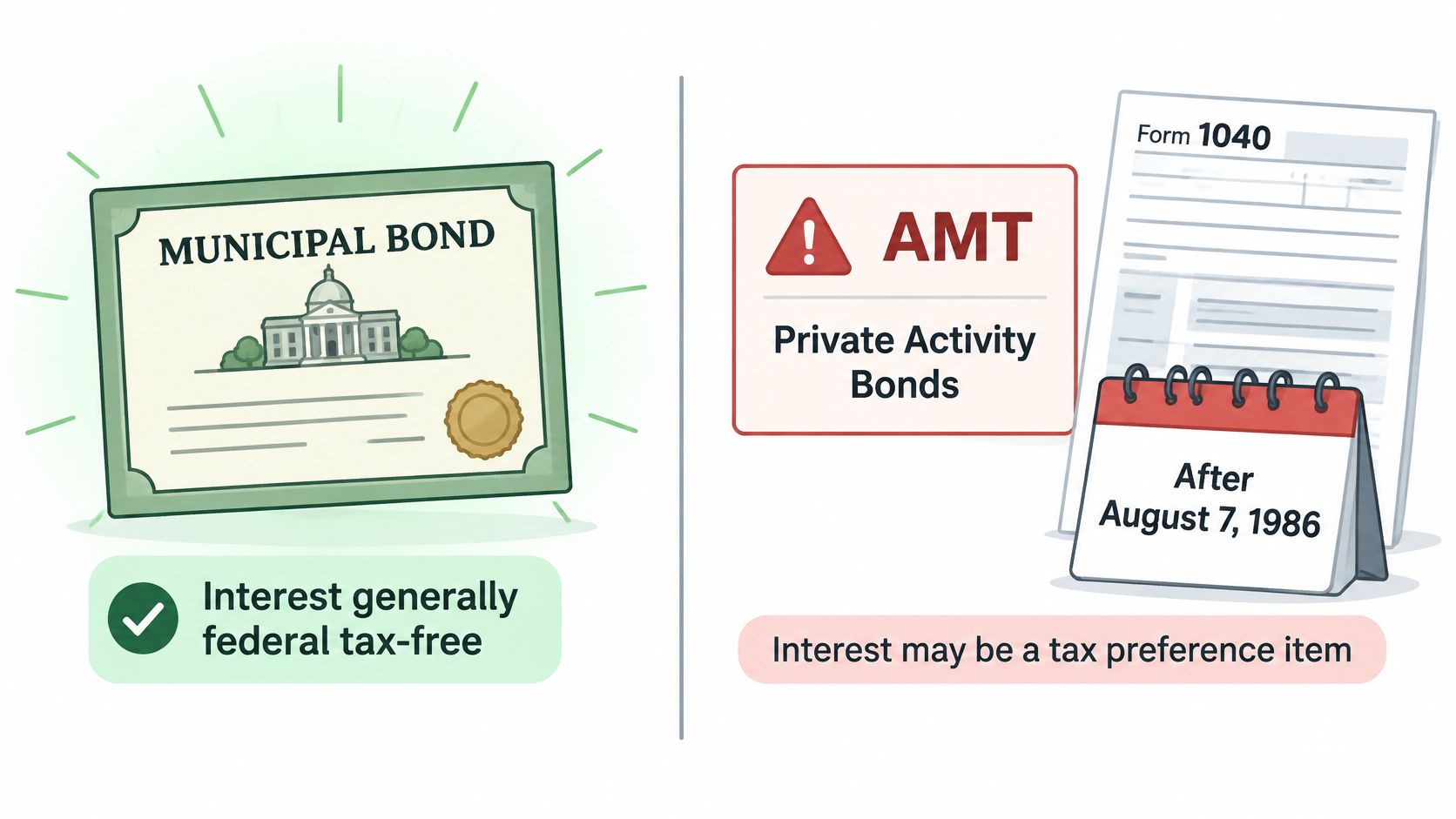
The AMT is one reason “federally tax-exempt” doesn't always mean “outside every federal tax calculation.” It's a parallel tax calculation that can reduce some tax benefits for people who owe it. Under IRS Publication 17, interest from certain qualifying private-activity bonds issued after August 7, 1986, may be an AMT preference item, subject to limited exceptions.
For an affected investor, interest that stays out of ordinary taxable income may still be added to the AMT calculation. So an AMT-exposed bond with a higher headline yield can leave you with less after-tax value than an AMT-free bond with a lower yield.
Check the bond before you buy
- Read the official statement. Look for language identifying whether interest may be subject to the alternative minimum tax.
- Compare the trade confirmation. Its tax designation should match the offering document.
- Consider your tax situation. Your filing status, income, and deductions affect whether AMT exposure matters to you. If you're unsure, ask a tax professional to assess your circumstances.
- Keep the labels distinct. “AMT-free” and “federally tax-exempt” don't mean the same thing.
Some municipal bonds are taxable because their structure or purpose falls outside the exemption. That doesn't make them failed investments; they can still finance projects and may offer a higher yield. Their suitability depends on the same basic comparison as any bond: the after-tax income, the risk, and the terms.
The useful habit is to evaluate the specific bond, not the category name. If the yield looks unusually attractive, find out what feature explains it, including whether AMT treatment is part of the answer.
Capital Gains and Fund Distributions Explained
A municipal investment can send money to you in several ways, and each can receive different tax treatment. The table is a starting point; your state's rules and the fund's holdings can change the details.
| Income event | Federal treatment | State treatment |
|---|---|---|
| Interest from a muni held to maturity | Generally exempt federally | Depends on your state and the issuer |
| Gain from selling a muni above your cost | Taxable as a capital gain | Varies by state; often taxable |
| Loss from selling a muni below your cost | Capital loss; can offset gains | Varies by state |
| Bond bought at a discount, then sold or matured | Accrued market discount generally taxed as ordinary income | Varies by state |
| Bond bought at a premium | Premium amortized to reduce cost basis; no deduction | Varies by state |
| Exempt-interest dividends from a muni fund | Generally exempt if the fund meets the 50% test | Depends on your state and the fund's holdings |
| Capital gain distributions from a muni fund | Taxable as capital gains | Varies by state |
The first common mistake is treating a tax-exempt coupon as if it makes the bond's entire return tax-free. If you sell above your cost, the gain may be federally taxable. If you sell below cost, the loss may be available to offset capital gains, subject to the applicable tax rules.
A bond bought below par can have market discount. When that discount accrues, it is generally taxed as ordinary income when the bond is sold or matures. A bond bought above par has a premium that is amortized to reduce cost basis; that amortization doesn't create a tax deduction.
Funds add another layer of activity
A municipal-bond fund may pass through exempt-interest dividends if it meets the IRS requirement that at least half of its assets are invested in tax-exempt bonds at the end of each quarter. The fund can also distribute taxable capital gains when it sells holdings at a profit. Selling your fund shares is a separate tax event, with a potential gain or loss based on your own purchase price.
Your Form 1099-DIV helps sort fund distributions into tax categories, but it doesn't erase state differences. State treatment can depend on both your residence and the fund's holdings. Also check the fund's annual report for its share of income from AMT-exposed bonds. Tax-exempt dividends can include that income.
If you're considering when to realize gains, this guide to tax-gain harvesting offers a framework for thinking through the timing and tax consequences.
Taxable-Equivalent Yield Calculator With Worked Examples
A municipal bond's quoted yield can look lower than a taxable bond's and still leave you with similar after-tax income. The taxable-equivalent yield converts the muni yield into the taxable yield that would produce the same federal after-tax amount.
Taxable-equivalent yield equals the tax-free yield divided by one minus your marginal tax rate.
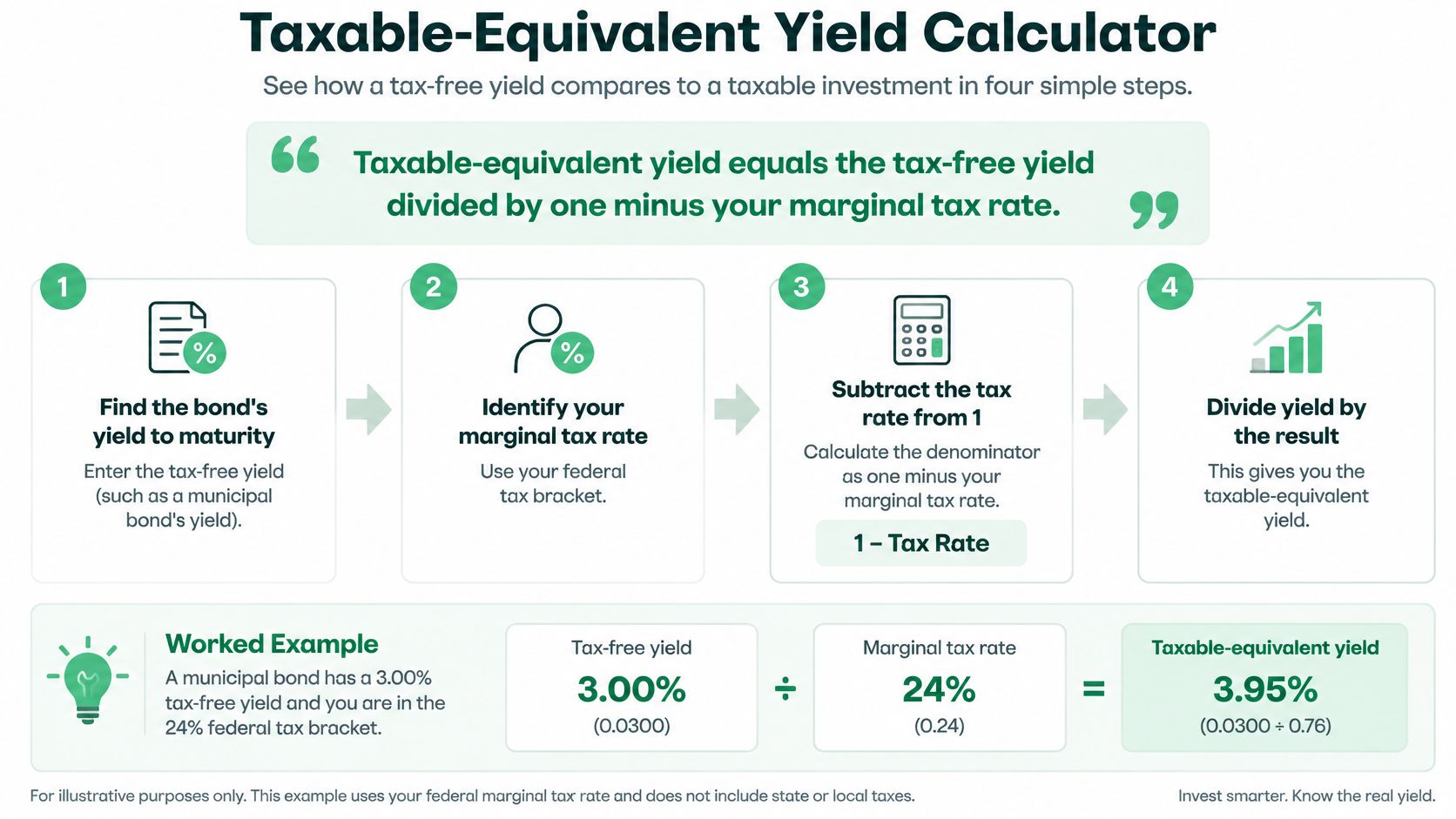
Use these steps:
- Find the bond's yield to worst. For a callable bond, this is the lower of its yield to maturity and yield to call. Look up the bond's terms on a municipal-bond disclosure page or your brokerage's bond page.
- Identify your federal marginal tax rate. Use the IRS tax tables for the year you're evaluating, and verify the current brackets before relying on a calculation.
- Subtract the rate from one. Divide the muni yield by the result.
- Compare like with like. The taxable alternative should have similar credit quality and maturity; a yield comparison alone says nothing about credit or call risk.
Worked examples
A 3.50% muni in the 24% bracket has a taxable-equivalent yield of 4.61%: 3.50% divided by 0.76. A taxable bond paying 4.75% would therefore produce more federal after-tax income in this simplified comparison, before state taxes.
For a Texas resident in the 32% bracket, the same 3.50% muni has a taxable-equivalent yield of 5.15%, calculated as 3.50% divided by 0.68. This comparison accounts for federal tax only; it doesn't account for investment risk, transaction costs, or other tax effects.
The grid uses illustrative 2026 examples, not current quotes. Check current yields and bond terms on a municipal-bond disclosure page or your broker's bond page before acting. If you're considering the trade-off between tax savings and other choices for your money, it can help to weigh the value of forgone options alongside the yield calculation.
| Tax-free muni yield | 22% bracket | 24% bracket | 32% bracket | 35% bracket |
|---|---|---|---|---|
| 3.50% | 4.49% | 4.61% | 5.15% | 5.38% |
For an in-state municipal bond where your state exempts the interest, the state tax benefit can raise its equivalent yield further. Calculate the federal comparison first, then account for state rules rather than mixing tax rates without checking how they apply.
When Munis Make Sense by Tax Bracket
The table shows the tax-exempt yield needed to match a 5.00% taxable bond, using federal tax only. The figures are arithmetic examples, not current market yields. They assume the taxable bond and muni have comparable risk and maturity.
| Federal bracket | Muni yield needed to match a 5.00% taxable bond | Does a 3.50% muni win? |
|---|---|---|
| 12% | 4.40% | No |
| 22% | 3.90% | No |
| 24% | 3.80% | No |
| 32% | 3.40% | Yes |
| 35% | 3.25% | Yes |
| 37% | 3.15% | Yes |
A state exemption can improve the case for an in-state muni, especially where state income taxes materially affect the taxable alternative. The federal-only table can't settle that question for you; add the state and, if applicable, local treatment to your own comparison.
Watch the retirement side effects
Tax-exempt interest can still matter in calculations outside ordinary federal taxable income. It counts toward provisional income, the calculation used to determine how much Social Security benefit may be taxable. So a muni can reduce the taxable interest you report while still affecting the Social Security tax calculation. The relevant thresholds are set by law and haven't been indexed for inflation; check current IRS guidance and your tax return details rather than relying on an old estimate.
Tax-exempt interest can also count when Medicare determines income-related monthly adjustment amounts, commonly called IRMAA. That means a muni's tax treatment can influence Medicare premiums even when its interest isn't included in ordinary taxable income. Review the current Medicare income thresholds for the year being assessed, since those figures can change.
Account location matters, too. Munis generally make the most sense in taxable accounts, where their tax treatment can be useful. Taxable bonds are often better suited to tax-advantaged accounts such as IRAs and 401(k)s, where interest can be sheltered according to the account's rules. That's a general placement principle, not a substitute for considering your withdrawal plan and overall portfolio.
For a homeowner or retiree in the 32% bracket or higher with savings in a taxable account, municipal bonds deserve a serious after-tax comparison. At 24% or below, taxable bonds or certificates of deposit often come out ahead unless an in-state exemption or other tax detail changes the arithmetic. Neither conclusion is a promise about future returns; bond prices, yields, and tax circumstances change.
Before placing an order, use this checklist:
- Confirm your tax bracket and state for the current tax year.
- Read the official statement for AMT treatment and call features.
- Find the yield to worst and calculate the taxable-equivalent yield.
- Compare a similar taxable bond by credit quality and maturity.
- Check Social Security and Medicare effects using your household's income and the current rules.
- Consider account placement before buying.
- Verify rates and thresholds on the day you act.
The Money Maniac advises readers to do their own research or consult with a licensed professional before making investment decisions. This article is educational, not personal tax or investment advice; review a decision with a licensed financial or tax professional who can assess your circumstances.
Get more posts like this
One short, useful email each Friday. Free, no spam, unsubscribe anytime.