CD vs Treasury Bills: Which Earns More After Taxes?
CD vs Treasury Bills compared on FDIC coverage, state taxes, early-exit costs and break-even yields, with worked examples and dated rates.

Daniel Anderson
Editor, The Money Maniac
November 14, 2026
12 min read

“Pick whichever pays the highest rate” is poor advice for comparing CDs and Treasury bills. The advertised rate leaves out the state tax bill, the cost of getting your money back early, and the possibility that you're comparing completely different holding periods.
My preference is straightforward: start with Treasury bills for short-term money in a taxable account when you pay state income tax. Make a CD earn its place by beating your after-tax break-even rate. For money earmarked for retirement spending, property taxes, or a roof replacement, the date you need it matters just as much.
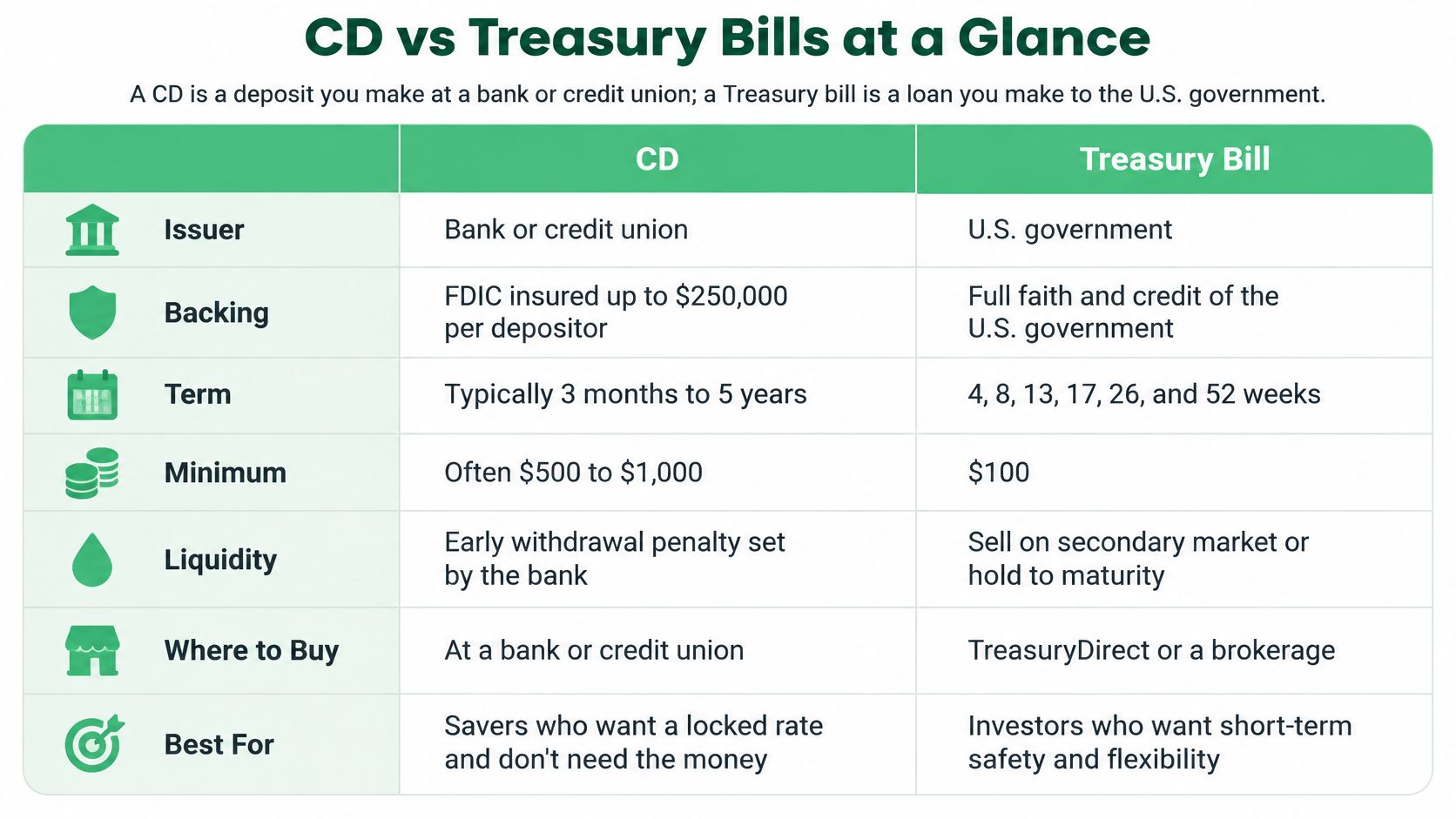
CD vs Treasury Bills at a Glance
A CD is a deposit you make at a bank or credit union. A Treasury bill is a loan you make to the U.S. government.
CD and Treasury bill at a glance
| Feature | Certificate of deposit (CD) | Treasury bill (T-bill) |
|---|---|---|
| Who issues it | FDIC-insured bank or NCUA-insured credit union | U.S. Department of the Treasury |
| Federal protection | Bank CDs are insured up to $250,000 per depositor, per bank, per ownership category; credit unions have analogous NCUA coverage | Not FDIC-insured; backed by the full faith and credit of the U.S. government |
| Typical terms | A few months to several years | 4, 6, 8, 13, 17, 26, or 52 weeks |
| State income tax on interest | Generally taxable | Exempt from state and local income tax |
| Early access | Bank-set early-withdrawal penalty; some market-linked CDs prohibit early redemption | Sell before maturity at the market price |
| Minimum purchase | Set by each bank | $100 at TreasuryDirect, in $100 increments |
| Rate quoted as | Annual percentage yield (APY) set by the bank | Bank-discount rate or investment yield reflecting auction or secondary-market pricing |
The FDIC's CD shopping guide explains deposit coverage, withdrawal restrictions, and the federal-versus-state tax distinction summarized above. The Treasury's daily bill-rate reference tracks the standardized bill maturities shown in the table; minimum-purchase details appear on TreasuryDirect's bill page discussed below.
The decision rule
Choose a CD when you can accept its fixed term and its rate compensates you for giving up flexibility. Choose a Treasury bill when the state-tax exemption, direct government backing, or short maturity matters more than keeping everything at your bank.
Pull the actual quotes before deciding. Pick the CD and bill you're considering, record their maturity dates, and save the withdrawal terms alongside the rates. A comparison between an available offer and a vague memory of a better rate isn't much use.
How Each One Pays You and Why Quotes Differ
A CD's APY describes its annual return with the stated compounding assumptions. The contract tells you when interest compounds, when you receive it, and whether taking interest out changes what you'll earn.
A Treasury bill has no periodic coupon payment. Typically, you buy it below face value and receive face value at maturity; the difference is your interest.
Follow the dollars before comparing the percentages
Consider a hypothetical $1,000 bill purchased for $980, maturing in 26 weeks, or 182 days. Your gain is $20.
Its simple annualized investment yield on a purchase-price basis is:
($20 ÷ $980) × (365 ÷ 182) ≈ 4.09%
That calculation is illustrative, not a current quote. It shows why the denominator and annualization convention matter.
The Treasury Department's rate methodology distinguishes the bank-discount convention, which uses face value and a 360-day year, from investment yield, which uses purchase price and a 365- or 366-day year. Using the hypothetical bill's face value produces a lower headline percentage even though the dollars you receive haven't changed.
Comparison rule: Match the holding period, then put both returns on the same annual basis. A bill's discount rate and a CD's APY aren't interchangeable.
For an exact comparison, calculate each product's dollars earned through the same date. If you want annual percentages, convert both to an equivalent effective annual yield rather than assuming that a simple annualized investment yield includes compounding.

Match the investment to the spending date
A longer CD may offer a useful rate lock, but that doesn't make it a fair substitute for a bill maturing before your next property-tax payment. Start with the date the money must become spendable, then compare qualifying investments.
Also account for reinvestment risk. When a bill matures, you can reinvest only at the rate available then. A fixed-rate CD preserves its contracted rate for its term, subject to any call provision allowing the issuer to redeem it early.
Your reference points are therefore the bill's investment yield and the CD's APY, plus their actual maturity proceeds. Don't assume repeated short-term bill purchases will reproduce the first purchase's yield.
Safety Comes Down to Who Stands Behind Your Money
Calling a Treasury bill automatically safer than an insured CD skips an important distinction. For a saver holding a plain deposit within insurance limits, the meaningful question is what protection applies and what could cause a loss.
The FDIC's deposit-insurance explanation sets coverage at $250,000 per depositor, per insured bank, per ownership category, including principal and accrued interest through the date of a bank failure. It also explains that Treasury securities aren't FDIC-insured, but are backed by the full faith and credit of the United States government.
Leave room for interest
Say you divide $500,000 between two separately insured banks in single-owner accounts. That can place the principal within the standard coverage limits described by the FDIC, assuming you have no other deposits counted in those same categories.
But filling each bank to the limit leaves no room for accrued interest. Keep a cushion, and include checking, savings, and other CDs when you total deposits at the same institution.
A Treasury bill creates no FDIC-insurance claim because you own government debt rather than a bank deposit. Its backing doesn't guarantee the price you'll receive if you sell before maturity.
Read beyond the CD label
The FDIC's deposit-insurance guidance explains that qualifying insured deposits must have principal guaranteed by the issuing bank. A product whose principal can decline for reasons other than an early-withdrawal penalty may not qualify as a traditional insured deposit.
That deserves attention with market-linked or indexed offerings. Don't assume that every product labeled CD has identical principal protection, insurance eligibility, or redemption rights. Some contracts restrict early withdrawal, and their return formulas can be more complicated than a fixed bank rate.
Before buying, make these checks:
- Confirm insurance status. Verify that the issuing bank is FDIC-insured, or that the credit union has applicable NCUA coverage.
- Read the principal guarantee. Identify exactly what the issuer promises at maturity and what happens if you exit early.
- Total your deposits. Group accounts by institution and ownership category, including accrued interest.
For capital-preservation money, complicated terms need a compelling benefit. A familiar label doesn't replace reading the contract.
Rate Snapshot and How to Check Today's Numbers
FDIC average CD rates vs. Treasury yields, Sept. 16, 2024. Source: FDIC national rates table for September 2024.
| CD term | FDIC average CD rate, Sept. 16, 2024 | Treasury yield, same date |
|---|---|---|
| 1 month | 0.24% | 5.41% |
| 3 months | 1.55% | 5.21% |
| 6 months | 1.81% | 4.89% |
| 12 months | 1.88% | 4.38% |
Treasury yields were substantially higher than national average CD rates in this dated snapshot. Treat historical yields as reference points, then get dated offers for both products before deciding. A bank's promotional or brokered CD rate can differ sharply from the national average.
Compare an available offer, not an average
Use current quotes to compare yields on the same basis and check the terms behind each one:
- Treasury bills: Check the Treasury's daily bill-rate table for short-term yields. The daily par yield curve offers broader context, but a specific bill quote is more useful for a purchase decision.
- CDs: Check the FDIC's national rates and rate caps page for market context, then get the issuing bank's actual rate.
- Purchase details: Record the maturity date, purchase price, yield convention, withdrawal provisions, and any transaction costs shown by your purchase channel.
TreasuryDirect sells bills directly, and brokerages offer another purchase route. CDs are available directly from banks or through brokerages. A brokered CD may have different terms from a deposit opened directly with a bank, so check its early-exit provisions before buying.
Build around your calendar
A ladder staggers maturity dates, creating recurring opportunities to access cash without selling the full balance. For scheduled expenses, choose monthly or quarterly maturities that match when you expect to need the money. Each rollover gets the rate available at that time, so keep immediate spending money outside the ladder.
Nominal income is only part of preserving savings. This guide to protecting savings from inflation explains why purchasing power also belongs in the decision.
After-Tax Math With a Worked Example You Can Redo
For a taxable account, use this simplified formula after putting both quotes on a comparable yield basis:
Break-even CD yield = Treasury bill yield × (1 − federal rate) ÷ (1 − federal rate − state rate)
The formula assumes interest faces the stated marginal rates, with no interaction between the federal and state calculations. It estimates the CD yield needed to leave you with the same after-tax income.
A dollar example
The Federal Reserve Bank of St. Louis FRED release reported a 4.24% three-month Treasury-bill secondary-market yield on December 27, 2024. That historical quote supplies the reference rate below, not a current offer or a promise about future reinvestment.
Assume, purely for this calculation, that $20,000 earns a simple annual return at the chosen rate for a full year. Use illustrative marginal tax rates of 24% federal and 9.3% state.
| Calculation | Hypothetical CD at 4.83% | Hypothetical bill return at 4.24% |
|---|---|---|
| Gross annual interest | $966.00 | $848.00 |
| Federal tax at 24% | $231.84 | $203.52 |
| State tax at 9.3% | $89.84 | $0 |
| After-tax interest | $644.32 | $644.48 |
The results are nearly identical because the CD's higher gross income pays the additional state tax. The slight difference comes from rounding the break-even CD rate.
Important caveat: A three-month bill doesn't lock in a full year's income. This annualized illustration assumes an unchanged return and ignores compounding; an actual purchase comparison should use matching holding periods and maturity proceeds.
Your break-even reference
Break-even CD yields against a 4.24% T-bill (Dec. 27, 2024)
The following figures are calculated examples using the formula, with the CD yield rounded to the nearest hundredth of a percentage point.
| Federal bracket | State tax rate | CD yield needed to match a 4.24% T-bill |
|---|---|---|
| 22% | 0% | 4.24% |
| 22% | 5% | 4.53% |
| 24% | 6% | 4.60% |
| 24% | 9.3% | 4.83% |
| 32% | 9.3% | 4.91% |
A CD's higher advertised yield can disappear on your state tax return. Calculate the dollars you keep before rewarding the larger percentage.
With no state income tax, this simplified model gives neither investment a tax advantage over the other. As the applicable state rate rises, the CD must pay more to tie.
The model ignores the federal deduction for state taxes, the net investment income tax, the alternative minimum tax, and income-related benefit effects. These state rates are examples, not a determination of your liability; include applicable local tax when relevant.
Confirm your federal marginal bracket using the current IRS tax tables for your tax year, then substitute live investment quotes. If your tax situation involves deductions, income thresholds, or multiple states, have your tax preparer check the comparison rather than treating the shortcut as a completed tax return.
Liquidity and Early Exit Costs Most Comparisons Skip
A CD's withdrawal penalty can erase the advantage that persuaded you to buy it. Price the likely early exit before committing, especially when the money might pay for a home repair or an unexpected medical expense.
Suppose a hypothetical CD contract charges a penalty equal to a stated period of interest. Calculate that dollar penalty, subtract it from the interest you'll have earned by your likely withdrawal date, and check whether the contract permits the penalty to reduce principal.
Put a price on both exits
For illustration, assume a $10,000 CD, a 4% simple annual rate, and a penalty equal to three months of interest. The penalty would be approximately $100, even if you hadn't yet earned that much; the actual contract determines the calculation and whether principal can be affected.
Now consider a hypothetical $10,000, 26-week Treasury bill sold at week 12, leaving 14 weeks. If market yields rise by half a percentage point, a rough short-duration estimate of the price effect is:
$10,000 × 0.005 × (14 ÷ 52) ≈ $13.46
That estimates a price decline of roughly $13 to $14 relative to an unchanged-yield valuation. It doesn't mean your total return since purchase is necessarily negative, and it excludes bid-ask spreads, fees, and the exact discounting calculation.
TreasuryDirect's bill guide explains that bills can be sold before maturity, but the proceeds reflect market pricing. If you hold through TreasuryDirect, verify the transfer and sale process before counting on early access; marketability doesn't mean instant cash in your checking account.
Choose the risk you can tolerate
A conventional CD penalty is a contractual cost you can calculate. A bill's sale price depends on market conditions, with shorter remaining maturities generally limiting sensitivity to yield changes.
- List possible spending dates. Include both the planned date and a plausible earlier need.
- Calculate net proceeds. Use the CD's actual penalty and a reasonable adverse-yield scenario for the bill.
- Check execution. Know how you would request redemption or arrange a sale.
Our guide on how to invest in CDs can help you examine the contract details. Choose the outcome you can live with, rather than assuming early access will be painless.
Interest, Social Security, and Medicare
Settle the account type before using the tax comparison. Inside a traditional IRA or another tax-deferred account, the account's tax rules govern; a bill's state-tax exemption doesn't provide the same immediate benefit it provides in a taxable account.
For taxable holdings, both products generate federally taxable interest. Treasury interest's state exemption doesn't remove that income from federal calculations.
Check the retirement-income effects
Interest can affect how much of your Social Security benefit becomes taxable. It can also count toward the income Medicare uses to determine an Income-Related Monthly Adjustment Amount, an additional premium for higher-income beneficiaries.
A CD that barely wins the simplified break-even calculation could produce a worse overall result if its additional gross interest changes either calculation. Neither product offers a blanket exemption from those federal income measures.
Use this check before committing:
- Identify the account. Separate taxable savings from tax-deferred retirement money.
- Recalculate the return. Apply your own marginal rates to taxable holdings.
- Add the interest to projected income. Check potential Social Security taxation and Medicare premium effects.
- Use current official guidance. Read the SSA's benefit-taxation pages and CMS's Medicare premium pages for the applicable year.
Our guide to when to take Social Security adds context for coordinating retirement income. Don't carry a historical investment yield into a future-year income plan without updating it.
Which Product Fits and What to Check
After-tax income and your spending date should decide the purchase. I'd check Treasury bills first for short-term taxable savings when you pay state income tax, including in the illustrative higher federal brackets. A CD earns the recommendation when its locked rate clears your break-even and its restrictions fit your plans.
| Your situation | Likely better fit | Check before you buy |
|---|---|---|
| Cash you may need within a few months | Short T-bill or savings account | Market price if you sell a bill early |
| Fixed sum you won't touch for one to two years | CD, if its rate clears your break-even | Size of the early-withdrawal penalty |
| Balance above $250,000 at one bank | Split across banks, or part in T-bills | Ownership categories and insurance per bank |
| Want cash arriving on a schedule | Ladder of bills or CDs with staggered maturities | Reinvestment rate at each rollover |
Apply the decision
For a hypothetical $50,000 taxable balance, using the earlier 24% federal and 9.3% state assumptions, the historical 4.24% bill benchmark requires a CD yield of approximately 4.83% to tie under the simplified model.
For a hypothetical $300,000 single-owner deposit balance at one bank, with no other ownership-category protection, $50,000 exceeds the standard insurance limit. Move the excess to another insured institution or consider bills, while leaving room for accrued interest.
Before buying:
- Write your cash-needed date.
- Obtain and date matching CD and bill quotes.
- Normalize their yield conventions.
- Apply your federal and state tax assumptions.
- Price an early exit and accept only a tolerable result.
Repeat the comparison on purchase day. Historical rates belong in examples, not purchase orders.
Get more posts like this
One short, useful email each Friday. Free, no spam, unsubscribe anytime.