How Do Social Security Survivor Benefits Work in 2026
Wondering how do social security survivor benefits work? Get 2026 eligibility rules, benefit math, claiming ages, tax limits and an application checklist.

Daniel Anderson
Editor, The Money Maniac
November 26, 2026
17 min read

You're sitting at the kitchen table with a stack of folders you never wanted to build. There's a deed to the house, two IRA statements, a life insurance policy, and a Social Security statement with your spouse's lifetime earnings printed down the middle. Somewhere between paying the utility bill and answering calls from relatives, a practical question forces its way to the front of your mind: how do Social Security survivor benefits work, and what does that monthly check look like after the dust settles?
Most guides hand you an eligibility checklist and call it a day. That's only half the puzzle. For a household in its 50s or 60s with a mortgage, meaningful savings, or a spouse still bringing home a paycheck, survivor benefits aren't a simple yes-or-no checkbox. They're a cash-flow decision for every person in the house, shaped by which of two benefits you start first, how work earnings or a family cap reshape the check, and how much you keep once the IRS takes its cut.
Getting the sequence right can add tens of thousands of dollars over a twenty-year retirement. Getting it wrong rarely triggers a warning bell from the agency. Let's walk through the rules one clean layer at a time so you can run your own numbers before making a single irreversible phone call.
Who Qualifies and What Each Person Receives
Social Security survivor benefits pay eligible family members from the deceased worker's earnings record, and the share depends on who the survivor is and when they claim.
| Recipient | Share of worker's basic benefit | Key condition | Claiming age or timing |
|---|---|---|---|
| Surviving spouse at survivor full retirement age | 100% | Born 1962 or later, so survivor full retirement age is 67 | Age 67 or older |
| Surviving spouse claiming early | 71.5% at age 60, rising toward 99% | No disability, claims before survivor full retirement age | Age 60 up to 67 |
| Surviving spouse with a disability | 71.5% | A qualifying disability | Age 50 and older |
| Surviving spouse caring for the worker's child | 75% | Child is under 16 or disabled | Any age while caregiving continues |
| Eligible child | 75% | Under 18, 18 to 19 in full-time K-12 school, or disabled before 22 | Until the condition ends |
| Divorced surviving spouse | Same shares as a surviving spouse | Married 10 years or more and not remarried before 60 | Age 60 or older |
| Dependent parent | Set by SSA based on number of qualifying parents | Age 62 or older and at least half supported by the worker | Age 62 and older |
Surviving Spouses and Caregivers
The top row of that table is the anchor for every spouse's decision. Wait until survivor full retirement age, which is 67 for anyone born in 1962 or later, and you can collect 100% of the deceased worker's basic benefit. Start earlier at age 60, and the rate drops to 71.5%, climbing steadily toward 99% for every month you hold off before 67.
Disability shifts that calendar forward by a full decade. A surviving spouse who meets Social Security's strict disability definition can begin collecting at age 50 at the 71.5% rate. If you're raising the deceased worker's child who is younger than 16 or has a qualifying disability, age requirements disappear altogether, and you can receive 75% as a caregiver while that care continues.
Children, Former Spouses, and Dependent Parents
Eligible unmarried children generally receive 75% of the basic benefit until age 18, or through age 19 if they're still enrolled full time in elementary or secondary school. An adult child whose disability began before age 22 can also qualify on that same parent's record, which becomes a critical lifeline for families caring for a disabled adult son or daughter.
Former spouses often assume divorce severed every tie to Social Security, which can be a costly mistake. If your marriage lasted at least 10 years and you stayed unmarried until at least age 60 (or age 50 if disabled), you qualify for the exact same benefit shares as a current widow or widower, even if your former spouse remarried. Dependent parents age 62 or older can also collect on an adult child's record if the deceased worker provided at least half of their financial support.
The program reaches far more households than is commonly realized. According to the Social Security Administration's December 2025 statistical snapshot, roughly 5.846 million survivor beneficiaries, representing 8.3% of all Social Security beneficiaries, collected about $9.477 billion that month, with an average monthly payment of $1,620.95.
When a worker's death stems from an accident or negligence rather than illness, families sometimes juggle civil legal filings alongside federal benefit claims. Those two tracks stay legally separate, and resources that help families understand wrongful death claim elements from Lawyer in Martin County can clarify how a civil recovery operates alongside Social Security without replacing it.
Keep one major caveat pinned to the top of your notepad as you read those percentages. Every percentage in the table applies to the worker's basic benefit, and when multiple family members claim on one record at the same time, Social Security's household ceiling can shave down the combined monthly payout.
How the Check Is Built From the Worker's Record
Social Security survivor benefits are federal insurance funded through payroll taxes and calculated from the deceased worker's covered earnings record. They aren't a private savings pot your spouse left in a vault, and there's no lump-sum account balance for the family to withdraw. Congress built the program that way through the Social Security Amendments of 1939, signed on August 10, 1939, with the first monthly survivor checks going out on January 1, 1940, and by 2025 the agency still paid 5,785,602 survivor beneficiaries under that core insurance design.
Homeowners insurance offers a useful comparison. You pay premiums every year so the insurer covers a catastrophic loss if a kitchen fire takes out the roof, yet you can't call the insurer after thirty claim-free years and ask for a refund of your premiums or the deed to a second house. Social Security's survivor program works on the same pooling principle: payroll taxes buy income protection for eligible dependents if a covered worker dies, provided the worker earned enough Social Security credits (with younger workers needing fewer credits to be insured).
Four Steps From Earnings Record to Monthly Check
Once you accept that the agency uses an insurance formula rather than an account ledger, the math becomes straightforward. Follow this four-step chain from your spouse's work history to the dollar amount deposited into your checking account:
- Locate the worker's Primary Insurance Amount (PIA). The Primary Insurance Amount is the monthly retirement check your spouse would have received at their own full retirement age. According to the SSA Survivors Benefits publication, survivor benefits stem directly from that PIA rather than from the surviving spouse's own work record or tax contributions. Grab your spouse's most recent Social Security statement to get a realistic starting estimate.
- Multiply the PIA by your category and age percentage. For a surviving spouse born in 1962 or later, survivor full retirement age sits at 67, which provides 100% of the basic benefit. Claiming between age 60 and 67 trims that percentage to roughly 71% to 99%, rising with every month you wait, while a child or caregiving spouse sits at 75%.
- Check whether your spouse already claimed early retirement. Here is the trap that catches retired couples off guard. If your spouse started collecting their own Social Security retirement check early at age 62, the agency generally bases your survivor benefit on that reduced check rather than the full PIA. One early claiming decision by the higher-earning spouse can permanently lower the surviving spouse's monthly income for decades.
- Apply the family maximum cap. If you're the only person claiming on your spouse's record, skip this step. When a spouse and one or more children claim together, Social Security enforces a family maximum, typically ranging between 150% and 180% of the worker's full benefit. If the family's combined unreduced shares exceed that ceiling, SSA reduces each person's payment proportionally until the total fits under the cap.
Every twelve months you wait between age 60 and age 67 lifts your permanent monthly survivor check. Before you commit to a date, ask Social Security for an official written estimate rather than trusting a generic rule of thumb.
Because the worker's earlier claiming choices and the family maximum formula both interact with exact birth dates and earnings histories, back-of-the-envelope percentages give you a solid starting range, while SSA's calculation gives you the exact dollar figure you can budget around.
When to Claim and What Work, Taxes and Remarriage Do to the Check
Anyone who hands you one magic claiming age for survivor benefits hasn't looked at your tax return or your monthly bills. A 61-year-old widower earning $75,000 a year at a full-time job, a 60-year-old retiree trying to avoid selling stocks during a rough market year, and a 54-year-old parent raising a teenager each face a totally different cash-flow math problem. Three rules reshape what hits your bank account: the earnings test, federal income taxes, and remarriage.
How a Paycheck Affects Your Check
You're allowed to work while collecting survivor benefits, though working before your full retirement age triggers the retirement earnings test. Under the Social Security Administration's survivor benefit amount guidelines, the 2026 annual earnings-test limit for people below full retirement age is $24,480, and SSA withholds benefits when your wages or net self-employment income go above that line.
For people under full retirement age for the entire year, the standard withholding formula holds back $1 in benefits for every $2 earned above the limit. Let's run that arithmetic right here so there's zero guesswork:
- Annual wages earned: Say you take a part-time consulting job paying $30,000 in 2026.
- Amount above the 2026 limit: Subtract $24,480 from $30,000, which leaves $5,520 over the threshold.
- Estimated benefit withheld: Divide $5,520 by 2, and SSA withholds roughly $2,760 of your survivor checks during the year.
Two nuances make that rule far less scary than it first appears. First, withheld benefits aren't automatically gone forever; SSA policy allows your age-based monthly payment to be recalculated upward once you reach full retirement age to credit you for the months your checks were withheld. Second, the SSA planner for working while receiving benefits confirms that your wages reduce only your own survivor payment, never the checks paid to eligible children on the same record.
Watch one quirky calendar detail tucked inside those rules. Even when your survivor full retirement age differs from your retirement full retirement age, SSA uses your retirement full retirement age to decide when the earnings test stops applying. If you're weighing whether to keep earning a paycheck alongside early benefits, walking through how part-time work interacts with early Social Security claiming can help you map out your net monthly income before you give notice at work.
Federal Taxes and Remarriage Rules
Even after Social Security deposits the check, the IRS gets a look at your total household income. Federal taxation of Social Security depends on combined income, which equals your adjusted gross income, plus nontaxable interest (such as municipal bond interest), plus half of your annual Social Security benefits.
| Filing status | Combined income | Share of benefits taxable |
|---|---|---|
| Single | Below $25,000 | None |
| Single | $25,000 to $34,000 | Up to 50% |
| Single | Above $34,000 | Up to 85% |
| Married filing jointly | Below $32,000 | None |
| Married filing jointly | $32,000 to $44,000 | Up to 50% |
| Married filing jointly | Above $44,000 | Up to 85% |
Those statutory thresholds haven't been indexed for inflation since Congress wrote them decades ago. For homeowners in their 60s drawing modest IRA distributions, pensions, or dividend income, crossing $34,000 as a single filer happens faster than expected. Check IRS Publication 915 for the exact federal worksheet, and verify your own state's tax rules separately, since a handful of states still tax a portion of Social Security while most exempt it entirely.
Cash-flow reality check: The gross check printed on your SSA award letter isn't your spendable income. Run your combined income estimate and check your state's tax rules before deciding whether to claim early or tap taxable savings first.
Finally, keep the remarriage rule in mind if love shows up again later in life. Under SSA's eligibility requirements, remarrying before age 60 (or before age 50 if you have a qualifying disability) generally ends your right to collect survivor benefits on your late spouse's record. Wait until age 60 or later to tie the knot, and your survivor eligibility stays completely intact, which might be the most unromantic wedding-date rule in federal law.
Your Own Retirement Benefit and the Survivor Benefit
If you spent thirty years paying into Social Security yourself, you've probably already asked the million-dollar question: do you collect both your own retirement check and your late spouse's survivor check?
No. Social Security doesn't stack two full monthly benefits on top of each other. Instead, the agency pays your own earned retirement benefit first, then adds a top-up equal to the difference if the survivor benefit is larger. In an illustrative example where your own full retirement benefit is $1,600 a month and your survivor benefit is $2,000 a month, Social Security sends you $2,000 total, not $3,600.
Why Claiming Order Changes Your Lifetime Payout
Here is where survivor benefits stand apart from regular spousal benefits, and where careful timing puts real money back in your pocket. Regular retirement and spousal claims fall under the deemed-filing rule, which forces you to claim both benefits at the same time. Survivor benefits are generally exempt from deemed filing.
That exemption lets a surviving spouse split the two clocks and run them in sequence. You can choose between two distinct switching paths:
- Start the survivor benefit first, delay your own retirement benefit until 70. Using that same illustrative pair of checks, suppose your own retirement benefit is $1,600 at age 67 and the survivor benefit is $2,000. Waiting three extra years past 67 earns roughly 8% per year in delayed retirement credits on your own record, pushing that $1,600 check up to about $1,984 at age 70. If your own benefit started slightly higher, say $1,700 at 67, delaying to 70 would lift it past $2,100, beating the $2,000 survivor benefit permanently.
- Start your own retirement benefit early, then switch to the full survivor benefit later. Suppose your own benefit will never beat your late spouse's check, even at age 70. You could claim a reduced own-record check at age 62 to cover bills, then switch over to 100% of the survivor benefit once you reach survivor full retirement age at 67.
Notice the asymmetry baked into those two clocks. Your own retirement benefit keeps growing by delayed retirement credits all the way to age 70, while a survivor benefit stops growing once you reach survivor full retirement age. Leaving a survivor check unclaimed from 67 to 70 buys you zero extra dollars per month.
One caution before you commit to either path: claiming your own retirement benefit early permanently reduces that own-record payment if you ever end up relying on it later. Because the optimal switching order hinges on exact benefit amounts, health, and cash needs, reviewing a broader framework on when to take Social Security benefits and asking SSA to confirm both scenarios in writing protects you from leaving decades of higher monthly income on the table.
A Worked Example With Numbers You Can Check
Abstract percentages blur together fast, so let's test the math on one hypothetical household. Everything below is a teaching illustration using clean round numbers so you can check every line on a pocket calculator.
Assume a deceased worker had a Primary Insurance Amount (PIA) of $2,000 per month and had not yet claimed early retirement before passing away. The surviving spouse was born in 1962 or later, putting survivor full retirement age at 67.
Under Path One, the surviving spouse claims immediately at age 60. At 71.5% of the $2,000 PIA, the monthly check comes out to $1,430. Over the 84 months between age 60 and age 67, those early checks put $120,120 ($1,430 multiplied by 84) into the household's bank account before Path Two has paid a dime.
Under Path Two, the surviving spouse waits until age 67 to claim 100% of the PIA, receiving $2,000 per month. Waiting produces a monthly gain of $570 ($2,000 minus $1,430). To see how long it takes for that extra $570 per month to catch up to the $120,120 head start, divide $120,120 by $570: you get roughly 211 months, or about 17.5 years past age 67. That places the simplified break-even point around age 84 to 85.
Every clean break-even calculation relies on simplifying assumptions, so label them plainly before making decisions off that number. This math ignores annual cost-of-living adjustments (which apply to a larger base if you wait), skips federal and state taxes, and assumes you spend rather than invest the early checks.
| Claiming path | What changes |
|---|---|
| Claim at age 60 | $1,430 per month (71.5% of PIA), totaling $120,120 across 84 monthly checks before age 67 |
| Claim at age 67 | $2,000 per month (100% of PIA), full basic benefit for life, before tax |
| Monthly difference | $570 per month; waiting adds this much every month starting at age 67 |
| Simplified break-even | Roughly 211 months after age 67 (age 84 to 85); ignores cost-of-living adjustments, taxes, and the family cap |
| Household with two children under 18 | $4,430 unreduced ($4,500 if children are under 16), capped at an assumed 180% family maximum of $3,600; the real cap comes from SSA's formula, not this assumption |
What Happens When Children Claim on the Same Record
Now add two eligible children to that exact same $2,000 PIA household and watch the family maximum step in. Each eligible child qualifies for 75% of the PIA, or $1,500 per month apiece, totaling $3,000 for the two kids.
In our first family pass, assume both children are 16 or 17 (still under 18, though past the age-16 caregiver cutoff) and the surviving spouse claims the age-60 survivor benefit of $1,430. Add them up and you get $4,430 in unreduced monthly benefits. If we assume a 180% family maximum ($3,600 on a $2,000 PIA), the agency trims the family's combined monthly payout down to $3,600 total. Remember that SSA computes the actual cap using its official formula, so treat $3,600 as a teaching model rather than a guarantee.
In a second pass, assume both children are younger than 16. Now the surviving spouse qualifies as a caregiver at 75% of PIA ($1,500 per month) rather than the reduced age-60 rate ($1,430). The unreduced household sum rises to $4,500 ($1,500 x 3), yet that same assumed 180% family maximum still caps total household payouts at $3,600.
Caregiver cutoff to watch: The 75% caregiving benefit for a surviving spouse stops the month the youngest qualifying child turns 16. At that point, the spouse switches to their own age-based survivor benefit, which carries an early-claiming reduction if claimed before age 67.
Seeing these numbers on paper usually clarifies a bigger planning question. If you're healthy and expect to live into your late 80s or 90s, waiting for the higher monthly base acts like inflation-adjusted longevity insurance. If taking $1,430 at 60 lets you avoid draining retirement accounts early, weaving survivor benefits into your broader sources of retirement income gives you cash-flow breathing room right when you need it most.
Confirm Eligibility and Start Your Application
Unlike standard retirement benefits, you can't file a survivor benefit application through an online form. You'll need to schedule an appointment by calling Social Security's toll-free number or visiting a local office. Having your paperwork stacked and ready before you dial saves weeks of back-and-forth delays.
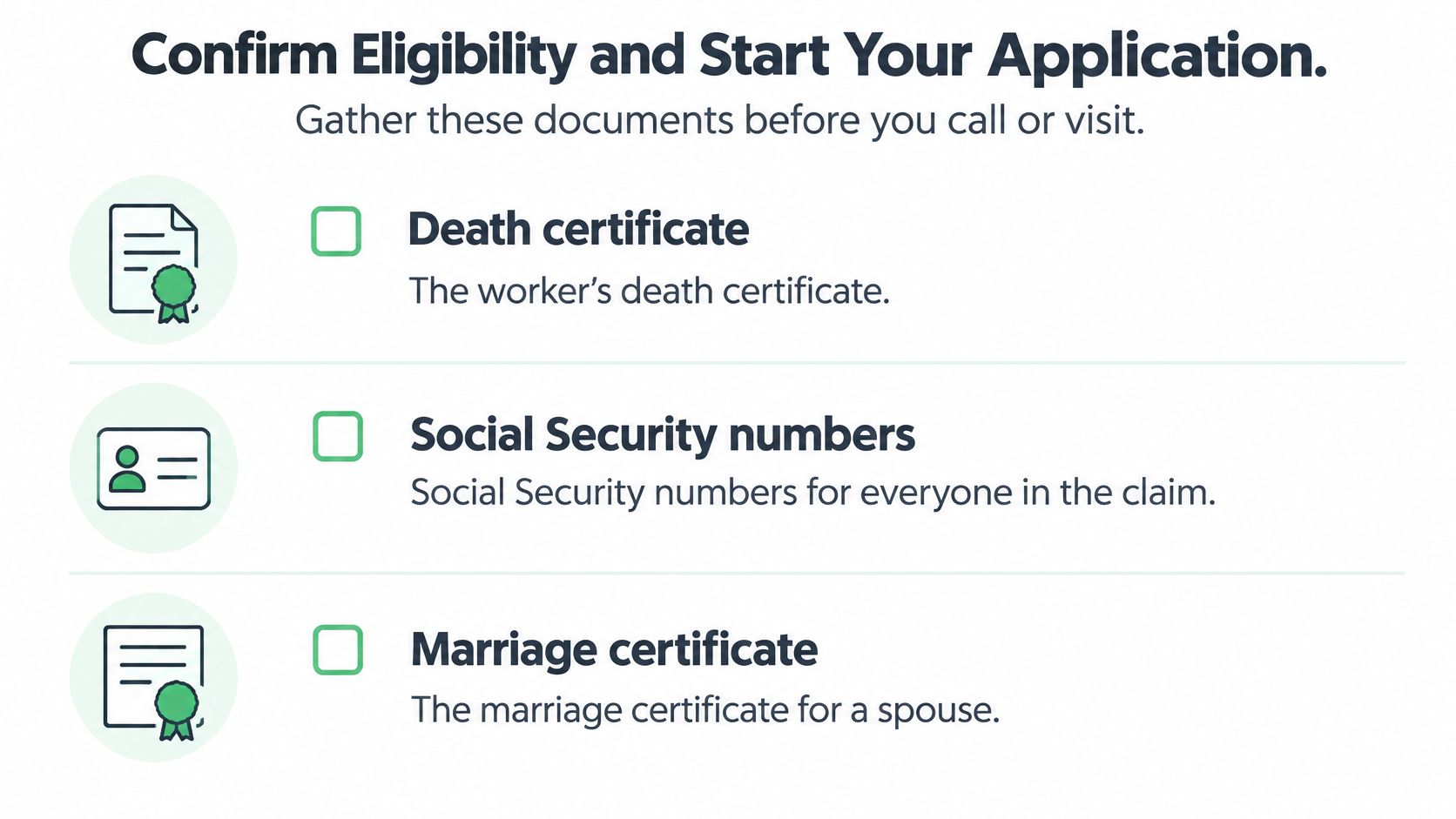
Paperwork to Pull Together Before You Call
Gather original or certified copies where required, since Social Security rarely accepts plain photocopies for vital records:
- Proof of death: The worker's official death certificate (funeral homes often report the death to SSA, though bringing your own certified copy avoids hiccups).
- Social Security numbers: Numbers for the deceased worker and for every surviving spouse, child, or dependent parent included in the claim.
- Relationship documents: Your certified marriage certificate for a spouse claim, or a divorce decree showing at least 10 years of marriage if claiming as a divorced surviving spouse.
- Children's records: Birth certificates for eligible children, plus proof of full-time enrollment in elementary or secondary school for any child aged 18 to 19.
- Recent earnings records: Your spouse's most recent W-2 forms or federal tax return, or self-employment tax filings if your spouse ran a business.
- Direct deposit details: Your bank's routing number and checking or savings account number so approved payments deposit electronically.
While you're on that first call, ask specifically about the one-time $255 lump-sum death payment. According to the Social Security Administration's guidance on survivor benefits, a qualifying spouse or eligible child may receive that $255 payment, though it follows SSA's strict priority rules and doesn't show up automatically in the mail. Filing directly with the agency ensures it isn't overlooked.
Three Questions to Ask SSA Before Locking In a Date
Treat your appointment as a fact-finding session before you finalize an irreversible start date. Ask the representative to put three specific answers in front of you:
- What is the written estimate across claiming ages? Request a printed or mailed breakdown showing the deceased worker's exact PIA, your monthly check if you claim today, and your check if you wait until survivor full retirement age.
- How does my own retirement record compare? Have the specialist run both switching paths side by side so you can see whether taking survivor benefits first or your own benefit first pays more over your expected lifespan.
- Am I eligible for retroactive benefits? Back payments for months prior to your application date aren't automatic. Whether SSA can pay retroactive months depends on your exact age and filing date, so ask directly before choosing an effective month.
Annual earnings limits, benefit statements, and tax brackets shift over time, so verify the current year's thresholds directly on SSA's official website before signing anything. If you work with a CPA or financial planner, bring your estimated combined income figure along with SSA's written printout so you can weigh taxes and cash flow together. Choose your claiming age only after every real number is sitting on the table in front of you.
Get more posts like this
One short, useful email each Friday. Free, no spam, unsubscribe anytime.