Paying Off Mortgage Before Retirement in 2026
Paying off mortgage before retirement comes down to after-tax interest, cash reserves, and one worked example. See which path fits.

Daniel Anderson
Editor, The Money Maniac
October 29, 2026
11 min read

A paid-off house is a comforting picture. Plenty of people in their 50s, 60s, and 70s still send a mortgage payment after the paycheck stops, and paying off a mortgage before retirement is a cash-flow and liquidity test, not a bet that stocks will beat your coupon.
Mortgage Debt Is Common at Retirement Age
The share of U.S. households headed by older adults with mortgage debt on a primary residence more than doubled, rising from 14.3% in 1992 to 33.4% in 2019, according to Congressional Research Service analysis of the Federal Reserve Survey of Consumer Finances. The same analysis found that in 2019, the median mortgage balance among those households was $86,000, and the average was $132,184.
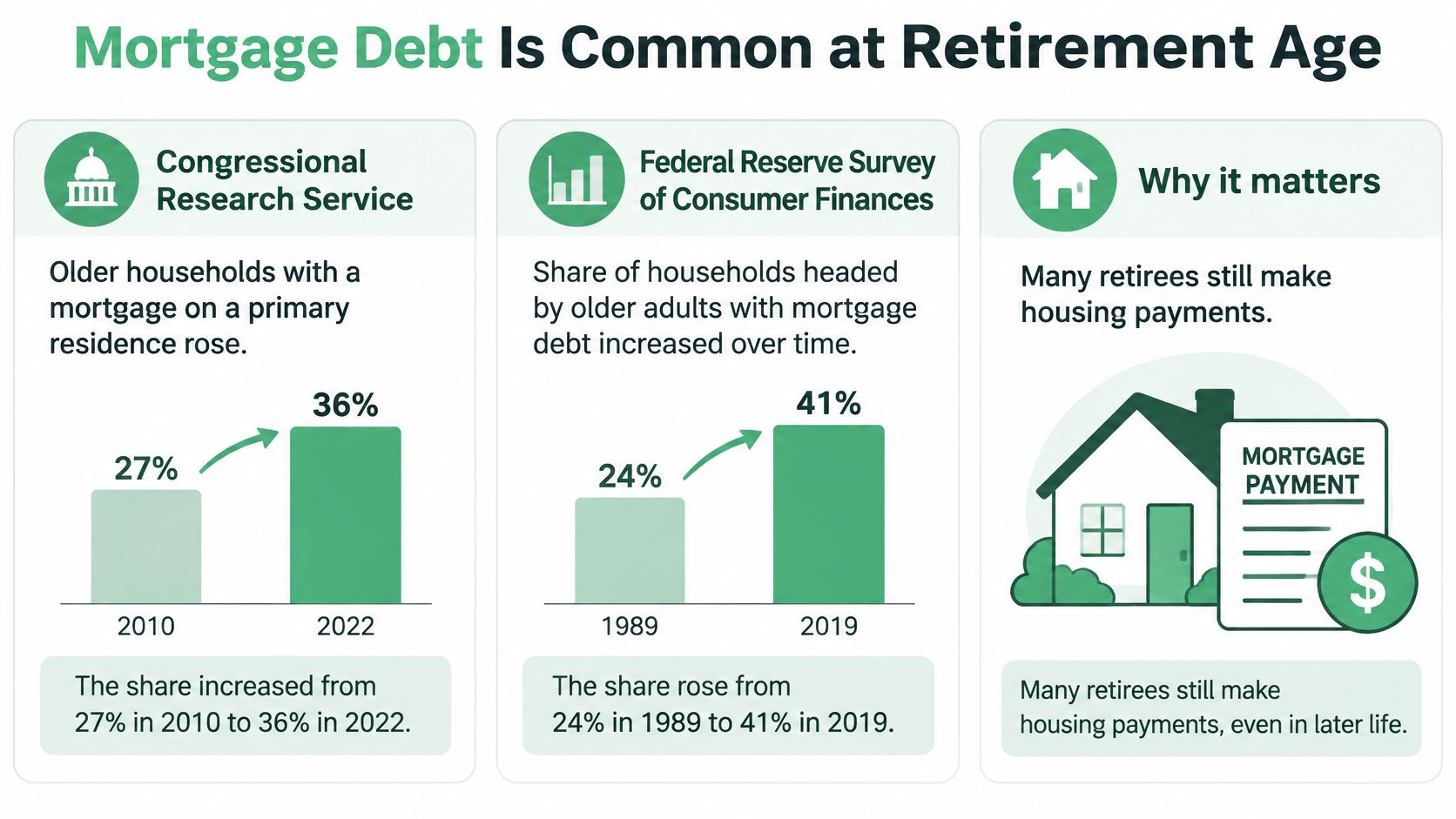
Longer working lives, later home purchases, refinancing, home-equity borrowing, and rising house prices all contribute to older households carrying housing debt. Federal Reserve figures summarized from the Survey of Consumer Finances show mortgage or home-equity debt in 47% of households ages 55–64 and 29% of households ages 65–74.
A mortgage payment raises the monthly income retirement must cover. Paying down the loan can reduce that burden, but only if enough cash remains available for repairs, health costs, and other bills. A paid-off home cannot pay those expenses.
Practical rule: Treat any rate in this article as a worksheet illustration. Check Freddie Mac's Primary Mortgage Market Survey for the current weekly average, and read your note for the rate that applies to you.
A Payoff Decision That Fits Your Numbers
Place your household in one row before you touch a formula. One lean per situation. The test is the same on every row: the guaranteed after-tax interest those dollars stop accruing has to beat a cautious after-tax return, and the path still has to leave the reserve alone.
| Situation | Lean | Main reason | Liquidity rule |
|---|---|---|---|
| High fixed rate and reserves already funded | Accelerate or pay off | Guaranteed interest saved can beat a cautious after-tax return | Leave 12 to 24 months of essentials untouched |
| Low fixed rate with years of work or a pension ahead | Keep the loan and invest extra cash | A cautious portfolio return may clear the after-tax loan cost, and that return is uncertain | Do not pull the payoff from a retirement account early |
| Thin cash, health costs, or a single income | Partial principal payment only | A full payoff can leave the household house-rich and cash-poor | Keep the reserve plus a healthcare buffer |
| Adjustable or payment-option loan near a recast | Model the new payment, then consider payoff or refinance | The bill can jump when the loan is re-amortized | Hold cash until the new payment is known |
| Itemizing with qualifying mortgage interest | Decide on the after-tax rate, not the coupon | The tax break is smaller than the headline rate for many filers | Same reserve rule as the other rows |
| Full-payoff penalty window still open | Extra principal if the note allows it, and delay the lump sum | Penalties often apply to paying off the whole balance inside about three or five years | Read the note and get a payoff quote first |
How to read a row
Read across, not down a wish list. The Lean column is the move I would make if that row matches your situation. The Liquidity rule can veto a rate that looks attractive on a napkin.
A high fixed coupon with a funded reserve is the cleanest case for sending principal. A low fixed coupon, with years of work or a pension still ahead, is the cleanest case for keeping the loan and investing the extra cash. Thin cash, medical bills, or one income means a partial principal payment, not a victory lap at the county recorder.
The row the bill can ambush
An adjustable or payment-option loan near a recast is a different animal. Consumer Financial Protection Bureau material on adjustable-rate mortgages explains that some loans recalculate payments at a recast, often after five years, and a 30-year loan recast after year five may be re-amortized over the remaining 25 years. If the balance has grown or rates have risen, the new fully amortizing payment can jump. Model that date before you celebrate today's bill.
Selling investments in a slump to cover that payment is sequence of returns risk. A smaller required withdrawal is one reason a payoff can help. It only helps if you still have cash when markets are ugly.
The table refuses two shortcuts. It does not freeze today's average mortgage rate as a lasting fact. It does not treat home equity as money that can pay a hospital bill. Each lean rests on an after-tax hurdle, and that hurdle is the next calculation.
Taxes Penalties and Bills That Remain
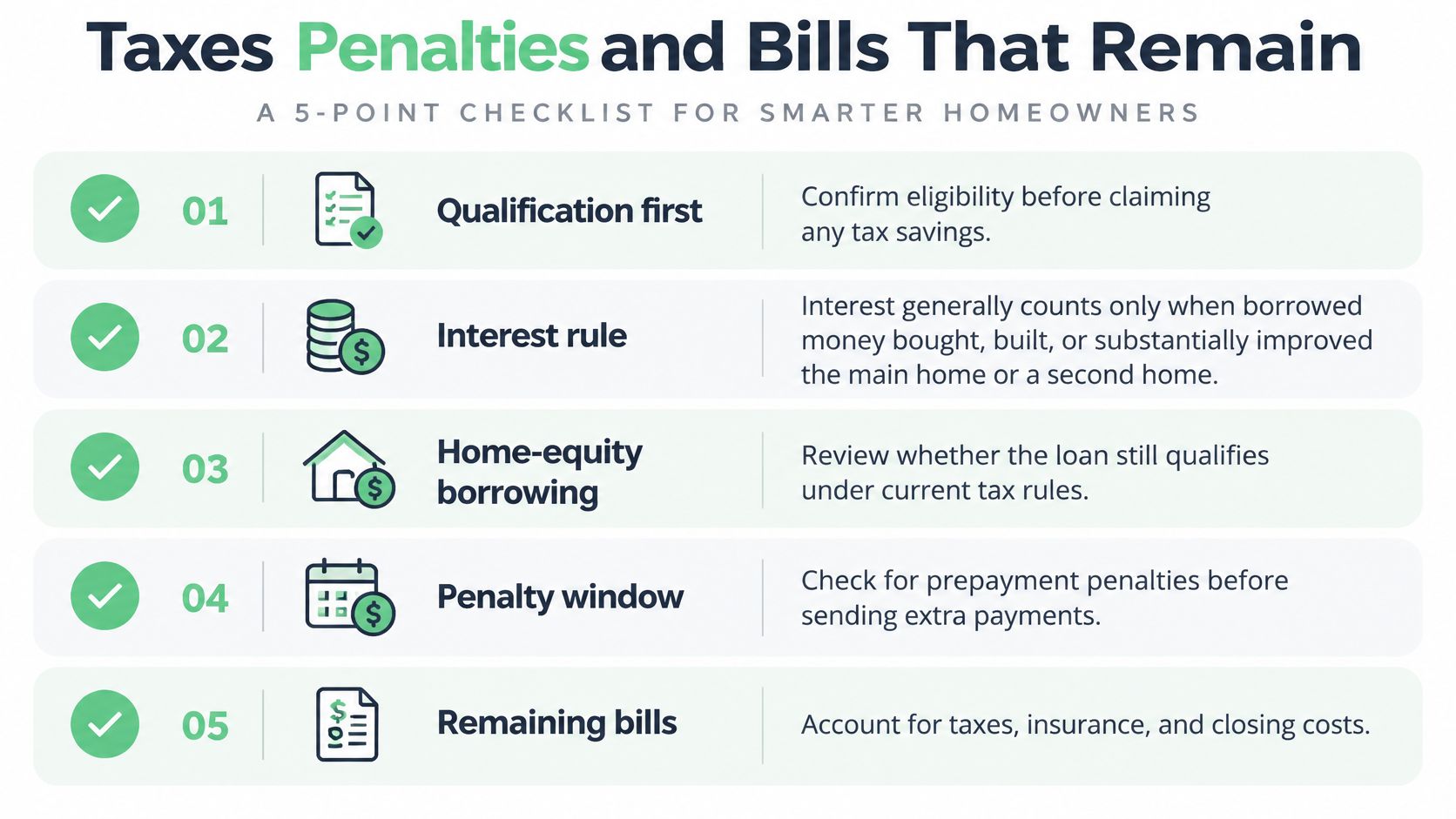
Mortgage interest reduces your tax bill only when specific conditions are met. The loan must generally have funded the purchase, construction, or substantial improvement of your main home or a second home. Interest on home-equity borrowing used for personal expenses, such as paying credit-card balances, generally does not qualify under IRS Publication 936.
Caps, then the itemizing test
For homes acquired after December 15, 2017, the deduction generally applies to interest on up to $750,000 of qualifying acquisition debt, or $375,000 for married taxpayers filing separately. Older acquisition debt generally keeps the $1 million cap, or $500,000 for separate filers, as explained in IRS Publication 936.
You also need to itemize for qualifying mortgage interest to reduce your taxable income. If your standard deduction is larger than your itemized deductions, the mortgage interest does not provide an additional deduction. Check the IRS instructions for the tax year you file.
Using retirement-account money to pay off the loan raises a separate tax question. Compare the tax treatment of traditional 401(k) and Roth accounts before withdrawing funds. A taxable withdrawal can cost more than the interest you aim to avoid.
Penalties, then the bills a zero balance still leaves
A prepayment penalty depends on your loan contract and when you pay. Under the Consumer Financial Protection Bureau's mortgage rules, penalties typically apply to paying off the entire balance, often through a sale or refinance, during a set period. Small extra principal payments generally do not trigger the fee. For a covered loan with a prepayment penalty, the lender generally must also offer an alternative covered loan without one and with a fixed annual percentage rate.
A zero balance does not zero out the cost of owning the house.
Property taxes, homeowners insurance, maintenance, and association dues remain. Before sending the payoff, confirm the official amount, the date through which interest is calculated, any penalty period, the amount of principal you can prepay each year, whether you itemize, and the housing bills that will continue.
The After-Tax Break-Even on Early Payoff
Use the mortgage's after-tax cost as the hurdle for investing money you could put toward principal. If you cannot claim a deduction for the interest, the hurdle is the loan rate. If you itemize and the interest qualifies, adjust the rate for the tax savings.
Vanguard's retirement debt guidance describes the tradeoff: paying down a fixed-rate mortgage at 6% saves 6% in nominal interest before any tax deduction. For a simple investment comparison, use a clearly labeled assumption, such as a 5% annual return before taxes and fees. That is an assumption, not a forecast, and a portfolio can lose value, especially when retirement withdrawals begin. A 401(k) or IRA withdrawal can also trigger income tax, a penalty before age 59½, or a higher marginal bracket.
A 6 percent row, then the rest of the sheet
Use 4%, 5%, 6%, and 7% as worksheet rates, not market quotes. If the interest is not deductible, the hurdle matches the mortgage rate. If you itemize and the interest qualifies, multiply the rate by one minus your marginal tax rate. At 6%, a hypothetical 22% deduction reduces the hurdle to 4.68%, or about 4.7%.
| Illustrative mortgage rate | Hurdle if no deduction applies | Hurdle if a 22 percent bracket deduction applies |
|---|---|---|
| 4% | 4% | 3.12% |
| 5% | 5% | 3.90% |
| 6% | 6% | 4.68% |
| 7% | 7% | 5.46% |
Use the deduction column only if you itemize and the interest qualifies. Include fees, capital-gains tax, and taxes on interest or dividends in the investment return you compare. Those costs reduce what you keep.
Order of operations
Work through these priorities before choosing between extra principal and investing:
- Pay high-interest or variable-rate debt first. A credit card or a loan that can reprice usually deserves attention before a fixed mortgage.
- Protect emergency savings and ongoing retirement contributions. Draining cash or stopping contributions can leave you exposed when bills arrive.
- Compare partial prepayments with investing using only the remaining dollars. The mortgage hurdle gives you a clear benchmark. Any investment assumption should be after taxes and fees, and should not put retirement cash flow at risk.
A Worked Payoff Example With Real Math
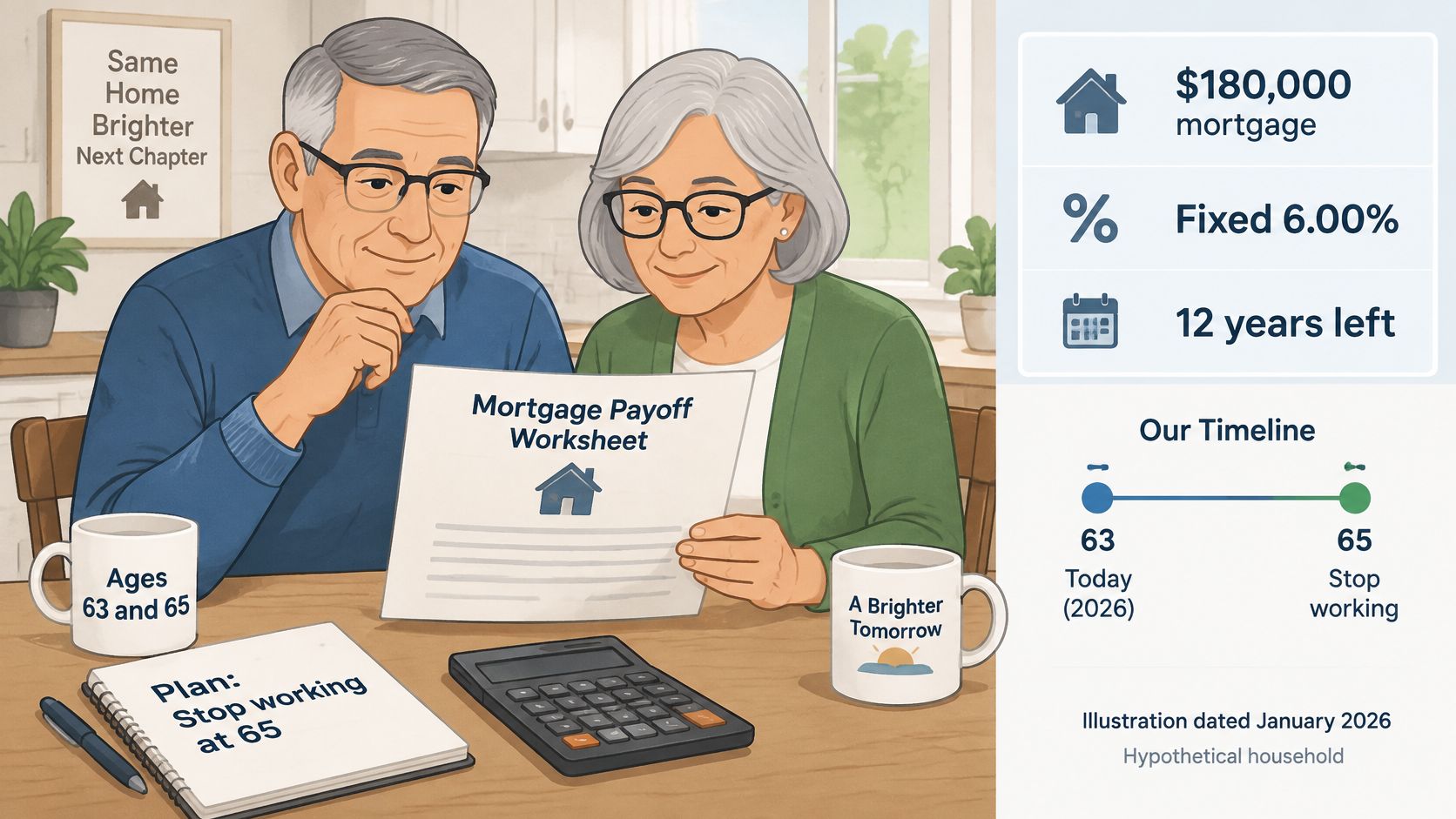
Say a hypothetical couple, both 63, plans to stop working at 65. They owe $180,000 at a fixed 6.00%, an illustration dated January 2026, with 12 years left. They take the standard deduction, so the interest saves no federal tax. Every input below is a stand-in for their payoff quote, their Social Security statement, and their pension letter.
The payment, in order
The monthly rate is 0.06 divided by 12, or 0.005. There are 144 payments left. Raised to that count, 1.005 comes out to about 2.051. The payment is principal times the monthly rate times that factor, divided by the factor minus one:
180,000 × 0.005 × 2.051 ÷ 1.051 lands near $1,756 a month, or about $21,080 a year.
Set essential spending at $62,000, including that payment. Combined Social Security plus pension income is $54,000, the sort of total you would copy from your own statements, not from a national average. Before any payoff, they draw about $8,000 a year from savings. They hold $220,000 in taxable savings.
Two cash positions
A full payoff leaves $40,000. Principal and interest leave the budget, so essentials fall to about $40,920, which the $54,000 of guaranteed income covers. The rate test favors payoff: a certain 6% beats a cautious 5% after-tax illustration on the same dollars. The cash test fails. $40,000 sits under a 12-month floor of about $40,920 of essentials, and that floor still ignores property tax, insurance, a roof, and healthcare. Twenty-four months of essentials would be roughly twice that floor. Forty thousand dollars is not a cushion. It is a short month away from trouble.
| Full payoff | Partial payment of $80,000 | |
|---|---|---|
| Taxable savings left | $40,000 | $140,000 |
| Balance remaining | $0 | $100,000 |
| Principal and interest | Gone | About $976 a month if the term stays 12 years |
| 12-month essentials floor | About $40,920, and cash is already under it | Reserve still covers more than a year |
The partial payment of $80,000 leaves $140,000 liquid. On the remaining $100,000, the same rate and the same 144 months produce about $976 a month, but only if the servicer recasts. Extra principal with no recast usually shortens the term and leaves the bill alone. Ask the servicer whether a recast is offered and what it costs.
Swap the illustration's 6% and $180,000 for your payoff quote. Use your Social Security statement and pension letter for income. Glance at the current Freddie Mac weekly average only as context for new loans, not as a rewrite of the note you already signed.
Four Ways to Handle the Loan
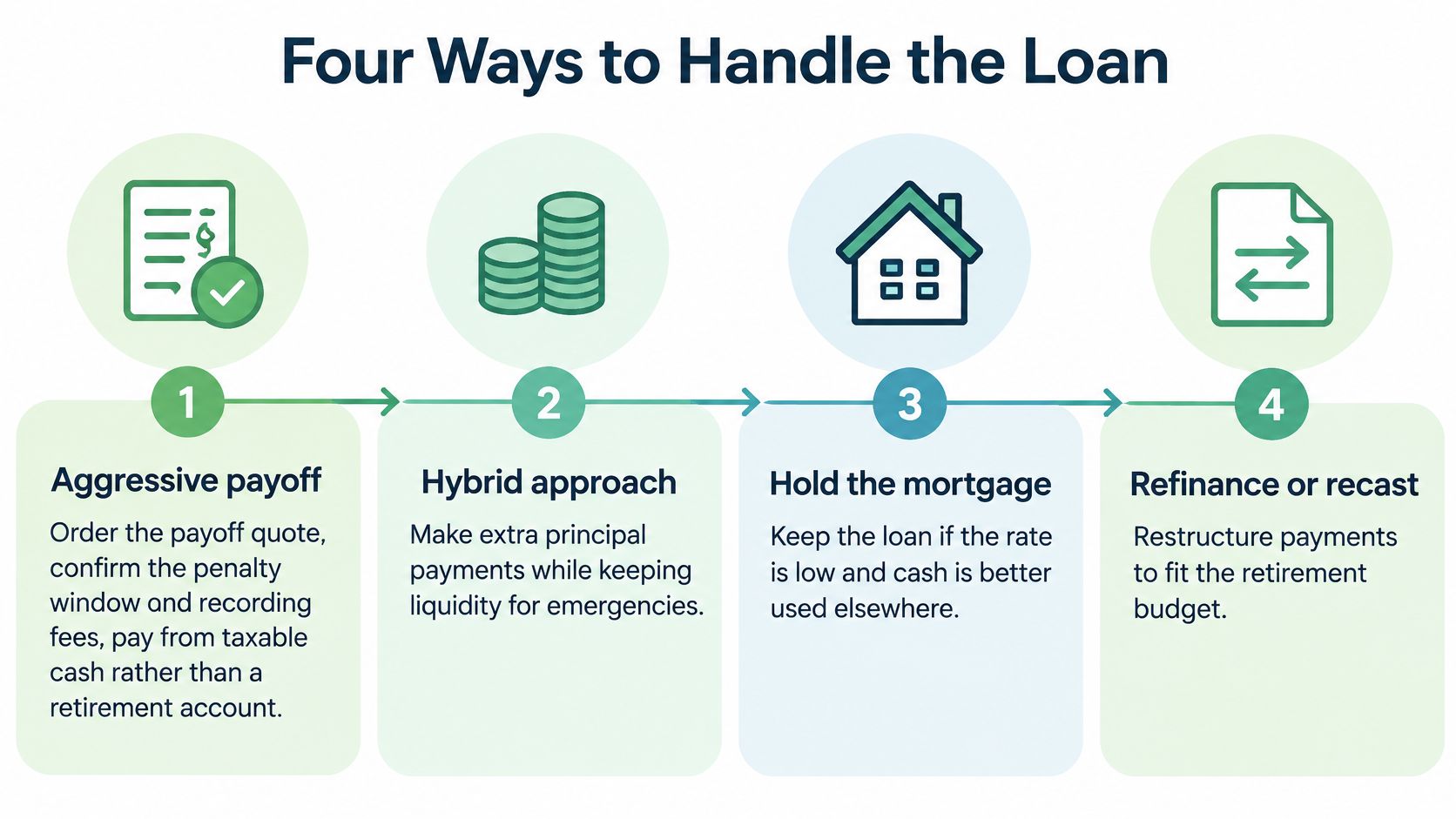
Choose how to carry out your decision. Each path has its own paperwork, costs, and follow-through.
-
Pay off the loan. Request a written payoff quote with a good-through date, then confirm any prepayment penalty and recording or release fees. Use taxable cash rather than withdrawing from a retirement account. After payment, keep the confirmation and follow up until the lien release is recorded.
-
Make a partial principal payment. Tell the servicer to apply the money to principal, not hold it as a future monthly payment. Ask whether it offers a recast, what the fee is, and what documents are required. Get the revised payment in writing before counting on a lower bill.
-
Refinance. Request estimates of the new payment, closing costs, and total interest over the period you expect to keep the loan. Compare those costs with the payment reduction over that same period. Check the new term carefully; a lower monthly bill can come with years of extra payments.
-
Keep the loan and invest the lump sum. Set the mortgage payment on autopay and decide in advance how the money will be invested. Keep enough accessible cash for planned withdrawals, so market losses do not force you to sell investments to make the housing payment.
Check the cash reserve before acting
Write down essential annual spending, guaranteed income, and the liquid assets that would remain after your chosen move. Then calculate how long those assets could cover a shortfall, including healthcare and home repairs. The guide to sizing an emergency fund can help you set a starting reserve; adjust it for the costs and risks of owning your home.
For a steady mortgage budget, compare the loan payment with a Treasury or CD ladder timed to cover several years of payments. Set the maturities and withdrawals to match the bills, and keep separate cash for expenses the ladder does not cover. A paid-off loan removes one monthly bill. It does not remove the need to fund the rest of retirement.
Choose a Path and Run Your Numbers
Pay the loan down only if its after-tax cost beats a cautious after-tax return and the payoff still leaves 12 to 24 months of essentials, plus room for healthcare and repairs. If the leftover cash would drop below that floor, stop at a partial principal payment or a recast and keep the rest invested or in safe reserves.
If the coupon is low, the interest is not deductible, and the reserve is the binding constraint, keeping the mortgage is often the sturdier retirement. Pride in a free-and-clear deed does not fund a bad year.
Get the lender's payoff quote. Swap the worked example's 6% and $180,000 for your balance, your rate, and your remaining term. Check the current Freddie Mac weekly average only as context for what new borrowers pay, not as your contractual cost.
Before money moves, project your lowest cash balance the way you would forecast a thin quarter, so you see the worst month after the lump sum leaves. Then run the choice in our free calculators, which stay in the browser with no signup and no data leaving your machine. The Mortgage Calculator estimates the payment, total interest, and the effect of extra principal. The Compound Interest Calculator shows how a lump sum and monthly contributions grow if those dollars stay invested. The Debt Payoff Calculator comes first if a higher-rate balance should be cleared ahead of the mortgage. Confirm each tool's inputs on the site before you rely on it. This is education, not a personal recommendation. Have a tax professional review itemizing, or any retirement-account withdrawal, before the wire goes out.
Get more posts like this
One short, useful email each Friday. Free, no spam, unsubscribe anytime.