Pros and Cons of a Reverse Mortgage: The Real Numbers
Weigh the pros and cons of a reverse mortgage with worked numbers, HECM eligibility rules, real costs, equity risks and alternatives to compare first.

Daniel Anderson
Editor, The Money Maniac
November 18, 2026
13 min read

Your reverse mortgage balance can grow even if you never borrow another dollar. The Consumer Financial Protection Bureau's key-terms guide explains why: interest and other charges get added to the debt instead of being paid out of your monthly budget.
That trade can be worthwhile. But the pros and cons of a reverse mortgage deserve to be weighed in dollars, especially if your house is also your backup plan for future care or an inheritance. My view: consider one for a durable retirement cash-flow problem, not as an easy way to make an uncomfortable budget disappear.
What a Reverse Mortgage Is and Who It Is For
A reverse mortgage is a loan against your home that generally requires no monthly principal or interest payment while you live there and meet the loan's obligations. Repayment generally comes due when you die, sell, or permanently move out.
The main U.S. product is the Home Equity Conversion Mortgage, or HECM, insured by the Federal Housing Administration. The CFPB's financial well-being brief identifies access to home equity while aging in place as a central benefit, while emphasizing that borrowing costs reduce the value homeowners receive.
Think of it as drawing down a savings account, except the money comes from borrowing against your house. Interest and fees accumulate on the loan rather than coming out of your checking account.
Who should take a serious look
The strongest candidate has substantial home equity, limited monthly cash, and a realistic plan to remain in the property. Having meaningful retirement savings doesn't automatically rule it out, but preserving those savings must justify the borrowing cost.
Use this quick self-test:
- Equity: Do you own the home outright, or could the proceeds clear your existing mortgage?
- Staying power: Does the house still suit your mobility, maintenance, and family needs?
- Household budget: Can you reliably pay the ongoing ownership bills?
- Purpose: Can you name the expense the borrowed money will cover?
Proceeds can come as a lump sum, monthly advances, or a line of credit. The right arrangement depends on when you need the money, not just how much a lender offers.
A substantial program with a narrow purpose
HUD reported more than 681,000 active FHA reverse mortgages, with a combined maximum claim amount exceeding $64.3 billion, as of September 30, 2025. That measures the program's reach and insured claim exposure, not cash sitting in borrowers' accounts.
My starting recommendation: Pursue a reverse mortgage only when staying in the home is both a personal preference and a financially workable plan.
Who Qualifies and How Much Cash You Can Get
Start with eligibility before mentally spending your home equity. The 2025 HUD Programs guide sets out the core HECM requirements, including a minimum borrower age of 62.
- Age: Every borrower must meet that minimum. The youngest borrower's age also affects borrowing capacity.
- Occupancy: The property must be your principal residence.
- Ownership: You generally need outright ownership or enough equity to pay off existing liens at closing.
- Counseling: You must complete counseling with an FHA-approved reverse-mortgage counselor.
- Financial capacity: You must be able to cover property charges and maintenance. Delinquent federal debt also needs to be resolved or covered by an approved repayment arrangement.
That financial assessment matters. A valuable house doesn't automatically make an otherwise unmanageable household budget workable.
Home value and spending money are different numbers
Under the HUD HECM counseling handbook, the initial disbursement limit generally uses 60% of the principal limit, or mandatory obligations plus 10% of the principal limit, subject to program restrictions. The principal limit depends on age, interest rates, and eligible property value, with the maximum claim amount capped by the lesser of appraised value and the applicable FHA mortgage limit.
For a hypothetical $200,000 principal limit, the ordinary initial-draw calculation is:
$200,000 × 60% = $120,000
Mandatory obligations can change that calculation. Your mortgage payoff, financed closing expenses, and other required allocations also reduce what's available for your own spending.
Ask for the net number
Request a written breakdown showing:
- Principal limit: The program's borrowing calculation.
- Required deductions: Existing debt, closing expenses, and required reserves.
- Available proceeds: What you can access, and when.
A lender's estimate should make those distinctions obvious. If you can't tell how much reaches your household after the mortgage payoff, you don't yet have a usable offer.
Advantages of Cash Without a Monthly Payment
The strongest advantage is straightforward: you can improve monthly cash flow without selling your home. For someone who wants to stay put, that can be more useful than owning a valuable property while struggling to cover ordinary expenses.
-
Relief from a required mortgage payment. Suppose, hypothetically, that your existing principal-and-interest payment is $1,400 a month and the reverse mortgage pays off that loan. Removing that payment leaves $16,800 a year available in your budget. Taxes, insurance, and upkeep still need their own funding.
-
Access without a move. Selling can release equity, but it also means finding somewhere else to live. A reverse mortgage can let you use part of the home's value while keeping your existing living arrangement.
-
A payout matched to the expense. Monthly advances may suit an ongoing income gap. A line of credit may suit irregular repairs or care costs. Under an adjustable-rate HECM, unused credit availability can grow over time, although that growth represents additional borrowing capacity rather than investment earnings.
-
Protection against an unlimited shortfall. HECMs generally provide non-recourse protection under program rules. That limits repayment exposure when the debt and property value diverge, but it doesn't guarantee an inheritance.
Match the money to a durable need
The case is strongest when proceeds support necessary repairs, in-home care, or a carefully measured income shortfall. It's weaker when the money finances gifts, speculative investments, or spending that leaves the underlying budget unchanged.
Consider the reverse mortgage alongside your other sources of retirement income. A household with substantial accessible savings should compare borrowing costs against a deliberate withdrawal plan before paying to access home equity.
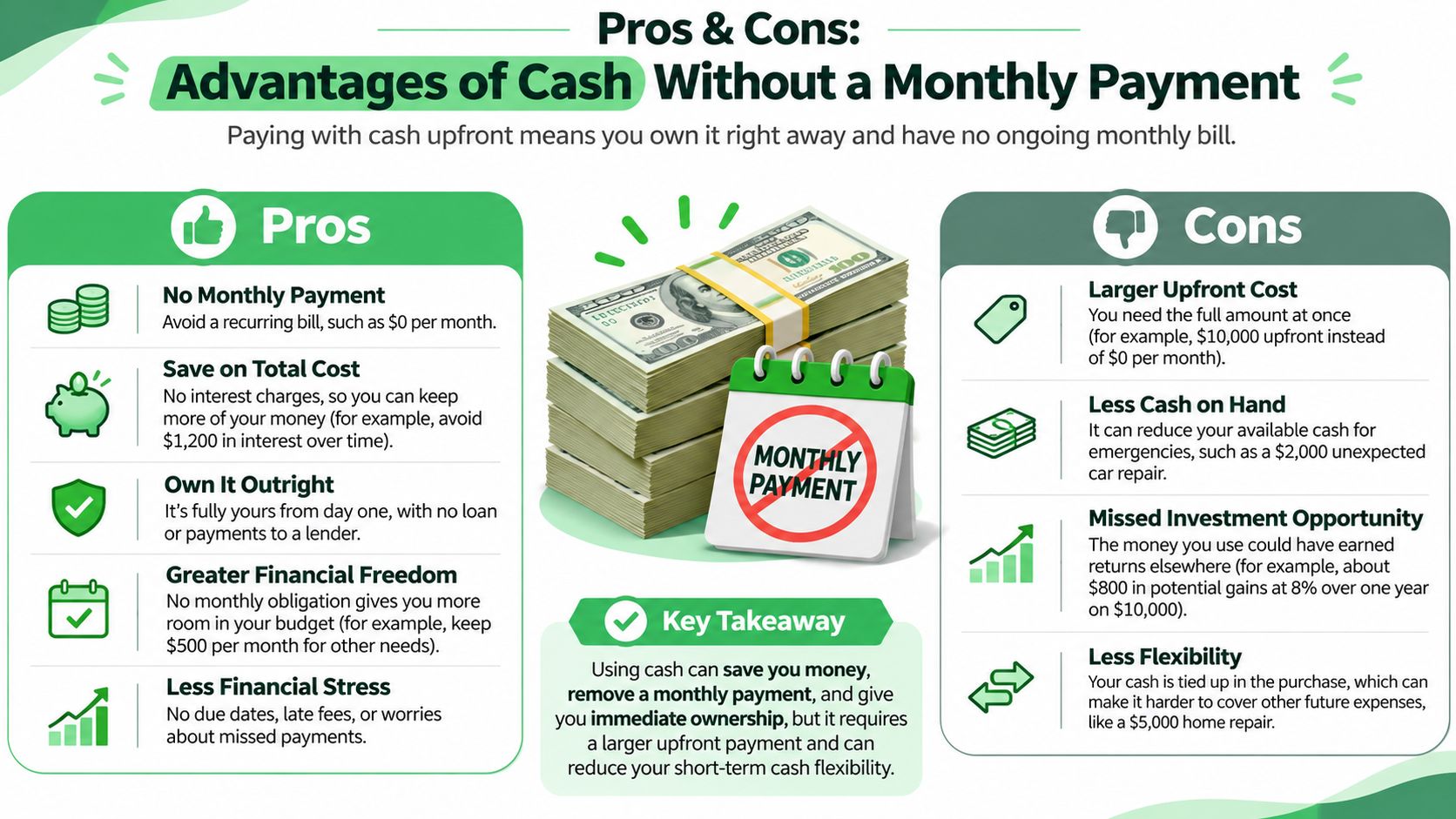
The benefit is convincing only when you can explain what the money will pay for, when you'll need it, and how long it must last.
The Downsides That Hit Your Equity and Your Heirs
Borrowing against your home today leaves less equity for tomorrow. If the home's value stays flat, every added dollar of debt reduces your ownership stake by a dollar. That can limit your choices if you later need the house to fund a move or other expenses.
-
Less flexibility later. A move for assisted living, accessibility, or family support may be harder to finance after you've borrowed against the property. Home appreciation could offset some balance growth, but don't build a care plan around it.
-
Foreclosure remains possible. A 2012 CFPB review found that nearly 10% of reverse-mortgage borrowers were at risk of foreclosure after failing to pay property taxes or homeowners insurance.
-
Taking everything upfront can create trouble. The 2012 CFPB review also reported that about 70% of borrowers took proceeds as a full lump sum. Borrowing before you need the money can add interest to the balance sooner and leave less available for later.
-
Complexity can lead to costly mistakes. Read the loan terms closely, including payout restrictions, occupancy conditions, and how the debt affects your estate. Don't rely on a sales conversation to explain obligations that should be clear in the documents.
Put the household and estate plan in writing
If the property stops being your principal residence, repayment can be triggered. If your spouse won't be a borrower, ask the counselor to explain the spouse's status and protections in writing.
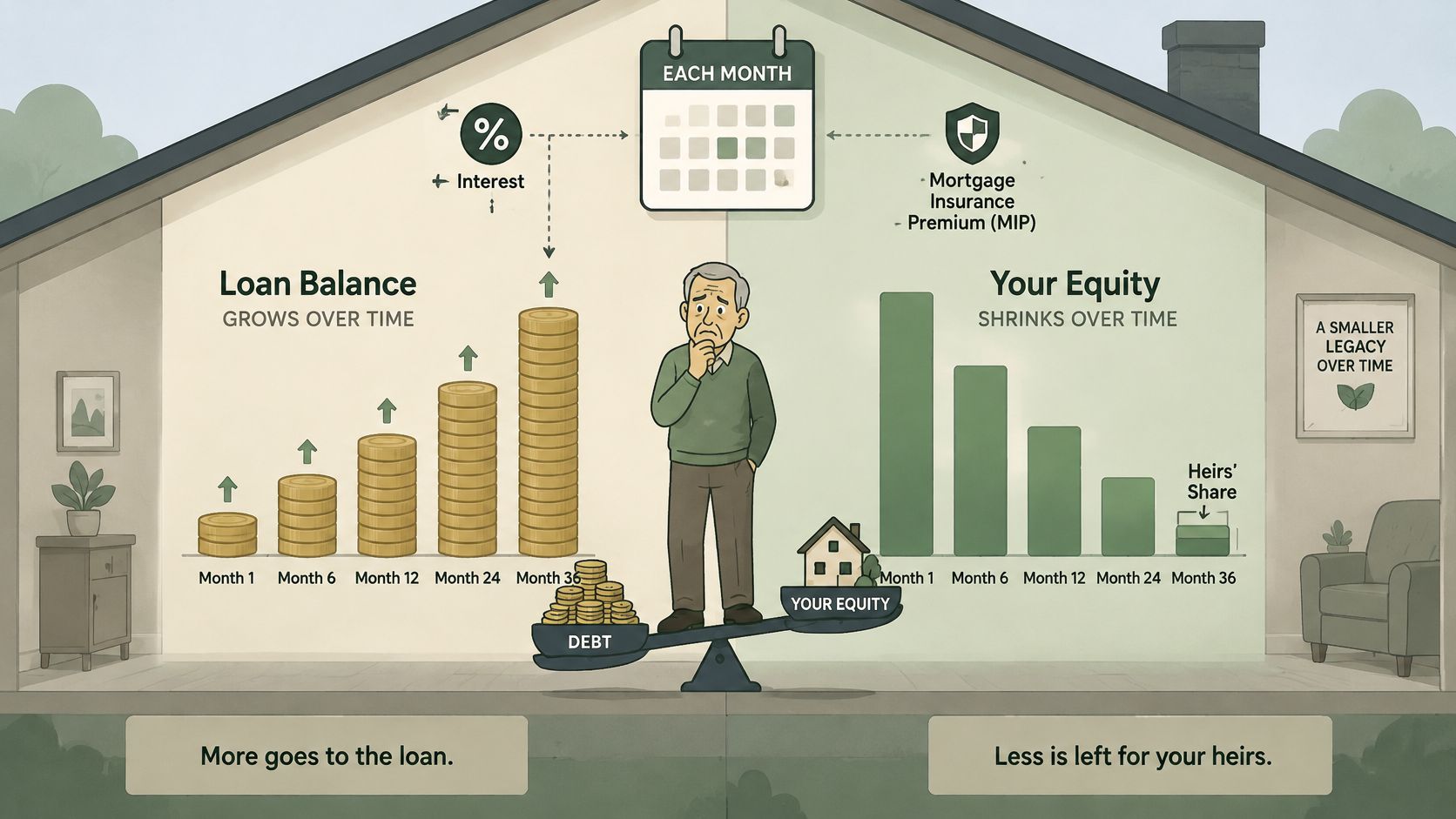
Families should distinguish mortgage repayment from tax treatment. A potential step-up in basis at death does not settle how an outstanding loan will be repaid.
For Texas families, the Law Office of Bryan Fagan, PLLC's explanation of an inherited house with mortgage in Texas offers estate-law context. Use it to prepare questions for an attorney, not to assume inheritance removes repayment obligations.
What a Reverse Mortgage Costs, Line by Line
Reverse mortgage costs on a hypothetical $400,000 home
| Cost | How it is charged |
|---|---|
| Origination fee | Upfront lender charge. Assume $6,000 for this illustration; confirm the permitted charge and current cap. |
| Initial FHA mortgage insurance | Upfront insurance charge. Assume $8,000 for this illustration; confirm the actual assessment. |
| Third-party closing costs | Appraisal, title, recording, and credit-report charges. Assume $3,000 here. |
| Annual mortgage insurance | 0.5% of the outstanding balance annually, equivalent to $500 on an unchanged $100,000 balance. |
| Servicing fee and interest | Charges set by the loan agreement and applicable rate, generally added to the balance. No separate servicing fee is assumed in the worked growth model. |
The CFPB's reverse-mortgage cost guidance identifies these upfront and ongoing cost categories and specifies the 0.5% annual mortgage-insurance premium. The other dollar amounts above are illustrative assumptions, not verified current fee quotes.
Upfront charges reduce what you receive
In this hypothetical example, the origination charge, initial insurance, and third-party expenses total:
$6,000 + $8,000 + $3,000 = $17,000
That equals 4.25% of the assumed $400,000 home value. Financing those charges avoids paying them from your bank account at closing, but you still owe them and can incur interest on them.
Origination charges pay the lender for making the loan. Initial mortgage insurance is a separate program charge, while third-party costs pay for services involved in closing. Ask for each category separately rather than accepting a single unexplained total.
Ongoing charges require a longer view
Annual insurance is based on the outstanding balance, so its dollar cost changes as that balance changes. Interest has the same practical problem: the amount charged can increase even when you stop taking advances.
A separate servicing charge, if applicable, adds another expense. Request a projection that includes every charge in your actual offer rather than relying on an interest rate alone.
Cost check: Ask how much debt you'll owe at your expected move date, not merely how little cash you need at closing.
Short occupancy makes large upfront costs especially difficult to justify. A longer stay spreads those initial expenses over more years of use, but also gives interest more time to accumulate. Both effects belong in the decision.
How a $150,000 Draw Grows Over Ten Years
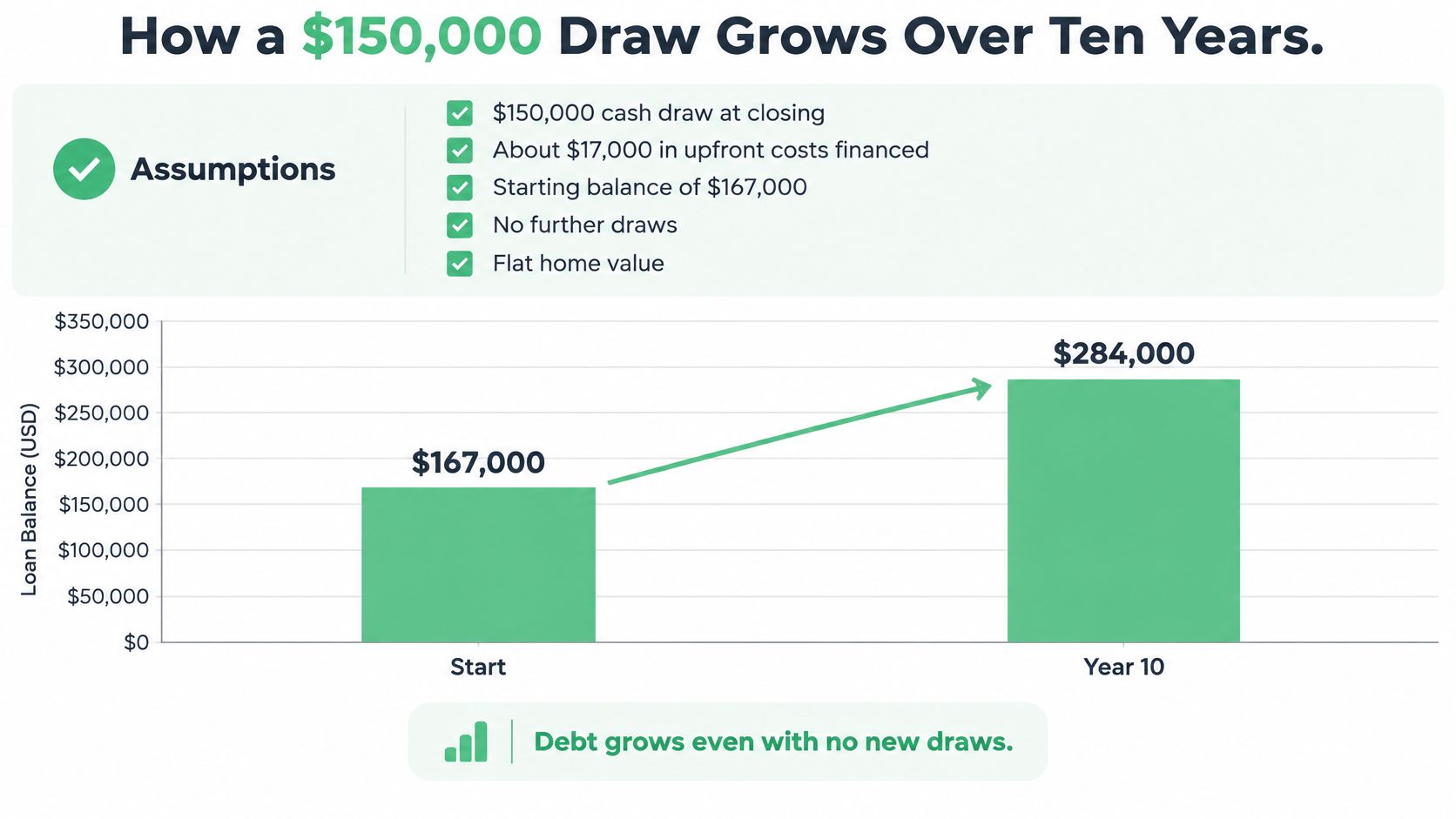
Consider a hypothetical illustration prepared for this article, not a market-rate quote. Assume:
- Cash received: $150,000 at closing.
- Financed upfront costs: $17,000, using the illustrative cost budget above.
- Starting loan balance: $167,000.
- Further withdrawals: None.
- Home value: A flat $400,000 throughout.
- Model method: Annual compounding, including insurance, with no separate servicing charge.
The interest assumptions below are hypothetical. Check an actual current offer with the lender and review it with an FHA-approved counselor before using any rate in your decision.
Hypothetical HECM balance growth on a $150,000 draw
| Interest rate (plus 0.5% insurance) | Starting balance | Balance after 5 years | Balance after 10 years | Equity left after 10 years |
|---|---|---|---|---|
| 4% interest, 4.5% combined | $167,000 | About $208,000 | About $259,000 | About $141,000 |
| 6% interest, 6.5% combined | $167,000 | About $229,000 | About $313,000 | About $87,000 |
| 8% interest, 8.5% combined | $167,000 | About $251,000 | About $378,000 | About $22,000 |
These are calculated scenario results, rounded to the nearest thousand dollars. They exclude selling expenses, additional borrowing, and changes in home value.
The difference is substantial. Over the modeled decade, the debt increases by approximately $92,000 in the lowest-rate case and $211,000 in the highest-rate case, despite identical cash received at closing.
The following graphic illustrates the direction of growth. Its endpoint uses a separate illustrative assumption; use the table for the scenarios calculated here.
Redo the calculation yourself
Use this simplified formula:
Future balance = starting balance × (1 + interest rate + 0.005)^years
For the middle scenario:
$167,000 × 1.065¹⁰ ≈ $313,000
Then subtract the result from your assumed future home value to estimate remaining equity. Actual monthly accrual, rate changes, servicing charges, and further draws will change the outcome.
For an initial cash draw of the size modeled here, a hypothetical $250,000 principal limit produces a $150,000 ordinary initial-disbursement allowance. Financed costs and other obligations also consume available proceeds, so that limit alone doesn't establish that the full transaction is feasible.
The useful question is personal: What future balance could your relocation budget or heirs tolerate?
Reverse Mortgage Alternatives Compared
| Option | Monthly payment | Cash or income available | Effect on home equity | Best when |
|---|---|---|---|---|
| Reverse mortgage (HECM) | No required principal-and-interest payment while conditions are met | Lump sum, monthly advances, or credit line | Debt increases as charges accrue | You need sustained cash flow and expect to stay |
| Home equity line of credit | Required under the agreement, sometimes interest-only initially | Revolving borrowing capacity | Borrowing reduces equity | You need flexible access and can afford repayment |
| Cash-out refinance | Required principal and interest | Lump sum after refinancing costs and debt payoff | A larger initial mortgage reduces equity | Income supports the payment and the full quote is competitive |
| Sell and downsize | New housing may involve rent or mortgage payments | Net sale proceeds after costs | Equity becomes cash or funds the next home | You want lower upkeep or greater mobility |
| Delay Social Security | No loan payment, but living costs need another funding source | Potentially higher future monthly benefit | No direct borrowing against the house | You can bridge expenses from other resources |
Match the financing to the problem
For a one-time repair, compare a smaller conventional borrowing arrangement before accepting substantial reverse-mortgage setup costs. A home equity line may offer flexible access, but examine repayment terms and the lender's ability to reduce or freeze availability.
For a steady income gap, compare the reverse mortgage with a planned savings withdrawal strategy. Delaying Social Security also deserves analysis using your own benefit estimate and claiming circumstances, rather than a generic increase assumption.
For long-term care or an unsuitable house, selling may solve more of the problem. Borrowing to stay in a property with expensive stairs, major repairs, or inaccessible bathrooms can postpone a necessary move while consuming the money needed to make it.
Compare complete transactions
A cash-out refinance deserves special care if it would replace an existing mortgage with less favorable terms. Review when refinancing a mortgage makes sense and compare the new payment, closing expenses, and total borrowing cost.
If leaving the house to family is a major goal, involve them before choosing financing. Wanting to inherit the property and being able to carry or refinance its debt are different matters.
My preference: Use the smallest, least costly arrangement that reliably solves the actual problem. A reverse mortgage earns its place when payment relief and continued occupancy justify the loss of future equity.
Run Your Own Numbers Before Calling a Lender
For most financially established homeowners, a reverse mortgage is a maybe-if loan. It deserves serious consideration when you expect a long stay, need sustained cash flow, and have a secure way to pay ownership expenses.
These planning horizons are decision scenarios, not eligibility rules.
Fit by situation
| Situation | Likely fit | Why |
|---|---|---|
| Plan to stay 10 or more years, large equity, need steady cash | Often worth a close look | You have time to use the cash-flow benefit, although borrowing costs continue accumulating |
| Plan to move within about 3 years | Usually a poor fit | Upfront expenses buy only a short period of payment relief |
| Heirs expect to inherit the house | Weigh carefully | They may need funds or financing to retain it |
| Cannot reliably cover taxes and insurance | Not a fit | Unpaid obligations can put the home at risk |
| One-time repair or small expense | Probably a poor fit | Setup costs may be disproportionate to the need |
| Emergency reserve only | Possibly a fit | An adjustable-rate credit line offers future borrowing capacity, but opening costs still need justification |
Complete these checks first
-
Build an ownership budget. Write down property taxes, homeowners insurance, routine maintenance, and likely major repairs. Test whether current income could cover them over a hypothetical decade, including room for increases.
-
Give the borrowing a job. Name the purpose, amount, and timing. A smaller standby line may fit better than taking a large sum immediately, especially when expenses are uncertain.
-
Stress-test the balance. Calculate shorter and longer occupancy scenarios using an actual quoted rate. For adjustable borrowing, also test an unfavorable rate path and a flat or declining home value.
-
Price the alternatives. Obtain comparable estimates for other financing and a realistic net-sale estimate. Compare what you receive, what you pay monthly, and what remains afterward.
Bring your spouse or another trusted person into this process if they'll share the housing consequences. A second reader can catch assumptions you've stopped noticing.

Get independent review before committing
Book the required counseling session with an FHA-approved reverse-mortgage counselor. Ask for explanations of net proceeds, repayment triggers, spouse protections, and every fee you don't understand.
Then run your own calculations. Our free mortgage-payment, compound-interest, and debt-payoff calculators require no signup and keep your information in your browser. A general compound-interest calculator can help test the simplified balance model, but it doesn't replace a loan-specific HECM projection.
Finally, consult a licensed financial professional and tax adviser. Ask them to confirm the treatment of loan advances and whether retained proceeds could affect means-tested benefits such as SSI or Medicaid before choosing a withdrawal schedule.
We encourage readers to do their own research or consult a licensed professional before investment decisions. The same discipline belongs here: make the lender's proposal survive your household budget, your care plan, and your family's expectations.
Get more posts like this
One short, useful email each Friday. Free, no spam, unsubscribe anytime.