When Does Refinancing a Mortgage Make Sense? Run the Math
When does refinancing a mortgage make sense? Break-even math, loan term traps, cash-out risks, and a calculator you can run in your browser.

Daniel Anderson
Editor, The Money Maniac
November 7, 2026
11 min read

Refinancing a mortgage makes sense when you keep the loan long enough to recover its costs: divide total refinance costs by monthly savings, so $6,000 divided by $250 breaks even in 24 months. But if the payment drops because you've stretched the debt over more years, have you saved money?
That's the gap in most refinance pitches. A smaller payment can improve your budget while leaving you with more interest to pay and a later debt-free date. Treat the advertised savings as a starting point, then check the fees, repayment schedule, and your realistic sale timeline.
Run the Break-Even Test Before Anything Else
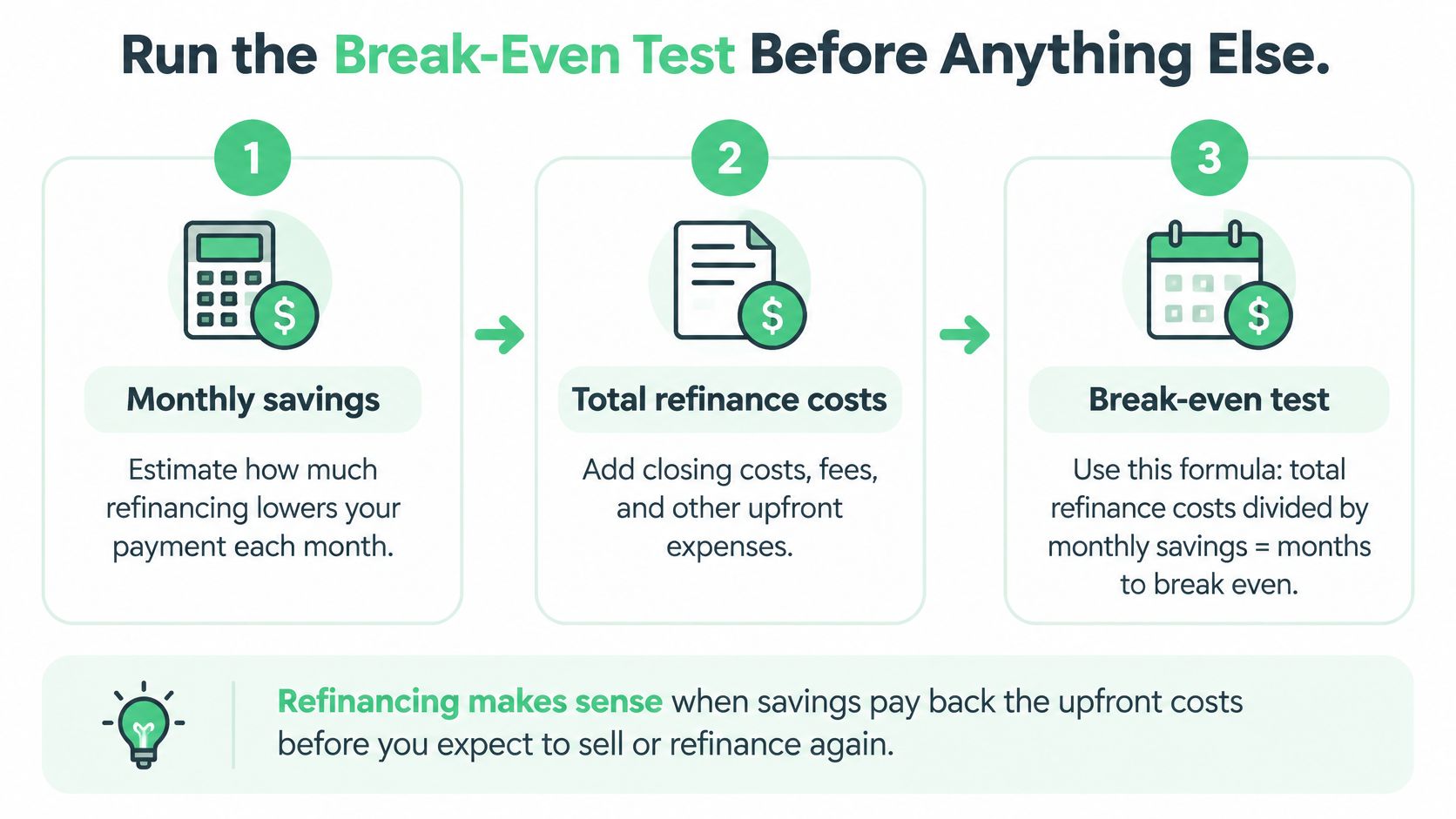
Start with the costs you must recover, then compare them with the monthly payment reduction. The relevant deadline is how long you'll keep the new loan, which could end when you sell or refinance again.
The Consumer Financial Protection Bureau's home-loan toolkit identifies roughly two years as a common break-even rule of thumb; its example of $6,000 in costs divided by $250 in monthly savings produces a 24-month recovery period. That's a screening tool, not an automatic approval.
Total refinance costs ÷ monthly payment savings = months to break even
Use principal and interest payments for the initial comparison. A change in your escrow collection for property taxes or insurance can make a payment look different without making the financing cheaper.
Match the recovery period to your plans
These scenarios show the arithmetic, rather than promised lender offers. The $5,458 cost input comes from the average refinance closing costs modeled in Neighbors Bank's 2025 refinance study; the other rows are illustrative calculations.
Break-even periods for common refinance scenarios
| Refinance costs | Monthly savings | Break-even | Break-even in years |
|---|---|---|---|
| $4,000 | $150 | About 27 months | About 2.2 years |
| $6,000 | $250 | 24 months | 2 years |
| $6,000 | $200 | 30 months | 2.5 years |
| $5,458 | $200 | About 27 months | About 2.3 years |
| $8,000 | $100 | 80 months | About 6.7 years |
Round the result conservatively when making a decision. Recovering almost all your costs before moving still leaves you short.
A likely job relocation, a growing family, or plans to buy another property should change the timeline you enter. Use your probable holding period, not the longest stay you can imagine. And don't assume another refinance will rescue a mediocre offer. That future transaction would have its own costs.
Practical rule: Leave room between break-even and your expected exit. A refinance that barely works under your best-case schedule is fragile.
If you want a complementary overview while collecting quotes, the refinance savings advice from ThriveXDNA offers another resource to review alongside your own calculations. Your actual Loan Estimates should determine the decision.
Keep the worksheet simple: costs, monthly savings, recovery period, expected exit. If the exit comes first, a lower rate can still lose money.
Adding Up What Refinancing Really Costs
The rate gets the headline. The fees determine how much of the benefit you keep.
Request an itemized Loan Estimate and separate the charges for obtaining the loan from amounts collected for taxes, insurance, and escrow funding. Cash needed at closing matters for your budget, but not every dollar represents a new financing expense.
Build a complete cost inventory
Check each offer for these items:
- Lender charges: Origination, underwriting, processing, and other loan fees.
- Third-party charges: Appraisal, credit report, title search, title insurance, and recording fees.
- Rate adjustments: Discount points you pay to obtain a lower rate, or credits provided in exchange for a higher rate.
- Existing-loan charges: Any prepayment penalty that applies when you pay off the current mortgage.
The CFPB's Loan Estimate rules provide the framework for disclosed loan costs and lender credits; in an illustrative financed-cost scenario, adding $5,000 to a $250,000 balance increases the debt by 2% before you pay interest on that addition.
A lender credit deserves the same scrutiny. It can reduce the cash you bring to closing while leaving you with a higher rate. Compare the credited offer against an otherwise comparable offer without the credit.
No cash paid upfront doesn't mean no economic cost. Ask where the expense went: into your balance, into your interest rate, or onto your closing statement.
Give discount points their own test
Points buy a lower rate upfront. Their value depends on the savings attributable specifically to that purchase, rather than the entire payment reduction from refinancing.
For a hypothetical offer, $4,000 in points divided by $55 in monthly interest savings takes about 73 months, just over six years. Selling or refinancing sooner would undermine that purchase.
Points are substantial enough to deserve attention: the CFPB's mortgage report found that 50.2% of borrowers paid discount points in 2022, with a $2,370 median points payment, while median mortgage closing costs reached $5,954, up 22% from 2021. Those are historical figures, not a quote for your loan.
Also consider what paying cash would do to your emergency reserves. A refinance can be mathematically attractive and still leave your household uncomfortably short of liquid savings.
Use the mortgage payment guide and calculator with PMI to help distinguish financing payments from other housing costs. Keep mortgage insurance separate in your worksheet so any change is visible.
Before comparing offers, write down total cash to close, costs added to principal, and points plus any prepayment penalty. Don't count the same charge twice. Those figures tell you what you're paying, how you're paying it, and how much debt you'll carry afterward.
How Much Rate Drop Is Enough
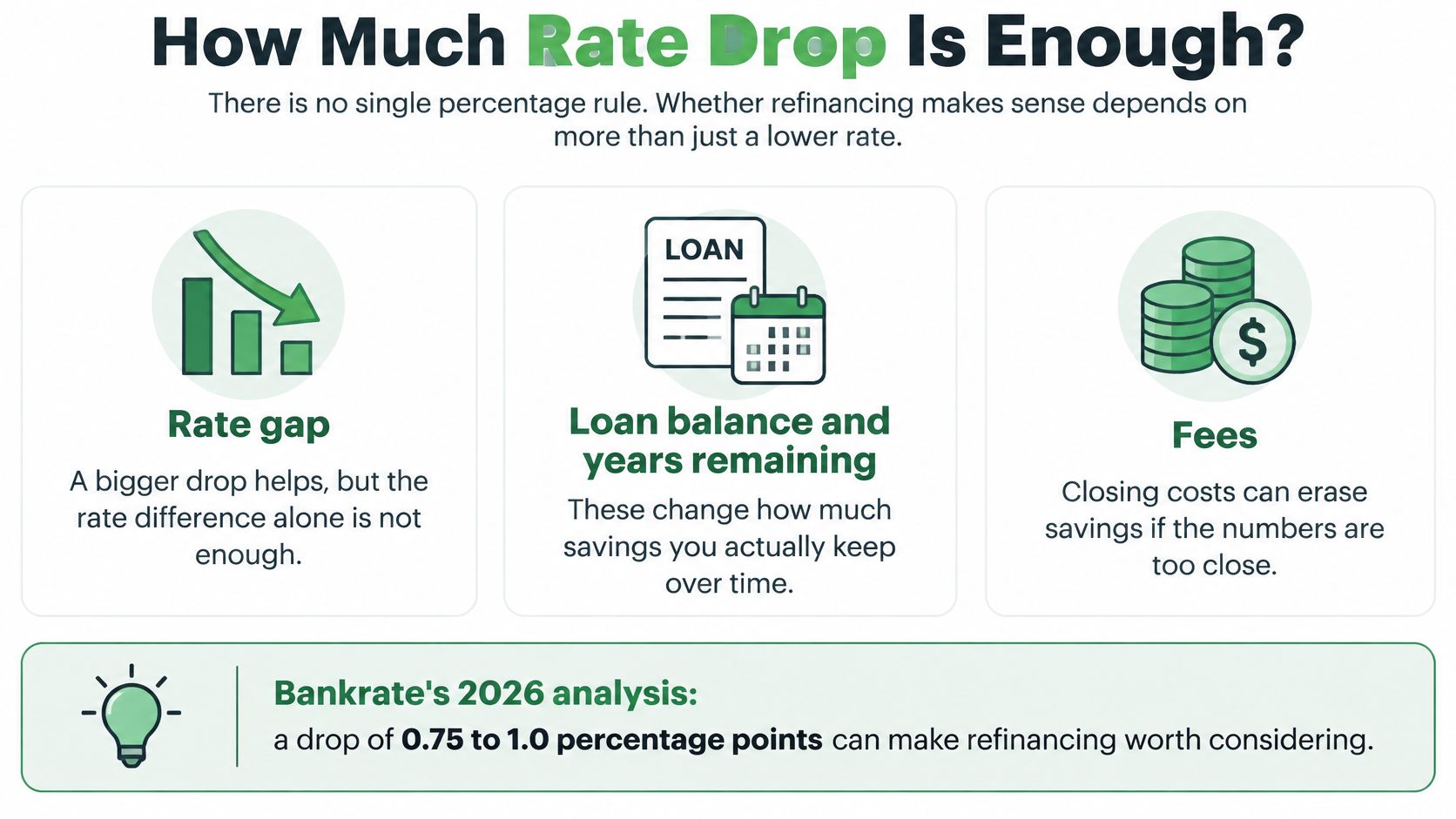
How much does the rate need to fall before a refinance pays off? There's no universal cutoff. The answer depends on your loan balance, the monthly savings, the refinance costs, and how long you expect to keep the mortgage.
A 0.75- to 1.0-percentage-point reduction is a useful starting point for requesting quotes. Actual costs and savings depend on the loan, so compare the offers against your own timeline.
Compare dollars rather than rate headlines
The CFPB's housing summit remarks estimated that moving from 7.25% to 6.5% on a $400,000 loan with a similar term would save about $200 monthly. That example shows why the rate cut alone is not enough: the balance and loan terms shape the dollar savings.
Monthly savings and recovery time for two rate cuts
| Rate cut and loan | Monthly savings | Months to recover $6,000 |
|---|---|---|
| 7.25% to 6.5% on a $400,000 loan | About $200 | About 30 months |
| Hypothetical 6.5% to 6.25% on a $300,000, 30-year loan | About $49 | About 123 months |
These are rounded examples using standard fixed-rate amortization, unchanged principal, and no financed fees. The smaller rate cut saves less each month, so it takes much longer to recover the assumed $6,000 cost.
If credit affects the offers available to you, refinancing options with lower credit scores can help you prepare questions for lenders. Use the rate you can qualify for, then check whether the break-even date comes before your planned sale or refinance. Use the figures above as a prompt to request quotes, then compare them line by line.
Loan Term Resets and the Lower Payment Trap
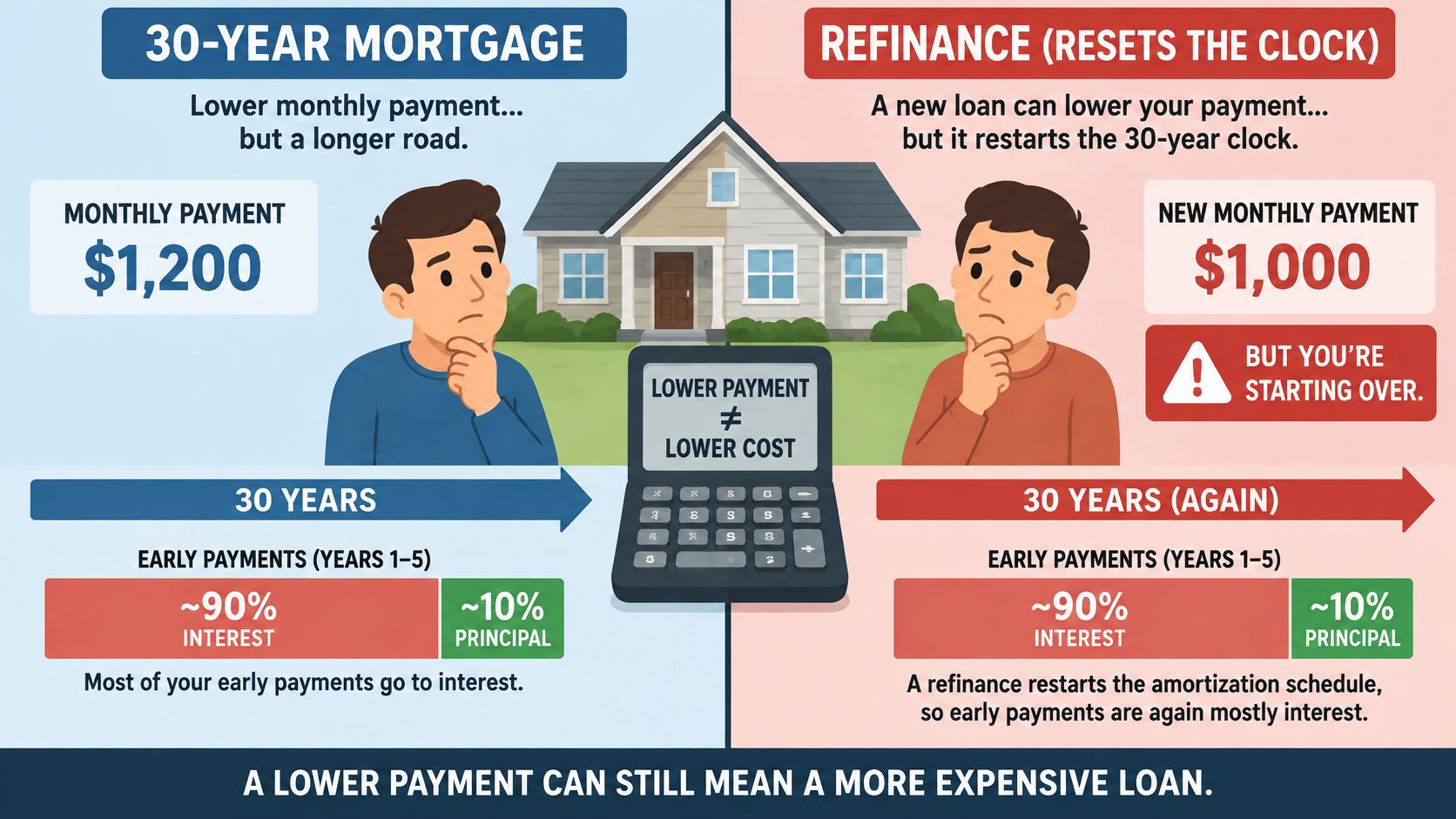
A lower payment can conceal a longer, more expensive payoff. In this hypothetical example, extending a $300,000 balance at 6.5% from 20 years to 30 adds about $145,700 in interest, even before closing costs or extra payments.
Monthly payment and total interest on a $300,000 balance at 6.5 percent
| Option | What changes |
|---|---|
| Keep the remaining 20 years at 6.5% | Baseline for the same balance: about $2,237 monthly and roughly $236,800 in remaining interest |
| New 30-year loan at 6.5% | About $1,896 monthly, roughly $382,600 in total interest, and repayment extended by 10 years |
The required payment falls by about $340 monthly. The rate has not improved; the new schedule gives you longer to repay the principal.
Compare the balance at your exit date
The CFPB's home-loan toolkit recommends comparing payments and interest over the time you expect to stay in the home. Include the projected loan balance at that point, since you'll need to repay it when you sell.
Amortization gradually reduces debt through scheduled payments. Interest is charged on the unpaid balance, so a longer schedule keeps more principal outstanding for longer.
The Federal Reserve's refinancing guide illustrates a 27-month basic break-even period and describes the calculation as a ballpark estimate. A payment-only calculation does not show whether the new schedule delays your payoff.
A lower required payment can buy useful flexibility, but record the extra borrowing cost. You can request a term no longer than your remaining schedule, or choose a longer term and make extra principal payments to preserve your original payoff date.
That second option depends on maintaining those payments. Automatic transfers can help, but don't base the decision on extra payments your budget can't sustain.
If you're considering paying off your mortgage before retirement, compare the proposed payoff date with your retirement date. A refinance that extends housing debt into retirement needs a stronger justification than a smaller payment today.
Cash-Out Refinancing Versus Rate-and-Term
Rate-and-term refinancing replaces your mortgage with a different rate or repayment schedule at approximately the same balance. Cash-out refinancing increases the loan and pays you the remaining proceeds after the old mortgage and transaction charges are covered.
The CFPB's loan-cost guide explains that cash-out loans are usually repaid over 30 years, which can produce smaller payments than a shorter loan while allowing the balance to decline more slowly. The money is secured by your home.
Rate-and-term, cash-out and second-lien options compared
| Option | What it does | Main risk | Best fit |
|---|---|---|---|
| Rate-and-term refinance | Replaces the loan with a new rate or term at about the same balance | Closing costs and a restarted repayment clock | Lowering the rate or payment without taking out more money |
| Cash-out refinance | Replaces the loan with a larger balance and pays you the difference in cash | Higher balance secured by the home, commonly with a long repayment period | Large, specific needs when the new rate is close to or below your current rate |
| HELOC or home-equity loan | Adds a second lien and leaves the first mortgage untouched | Variable-rate payments on a HELOC and another loan to manage | Keeping a low first-mortgage rate while accessing equity |
Price the whole borrowing decision
In a hypothetical example, replacing a 3% first mortgage with a 6.5% cash-out loan reprices the existing balance as well as the additional borrowing. Comparing only the rate on the new cash misses most of the transaction.
Dated figures illustrate the scale of that trade-off: First American's October 28, 2026 report reported $13.2 trillion in accessible equity in the second quarter of 2026, with $11.6 trillion, about 88%, behind first-mortgage rates below the report's prevailing 6.49% rate; the accompanying research notes cite ICE figures showing $47 billion withdrawn in the first quarter of 2026, with HELOCs and home-equity loans supplying 54%. These are dated measures, not current rate quotes.
A second-lien loan can carry a higher advertised rate yet cost less overall because you preserve the cheaper first mortgage. Compare combined interest costs, payments, fees, and repayment dates across both debts.
Match the purpose to the payoff horizon. A carefully budgeted renovation may justify long-term financing, but added property value isn't guaranteed. Consolidating credit cards requires particular caution: you're moving debt onto your home, and you still need a plan to prevent new card balances.
Before borrowing: Name the expense, set its payoff deadline, and compare alternatives that preserve your existing mortgage.
A HELOC or home-equity loan deserves serious consideration when your first mortgage is inexpensive and the cash need is limited. Cash-out becomes more competitive when replacing the first mortgage doesn't impose a substantial rate penalty.
Run the Break-Even Numbers in the Calculator
Use our Mortgage Calculator to estimate monthly payments, total interest, and the impact of extra payments. Keep a separate worksheet for closing costs, points, your expected holding period, and the break-even calculation rather than assuming those are dedicated calculator outputs.
Enter comparable loan scenarios
Record the current balance, rate, and remaining term. Then run each proposed rate and term, adding financed closing costs to principal when applicable.
For each offer, save:
- Payment results: Current and proposed principal-and-interest payments.
- Transaction costs: Fees paid in cash, financed charges, and points.
- Exit results: Interest paid and principal remaining when you expect to sell.
- Recovery period: Costs divided by monthly savings, calculated separately.
For a clearly hypothetical run, start with a $300,000 balance at 6.5% with 20 years remaining. Compare offers at 5.75%, with $6,000 in cash-paid costs, using either the remaining term or a fresh 30-year schedule.
| Hypothetical offer | Approximate payment | Monthly reduction | Simple break-even |
|---|---|---|---|
| Preserve the 20-year schedule | $2,106 | $131 | 46 months |
| Reset to 30 years | $1,751 | $486 | 13 months |
These are rounded fixed-rate amortization calculations, excluding escrow and mortgage insurance.
Change the sale date
With a hypothetical five-year stay, both offers clear the payment-based recovery test. With a sale after two years, the same-term offer doesn't, while the longer loan appears to.
That apparent win needs a balance check. Over the shorter stay, the longer loan leaves substantially more principal unpaid. Compare interest paid plus transaction costs, alongside the cash-flow benefit, before declaring it cheaper.
For a full comparison, obtain an amortization schedule from the lender and total the interest through your expected sale month. Don't substitute lifetime interest for holding-period interest, and don't treat slower principal repayment as savings.
Run Your Own Numbers Before You Apply
Refinance when the offer improves your finances under a realistic timeline, with room for plans to change. A meaningful rate reduction helps, but the new term, cash requirements, and outstanding balance must also support the decision.
A shorter term can justify a higher payment if faster repayment is your goal. A longer term can justify additional interest if necessary payment relief is worth that price. Be explicit about which benefit you're buying.
Finish this checklist before committing
- Pull your current loan details. Get the unpaid principal, rate, remaining term, and payment breakdown from your latest statement. Request a payoff quote before closing.
- Collect competing Loan Estimates. Get at least two and consider shopping more broadly: ICE's 2025 Borrower Insights Survey found that 78% of borrowers compared only one or two options before choosing a mortgage lender.
- Compare each offer consistently. Record payment changes, recovery time, interest through your planned exit, and the remaining balance. Keep the assumed sale date identical across offers.
- Check penalties and points. The CFPB's refinance guidance says to check the existing loan for a prepayment penalty. Confirm that the quoted rate includes every required upfront charge.
- Stress-test an earlier exit. As a hypothetical stress test, assume you sell two years from now. If the transaction becomes unattractive, decide whether the likely benefit warrants that risk or whether waiting is better.
Don't sign because an offer expires soon. Sign because you understand the costs and the repayment schedule.
Keep your emergency fund in the decision, too. Spending available cash to reduce a mortgage payment can leave you poorly prepared for repairs or an income interruption.
This article is educational, not individualized financial or legal advice. Rates, rules, and loan terms change; a licensed professional can review the tax and legal details for your situation before you commit.
Get more posts like this
One short, useful email each Friday. Free, no spam, unsubscribe anytime.