Mortgage Calculator with PMI: A Practical Guide
Learn how a mortgage calculator with PMI works, what inputs matter, and how to read the results so you can make a better borrowing decision.

Daniel Anderson
Editor, The Money Maniac
September 25, 2026
13 min read
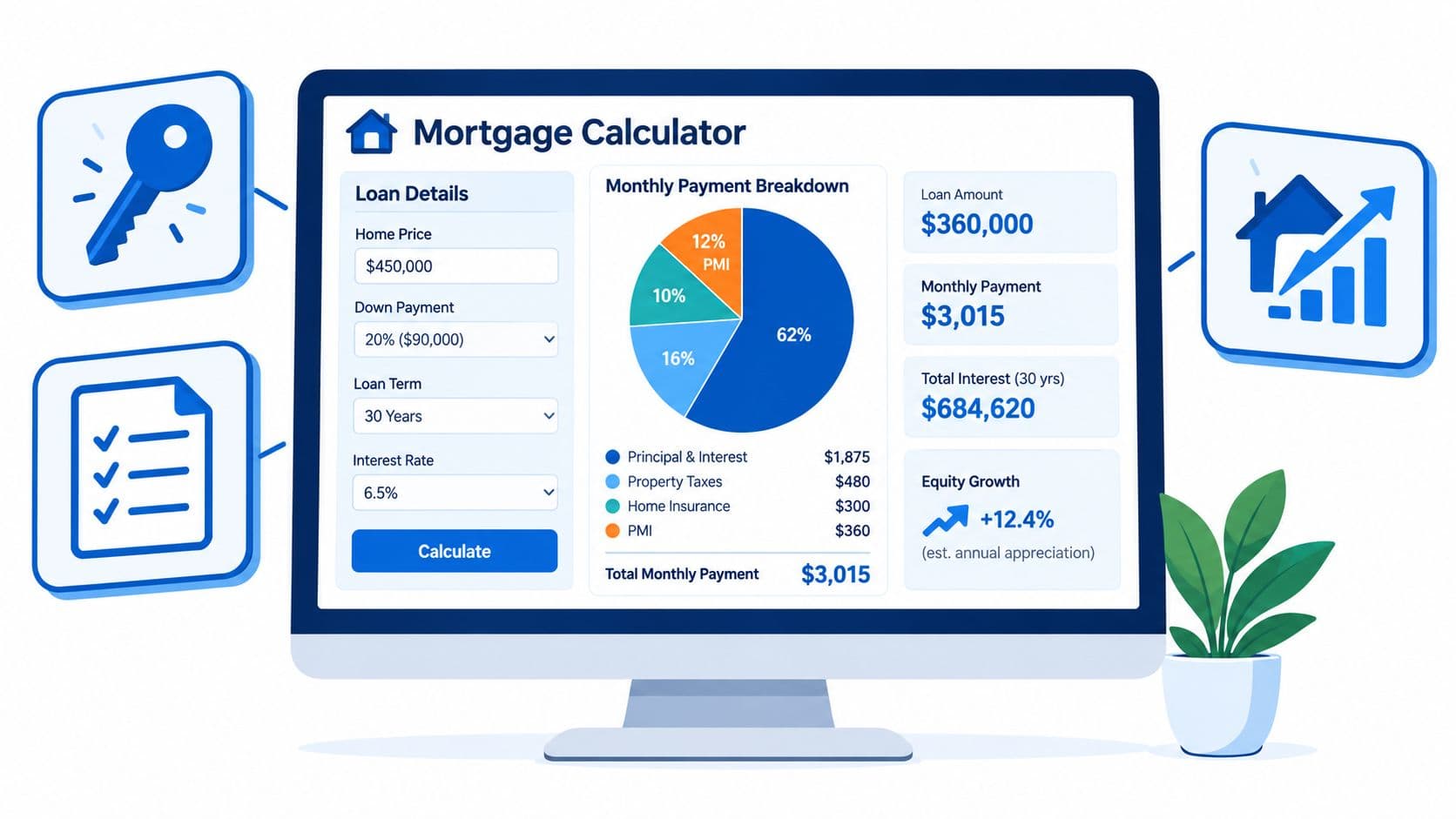
Private mortgage insurance is usually modeled as an annual percentage of the original loan amount, often around 0.46% to 1.50%, then divided by 12 to estimate the monthly charge. That's the number that turns a loan you thought looked manageable into a payment that suddenly asks a few more questions of your budget.
A lot of buyers meet PMI for the first time at the worst possible moment, right after they've found a house they can almost afford. The calculator says yes, the lender says yes, and then that little PMI line item shows up like a tax on optimism. It's not mysterious, though. It's a standard cost that matters most when your down payment is below 20%, and a good mortgage calculator with PMI should treat it as part of the actual monthly payment, not an afterthought.
Why PMI Shows Up in Your Monthly Payment

A buyer can focus on the house price and still miss the part that changes the monthly bill. Private mortgage insurance appears when the borrower puts less than 20% down, because the lender wants protection against a larger loss if the loan goes bad. A mortgage calculator with PMI should include that charge from the start, since leaving it out makes the payment look lower than it is.
PMI is not a minor add-on in practice. USMI's PMI data summary shows that private mortgage insurance has supported low-down-payment lending for a long time, and that the market remains active at a large scale. That matters because PMI is part of how these loans are priced, not a side detail to be handled later.
What PMI protects
PMI protects the lender, not the borrower. That is the point that shapes the monthly cost. The charge does not improve the home, lower the rate, or create equity for the buyer. It offsets the lender's risk when the borrower starts with limited equity.
Practical rule: If your down payment is small, the calculator needs to show PMI with principal and interest so you can judge the actual cash flow impact, not just the headline mortgage number.
A good calculator makes that extra cost visible right away. If it hides PMI, you are budgeting without the full payment in view, and that usually leads to a bad surprise later.
Inputs Required for a Mortgage Calculator With PMI
A mortgage calculator with PMI only works if the inputs are accurate. When the numbers are loose, the result looks precise while missing part of the monthly burden. PMI is especially sensitive to the loan amount, credit profile, and loan-to-value ratio, so a single flat assumption can distort the payment quickly.
The Urban Institute's chartbook shows that from 1999 to 2015, 20.7% of 30-year fixed-rate, full-documentation, fully amortizing loans carried private mortgage insurance, with the share as low as 9.1% in 2009 to 10 and as high as 24.6% in 2011 to 15. That same chartbook makes the larger point clear. PMI use varies with borrower profile and loan structure, so the calculator has to reflect more than a generic monthly add-on.
The fields that matter
A calculator should ask for the loan amount or purchase price, the down payment, the interest rate, the loan term, and estimated property taxes, homeowners insurance, and HOA dues when they apply. PMI rate belongs in that list too, because it changes the monthly payment and the total cost of carrying the loan long enough for cancellation to matter.
For a practical place to test those inputs, the The Money Maniac mortgage calculator follows the same monthly-payment logic readers need before they make an offer. If you want a second way to check repayment assumptions, a separate home loan repayment calculator can help you compare how the payment behaves over time.
The Bluevectis mortgage calculator is another useful reference point for checking how the core loan inputs affect the monthly estimate.
| Input | Why It Matters | Typical Range or Note |
|---|---|---|
| Purchase price or refinance amount | Sets the size of the loan base | Use the actual contract price or outstanding balance |
| Down payment | Drives loan-to-value and PMI eligibility | Smaller down payments usually mean PMI |
| Interest rate | Changes principal and interest | Use the lender's actual quote if you have it |
| Loan term | Changes monthly payment and total interest | Common terms are longer or shorter repayment periods |
| Property taxes | Part of the actual monthly housing cost | Include the local estimate if available |
| Homeowners insurance | Part of the actual monthly housing cost | Use an actual quote if you can |
| HOA dues | Can materially raise monthly housing cost | Include only if the property has them |
| PMI rate | Determines the insurance charge | Often modeled as an annual percentage of the original loan amount |
Consumer calculators typically divide the annual premium by 12, which is why the line item matters in monthly budgeting. That is the point many buyers miss when they focus only on principal and interest.
Why shortcuts create bad estimates
Many calculators make one quiet PMI assumption and stop there. That shortcut misses borrowers with average credit, higher or lower down payments, or loans that sit outside a tidy middle case.
A better calculator lets you test a range instead of one neat number. That gives a clearer view of monthly affordability, especially when the payment needs to be judged before cancellation is even possible.
How PMI Pricing Is Modeled in Calculators
A mortgage calculator with PMI usually prices the insurance as a percentage of the original loan amount, then spreads that annual cost across 12 months. That keeps the estimate easy to read, but it also explains why the PMI line often stays flat even as the loan balance falls. The payment does not automatically shrink with amortization until cancellation rules start to matter.
The FDIC consumer compliance manual notes that a commonly cited annual PMI range is about 0.46% to 1.50%, with the exact rate shaped by loan type, credit score, and whether the loan is fixed or adjustable. FDIC guidance supports the same practical point, a calculator has to keep principal and interest separate from insurance, because the loan balance changes even when the insurance charge does not.
What the math looks like
The basic formula is simple. Multiply the loan amount by the PMI rate, then divide by 12. That monthly figure gets added to the rest of the payment, which is why small rate differences can change affordability more than buyers expect.
A stronger credit profile usually means a lower PMI charge than a weaker one, even on the same house. Two borrowers can look at the same property and end up with very different monthly totals, and that is a function of the loan terms, not a calculator mistake.
For a broader repayment check, use this calculator before you buy. It helps you compare the full monthly path, not just the sticker price of the home.
Why scenario ranges beat one estimate
A useful PMI calculator should let you test a lower estimate, a middle estimate, and a higher estimate. That matters because the payment has to work even if the lender's quote lands near the expensive end of the range.
PMI can also behave differently in adjustable-rate setups, so a 5/5 ARM pricing overview is a good reminder that the loan type affects more than the interest line alone. A single “best guess” looks tidy, but it hides the trade-off you need to judge, whether the monthly payment stays manageable under more than one plausible PMI cost.
Reading Amortization With PMI Separated Out
A mortgage calculator with PMI is far more useful when the insurance cost sits in its own lane. If PMI is buried inside one monthly number, you can't tell whether the payment is mostly principal, mostly interest, or still carrying insurance that may not last forever. That makes it harder to see where your money is really going.
The clearest view is an amortization schedule that separates principal, interest, PMI, and the rest of the monthly housing cost. The reason is simple. Principal builds equity, interest is the cost of borrowing, and PMI is temporary if you follow the standard rules. Blend them together and the picture gets muddy fast.
What the schedule should show
| Month | Principal | Interest | PMI | Taxes and Insurance | Total Payment |
|---|---|---|---|---|---|
| 1 | Monthly principal amount | Monthly interest amount | PMI charge | Escrow items if included | Full monthly outlay |
| Mid-loan | Larger principal, lower interest | Lower than earlier months | Same until removal threshold | Escrow items if included | Full monthly outlay |
| After removal | Larger principal, lower interest | Lower than earlier months | $0 after PMI ends | Escrow items if included | Lower monthly outlay |
That layout matters because it lets you see the month when PMI drops off instead of assuming it will follow the balance down automatically. It also makes side-by-side comparisons possible. If you're deciding between keeping more cash on hand or pushing the down payment higher, the schedule gives you the actual cost of either choice.
Useful habit: Look for the point where PMI stops, then compare the cumulative insurance paid to the cash you preserved by not putting more down.
The clearest calculators also show scenario ranges. That's better than a single line because the same home price can produce very different monthly payments depending on credit profile and financing structure. Put bluntly, one checkbox is not a strategy.
PMI vs Larger Down Payment Trade-offs
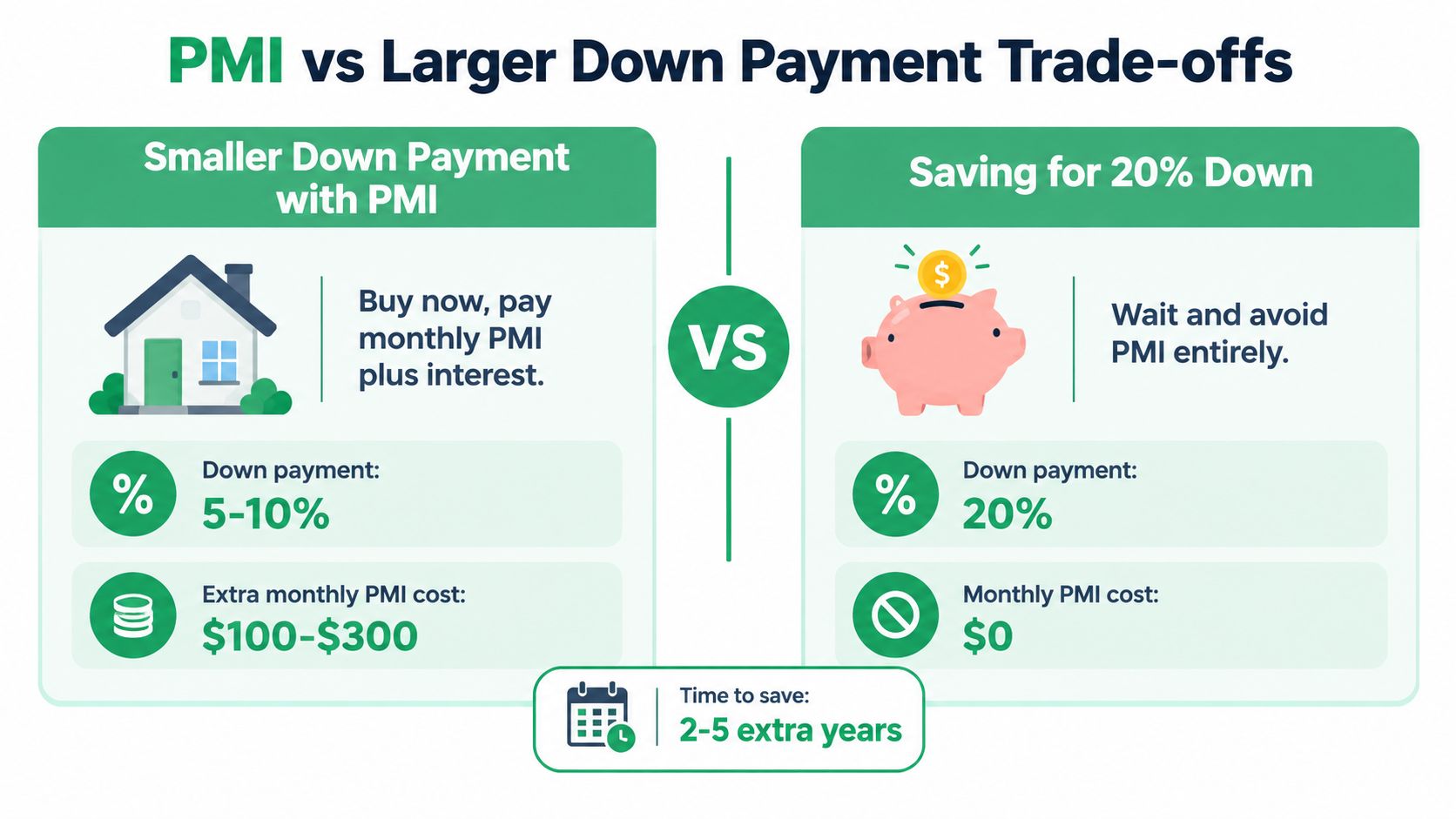
A smaller down payment gets you into the house sooner, but it usually means PMI and a higher monthly payment. A larger down payment can remove PMI, yet it also locks up more cash at closing. A mortgage calculator with PMI should show both paths clearly, because the better choice is not always the one with the lower payment today.
The key question is whether you want to carry a temporary insurance cost or keep a stronger cash reserve. That matters in practice. A home with no savings cushion can become expensive fast if a furnace fails, the roof leaks, or income drops.
Side-by-side comparison
| Scenario | Down Payment | Monthly PMI | Estimated Total PMI Paid |
|---|---|---|---|
| Smaller down payment with PMI | Lower than 20% | Above zero until removal | Higher, but front-loads access to the home |
| Saving for 20% down | 20% | $0 | $0 |
Recent market data show private mortgage insurance remains active in housing finance, with more than 800,000 borrowers purchasing or refinancing with private MI in 2024, and the PMI market showing strong credit performance in 2025 despite muted growth. For a broader look at housing costs, see why home prices matter for PMI decisions. Consumer guidance also notes that the removal date depends on loan balance, home value, and borrower action, not just the original down payment.
When the smaller down payment can be the smarter move
If waiting for 20% down means staying in place for years while rents rise or cash sits unused, PMI can be a reasonable temporary cost. If a larger down payment would leave you short on reserves, the smaller path gives you breathing room. That does not make PMI cheap, it just means the trade-off is real.
A practical filter helps. If the monthly PMI is manageable and your reserve would be too thin after a bigger down payment, the smaller-down-payment path may be the better risk choice. If the PMI charge is high and the home only works because you are stretching, the math starts to look less favorable.
How PMI Removal Rules Change Total Cost
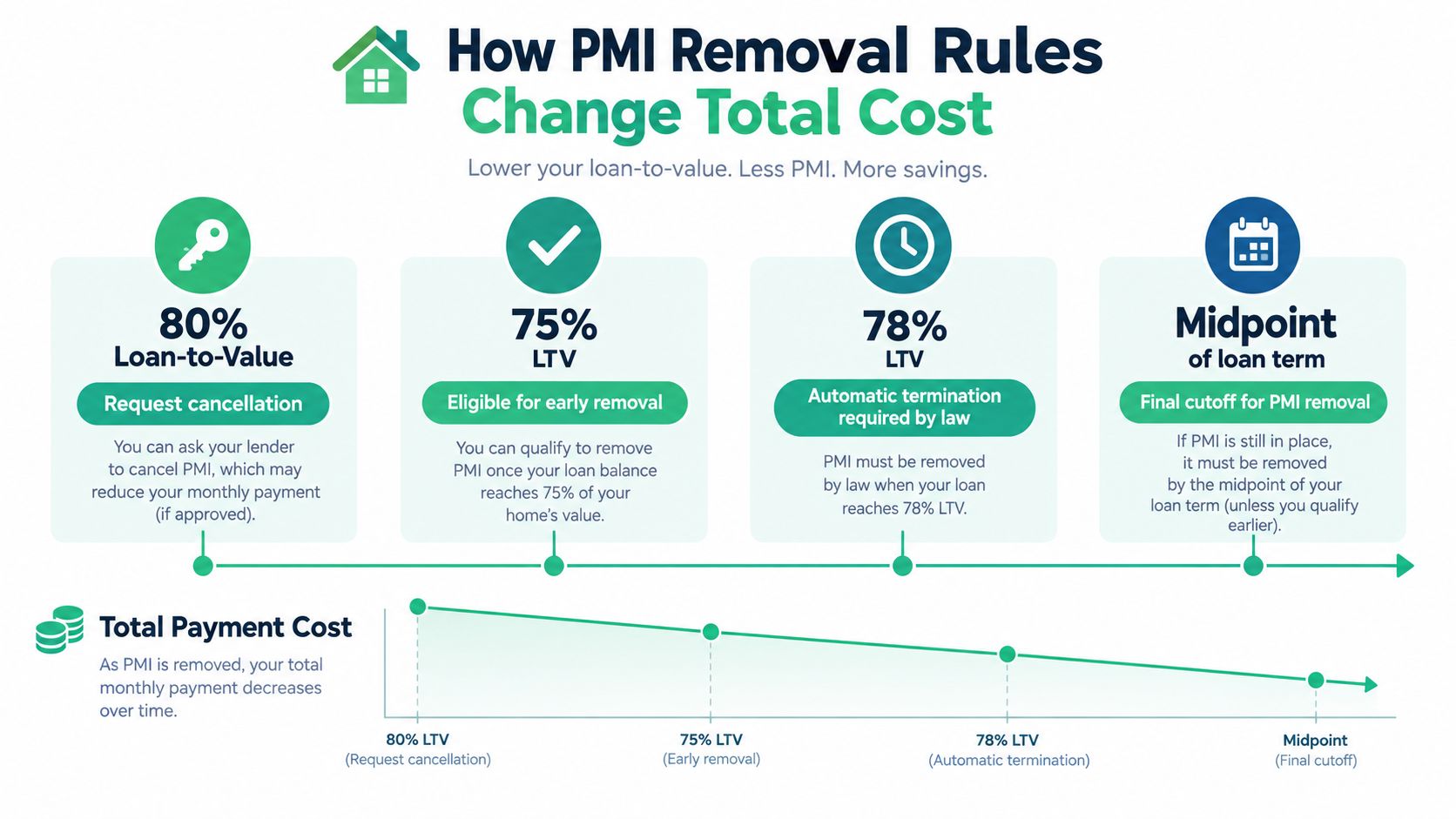
PMI rarely stays attached to a loan for the full term, and that exit timing changes the total cost more than many buyers expect. Federal guidance makes the key point clear, the end date is part of the cost.
A calculator that treats PMI as a fixed forever charge will overstate what you pay. The better view is simple: model the monthly charge, then model when it stops.
Why the exit month matters
The same loan can produce very different PMI totals depending on when the insurance ends. If a borrower reaches the exit point sooner, the cumulative cost falls. If the balance stays above the removal point for longer, PMI keeps adding to the payment month after month.
Here is the practical trade-off. On a $300,000 loan with a monthly PMI charge of $150, ending PMI after 5 years means about $9,000 in total PMI. If the same charge runs for 10 years, the total is about $18,000. The mortgage itself did not change, but the holding cost of the insurance doubled because the exit date moved later. That is why a useful calculator should compare scenarios, not just show one payment.
Extra principal payments can shorten the PMI timeline, and home value growth can do the same in practice. A strong calculator should let you test both, because a small change in paydown speed can shift the cancellation month enough to matter.
How to read the total cost
Start with the projected monthly PMI, then look at the month it is expected to stop. Compare that total with the cost of making a larger down payment up front. In some cases, paying PMI for a shorter period preserves cash without changing the final purchase much. In others, the insurance stays on long enough that the extra monthly cost outweighs the benefit of buying sooner.
That comparison is where the decision gets real. If you are evaluating Emerald Coast luxury properties for sale, the home price may look manageable on its own, but PMI can still change the monthly path enough to affect affordability. The right question is not only whether the loan fits today. It is how long PMI stays in the payment and what that does to the full cost.
When PMI Makes Sense and When It Does Not
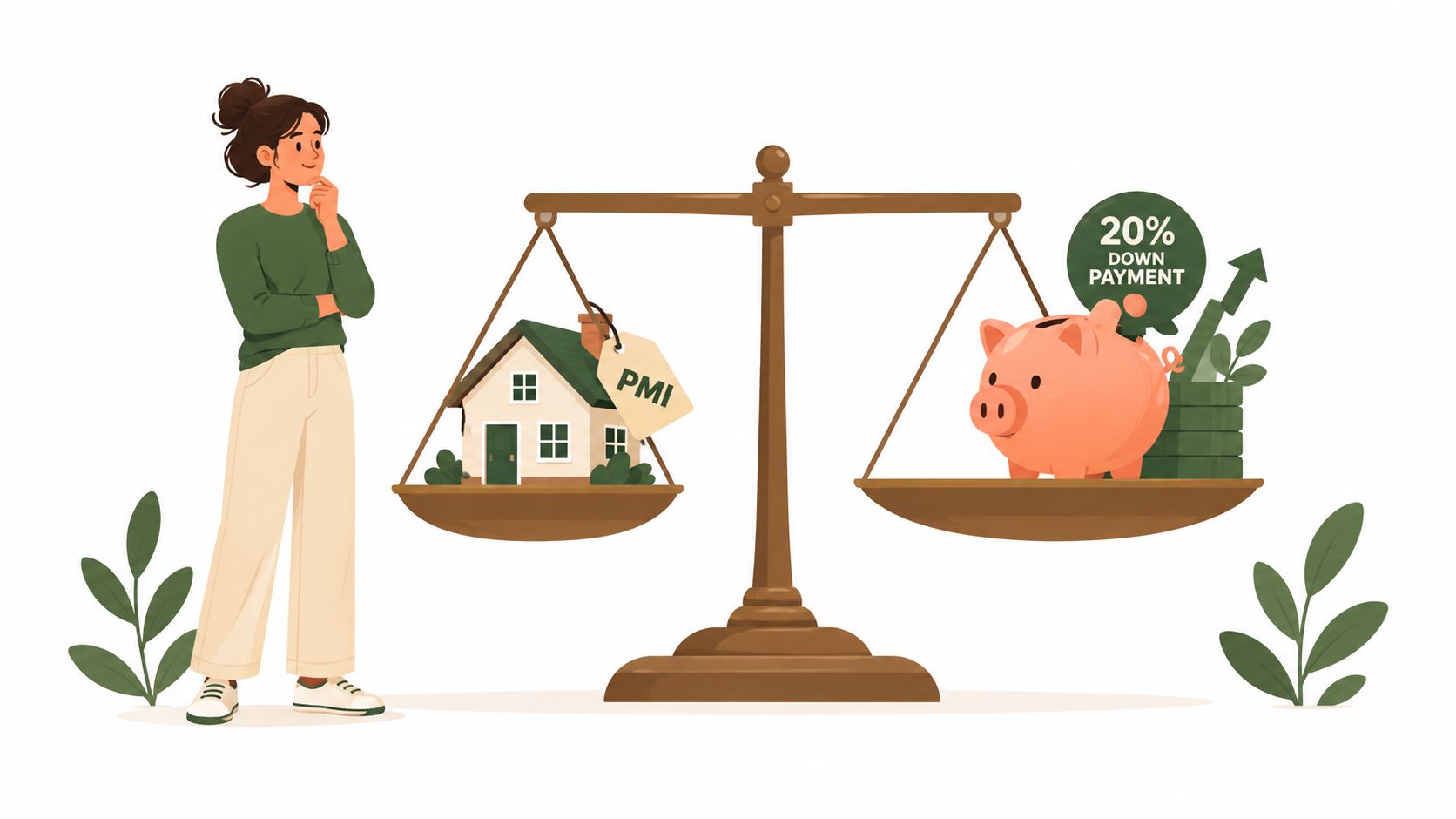
PMI makes sense when it's the price of keeping your cash position healthy enough to buy responsibly. It's harder to justify when the monthly charge is large, the home purchase already stretches your budget, and the calculator shows that the insurance will hang around longer than you expected. The right answer depends on timing, reserves, and how fast you can realistically get to removal.
A strong mortgage calculator with PMI should help you answer one question, not just “Can I qualify?” but “What does this choice do to my monthly life?” That's the difference between a decent purchase and a payment you'll resent every month until PMI finally drops away.
A simple decision lens
If your emergency savings would be fragile after a bigger down payment, PMI can be the less risky move. If your income is stable, your payment is comfortable, and the calculator shows a clear path to cancellation, paying PMI for a while may be acceptable. If neither of those is true, the bigger down payment or a less expensive home deserves a second look.
The annual PMI range many consumer calculators use, 0.46% to 1.50% of the loan amount, is a reminder that this is not a tiny rounding error. Bankrate's mortgage calculator guidance reflects that monthly charge by dividing the annual premium by 12, which is exactly why the line item matters in the monthly budget.
What the smarter choice usually looks like
The smarter choice usually isn't the one with the lowest first-month payment. It's the one that preserves enough flexibility that one surprise bill doesn't wreck the whole plan. PMI can be a sensible bridge, but it should be a bridge with a visible end date, not a permanent toll booth.
Quick Checklist Before and After Using a Mortgage Calculator With PMI
Before you run the numbers, gather the loan amount, the actual interest rate quote, the down payment, and any property tax, insurance, or HOA estimates you already have. If you guess on those inputs, the payment estimate will drift away from reality fast. A calculator can only be as sharp as the numbers you feed it.
After you get the result, check three things. First, does the payment include PMI separately. Second, does the calculator show when PMI can end. Third, does the payment still work if the monthly housing cost is higher than you first hoped. That last one is where optimism goes to get humbled.
Quick pre and post check
- Confirm the loan amount: Use the actual purchase price minus down payment, or the refinance balance if you're refinancing.
- Use the quoted rate: Don't plug in a round number just because it looks cleaner.
- Add the full housing cost: Include taxes and insurance if the calculator allows it, since lenders care about the whole payment.
- Check PMI removal timing: A good estimate should show when cancellation becomes possible under standard U.S. rules.
- Compare at least two scenarios: Run one with the current down payment and one with a larger down payment if you're still deciding.
For conventional loans, borrowers generally have the right to request PMI cancellation once the mortgage balance is scheduled to reach 80% of the home's original value, and federal guidance says the servicer must automatically cancel PMI at 78% LTV or at the midpoint of the loan term, whichever comes first. Federal Reserve guidance on PMI cancellation is the cleanest reminder that the payment should be viewed over time, not as a single snapshot.
The Takeaway on PMI and Monthly Affordability
A mortgage calculator with PMI is only useful if it treats PMI as a real, changing cost. That means showing the monthly premium, the total payment, and the likely point where the insurance can end. If the calculator hides that timing, it's giving you a partial answer dressed up like a full one.
The practical judgment is straightforward. PMI can be reasonable when it helps you buy without draining your reserves, especially if the calculator shows a plausible path to cancellation. It becomes much harder to defend when it pushes the budget too close to the edge or when the removal date is so far out that the insurance cost stops feeling temporary.
The right move is usually the one that protects your monthly cash flow and leaves room for the unexpected. Houses have a lovely habit of producing surprise expenses right after closing, which is rude but very on brand.
Get more posts like this
One short, useful email each Friday. Free, no spam, unsubscribe anytime.