How Much House Can I Afford on 100k: A Realistic Guide
How much house can I afford on 100k? Get a realistic, location-aware look at income, debt, rates, and down payments before you shop.

Daniel Anderson
Editor, The Money Maniac
October 15, 2026
17 min read
If you're searching how much house can I afford on $100k, you probably want one clean number. Most affordability articles are happy to provide one, usually somewhere between a low and high national estimate, then move on. That shortcut is convenient and often wrong.
A $100,000 salary equals approximately $8,333 in gross monthly income. A common starting point is keeping total housing costs near 28% of gross income, which creates a target of about $2,333 per month for principal, interest, property taxes, homeowners insurance, and applicable association fees (U.S. Census Bureau). That points toward roughly $350,000 to $400,000 in a moderate-rate environment for a borrower with no other debts and a 20% down payment, but the range can move sharply.
The useful question isn't “What price will a bank approve?” It's “What payment lets me buy a home and still handle repairs, savings, retirement contributions, taxes, insurance changes, and an unpleasant surprise or two?” Location, mortgage rates, existing debt, and upfront cash decide that answer.
The Question Almost Everyone Gets Wrong
A $100,000 salary is not a home-price converter. It does not produce one reliable purchase price because the same income can support very different payments across counties. Property taxes, insurance, HOA dues, existing debt, the mortgage rate, and your available cash all change the result.
The better question is: What monthly payment keeps me financially flexible after I buy? A lender may approve a payment that leaves too little room for repairs, utilities, transportation, healthcare, retirement savings, and ordinary surprises. Approval measures borrowing capacity. Your budget measures whether ownership remains sustainable.
A 28% housing guideline points to about $2,333 per month for total housing costs, including principal, interest, property taxes, homeowners insurance, and applicable association fees, as noted by the U.S. Census Bureau. Treat that figure as a starting guardrail, not a target you must reach.
The practical answer: On $100,000, start by testing a financially comfortable housing payment around $2,083 to $2,500 per month, then reduce it when taxes, insurance, debt, or limited savings make ownership more expensive.
A county tax bill can change the answer quickly. A lower-priced home in a high-tax area may require a larger monthly payment than a more expensive home in a lower-tax area. Insurance premiums and HOA dues create the same problem, especially for condos and townhomes. Compare the complete monthly cost, not the listing price.
Four variables that change the result
Local costs can outweigh the purchase price. Property taxes, homeowners insurance, and association fees belong in the housing budget. They can turn an apparently affordable home into a payment that leaves little cash for other priorities.
Rates reshape borrowing power. The purchase price may stay the same while the principal-and-interest payment changes materially. Test the payment at the rate you can obtain, then leave room for insurance and tax increases.
Existing debt reduces housing capacity. Car loans, student loans, personal loans, credit-card minimums, and other recurring obligations take a direct share of monthly cash flow. Two buyers earning the same salary do not have the same buying power if one carries a large car payment.
Down payment affects both liquidity and monthly cost. More cash usually means a smaller loan and potentially lower mortgage insurance. A smaller down payment preserves reserves but can raise the payment and add mortgage insurance. Do not empty your savings to reach a higher price range.
The result should be a range, not a magic price tag. A moderate-cost area, manageable insurance, limited debt, and strong reserves can support a higher purchase price. High taxes, costly insurance, substantial HOA dues, or thin savings should push your budget lower.
National affordability reinforces the point. In Q1 2026, housing expenses exceeded the traditional 28% front-end benchmark in 401 of 580 U.S. counties, or 69.1%, and averaged 30.3% of typical worker wages, according to RISMedia. Income alone cannot tell you what a home costs to live in. Your sustainable monthly payment is the number to protect.
What Actually Goes Into a Home Affordability Calculation
An honest affordability estimate starts with monthly cash flow, not the listing price. The lender cares about gross income and qualifying debt. You should care about those items too, then add the costs that make ownership livable rather than merely approvable.
Your gross monthly income is the starting point. On a $100,000 salary, that's approximately $8,333 per month. Lenders use debt-to-income ratio, or DTI, when deciding which mortgage products and terms you may qualify for, as explained by Fannie Mae's homebuying guidance.
The inputs that drive the calculation
-
Gross income: Use dependable income before taxes and payroll deductions. A bonus that varies wildly shouldn't carry the same weight as a stable salary.
-
Recurring debt: Add required monthly payments for auto loans, student loans, personal loans, credit cards, and other obligations. The payment matters more than the remaining balance for DTI purposes.
-
Mortgage rate and term: The rate determines the principal-and-interest payment. The term determines how quickly you repay the loan and how much interest the payment contains.
-
Down payment: More cash generally means a smaller loan. Less cash leaves more money available for reserves but may increase mortgage insurance and the monthly payment.
-
Property taxes and insurance: These costs belong in the housing budget. They can vary sharply by location and property, and lenders often collect them through escrow.
-
HOA fees: Association dues count as a housing obligation and can materially change the result. A modest-looking condo price can become costly when dues are added.
-
Closing costs and reserves: The down payment isn't the entire cash requirement. You also need money for closing, moving, immediate repairs, and the months when life refuses to follow the spreadsheet.
The headline price hides these moving parts. A home with a lower purchase price but higher taxes, insurance, or HOA dues may require a larger monthly outlay than a more expensive property in a lower-cost area. That's why you should calculate the total monthly housing payment before deciding whether a listing is affordable.
The number you should protect
A common starting point is the 28% housing guideline, but it shouldn't become a blind commandment. Use it to establish a ceiling, then reduce the target if your household has childcare, irregular income, aggressive retirement goals, or expensive transportation.
The model should work in this order:
- Start with gross monthly income.
- Subtract recurring monthly debt from the total-debt limit you choose.
- Reserve room for taxes, insurance, and HOA fees.
- Use the remaining amount for principal and interest.
- Test the result against your cash reserves and expected maintenance.
That sequence prevents the classic mistake of taking a loan amount, adding a down payment, and calling the result affordable. The monthly payment is where the household feels the decision.
The 28/36 Rule and the DTI Ceiling Lenders Actually Use
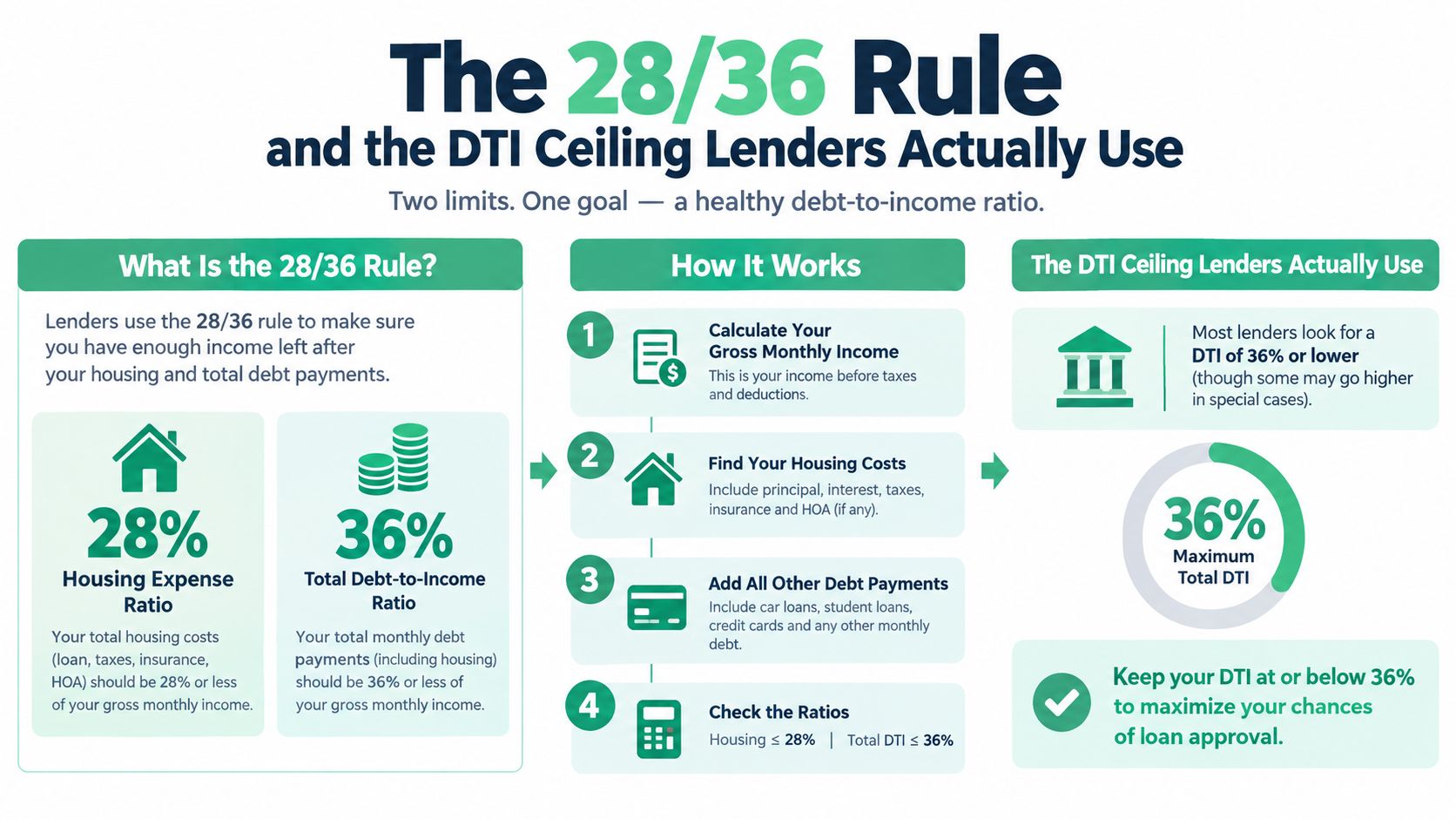
The traditional 28/36 framework gives you two useful reference points, but it is not a personal budget. Housing costs should stay near 28% of gross monthly income, while total recurring debt should remain near 36%. On $8,333 of gross monthly income, that equals roughly $2,333 for housing and approximately $3,000 for all qualifying debt combined.
The front-end figure covers housing. The back-end figure includes housing plus car loans, student loans, credit-card minimums, and other recurring obligations. If you already owe $1,000 each month, that payment uses part of the back-end limit before a mortgage enters the calculation.
Why approval can exceed comfort
Modern underwriting may accept a much higher DTI than the traditional rule. CFPB materials describe 43% as a benchmark in certain qualified-mortgage assessments, while clarifying that it is not a universal cap. Current Fannie Mae guidance can permit total DTI up to 50% for loans evaluated through its automated underwriting system. Manually underwritten loans generally start at 36% and may reach 45% when credit and reserve requirements are met (CFPB mortgage rules guidance).
These are qualification boundaries, not lifestyle recommendations. At 43% DTI, a borrower with no other monthly debt might technically have around $3,583 available for total obligations. That figure includes principal, interest, taxes, insurance, HOA dues, and other debts. It does not make $3,583 a wise housing payment.
For planning, I prefer 25% to 30% of gross income, or approximately $2,083 to $2,500 per month, before adjusting for taxes, insurance, maintenance, childcare, and retirement savings. This range leaves room for costs underwriting does not fully capture. Use the lower end if your income varies or your nonhousing spending is already high.
A $1,000 monthly debt payment doesn't make your salary smaller. It makes your available housing budget smaller.
Run the debt version of the calculation
Suppose you earn $100,000 and have a $1,000 monthly obligation across a car loan, student loan, and credit cards. The lender may still approve you, but that debt reduces the housing payment available under the same DTI framework.
Your practical options are straightforward:
- Lower the purchase price.
- Increase the down payment.
- Choose a property with lower taxes, insurance, or HOA dues.
- Pay down debt before applying.
Use a debt-to-income calculator to test those trade-offs instead of guessing. You can compare debt-to-income tools while building a side-by-side view of your obligations.
The right target is the payment you can carry after taxes and normal spending, not the maximum number on a preapproval letter. Lenders price risk. You live with the payment.
How Mortgage Rates Reshape the Affordable Price
Mortgage rates can change affordability by tens of thousands of dollars without changing your salary. Freddie Mac's historical record includes a 30-year fixed rate of 18.63% in 1981, showing how sharply borrowing costs have varied across generations (Freddie Mac mortgage-rate history).
Recent payment examples make the effect more concrete. A $300,000, 30-year mortgage costs approximately $1,896 per month at 6.5%, $1,996 at 7.0%, and $2,098 at 7.5%, before taxes and insurance, based on Freddie Mac's published figures (Freddie Mac PMMS). A difference of a few hundred dollars can decide whether the payment fits after taxes, insurance, debt, and ordinary spending.
The 7.40% illustration
At a 7.40% 30-year fixed average on October 8, 2026, principal and interest run approximately $691 per month for every $100,000 borrowed. A $2,000 principal-and-interest budget supports about a $290,000 loan before taxes, insurance, HOA fees, and mortgage insurance.
The loan amount is not the home price. With 20% down, it corresponds to roughly a $363,000 purchase price. With 10% down, it corresponds to about $322,000, before closing costs and reserves.
| Rate | P&I per $100k borrowed | Max loan at $2,000 P&I | Purchase price with 20% down |
|---|---|---|---|
| 6.5% | About $632 | About $316,000 | About $395,000 |
| 7.0% | About $665 | About $301,000 | About $376,000 |
| 7.40% | About $691 | About $290,000 | About $363,000 |
| 7.5% | About $699 | About $286,000 | About $358,000 |
The table isolates principal and interest. It does not set a complete housing budget. If taxes, insurance, and HOA fees consume $600 monthly, only $1,400 remains for principal and interest. At 7.40%, that supports approximately a $203,000 loan.
How to respond to rate pressure
Run the payment at a rate above your hoped-for quote. If the purchase only works at the optimistic rate, the purchase does not work yet.
You can respond with a larger down payment, a lower purchase price, less recurring debt, or a lower rate. Compare lenders because loan pricing and fees vary, but do not assume refinancing later will rescue an overstretched purchase. The right test is whether the payment leaves room for savings and unexpected costs, not whether a lender will approve it.
For the broader forces behind today's pricing pressure, read why homes are so expensive.
Down Payment Paths and the Cash You Actually Need
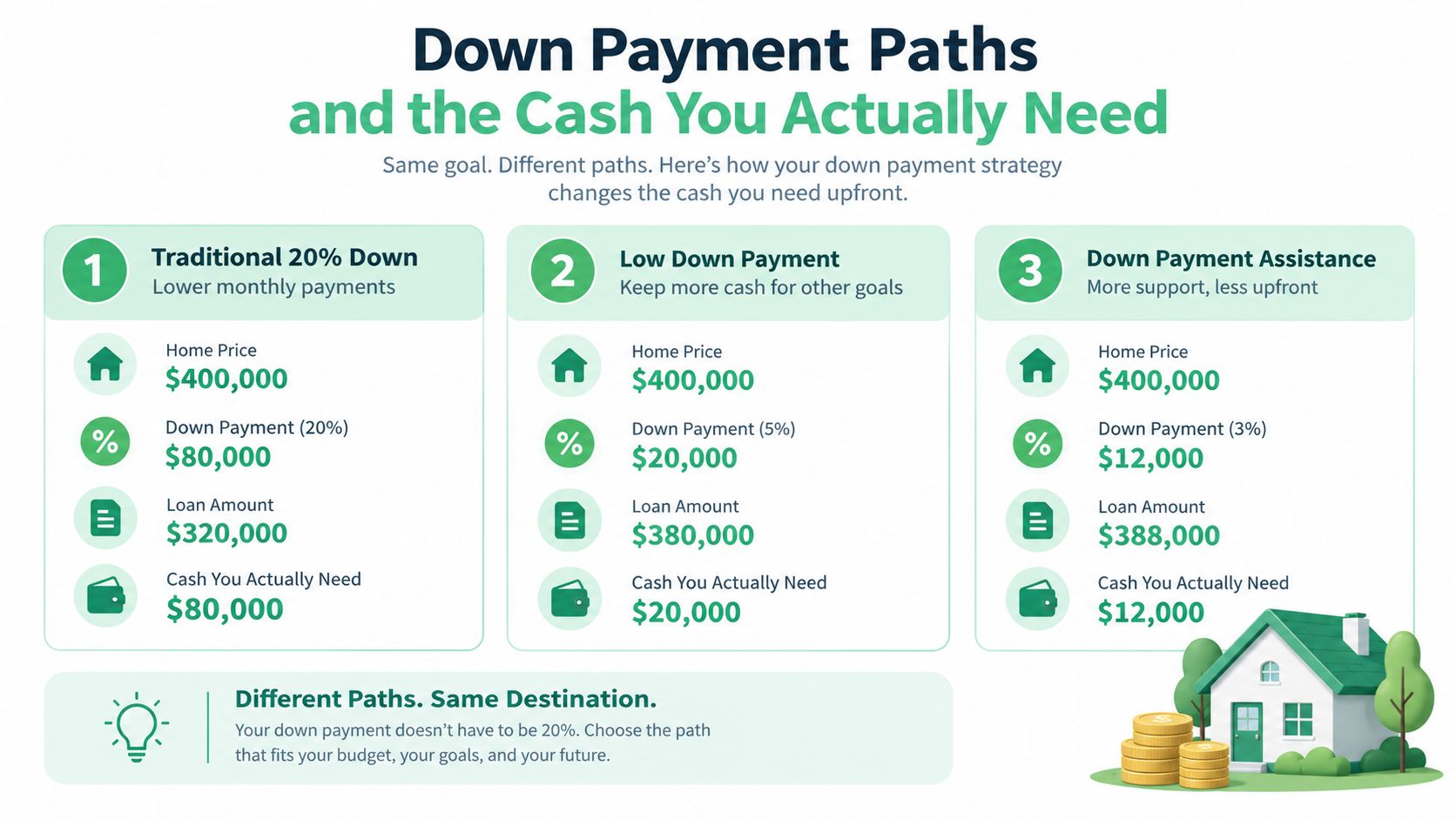
A 20% down payment is useful, but treating it as the default can distort the decision. It lowers the loan balance and can eliminate mortgage insurance, yet draining every liquid dollar to reach 20% leaves you exposed after closing. A smaller down payment may cost more monthly while preserving the cash that keeps a homeowner from reaching for a credit card when the water heater quits.
Realtor.com's May 2025 affordability benchmark used a 20% down payment and estimated taxes and insurance at 1.72% of home price annually. That method is transparent, but its cash assumption changes the headline answer. A buyer with the same salary and only a modest reserve faces a different practical decision.
Three paths, three trade-offs
A 3% path keeps more cash available for closing and reserves. It also produces a larger loan relative to the purchase price and may involve mortgage insurance. The payment can be higher, and the buyer has less initial equity if prices fall or selling costs arrive early.
A 10% path splits the difference. The loan is smaller than with a low-down-payment option, while the required cash is less severe than 20%. It can be a reasonable middle route when the buyer has savings but doesn't want to empty the account.
A 20% path reduces the loan and may remove mortgage insurance. It makes the monthly budget cleaner, but the cash requirement is substantial. The down payment also competes with emergency savings, retirement contributions, moving expenses, and immediate repairs.
Compare the cash, not just the percentage
| Down payment path | Main advantage | Main risk | What to check |
|---|---|---|---|
| 3% | Preserves more upfront cash | Larger loan and possible mortgage insurance | Monthly payment and reserve level |
| 10% | Balances liquidity and payment size | Still requires meaningful cash | Insurance, closing costs, and remaining savings |
| 20% | Smaller loan and potentially no mortgage insurance | Can drain liquidity | Emergency fund and post-closing repairs |
Your total cash requirement includes the down payment, closing costs, prepaid taxes and insurance, moving expenses, and a reserve for ownership surprises. A calculator showing only the down payment is giving you a partial answer.
Before choosing a loan, compare programs available in your location and situation. A guide to first-time home buyer programs BC 2026 illustrates why buyers should research assistance options rather than assume every purchase requires the same upfront cash. The principles vary by jurisdiction, and U.S. buyers should verify the rules for their own state and loan type.
You can also use this framework for how much you should save for a house. My opinion is blunt: a 20% down payment that leaves you with no emergency cushion is worse than a smaller down payment that leaves you financially functional.
What $100k Buys in Three Real Markets
A $100,000 salary does not buy one national house price. It buys a monthly payment, and that payment changes sharply with property taxes, insurance, HOA dues, interest rates, and down payment. Use the table below as a set of decision scenarios, not a promise about available listings.
| Market profile | Approx. home price | Taxes and insurance | Total monthly PITI | Rate assumed |
|---|---|---|---|---|
| High-cost metro condo | About $200,000 | High relative to price, plus HOA exposure | Near the buyer's conservative budget | Moderate to high |
| Moderate Midwest market | About $360,000 | More manageable relative to price | Near the buyer's conservative budget | Moderate |
| High-tax coastal state | About $260,000 | Property taxes can approach $500 monthly | Near the buyer's conservative budget | Moderate to high |
Assumptions for these illustrations: the examples use a moderate to high mortgage rate, a down payment sized to the buyer's conservative budget, estimated property taxes and insurance, and HOA costs where applicable. Confirm the actual rate, tax bill, insurance quote, and association fees before treating any price as affordable.
The point is simple. A salary-only estimate misses the expenses that determine whether the payment remains comfortable.
The lower-cost Midwest example
In a moderate Midwest market, a $100,000 earner may fit a single-family home around $360,000 within a conservative budget when the down payment, interest rate, taxes, insurance, and existing debts line up. The purchase price is higher than the condo example, yet the ongoing costs may take a smaller share of the budget.
That price still requires scrutiny. Check the local tax bill, obtain an insurance estimate, and budget for maintenance. An older property may replace lower taxes with larger repair bills. The Midwest advantage is not a free pass. It is the possibility of keeping more monthly cash available for ordinary spending and future savings.
The condo and coastal examples
A $200,000 condo in a high-cost metro can use the same monthly budget as a far more expensive home elsewhere. HOA dues, building insurance, and property taxes may absorb a large share of the payment. The buyer can end up with less space while paying for location and shared-building services.
A $260,000 starter home in a high-tax coastal state may carry property taxes approaching $500 per month, depending on the area and assessment. That bill leaves less of the monthly budget for principal and interest, reducing the purchase price the salary can support even when the listing looks affordable.
Location changes the answer more than a national calculator suggests. Housing costs can exceed the traditional 28% benchmark across many counties, leaving workers with less room for savings, repairs, and other household expenses.
Run the comparison for your ZIP code. Get an insurance quote, inspect the tax record, request HOA documents, and add commuting costs. The payment that keeps you financially flexible matters more than the largest loan a lender will approve.
Buying Power, Cash Flow, and the Question That Matters
A lender's maximum approval is not your buying power. Real buying power is the largest payment you can carry without losing flexibility. The right payment leaves room to keep saving, absorb a repair, manage a temporary income interruption, and make ordinary household decisions without treating the mortgage as the deciding factor.
Affordability pressure remains visible even for households near the median income. A family earning $106,800 needed 34% of income for the mortgage on a median-priced new home in Q2 2026, based on a 6.51% average 30-year rate and a $410,700 median new-home price, according to the previously cited housing-affordability analysis. That comparison does not set your budget, but it shows why a six-figure income can still produce a tight monthly cash flow.

Five ways to improve the result without becoming house-poor
-
Pay down revolving debt before applying. Credit-card minimums use DTI capacity and often carry expensive interest. Lower required payments can improve the housing calculation without increasing your salary.
-
Choose a smaller down payment when liquidity matters. A low-down-payment conventional or FHA loan can preserve cash for closing costs and emergencies. The trade-off is a larger loan and potentially higher mortgage insurance. Compare the complete monthly payment, not only the cash required upfront.
-
Consider buying down the rate with points. An upfront payment may reduce the interest rate. Use a break-even calculation: compare the monthly savings with the cost of the points and the length of time you expect to keep the loan. A lower rate is not automatically a better deal.
-
Shop at least three lenders. Request the same loan structure, rate assumptions, fees, and estimated payment from each one. A lower advertised rate may lose its advantage if the closing costs are higher.
-
Change the property strategy. A smaller home, condo, multi-generational arrangement, or different neighborhood can reduce the payment. Changing the property often creates more room than forcing a tiny improvement in the budget.
Risks that belong in the spreadsheet
Keep cash after closing. Homeowners still face repairs, insurance changes, and maintenance costs that do not appear in principal and interest.
Co-signing can reduce your future borrowing capacity because another loan may affect your DTI. Treat someone else's mortgage obligation as a claim on your finances.
Base the purchase on income you can document today. A future raise can improve your position later, but it should not be carrying the budget now.
Compare total cost, not just the rate. Points, lender fees, mortgage insurance, property taxes, and homeowners insurance all affect the result. The lowest-looking monthly payment may require the most cash upfront.
My recommendation: Choose the payment that lets you keep saving after closing. A larger home has value, but financial flexibility pays you back every month.
Your Next Steps and the Mortgage Calculator
Start with the payment you can carry, not the maximum a lender approves. For a $100,000 salary, gross monthly income is approximately $8,333. Enter that figure, every recurring debt, your realistic down payment, and property-tax and insurance estimates for the ZIP code you are considering. A housing target near $2,333 per month is a useful starting point, then adjust it for other debts, local costs, and the cash you want to keep after closing.
Use The Money Maniac mortgage calculator to test principal, interest, property taxes, homeowners insurance, and mortgage insurance. Change the rate and down payment instead of treating one result as a verdict. Then verify the assumptions with lenders, insurers, and local tax records.
Your five-step action plan
-
Pull your credit reports. Correct errors before applying. Your credit profile can affect both approval and the rate used in your payment estimate.
-
Pay down revolving balances. Prioritize debts with large required monthly payments. Reducing those obligations can improve monthly flexibility, even when the balance itself is not large.
-
Get pre-qualified with at least three lenders. Give each lender the same income, debt, down-payment, and property assumptions. Compare the resulting loan structures and estimated cash requirements, not isolated rate advertisements.
-
Build a closing and reserve fund. Keep cash for closing, moving, immediate repairs, and ordinary household expenses. If you are considering a fixer-upper, find drywall installation costs before treating the lower purchase price as a bargain. A down-payment goal should never consume every reserve dollar.
-
Recalculate every six months. Rates, debts, income, taxes, insurance, and savings change. Your affordable payment should change with them.
Three questions buyers usually ask next
How long will saving take on a $100,000 salary? Work backward from the down payment, closing costs, and reserve requirement. Divide that cash target by a monthly savings amount you can maintain without replacing savings with credit-card debt.
Does a co-borrower change the math? Yes. The co-borrower's income and qualifying debts affect the application. The legal obligation is shared too, so agree on ownership, payments, and a repayment plan before buying.
What if I may move within five years? Include transaction costs, maintenance, and the risk of selling in a weak market. A lower purchase price and stronger liquidity may be wiser than stretching for a home that depends on appreciation.
The practical answer to “how much house can I afford on $100k” is to start around a $2,083 to $2,500 monthly housing target, test local costs, subtract existing debt, and protect your reserves. The bank's maximum is only a data point. Sustainable cash flow is the decision.
Get more posts like this
One short, useful email each Friday. Free, no spam, unsubscribe anytime.