Closing Costs Explained: What Buyers Pay at Settlement
Closing Costs Explained with dollar ranges by price, a step-by-step cash-to-close estimate and practical ways to lower what you bring to the closing table.

Daniel Anderson
Editor, The Money Maniac
November 12, 2026
11 min read
Use 2% to 5% of the purchase price as a starting guess, not a budget. Closing costs can rival the down payment for some buyers: 14.5% of low-income first-time buyers faced costs at least as large as their down payment, according to the CFPB home loan toolkit's summary of Fannie Mae findings. The share was 9.5% among first-time buyers and 5.2% among all buyers.
Check your Loan Estimate line by line before settling on a cash-to-close figure. Focus on which charges can legally rise, and set aside enough for the high case rather than the hopeful one.
What Closing Costs Include, Item by Item
Closing costs are the upfront transaction and mortgage expenses paid on top of the down payment. The closing paperwork groups them into one total, but each line has a different purpose. Sort them into service fees, prepaids, and escrow before deciding what to challenge.
| Category | What it covers | How it is priced | Typical range |
|---|---|---|---|
| Lender charges | Origination fees and discount points | Percent of the loan amount; 1 point = 1% of the loan | Origination about 0.5% to 1% of the loan |
| Third-party services | Appraisal, credit report, title search and title insurance | Flat fees or a share of the purchase price | Title insurance often 0.5% to 1% of the price |
| Government and recording charges | Recording fees and, in some places, transfer taxes | Set by county or state | Flat per-document fee on the local schedule |
| Prepaid items | Property taxes, homeowners insurance, prepaid interest | Based on closing date and annual bills | Bills collected in advance |
| Initial escrow deposit | Cushion held for future taxes and insurance | Based on the lender's escrow schedule | A few months of taxes and insurance |
The two prices that move the bill
The Consumer Financial Protection Bureau's mortgage-cost explanation defines a discount point as 1% of the loan amount, paid upfront to reduce the interest rate. On a $300,000 loan, one point costs $3,000. Origination fees and title insurance can also add substantially to the bill, so check how each is calculated rather than treating all charges as a single percentage.
Prepaids and escrow deposits are advance payments toward taxes, insurance, and interest. Check the dates and amounts used to calculate them, then separate those lines from fees for services.
Sort the bill: Find each line on the Loan Estimate and classify it as a service fee, prepaid, or escrow deposit before deciding whether the amount needs an explanation.
Typical Closing Costs by Purchase Price
Closing costs can add thousands of dollars beyond the down payment. The CFPB's homebuying budget guide gives a typical range of 2% to 5% of the purchase price. On a $400,000 home, that means $8,000 to $20,000.
Fannie Mae reports a median of 2.18% of the purchase price, net of credits, a useful middle estimate for early planning. That works out to $5,450 on a $250,000 purchase and $8,720 on a $400,000 purchase.
| Purchase price | Low end (2%) | Fannie Mae median (2.18%) | High end (5%) |
|---|---|---|---|
| $250,000 | $5,000 | $5,450 | $12,500 |
| $400,000 | $8,000 | $8,720 | $20,000 |
Down payment and closing costs
A 10% down payment on a $400,000 home is $40,000. Add the estimated closing costs, and the cash needed before credits is about $48,000 to $60,000. Keep the down payment and closing costs separate in your budget so the total does not catch you off guard.
The percentage varies because loan type changes mortgage insurance and lender fees. A smaller down payment can add insurance charges, while condos and unusual properties may require extra third-party work. Optional services, such as a survey or attorney closing, add flat costs that a percentage estimate may not capture.
Use the low, median, and high figures as a first-pass estimate, then replace them with the charges on your Loan Estimate when the lender issues it. If your income is near six figures, compare the payment and cash needed at closing with this guide to how much house you can afford on $100k.
Where Closing Costs Differ by State
In 2025, average purchase-mortgage closing costs were $4,528. Delaware averaged $12,707, or 3.06% of the purchase price, while South Dakota averaged $1,386, or 0.39%, according to Yahoo Finance's report on closing costs by state. Those figures show why the 2% to 5% rule is only a starting guess: your state can shift the bill sharply.
| Location and year | Average closing costs | Share of purchase price |
|---|---|---|
| National average, 2025 | $4,528 | Not published as one national percent |
| Delaware, 2025 | $12,707 | 3.06% |
| South Dakota, 2025 | $1,386 | 0.39% |
| National average, 2024 (LodeStar) | $4,661 | Not stated as a percent of price |
| National median, 2024 (LodeStar) | $3,513 | Not stated as a percent of price |
HousingWire's report on LodeStar's study gives a 2024 average of $4,661 and a median of $3,513. A later HousingWire report on 2025 costs says purchase-mortgage closing costs fell 2.9% that year, while 23 states saw costs rise.
Why the average misleads
Averages can describe different baskets of charges. The figures in the Yahoo Finance report and LodeStar's figures reported by HousingWire are not directly interchangeable: one reports state-level 2025 averages, while the other reports national 2024 averages and a median. Check what each estimate includes before using it to set your budget.
Transfer taxes, recording fees, and title charges vary by location. Prepaid taxes and escrow funding depend on your tax bill and closing date, so a national average cannot predict those lines for your purchase.
Use the state figures as a warning to check your Loan Estimate, not as a substitute for it. Read the charges line by line and ask your lender whether each percentage-based fee is calculated from the loan amount or the purchase price. If your state's typical costs run high, plan around the higher end rather than relying on the national headline.
How to Estimate Your Own Cash to Close
Count each dollar once. Double-counting, or forgetting the escrow cushion, is how a tidy estimate blows up on signing day. Work from the loan outward, then subtract money already committed.
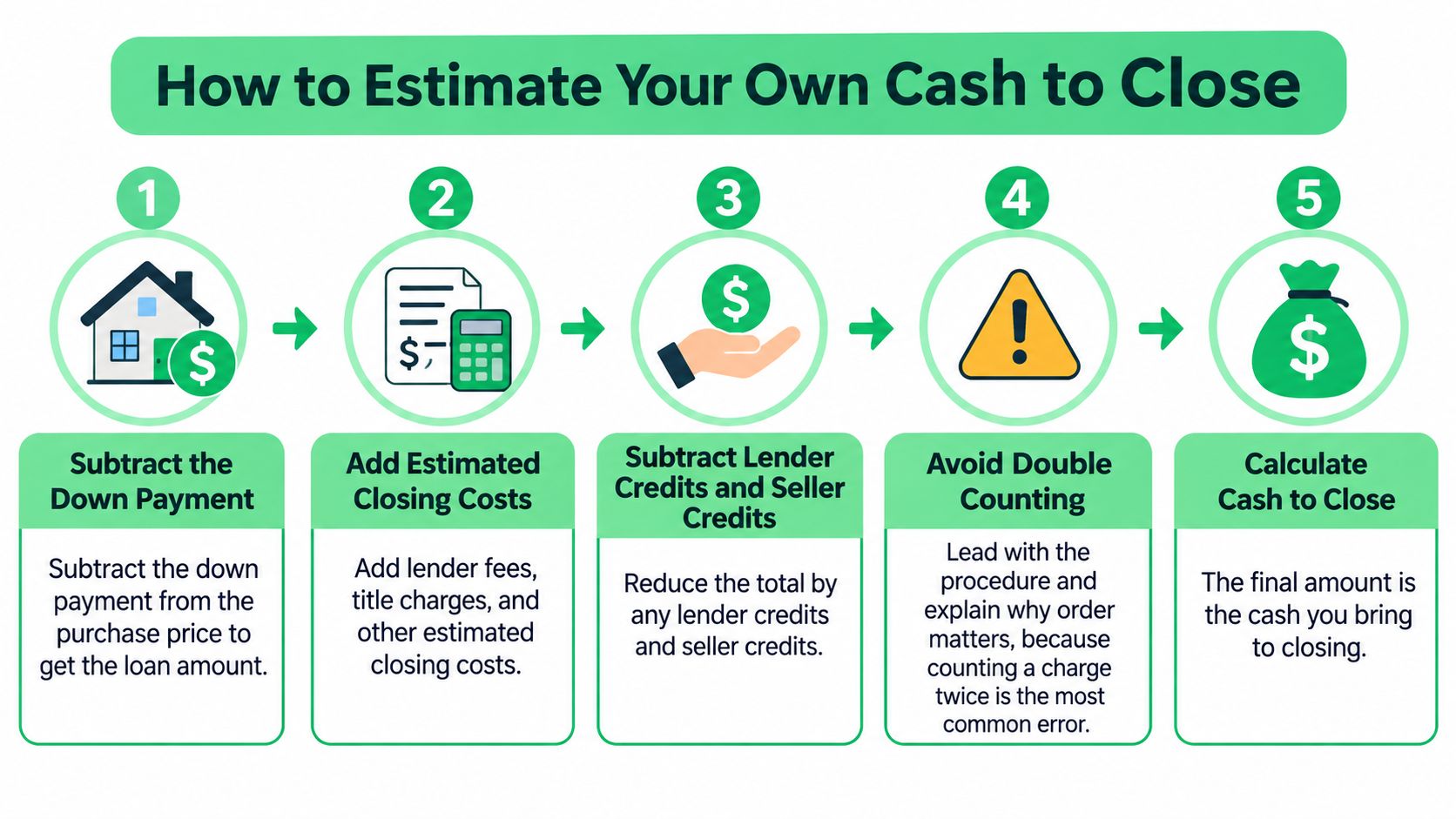
- Subtract the down payment from the purchase price. That remainder is the loan amount, and several lender charges are a percent of it.
- Add lender charges and any discount points from the Loan Estimate. One point on a $320,000 loan is $3,200.
- Add third-party services: appraisal, credit report, title search, and title insurance. Use quoted amounts, not a guess from a forum.
- Add government and recording charges from the estimate. These follow the local schedule.
- Add prepaids as the lender estimates them: interest from closing through month-end, the first homeowners insurance premium, and prepaid property taxes. A later closing date raises prepaid interest.
- Add the initial escrow deposit. This is the cushion for future taxes and insurance, and it is the line people skip because it is not a fee.
- Subtract lender credits and seller concessions. They lower cash today and may come with a higher rate or a changed price.
- Subtract earnest money already paid. It counts toward the cash you need. It is not an extra closing cost.
Run the total twice, once with low quotes and once with high quotes, and set both next to the 2% and 5% planning range for your price. The last line should be cash still needed, not a gross fee list.
In a 2025 Bankrate survey, 81% of aspiring homeowners called the down payment plus closing costs at least a somewhat significant obstacle, and 52% called them very significant. Earnest money leaves when the offer is accepted. The rest is due at settlement, after the final disclosure is in your hands, not on application day. Subtract only credits, concessions, and documented gifts the lender has already put on the estimate. A "no-closing-cost" offer usually moves the expense into the rate or the loan balance.
If the monthly payment is the other half of the decision, compare it with rent using our mortgage payment versus rent calculator.
Checking the Loan Estimate Against the Closing Disclosure
Some charges cannot rise at all. Others can rise only inside a cap. Under the TILA-RESPA framework, the Loan Estimate sets those limits, and the CFPB's tolerance explainer is the rulebook.
Charges paid to the lender, the broker, or their affiliates, plus required services you cannot shop for, generally cannot exceed the estimate unless a valid changed circumstance occurs. Recording fees and shoppable third-party services share a cumulative 10% tolerance. Prepaid interest, property-insurance premiums, initial escrow deposits, and some borrower-selected services can change without that cap, because timing, your insurer, or an outside bill sets the amount. If a regulated cost exceeds its limit without a qualifying change, you may be entitled to a refund of the excess.
| Cost group | Can it rise? | What to do |
|---|---|---|
| Lender charges and points | No, unless a valid changed circumstance occurs | Ask for the reason in writing and challenge any unexplained increase |
| Required services you cannot shop for | No, same limit | Confirm the provider and amount match the estimate |
| Recording fees and shoppable third-party services | Combined total may rise up to 10% | Add up the group and compare it with the estimate |
| Prepaid interest and homeowners insurance premiums | Yes, no cap | Check the amounts against your actual policy and bills |
| Initial escrow deposit | Yes, no cap | Ask the lender how the deposit was calculated |
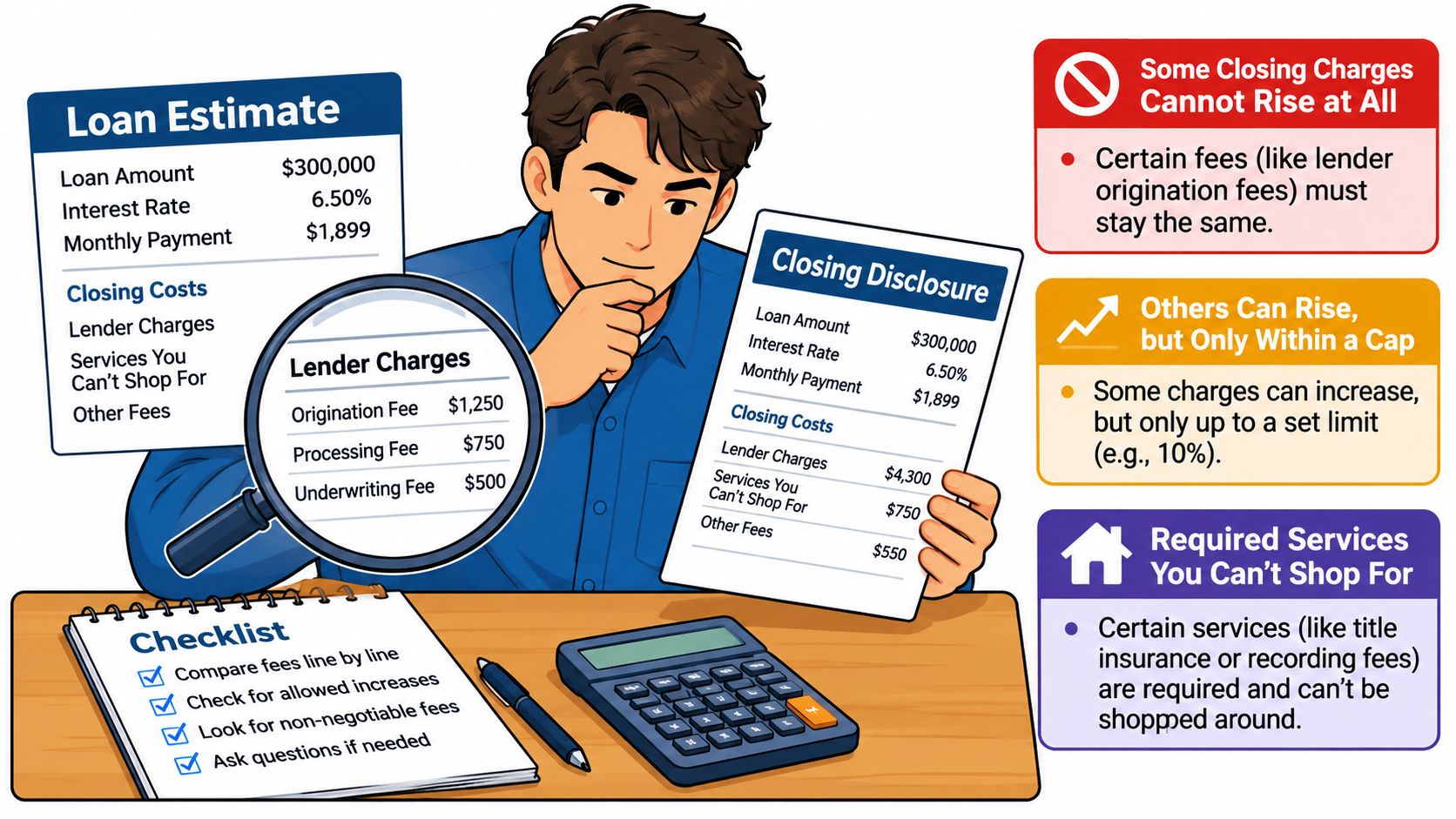
Five checks before you sign
The CFPB guide to the Loan Estimate and Closing Disclosure says the lender generally must send a Loan Estimate within three business days of application, and you must receive the Closing Disclosure at least three business days before you consummate the loan. An inaccurate APR, a new prepayment penalty, or a changed loan product can restart that three-day clock.
- Put the Loan Estimate and the Closing Disclosure side by side.
- Match each line by category, not by page position. The layouts differ.
- Mark every increase and note its tolerance group.
- Ask the lender, in writing, for the reason behind each increase.
- If a capped cost is over its limit without a valid reason, ask about the refund before you sign.
Use the three days to check. Do not skim while everyone else is packing up the conference room.
Ways to Lower the Cash You Bring to Closing
You have real levers: seller concessions, lender credits, discount points, rolling an FHA upfront premium into the loan, shopping title and settlement services, and no-closing-cost pricing. Each one trades cash today for something else. Pick the trade on purpose.
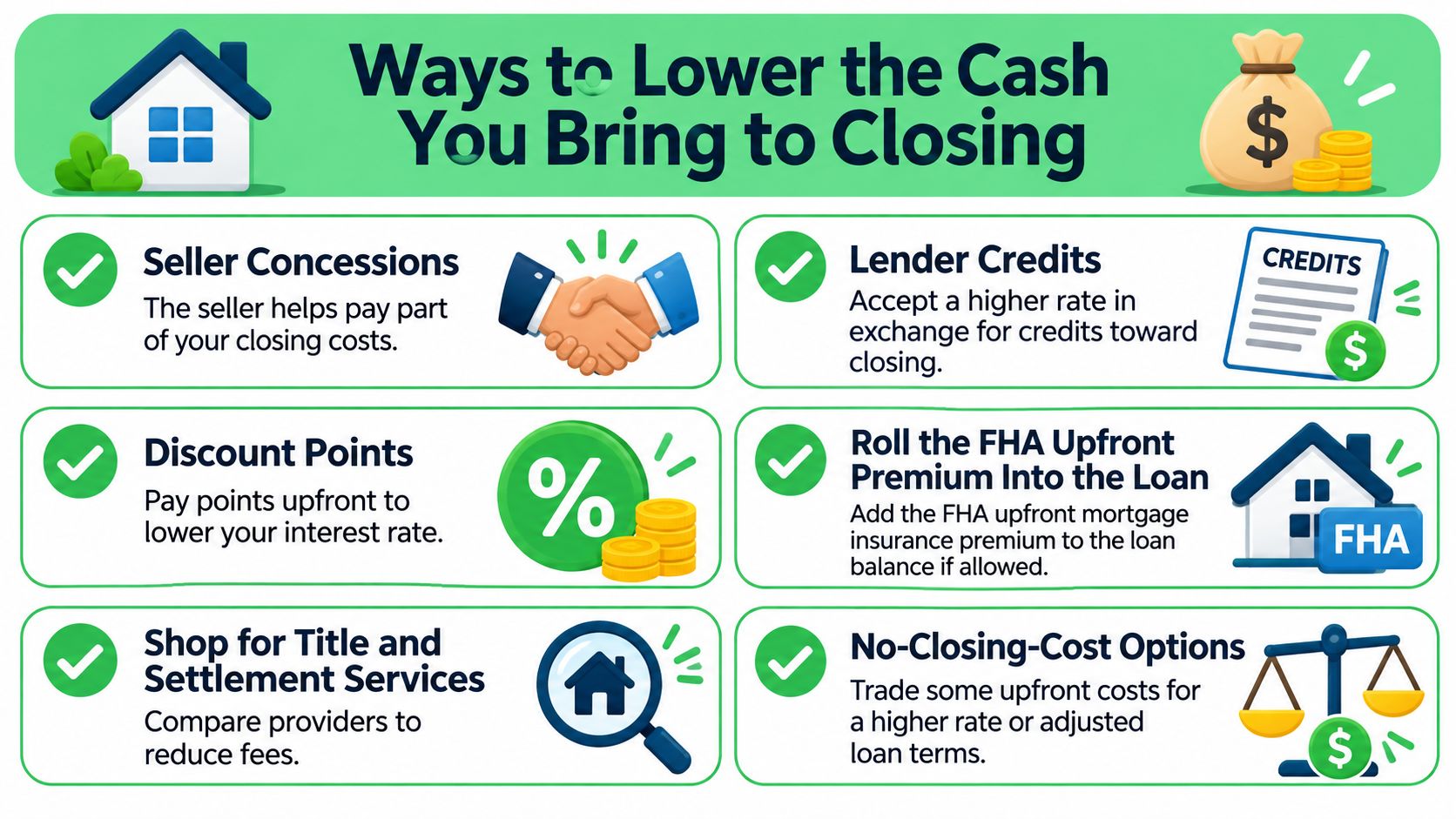
| Tactic | Cash today | What you give up |
|---|---|---|
| Seller concession | Lower, if the contract allows it | Negotiating room on price or repairs |
| Lender credit | Lower | A higher interest rate |
| Discount point | Higher | You buy a lower rate and need time to break even |
| FHA upfront premium rolled in | Lower | A larger loan balance and interest on that premium |
| Shopped title package | Often lower | Time spent comparing full quotes |
| No-closing-cost pricing | Much lower | A higher rate or a larger balance for the life of the loan |
The FHA premium does not vanish
The CFPB's mortgage-insurance explainer is blunt about FHA loans. You pay an upfront mortgage-insurance premium and an ongoing monthly premium. If cash is short, you can generally roll the upfront premium into the loan. Adding a $7,000 premium means you pay interest on that $7,000 for as long as it stays in the balance. Pricing does not vary much with credit score, so include both insurance charges when you compare FHA with conventional financing. Compare total cash, monthly payment, loan balance, and long-run cost. Ignore the minimum down payment as a standalone brag.
Lender credits are the mirror image of points. Credits cut cash now and raise the rate. Points cost cash now and cut the rate. A point pays off only if you keep the loan long enough to recover the upfront dollars in monthly savings. Ask the lender for the break-even month in writing, then decide whether you will still own the loan then.
Title and settlement services are where buyers often find real savings, because you can shop some of them. The CFPB's shopping guide says title charges can include the search, the policy, related issuance work, and sometimes the closing agent's fee. Itemized title-company lines should add up to the title total on the federal forms. Get competing quotes where the lender allows it, and compare the full package, not the headline premium.
Prefer moves that cut cash without raising the lifetime cost of the loan. Treat every credit as a rate trade you understand before you accept it. If the gap is a savings problem rather than a fee problem, start with how much you should save for a house.
Set Aside the High Case Cash to Close
Sign only when the high-case cash to close is sitting in an account the lender will accept. The low quote is a wish. The high quote is the decision.
Build two columns from the Loan Estimate.
- List lender charges, third-party services, recording charges, prepaid interest, the homeowners insurance premium, prepaid taxes, and the initial escrow deposit.
- Keep quoted amounts in the low column. In the high column, lift the shoppable group to the 10% tolerance ceiling, and add extra prepaid interest if closing slips later in the month.
- Subtract earnest money, seller concessions, lender credits, and any gift or assistance the lender has agreed to document.
- When the Closing Disclosure arrives, match the high column to the cash-to-close line. Ask in writing about every increase outside its tolerance.
- If the high column would drain your emergency reserve, stop. Ask a HUD-approved housing counselor whether a seller credit, a different rate, or a later closing date beats signing short.
Our Mortgage Calculator estimates monthly payments, total interest, and the effect of extra payments, so you can see what a higher rate from a lender credit does to the loan. The mortgage, compound-interest, and debt-payoff calculators run in the browser with no signup, and your numbers stay on your device. Closing cash is only one check. Moving day has its own bill, and it helps to compare Boston hourly moving rates from TLC Moving & Storage before you assume the leftover cash covers the truck.
Do not sign on a promise that "it will be close." Sign when the high-case dollars are real and every changed fee has a written reason.
Get more posts like this
One short, useful email each Friday. Free, no spam, unsubscribe anytime.