How Much Should I Save for a House: Complete 2026 Guide
Learn how much to save for a house with our step-by-step 2026 guide. Discover down payment strategies, closing costs, and real savings plans.

Daniel Anderson
Editor, The Money Maniac
October 1, 2026
13 min read
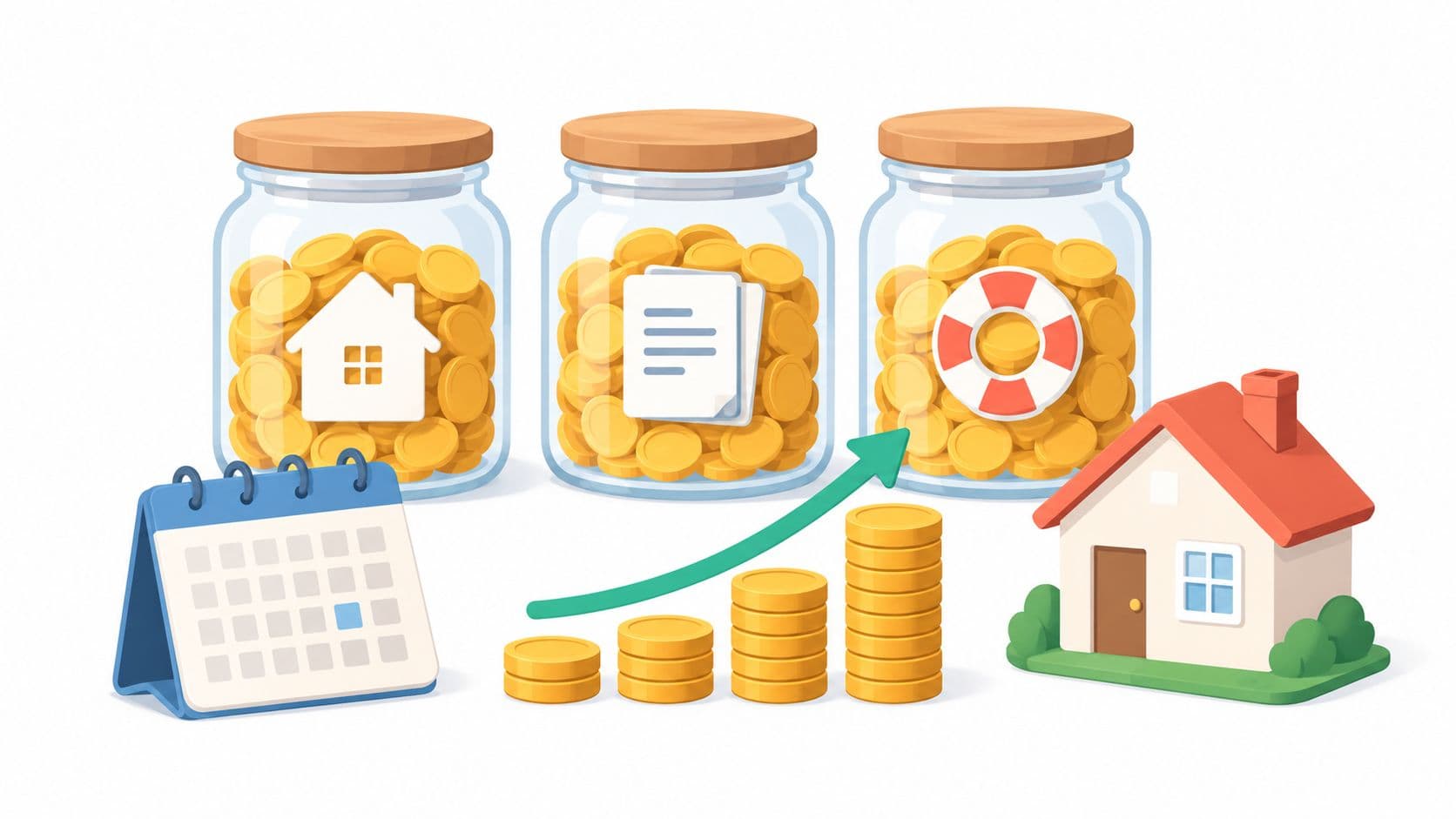
You've found a house that looks affordable on the listing page. The down payment calculator says you're getting close, but then the inspection, lender fees, moving truck, insurance, and first repair enter the conversation. Suddenly, the question isn't just “Can I reach the deposit?” It's whether you'll still have enough cash after the keys are in your hand.
That's the practical answer to how much should I save for a house. A down payment matters, but it's only one part of the cash required to buy safely. Your target should include the deposit, closing costs, and a reserve that keeps one bad week from turning homeownership into a financial emergency.
Why the Standard Advice Falls Short
A buyer scrolling through listings often starts with one rule: save 20% of the purchase price. It's a useful planning benchmark, particularly because putting 20% down on a conventional mortgage typically avoids private mortgage insurance and reduces the amount borrowed. But treating it as the only acceptable target can make a realistic purchase feel impossible, especially for a first-time buyer.
The latest National Association of Realtors data tell a more complicated story. In 2025, the median down payment was 19% for all buyers, 10% for first-time buyers, and 23% for repeat buyers, according to Bankrate's summary of the National Association of Realtors data. The first-time-buyer figure reached the highest level seen since 1989, yet it still sat at about half of the traditional 20% target.
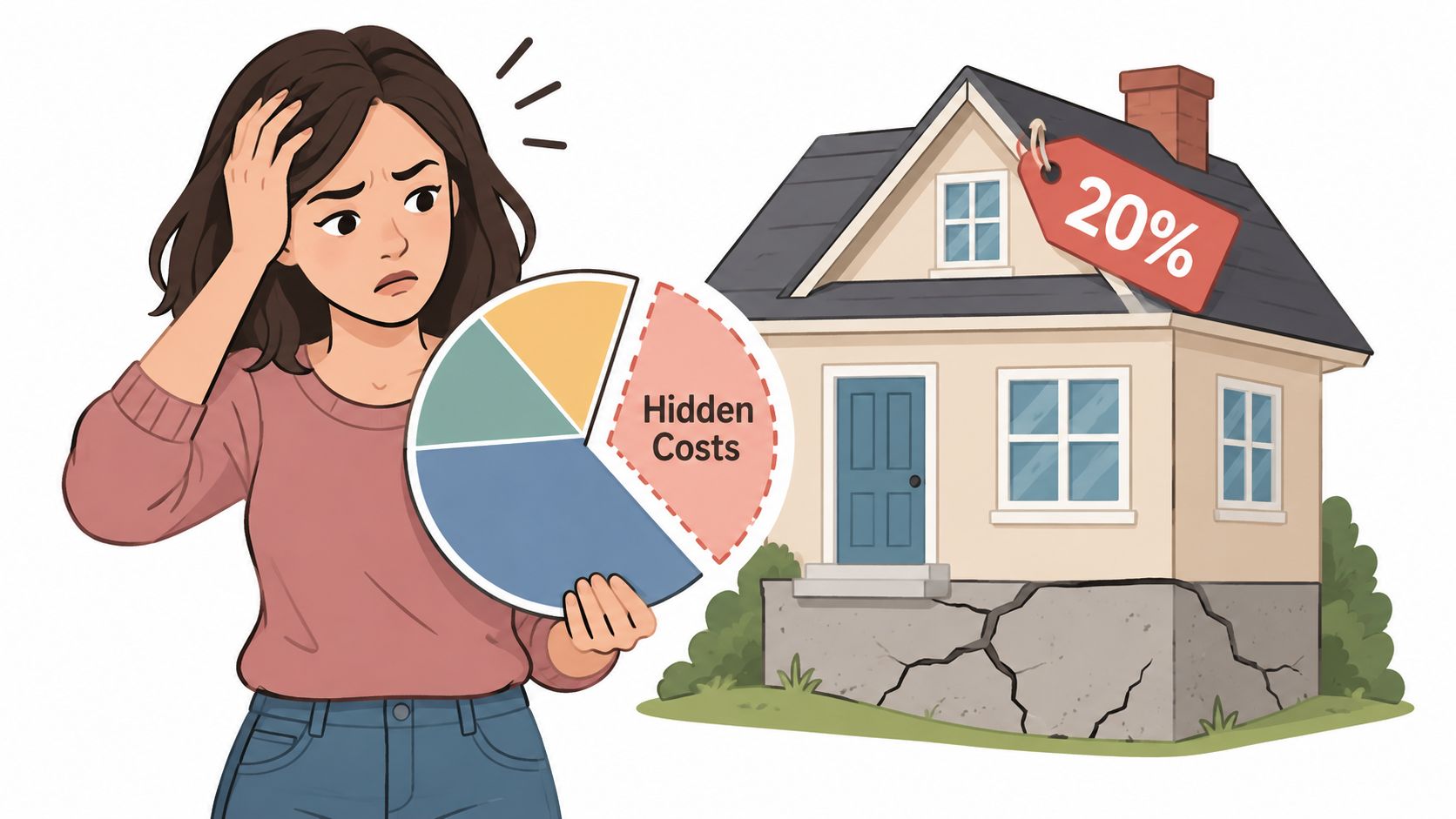
The deposit is only the visible number
Suppose you've saved enough to make the planned down payment. You may still need cash for lender charges, title work, inspections, prepaid taxes and insurance, moving expenses, and the small collection of purchases that arrive immediately after closing. A house rarely waits politely for your next paycheck before needing something fixed.
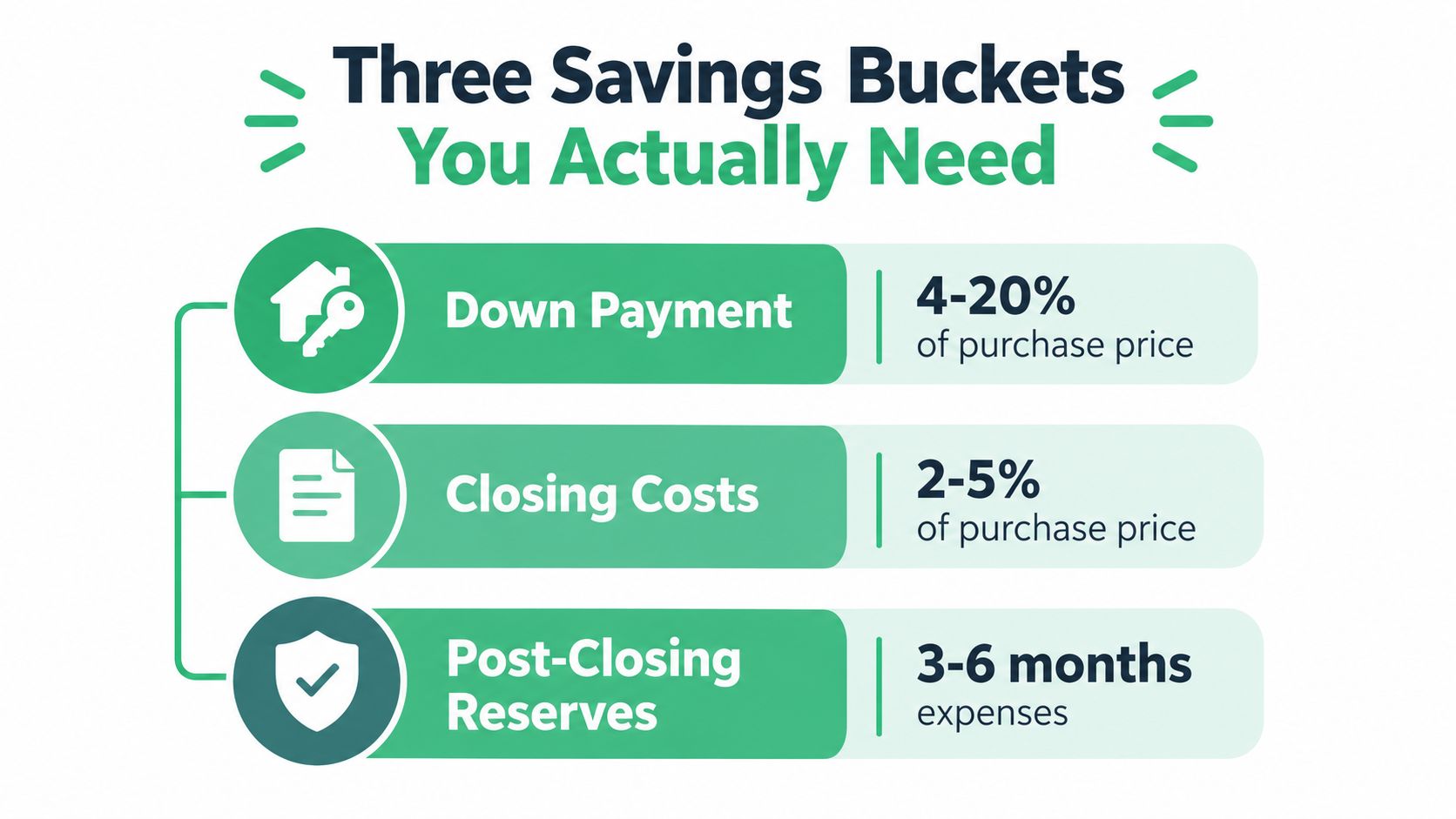
The Consumer Financial Protection Bureau recommends separating your cash into three categories: the down payment, closing costs, and an emergency cushion. It says closing costs commonly run 2% to 5% of the purchase price, and buyers should retain an emergency fund covering at least three to six months of expenses. The guidance is laid out in the CFPB's home-buying explanation of how to determine your down payment.
Practical rule: Never transfer every available dollar into the closing account simply because the lender approves the transaction.
Why one target creates stress
A single savings number hides the trade-off between getting to closing and remaining financially stable afterward. Someone who saves only for the deposit may qualify for a mortgage but have no flexibility when the appraisal comes in below the offer, the interest rate changes before closing, or the furnace decides to retire during move-in week.
The better question is: How much cash do I need to stay safe after closing in my market? That answer depends on the loan, purchase price, local taxes and insurance, the condition of the property, and how much income remains after recurring debt payments.
The 20% benchmark still has value. It can lower monthly carrying costs and help avoid PMI. It just shouldn't erase the other buckets that make the purchase sustainable.
Three Savings Buckets You Actually Need
Think of your house fund as three separate accounts, even if your bank holds the money in one place. Each bucket has a different job, and money earmarked for one purpose shouldn't solve another problem without notice.
Bucket one, the down payment
The down payment is the portion of the purchase price you pay upfront. A larger deposit usually means a smaller mortgage balance and a lower monthly payment, but it also ties up cash that could otherwise protect you from job loss, repairs, or other expenses.
For a $350,000 home, the traditional 20% target would mean $70,000 for the down payment. That example, along with the broader guidance on closing costs and reserves, is summarized in the National Association of Realtors' first-time-buyer report.
Bucket two, closing costs
Closing costs cover the services and prepaid items required to complete the purchase. They can include lender fees, title-related charges, inspections, appraisal costs, taxes, and insurance collected at closing.
For the same $350,000 home, a planning range of $7,000 to $17,500 represents 2% to 5% of the price. The final bill varies by loan, location, lender, and transaction details, so ask for a loan estimate early rather than treating a generic estimate as a promise.
Bucket three, post-closing reserves
Reserves are the money that stays available after the purchase. They cover ordinary life disruptions and the costs that arrive once you own the property, from a broken appliance to a gap between jobs.
The industry example above uses $15,000 to $30,000 for emergency reserves. Added to the $70,000 deposit and closing-cost range, the complete cash target becomes materially larger than the down payment alone. Depending on the market and the reserve policy, total cash can exceed the deposit by 50% to 70%.
| Savings bucket | Job | Example for a $350,000 home |
|---|---|---|
| Down payment | Reduces the mortgage balance | $70,000 at 20% |
| Closing costs | Pays transaction and prepaid expenses | $7,000 to $17,500 |
| Reserves | Protects cash flow after closing | $15,000 to $30,000 |
A sinking fund can help with predictable costs that don't belong in your emergency reserve. The sinking fund categories guide can help you separate irregular expenses from the money reserved for a genuine emergency.
The important discipline is psychological as much as mathematical. Don't call all your cash “the down payment” and then discover at closing that you've spent your repair fund before you owned the front door.
Choosing Your Down Payment Strategy
The best down payment is the one that leaves you able to own the home after closing. Compare the immediate payment benefit with the cash you would keep for repairs, job changes, moving costs, and other near-term demands. Your credit profile, monthly budget, loan eligibility, and expected time in the home all affect that choice.
| Strategy | What it may offer | Main trade-off |
|---|---|---|
| Below 20% down | Preserves more cash upfront | Mortgage insurance and a larger balance may raise monthly costs |
| 20% down | Typically avoids PMI | Uses more liquidity at closing |
| Government-backed financing | May offer a lower minimum down payment | Insurance, fees, eligibility, and property rules require review |
| Eligible zero-down financing | May allow 0% down for qualifying borrowers | Eligibility and property requirements apply |
For the first-time-buyer planning example, a conventional mortgage often requires at least 5% down, while 20% is generally the threshold used to avoid PMI. FHA financing allows a 3.5% minimum down payment for borrowers with a credit score of 580 or higher. Borrowers with scores from 500 to 579 generally need 10% down, according to Bankrate's FHA down-payment guide.
Some eligible borrowers may qualify for financing with 0% down. That reduces the deposit, not the total cash target. Closing costs, prepaid expenses, moving costs, and reserves still need their own funding, as explained in this first-time home-buying guide.
The liquidity decision
A smaller deposit can be the better choice when keeping cash available matters more than removing PMI. A buyer with variable income, limited reserves, or a property likely to need work may be safer with a lower upfront payment and a larger post-closing cushion.
PMI changes the comparison rather than automatically making a smaller deposit expensive. An industry estimate reported in this housing affordability review found that PMI helped homebuyers reduce the cash needed at closing by $48,000 in 2025. The figure does not make PMI suitable for everyone. It illustrates the trade-off between a recurring insurance cost and draining the savings account that covers real-life surprises.
Keep the decision practical:
- Can I keep my emergency reserve intact after closing?
- Does the resulting payment fit comfortably alongside my other debts?
- Will I need cash soon for repairs, childcare, moving, or a change in employment?
Treat the down payment, closing costs, and reserves as separate targets. The strategy with the lowest projected interest cost can leave you financially exposed if it empties your savings on closing day. A somewhat higher monthly payment may be manageable, while having no cash left for an unexpected bill is much harder to absorb.
Working Backward From Monthly Affordability
A home can fit your preferred price range and still strain your budget once taxes, insurance, debt payments, and ownership costs are included. Set the monthly payment first, then work out the mortgage balance and purchase price it can support. This keeps a tempting listing from turning your savings plan into a financial stretch.
A common underwriting framework limits housing costs to 28% of gross monthly income and total debt service to 36%. Housing costs include principal, interest, property taxes, homeowners insurance, and HOA fees where applicable. Total debt service adds recurring obligations such as car loans, student loans, and credit-card payments. Use this affordability calculation worksheet to check both limits.
A simple income example
With gross income of $10,000 per month, the 28% housing limit is $2,800. The 36% total-debt limit is $3,600, so existing debt reduces the amount available for housing.
Suppose other debts cost $800 per month. The total-debt limit then leaves $2,800 for housing, matching the front-end limit. If those other debts rise, the back-end test becomes stricter. A buyer who focuses only on the mortgage payment can miss that constraint.
The result is a ceiling, not a spending recommendation. Leave room for irregular ownership costs and changes in income rather than using every dollar allowed by the ratios.
Turn the payment into a savings target
Ask a lender or use a mortgage calculator to estimate the mortgage balance supported by your payment ceiling. Compare that balance with the purchase prices you are considering, then calculate the deposit required for each option.
A smaller down payment may let you buy sooner, but a conventional loan below 20% down often includes PMI. PMI creates a recurring cost that varies with the loan and borrower. Compare that premium with the cash you would preserve by making a smaller deposit, especially when closing costs and reserves are separate savings targets.
Your worksheet should contain four lines:
- Maximum monthly housing payment, based on income and existing debt.
- Estimated mortgage balance, based on the payment and loan terms.
- Down payment needed, comparing smaller and larger deposit options.
- Cash remaining after closing, including costs and reserves.
The useful target is the amount that keeps the payment manageable without consuming the money needed for closing or early ownership expenses. A lower deposit can be rational if it protects liquidity, while a larger one can make sense when the resulting payment reduction does not leave your reserves too thin.
Building Your Timeline and Monthly Plan
A savings target becomes useful only when it turns into a monthly contribution. Divide the cash you need by the amount you can save, then test the result against your likely purchase date and the affordability calculation.
Recent market data shows why buyers shouldn't treat one down-payment figure as permanent. Realtor.com reported a typical down payment of $27,100 in the second quarter of 2026, equal to 13.7% of the purchase price, after 12.9% in the first quarter and 14.3% a year earlier. The same report placed the first-quarter median at $23,400, as summarized in Realtor.com's down-payment report.
That movement doesn't tell you what your own target should be. It does show that buyers adjust the deposit they bring to the transaction instead of waiting indefinitely for a perfect 20% balance.
Build the calendar in phases
Use a simple sequence:
- Stabilize: Build or protect your emergency cushion before directing every spare dollar toward the home fund.
- Accumulate: Save for the down payment and closing costs in separate tracked categories.
- Validate: Get pre-approved when your finances are ready, then update the target using an actual payment estimate.
- Buy carefully: Keep the reserve untouched unless the transaction requires a documented use of funds.
For an illustration, saving $2,000 per month produces $48,000 over two years or $72,000 over three years, before interest. Those are arithmetic examples, not promises about what you'll earn or what a home will cost. If your full target is $100,000, a $2,000 monthly contribution leaves a longer timeline, while a smaller down payment may bring the purchase date forward at the cost of a larger mortgage and possibly PMI.
Automate the boring part
Set an automatic transfer for the day after your paycheck arrives. Keep the house fund in a liquid savings account designed for short-term goals rather than assets whose value can fall just when you need to close.
Review the plan whenever your income, debts, target market, or expected purchase date changes. A monthly contribution that worked while renting may stop working after a salary change or new debt. You can also use a compound-interest calculator to understand how savings growth affects the timeline, while remembering that a house fund should prioritize stability and access over chasing uncertain returns.
When 20% Down Isn't the Smart Move
A buyer may have enough saved for a 20% down payment, yet still be poorly prepared to own the home. If that deposit consumes the funds needed for closing costs, repairs, or an income interruption, reaching the standard percentage can create more risk than it removes.
Twenty percent down reduces the loan balance and may eliminate PMI, but it also ties up cash in the property. A smaller deposit preserves liquidity, while increasing the mortgage payment, total interest, and potentially the insurance cost. The decision should compare the full financial effect, not just the down-payment percentage.
Compare cash retained with the cost of PMI
Suppose the 20% option would leave you with almost no money after closing. Paying PMI may be reasonable if the monthly premium fits your budget and the retained cash protects you from a repair bill or a period without income.
PMI pricing depends on the loan, borrower, and lender. Use the lender's actual quote rather than a broad planning estimate, then compare that recurring cost with the cash you would keep by making a smaller deposit. A mortgage calculator with PMI can show how different deposit sizes affect the payment and borrowing cost.
A mortgage payment is a recurring obligation. Cash reserves provide flexibility. Price both before deciding which one to maximize.
Keep the savings targets separate. Your down payment reduces the loan. Closing costs fund the transaction itself. Reserves support the first months of ownership. A smaller down payment can be sensible when it leaves the latter two balances intact, even if the loan carries PMI.
Situations favoring a smaller deposit
A lower down payment deserves serious consideration when:
- Your reserves are thin: Keeping cash can help cover repairs, medical costs, or a temporary income interruption.
- The property needs work: An older home may require immediate spending that never appears in the listing price.
- You expect to refinance or move: A shorter ownership horizon can make transaction costs harder to recover, so available cash may matter more than reaching a particular equity threshold.
- The payment remains affordable: The full monthly cost must fit your budget after including principal, interest, taxes, insurance, and PMI.
Do not assume future investment gains will beat PMI. That comparison depends on uncertain returns, taxes, timing, and your tolerance for loss. Use the known PMI quote, the cash retained, and the consequences of having too little money after closing.
The stronger choice is the deposit that supports a durable monthly budget and leaves enough liquidity for the realities of homeownership. Twenty percent is useful when it improves the plan without weakening the rest of it.
Your Next Steps to Homeownership
You don't need a perfect forecast to start. You need a savings target that reflects the home price you can afford, the loan you may use, and the cash you'll still need after closing.
Begin with this checklist:
- Set the payment ceiling: Apply the 28% housing guideline and the 36% total-debt guideline to your gross monthly income.
- Choose a loan path: Compare conventional, FHA, VA, and USDA eligibility based on your credit profile and circumstances.
- Create three balances: Track the down payment, closing costs, and post-closing reserves separately.
- Protect liquidity: Don't count emergency savings as available for the deposit unless you're deliberately accepting the risk of having less cash.
- Automate the transfer: Move a chosen amount into the home fund after each paycheck.
- Recheck the math: Update the target when the home price, debt load, income, or expected purchase date changes.
Use small changes deliberately
Small adjustments can change the timeline without requiring a dramatic lifestyle overhaul. Paying down $500 of credit-card debt can reduce a monthly obligation and improve the debt calculation, while increasing savings by $200 per month adds $2,400 over a year. Those examples don't guarantee a particular mortgage approval or purchase date, but they show where to look for an advantage.
A useful monthly review asks:
- Did my savings transfer happen?
- Did my recurring debt change?
- Is my emergency cushion still intact?
- Has the price range I'm considering changed?
- Would the payment still work if ownership costs were higher than expected?
Credit improvement can help, but do not take on new debt just to create a cosmetic score change. Reduce expensive revolving debt where possible, avoid opening unnecessary accounts before applying, and ask a lender which factors influence your loan options.
For a broader preparation list covering documents, budgeting, and purchase logistics, this first time home buyer checklist can help you organize the process without relying on memory and optimism, the two least reliable items in a mortgage file.
The practical answer
So, how much should you save for a house? Start with the down payment that supports an affordable monthly payment, add closing costs separately, and preserve an emergency cushion of at least three to six months of expenses, following the CFPB's guidance. A 20% deposit remains a useful benchmark, but it's a poor goal if reaching it leaves you unable to absorb the ordinary costs of owning a home.
Before touring more properties, write down your maximum payment, three cash targets, and monthly savings amount. Then ask a lender to validate the assumptions with a pre-approval and a detailed estimate of your cash to close.
Get more posts like this
One short, useful email each Friday. Free, no spam, unsubscribe anytime.