Mortgage Calculator: Pay Off Early
Use a mortgage calculator to see how extra payments pay off your loan early, with step-by-step inputs, extra payment scenarios, and the real savings.

Daniel Anderson
Editor, The Money Maniac
September 27, 2026
11 min read
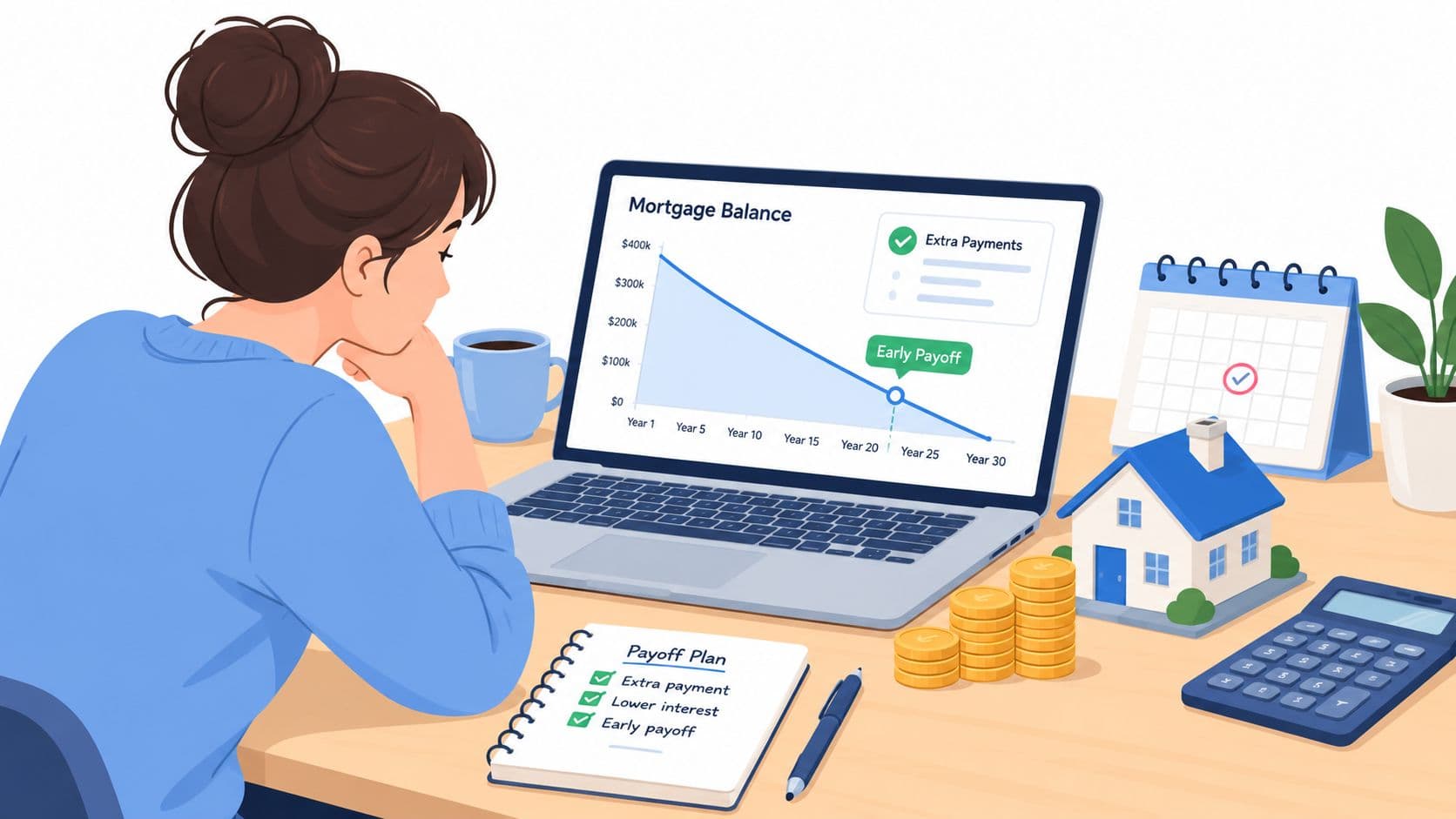
You're probably staring at the same annoying mortgage statement a lot of homeowners stare at, the one that shows a payment you can afford and a remaining balance that still feels insultingly large. If you're wondering whether tossing an extra few hundred dollars at the loan each month is smart discipline or just a fast way to make your cash flow miserable, a mortgage calculator pay off early workflow is the cleanest way to decide.
The calculator matters because it turns wishful thinking into a side-by-side decision. Instead of asking, “Would extra payments help?”, you can see the baseline payoff date, the accelerated payoff date, and how much interest disappears when you change one number at a time. That's the part people miss. A mortgage is front-loaded, so early extra principal payments have a bigger impact than late ones, which means timing and structure matter more than motivational slogans.
A rough rule of thumb is not enough here. The right answer depends on the remaining balance, the note rate, the payment cadence, whether you have escrow wrapped into the bill, and whether your lender treats extra principal correctly. Run the numbers before you decide anything. Otherwise you're just doing expensive vibes.
Why a Mortgage Calculator Is the Best Way to Plan Early Payoff
A borrower with a $320,000 30-year loan at 6.5% can look at a statement and still see 27 years remaining. That's the kind of number that tempts people to throw an extra $300 a month at the loan and call it progress, without checking whether the trade-off fits the rest of their finances. A calculator makes that decision real.
Practical rule: If you can't see the payoff date change on the screen, you're guessing, not planning.
The value of a mortgage calculator pay off early setup is that it shows you what each extra dollar does. You're not just asking how much the monthly payment is. You're comparing the current path against an accelerated path, then measuring the gap in months, total interest, and ending balance. That comparison is where the truth lives.
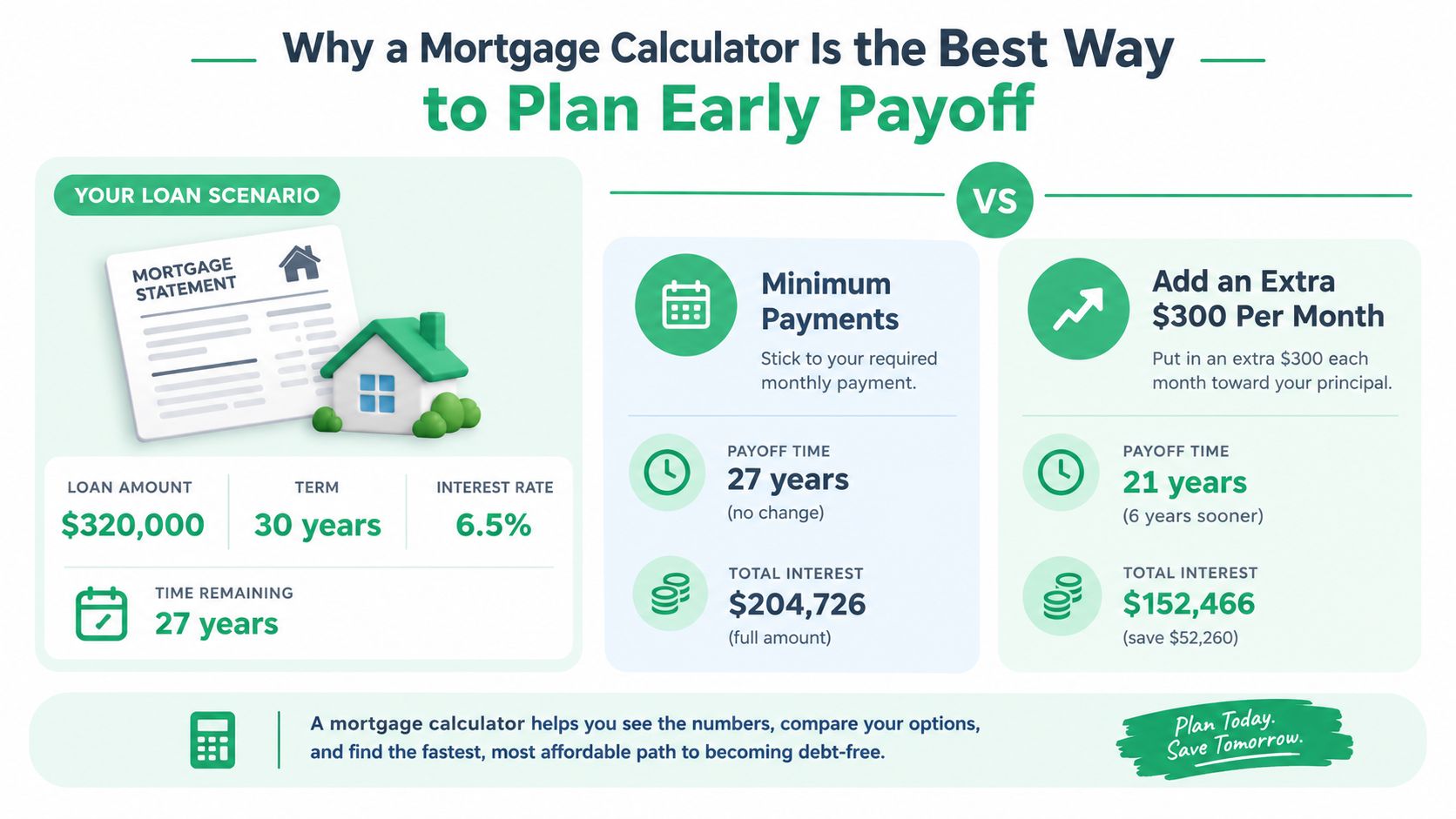
A lot of people rely on vague advice like “round up your payment” or “just make one extra payment a year.” Those ideas can be fine, but they're not interchangeable. A calculator shows the difference between a small recurring overpayment and a one-time lump sum, and that difference can be huge because the balance falls faster when principal comes down sooner. The earlier the balance drops, the less interest gets billed on the remaining amount.
The point is not to chase the most aggressive payoff date on the screen. It's to find the point where extra principal still feels sustainable, because a payment plan you can keep is worth more than a heroic plan you quit after three months. Calculators make that visible fast, which is why they're the right first move instead of the last.
What to Put Into the Calculator Before You Hit Calculate
Start with the numbers that actually move the answer
A good calculator lives or dies on loan balance, interest rate, and remaining term. Those three inputs do most of the work because they define the size of the debt, the cost of carrying it, and how much time is left for interest to compound. If any one of them is off, the result gets fuzzy fast.
The start date matters too. Extra principal paid earlier in the month usually trims more interest than the same payment made later, because interest accrues on the balance that's still sitting there. That timing detail sounds minor until you multiply it across years.
The monthly payment field matters for a different reason. It lets the calculator isolate how much of your current payment is going to interest and how much is reducing principal. If you're paying escrow for taxes and insurance, make sure the tool separates that from principal and interest, because the extra payment needs to hit the loan balance, not your tax bucket.
Don't skip the fields that seem optional but aren't
PMI status matters if your loan is still above 80% loan-to-value. Once you get to 78% loan-to-value, automatic removal can kick in, and that changes the monthly bill and the payoff math. If your calculator ignores PMI, the picture can be off just enough to mislead you.
Rate input precision matters less than people think, but APR and note rate are not the same thing. A tiny difference like 6.49% versus 6.5% barely changes the answer. Mixing up APR with the mortgage rate absolutely can.
| Input Field | Required? | What It Controls |
|---|---|---|
| Loan balance | Yes | How much principal is left to pay |
| Interest rate | Yes | How fast interest accrues |
| Remaining term | Yes | How long the schedule runs |
| Start date | Usually | When extra principal begins saving interest |
| Current monthly payment | Usually | How much goes to interest versus principal |
| Property tax and insurance | Optional, but useful | Whether the tool matches the real bill |
| PMI status | Optional, but useful | Whether the monthly payment changes near 80% loan-to-value |
| Rate type, APR or note rate | Yes, if offered | Whether the calculation is based on the right borrowing cost |
If you want a straightforward place to test those inputs, the mortgage calculator at The Money Maniac is built for that kind of planning.
Modeling Extra Monthly Payments and One-Time Lump Sums
Recurring extras are the easiest place to start
If you want to model a steady overpayment, enter a fixed monthly amount and mark it as principal-only. That's the cleanest version of early payoff because the money goes straight at the balance instead of disappearing into the lender's general account like a polite little donation.
You can also model an annual boost by front-loading $3,600 a year in the calculator, which is just a convenient way to simulate a recurring extra payment without changing your regular monthly cash flow. A biweekly toggle works too, because it effectively adds one extra monthly payment per year. The calculator should show the revised amortization schedule, not just a headline savings figure.
Lump sums need a different test
A tax refund, bonus, or inheritance is a different animal. Enter it as a one-time lump sum applied to principal, then rerun the schedule. That gives you the payoff date with the windfall included, which is the only number that matters if you're deciding whether to throw that cash at the loan or keep it liquid.
A lump sum can look small on paper and still pull several years off the back end when it lands early enough in the loan.
Sensitivity testing is where this gets useful. Add extra payments in $100 increments and watch the payoff date shift. That tells you whether you're getting a meaningful change or just a feel-good reshuffle.
The one trap worth watching for is payment application. Some calculators treat a lump sum as a payment toward the next installment instead of true principal reduction. That understates the savings, which is annoying, because mortgage math is already doing enough without the software improvising.
Use the calculator output the way you'd use a map. The revised amortization schedule shows the new payoff date, how many months you shaved off, and how much interest vanished along the way. That's the point. The rest is decoration.
Reading the Amortization Schedule Like a Pro
The amortization table is where the loan stops being abstract. The monthly payment gives you a headline number. The table shows how much of each payment is going to interest, how much is directly reducing the balance, and how fast the loan is aging.
The columns that matter most
| Column | What It Shows | Why It Matters for Early Payoff |
|---|---|---|
| Payment number | Which installment you're on | Lets you see how fast the loan ages |
| Payment amount | Total paid that period | Shows whether extra principal is being added |
| Interest portion | Part of the payment going to interest | Tells you how much is being lost to carrying the debt |
| Principal portion | Part reducing the balance | This is the part that creates early payoff |
| Remaining balance | What you still owe after the payment | Shows whether the balance is dropping fast enough |
| Cumulative interest | Interest paid so far | Makes the long-term cost impossible to ignore |
Read the table by comparing a few rows across the year, not by staring at one payment in isolation. The first rows usually look ugly because the lender takes more interest up front. That is normal amortization, and it explains why early extra payments have the most room to work. By the time the balance is lower, more of each payment is already going to principal.
What matters most is the gap between the interest column in the early rows and the same column much later in the schedule. Row 1 and row 120 will not look anything alike. That gap is the carrying cost you can reclaim with extra principal payments.
Useful habit: Check the cumulative interest line before you brag about the payoff date. That is the number your future self will care about.
The summary line at the bottom deserves attention too. It is where total interest saved shows up, and that one figure usually makes the trade-off feel real. If PMI is part of your payment, the mortgage calculator with PMI shows how removal timing changes the schedule. A shorter payoff date is nice. A lower total interest bill is what changes the economics.
When Early Payoff Is the Wrong Move
Throwing every spare dollar at the mortgage can be a bad habit when the rest of the balance sheet is shaky. The calculator won't tell you that on its own, because it only shows mortgage math. You still have to compare the mortgage against the other places your cash could go.
Compare the mortgage against investing and liquidity
If your mortgage rate is relatively low, every extra principal payment has an opportunity cost. That cash could stay liquid, get invested, or sit ready for emergencies. The point isn't that investing always wins. The point is that a guaranteed interest saving from principal prepayment isn't automatically the best use of cash when the mortgage rate is modest and your emergency fund is thin.
A separate question is higher-rate debt. If you're carrying balances with a much higher after-tax cost than the mortgage, those should usually get attention first. A mortgage feels bigger, but size alone doesn't make it the most expensive problem.
Treat the house as a shelter, not a cash vault
Paying down the mortgage also converts liquid money into home equity. That can feel great until you need cash and have to borrow again at a worse rate. That's the part people like to skip over because it's not as satisfying as seeing the principal fall. Still, it matters.
If you're sorting through whether to pay extra, keep a resource like INTELLI tips for home sellers in mind when you're thinking about how mortgage balance, equity, and sale timing can interact during a move. Selling with a mortgage attached is normal, but the payoff decision should still fit your broader housing plan.
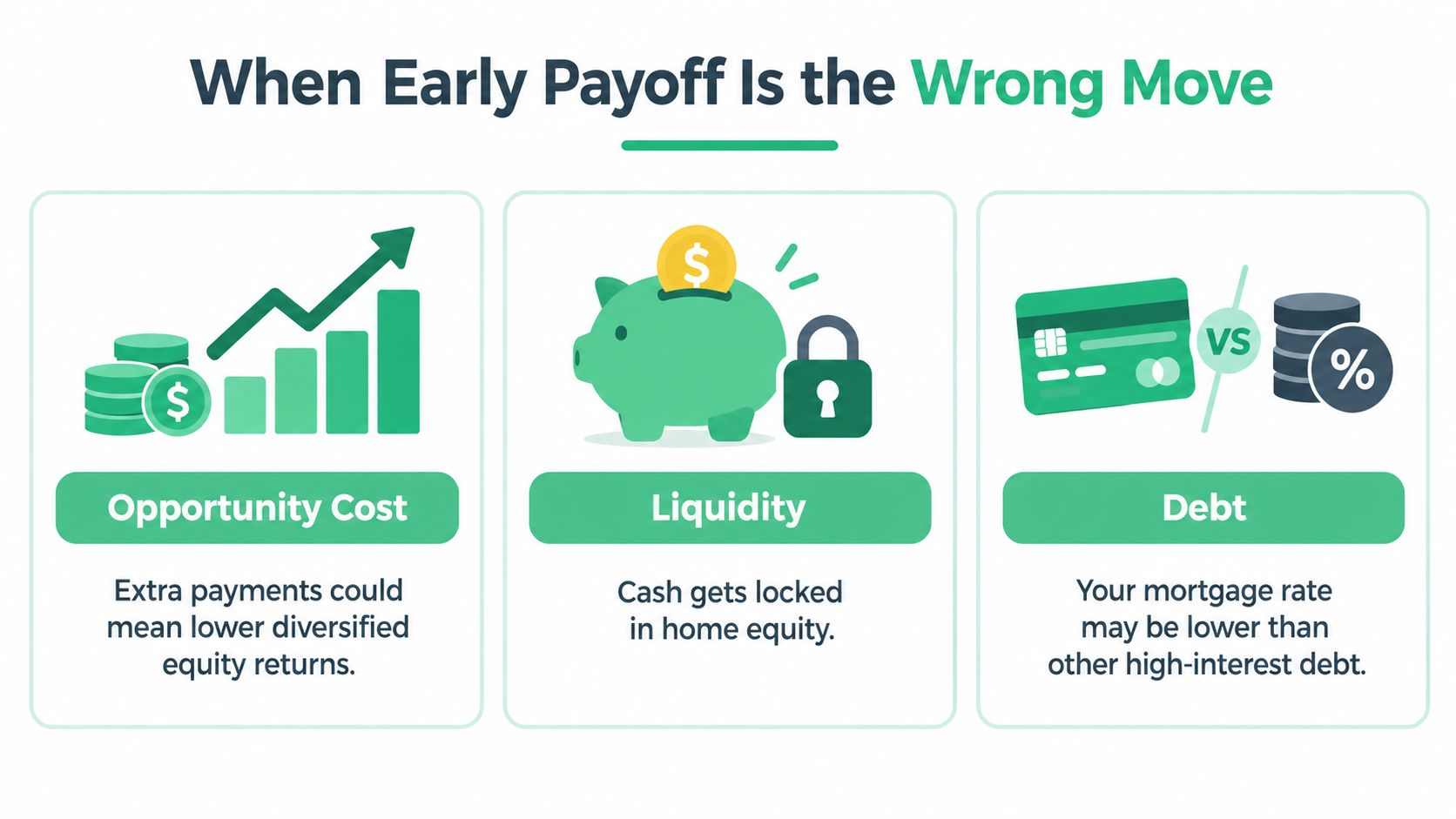
A decent rule is simple enough. If your mortgage is near or below roughly 4%, you should at least test the investing and liquidity alternatives before prepaying aggressively. If you have higher-rate debt sitting elsewhere, that debt gets a hard look first. Run all three scenarios in the same week, then decide with your eyes open instead of your emotions doing the math.
Mistakes That Can Wreck Your Early Payoff Plan
The fastest way to ruin the numbers is to assume the lender will handle everything the way you meant it. Mortgage servicers are not mind readers. They follow instructions, and sometimes they follow the wrong ones if you don't specify things clearly.
The usual ways people lose the edge
A prepayment penalty can change the economics quickly. The CFPB notes that some lenders charge a fee if you pay off all or part of a mortgage early, and it usually applies only in the first three or five years, so check the note before sending a big extra payment. Small extra principal payments often don't trigger it, but a large payoff or refinance-related move sometimes can.
Escrow confusion is another classic mess. If your extra money gets routed into taxes or insurance instead of principal, you won't see the payoff acceleration you expected. That's why the payment instruction has to be explicit.
Refinancing can also reset the clock. A lower rate can help, but if you start a new term without checking closing costs and the new amortization schedule, you may feel productive while extending the time horizon. PMI timing belongs in the same mental bucket, because once your balance falls far enough, that monthly drag can disappear and change the payoff math.
Confirm where the extra money lands before you celebrate anything. The statement should show principal reduction, not just a larger payment with no real payoff speed.
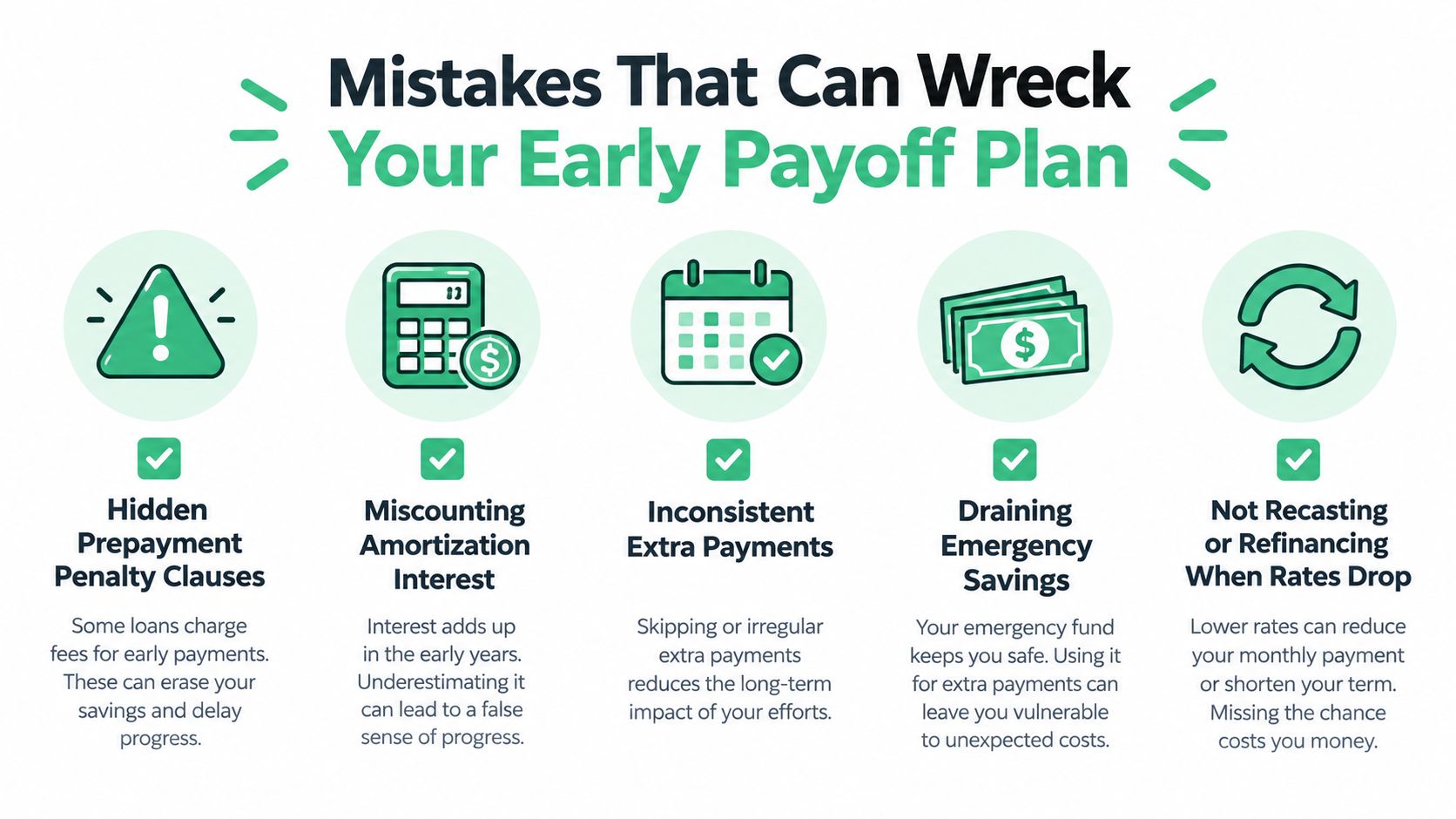
Before you hit submit, run this checklist:
- Check for a prepayment penalty: Read the note so a big extra payment doesn't trigger a fee.
- Verify principal-only application: Make sure the lender applies the extra cash to the balance.
- Recheck the rate and term: Confirm the calculator matches the loan you have.
- Confirm tax and insurance handling: Don't let escrow swallow the extra payment.
- Watch PMI status: Know whether extra principal is pushing you toward removal.
Turning the Numbers Into Your Payoff Plan
Start with the payoff date you can live with, not the most aggressive version the calculator spits out. If an extra payment plan leaves you tense every month, it's too tight. A workable plan is the one you'll still be following next year without muttering at your checking account.
Pick a cadence, then name the trade-off
Compare a few versions before you commit. Try $200 extra every month, $600 quarterly, and one annual lump sum equivalent, then note the total interest saved and the projected payoff date for each. The best option is usually the one that fits your cash flow cleanly, not the one that wins the spreadsheet by twelve dramatic minutes.
This is also where you get honest about the sacrifice. Maybe it means pausing retirement contributions for a bit. Maybe it means delaying a home project. Maybe it means skipping an extra Roth contribution this year. Say the trade-off out loud so you don't accidentally make it later with overdraft fees.
If you're combining finances with a spouse or partner, practical coordination matters even more, so a guide like practical money advice for newlyweds can help frame who pays what and how to keep the plan from turning into a recurring dinner-table argument.
Put the decision on autopilot
Use a simple commitment line like this:
I will pay $X extra per month until YYYY, then reassess.
Set a 90-day check-in to compare the calculator output against the actual statement. If the payment isn't hitting principal the way you expected, fix it. If cash flow got tighter, scale the extra amount down before the plan starts eating your peace of mind.
For a broader payoff framework, the debt payoff calculator can help you compare mortgage acceleration against other balances and keep the whole plan in one place.
Get more posts like this
One short, useful email each Friday. Free, no spam, unsubscribe anytime.