How to Use Mortgage Calculator
How to use mortgage calculator. Learn how to use a mortgage calculator step by step, interpret the output, and test real scenarios so you borrow

Daniel Anderson
Editor, The Money Maniac
October 6, 2026
11 min read

You're staring at a mortgage calculator, and the number on the screen says $2,100 a month. It feels manageable until you remember property taxes, insurance, mortgage insurance, HOA dues, repairs, utilities, and the other small financial gremlins that enjoy appearing after closing.
That's why learning how to use a mortgage calculator matters. Used properly, it's a household cash-flow stress test. Used lazily, it's a machine for turning an optimistic guess into a very official-looking mistake.
What a Mortgage Calculator Actually Does and Where It Falls Short
A mortgage calculator takes three core inputs, loan amount, interest rate, and loan term, and uses a standard amortization formula to estimate the fixed periodic payment for principal and interest. Principal is the money you borrowed. Interest is the lender's charge for letting you borrow it.
The calculation uses the loan balance, a monthly version of the interest rate, and the total number of monthly payments. The result is designed so each scheduled payment covers the interest accruing during that period and pays down some principal. Early in the loan, the interest portion is larger because the outstanding balance is larger. As the balance falls, more of each payment goes toward principal.
That calculation is useful, but it answers a narrow question: What would the loan payment be under these assumptions? It doesn't automatically answer whether the home fits your life.
Practical rule: Treat the headline principal-and-interest figure as the beginning of the analysis, not the answer.
A basic result can leave out property taxes, homeowners insurance, mortgage insurance, HOA dues, and purchase costs. The Consumer Financial Protection Bureau's mortgage guidance recommends estimating taxes and insurance separately and subtracting them from the total monthly amount you can afford. If your housing budget is $2,500 and taxes plus insurance are estimated at $500, your target for principal and interest is approximately $2,000, not the full $2,500.
The calculator also can't guarantee approval. It doesn't verify your income, inspect your credit file, assess your assets, or issue a loan estimate. For an adjustable-rate mortgage, a starting payment can also conceal the risk of future payment increases. Federal consumer guidance warns that ARM payments can rise substantially and can even create negative amortization when the payment doesn't cover accruing interest.
Run the tool in three passes:
- Clean inputs, using the loan amount, quoted rate, and term.
- Full-cost inputs, adding taxes, insurance, mortgage insurance, and HOA dues.
- Stress-tested inputs, using a higher rate, larger expenses, and a payment ceiling you can defend.
That sequence takes a few extra minutes. It can save you from spending years defending a payment that looked harmless on a screen.
The Inputs That Drive Your Payment and How to Enter Them Right
Start with the amount you'll borrow. For a purchase, that generally means the home price minus the down payment, plus any financed charges. Entering the sticker price as the loan amount makes the calculator solve the wrong problem.
Next, enter the actual quoted interest rate you're evaluating. Don't type a rounded guess just because it looks cleaner. If the lender gives you a note rate and an annual percentage rate, understand which figure the calculator accepts and use it consistently. The note rate drives the scheduled principal-and-interest calculation, while APR reflects a broader cost picture that can include certain fees.
The term controls how quickly you repay the balance. A longer term usually produces a lower required monthly payment, while a shorter term generally pays the balance down faster and reduces the period during which interest accrues. Compare the terms side by side instead of assuming the lowest monthly figure is automatically the best deal.
Then add the costs that often sit behind an “advanced settings” button:
- Property taxes: Use a realistic annual estimate divided into monthly costs. The assessed value used for taxes can differ from the purchase price, so don't assume the two are interchangeable.
- Homeowners insurance: Use a current quote or a defensible local estimate, not a placeholder that makes the payment look pleasant.
- Mortgage insurance: Include it when it applies to the loan structure and down payment.
- HOA dues: Add the recurring fee even if the calculator treats it as optional.
- Other ownership costs: Keep repairs, utilities, commuting, and irregular expenses in your household budget rather than pretending they don't exist.
The CFPB's monthly payment worksheet defines the practical housing obligation as principal, interest, mortgage insurance, and escrowed taxes and insurance, with condo or HOA fees also relevant to the household budget.
| Input | Basic Pass | Full-Cost Pass |
|---|---|---|
| Home price | Enter the purchase price | Enter the purchase price and verify the resulting loan amount |
| Down payment | Enter the cash contribution | Compare more than one down-payment scenario and preserve cash reserves |
| Loan amount | Use the amount borrowed | Include financed charges when applicable |
| Interest rate | Use the quoted rate | Test the expected rate and a higher stress-test rate |
| Loan term | Choose the proposed term | Compare 15-, 20-, and 30-year terms |
| Taxes and insurance | Leave blank only for a rough P&I estimate | Add monthly property taxes and homeowners insurance |
| Mortgage insurance | Leave blank only if it doesn't apply | Add the applicable monthly amount |
| HOA dues | Leave blank only if none exist | Add the recurring association fee |
For a more detailed treatment of mortgage insurance inputs, use this mortgage calculator with PMI. The small fields are where large errors hide. Entering the rate as a whole number instead of a percentage, forgetting mortgage insurance, or using the home price instead of the loan amount can make the output look precise while being entirely wrong.
Reading the Amortization Schedule Without Getting Lost
The amortization schedule is the part many readers skip, which is unfortunate because it shows where the money goes.
A typical schedule includes:
- Payment number, identifying the scheduled installment.
- Payment amount, the principal-and-interest amount due.
- Principal paid, the portion reducing the balance.
- Interest paid, the lender's charge for that period.
- Remaining balance, what you still owe afterward.
The first payment usually contains more interest than principal because interest is calculated against the original, larger balance. As you make payments, the balance declines and the interest charge gradually becomes smaller. The schedule therefore starts with a steep interest-heavy slope and becomes more principal-focused over time.
The exact split depends on the loan amount, rate, term, payment frequency, and assumptions. Don't copy a first-payment breakdown from one mortgage and apply it to another. For a useful visual explanation of how the columns work together, see this amortization schedule explained.
Freddie Mac's payment illustrations show the effect clearly. For a fully amortizing 30-year mortgage of $200,000, principal-and-interest payments are approximately $1,896 at 6.5%, $1,996 at 7%, and $2,098 at 7.5%. Those figures come from Freddie Mac's mortgage-rate guidance and payment illustrations.
A move from 6.5% to 7% raises the payment by about $100 per month. Across 360 monthly payments, that difference represents roughly $36,000 in additional scheduled payments before taxes, insurance, fees, or refinancing changes are considered.
The amortization schedule is the receipt for the loan. Read it before you sign up to keep paying.
Use the schedule to test extra principal payments, then check how the remaining balance and total interest change. The calculator can show the effect of paying more, but don't treat an extra-payment strategy as automatic. Keep adequate cash reserves and account for other purchase costs first.
Refinancing deserves similar scrutiny. A new loan can reduce the payment, but restarting a long repayment schedule may extend the period during which interest accrues. Compare the remaining balance, remaining term, closing costs, and total interest, rather than celebrating a smaller monthly number by itself.
Stress-Testing the Result Against Your Real Budget
A lender's maximum and your personal maximum are different numbers. The lender is assessing repayment risk under underwriting rules. You're deciding how much room your household needs for savings, repairs, childcare, healthcare, commuting, and ordinary life.
Start with gross monthly income, meaning income before taxes. Then compare the complete housing obligation, including principal, interest, property taxes, homeowners insurance, mortgage insurance, and HOA dues, against a 28% front-end benchmark. Add recurring auto, student-loan, credit-card, personal-loan, and support obligations, then compare total debt against a 36% back-end benchmark. The CFPB discusses the common 28% of pretax income housing guideline in its affordability guidance, while Fannie Mae's underwriting guidance sets a 36% maximum total DTI for manually underwritten loans in the stated circumstances, with higher limits possible under specified requirements and automated underwriting.
Those are screening standards, not lifestyle recommendations. A household can fit within a lender's ceiling and still have no practical breathing room after taxes, utilities, maintenance, retirement contributions, or irregular bills.
| Metric | 28% Front-End Rule | 36% Back-End Rule | Your Scenario |
|---|---|---|---|
| Income basis | Gross monthly income | Gross monthly income | Enter your gross monthly income |
| Included costs | Complete housing obligation | Housing obligation plus recurring debts | Add your actual figures |
| Purpose | Screens housing burden | Screens total debt burden | Identify the tighter limit |
| Decision use | Approval reference | Approval reference | Set a lower personal ceiling if needed |
Run the test in this order:
- Calculate gross monthly income. Use the income a lender can document and reasonably count.
- Build the complete housing payment. Add every recurring housing cost to principal and interest.
- Add existing monthly debts. Include minimum required payments, not optimistic payoff assumptions.
- Subtract the payment from take-home pay. The remainder must cover living costs, savings, repairs, and irregular expenses.
- Set a personal ceiling. Choose the payment that leaves room for the life you have.
For an ARM, enter the initial payment and the fully indexed or maximum permitted payment. A teaser payment is a marketing number with better lighting. If the maximum payment would force you to cut savings or rely on future refinancing, the loan fails your stress test.
The strongest result is the payment you can defend after a bad month, not the largest payment a lender will approve.
Scenarios Worth Running Before You Commit
A mortgage calculator becomes useful when it tests your household cash flow, not when it produces one flattering payment. Run several versions of the same purchase. The differences show what the loan costs under pressure and which trade-offs you are accepting.
Start with the same loan amount and compare 15-, 20-, and 30-year terms. Shorter terms usually demand higher monthly payments, repay principal faster, and leave less time for interest to accrue. A longer term creates more monthly flexibility, but it can produce a larger lifetime interest bill. Record the payment, total interest, remaining balance at meaningful points, and cash left after closing.
Compare down payments next. A larger down payment reduces the balance, which generally lowers both the calculated payment and total interest. A smaller down payment keeps more cash available, but it leaves a larger balance and may add mortgage insurance. Choose based on the value of liquidity and your reserve needs, not on treating a down-payment percentage as a measure of virtue.
Rate uncertainty deserves its own stress test. Enter the expected rate, then run the same loan one and two percentage points higher. Scotsman Guide's Freddie Mac data note that the average 30-year fixed mortgage rate reached 18.63% in 1981. The same report shows the average U.S. 30-year fixed rate ended 2025 at 6.15% after reaching 7.04% in January, while the 15-year rate ended at 5.44%, according to reported Freddie Mac market-rate data. The point is not to predict the next rate. It is to see whether your budget survives a less friendly one.
| Scenario | Loan Amount | Rate | Monthly P&I | Total Interest | Break-Even |
|---|---|---|---|---|---|
| Expected rate, long term | Same borrowed amount | Expected quote | Record calculator result | Record calculator result | Compare with alternatives |
| Higher-rate stress case | Same borrowed amount | Expected rate plus one point | Record calculator result | Record calculator result | Note affordability impact |
| Higher-rate stress case | Same borrowed amount | Expected rate plus two points | Record calculator result | Record calculator result | Note affordability impact |
| Shorter-term loan | Same borrowed amount | Applicable quote | Record calculator result | Record calculator result | Compare payment increase with interest reduction |
| Larger down payment | Lower borrowed amount | Applicable quote | Record calculator result | Record calculator result | Include cash-reserve impact |
The buy-now-versus-wait decision needs a separate worksheet. Compare another year of rent, a possible home-price change, a possible rate change, and the cash you could save while waiting. Run both directions because waiting can improve your cash position while worsening the purchase price, and a lower future rate is never guaranteed. Do not make refinancing the rescue plan for a payment that fails today.
Discount points need a break-even calculation too. Divide the upfront cost by the monthly payment reduction. That result shows how long the lower rate must stay in place before the savings recover the fee. If you may move, refinance, or need that cash sooner, paying for the rate reduction is a poor trade.
Put major future expenses on the same scenario sheet. A planned addition, major repair, or other project competes with the mortgage for cash. If the property may need construction, research financing and permits for a home addition in Massachusetts before treating the project as a vague future possibility.
For an extra-payment comparison, use this mortgage calculator to pay off early. Compare the interest saved with the cash you would give up each month. Choose the payment structure that leaves your household resilient, not the largest loan your spreadsheet can tolerate.
A Pre-Application Checklist and Your Next Move
Before contacting a lender, assemble the documents and rerun the calculator with your personal affordability ceiling. The checklist should include:
- Income documents: Gather your last two pay stubs and the last two years of W-2s or 1099s.
- Bank records: Collect two months of bank statements showing the down payment and available cash reserves.
- Debt list: Write down monthly payments for car loans, student loans, credit cards, personal loans, and support obligations.
- Calculator screenshots: Save the amortization schedule at today's rate and at a rate one percentage point higher.
- Credit review: Check your credit reports for errors before a lender's review exposes them.
- Down-payment documentation: Make sure the funds can be traced and are ready to verify.
- Savings plan: Review how much you should save for a house alongside the payment, closing costs, and cash reserves.
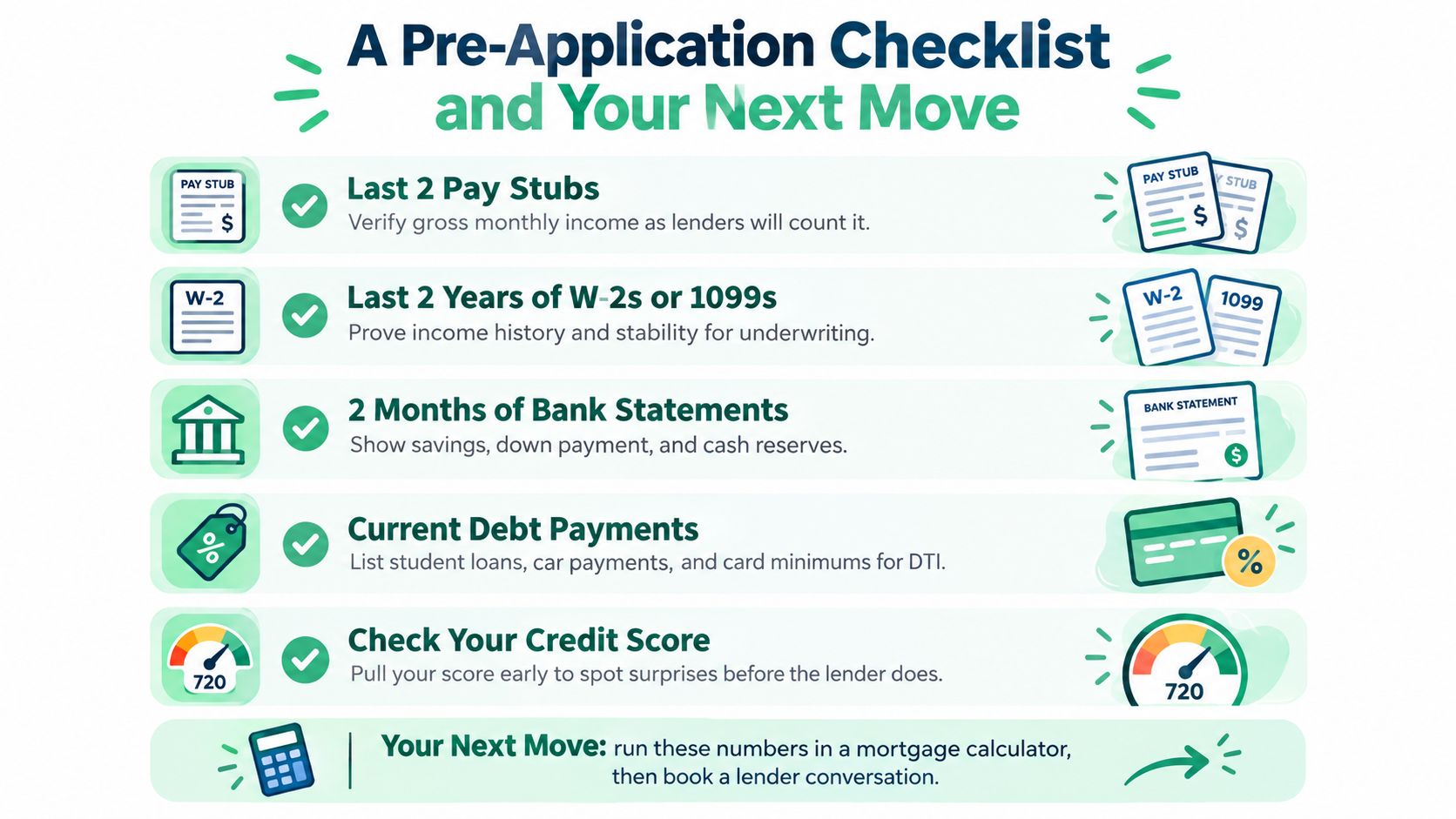
If the stress-tested payment leaves room for savings and ordinary surprises, and your scenario comparison supports buying, request loan estimates from multiple lenders during the applicable rate-shopping window. Compare the rate, APR, fees, payment assumptions, mortgage insurance, and total interest. A calculator cannot replace those documents.
If the numbers feel tight, wait, save, and rerun the analysis. The responsible next move is an honest second calculation, not a rushed application built around the lender's maximum.
Get more posts like this
One short, useful email each Friday. Free, no spam, unsubscribe anytime.