Why Are Homes So Expensive and What Actually Drives Prices
Why are homes so expensive right now? We break down supply, rates, zoning and costs with data to show what really drives prices and what to watch next.

Daniel Anderson
Editor, The Money Maniac
September 22, 2026
14 min read

Over the past three decades, real house prices across the OECD rose by nearly 60 index points, reaching 134 index points in 2022-Q2, their highest level in that period before easing slightly in 2023, according to the OECD housing-price data. That puts today's sticker shock in better perspective. Housing didn't suddenly become expensive during the post-pandemic boom. In many major markets, prices had already outrun general inflation for decades.
The useful question, then, isn't why are homes so expensive right now. It's why the housing system keeps producing expensive homes, even when sales slow, household growth weakens, and buyers retreat. The answer involves a shortage of homes in job-rich places, restrictive land-use rules, costly construction, missing entry-level inventory, and mortgage lock-in that keeps existing owners from selling.
That combination matters for your own decisions. A national headline can tell you that housing is costly, but it can't tell you whether your local problem is scarce listings, zoning, expensive new construction, or a shortage of modest homes. For lower-cost options in a competitive city, it may also be worth learning how to browse NYC housing lotteries, where access depends on an application process rather than winning a bidding contest.
This guide treats home prices as a system of incentives and constraints. The practical goal is to help you identify which parts you can control, which signals deserve attention, and why waiting for demand to cool may not be enough to make housing affordable.
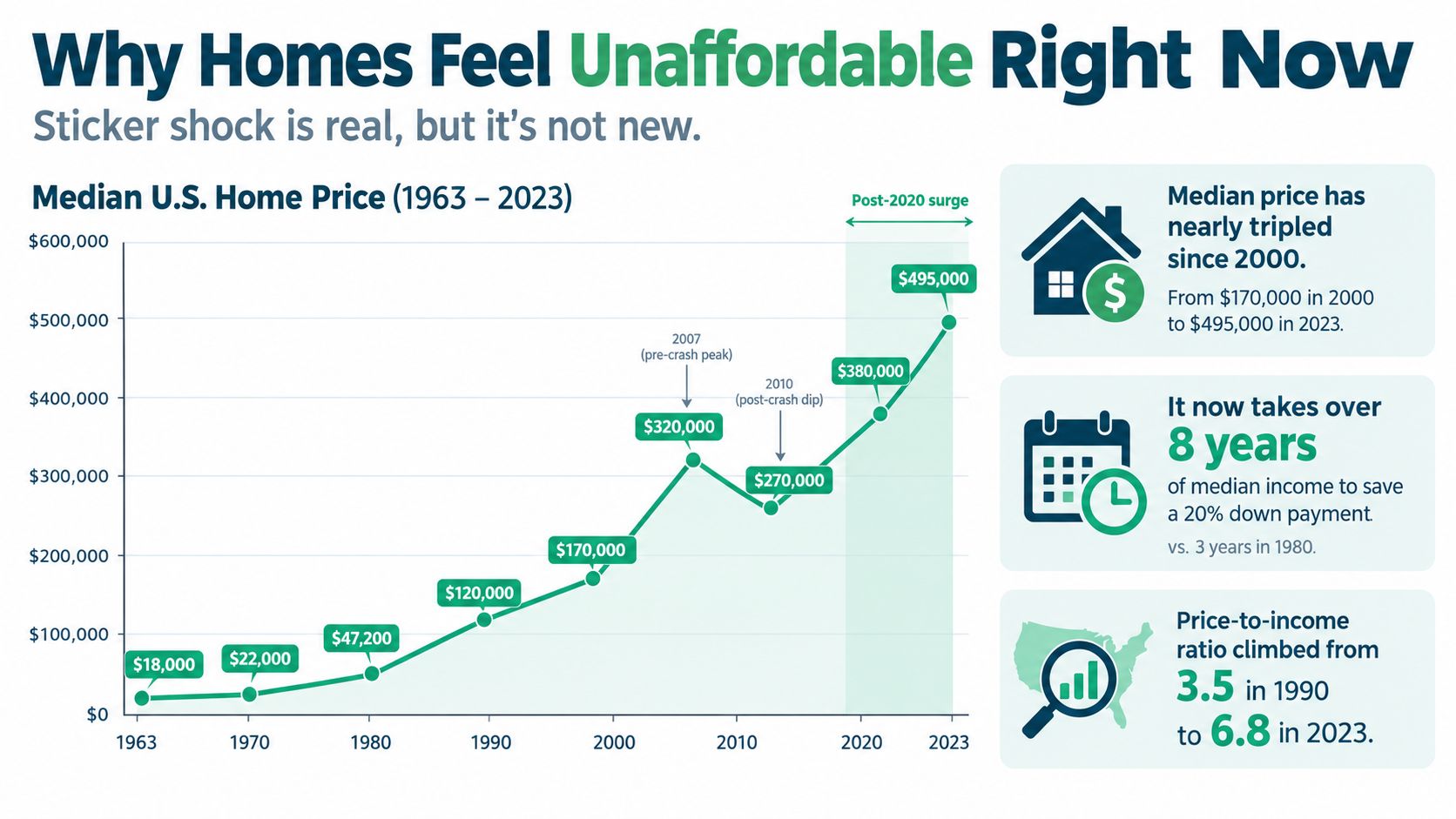
Why Homes Feel Unaffordable Right Now
Home prices rose from 74.9 index points in 1996-Q1 to 106.2 in 2007-Q1, then climbed again after 2012 and passed their earlier peak in 2017-Q2, according to the OECD housing-price analysis. Prices eased after their 2022-Q2 high, but a modest retreat cannot erase decades of accumulated gains. The recent boom was an acceleration of a longer affordability problem.
A listing price reflects more than wood, wiring, and labor. It includes land value, the number of homes local rules allow, permitting delays, construction financing, and the cost of a mortgage. It also reflects scarcity created when owners have strong financial reasons to stay put. Buyers see one figure, but that figure combines several constraints.
The price tag contains several different costs
Land can be expensive because a desirable location has limited space. It can become even more expensive when zoning restricts the number of homes that may occupy that space. Permit fees, redesigns, hearings, and waiting periods add regulatory costs before construction begins. Materials, labor, insurance, and financing then raise the cost of each finished unit.
The available homes may also be the wrong homes. A city can have listings while offering too few modest properties for households with ordinary incomes. Slower demand does not automatically solve that mismatch, especially when owners with older mortgages avoid selling and builders cannot profitably add enough entry-level supply. For lower-cost options in a competitive city, households may also browse NYC housing lotteries, where access depends on an application process rather than a bidding contest.
The six drivers worth separating
- Long-run price growth: Housing costs have outpaced general inflation across many major markets over an extended period.
- Local shortages: Competition is strongest near jobs and amenities, not in the national market viewed as one place.
- Regulatory scarcity: Zoning and land-use rules limit how quickly builders can respond.
- Construction costs: Materials, labor, tariffs, financing, fees, and approvals raise the price of new homes.
- Missing attainable homes: Listings can exist without offering properties ordinary households can afford.
- Mortgage lock-in: Owners with cheaper older loans may stay put, reducing turnover and available inventory.
The practical conclusion is uncomfortable. Cheaper homes require more than weaker demand. They require lower construction and regulatory costs, more homes in job-rich places, and enough resale inventory to loosen the market. When those parts remain constrained, prices can stay high even after buyers retreat.
How Housing Prices Actually Work
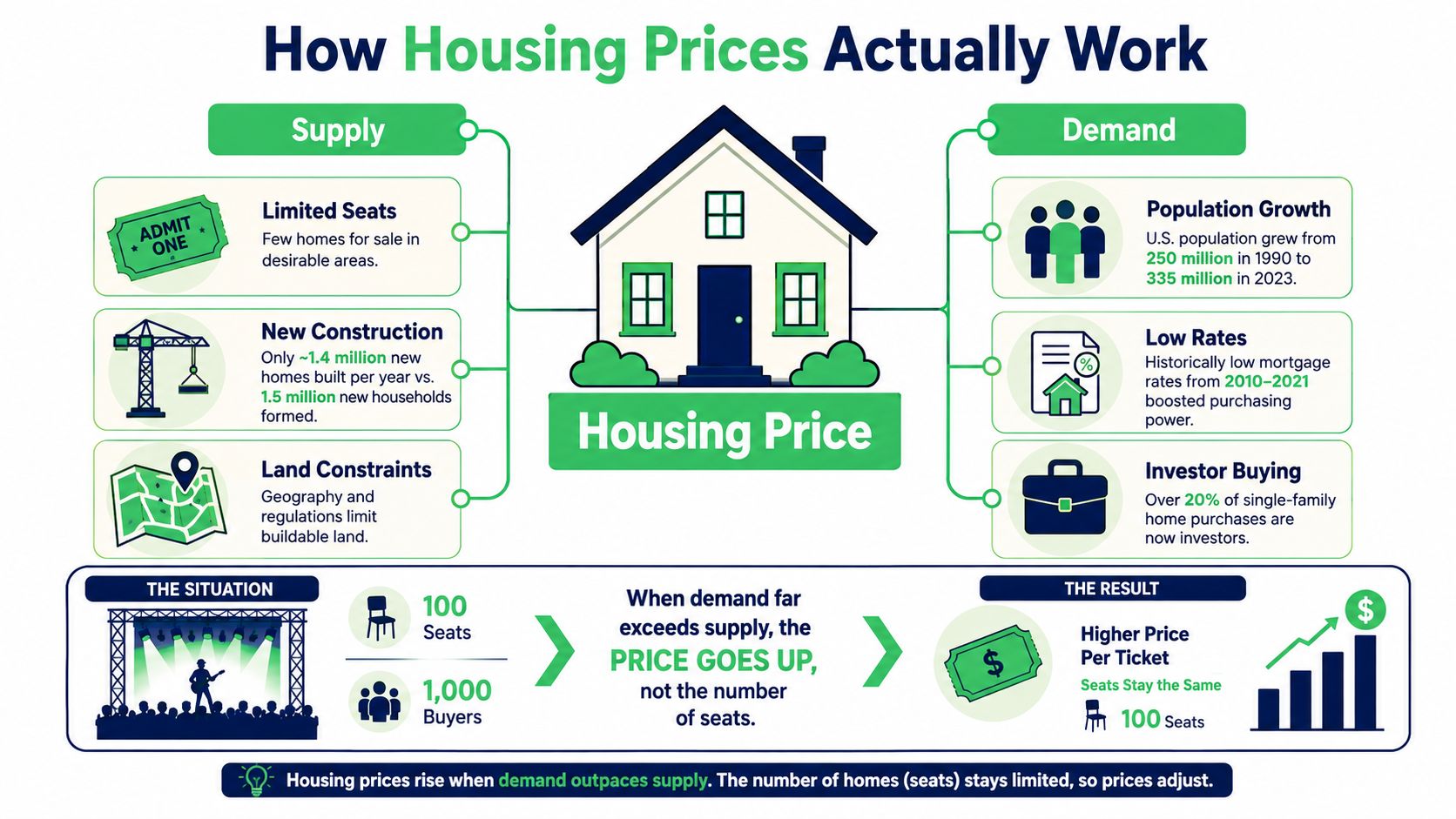
A home's price reflects a contest between available housing and the households able to pay for it. If a neighborhood offers few homes while jobs and incomes attract more buyers, competition raises prices. Housing supply is not a switch that builders can flip. Adding a unit requires land, financing, plans, permits, workers, materials, infrastructure, and a buyer or renter able to support the project.
Supply responds slowly
Supply responsiveness measures how quickly construction increases after prices rise. In a flexible market, higher prices attract projects, and added homes eventually ease competition. In a constrained market, higher prices may generate little new supply because zoning, infrastructure limits, approval requirements, and neighborhood restrictions make projects slower or less profitable.
The OECD's housing policy research identifies a central problem: housing supply in job-rich urban areas has not kept pace with demand, while supply growth in many countries has lagged income growth. When incomes rise faster than the housing stock, real house prices tend to face stronger upward pressure.
The cost structure matters as much as the demand story. Land prices capture location value, while permits, required infrastructure, financing, labor, and materials add regulatory and construction costs. A guide to land value for policy makers helps clarify why a well-located plot can remain expensive before construction begins.
Use two questions to assess any market:
- Are household incomes and job opportunities attracting more buyers?
- Can builders add homes quickly enough, in the locations and price ranges people need?
If the first answer is yes and the second is no, prices face upward pressure. If both answers weaken, sales can fall without prices falling much. Owners may delay selling, while builders pause projects whose costs no longer fit expected revenue.
Location beats national averages
National housing figures can hide severe local shortages. A country may add homes overall while an employment center lacks apartments, townhouses, or smaller houses near jobs, transit, schools, and amenities. Buyers compete for a particular commute and neighborhood, not for the national housing stock.
For a broader look at property concepts and household decisions, readers can explore The Money Maniac's real-estate guides. The practical habit is to treat housing supply as local, slow-moving, and shaped by rules.
Start analysis with the homes available at the price a household can afford. “Demand is strong” is too broad to explain a specific market. If the homes people need are not being added, softer demand may reduce sales volume without making housing cheap.
The Supply Shortage in Job Rich Cities
Housing shortages are most severe where jobs, transit, and amenities cluster. Workers can move toward opportunity, but homes cannot move with them. If construction trails the number of households seeking access to these places, existing homes become scarce, and buyers compete for the same limited stock.
Supply growth can lag behind income growth in job-rich urban areas, even while national construction figures look adequate. The result is a local shortage, not necessarily a nationwide absence of homes. A city may have enough housing in aggregate yet lack apartments, townhouses, or smaller houses near employment and services.
The inventory problem is visible
The U.S. had 1.1 million homes available for purchase in March 2024, down from 1.7 million in March 2019, according to the Harvard Joint Center for Housing Studies. Fewer listings leave buyers with fewer chances to find a home that fits both their needs and their budget. Limited inventory also gives sellers more pricing power, even when demand starts to cool.
The shortage is not only about the number of homes. It is also about price and tenure. The National Low Income Housing Coalition found 7.1 million affordable rental homes for 11.0 million extremely low-income renter households, leaving a 3.9 million-unit gap, according to its 2024 gap report. A market can therefore look well supplied while still failing households with the least ability to bid higher.
Shortage estimates vary, but the direction doesn't
Different methods produce different estimates. A shortage figure depends on assumptions about household formation, affordability, replacement needs, and what qualifies as adequate supply. It is not a count of vacant lots waiting for construction.
| Source | Measure | Estimate |
|---|---|---|
| Harvard Joint Center for Housing Studies | U.S. homes available for purchase in March 2024 | 1.1 million |
| National Low Income Housing Coalition | Affordable rental homes versus extremely low-income renter households | 7.1 million versus 11.0 million |
| National Low Income Housing Coalition | Affordable rental-home shortfall | 3.9 million units |
| Freddie Mac, cited by Congressional Research Service | Estimated U.S. housing shortage in Q3 2024 | 3.7 million homes |
The Congressional Research Service summary notes that shortage estimates vary by methodology while reporting Freddie Mac's 3.7 million-home estimate for Q3 2024. The precise figure is less important than the consistent direction: supply remains inadequate, particularly at attainable price points. Construction costs and local approval constraints help explain why builders do not quickly close that gap.
Practical rule: Check listings by price band and neighborhood, not only total inventory. A city can add expensive units while leaving the homes you need scarce.
Zoning and Land Use Rules That Quietly Inflate Prices
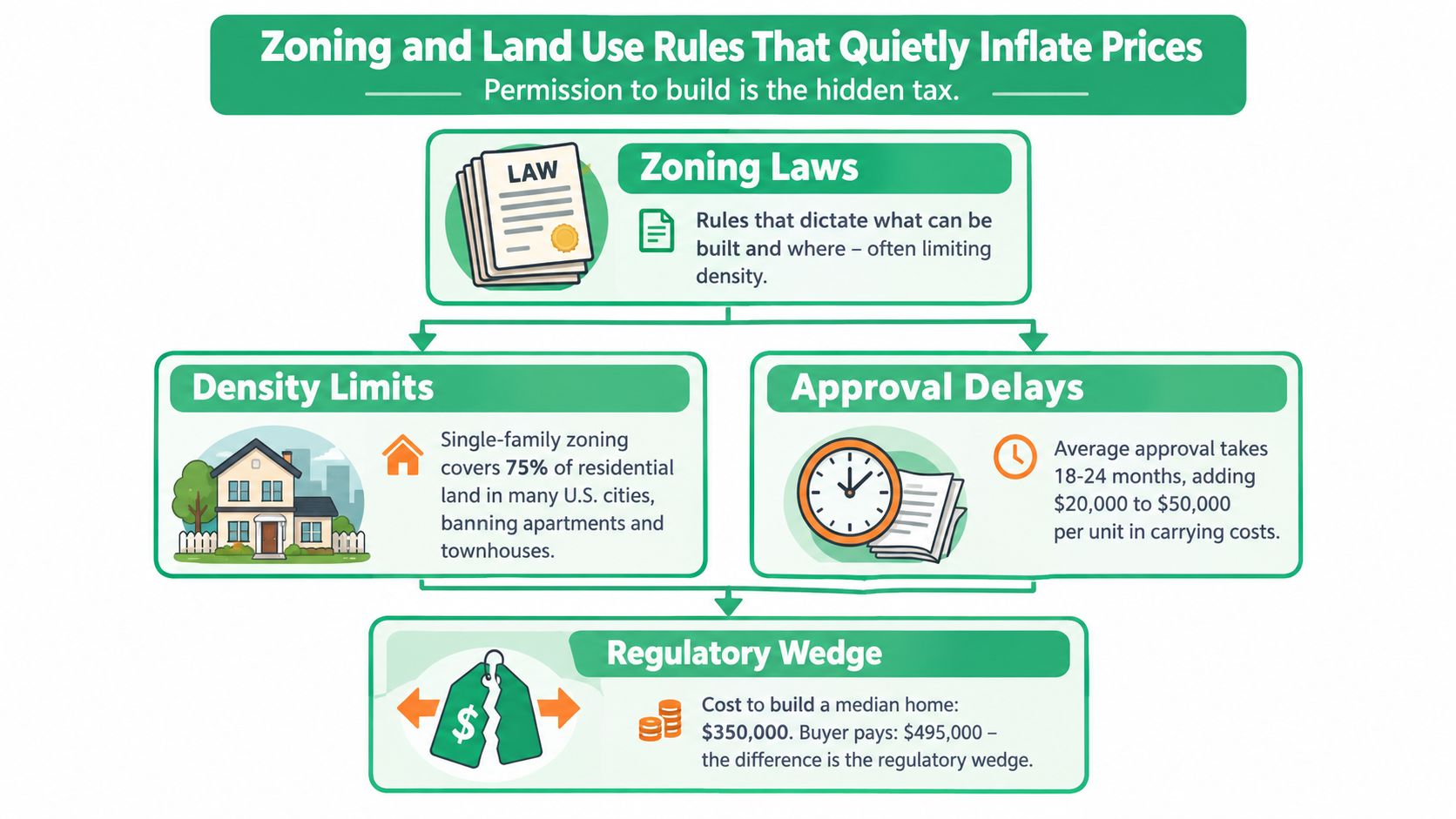
A zoning rule decides what may be built on a parcel. It can limit a lot to one detached house, restrict building height, require large setbacks, or block apartments and townhouses. Each rule may look local and technical, but together they determine how many households can access a desirable location.
Scarcity changes the price builders need
Strict land-use rules reduce supply responsiveness. When builders can't add enough units, prices must rise more before a project becomes worthwhile. The result is a wedge between the cost of supplying a home and the price buyers must pay for permission to occupy a scarce location.
Research summarized by the Reserve Bank of Australia's analysis of zoning estimated that zoning lifted detached-house prices above marginal supply cost by 73% in Sydney, 69% in Melbourne, 42% in Brisbane, and 54% in Perth. These figures don't mean every home in those cities contains the same markup. They demonstrate how administrative constraints can create a substantial gap between construction economics and market prices.
A useful way to think about it is that zoning can turn land into a rationed asset. Buyers aren't paying only for the physical structure. They're paying for the right to have a home in a place where the rules prevent many additional homes from competing with it.
Approval delays become financing costs
A project that waits for approvals still incurs expenses. Developers may pay interest, staff, insurance, design fees, taxes, and other holding costs before a single unit is occupied. Those costs must eventually be recovered through sale prices or rents, assuming the project proceeds at all.
This is why reform debates should focus on process as well as density. Allowing more homes on paper won't help much if approvals remain unpredictable, infrastructure requirements are unclear, or local objections can keep projects in limbo. The Unitism guide to land value for policymakers offers useful background for readers who want to understand how land value and public decisions interact.
What to watch locally
When evaluating a proposed housing reform, ask:
- Capacity: Would the rule permit more homes on already serviced land?
- Price range: Would it enable smaller or less costly units, or mainly expensive projects?
- Timing: Would approvals become faster and more predictable?
- Cost allocation: Which fees and infrastructure obligations fall on each new unit?
The important insight is that regulation can raise prices without anyone writing a check labeled “housing tax.” The cost appears indirectly, through fewer homes, slower construction, and higher land values.
Why It Costs More to Build Every New Home
Building more homes helps only when builders can produce homes that households can afford. If every new project carries higher material prices, labor expenses, financing costs, tariffs, fees, and regulatory burdens, additional supply may arrive slowly and at a price far above what first-time buyers need.
A 2026 U.S. Senate report said tariffs and economic uncertainty raised home-building costs over the prior year and reduced new housing starts, worsening the shortage, according to the Senate Joint Economic Committee housing report. The report also discussed state and local rules, permit delays, and land-use restrictions that can add more than $100,000 to a home's cost. It cited industry estimates placing regulatory burdens at 24% of the cost of a new single-family home and 41% for multifamily projects, all in the same report.
The extra cost reaches the buyer
Suppose a regulatory and approval burden adds $100,000 to a home. The buyer doesn't experience that as an abstract policy figure. The amount becomes part of the purchase price, the down payment requirement, closing costs, and the loan balance.
The monthly effect depends on the mortgage rate, term, taxes, insurance, and down payment. That means a responsible calculation can't produce one universal payment from the available facts. The method is straightforward, though: enter the original price, add the extra cost, select your loan assumptions, and compare the resulting principal-and-interest payment. A bigger loan also increases the cash needed upfront, unless the buyer uses a smaller down payment and accepts a larger balance.
Supply can be expensive before it exists
Construction economics have a feedback loop:
- Rules and delays raise project costs.
- Higher costs force builders to target higher sale prices.
- Higher prices shrink the pool of qualified buyers.
- Fewer viable projects reduce the flow of new homes.
- Scarcer supply keeps existing homes expensive.
This loop changes the policy answer. Building more matters, but reducing the cost and uncertainty of building matters too. A city that permits additional homes while making each unit expensive to approve and finance may increase supply without producing much relief for ordinary households.
The affordability test is simple
Don't ask only whether a policy creates more units. Ask whether it creates the right units at a price households can carry. A large project of high-cost homes may add inventory while doing little for renters seeking a modest apartment or buyers trying to enter the market.
The construction-cost story also explains why prices can remain high during weak sales. Builders may pause because projects no longer pencil out, while existing owners avoid listing. Fewer transactions don't automatically create a flood of affordable homes. They can reveal a market where both new supply and resale supply are constrained.
Mortgage Rates Lock In and Freeze the Market
Mortgage lock-in gives homeowners a financial reason to stay put. Someone with an older, low-rate mortgage may face a much larger payment after selling and purchasing a similar home, even if the new property costs no more than the old one.
The Philadelphia Fed found that mortgage lock-in prevented 1.7 million transactions and increased home prices by 7%, according to its study of mortgage lock-in and housing prices. That mechanism helps explain the strange combination of high prices and low sales. Owners stay, buyers see few listings, and the market becomes less liquid.
The move-up penalty
Consider a homeowner who refinanced into a cheap fixed-rate loan. Moving means giving up that payment and borrowing at a higher rate. Even if the homeowner has substantial equity, the replacement mortgage can make the move financially uncomfortable.
That decision affects everyone else. A starter home that might normally be sold to a first-time buyer remains occupied. The current owner doesn't need to be an investor or speculator. They may be protecting a monthly budget that works.
Compare the incentives, not just the rates
| Question | Selling and buying | Staying put |
|---|---|---|
| Mortgage | Replaced with a new loan at current terms | Existing loan remains |
| Monthly payment | May rise sharply | More predictable |
| Listing supply | Adds a home to the market | Keeps the home unavailable |
| Household flexibility | Supports relocation or downsizing | Rewards waiting |
| Market effect | Improves turnover | Keeps inventory thin |
You can test the payment side with The Money Maniac mortgage calculator. Change the loan amount and interest-rate assumptions, then compare the payment with your after-tax budget. The calculation won't predict rates or prices, but it can show how much room your finances have before housing crowds out savings, repairs, and ordinary life.
For regional context, readers considering California can review information on the 30-year fixed rate in California in 2026. Treat any rate page as a reference point rather than a promise. Your actual offer depends on credit, loan type, down payment, lender pricing, and other underwriting details.
Why waiting for lower rates may disappoint
Lower rates could help some buyers qualify, but they could also encourage locked-in owners to list and bring more homes to market. The result depends on how supply and demand respond together. If many buyers return before inventory improves, competition may push prices higher and absorb part of the payment relief.
That doesn't make waiting irrational. It means the decision should rest on your cash reserves, job stability, time horizon, and local inventory, not on a confident prediction about the next rate move.
What Would Actually Make Homes More Affordable
Homes become more affordable when supply expands and the cost of producing each unit falls. Building in job-rich areas helps, but the effect stays limited if zoning blocks modest density, permits take too long, and construction expenses push new homes toward the high end. Housing prices are therefore a construction-cost and regulatory-cost problem, not only a demand problem.
A market can have cooling demand and still leave families without options when its cheaper homes are missing. The practical target is attainable housing, supported by apartments, townhouses, smaller homes, and accessory units rather than only large, expensive new builds.
What policy can change
A credible affordability agenda would focus on:
- Flexible land use: Allow more housing types where roads, utilities, and services can support them.
- Predictable approvals: Shorten uncertainty so builders do not carry avoidable financing and holding costs.
- Lower production costs: Review fees, tariffs, and construction requirements that raise the price before a unit is completed.
- Entry-level supply: Judge progress by the homes households can afford, not just total units.
- Mortgage turnover: Recognize that owners with older, cheaper loans may keep homes off the market even after buyer demand cools.
Permit delays and zoning limits act like a wedge between what land and materials could produce and what the market is allowed to build. That wedge keeps prices high, even without a surge in demand. Mortgage lock-in adds a second constraint by discouraging existing owners from selling, so new construction must carry more of the burden.
These reforms will not create instant bargains. Housing must be planned, financed, built, and occupied. They can make supply respond faster and prevent scarcity from becoming the default setting.
What buyers and renters can do now
Your controllable variables are budget, location, loan size, savings rate, and the amount of space you need. Zoning and mortgage markets are not part of your personal emergency fund, so avoid a plan that depends on either one rescuing your purchase.
Use five checks:
- Payment stress: Include taxes, insurance, maintenance, and association fees in the full housing cost.
- Cash resilience: Keep liquidity for ordinary emergencies and ownership repairs.
- Local supply: Track listings in your price range, not merely inventory across the city.
- Flexibility: Compare renting and buying over the time you expect to stay.
- Down-payment plan: If saving while renting is the obstacle, follow this guide to saving for a house while renting.
The sensible choice is neither a crash forecast nor an urgent purchase. Buy when the payment works under conservative assumptions and the home fits your life. Rent when flexibility and cash preservation matter more. Watch entry-level listings, approval reforms, construction activity, and mortgage turnover. Those indicators reveal more than a dramatic national headline.
Get more posts like this
One short, useful email each Friday. Free, no spam, unsubscribe anytime.