Asset Allocation by Age: Rules That Hold Up in 2026
Asset allocation by age explained: how the 100, 110 and 120 minus age rules compare, where glide paths fit, and when to adjust your mix.

Daniel Anderson
Editor, The Money Maniac
November 9, 2026
15 min read

Subtract your age from 100, put that percentage in stocks, and you're done. That's the most popular version of asset allocation by age, and it's also the laziest. Age tells you roughly how much time you have. It tells you nothing about your paycheck, your pension, your debts, or whether you'll need this money in three years or thirty.
Use the rules below as a starting line, then adjust them. That adjustment, not the arithmetic, is where the key decision lives.
The 100, 110 and 120 Minus Age Rules Compared
The arithmetic is simple. Pick a number, subtract your age, and the result is your stock percentage. The rest goes to bonds and cash.
Stock share under three age-based rules
| Rule | Stocks at 30 | Stocks at 50 | Stocks at 70 |
|---|---|---|---|
| 100 minus age | 70% | 50% | 30% |
| 110 minus age | 80% | 60% | 40% |
| 120 minus age | 90% | 70% | 50% |
The 100 rule is the most cautious of the three. The 110 and 120 versions push stocks higher, and the argument for them rests on longer lifespans and longer retirements that need more growth to fund. That's a judgment call, not a settled law of physics. Treat it that way.
Say you're 30 with $50,000 invested for retirement.
- 100 minus age: $35,000 in stocks, $15,000 in bonds and cash
- 110 minus age: $40,000 in stocks, $10,000 in bonds and cash
- 120 minus age: $45,000 in stocks, $5,000 in bonds and cash
Same person, same account, a $10,000 difference in stock exposure depending on which rule you picked on a Tuesday afternoon. That gap is the whole point. The formula is doing less work than people think.
What the rule leaves out
The SEC's introduction to investing on Investor.gov defines asset allocation as dividing investments among stocks, bonds, and cash, with the appropriate mix depending on an investor's time horizon and risk tolerance. A long horizon makes volatile assets easier to tolerate because there's more time to recover. A short horizon generally calls for less volatility because withdrawals may be close.
Notice what that definition centers on. Horizon and tolerance, not birthdays. Someone in their 30s saving for retirement may reasonably hold more stocks than someone the same age saving for a house down payment in three years. The rule can't see that difference.
Risk tolerance also has two parts, your willingness to endure losses and your financial ability to absorb them. A high earner with a large emergency fund can withstand a decline more easily than someone who would need to sell investments to cover next month's rent.
Practical rule: Start from 110 if your job is steady and retirement is decades away. Start from 100 if losses would keep you up at night or you'll need the money within a decade.
None of the three rules looks at income, goals, or retirement date. Use one to get a first draft, then check that draft against your actual life.
Why Your Age Alone Does Not Set Your Mix
Two investors can share a birthday, a balance, and a stock percentage and still need different portfolios. Age gives you a starting line. The rest of the decision comes from the life the formula cannot see.
Vanguard's perspective on expanding its Target Retirement lineup describes a lifecycle model that evaluates thousands of possible glide paths by balancing expected median wealth against uncertainty in outcomes. The optimal path depends not only on age, but also on risk aversion, retirement age, savings rate, starting compensation, and whether the investor has a defined-benefit pension.
That list matters because each item changes what your portfolio has to do. More guaranteed income means less of your portfolio must pay basic bills. A later retirement means more years of contributions and more time to recover from a downturn. The published glide paths assume a household with a steady paycheck, a predictable retirement date, and no competing goals. Real households rarely match that template, and many investors do not follow a glide path at all.
Two 35-year-olds, two different answers
Take two investors, both 35, both with $80,000 invested. An age rule gives them the identical stock percentage.
The first has a steady salary, a pension coming, and saves 20% of pay. Her paycheck arrives predictably, and the pension will cover a chunk of retirement spending. She can reasonably hold more stocks because a bad market year does not threaten her rent or her basic retirement income.
The second freelances. Income swings month to month, there is no pension, and a slow quarter sometimes means dipping into savings. If a market drop lands in the same month as a gap in client work, she may have to sell at the worst moment. She needs the portfolio to cushion uneven income, which argues for fewer stocks and more in bonds and cash.
Same age. Same balance. Very different capacity for risk.
Your paychecks are an asset too
Economists call your future earnings human capital. In plain terms, it is the money you will make over the rest of your working life, and it behaves like an asset you already own.
A stable salary works like a bond, steady payments you can count on. If you already have that bond-like income stream, your investment portfolio can carry more stock risk. Unpredictable income is closer to holding stock already, so piling more stock risk on top concentrates your whole financial life in one kind of bet.
That is why a young investor with stable income and high savings capacity may rationally hold more equities than another investor of the same age whose income is volatile. Age is a proxy for human capital, and sometimes a poor one.
What actually moves the stock share
A pension or reliable salary argues for more stocks because less of the portfolio must cover basic bills. Volatile income or a thin emergency fund argues for fewer, since a market drop can land beside a missed paycheck or a surprise bill. Money with a goal about three years away belongs in safer assets, whatever your age. An earlier retirement argues for less stock risk before withdrawals begin. A later retirement or longer working life argues for more stocks, because you have more time to recover and keep growing.
Use those factors to adjust your starting rule by modest steps, perhaps five or ten percentage points at a time, then revisit the mix after a job change, a new pension, a higher savings rate, or a shift in retirement plans. A birthday alone rarely changes your finances that much.
A diversified global equity allocation can supply the growth. Size high-quality bonds and cash around near-term spending needs and your ability to tolerate losses. That is a guardrail with your circumstances built in, which is more than any subtraction problem can offer.
How Glide Paths Shift From Growth to Stability
A glide path works like a ski slope: steep at the top when you're young and holding mostly stocks, then leveling out as you approach the bottom and need the money. Nobody jumps from aggressive to conservative on one birthday. The slope does the work gradually, trimming stock exposure a little at a time so a single bad year near retirement can't wreck decades of saving.
Vanguard's research on age-appropriate allocations in target-date funds shows a representative glide path starting at approximately 90% equities for investors around age 20. By age 65, the allocation reaches roughly 50% equities. By age 72, the age Vanguard identifies as the most common point for beginning withdrawals, it reaches approximately 30% stocks and 70% bonds.
That 90% to 30% range is a widely used benchmark, and it carries an honest caveat. A lifecycle glide path does not guarantee higher returns. Retirement-wealth outcomes from lifecycle strategies can land broadly similar to an age-invariant portfolio holding the same average equity exposure. The slope's real job is managing changing risk capacity, especially the danger that a severe decline near retirement impairs withdrawals. You trade some upside for a smaller chance of disaster at the worst time. The slope also assumes a household with a steady paycheck, a fixed retirement date, and no major shocks. Your actual mix starts from the slope and adjusts for what the slope cannot see. The slope is a starting line, not a finish line.
The SEC's guidance on rebalancing your investment portfolio gives a simpler illustration. An investor in their 20s might hold 80% stocks and 20% bonds. Someone closer to retirement might use 60% stocks and 40% bonds. During retirement, a portfolio might contain 30% to 50% stocks and 50% to 70% bonds. Same shape, different starting point. Both are examples, not prescriptions, and the gap between 80% and 90% early on tells you how much room reasonable people leave for judgment.
A target-date fund shifts its mix automatically as the selected retirement year approaches. That convenience is real, especially if you know you won't rebalance on your own. Funds don't all follow the same path, though. Some become more conservative before retirement and then hold steady. Others keep reducing stock exposure for years after the target date, which changes your risk long after you've stopped paying attention.
Before you buy one based on the year in its name, check three things.
- Stock percentage at the target year: Two funds with the same year can hold very different mixes on retirement day.
- Landing allocation: Find where the slope finally levels out and how long it takes to get there.
- Fees: You're paying for automation, so confirm the cost is reasonable for work you could approximate yourself.
A benchmark shows the typical shape of the slope. It can't tell you whether that slope fits your income, your goals, or your timeline.
If Social Security or a pension will cover most of your spending, you may tolerate more stocks at every stage than either benchmark suggests. If your portfolio is the whole plan, you may want the gentler end.
What Investors Actually Hold at Each Age
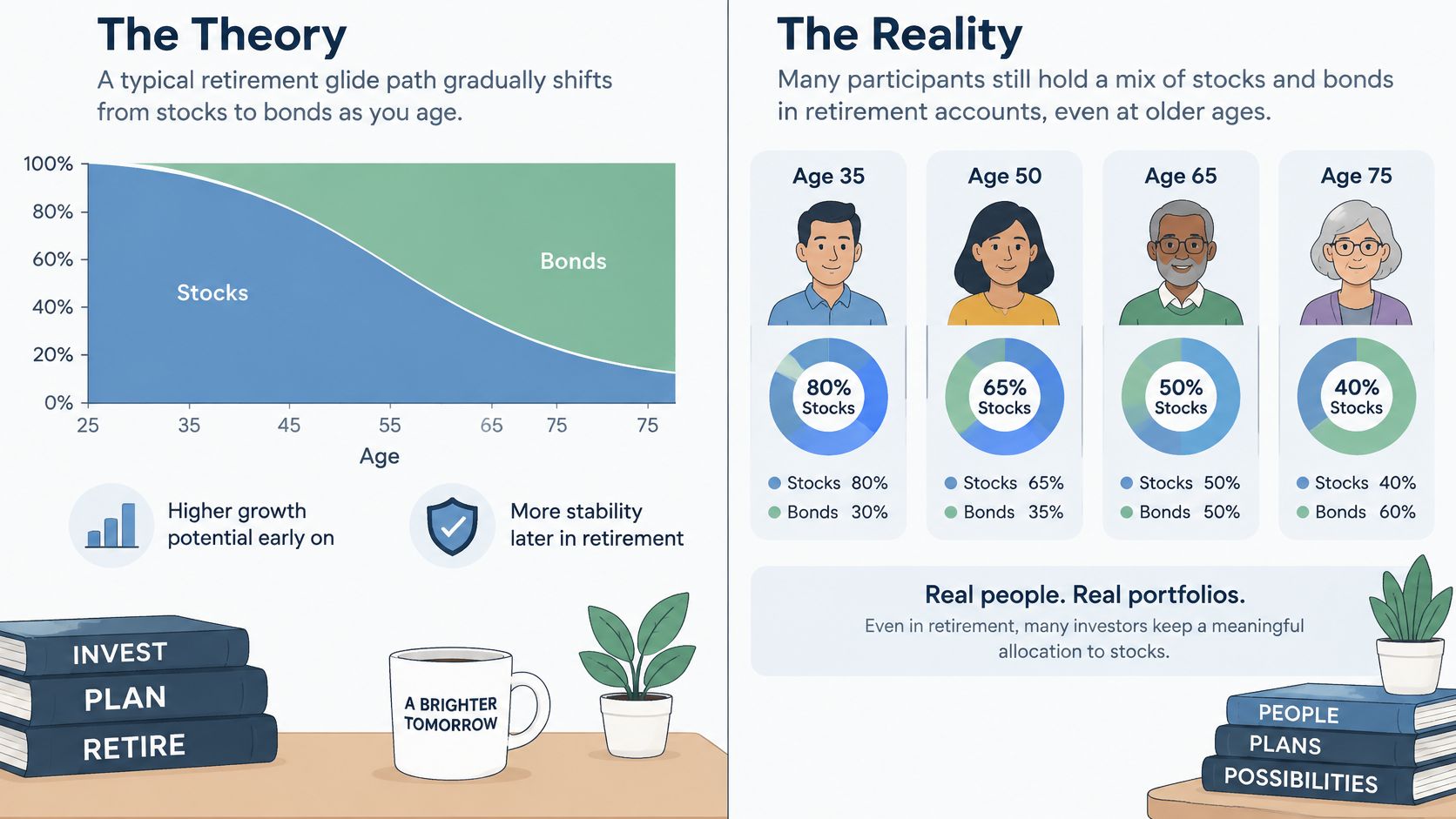
Age-based rules draw a clean line: the most stocks when you are young, then a steady cut. Households do not invest that way.
Vanguard's 2025 research on target-date fund participants found that in a 2019 to 2024 panel, 50% of participants aged 50 and older increased their equity share, compared with 34% of those aged 20 to 34, that average equity allocations never exceeded 60% at any age and peaked in middle age, and that 85% of surveyed defined-contribution participants held at least some target-date exposure in 2025.
The youngest group was not the most aggressive. Half of the older group raised stocks, the opposite of the textbook slope. Average holdings are hump-shaped: cautious early, bolder in the middle years, then lighter on stocks later.
Why would older investors add stocks
The panel cannot explain any one move. More confidence, an employer default, a longer retirement, or worry that cash and bonds will lag inflation and longevity can all produce the same trade.
Some of that reasoning is sound. A retiree whose pension or Social Security covers the bills, with money she will not spend for fifteen years, can keep a large stock sleeve on purpose. A 30-year-old buying a house in three years should hold very little stock in that slice, even with decades of work still ahead.
I would separate the total balance from the slice you need in the next few years before trusting an age rule. Those rules only see the total. They also assume a household they cannot see: other accounts, a pension, a down payment, or a policy you have not counted.
A January 2024 dashboard dataset on Americans turning 65 showed people in their 50s held 39.2% of assets in U.S. stocks, 25.7% in cash, and 7.3% in U.S. bonds. A quarter of the portfolio in cash changes the risk picture more than a few points of stock weight.
Defaults do a lot of the deciding
With target-date exposure that common, many allocations are a plan sponsor's choice, not a personal glide path. The default also stops at the account wall. Outside assets never enter the formula.
That outside tally includes understanding when life insurance counts as an asset before you call a single account too aggressive or too cautious.
Use the age default as a starting line, then check it against near-term spending, other accounts, and income you cannot outlive. If the default and the household disagree, follow the household. That is the plan you are funding.
Protecting Your Mix Once Withdrawals Begin
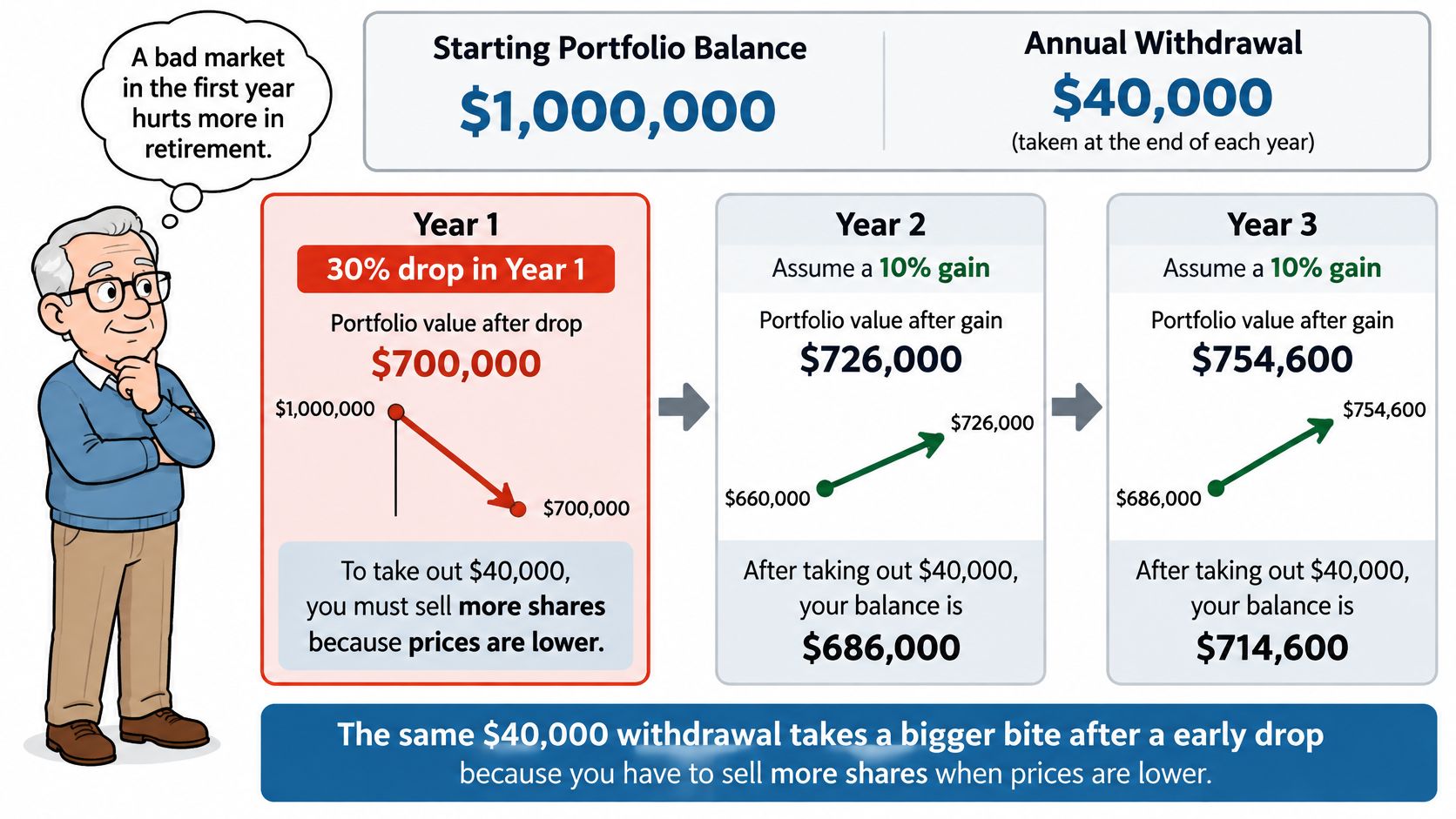
Retirement changes the math because you're now selling. Sequence-of-returns risk means the order of your returns matters, not just the average. A bad stretch early, while you're withdrawing, does damage a later recovery can't undo.
A labeled illustration
Say a retiree starts with $1,000,000 and withdraws $40,000 a year. A 30% drop in year one cuts the portfolio sharply, and funding that same $40,000 now requires selling a larger slice of what's left. Fewer shares remain to benefit when markets recover, so the hole gets deeper even if average returns later look fine.
Morningstar's analysis of the biggest risk for new retirees found that for a 30-year retirement with fixed real withdrawals and a 90% success target, portfolios with substantial fixed-income exposure generally supported higher starting withdrawal rates than highly equity-heavy portfolios. Its analysis identified bond allocations around 50% to 70% as particularly effective in some scenarios.
That range lines up with the retirement end of the published benchmarks. It doesn't mean stocks disappear.
Separate the money by when you'll spend it
A bucket approach makes the trade-off concrete. Hold roughly five years of planned withdrawals in cash and high-quality short and intermediate-term bonds. At $40,000 a year, that's $200,000. Keep diversified stocks for spending that sits further out, where they have time to recover.
Our guide to the retirement bucket strategy walks through refilling that near-term bucket in good years so you're not forced to sell stocks in bad ones.
Dropping stocks entirely feels safe and usually isn't. Over several decades, inflation quietly erodes a portfolio that never grows.
Inflation risk and longevity risk can make a zero-equity portfolio fragile across a multi-decade retirement. You need enough stability to fund the next few years and enough growth to fund year twenty-five. Those are different jobs, so give them different assets.
Set your actual percentage using your own facts. Guaranteed income from Social Security or a pension, flexibility to trim spending, health, taxes, and any goal of leaving money to heirs all push the number around. Someone who can cut spending 10% in a bad year can hold more stocks than someone whose budget is already bare bones.
Measure your mix against the benchmarks, then adjust. They are reference points for a conversation with your own numbers, not a prescription someone else wrote for you.
Stress-Test Your Mix Before You Commit
Run the dollar test before the market runs it for you.
The dollar test
Take $100,000 invested at 80% stocks, which is $80,000 in stocks and $20,000 in bonds and cash. Now assume stocks fall 30% while the rest holds steady. A simplification, but a useful one.
- Stock loss: 30% of $80,000 is $24,000
- New balance: $100,000 minus $24,000 is $76,000
- Total decline: 24%, on money you may have spent years saving
Two questions decide whether that mix survives a real drawdown. Could you sit through a $24,000 paper loss without selling? And would you need any of that money in the next few years, which turns a paper loss into a permanent one?
If either answer gives you pause, the stock share is too high for you, whatever your age says. Lower it until the dollar figure becomes tolerable, then confirm your emergency fund covers several months of expenses so a job loss never forces a sale near the bottom. Willingness and ability both have to clear this bar, and the stricter one sets the ceiling.
The arithmetic matters most in the years just before and after you start spending the money. Our explainer on what sequence of returns risk means for your withdrawals covers why a bad first decade hurts more than a bad third.
Questionnaires measure answers, not circumstances
Risk questionnaires and allocation calculators from brokerages and workplace plans are a reasonable first pass. They capture preferences. They don't see your paycheck, your mortgage, or your timeline, so take the label they hand back as a starting point and run the mix through the dollar test before adopting it. Being told you're "moderately aggressive" says nothing about whether a 24% hit fits your life.
Rerun the test after each major life change: a job loss, a new mortgage, an earlier retirement date than you planned. A mix that survives comfortably today can fail six months from now. Five minutes of arithmetic is cheaper than discovering the answer during a downturn, when your only remaining option is to sell.
Build Your Allocation Step by Step, Then Review It Yearly
A rule gives you a number, not a plan. I'd start retirement money at 110 minus your age in stocks, with the rest in bonds, then build the actual mix around your goals. The routine below turns that starting point into something you can explain and defend.
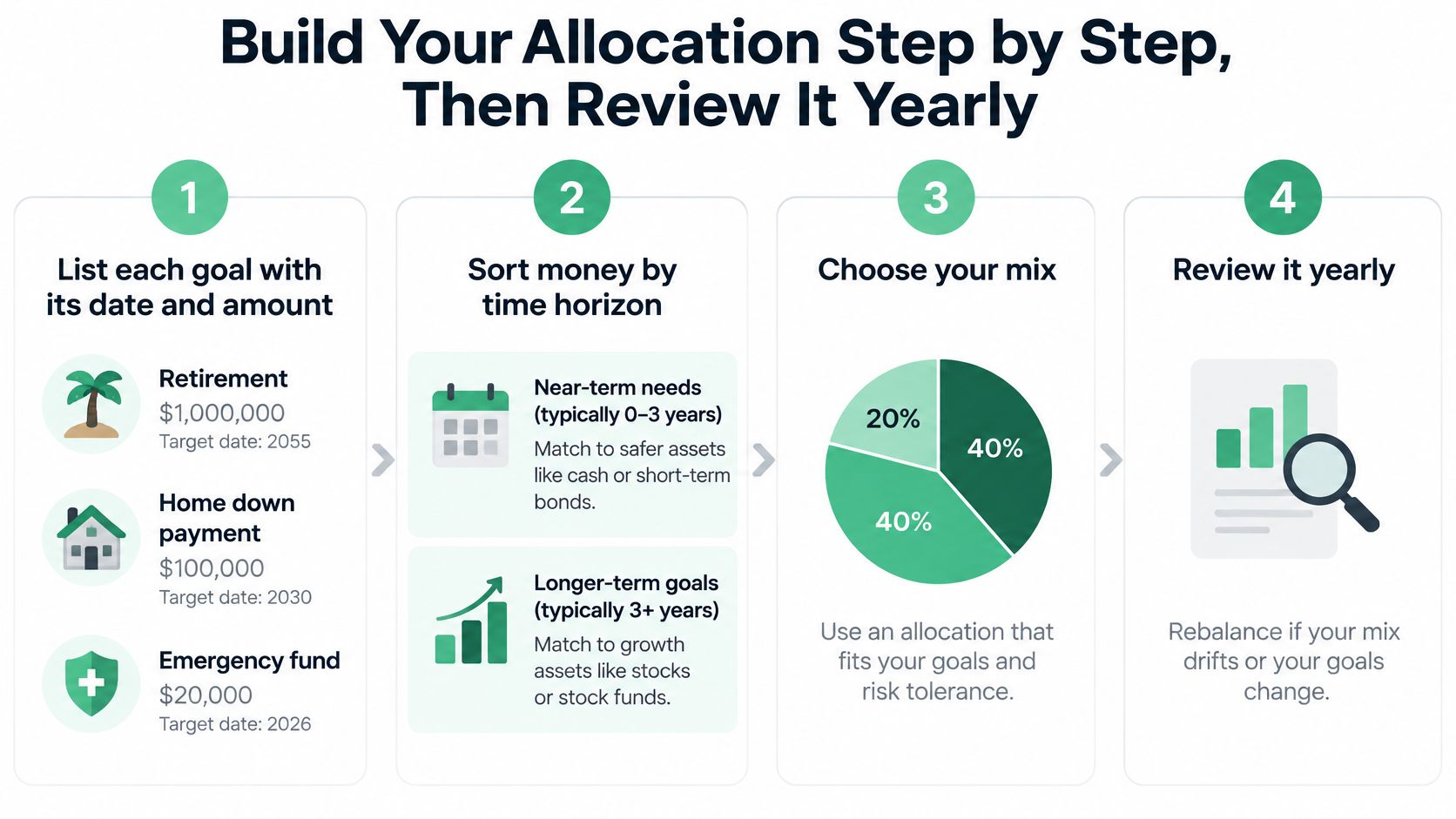
The seven steps
- List each goal with its date and amount. Retirement, a home down payment, and an emergency fund run on separate clocks. One blended mix serves none of them well.
- Sort money by horizon. Money you need within about three years belongs in cash or short-term bonds. Short horizons leave no time to recover from a stock decline.
- Pick a starting stock share. Use the 110 rule when income is steady and retirement is decades away. Use 100 when losses would keep you up at night or you need the money within a decade.
- Adjust for your factors. Pension coverage, income stability, the size of your emergency fund, and your planned retirement date all move the number. Make small, deliberate shifts rather than a wholesale guess.
- Look through each fund's holdings. Two funds can own many of the same companies, so check for overlapping holdings before assuming you are diversified. Our primer on index fund investing and how broad funds work explains what to inspect inside a fund.
- Diversify inside each asset class. Spread stock money across companies, sectors, and regions. Spread bond money across issuers and maturities so one borrower or one rate move cannot dominate.
- Add up the household total. Combine workplace plans, IRAs, and taxable accounts. The overall stock share is what you live with, and one conservative account can hide an aggressive household.
If you hold a target-date fund, check its stock share, fees, and landing allocation during step seven. Count it at its real mix, not the year on the label.
Step four carries more weight than the age rule. A stable pension or reliable income supports a higher stock share because less of the portfolio has to cover basic bills. Volatile income, a thin emergency fund, or a goal due within about three years pushes the stock share down. So does an earlier retirement date, while working longer gives the portfolio more time to recover.
The yearly review is the decision
Review the mix once a year and after any major life change, a job change, a new pension, or a shift in retirement plans. Rebalance when the mix has drifted well away from target, and recheck whether the target still fits.
For the savings side of the plan, our Compound Interest Calculator shows how lump sums and monthly contributions grow over time with compounding. Use it to set the contribution, then use the seven steps for the split.
Do your own research or consult a licensed professional before making investment decisions. An age rule can start the conversation, and your circumstances should finish it.
Get more posts like this
One short, useful email each Friday. Free, no spam, unsubscribe anytime.