How Much Should I Invest Each Month
Wondering how much should I invest each month? Use this practical framework to balance debt, build an emergency fund, and hit your exact savings targets.

Daniel Anderson
Editor, The Money Maniac
October 2, 2026
13 min read

You've opened your budgeting app, stared at the balance, and wondered whether investing $100 a month is responsible or laughably small. Meanwhile, every financial article seems to shout “save 15%” as if rent, groceries, debt payments, and surprise car repairs are optional side quests.
The better answer to how much should I invest each month starts with your cash flow, not a slogan. Use 15% of gross income as a long-term target when your finances can support it, but stage your way there. Build financial defenses first, collect available employer matching money, then automate an amount you can sustain through ordinary months and mildly annoying ones.
Why the Standard Savings Advice Fails Real Budgets
A household can follow the famous savings percentage and still end each month with no cash, a growing credit-card balance, or investments that must be sold at the worst possible moment. A flat percentage works as a destination. It fails as a universal starting line.
The U.S. personal saving rate was 4.1% in August 2026, while the euro area household saving rate was 14.3% in the first quarter of 2026, according to the Federal Reserve Economic Data series on personal saving and the European Central Bank's economic bulletin. These figures describe different regions and broader household behavior, so they are not a direct template for your budget. They do establish the important point: saving capacity varies sharply, and one fixed percentage cannot fit every household.
The same rule breaks down when income arrives unevenly, housing consumes a large share of pay, or debt payments take priority every month. A household with little surplus may automate too much, withdraw the money after the next repair or bill, and conclude that investing does not work. That is a cash-flow problem wearing an investing costume.
Treat 15% as a destination
15% of income is a sensible long-term retirement target, not a monthly character test. A retirement savings analysis reports a combined employee and employer 401(k) savings rate of 14.4% in the second quarter of 2026, while workers contributed 9.6% of pay on average before employer contributions were included, as summarized in this retirement savings rate analysis.
Employer contributions can carry part of that target, and younger workers may sit below the overall figure while establishing a useful habit. The same analysis reports that plan participants under age 25 averaged 9.6% of salary including employer contributions. The benchmark gives you a direction. It does not give your landlord permission to accept percentages instead of dollars.
Start with your monthly investable surplus:
Take-home pay minus essential spending, minimum debt payments, and a realistic cash reserve contribution.
If the result is zero, set your current investment target at zero until you create room. If high-interest debt absorbs the surplus, direct extra cash there before increasing market exposure. Paying down a costly balance can improve your position without exposing money needed soon to market declines.
Review spending with a system your household can maintain, such as the approaches collected in these budgeting methods. The goal is not a beautiful spreadsheet that expires by Thursday. It is a reliable view of what remains after bills, debt, and near-term cash needs.
Stage the climb
Begin with an automatic amount that survives several ordinary billing cycles. Increase it after a debt is cleared, income rises, or a recurring expense disappears. This approach matches contributions to real cash flow instead of forcing a percentage that gets canceled whenever life sends an invoice.
Use three tests:
- Can you repeat it? It must work in a normal month, including repairs, medical bills, and birthdays.
- Can you increase it? Set a review after a meaningful pay increase or major debt payoff.
- Can you leave it invested? Money needed soon should not be exposed to sequence risk.
Consistent saving is the foundation to build lasting wealth. My recommendation is direct: invest something sustainable now, then work toward 15% over time. A smaller contribution that stays invested beats a perfect target repeatedly abandoned.
Clearing the Runway Before You Invest
Investing works best when your financial life can absorb a setback without selling at an ugly moment. Before choosing a stock-market contribution, build the runway that lets you keep contributing when the market is down or your boiler develops a personal grudge.

Start with cash protection
First, identify the amount you need for essential monthly bills. Include housing, utilities, food, insurance, transportation, minimum debt payments, and other expenses that continue even when life becomes inconvenient.
Then build a readily accessible emergency reserve based on your own job stability, income pattern, health situation, and likely household repairs. A salaried worker with secure employment may need less cash flexibility than a contractor whose income arrives in waves. There's no useful prize for selecting a reserve that looks impressive on paper but leaves you reaching for a credit card when the washing machine leaks.
Keep this reserve separate from investment money. Its job is stability, not growth. If the cash is needed for a near-term emergency, market volatility has no business deciding how much of it remains.
Remove expensive debt
Next, attack high-interest revolving debt before increasing taxable-market investing. Consider an illustrative credit card balance charging 24% APR. Paying that balance down offers a definite interest-cost reduction, while an investment return is uncertain and can arrive after a fall rather than before it.
Use an online debt repayment plan calculator to compare an interest-first approach with other repayment schedules. The point isn't to make debt repayment entertaining. The point is to see how much monthly cash becomes available when expensive balances stop consuming it.
Practical rule: If a debt's guaranteed cost is painfully high, treat repayment as the first investment in your financial stability.
That rule has exceptions. Low-cost debt with a manageable payment may coexist with retirement contributions, especially if stopping contributions would cause you to lose an employer match. But expensive credit card debt deserves urgency because it compounds against you every billing cycle.
Use a simple order of operations
Once you know your cash need and debt burden, route each new dollar in this order:
- Cover essential bills and minimum payments. Missing these creates fees, credit damage, and stress that no portfolio allocation can repair.
- Build the emergency reserve. Add a recurring amount until your cash buffer matches your income and household risk.
- Capture an available employer match. If your workplace adds money when you contribute, meeting the match threshold usually belongs ahead of extra investing elsewhere.
- Pay down toxic debt. Direct additional surplus toward balances with punishing interest.
- Increase long-term investing. Raise the automatic contribution as financial pressure falls.
This sequence keeps you from investing aggressively with one hand while borrowing at high rates with the other. Once the runway is built, your monthly investment amount can serve its intended purpose, buying long-term assets rather than acting as a temporary holding pen for money you'll soon need.
Finding Your Actual Monthly Investment Number
Suppose your salary arrives, your bills take their share, and the amount left over looks suspiciously smaller than every “save 15%” rule suggests. After building cash reserves and addressing high-cost debt, calculate a target that includes employer contributions rather than treating the full amount as your payroll burden.
Annual gross income × 15% ÷ 12 = total monthly retirement contribution target.
The 15% benchmark offers a starting point, not a commandment. The calculation includes your contributions and employer money. If your employer contributes a match, subtract the expected monthly match from the total target to find the amount that must come from your paycheck. The benchmark is discussed in this retirement savings rate analysis.
For someone earning $60,000 annually, a 15% target equals $9,000 per year, or $750 per month. If the employer contributes an illustrative 4% of pay, the employee contributes the remaining 11%, equal to $6,600 per year, or $550 per month. That 4% is a calculation assumption, not a universal match promise.
Monthly investment targets by income
| Annual Income | 15% Total Target | Your Monthly Out-of-Pocket, Minus 4% Match |
|---|---|---|
| $40,000 | $6,000 annually, $500 monthly | $4,400 annually, $366.67 monthly |
| $60,000 | $9,000 annually, $750 monthly | $6,600 annually, $550 monthly |
| $90,000 | $13,500 annually, $1,125 monthly | $9,900 annually, $825 monthly |
Use the formula for your own salary. Plan rules still matter. Some employers apply matching only up to a specific contribution level, and eligibility requirements can delay or limit the money. Read the plan terms before counting a contribution that may not arrive.
Regional living costs can change the answer sharply. A salary that supports a $750 monthly contribution in one area may leave little room for that amount elsewhere, as the World Property Investor London data illustrates. Your target must survive rent, transport, food, insurance, and ordinary bad luck, not just look tidy in a spreadsheet.
Adjust for the person behind the percentage
Irregular income calls for a conservative base. Calculate the automatic contribution from a weaker but realistic month, then add extra investments when stronger months produce genuine surplus. A transfer that forces repeated reversals is not discipline. It is a recurring administrative prank.
Existing portfolio exposure also changes the right monthly number. Wealth gains have accrued predominantly to higher-income households with substantial equity holdings, increasing consumption exposure when markets correct, as discussed in the 2026 economic bulletin. If your current wealth already sits heavily in equities, raising the contribution without checking concentration can increase risk rather than improve the plan.
Reduce new equity purchases, broaden the allocation, or hold more cash when you may need the money within one to three years. Those periods are decision boundaries, not forecasts. Money with a near-term job belongs in a safer assignment than retirement money intended to remain invested for decades.
Your target should answer two questions: How much can you contribute consistently, and how much market exposure fits the job that money must perform?
Start at the employer-match threshold, work toward the 15% total target, and adjust for income volatility, debt, regional costs, and concentration. The right monthly investment number is the amount your cash flow can sustain without turning every unexpected bill into a portfolio withdrawal.
The Math Behind Monthly Contributions Versus Lump Sums
Monthly investing and lump-sum investing solve different problems. The right choice depends on whether the money arrives gradually, whether it is already available, and how much market loss you can tolerate without abandoning the plan.
A lump sum puts available cash into the market immediately. Dollar-cost averaging, or DCA, divides that cash into equal purchases at regular intervals. Falling prices buy more shares with each fixed contribution; rising prices buy fewer. DCA reduces the pressure to identify the perfect entry day, a skill that tends to appear most reliably in hindsight.
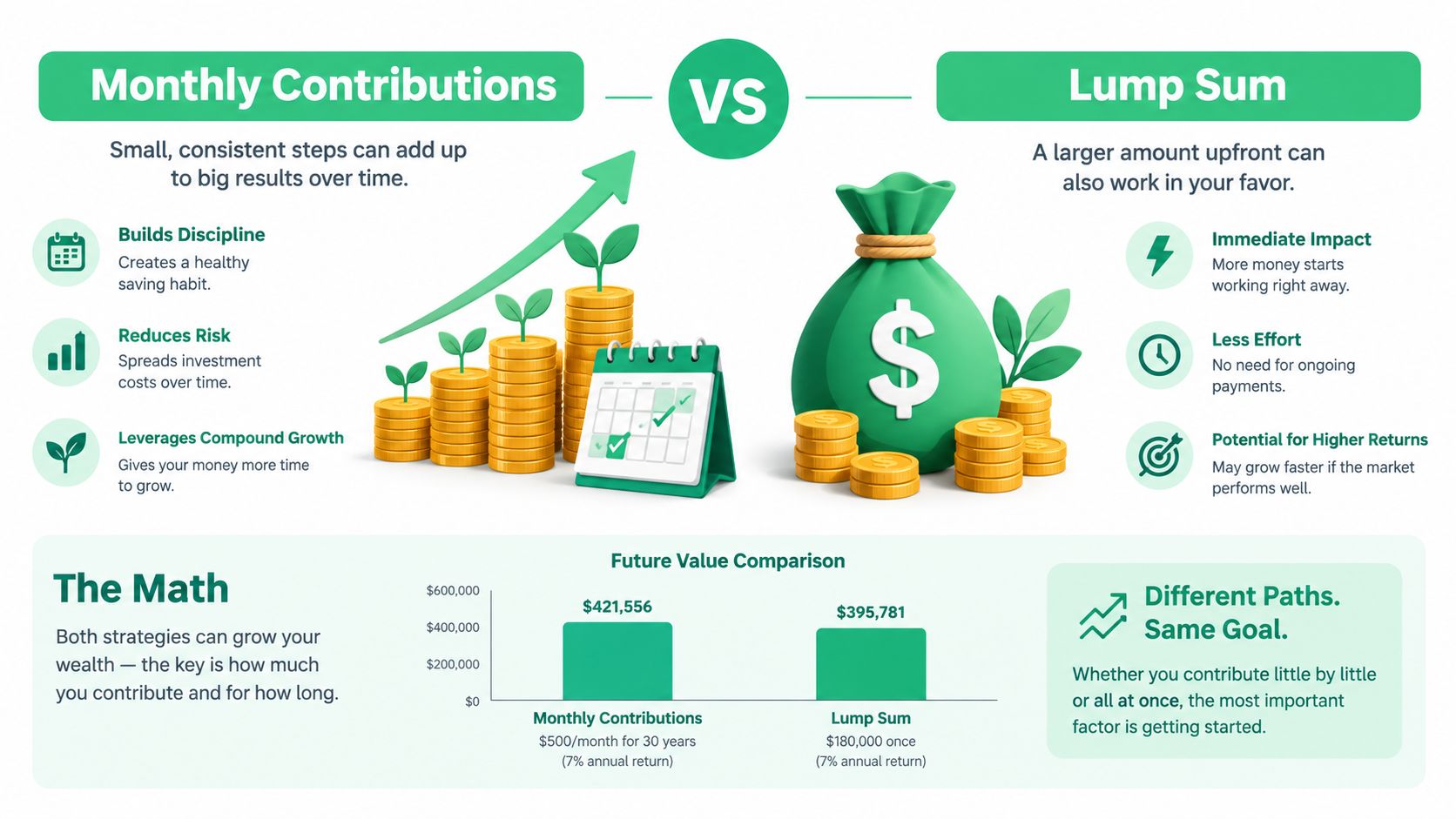
The mathematical edge belongs to earlier investment
Available cash usually has a higher expected opportunity cost outside the market than inside it. Every month of delay leaves that money unexposed to both gains and losses, while the market's long-term upward drift can make the delay expensive.
Vanguard's analysis found that, in the United States, a 12-month dollar-cost-averaging strategy ended with an average portfolio value of $2,395,824, compared with $2,450,264 for lump-sum investing, a 2.3% advantage for investing immediately. The same analysis reports that lump-sum investing beat DCA about two-thirds of the time in a review of U.S. stock returns from 1926 through 1991, and that a 40-year S&P 500 analysis showed average annualized 10-year returns of 11.7% for investing on the first day of a month versus 10.4% for entering gradually over seven months after a market peak, as detailed in Vanguard's analysis of dollar-cost averaging.
Those averages favor earlier exposure, not reckless timing. Money needed soon should not be rushed into volatile assets merely to satisfy a spreadsheet. Money intended for a long investment period can usually tolerate the market's bad moods, provided you can keep holding through them.
Behavior can outweigh the spreadsheet
A paycheck investor rarely receives a true lump sum. Income arrives monthly, so investing each month is the natural process rather than a compromise. It also prevents repeated debates about whether a market drop is a bargain or a warning from the financial gods.
Research comparing DCA with market-timing strategies found a 30-year S&P 500 study in which DCA produced a 254% return, compared with 227% to 252% for several timing approaches. Only a perfect-foresight strategy performed better, at 289%, according to this analysis of dollar-cost averaging and market timing.
For a bonus, inheritance, or other available cash, invest promptly when your reserve, debt position, and time horizon are already in order. If an immediate purchase would make you panic and sell, use a short, written schedule with fixed dates and amounts. The schedule should manage your behavior, not serve as a disguised attempt to predict the next correction.
For long-term goals, use a compound interest calculator to test different contribution amounts, investment periods, and assumed returns. Keep the assumption modest. The calculator can show possible outcomes, but it cannot sign a contract with the market.
Where to Put the Money and How to Automate It
The account determines the tax treatment. The investment determines the portfolio risk. The automation determines whether the plan survives your enthusiasm for spending money that happens to be visible in your checking account.
Start with the employer retirement plan if it offers matching contributions. Contribute enough to receive the available match, then consider whether additional retirement contributions, an individual retirement account, or a standard brokerage account best fits your tax situation and goal. Workplace plans and individual accounts have different rules, investment menus, and withdrawal considerations, so check the current terms before committing the full monthly target.
For 2026, the IRS sets the 401(k) contribution limit at $24,500 and the IRA limit at $7,500, according to the IRS announcement on 2026 retirement contribution limits. Those limits form a practical ceiling for tax-advantaged contributions, although your plan rules, income, eligibility, and contribution type may affect what you can use.
Use a simple account sequence
A sensible execution order looks like this:
- Workplace match first. Direct enough from each paycheck to receive the available employer contribution.
- Tax-advantaged retirement space next. Use an appropriate individual or workplace account for money intended for retirement, subject to the applicable rules.
- Standard brokerage money after that. Use a taxable account for long-term goals that don't fit retirement-account restrictions or for additional investing after tax-advantaged priorities.
- Short-term money stays out of volatile investments. If you'll need it within a short horizon, preserve access and stability rather than chasing a return.
Within the account, choose a diversified portfolio that matches your timeline and ability to tolerate losses. A long retirement horizon can support more exposure to volatile growth assets than a near-term house deposit, but the right allocation depends on your complete financial picture. Keep the design understandable enough that you can explain why each holding exists.
Remove decisions from payday
Set the contribution to leave your paycheck automatically if your workplace plan allows it. For other accounts, schedule an automatic bank transfer shortly after payday and pair it with an automatic investment instruction when available.
Use the same monthly amount until your review date. Don't change it because a headline says the market is doomed or because a good month makes you feel like a financial genius. Review the contribution when your income, debt, emergency reserve, household responsibilities, or investment concentration changes.
The Money Maniac also publishes calculators that let you model starting money, monthly contributions, an assumed return, and an investment period. Use projections to compare choices, not to manufacture certainty.
Your Monthly Investing Action Plan
Your exact number should come from a short audit, not a lucky guess. Run through the checklist below and write down the result.
- Confirm the runway. Check that you have accessible emergency cash appropriate for your income stability and essential bills.
- List expensive debt. Direct surplus toward high-interest balances before raising long-term market contributions.
- Capture the match. Find the contribution level required to receive all available employer matching money.
- Calculate the target. Multiply gross annual income by 15%, divide by 12, then subtract the employer contribution expected each month.
- Apply the cash-flow test. Reduce the result if the transfer would force borrowing, repeated withdrawals, or missed essentials.
- Review concentration and timing. If you already hold substantial equities or need the money within one to three years, reconsider the risk attached to each new dollar.
- Automate the starting amount. Schedule it around payday so investing happens before discretionary spending.
- Raise it deliberately. Put an annual reminder on your calendar to increase the contribution after a pay rise, debt payoff, or sustained improvement in cash flow.
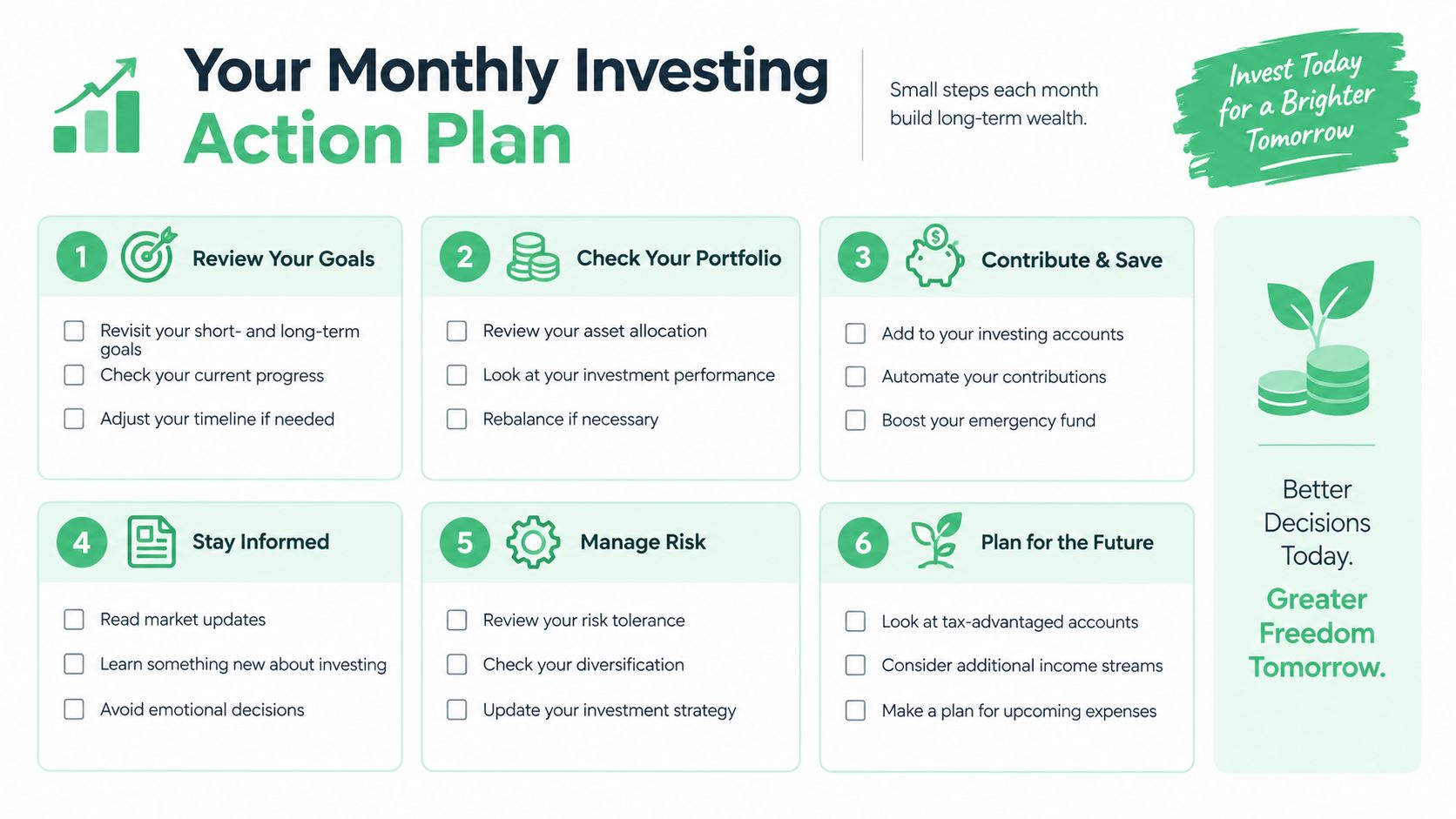
The judgment is simple. Invest at least enough to capture your employer match when your basic runway is sound, aim for a total contribution near 15% over time, and lower the starting amount if your budget cannot sustain it. A contribution you can maintain through boring months is more valuable than an ambitious transfer that collapses at the first financial inconvenience.
Set the transfer today, record the date for your next review, and increase it when your cash flow improves. Your future self doesn't need a heroic gesture. It needs a system that keeps showing up.
Get more posts like this
One short, useful email each Friday. Free, no spam, unsubscribe anytime.