How Many Millionaires Are in the US? Latest 2026 Figures
How many millionaires are in the US? About 24 million by UBS's latest count, plus why estimates vary and what a million dollars really buys in retirement.

Daniel Anderson
Editor, The Money Maniac
October 27, 2026
12 min read

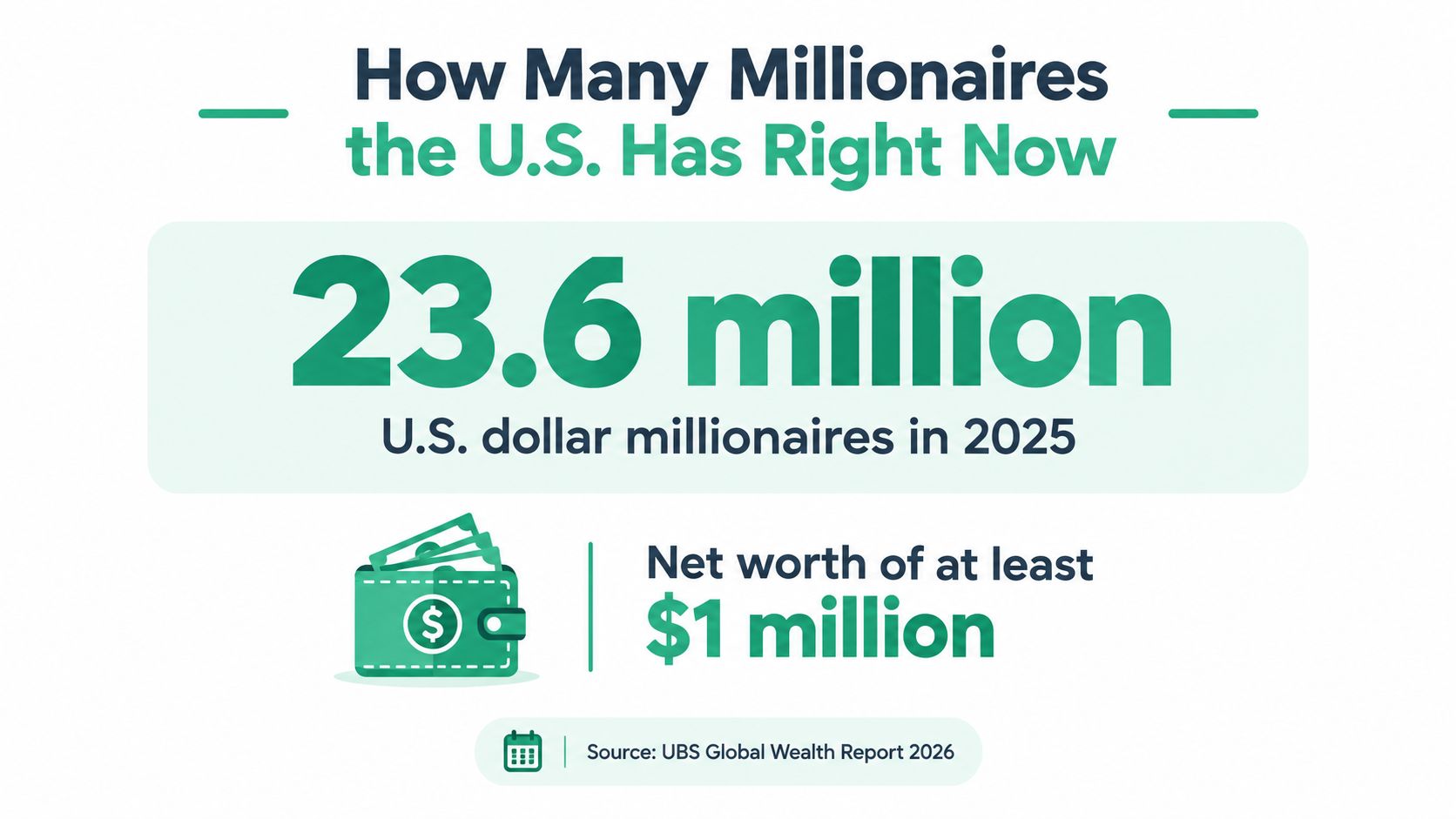
About 23.6 million U.S.-dollar millionaires lived in the United States in 2025, according to UBS's Global Wealth Report 2026, which defines a millionaire as someone with net worth of at least $1 million.
The important question for a homeowner approaching retirement is how much of that wealth can support everyday spending. A valuable house can put you over the millionaire threshold while leaving your retirement budget surprisingly tight. There's also an inconsistency in the published totals that deserves attention before anyone treats the headline as an exact count.
How Many Millionaires the U.S. Has Right Now
The UBS Global Wealth Report 2026 estimates that about 23.6 million people in the United States had net worth of at least $1 million in 2025. UBS's measure includes financial and real assets, minus liabilities, and accounts for more than 40% of the millionaires in its global sample.
This is a broad wealth measure. It includes property, retirement savings, investments, and business ownership, so a homeowner can meet the threshold even if much of their wealth is tied up in a house.
The estimates don't reconcile neatly
The table preserves each source's reported figure and definition. These are estimates of people. Households, high earners, and investment accounts are counted differently.
U.S. millionaire estimates by year and source
| Year | Source | Estimate | Definition used |
|---|---|---|---|
| 2023 | Capgemini World Wealth Report 2024, as reported by CNBC | 7.43 million | Narrower investable-assets measure |
| 2024 | UBS Global Wealth Report 2025 overview | About 23.6 million | Net worth of $1 million or more |
| 2024 | UBS figure reported by CNBC | 23.8 million | UBS net-worth measure; revision status unresolved |
| 2025 | UBS Global Wealth Report 2026 | About 23.6 million | Net worth of $1 million or more |
The discrepancy matters. The UBS 2025 overview reports one total for 2024, while CNBC's coverage of that report gives another. The 2026 report's estimate for 2025 is close to the lower 2024 figure, despite the reported increase in the millionaire population.
The two 2024 figures cannot both serve as a clean point in a year-to-year trend. A revision, reporting error, or difference in coverage could account for the gap, but the available figures do not resolve it. Read the UBS total as a level estimate, not an audited population count.
Practical rule: Use the UBS net-worth estimate for the broad question. Use an investable-assets measure when asking how many people have substantial savings available to invest.
For homeowners in their fifties and sixties, the distinction affects what the headline can say about retirement. Home equity counts toward net worth, but it does not automatically provide money for regular expenses. A person can qualify on paper while having far less available to draw from.
Why Different Sources Give Different Counts
Say a retired couple owns a paid-off house worth $600,000 and holds $450,000 in retirement accounts and taxable savings. Their hypothetical household net worth is $1,050,000, before any other assets or debts.
They cross a household million-dollar net-worth threshold. They fall short of a million-dollar investable-assets threshold because their available savings total only $450,000. And their joint balance sheet doesn't establish that either spouse individually qualifies for a person-based millionaire count.
The definition comes before the headline
For that couple, the measure decides the label. Use net worth when the question is where a household stands on paper, and use investable assets when the question is what a household could realistically draw on in retirement.
What each millionaire source measures
| Source | What it counts | Home equity included | Latest U.S. figure used here |
|---|---|---|---|
| UBS Global Wealth Report | Individual net worth, assets minus debts | Yes | About 23.6 million, 2025 |
| Capgemini World Wealth Report | Investable assets, excluding the primary residence | No | 7.43 million in 2023, reported by CNBC |
| Federal Reserve Survey of Consumer Finances | Household finances and net worth | Yes | No comparable millionaire total |
| Forbes wealth lists | Billionaire rankings rather than a full millionaire census | Not applicable | No millionaire total |
The Federal Reserve's household perspective suits a couple comparing its balance sheet with other households. Its results still describe households in a specific survey year, so the figure belongs in a household-to-household comparison.
A ranking of exceptionally wealthy people does something different again: it tracks the top of the distribution and says nothing about how many ordinary homeowners have crossed the million-dollar line.
Before trusting a headline, ask:
- What counts as wealth? Look for home equity, retirement accounts, business interests, and debt treatment.
- What date does it describe? A report's publication year can differ from its measurement year.
- Who gets counted? Individuals and households aren't interchangeable.
A "record number of millionaires" headline that never says whether it counted individuals or households fails the third question, no matter how large the number.
How the Count Has Grown and Why It Swings
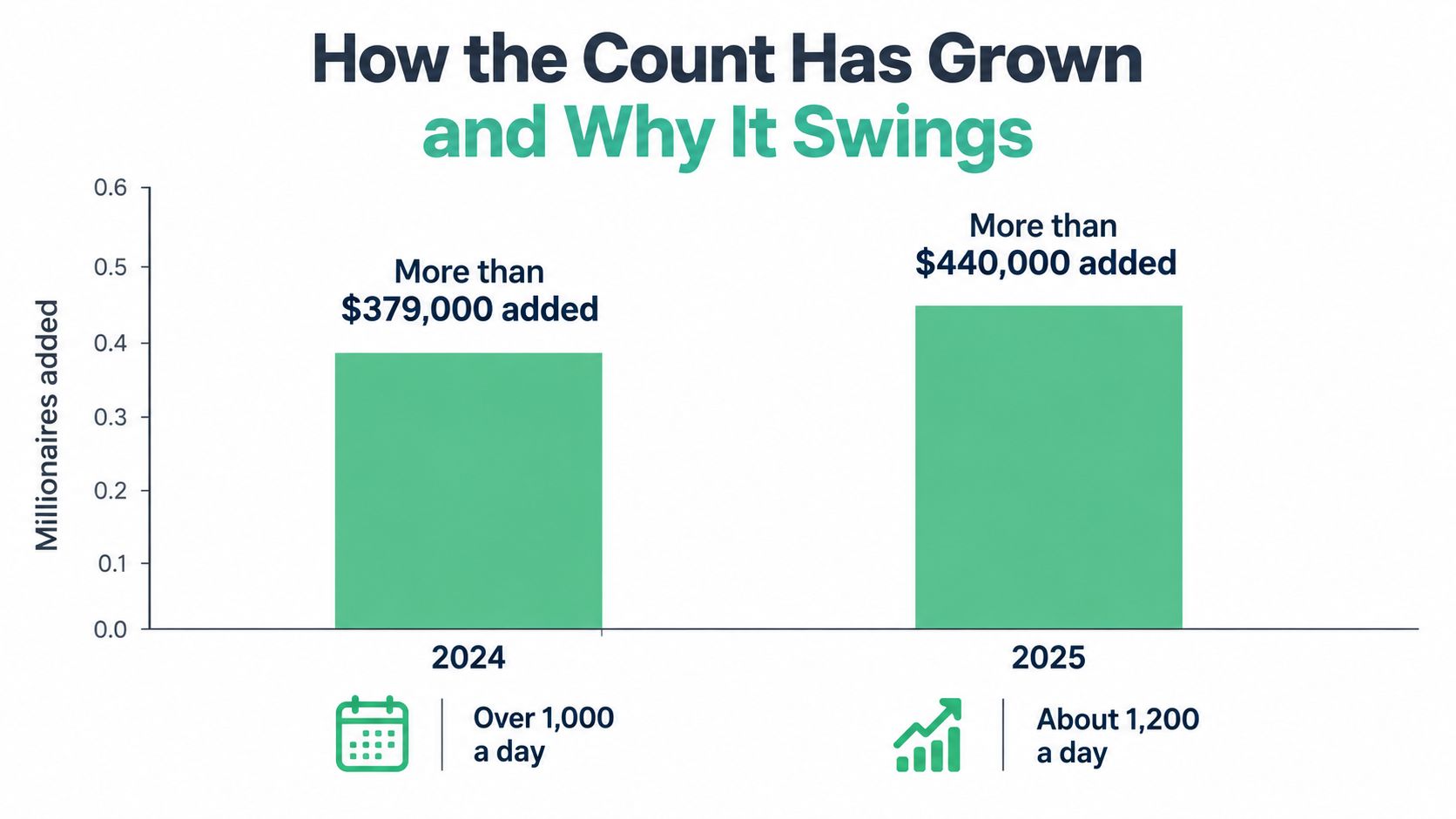
UBS reported more than 440,000 additional U.S. millionaires during 2025, compared with more than 379,000 during 2024, an approximately 16% larger annual addition, according to its 2026 Global Wealth Report announcement. Those reported additions are more useful for discussing momentum than subtracting conflicting headline totals.
A threshold can move without a raise
Consider a hypothetical household with $950,000 in net worth, including $700,000 in stocks and investment funds. Assume everything else stays unchanged.
| Illustrative market move | Change in investments | Resulting net worth |
|---|---|---|
| 5% gain | +$35,000 | $985,000 |
| 10% gain | +$70,000 | $1,020,000 |
| 10% decline | −$70,000 | $880,000 |
A modest gain brings this household closer, but it doesn't automatically cross the line. In this example, the larger gain creates millionaire status without any additional saving, while the decline moves the household farther away.
These percentages are illustrations, not forecasts. Actual results also depend on changes in property values, debts, business valuations, and the investments someone owns.
The distinction matters because crossing a nominal wealth threshold doesn't necessarily change anyone's daily life. The household might have the same pension, the same grocery budget, and the same leaking dishwasher before and after qualifying.
A rising millionaire count can describe higher asset valuations without demonstrating an equally large improvement in household cash flow.
Don't combine a narrower investable-assets count with a broader net-worth count and call the difference wealth creation. For trend analysis, keep the definition consistent and identify the reporting edition. When editions disagree, report the stated annual change separately rather than manufacturing a precise growth series from incompatible totals.
Who the Millionaires Are and Where They Live
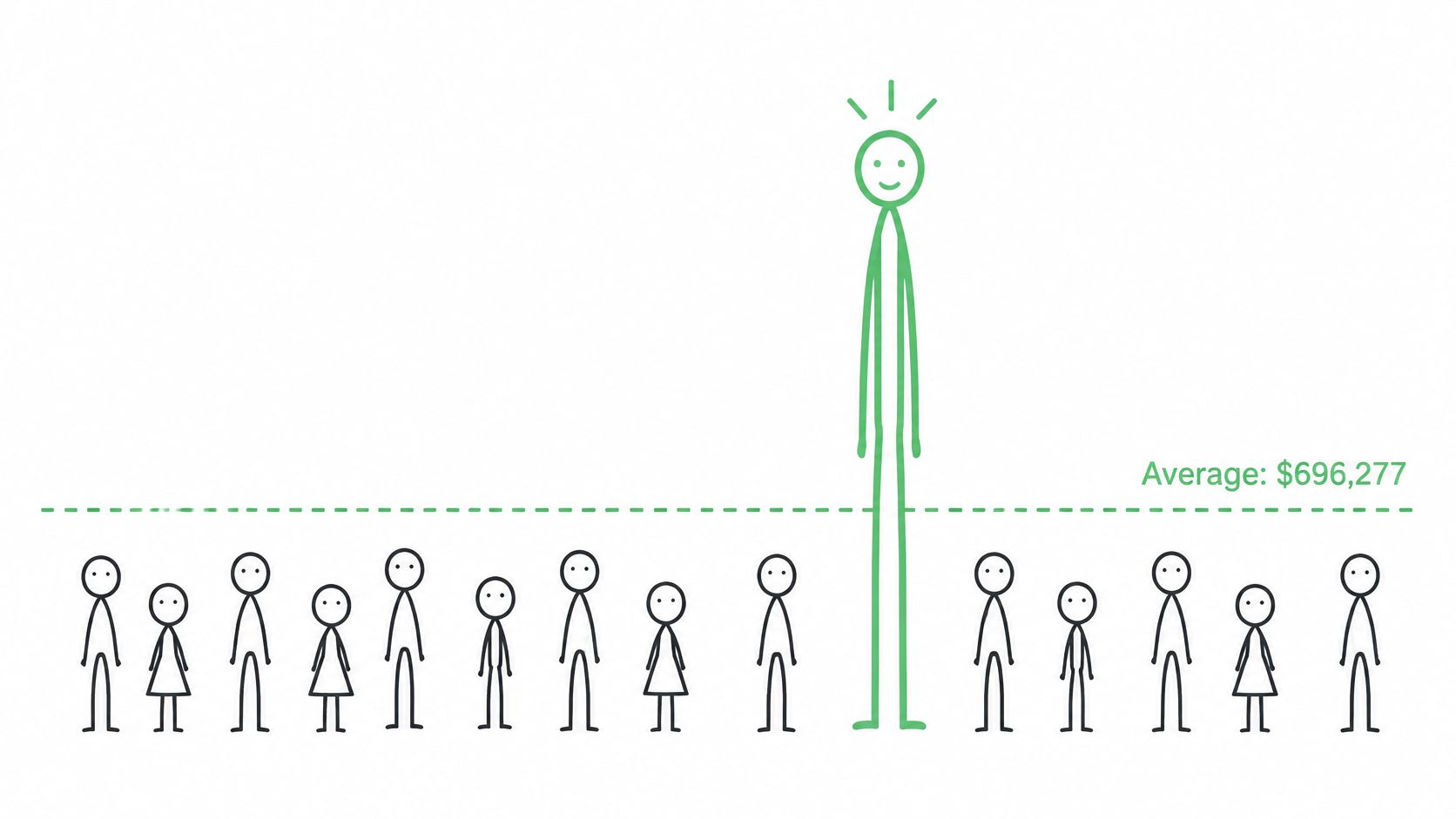
One large fortune can pull a national average far above the middle. The UBS Global Wealth Report 2025 announcement reports average U.S. wealth of $696,277 against a median of $68,998 in its cross-country comparison, a ratio of roughly ten to one.
A worked example shows how the gap forms. Line up ten households worth $69,000 each; the median and the average both sit at $69,000. Raise the tenth household to $6.9 million and the median stays put while the average climbs to $752,100. The household implied by that average has finances nothing like the household in the middle.
Neither figure reveals what a retired household can spend in a year. That question defines who the millionaires actually are. A household qualifies the moment assets minus debts pass $1,000,000, whether the wealth sits in a paid-off house, a retirement account, or a checking balance. Two profiles land in the same count: a paper millionaire whose seven figures are locked in the home it still lives in, and a cash-flow millionaire who can draw $40,000 a year without touching the front door.
Geography changes what the title is worth
A national count cannot say how many millionaires are retirees, how many own their homes outright, or how your state ranks; those answers require age-specific and state-level data the reports cited here do not publish. More useful is what the title buys where you plan to live. Take a homeowner carrying $450,000 in equity.
- Expensive destination: a $900,000 replacement home means the move requires substantial additional capital.
- Less expensive destination: a $250,000 replacement home leaves a surplus after transaction costs, converting stored housing wealth into spendable savings.
The household keeps the same net worth in both scenarios, yet only one move turns paper wealth into cash flow. Selling expenses, moving costs, taxes, and the condition of the replacement home all shape the actual outcome.
If Puerto Rico is on your list, Act 60 answers from Christie's Puerto Rico can help frame questions for a qualified tax adviser. A property decision should never rest on an assumed tax benefit.
The comparison that matters runs between the assets you own and the commitments they must support. Separate property, accessible investments, and concentrated business interests, then ask which could fund spending without forcing a rushed sale.
What a Million Dollars Buys in Retirement
A hypothetical retiree can have $1,000,000 in net worth and considerably less available to support withdrawals. The composition of that balance sheet deserves more attention than the round number at the bottom.
The UBS Global Wealth Report 2025 provides the broader context: changes in asset values affect measured wealth. Retirement planning adds another requirement, determining how those assets can support withdrawals through uncertain future conditions.
Follow the money through the balance sheet
How a $1,000,000 net worth splits into spendable money
| Asset | Counts toward $1M net worth | Can fund living costs |
|---|---|---|
| Home equity, $450,000 | Yes | Requires selling, downsizing, or borrowing |
| Traditional IRA, $350,000 | Yes | Withdrawals available, subject to applicable taxes and rules |
| Taxable brokerage account, $150,000 | Yes | Sales or distributions can provide cash; taxes may apply |
| Cash and savings, $50,000 | Yes | Yes |
| Total, $1,000,000 | Yes | $550,000 outside the home, before applicable taxes |
The retiree has $550,000 in financial assets, not a million-dollar withdrawal portfolio. Even that figure isn't an after-tax spending balance.
Traditional IRA withdrawals can create taxable income, while selling appreciated investments can create capital gains. The amount retained depends on the account's tax treatment and the retiree's circumstances.
What an illustrative withdrawal actually produces
For arithmetic only, suppose the retiree tests an initial annual withdrawal equal to 4% of financial assets:
$550,000 × 0.04 = $22,000 before tax.
Applying the same assumption to the entire net worth would produce $40,000. That would overstate the illustrative portfolio withdrawal by $18,000, because it treats the house as though it were an accessible investment account.
This is a hypothetical planning input, not a verified safe withdrawal rate or a guarantee. A sustainable plan depends on retirement length, investment mix, inflation, fees, market losses, and the ability to reduce spending. An early downturn combined with withdrawals can make recovery harder.
Budget test: Subtract reliable income from expected spending first. The remaining gap is what your financial assets must support.
Use your own Social Security estimate and pension information rather than a national average. Enter your actual Medicare premiums and other healthcare costs, and verify current required-distribution rules before scheduling withdrawals. No unverified benefit amount, premium, or distribution age belongs in a retirement budget.
Housing decisions deserve the same care. If you're evaluating a coastal move, Dream Destin Realty's Miramar Beach home prices can provide a starting point for checking replacement-housing assumptions, rather than assuming downsizing will release cash.
For a larger-balance-sheet comparison, consider the questions raised by a $4 million net worth. The useful exercise remains identifying accessible assets, spending obligations, and taxes, rather than borrowing someone else's retirement target.
How to Estimate Your Own Path to a Million
Start with a balance sheet you can defend. A realistic home valuation and complete debt list are more useful than a projection calculated to the penny from optimistic inputs.
Build the starting balance correctly
-
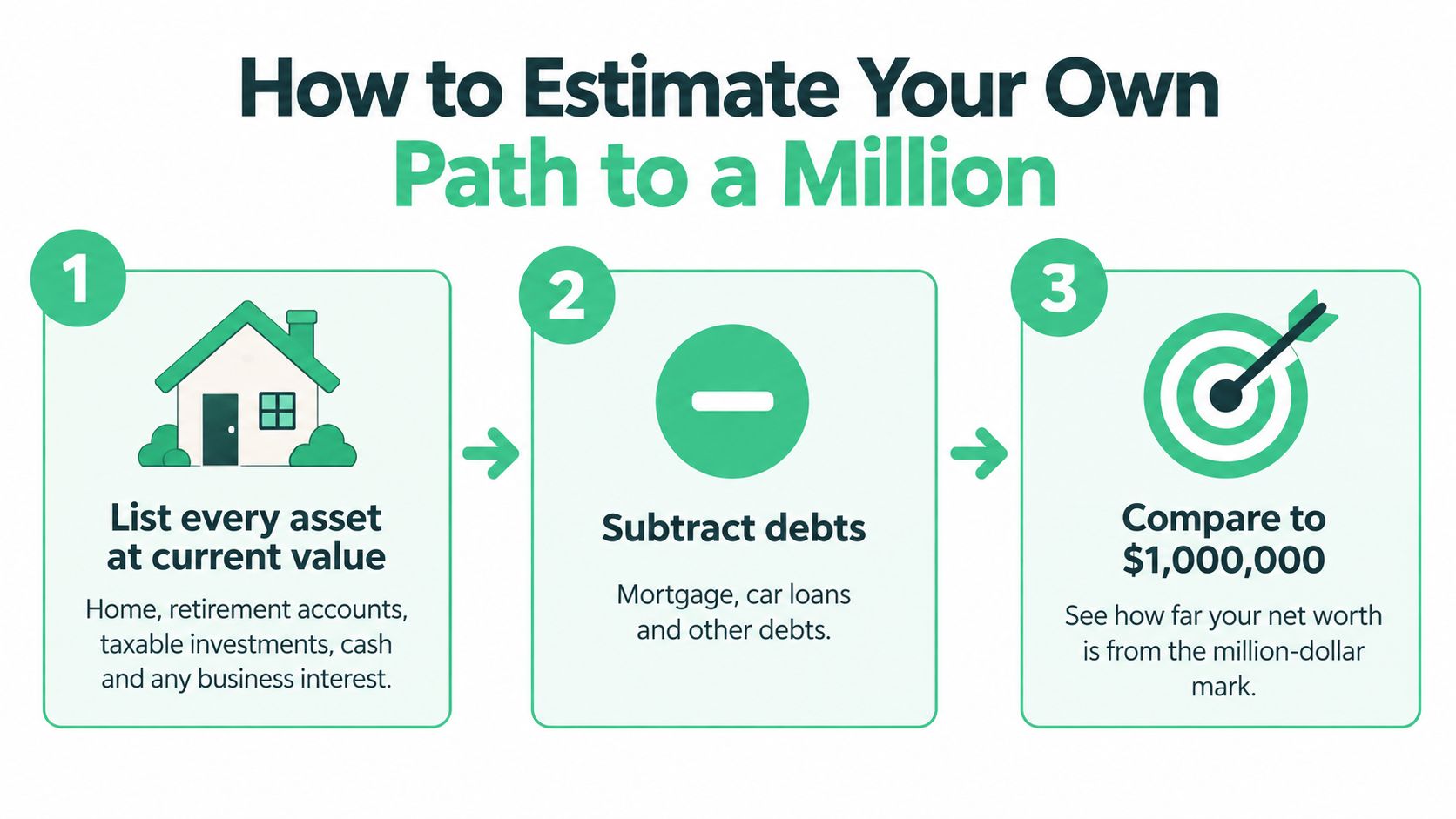
List assets at current value. Include your home, retirement accounts, taxable investments, cash, and business interests. Use realistic sale values rather than hoped-for asking prices.
-
Subtract outstanding debts. Include the mortgage, vehicle loans, credit cards, student loans, and other liabilities. Separately estimate selling costs and potential taxes to understand liquidation proceeds; don't confuse that after-tax estimate with conventional net worth.
-
Separate accessible capital. Keep home equity and hard-to-sell business interests apart from financial assets. Also distinguish retirement accounts from cash available without account-specific restrictions.
-
Calculate the gap. Subtract current net worth from your target. If you're already above it, calculate the gap between your financial assets and the amount needed to support your spending instead.
-
Project contributions and growth separately. Apply investment assumptions to invested assets, not indiscriminately to your house and every other balance-sheet item.
For a hypothetical illustration prepared in 2026, assume $640,000 grows at 5% annually for 10 years, with no additions. The calculation is $640,000 × 1.05¹⁰, which produces approximately $1.04 million, before taxes, fees, and inflation.
That assumed return is neither a forecast nor a current bond yield. Check current Treasury yields directly with the Treasury when comparing available rates, and expect quoted yields to change. A risky portfolio's assumed return and a government security's quoted yield aren't interchangeable promises.
Add monthly savings without hiding the assumptions
For monthly contributions made at month-end, the future-value calculation is:
Future value = P × (1 + r)ⁿ + C × [((1 + r)ⁿ − 1) ÷ r]
Here, P is starting capital, C is monthly saving, r is the monthly assumed return, and n is the number of months. Use consistent compounding assumptions.
The hypothetical table uses a nominal annual assumption divided into monthly periods, with contributions starting from zero. Values are rounded.
Savings growth to $1 million at an assumed 5 percent
| Monthly saving | After 20 years | After 30 years |
|---|---|---|
| $500 | $205,517 | $416,129 |
| $1,000 | $411,034 | $832,259 |
These calculations exclude taxes, fees, and inflation, and assume smooth returns that real investments don't deliver. Use a monthly compound-interest calculation to test different starting balances, contributions, and time horizons rather than relying on one favorable outcome.
For someone approaching retirement, extending the projection by decades may have little practical value. Test what happens before your intended retirement date, then model withdrawals separately.
If you're considering business ownership as another route, Dealmaker Wealth Society's discussion of how to build enduring wealth beyond a salary offers a related perspective. Evaluate the possibility alongside concentration risk, borrowing obligations, and the difficulty of selling a business when you need cash.
The best projection is one you can update when circumstances change. Review contributions, debt balances, and valuations regularly, and revise assumptions rather than treating an attractive spreadsheet result as an appointment with wealth.
Check Your Own Number Before You Plan Around It
For personal planning, the headline millionaire count is a weak yardstick. Accessible assets measured against your expenses give you a more useful answer about retirement readiness. A millionaire on paper whose wealth sits mostly in a paid-off house faces a different retirement than someone who can draw $40,000 a year from investments.
You don't need to resemble the average millionaire. You need enough reliable income, financial reserves, and flexibility to support the life you're planning.
Turn the estimate into a decision
-
Verify the underlying records. Check the edition and measurement year of any wealth report. For household comparisons, use dated Federal Reserve survey tables; for retirement income, use your personal Social Security statement; for withdrawal obligations, check current IRS guidance.
-
Test your own balance sheet. Run savings assumptions through our free browser-based calculators, then organize assets and liabilities with the net-worth planning resource. Enter each line item separately: cash accounts, retirement balances, taxable investments, mortgage balance, and other debts, so the output shows what each dollar is doing rather than collapsing everything into one reassuring total.
-
Get individualized tax help. Take Roth conversion decisions, withdrawal timing, and other tax-sensitive choices to a fee-only fiduciary planner who can review your full situation. Ask how the recommendation changes under less favorable investment results.
The Money Maniac's content is intended for informational and educational purposes only, not professional advice from a certified financial or legal expert.
Bring your latest account statements, mortgage balance, and spending records to the calculation. A carefully measured starting point is worth more than a reassuring label.
Get more posts like this
One short, useful email each Friday. Free, no spam, unsubscribe anytime.