4 Million Net Worth Explained for Retirement
Learn how to calculate $4 million net worth, what it means for retirement, and how age, debt, location, and spending change the picture.

Daniel Anderson
Editor, The Money Maniac
October 22, 2026
13 min read

The popular shortcut says a $4 million net worth means you can retire comfortably. That advice skips the part where you still have to pay the bills. Before leaving work, you need to know which assets can fund spending, what you'll owe in taxes, and how much room you have to adjust when life gets expensive.
A large balance sheet gives you options. Turning those options into dependable retirement income takes a more careful calculation.
What $4 Million Net Worth Really Signals
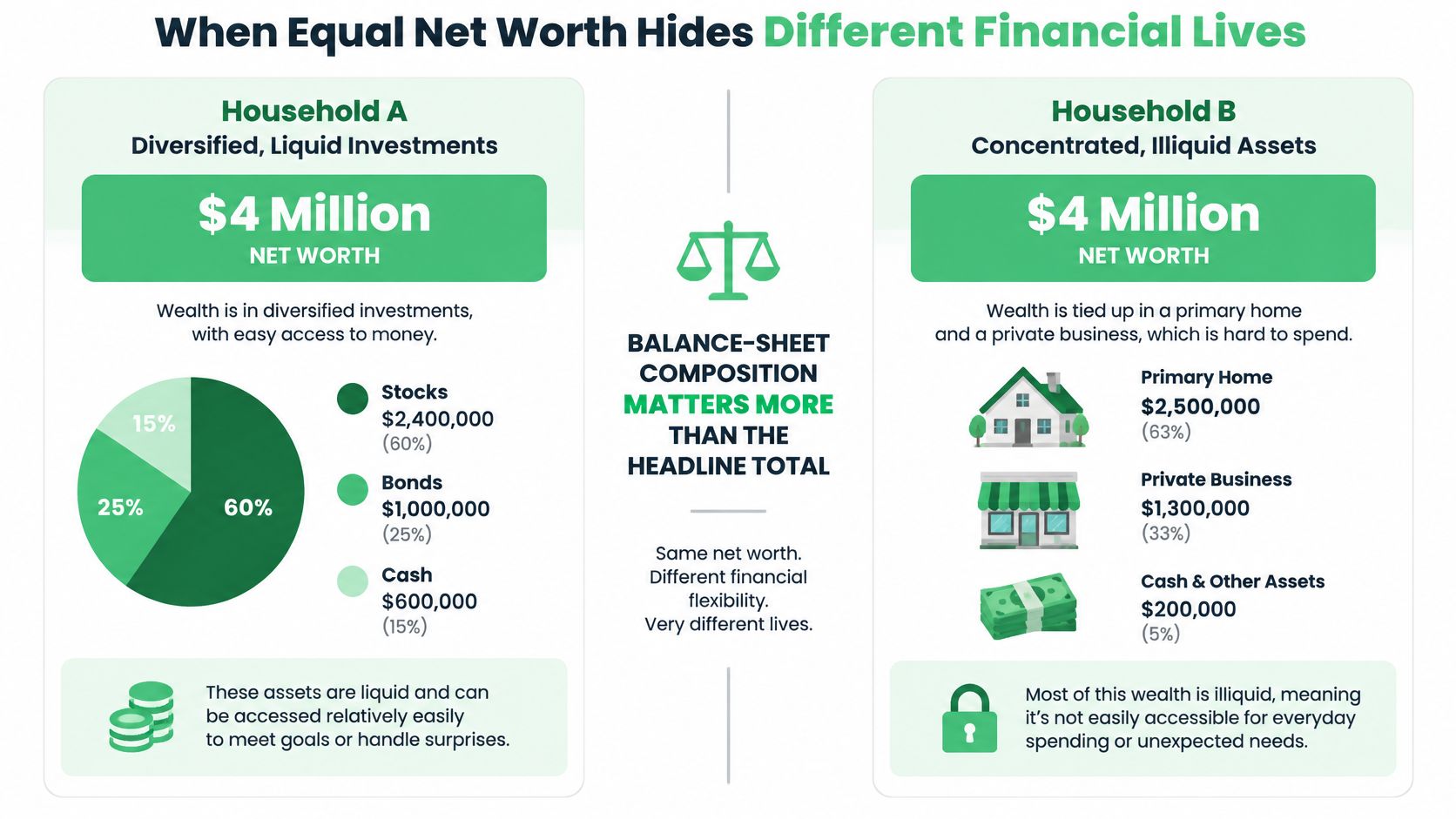
A household with diversified investments and manageable expenses has a different planning problem from a household whose wealth sits inside a home or private business. Both may feel wealthy when updating their accounts. Only one may have readily available money for groceries, insurance, and an unexpected roof replacement.
Financial independence is an ongoing cash-flow outcome. You need enough accessible resources to support your spending through retirement, including periods when investments disappoint. A milestone alone can't answer that question.
Start with the life the money must support
Age, household size, location, and debt all belong in the conversation. Retiring early means asking your assets to support you for longer. Supporting relatives or remaining in an expensive neighborhood can leave less room for discretionary spending.
Your willingness to change matters, too. Someone who can postpone travel or relocate has options that someone with rigid obligations may not have.
- Age and timing: When do you want to stop earning, and how long might retirement last?
- Household commitments: Who depends on your income or assets?
- Spending choices: Which expenses would you reduce if circumstances changed?
- Asset access: Can you fund ordinary living costs without a rushed sale?
Treat the milestone as a starting point
My judgment is straightforward: a substantial balance sheet deserves careful planning, not automatic reassurance. You don't need to apologize for having wealth, but you shouldn't confuse a favorable account statement with a tested retirement plan.
Practical rule: Ask how much of your wealth can support your actual life without selling essential assets or taking risks you can't afford.
That question produces useful decisions. A status label mostly produces dinner-table arguments, which rarely improve anyone's retirement budget.
Calculate Your Net Worth From the Ground Up
Start with documents rather than memory. Gather account statements, loan balances, property records, and any support for business valuations. Use values from a consistent date so you're comparing like with like.
The accounting formula is simple: total net worth equals assets minus liabilities. The harder part is deciding what belongs in each category and giving it a defensible value.
Build a balance sheet you can explain
Include cash, taxable investments, retirement accounts, real estate, business interests, vehicles, and other meaningful assets. Then subtract mortgages, credit-card balances, student loans, and other debts. Identify personal guarantees separately and review whether they create an obligation that needs to be reflected.
Balance-sheet items to separate
| Item | Count toward net worth? | Planning question |
|---|---|---|
| Cash and savings | Yes | How much is available after upcoming bills? |
| Taxable investments | Yes | What taxes or market exposure come with selling? |
| Retirement accounts | Yes | What withdrawal taxes or access restrictions apply? |
| Primary residence | Yes, with its mortgage counted separately | Would you actually sell or downsize? |
| Private business | Yes, using a supportable valuation | Could you find a buyer on acceptable terms? |
| Vehicles and valuable property | Yes, at realistic resale values | Would selling meaningfully support retirement? |
| Outstanding debts | Subtract them | What payments must future income cover? |
| Personal guarantees | Review individually | What could you become responsible for? |
Don't count home equity and the full home value together. Likewise, avoid subtracting business debt twice if it's already reflected in the value of your ownership interest.
For an inventory connected to a Texas family-law matter, Bryan Fagan team's inventory tips from Law Office of Bryan Fagan, PLLC provide a context-specific resource. A legal inventory and a retirement balance sheet serve different purposes, so use the requirements appropriate to your situation.
Keep separate totals for separate decisions
Track investable net worth, meaning assets you can realistically use to support spending without selling your home or dismantling a business. Within that amount, identify liquid reserves, the money available for near-term needs.
You can use a spreadsheet, a paper ledger, or the net worth calculator to organize assets and liabilities. Keep notes beside uncertain values rather than giving every estimate the appearance of precision.
Retirement accounts deserve particular attention. Their statement balances may include money you'll eventually owe in withdrawal taxes, so they shouldn't automatically be treated as fully spendable.
How $4 Million Compares With Other Households
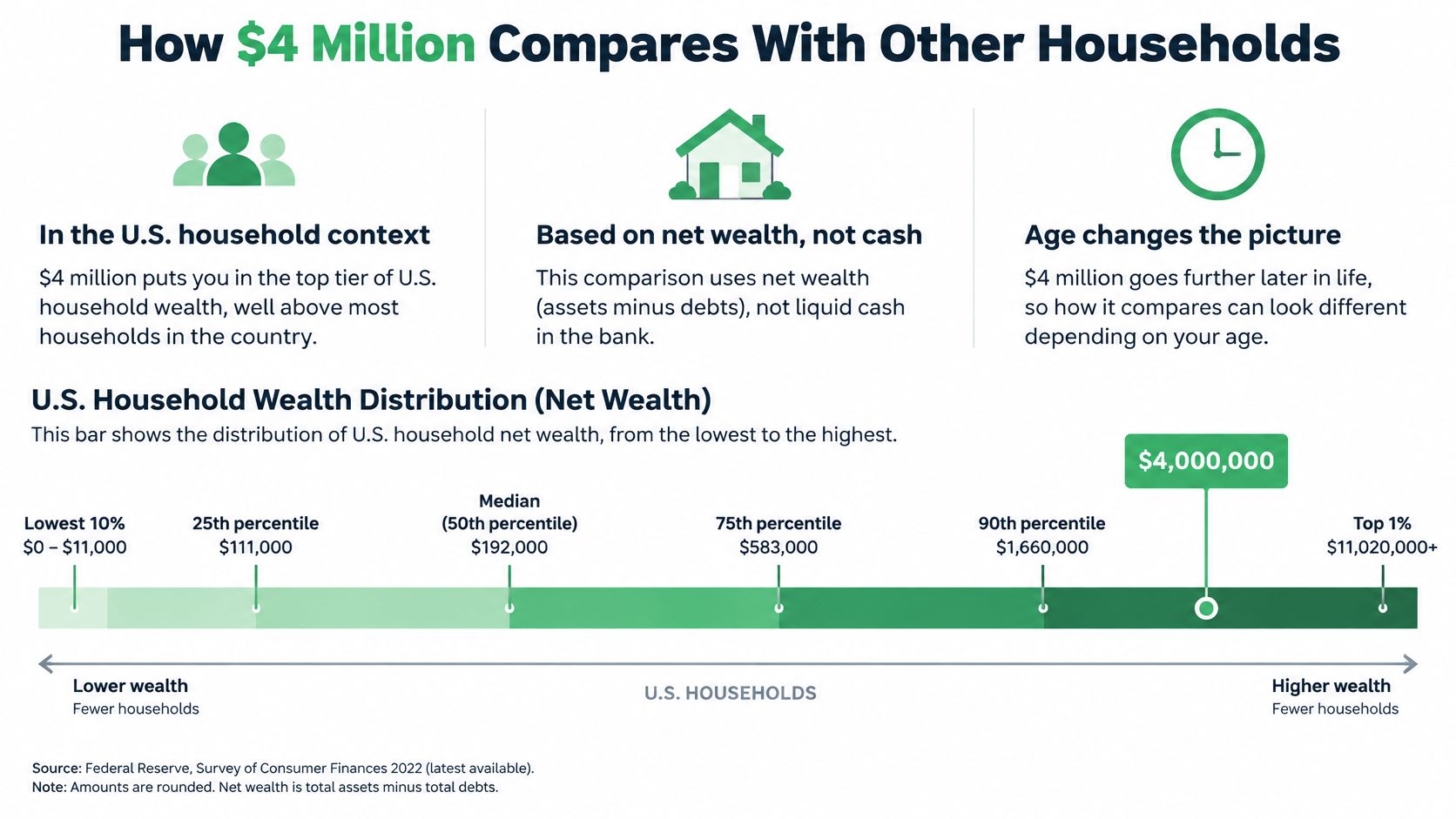
A $4 million net worth is a ranking, not a verdict. The percentile data shows where a balance sheet lands, and the retirement math still has to do the rest of the work.
In the United States, a $4 million net worth places a household approximately in the top 5%, above roughly 95% of households, with an estimated cutoff of $3.78 million in 2022 dollars, according to Federal Reserve Survey of Consumer Finances data. The same survey-based estimates put this wealth near the 98th percentile for households aged 35–39, around the 92nd percentile for ages 60–64, and below an estimated top-1% threshold of $13.6 million.
Those figures support one defensible conclusion: this is substantial U.S. household wealth. They do not tell you what the household can spend.
Compare households on the same basis
The percentile ranking measures total net wealth: home equity, business interests, retirement accounts, and financial assets minus debts. Holding that figure next to a neighbor's brokerage balance compares an entire balance sheet with a single account.
Before drawing conclusions from any comparison, check the units:
- Household versus individual: a ranking built on households misleads if your figure counts one person.
- Wealth versus income: a balance-sheet position says nothing about annual earnings.
- Survey-year dollars: a benchmark stated in 2022 dollars needs that date attached, since prices and asset values move.
- National versus international: homeownership rates, currencies, and survey methods differ across countries, so a U.S. ranking stays a U.S. ranking.
Use age as context rather than a verdict
The age breakdown above explains why an all-household ranking can mislead. A 38-year-old at $4 million has decades of potential compounding and a genuine early-retirement option. A 62-year-old at the same figure is making withdrawal decisions now. Same balance sheet, different clock.
For a closer benchmark, compare against the average net worth of retirees, while keeping your own spending plan separate from the comparison.
You can acknowledge real affluence and still have legitimate planning questions. Being financially fortunate and wanting to know what your money can support are parts of the same conversation.
When Equal Net Worth Hides Different Financial Lives
Consider a hypothetical comparison: a household with $4 million in diversified liquid investments and no debt, alongside a household with a $3 million home, a $2 million business interest, and $1 million in liabilities. Both report the same net worth under the assets-minus-liabilities framework used in the St. Louis Fed's discussion of household wealth.
The accounting works. The retirement mechanics differ considerably.
Follow the money into the checking account
The investment-owning household can generally raise spending money by selling holdings. That introduces market and tax considerations, but it doesn't necessarily require changing where the family lives or who runs a business.
The property-and-business household needs a more explicit funding route. Business distributions might support living costs, but the owner should distinguish income available without daily involvement from compensation for continuing to work.
| Retirement question | Diversified investment household | Home-and-business household |
|---|---|---|
| How does spending get funded? | Withdrawals and investment income | Business distributions or planned asset transactions |
| What needs careful review? | Portfolio exposure and withdrawal taxes | Valuation, sale timing, business dependence, and debt |
| What could force a difficult decision? | Selling investments after losses | Selling property or ownership under pressure |
Neither household is automatically safer. A disciplined investor with modest expenses may be well positioned, while an investor making large withdrawals may face serious strain. A business owner may have reliable distributions, or may have wealth that depends heavily on continued personal effort.
Put the address into the budget
Location changes the expenses that assets must support. Price your actual housing, healthcare, insurance, transportation, and education choices rather than borrowing a national lifestyle estimate.
Include the household's real obligations. Debt payments continue even when a business distribution stops or a planned sale takes longer than expected.
Count an asset at a defensible value. Count on it for retirement spending only when you can explain how the money reaches your checking account.
Before deciding to retire, write down the funding route for every major spending category. An assumed future sale deserves a timeline, a tax estimate, and a fallback plan.
What $4 Million Could Fund in Retirement
The common shortcut multiplies $4 million by 4% to get $160,000 annually. For comparison, Morningstar's 2025 retirement-income research estimates a 3.9% starting withdrawal rate, or $156,000 before taxes and fees, for inflation-adjusted withdrawals over 30 years with a 90% probability of retaining money at the end; it also reports that flexible approaches could start near 6%, as explained in its retirement withdrawal research.
Those are planning assumptions, not a dependable-income guarantee. The research-based estimate depends on a diversified portfolio, a defined horizon, and a specified withdrawal approach.
Illustrative $4 million spending scenarios
The following calculations apply the rates above to a portfolio of the stated size.
| Illustrative starting rate | First-year withdrawal | Main planning caveat |
|---|---|---|
| Research benchmark of 3.9% | $156,000 | Depends on the research assumptions and retirement horizon |
| Common 4% shortcut | $160,000 | Simple arithmetic doesn't establish sustainability |
| Flexible approach near 6% | About $240,000 | Requires accepting spending fluctuations and less predictable income |
The final row needs special care. A flexible withdrawal approach can allow greater initial spending because the retiree accepts adjustments later. Don't borrow its higher starting amount while assuming the steadier spending pattern of another approach.
Translate withdrawals into a household budget
A portfolio withdrawal isn't the same as take-home pay. Depending on the account and transaction, some money may need to cover taxes, and investment or advisory costs may reduce what remains available.
Build your spending estimate from actual records:
- Core living costs: Housing, food, utilities, insurance, and routine transportation.
- Health and family obligations: Medical spending, caregiving, and support you intend to continue.
- Irregular expenses: Repairs, replacement vehicles, and other costs that don't arrive monthly.
- Discretionary choices: Travel, gifts, hobbies, and optional upgrades.
Compare that total with after-tax resources, including any other income you expect to receive. Identify which assumptions depend on continuing employment, a business sale, or unusually strong investment performance.
The distinction between total and investable wealth matters directly to this calculation. Apply a portfolio withdrawal assumption to the assets funding withdrawals, rather than automatically applying it to the entire balance sheet.
A longer retirement, different asset mix, or less flexible budget calls for a different assessment. You're looking for a spending policy you can live with through difficult conditions, not the largest starting withdrawal a calculation will permit.
Build a Retirement Cash Flow That Can Bend
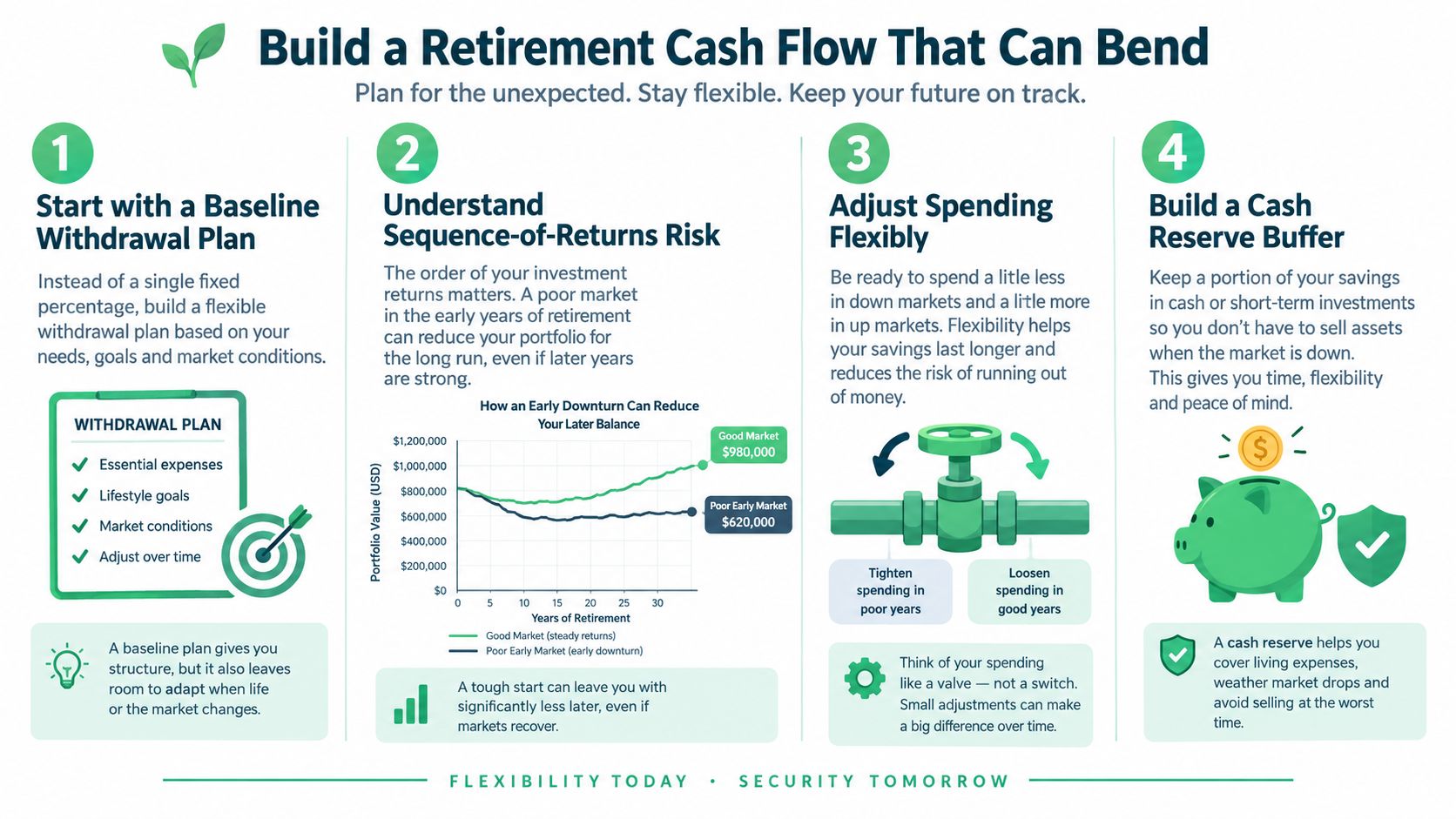
Retirement spending doesn't necessarily settle into a smooth pattern after the final paycheck. JPMorgan's analysis of more than 280,000 de-identified Chase households found volatile retirement spending that often peaks around the transition from work, and warned about damaging early withdrawals when sequence-of-returns risk is greatest in its retirement spending analysis.
Sequence-of-returns risk means the order of investment results matters when you're withdrawing money. Selling investments after an early decline leaves fewer assets available to participate in a recovery.
Give different expenses different rules
Separate essential obligations from spending you can change. Mortgage payments and necessary medical care need firmer funding than travel, renovations, or optional gifts.
A written policy might include:
- Near-term funding: Hold planned spending money in cash and appropriate high-quality bonds, while recognizing that bonds can fluctuate.
- Reserve replenishment: Consider refilling reserves after strong market periods as part of a rebalancing policy.
- Discretionary adjustments: Postpone optional purchases after severe declines rather than selling assets automatically.
- Regular review: Revisit the budget when markets, health, household responsibilities, or income change.
For background on the static benchmark, the guide to the 4 percent rule for retirement explains the framework. Your operating policy also needs instructions for what happens when reality departs from the assumptions.
Balance liquidity against growth
Cash can make it easier to pay bills without selling volatile assets at an uncomfortable moment. Holding too much, however, can reduce long-term growth potential and leave more money exposed to purchasing-power erosion.
There's no universal reserve size that resolves this trade-off. Choose it based on essential expenses, reliable income, portfolio exposure, and how quickly you could reduce discretionary spending.
Stress-test question: If retirement began with prolonged weak markets, which purchases would you postpone, and how would you fund the bills you can't postpone?
Model different market paths rather than relying entirely on an average-return projection. Include a difficult opening decade and test the spending cuts you are willing to make.
A flexible plan works only if the household can follow it. Writing down the rules before a downturn makes the choices clearer when decisions feel personal.
Protect Purchasing Power and Plan the Estate
A wealth target needs a date attached. Using the CPI-based comparison, $4 million in 2000 would require roughly $7.83 million in 2026 for comparable general purchasing power, while $4 million in 2026 resembles about $2.04 million in 2000 purchasing power, using the CPI-U framework behind the Bureau of Labor Statistics inflation calculator.
That distinction changes how you should interpret a future milestone. An unchanged account balance may buy less even when the statement looks reassuring.
State the lifestyle target in purchasing-power terms
CPI measures broad consumer prices. Your personal experience can differ because housing, healthcare, education, insurance, and location affect your spending mix.
Use an inflation-adjusted goal alongside the nominal target:
- Describe the lifestyle: Specify the housing, healthcare, travel, and family support you intend to fund.
- Date the estimate: Record when you priced those expenses.
- Update the assumptions: Revisit costs alongside contributions, returns, taxes, and withdrawals.
Avoid treating a future target as permanently sufficient. A retirement estimate needs periodic maintenance, much like the house it's supposed to help pay for.
Separate estate taxes from estate organization
For 2026, the IRS lists a $15 million basic estate-tax exclusion and a $19,000 annual gift-tax exclusion per recipient; gifts above the annual exclusion may require reporting and reduce the remaining lifetime exclusion without automatically creating an immediate tax bill, according to the IRS estate and gift-tax update.
Falling below the federal exclusion doesn't settle every estate question. State estate or inheritance taxes, prior taxable gifts, ownership arrangements, and estate composition can affect the outcome.
Organize wills, powers of attorney, beneficiary designations, and account ownership before a crisis forces someone else to assemble the paperwork. Check that the documents reflect your current family circumstances and intentions.
For readers considering the legal questions surrounding substantial assets, Law Office of Bryan Fagan estate planning from Law Office of Bryan Fagan, PLLC offers a related resource. Get advice specific to your jurisdiction and circumstances rather than assuming a general threshold answers everything.
Review the applicable rules in the year of a gift or death. Tax-aware planning requires both current figures and accurate personal records.
Make Your Personal Net Worth Plan
Your first useful deliverable is a balance sheet paired with an annual spending estimate. Add your expected retirement date, debts, anticipated taxes, and the income sources that would continue after you leave work.
That gives you something concrete to evaluate. You can compare your household with realistic planning profiles instead of deciding your future from a national percentile.
Match the analysis to your situation
An investment-funded retiree needs a withdrawal and allocation policy. A business owner needs to assess distributions, succession, and sale options. A homeowner relying on downsizing needs to investigate replacement housing and the money left after the transaction.
Use the profile that resembles your circumstances, including the inconvenient details. A plan built around spending cuts you'd never accept won't be much help.
Turn the balance sheet into decisions
- Update the inventory: Reconcile assets and liabilities against current records, and flag uncertain valuations.
- Separate accessible wealth: Identify money available for retirement spending and assets you intend to retain.
- Build the spending baseline: Include recurring bills, irregular expenses, taxes, and debt payments.
- Run a stressed scenario: Test weak early markets, delayed asset sales, and expenses that exceed expectations.
- Name the flexible expenses: Decide in advance what you would reduce and what must remain funded.
- Review estate documents: Check ownership, beneficiaries, decision-makers, and document accessibility.
Bring unresolved questions to the appropriate financial, tax, or legal professional. Ask them to show their assumptions and explain which changes would cause the recommendation to fail.
A $4 million net worth can support meaningful financial independence for some households and still fall short for others. The decisive work is matching accessible resources to the life you intend to fund.
Start by completing the inventory and spending baseline before changing investments or setting a retirement date. Those records will make the next decision more grounded, even if the answer requires a little more work than the headline promised.
Get more posts like this
One short, useful email each Friday. Free, no spam, unsubscribe anytime.