Are CDs FDIC Insured? the $250,000 Limit Explained
Are CDs FDIC insured? Yes, when the issuing bank is FDIC-insured: up to $250,000 per depositor, per bank, per ownership category. Learn how to check.

Daniel Anderson
Editor, The Money Maniac
November 27, 2026
12 min read

Could your CD be fully insured when you open it but partly uninsured by maturity? Yes. A CD at an FDIC-insured bank has coverage up to $250,000 per depositor, per bank, per ownership category, including principal and accrued interest, under the FDIC's deposit insurance rules.
The trap is treating each CD as a separate allowance. Interest, another CD, and savings held in the same category at that bank all count toward the same ceiling. For retirement cash or home-sale proceeds, check the combined balance before chasing the rate. Leave room for interest rather than filling the allowance with your initial deposit.
Yes, CDs Are FDIC Insured Up to $250,000
The FDIC's guide to insured financial products explicitly includes CDs, checking accounts, savings accounts, and money market deposit accounts, with standard coverage of $250,000 per depositor, per insured bank, per ownership category. Coverage includes your principal and accrued interest through the date the insured bank fails, subject to that limit.
That last detail matters. The amount you originally deposited can be comfortably within the ceiling while your growing balance eventually exceeds it. And the bank doesn't give every certificate its own insurance allowance.

The rule that determines protection
A CD's interest rate and maturity date don't determine its insurance coverage. The decisive details are which bank issued it, who legally owns it, and how much that owner holds there in the same category.
For a forward-looking check, add the CD's projected maturity value to your other deposits at that bank in the same ownership category. That gives you a useful planning total, although actual coverage at a bank failure is based on the balance, including interest accrued through that date.
Practical rule: Leave room for interest. A deposit that starts exactly at the insurance ceiling has no room to grow within it.
Check these details before transferring money:
- Issuing institution: Confirm that the actual bank issuing the certificate is FDIC insured.
- Other deposits: Include accounts you use for bills, emergency savings, and other cash reserves.
- Ownership: Read the account title rather than assuming every account with your name belongs in the same category.
The word CD alone establishes nothing about insurance. Start with the issuer, then do the arithmetic.
How Much Coverage Each Ownership Category Gets
Ownership category means the legal capacity in which you hold the money. A personal account, a qualifying joint account, and an IRA deposit can receive different treatment even when the same bank holds them.
The FDIC's deposit insurance FAQ explains that changing a deposit product or using another branch doesn't create separate coverage. The standard single-account allowance is $250,000, and qualifying categories can receive separate protection.
Coverage per depositor by ownership category
| Ownership category | Standard coverage | Example at one bank | Key condition |
|---|---|---|---|
| Single account, one owner, per FDIC's account ownership category guide | $250,000 total | Owner's CDs, savings, checking, and money market deposit accounts combined | All single-owner deposits at the bank share one limit |
| Joint account, multiple co-owners, per FDIC's account ownership category guide | $250,000 per co-owner | Two co-owners with a joint CD of $500,000 are fully covered, assuming no other joint deposits affect coverage | Each co-owner needs a genuine right to withdraw |
| Retirement accounts, including IRAs and certain others, per FDIC's account ownership category guide | $250,000 per owner | A $250,000 IRA CD and $250,000 single-owner savings account can be covered separately | Retirement ownership must be properly recorded |
| Revocable trust, per FDIC's account ownership category guide | $250,000 per eligible beneficiary, up to five beneficiaries for calculating maximum coverage | An owner with five eligible beneficiaries can reach $1,250,000 | Trust titling and beneficiary records must match the legal structure |
| Corporation, partnership, or LLC, per FDIC's account ownership category guide | $250,000 per entity | A business CD of $250,000 can be separate from the owner's personal deposits | Must be a legally separate entity; a sole proprietorship counts as single ownership |
Joint coverage is bigger only when the ownership is real. Each co-owner needs the required rights, including the ability to withdraw. If the account title is sloppy, don't assume the bank will treat it as a joint category when the math matters.
Trust paperwork deserves special care
Under the FDIC's insured deposits guide, qualifying trust deposits can receive $250,000 per eligible beneficiary, with a maximum of $1,250,000 per trust owner when five or more eligible beneficiaries are named. The calculation combines that owner's qualifying revocable and irrevocable trust deposits at the same bank.
Opening more trust CDs doesn't produce fresh allowances. Beneficiary eligibility, account titles, and the legal arrangement must support the coverage you're claiming. Paperwork earns its keep here.
For a retired couple, a joint CD and an individually owned IRA CD can occupy separate categories. But adding a spouse to an account changes legal ownership, so don't treat it as an administrative shortcut.
Write down each account's exact title and owner for every bank. Then assign each deposit to the right row. That is how you avoid the classic mistake of trusting the CD label while ignoring the ownership rules behind it.
Why Interest and Stacked CDs Can Push You Over
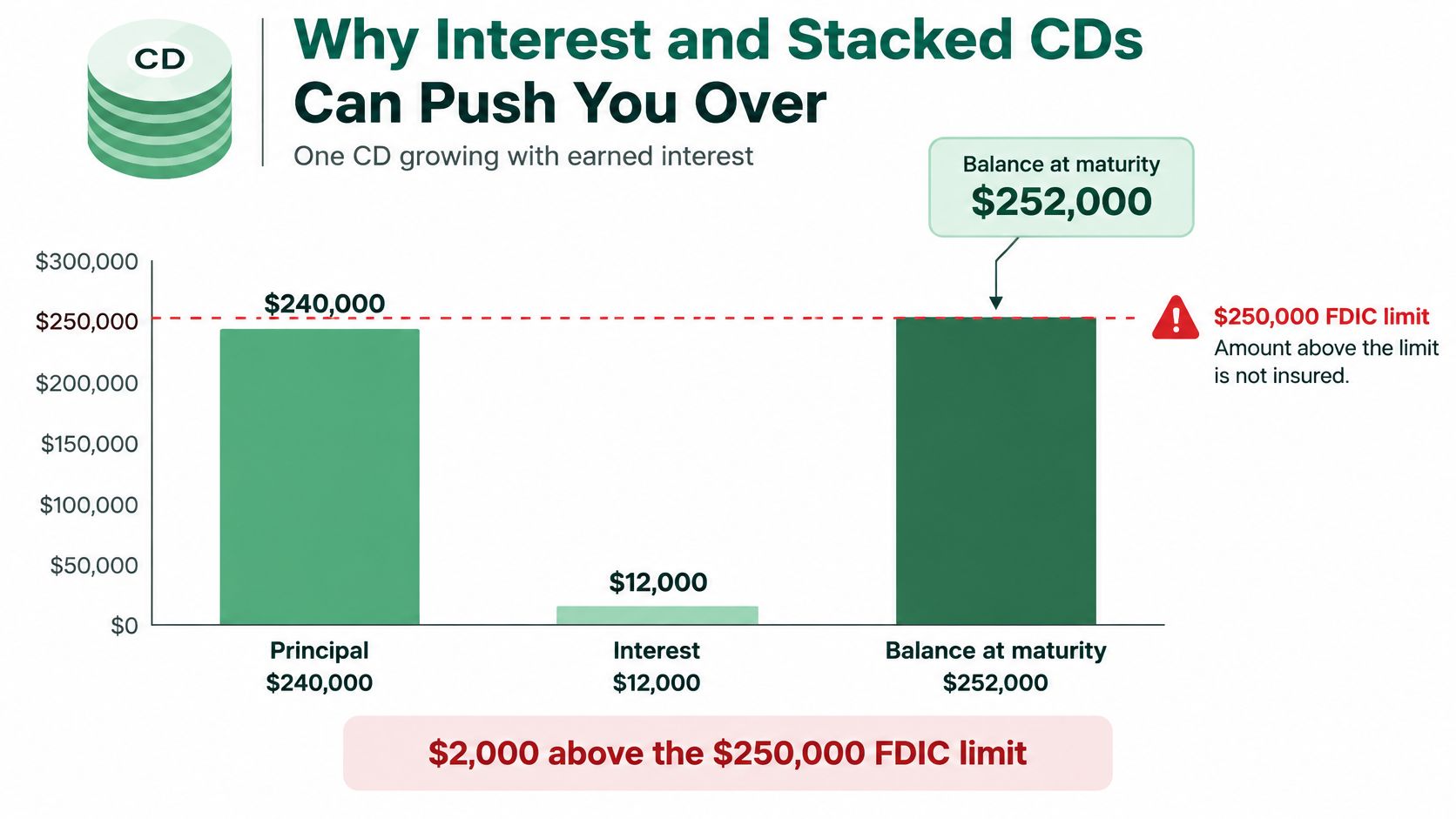
Consider a hypothetical 2026 example, using a 5.00% annual yield for one year. This is an arithmetic assumption, not a claim about an available offer. Check your bank's own website for current rates before making a decision.
Start with a CD principal of $240,000. Under that assumption, it earns $12,000, producing $252,000 at maturity. Compared with the standard ceiling, that leaves $2,000 uninsured if the bank fails at that balance and you have no other deposits affecting the calculation.
Combine accounts before judging coverage
An ordinary savings account can create an even larger gap. The FDIC's Deposit Insurance at a Glance brochure sets out the combined-deposit rule: a $200,000 CD plus $75,000 in single-owner savings at the same bank totals $275,000, leaving $25,000 uninsured.
The arithmetic is simple enough to do on a statement:
| Hypothetical balance calculation | Amount |
|---|---|
| CD principal | $200,000 |
| Savings balance in the same ownership category | $75,000 |
| Combined deposits before additional interest | $275,000 |
| Amount above the standard coverage ceiling | $25,000 |
Use this formula for each category:
Potential uninsured balance = category deposits, including accrued interest, minus the applicable coverage limit. A negative result means you have remaining room, not negative insurance.
Don't count interest twice. If your statement balance already includes credited interest, add only accrued interest that isn't reflected there. For planning, also estimate what will accumulate before maturity.
A ladder still needs an insurance check
A CD ladder spreads money across different maturity dates. It can help you avoid locking all your cash into the same term and gives you scheduled opportunities to access or reinvest money.
But the FDIC's deposit insurance overview makes clear that separate certificates in the same category at the same bank share coverage. Different maturity dates don't create additional insurance.
That distinction matters when you've built a ladder over years. Each purchase may have looked modest on its own while the combined balance grew beyond your intended protection.
The cleanest fix is usually to place the excess at a separately insured bank. An applicable ownership category can also help, but don't change legal ownership casually just to fit an insurance calculation.
Recheck at every rollover. A renewal may include accumulated interest, and the new rate changes how much room you'll need during the next term.
Bank-Issued and Brokered CDs Compared
| Feature | Bank-issued CD | Brokered CD |
|---|---|---|
| Who issues the CD | The bank where you open it | A bank selected through the broker; purchases may span several banks |
| Where FDIC coverage attaches | The issuing bank you deal with | The issuing bank, through qualifying pass-through arrangements |
| How the limit is counted | Your deposits in each ownership category at that bank | Your deposits in each category at each issuing bank |
| What to verify | Bank's FDIC status and your combined balances | Issuing bank names, amounts placed, and ownership registration |
| Selling before maturity | Early withdrawal usually carries a contractual penalty | A secondary-market sale may return less than principal |
| Main insurance risk | Exceeding coverage at the bank | Improper placement or inadequate ownership records |
A brokered CD can be FDIC insured. The FDIC's discussion of brokered deposits explains the role of intermediaries in placing deposits with banks, including arrangements that distribute funds among insured institutions.
The protection depends on the issuing bank and the applicable ownership records and pass-through requirements. A polished brokerage screen doesn't establish any of those details by itself.
Find out who actually holds the deposit
A broker may help spread your purchases across banks. That's useful only if you also account for money you already hold directly at those institutions.
Suppose your broker selects the bank where you keep your household savings. The brokered purchase joins the coverage calculation at that bank. Buying through a different channel doesn't separate the deposits.
Ask for these details in writing:
- Issuing bank names: Obtain the legal institution names for every placement.
- Amounts placed: Match the broker's confirmation to each issuing bank.
- Registration: Check ownership, account capacity, and any beneficiary information.
- Intermediary failure procedures: Ask how you would establish ownership and access your deposit if the broker stopped operating.
Insurance doesn't guarantee an early-sale price
A brokered CD sold before maturity may bring less than you paid. FDIC insurance doesn't reimburse market-price losses or fees.
The Securities Investor Protection Corporation, or SIPC, provides a different form of protection involving missing customer securities and cash at a failed member brokerage, subject to its rules. It doesn't insure investment performance. Ask the broker which protections apply to the specific holding and how the deposit is recorded.
If you're comparing places to hold cash until a known spending date, our CD versus Treasury bills comparison can help frame the trade-offs. First decide when you'll need the money, then evaluate the access terms.
What FDIC Insurance Does Not Cover
| Product | FDIC insured? | What protects it instead |
|---|---|---|
| Bank savings or checking account | Yes, within applicable limits | FDIC deposit insurance |
| Money market deposit account at a bank | Yes, within applicable limits | FDIC deposit insurance |
| Bank CD | Yes, within applicable limits | FDIC deposit insurance |
| Credit union share certificate | No | NCUA insurance at federally insured credit unions, which carries its own standard limit per depositor |
| Money market mutual fund | No | No deposit insurance or guaranteed investment value |
| Treasury bill or Treasury note | No | Full faith and credit of the U.S. government |
| Annuity | No | Applicable state guaranty association protection, subject to state limits and eligibility |
| Stocks, bonds, and mutual funds | No | No deposit insurance; SIPC protection concerns brokerage failure, not market losses |
FDIC insurance protects covered bank deposits when an insured bank fails. It doesn't cover falling investment prices, disappointing returns, or the costs of leaving a contract early.
That distinction matters even when you buy an investment inside a bank branch. The location of the sale doesn't turn an annuity or mutual fund into an insured deposit. A marble lobby is not a regulator.
Similar names can conceal different products
A money market deposit account is a bank deposit. A money market mutual fund is an investment fund. The names are close enough that savers routinely confuse the two, and the difference only becomes obvious when someone reads the legal disclosures after moving the money.
Say you move a hypothetical $100,000 into a fund described as cash-like. That description tells you nothing about deposit insurance. Read the product's legal name and disclosures before treating it as protected bank cash, because "cash-like" is marketing language, not a coverage category.
For genuine deposit accounts, the comparison points are different. Our guide to money market accounts versus high-yield savings accounts walks through the account features worth evaluating.
Name the loss before expecting protection
An early withdrawal penalty is a contractual cost. A loss from selling a brokered CD before maturity is a pricing issue. Neither becomes an insured bank-failure loss because the underlying certificate qualifies for deposit insurance. Insurance answers one question: what happens if this bank fails? It stays silent on everything else.
A fintech app raises a separate problem. Many apps are intermediaries rather than banks, so you need to establish where the money was placed and what records identify you as its owner. If the app can't answer that question in writing, treat the arrangement as unverified until it can.
Check the product name, the institution holding the money, and the regulator or insurance agency behind that institution.
Credit union certificates require their own check: confirm that the credit union is federally insured rather than assuming every institution using the word certificate has the same backing. For annuities and investment accounts, examine the separate protection rules that apply to each one instead of importing the bank-deposit rules. Three checks, one afternoon, no assumptions.
How to Verify a CD Is Insured Before You Buy
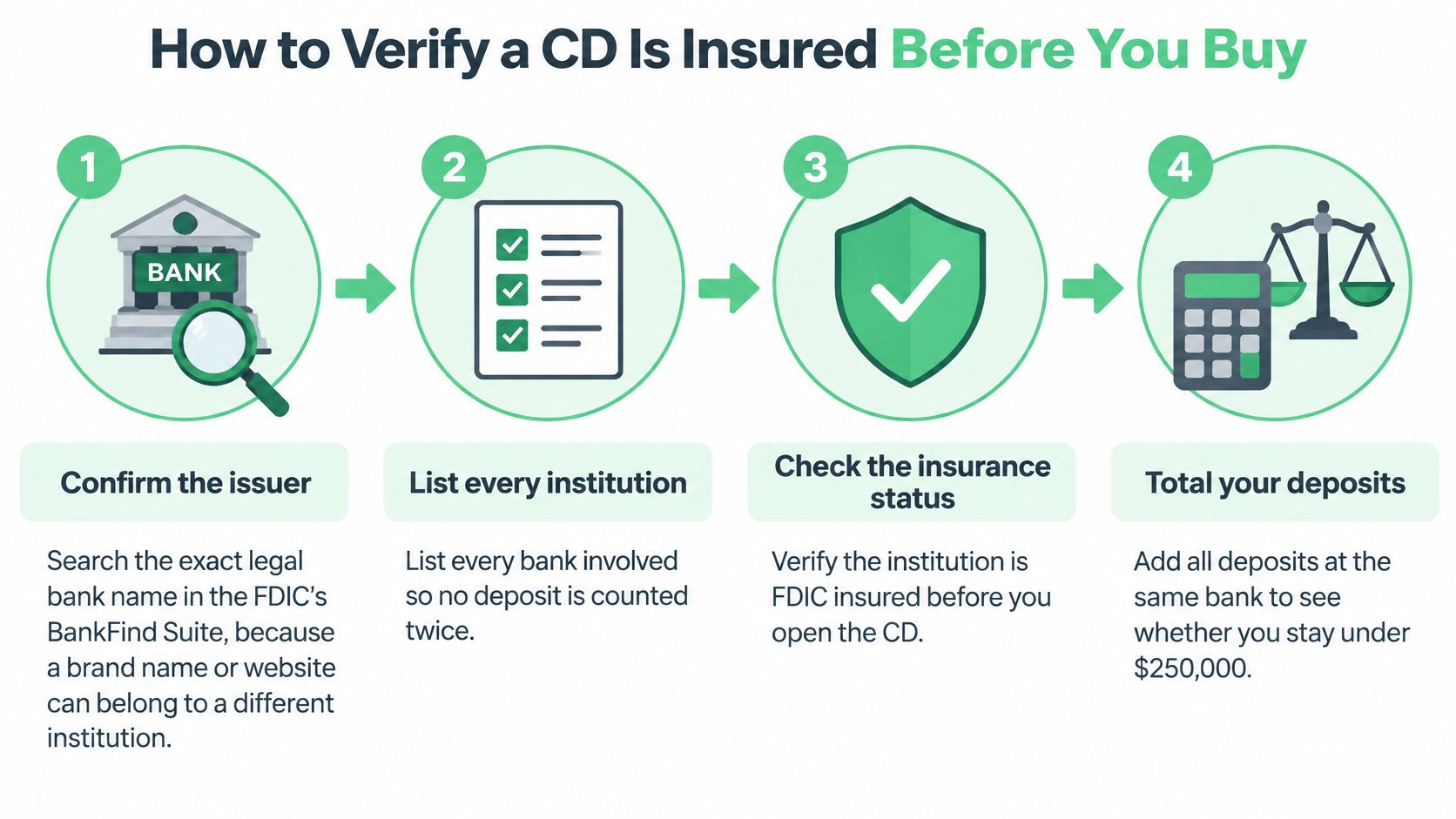
Gather your bank statements, brokerage confirmations, and beneficiary records. You can make a useful first pass in an afternoon, although unclear trust arrangements or missing intermediary records may take longer to resolve.
The objective is a written inventory you can check again at renewal. Memory is a poor filing system for retirement savings.
Run the account-by-account check
-
Confirm the issuer. Search the exact legal bank name in the FDIC's BankFind Suite. A familiar brand, branch sign, or website name may represent an institution you already use under another name.
-
List every deposit at that bank. Include CDs, checking, savings, and money market deposit accounts, then group them by ownership category. Keep direct deposits and brokered placements on the same bank worksheet so you don't overlook their combined effect.
-
Separate today's balance from the projected maturity balance. Record principal and interest accrued so far, then estimate the additional interest expected before maturity. The projected total helps you plan ahead; it isn't a substitute for the actual failure-date calculation.
-
Compare each category with its applicable allowance. Use the ownership table to identify the relevant treatment rather than assigning a fresh allowance to each account. For complicated joint or trust holdings, use the FDIC's Electronic Deposit Insurance Estimator to help check the calculation.
-
Review titles and beneficiary records. Confirm that the bank's records reflect the actual legal ownership. Resolve a missing owner, outdated beneficiary designation, or incorrectly registered retirement deposit before relying on that category's treatment.
-
Request brokered placement details in writing. Obtain issuing bank names, amounts, and registration information from the broker. Repeat the issuer and balance checks for every receiving bank, including institutions where you already keep money directly.
-
Repeat before every rollover. Check the proposed renewal amount, maturity date, and interest assumption before accepting it. Set a calendar reminder early enough to review the bank's renewal notice and instructions without rushing.
Keep a record someone else can understand
Your worksheet should include the legal bank name, account title, current balance, projected maturity value, and maturity date. Save the supporting statements and confirmations alongside it.
If a spouse, executor, or trusted helper needed to understand the arrangement, they should be able to follow it without guessing which account belongs where. That's especially valuable when household finances have become concentrated with the person who usually handles the paperwork.
The estimator can assist with arithmetic and ownership rules, but it can't correct inaccurate records. A healthy setup has documented ownership and balances within the applicable coverage at every bank.
Keep Your Totals Under the Limit Before Your Next CD
An insured CD can be a sound place for cash you expect to leave untouched until maturity. For money supporting retirement spending or a planned home expense, I'd settle the insurance question before comparing yields.
This week, make a one-page inventory of every bank, account title, balance including accrued interest, and maturity date. If a category exceeds its coverage, plan to place the excess at another insured bank or in an applicable, properly titled category before committing more money.
Let spending needs guide the term
Use maturity dates to reorganize deposits without triggering an early withdrawal penalty. Check the renewal instructions so an automatic rollover doesn't lock in a setup you intended to change.
If you may need the cash sooner, compare access terms using our high-yield savings account versus CD guide. Keep near-term spending accessible rather than depending on an early CD exit.
The rate used here is a hypothetical 2026 example, not a current offer. Check the bank's own published terms before acting.
This is general information, not a personal recommendation. At The Money Maniac, we advise readers to do their own research or consult a licensed professional before making investment decisions, particularly when trusts, estates, or complex ownership are involved.
Your decision rule is simple: resolve any uncovered balance before buying the next CD. Start with the inventory, then make the placement.
Get more posts like this
One short, useful email each Friday. Free, no spam, unsubscribe anytime.