How Are CDs Taxed? a Plain Guide for Savers
How are CDs taxed? Learn how CD interest is taxed federally and by state, what Form 1099-INT reports, and how to keep more of what your CD earns.

Daniel Anderson
Editor, The Money Maniac
November 28, 2026
13 min read

Your January mail brings a Form 1099-INT from the bank, and box 1 holds a number larger than you expected. Run it through your federal bracket, add whatever your state takes, and the CD you were pleased to lock in last year looks less generous than the rate sheet promised. Nobody at the branch mentioned that part.
Interest from a certificate of deposit is ordinary income. It's taxed at your regular rate, the same one that applies to your pension and your savings account, and it's taxed in the year the bank pays it. The rules aren't complicated. The arithmetic is where people get surprised, because the rate printed on the CD and the rate you keep are two different numbers.
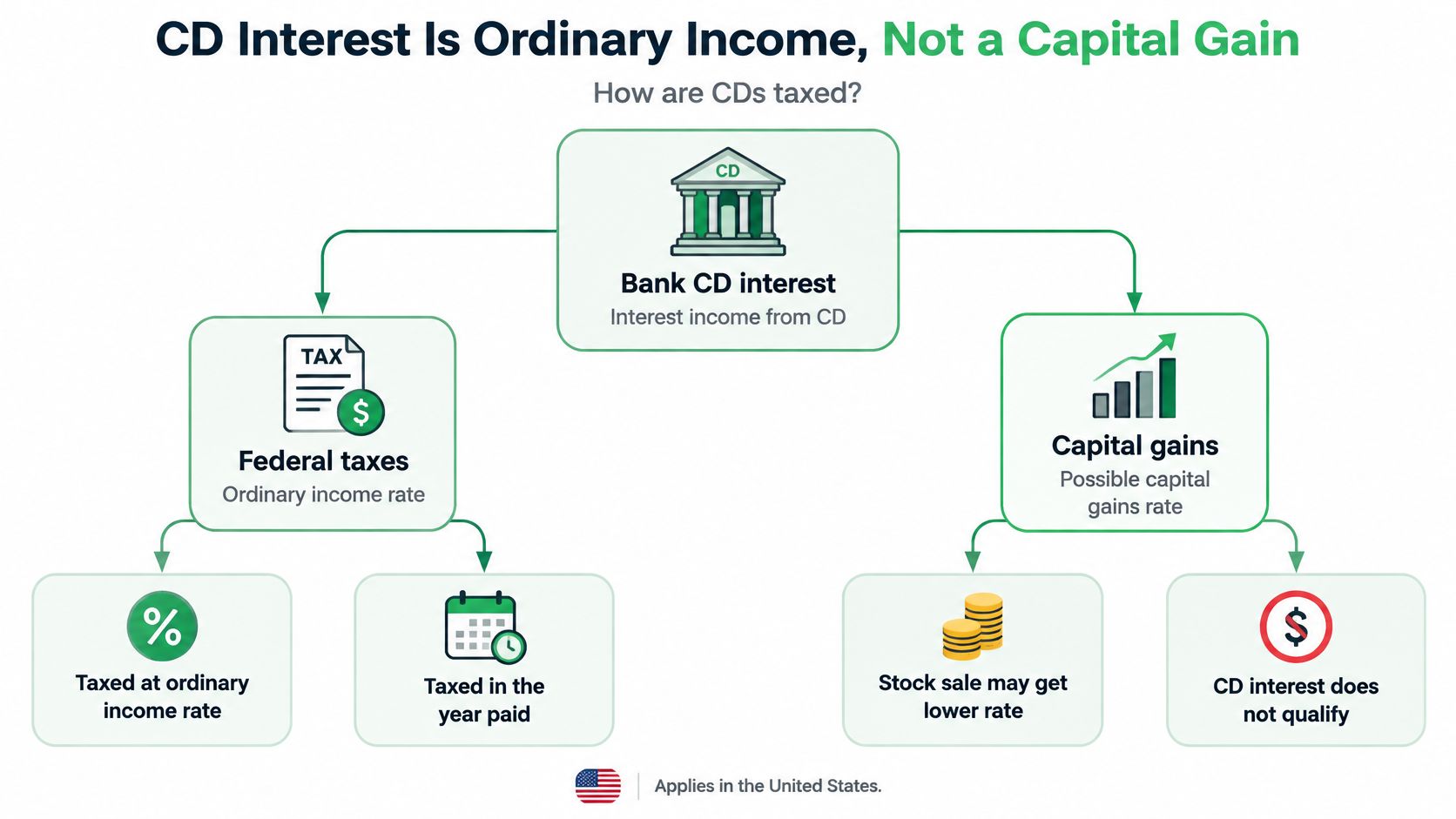
CD Interest Is Ordinary Income, Not a Capital Gain
Interest the bank credits on a certificate of deposit is taxable interest income. The IRS position on taxable interest puts that interest in the same ordinary-income group as wages, pension payments, and savings-account interest, so it uses your regular rate. A stock sale can qualify for capital gains rates. CD interest stays in the ordinary group.
The rate on the certificate and the rate you keep are different numbers. Take the interest the bank pays, subtract federal tax at your ordinary rate, then subtract whatever your state charges. What is left is the after-tax yield. The APY on the disclosure is only the starting figure in that subtraction.
People who keep a small CD at a second bank sometimes wait for a form before they report anything. You still report all taxable interest, whether or not a form arrives. Banks generally issue Form 1099-INT once reportable interest reaches $10, under the Instructions for Forms 1099-INT and 1099-OID. That $10 figure is the bank's paperwork cutoff. Earn $9 on one CD and $35 on another and both amounts are taxable, even if only the larger one generates a form.
Most states, and a number of cities, tax interest income too, starting from the federal figure. A handful of states have no income tax at all, and some give breaks on particular kinds of interest. Check your own state revenue department's guidance for the year you are filing rather than assuming the federal answer is the whole answer. On that same page, see how the state treats interest from U.S. Treasury securities. Several states tax CD interest in full and exempt Treasury interest, and that gap can decide which of the two wins once both are measured after state tax.
A CD works like a loan you make to the bank. The bank pays you for the use of your money, the same way it pays interest on a savings account, and the tax code files that payment with other ordinary income. Choosing a deposit because the term is fixed and the balance feels steady leaves the interest on that same ordinary line.
What to compare: the after-tax yield, not the advertised APY. A CD advertised at 4.00% in 2026 does not keep 4.00%, and the size of the gap depends entirely on your bracket and your state.
What Your CD Interest Really Costs by Bracket
A CD doesn't get its own tax rate. Your interest climbs the same bracket ladder as every other dollar of ordinary income, so the identical CD produces very different after-tax results in different households. The IRS tax inflation adjustments for tax year 2025 set federal marginal rates between 10% and 37%, with the 24% bracket beginning above $103,350 of taxable income for single filers and $206,700 for married couples filing jointly.
The table below uses those tax year 2025 brackets. The right-hand column is the part worth reading twice: it shows what a dollar of CD interest keeps at each rate, expressed as the after-tax yield on a CD paying 4.00%.
| Marginal rate | Single filer taxable income (2025) | Married filing jointly (2025) | Federal tax on $10,000 of CD interest | After-tax yield on a 4.00% CD |
|---|---|---|---|---|
| 10% | Up to $11,925 | Up to $23,850 | $1,000 | 3.60% |
| 12% | $11,925 to $48,475 | $23,850 to $96,950 | $1,200 | 3.52% |
| 22% | $48,475 to $103,350 | $96,950 to $206,700 | $2,200 | 3.12% |
| 24% | $103,350 to $197,300 | $206,700 to $394,600 | $2,400 | 3.04% |
| 35% | $250,525 to $626,350 | $501,050 to $751,600 | $3,500 | 2.60% |
| 37% | Above $626,350 | Above $751,600 | $3,700 | 2.52% |
The 32% bracket sits between the 24% and 35% rows and is left out only to keep the table readable. The tax column assumes the full $10,000 lands inside a single bracket, which rarely happens in practice. Real returns spill across bracket lines, and that spill is where the math gets interesting.
Same CD, same 4.00% rate, yet the yield you keep runs from 3.60% down to 2.52% depending on where your income already sits. The rate on the CD is not the rate you keep.
One couple, one CD, two brackets
Say a married couple files jointly with $95,000 of taxable income before any CD interest. Under the 2025 brackets, that puts them near the top of the 12% bracket, which ends at $96,950 for joint filers.
They hold $250,000 in a CD paying 4.00%, which produces $10,000 of interest for the year. Only $1,950 of that interest fits inside the remaining room in the 12% bracket, costing $234. The other $8,050 spills into the 22% bracket and costs $1,771. Their federal tax on the interest comes to $2,005.
State tax at 5% takes another $500. They keep $7,495 out of $10,000, an after-tax yield of just under 3.00% on a CD advertised at 4.00%.
That spill is the piece savers tend to miss. Your first dollars of interest get taxed at your old rate and your last dollars get taxed at the next one up, which means the marginal rate on new interest is usually worse than the average rate on your whole return. A household that thinks of itself as "in the 12% bracket" can still pay 22 cents of every new interest dollar to the IRS.
Before you run your own numbers: pull the current rate off your bank's rate sheet, then find where your taxable income sits in the bracket table above. Two numbers, one subtraction, and you know what the CD actually pays you.
When the Interest Counts and What the Bank Sends
Timing is the second surprise. According to the IRS rules on investment income and interest, interest on a CD is generally included in income when you receive it or when you're entitled to receive it without paying a substantial penalty. A one-year CD that pays at maturity creates one taxable event. A CD that pays interest annually creates a tax bill in every year it pays, even though the CD hasn't matured.
Longer-term CDs, those maturing in more than a year, usually fall under the original issue discount rules. The bank reports a slice of the total interest each year on Form 1099-OID instead of waiting for the final payment. A five-year CD bought for $10,000 that will mature at $12,763 isn't one tax event in year five; the accrual is allocated across the years in between.
That's where phantom income comes from. Tax can be due on interest that has raised the CD's value but has never reached your checking account.
| Situation | Form | Where it shows up |
|---|---|---|
| CD pays at least $10 of interest in the year | Form 1099-INT | Box 1, interest income |
| CD interest under $10 from one bank | No 1099-INT required | Still reportable on your return |
| Early withdrawal penalty charged | Form 1099-INT | Box 2, early withdrawal penalty |
| Multi-year CD with interest accrued but unpaid | Form 1099-OID | Original issue discount income |
| CD held in a brokerage account | Consolidated 1099 | Interest section |
Brokers who hold CDs for you send the same information, often folded into a consolidated 1099 with your other accounts. Your state return generally starts from the federal interest figure, so one total drives both filings.
The practical check takes two minutes. Add every figure in box 1 across all your 1099-INT forms, add any 1099-OID amounts, and compare the sum with the interest line on your return. If they don't match, find out why before you file.
Holding a CD Inside an IRA or Other Tax-Advantaged Account
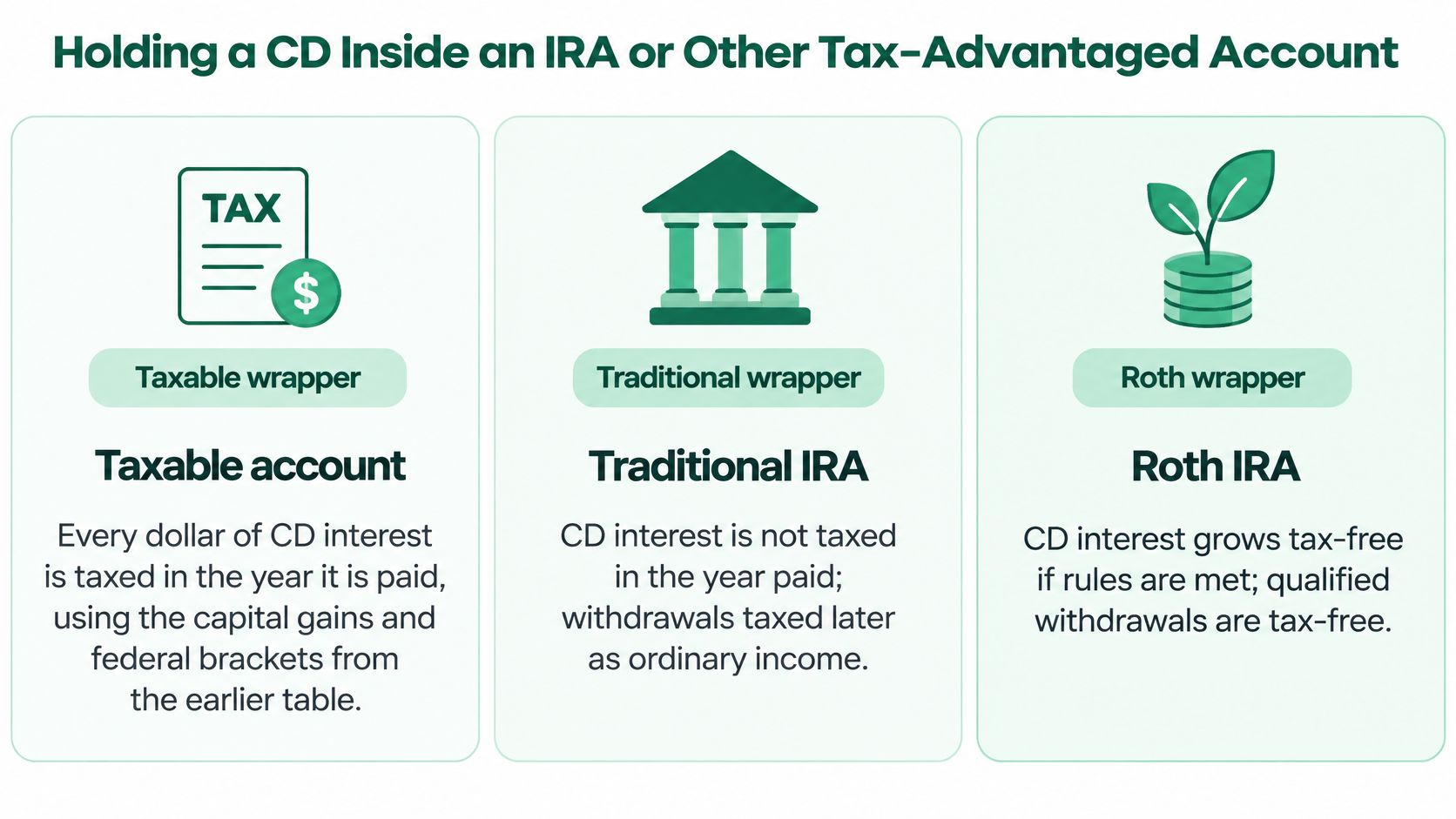
Take the same CD paying the same rate and drop it into three different accounts. In a taxable account, a saver in the middle brackets keeps noticeably less of each interest payment than the advertised yield, because every dollar is taxed in the year it's paid at whatever rate the bracket table above assigns. Inside a traditional IRA, the full yield compounds year after year. Inside a Roth, the full yield is what the saver keeps. The rate on the CD never changed. The account decided what that rate was worth.
The taxable version is the simplest to understand. Nothing is deferred and nothing is sheltered, so the after-tax yield is the advertised rate minus your bracket's slice, every single year.
A traditional IRA works like a delayed toll booth. Interest isn't taxed as it accrues, so the CD compounds at its full rate inside the account. You pay ordinary income tax when you withdraw, which helps if your bracket in retirement is lower than it is now and hurts if it isn't. Withdrawals before age 59½ generally add a 10% additional tax on top, which IRS Publication 590-B covers along with its exception list, so check those exceptions before you lock IRA money into a long CD. The wrapper also can't fix a bad match between the CD's term and the account's rules.
A Roth IRA or Roth 401(k) is the cleanest version. Interest compounds untaxed and qualified withdrawals come out tax-free, so a CD held there keeps its full advertised yield from start to finish. The trade-off is access. IRA money lives under distribution rules, and a CD inside one is a bad home for the cash you might need for a new roof.
That trade-off has a logic to it that goes past CDs. Our newsletter issue from December 30, 2024 made the case in one line: keep growth-focused ETFs in taxable accounts and park income-heavy assets in tax-advantaged ones. A CD is the definition of an income-heavy asset, since every dollar it earns is taxed as ordinary income rather than at the lower capital gains rates growth investments can produce. That is why it fits awkwardly in a plain brokerage account once your bracket climbs: the higher your bracket, the wider the gap between the advertised rate and what you keep, and the more the wrapper matters. If you're still deciding whether pre-tax or after-tax retirement money suits you better, our breakdown of the traditional 401(k) versus the Roth covers which saver each one fits.
Rule of thumb: a CD you won't touch for years, held in an account where you still have contribution room, usually belongs inside the wrapper. Cash you may need within a year or two belongs in a taxable account, even though it's the less tax-efficient choice.
Edge Cases That Change the Answer
Most CD tax questions have one answer. A few situations change it, and those are the ones worth checking before you file, because each one alters what you keep from the advertised rate.
Breaking a CD early. The penalty your bank charges is deductible as an adjustment to income on Schedule 1 of Form 1040, whether or not you itemize, and box 2 of Form 1099-INT reports it. The deduction reduces your adjusted gross income rather than the interest itself, so its value depends on your bracket. A saver in a higher bracket recovers more cents per dollar of penalty than a saver in a lower one. Either way, the penalty offsets only part of the tax on the interest you did earn. It softens a bad outcome but doesn't rescue it, and the after-tax yield you end up with will sit well below what the rate board promised.
Buying a CD on the secondary market. You pay the seller for interest that accrued before you owned the thing. When the next payment arrives, you report only the portion earned during your holding period, and the seller reports interest through the sale date. Check the 1099 figures before you accept them. Reporting the full payment would mean paying tax on interest that belongs to someone else's holding period, which shrinks your real yield on money you never received.
Brokered CDs. Still a deposit, so the interest is still ordinary income, but the broker may report it on 1099-INT or on 1099-OID depending on the structure. Selling before maturity can also create a separate gain or loss on top of the interest. If you're weighing a brokered CD against a short-term government issue, our CD versus Treasury bills comparison covers the state-tax angle that decides it for many savers.
Inherited CDs. The principal you receive is your original deposit and generally isn't taxable. Interest earned before death goes on the decedent's final return or the estate's return; interest earned after death belongs to you as the heir. Sort out which is which before you report the whole balance, because paying tax on the decedent's share is a quiet way to hand back part of your inheritance.
CDs at a foreign bank. The interest is still taxable in the U.S. at ordinary income rates, same as a domestic deposit. If your foreign accounts together exceed $10,000 at any point in the year, an FBAR filing with FinCEN may apply, per the IRS guidance on reporting foreign accounts, and Form 8938 carries its own separate thresholds.
The filing habit that saves trouble: match every interest figure on your return to a specific form, and keep a note of which account each one came from. For each tax year, keep the 1099-INT and the year-end account statement for every CD together in one folder, so any figure on your return can be traced back to a document in under a minute.
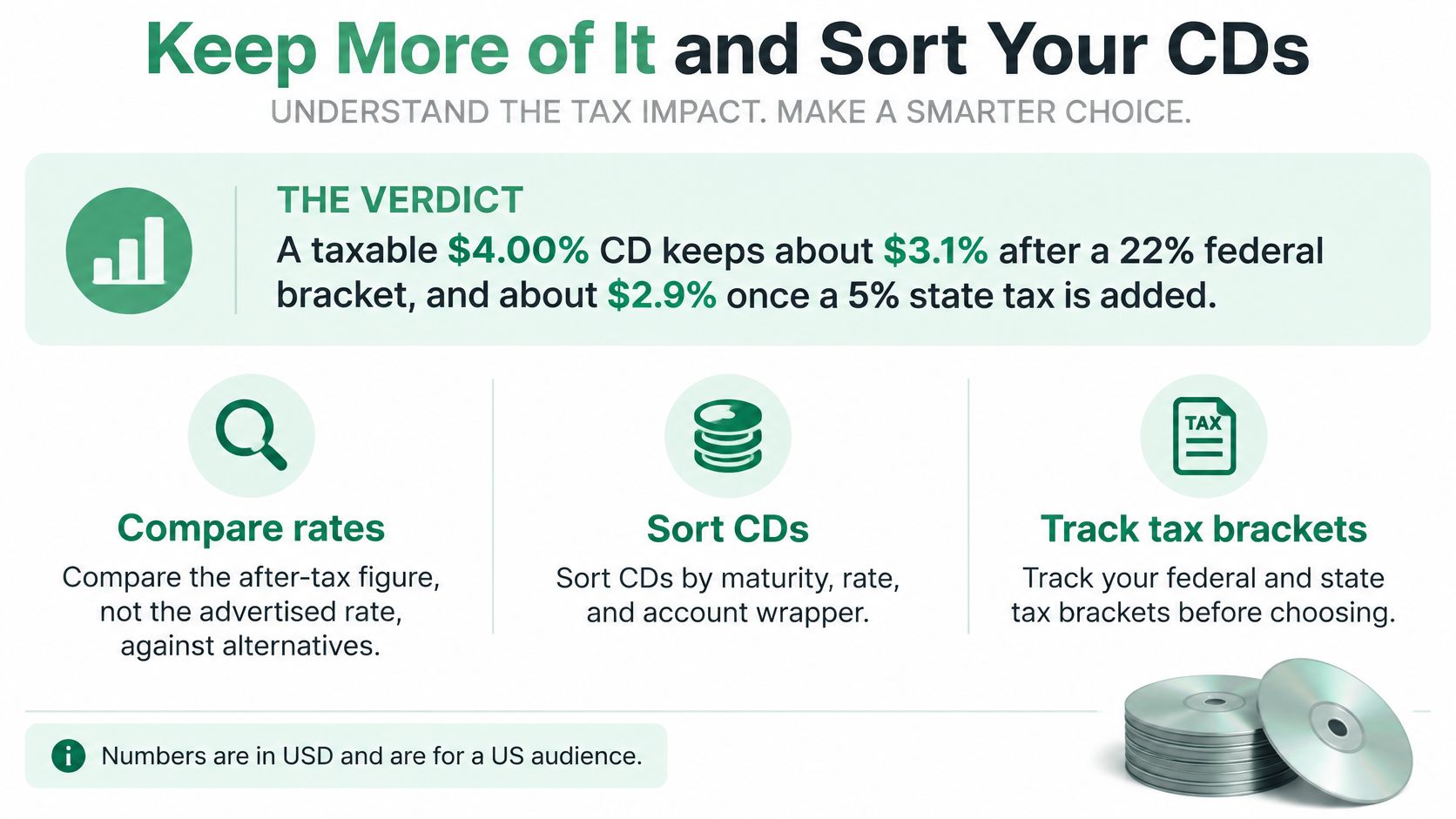
Keep More of It and Sort Your CDs
A CD's advertised rate is the starting point for your return. Take a hypothetical 4.00% CD: at a 22% federal bracket, 4.00% × (1 − 0.22) leaves 3.12%, or about 3.1%. Applying an illustrative 5% state reduction to that remainder gives 3.12% × (1 − 0.05) = 2.96%.
This example applies the reductions sequentially. Your calculation should reflect how federal and state taxes interact on your return. The useful comparison is what you keep, with the account type included, rather than the rate alone.
For buying and laddering decisions, our guide to how to invest in CDs explains terms, rungs and how to match maturities to your timeline.
Keep tax benchmarks separate from deposit yields. The IRS publishes rates used to calculate interest on tax underpayments and overpayments on its quarterly interest rates page. Those rates do not determine what your bank pays. A fixed-rate CD keeps its contracted rate while market rates change.
The levers that affect what you keep
1. Use tax-deferred space when you have room. A CD inside a traditional IRA changes when income is taxed; a Roth IRA can change whether qualifying withdrawals are taxed at all. The same advertised yield can therefore produce a different spendable return depending on the account and withdrawal rules.
2. Choose the interest schedule deliberately. Annual payments can provide cash for the tax bill. Payment at maturity does not automatically postpone taxation: a multi-year CD may accrue taxable interest before you receive cash. Check the reporting treatment before choosing a payout schedule.
3. Compare a short-term Treasury against the CD at your bracket. Include state-tax treatment in the comparison. A difference in headline yields can look different after taxes, especially for savers in a high-tax state.
4. Manage taxable interest around changes in income. A lower-income year may change how much tax you owe on interest. But splitting a maturity's proceeds across new CDs does not move interest already earned into another tax year. Focus on when interest becomes taxable, rather than when you reinvest the principal.
5. Keep emergency cash taxable and accessible. An early withdrawal penalty can erode the benefit of a higher yield. Separate money you may need soon from money you can leave untouched through maturity.
A ten-minute checklist before your next CD
- List every CD you own with its rate, maturity date, account type and interest-payment schedule.
- Pull last year's 1099-INT forms and reconcile the box 1 totals with the interest reported on your return. Resolve differences before carrying those figures into your records.
- Identify interest you cannot yet spend, then set aside accessible cash for any tax due on it.
- Check withdrawal terms so your emergency fund does not depend on breaking a CD.
If accrued interest creates a cash squeeze, ask the bank whether annual interest payments would fit your needs better. For a large purchase, a tax preparer can help clarify reporting and account-placement choices.
Get more posts like this
One short, useful email each Friday. Free, no spam, unsubscribe anytime.