Paying Off Debt vs Investing by the Rate
Paying off debt vs investing depends on rate, taxes, match, and cash. Use the 2026 break-even table to see where your next dollar goes.

Daniel Anderson
Editor, The Money Maniac
November 1, 2026
14 min read
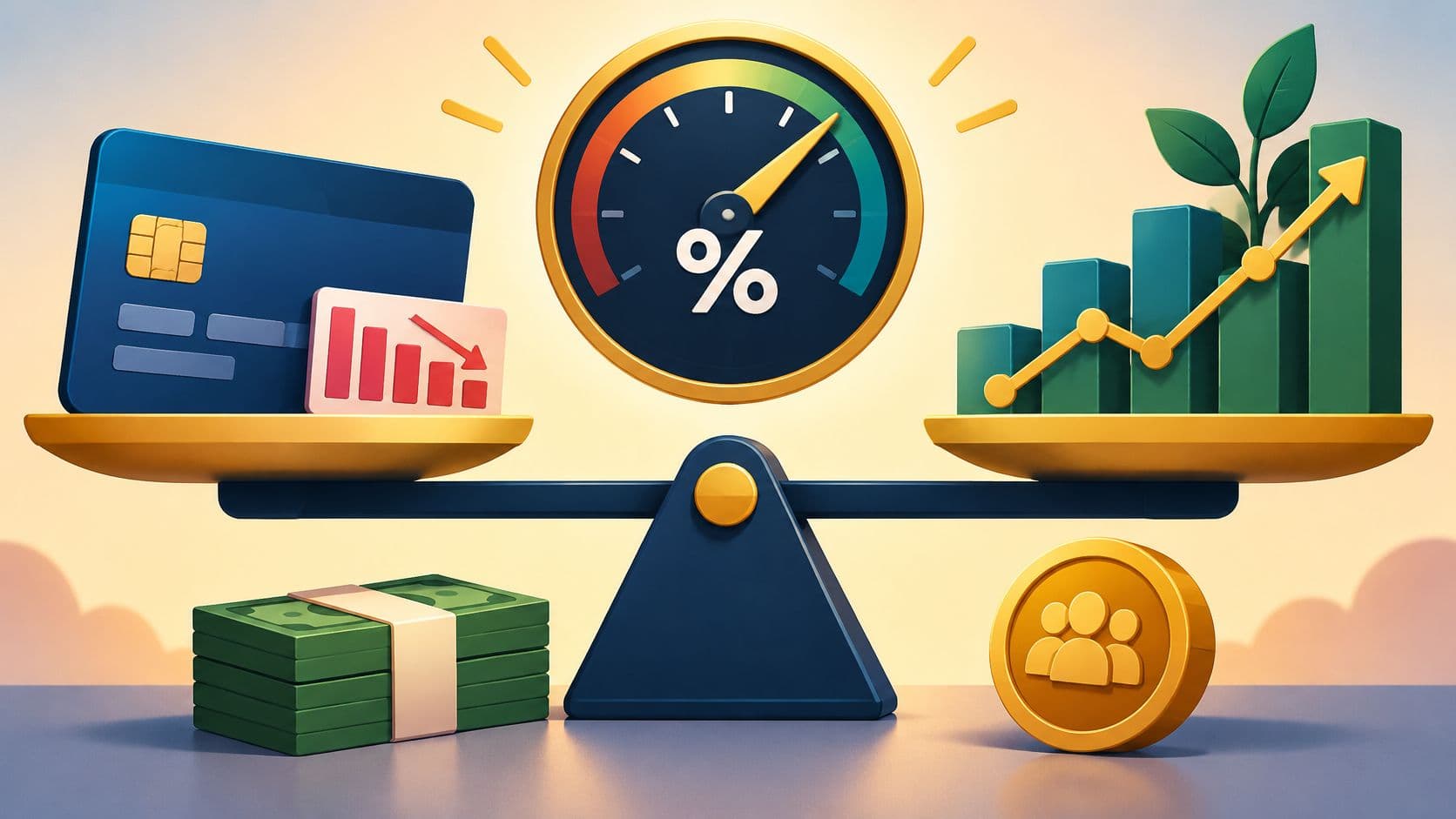
A 22.36% credit-card rate makes the investing debate fairly short. That was the commercial-bank credit-card rate reported for August 2026 in the Federal Reserve's credit-card interest-rate series. Paying that balance down avoids a known expense. Buying stocks gives you an uncertain result, including the possibility of losing money while the card issuer continues collecting interest.
The useful way to approach paying off debt vs investing is to decide where your next dollar belongs in a sequence. Cover essentials and minimum payments, capture a worthwhile employer match when you can safely afford it, and keep enough cash to avoid borrowing again. Then compare your debt's cost with what an investment might realistically deliver after taxes, fees, and risk.
The Rate Test That Settles Most Cases
Each spare dollar stands in line behind earlier claims: minimum payments, a worthwhile employer match, and enough cash to keep a surprise from becoming new debt.
Whatever reaches the front of that line faces a two-way comparison between the guaranteed cost of your debt and the possible return of an investment. Debt repayment earns its "return" through interest you avoid. The saving follows your loan's terms rather than market performance, so it arrives with the reliability of a bill that stopped existing. For a variable-rate balance, future savings shift when the rate shifts, but the interest avoided at the applicable rate is still real money.
Payoff return versus the investing hurdle
| Debt or priority | Rate or payoff | Certain saving on $10,000 | What investing must beat | Usual call |
|---|---|---|---|---|
| Credit card at the August 2026 bank-average rate | 22.36% | About $2,236 before compounding | More than 22.36% after taxes and fees, despite uncertain annual results | Pay this before taxable investing |
| High-rate revolving balance | 20% | About $2,000 before compounding | More than 20% with no guarantee | Pay this off |
| Moderate installment loan | 7% | About $700 before compounding | A 7% certain saving, while stocks can lose money | Decide after match, cash, taxes, and job security |
| Low fixed-rate loan | 4% | About $400 before compounding | Expected long-run growth above 4%, which is uncertain | Often keep the loan and invest if cash is stable |
| Employer retirement match | If your plan adds 50% on matched dollars | No interest avoided; $1,200 contributed can bring $600 | Not a market hurdle | Capture the full match first unless solvency or vesting says otherwise |
These are simple first-year comparisons. Actual interest savings depend on payment timing, compounding, fees, and balance changes. The match sits in its own row because employer contributions follow plan rules, and a dollar of free money outranks a dollar of avoided interest at nearly any card rate.
Make the obvious calls first
Pay debt in the high teens and above before adding taxable investments. Hoping to outperform a card charging 22.36% introduces market risk without removing the obligation to pay the interest. A strong market year could beat that rate. Building a household plan around the possibility is an expensive form of optimism.
A cheap fixed loan leaves more room for investing, provided you can keep making payments through a losing market year. That condition carries weight: an investor with no cash reserves is one car repair away from refinancing the emergency at card rates. Moderate-rate debt needs closer inspection because taxes, cash reserves, and income stability can all change the answer.
Practical rule: Don't compare a certain borrowing cost with an investment return you merely hope to receive.
For a sense of how far minimum payments alone carry a balance, the guide from Morgan & Morgan Attorneys at Law P.C. on paying down credit card balances offers useful repayment context. Whatever you choose, keep required payments current on every account while extra money goes to the chosen target.
Pull the APR, or annual percentage rate, from each statement and match the debt to a row above. Mark whether each rate is fixed, variable, or promotional, since those details decide how durable today's comparison will be. Put installment plans in the same inventory: a split payment with no stated interest still claims part of every paycheck before investing enters the picture.
After-Tax Break-Even on Ten Thousand Dollars
The rate printed on your statement is a starting point. Your real break-even depends on how much interest you avoid paying and how much investment return you keep.
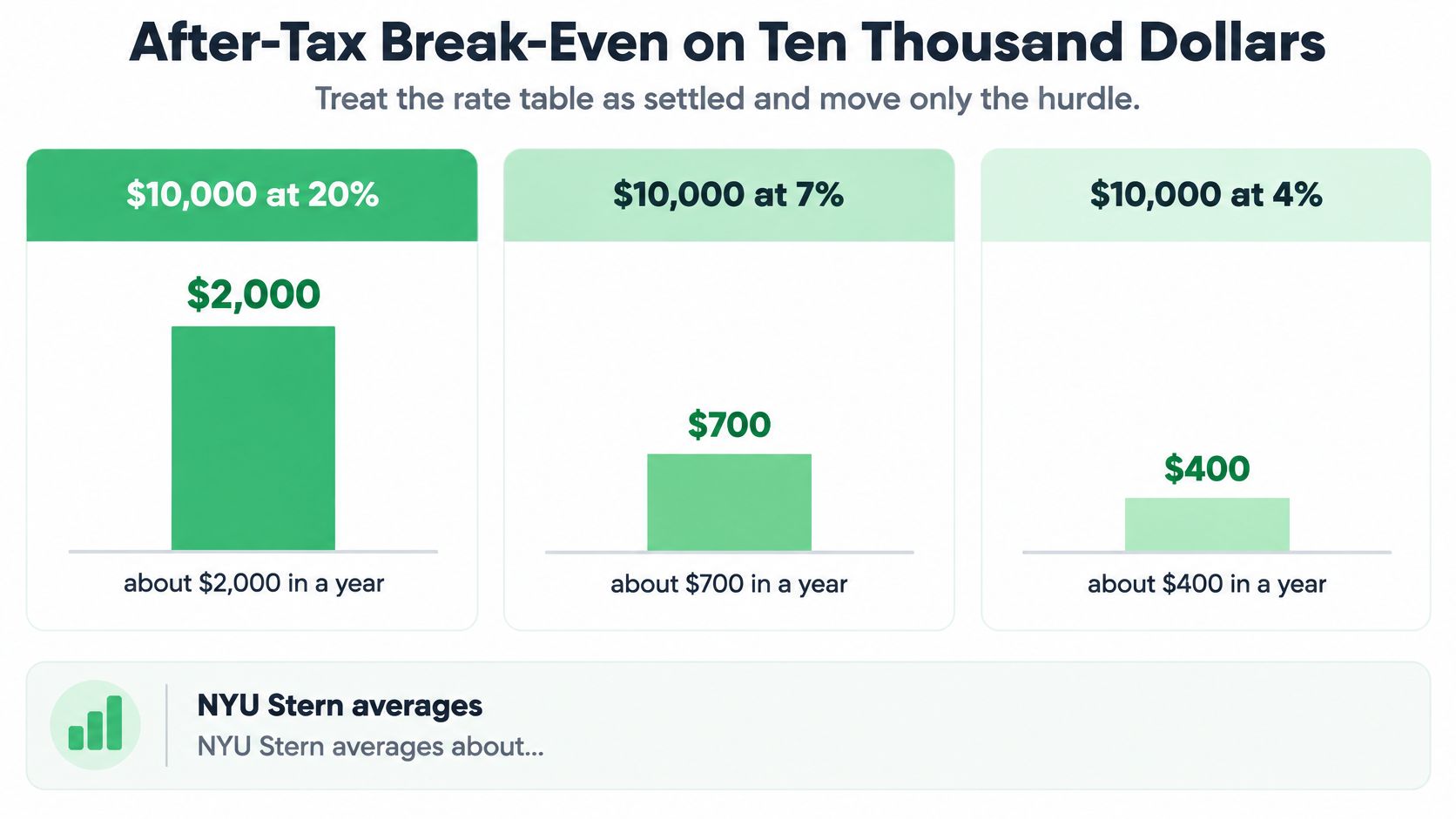
On a hypothetical balance of $10,000, simple annual interest runs $2,000 at 20%, $700 at 7%, or $400 at 4%, before compounding and payment-timing effects. For perspective, NYU Stern's historical return dataset reports an average annual S&P 500 return of approximately 11.85% from 1928 through 2025, including dividends, and includes a −4.23% return in 2018.
That history supports the clear call on expensive debt. It also shows why a stock-market average works nothing like a paycheck.
Adjust what you actually pay and keep
Use this sequence for the closer decisions:
- Start with the loan rate. That is the borrowing cost before any tax adjustment.
- Recognize only usable deductions. Reduce the cost only for a deduction you qualify for and can use. A loan category's potential tax treatment does not automatically lower your bill.
- Subtract investment fees. Fund expenses reduce the return available to you.
- Account for investment taxes. In a taxable account, dividends, interest, and realized gains may leave you with less than the headline return.
For the moderate installment loan in the table, the portfolio must clear the debt's effective cost after investment expenses and applicable taxes. Matching the nominal rate before costs does not get you there.
Retirement accounts alter tax treatment and timing. They leave investment losses fully intact. Compare like with like: nominal debt costs against nominal investment assumptions, then make the relevant tax adjustments.
Give uncertainty a place in the calculation
The SEC's savings and investing guide explains that diversification spreads money among investments but can never guarantee protection when markets fall. It also explains compound interest, earning interest on both the original principal and accumulated interest.
A longer horizon gives compounding more room to work and a losing stretch more room to recover. As a planning rule, do not fund a goal inside five years by assuming stocks will deliver their long-run average.
A compound interest calculator shows how lump sums and monthly contributions grow over time. Try a hypothetical 5% return, then 0%, keeping contributions and timing unchanged; neither figure is a forecast or a worst-case outcome.
If you are comparing results across different holding periods, use our guide to calculating annualized returns. Most of all, label the historical average history, and treat your own projected balance as an estimate.
Capture the Match Before Extra Payments
Before any rate comparison runs, one decision sits earlier in the sequence. The IRS's matching-contribution example shows why: an employer matching 50% of employee contributions up to 5% of salary turns an employee contribution of $1,200 into another $600, a 50% gross addition before investment returns enter the picture. The guidance describes tax-deferred matching contributions and traditional elective deferrals whose taxation is postponed until withdrawal; Roth contributions carry different tax treatment.
An addition tied directly to your contribution outruns what paying down moderate-interest debt saves, so capturing the full match can justify investing while a balance remains. The qualifier comes first in the order of operations: rent covered, groceries bought with money you have, every minimum payment current. A match earned on top of an overdraft is arithmetic performed in a burning building.
One catch: matches come with fine print.
Your summary plan description, the document spelling out your retirement plan's rules, holds three numbers worth writing down. The match percentage tells you what the employer adds for eligible contributions. The contribution threshold tells you what share of pay you must defer to receive the full amount. The vesting schedule tells you when employer dollars become permanently yours, which matters because a contribution you would forfeit by leaving next month cannot be counted at full value.
The payroll move that follows is narrow. Set your deferral to whatever earns the complete match, and treat every dollar beyond it as unmatched money facing the ordinary trade-off: uncertain investment growth against certain interest savings.
For 2026, the IRS retirement-limit announcement sets the employee elective-deferral limit at $24,500 for many 401(k), 403(b), governmental 457 plans, and the federal Thrift Savings Plan, with a general $8,000 catch-up for employees age 50 or older and a special $11,250 catch-up for ages 60 through 63. Employer matching dollars count toward the plan's overall annual-additions limit; they do not shrink your deferral room.
A ceiling describes permission, not instruction. Our guide to what it means to max out a 401(k) separates the legal cap from the smaller target that matters here: the deferral level that earns the full match. Raising contributions past that point belongs after a deliberate look at remaining debt, cash on hand, and goals, not after a round of retirement-plan bingo.
Build a Cash Buffer Before You Go All In
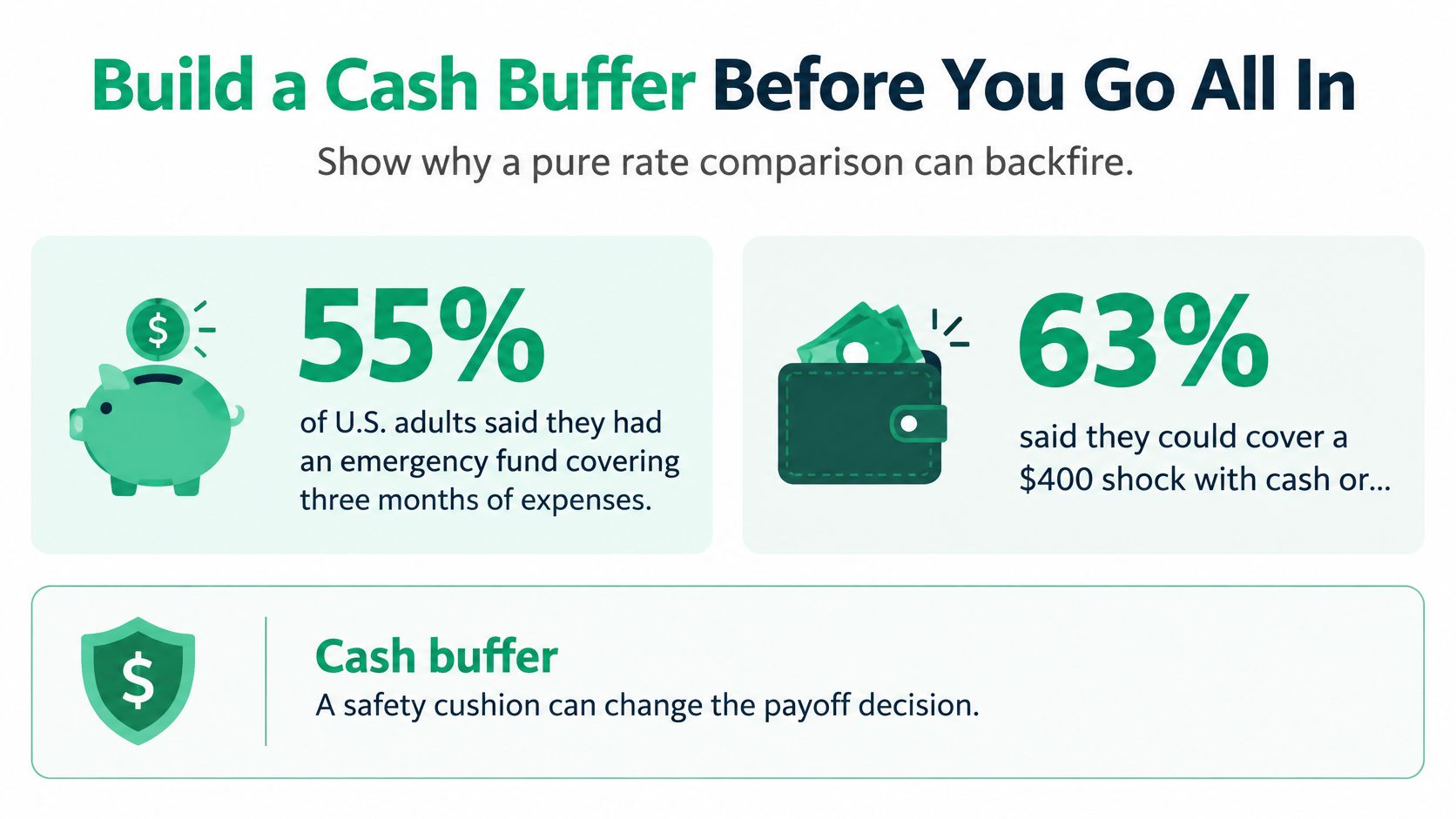
A $400 surprise is the standard stress test for household finances, and plenty of households fail it. In 2025, 55% of U.S. adults reported having an emergency fund covering three months of expenses, while 63% said they could cover a hypothetical $400 expense with cash or its equivalent, according to the Federal Reserve's household savings report.
That gap is why a cushion sits ahead of the rate test in the sequence. Send every spare dollar at a balance and the next repair bill lands on a credit card, often at a worse rate than the debt you just paid down. The optimized plan develops a fairly obvious leak.
Cash has a job even when its expected return trails stocks: it covers the emergency without forcing you to sell investments or open fresh revolving debt. Boring, low-yielding, and exactly what you want at 2 a.m.
Set a staged reserve target
A practical starting target is at least $2,000, or about one month of must-pay bills if that's larger. Treat it as a planning target, not a universal amount proven sufficient for every household. Must-pay bills means housing, utilities, groceries, insurance, transportation, and required debt payments.
With an affordable employer match captured, the reserve grows in stages:
| Milestone | Cash target | When to expand |
|---|---|---|
| Starter cushion | At least $2,000, or one month of must-pay bills if larger | In place before extra payments beyond minimums |
| Working buffer | The starter amount, held steady while you pay down expensive balances | Grows only after high-cost revolving debt is gone |
| Full reserve | Three months of must-pay bills, leaning toward six for irregular income, substantial medical exposure, or a one-earner household | The end goal before aggressive investing |
How much is enough depends on your obligations, not a national average. A freelancer with uncertain payment dates may need more cash than an employee with dependable pay and a second household income. The relevant question is how long you could keep required bills paid without borrowing.
A debt payment improves your balance sheet. Accessible cash keeps an ordinary emergency from becoming another debt.
Protect cash flow, not only net worth
The Federal Reserve's 2025 Survey of Consumer Finances release reports that about 77% of U.S. families had debt, retirement-plan participation was approximately 65%, and stock-market participation was 56%; the share whose debt payments exceeded 40% of income rose from 6.5% in 2022 to 8.6% in 2025.
That overlap explains why sequencing matters. A household can hold investments and still struggle to make required payments.
The Money Maniac's December 30, 2024 newsletter recommended keeping emergency funds in high-yield savings accounts or short-term Treasury bills. Keep immediately needed cash readily accessible, and match any Treasury maturity to when you might need the money rather than treating it like checking-account cash.
Our guide to how big your emergency fund should be walks through tailoring the target. Start by writing down one month of must-pay bills and comparing that dollar amount with the cash you could reach this week.
Installment Plans That Only Look Free
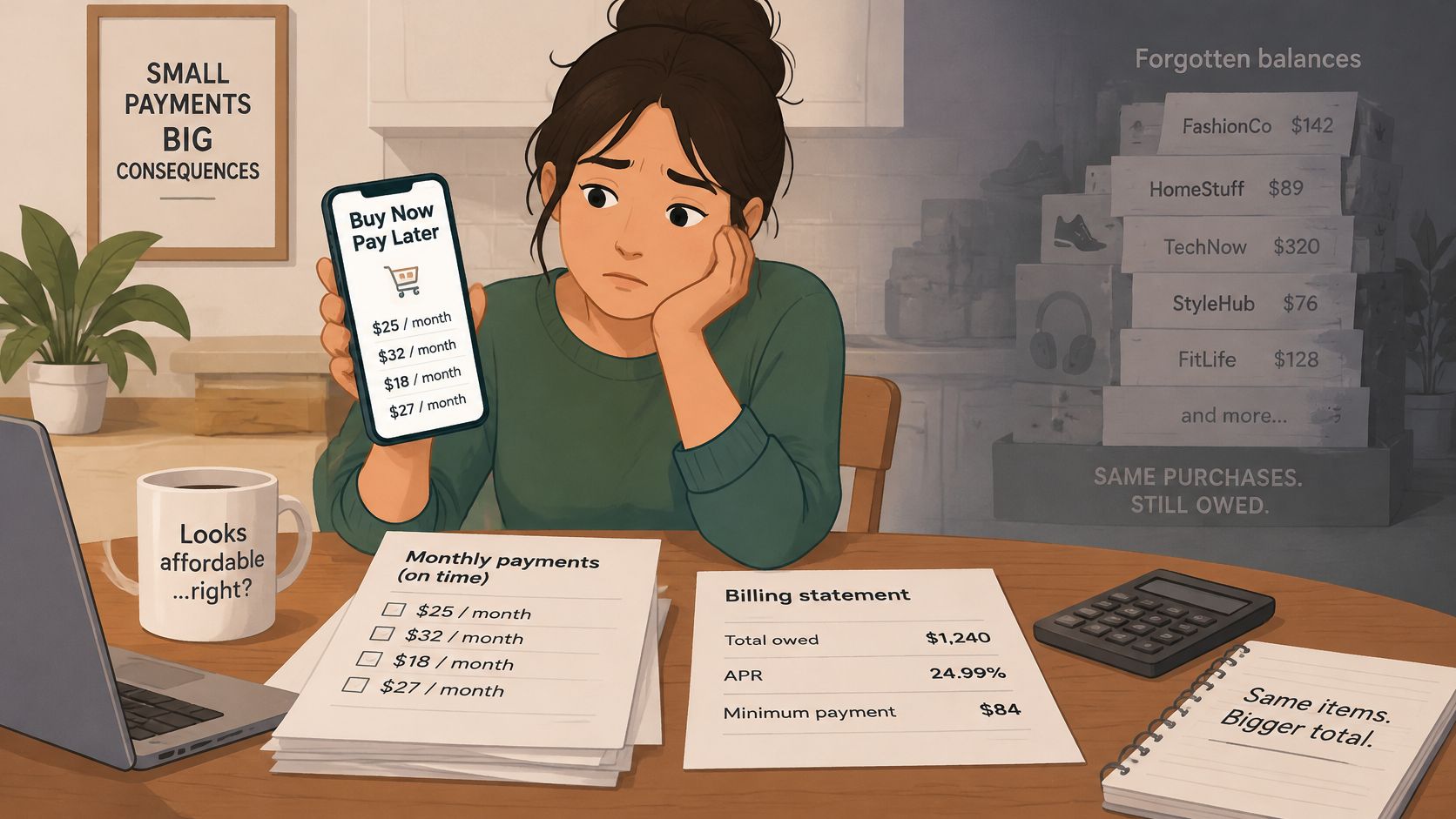
One payment lands on Friday, another the following Tuesday, a third the day before rent. None of them looks like debt on its own, which is exactly why buy-now-pay-later balances get left off debt lists.
The Richmond Federal Reserve's examination of buy-now-pay-later credit reports that U.S. transaction value grew about 20% annually in real terms since 2021, reaching an estimated $70 billion in 2025 (around 1.1% of credit-card spending), and discusses Federal Reserve survey findings that 16% of adults used these plans during the prior 12 months in 2025 while 64% of late payers said they were charged an additional fee.
An advertised interest-free purchase still commits future income. A 0% plan carries a hazard a 22% card doesn't: the card balance sits on a statement looking obviously owed, while the installments disguise themselves as ordinary bills until several collide in the same week.
Put every installment on the same calendar
Before deciding where extra money should go, run a cash-flow check covering the next 60 days, a practical planning window rather than a prediction:
- Inventory every balance. Include store financing, installment apps, promotional cards, and ordinary loans. Record due dates and what happens if you pay late.
- Total the required payments. Place them beside expected paydays and essential spending. Check the timing, not merely the monthly total.
- Pause optional investing when bills require borrowing. Preserve essential payments first and reconsider matched contributions if continuing them would threaten solvency.
Brokerage apps and installment apps live on the same phone, which is how a person ends up holding an index fund while having zero uncommitted income arriving next payday. Account balances won't reveal that. A due-date calendar will.
Consolidation deserves the same scrutiny. Rolling several plans into one loan can make payments easier to track, but the amount owed doesn't shrink in the process. Inspect the full cost, repayment term, fees, and any collateral requirement before signing. LifeBack Law Firm, P.A.'s explanation can help you weigh the downsides of debt consolidation before exchanging several obligations for a new loan.
While fee-risk balances exist, declining new installment offers matters as much as paying on time. Every new plan stacks another fixed due date onto paydays that are already spoken for, and the math only gets tighter from there.
When low-rate balances carry similar costs, clearing the smallest removes a due date and delivers a quick win. That motivational choice shouldn't divert extra money from substantially more expensive revolving debt.
Finish with a dated payment list you can reconcile against your bank balance. A promising investment assumption won't help when an automatic withdrawal lands the morning before your paycheck.
Where the Next Dollar Goes
Your best next move should be specific enough to automate. "Build wealth" is a reasonable ambition, but it doesn't tell payroll or your bank where to send the money.
Choose a priority using your actual household situation. Treat the amounts and rates below as scenario assumptions and planning targets; your own balances belong in the first column.
Where the next dollar goes by situation
| Situation | Next dollar goes to | Stop or switch when |
|---|---|---|
| Card near 22% and little cash | Starter buffer, then the card | Card is gone and the starter cushion is funded |
| Match available and a 7% student loan | Full match, small buffer, then the loan or a split | Match is captured and remaining rate is cheap and fixed |
| 4% fixed mortgage, stable job, long horizon | Investing after match and buffer | Rate resets, cash falls, or the goal is under five years |
| 0% promo with a known end date | Scheduled payoff before the regular APR | Balance is zero before the promo ends |
| Buy-now-pay-later plus new investing | Due dates and fee-risk balances first | No new borrowing is needed for ordinary bills |
| Irregular or commission income | A larger cash reserve before more stock | Three to six months of core expenses are set aside |
For a fixed-rate mortgage, a rate reset won't occur under the existing terms. That trigger matters if you refinance, replace the loan, or discover that the mortgage was adjustable rather than fixed.
Apply the judgment to your household
Expensive card debt and thin savings call for focused repayment. Keep the starter cushion from the buffer section intact and direct extra cash to the card. Once it's cleared, redirect the former payment automatically so the money doesn't disappear into ordinary spending.
With a moderate student loan, income stability changes the decision. If your pay is shaky, reducing required obligations and strengthening cash may matter more than maximizing expected investment growth.
If the loan is fixed, your job is dependable, and you can use an interest deduction, splitting extra cash between repayment and investing can be reasonable. Check the actual deduction and any loan-specific benefits before accelerating payments. Two loans at the same rate can still deserve different treatment.
A cheap fixed mortgage creates a different opportunity. Once cash is adequate and your investment horizon is long, keeping the scheduled payment while investing the surplus is defensible. The catch is behavioral. It still requires the discipline to invest that surplus rather than upgrade the household's spending.
Promotional balances need a payoff deadline. Divide the remaining balance across the payments available before the promotion ends, allowing time for processing so the last transfer doesn't post late. Read the agreement for fees and deferred-interest provisions rather than assuming every promotion works the same way.
For commission or freelance income, use your dependable floor rather than your best month to set recurring commitments. Save more after strong months so weak months don't force you to sell investments at whatever price the market offers that day.
Reassessment trigger: New card borrowing for ordinary bills means your allocation needs attention, even if your investment account is growing.
Give every extra dollar an assignment
The match and the starter cushion from the earlier sections still come first. Once required bills and minimum payments are covered, the remaining decisions look like this:
- Rank the remaining debts. Order them by rate, then pull installment plans with fee risk or expiring promotions toward the front even when their balances are small.
- Pick one payoff order and keep it. Highest rate first saves the most interest; smallest balance first removes a due date sooner. Switching midstream usually means doing neither well.
- Write down a split for moderate debt. For a cheap fixed loan, decide once what share of the surplus goes to repayment versus investing, so every payday stops being a fresh debate.
- Redirect freed payments the same week. When a balance hits zero, its old payment moves to the next target automatically, before it can blend into spending.
- Stress-test the investing share. Run the plan at a lower assumed return. A plan that only works in favorable markets needs more cash, smaller commitments, or a later goal.
- Calendar the review triggers. A rate reset, an expiring promotion, a job change, or new borrowing for bills each calls for another look at the order.
Automate the chosen allocation immediately after payday. Money with an assignment rarely wanders off.
Do your own research or consult a licensed professional before making investment decisions. Confirm plan rules and your tax treatment before relying on a match or deduction to justify carrying debt.
The clearest judgment remains straightforward: prioritize expensive debt over hopeful taxable-investment returns, retain cheap fixed debt when your finances support investing, and protect the cash and employer benefits that make either strategy sustainable.
Get more posts like this
One short, useful email each Friday. Free, no spam, unsubscribe anytime.