What Does Max Out 401k Mean: A Clear 2026 Guide
What Does Max Out 401k Mean. Learn what maxing out a 401(k) really means in 2026, including IRS limits, employer match rules, tax impacts

Daniel Anderson
Editor, The Money Maniac
October 21, 2026
12 min read

Maxing out a 401(k) means contributing the full IRS employee deferral limit of $24,500 for 2026, separate from any employer match.
You might be looking at your pay stub right now, wondering whether the retirement deduction you chose during enrollment is enough. The answer depends on your annual contributions, your eligibility for catch-up contributions, and some easy-to-miss details in your employer's plan.
The dollar ceiling is straightforward. Arranging your paychecks so you reach it without missing matching contributions takes a little more care.
A Paycheck Scenario Most 401(k) Savers Recognize
You open your pay stub and find a line labeled “401(k).” Money came out, your employer may have added something, and your retirement account balance has changed. So far, so good.
But none of those details, by itself, tells you that you're maxing out.
Your pay stub might show the deduction from your latest paycheck alongside a year-to-date contribution total. The current deduction tells you what happened this payday. The year-to-date figure helps you judge your progress toward the annual employee limit.
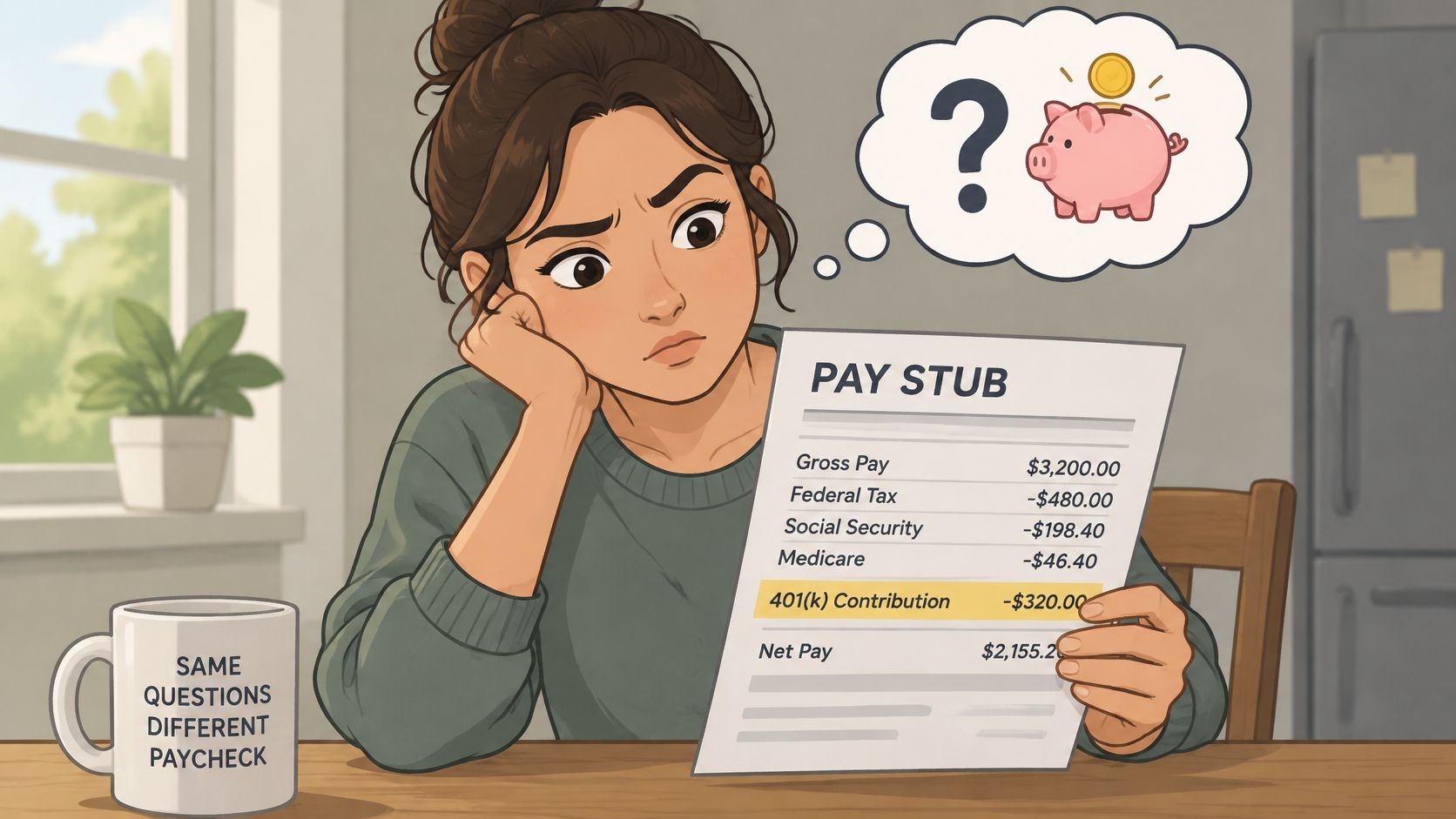
Read the deduction before the account balance
Start with your own payroll contributions. Keep employer deposits separate, and don't use your investment account's total balance to measure how much you've contributed this year.
That distinction matters because a balance and a contribution total answer different questions. Your payroll election controls how much of your pay you direct toward the plan. It doesn't tell you which investments to choose or what those investments will eventually be worth.
Look for these details in your payroll portal:
- Your contribution election. Check whether you selected a dollar amount or a percentage of eligible pay.
- Your employee contribution total. Identify the year-to-date amount attributable to your own deductions.
- Your employer contribution total. Keep matching deposits separate when checking your personal progress.
- Your remaining paychecks. Use the actual payroll calendar rather than assuming every month has the same number of paydays.
Practical rule: Judge your progress using employee contributions and remaining paychecks, then check the employer match separately.
A paycheck deduction can look substantial and still fall short of the annual ceiling. It can also be perfectly sensible for your budget without reaching that ceiling.
“Maxing out” describes a contribution milestone. Deciding how aggressively to pursue it requires a look at the rest of your finances, too.
What Maxing Out a 401(k) Actually Means
An employee elective deferral is money you choose to contribute from your pay. That's the category people generally mean when they talk about maxing out a workplace retirement plan.
The phrase causes confusion because people also use “max” when discussing employer matching. Contributing enough to receive the full employer match and contributing the full employee allowance are different milestones.
Separate the contribution categories
Think of your account as having records for different sources of money. Your own traditional and Roth payroll deductions belong in the employee-deferral category. Employer matching and other employer contributions belong in another category.
The infographic shows those separate contribution sources. When you're checking whether you've maxed out your personal employee allowance, focus on your own deferrals.
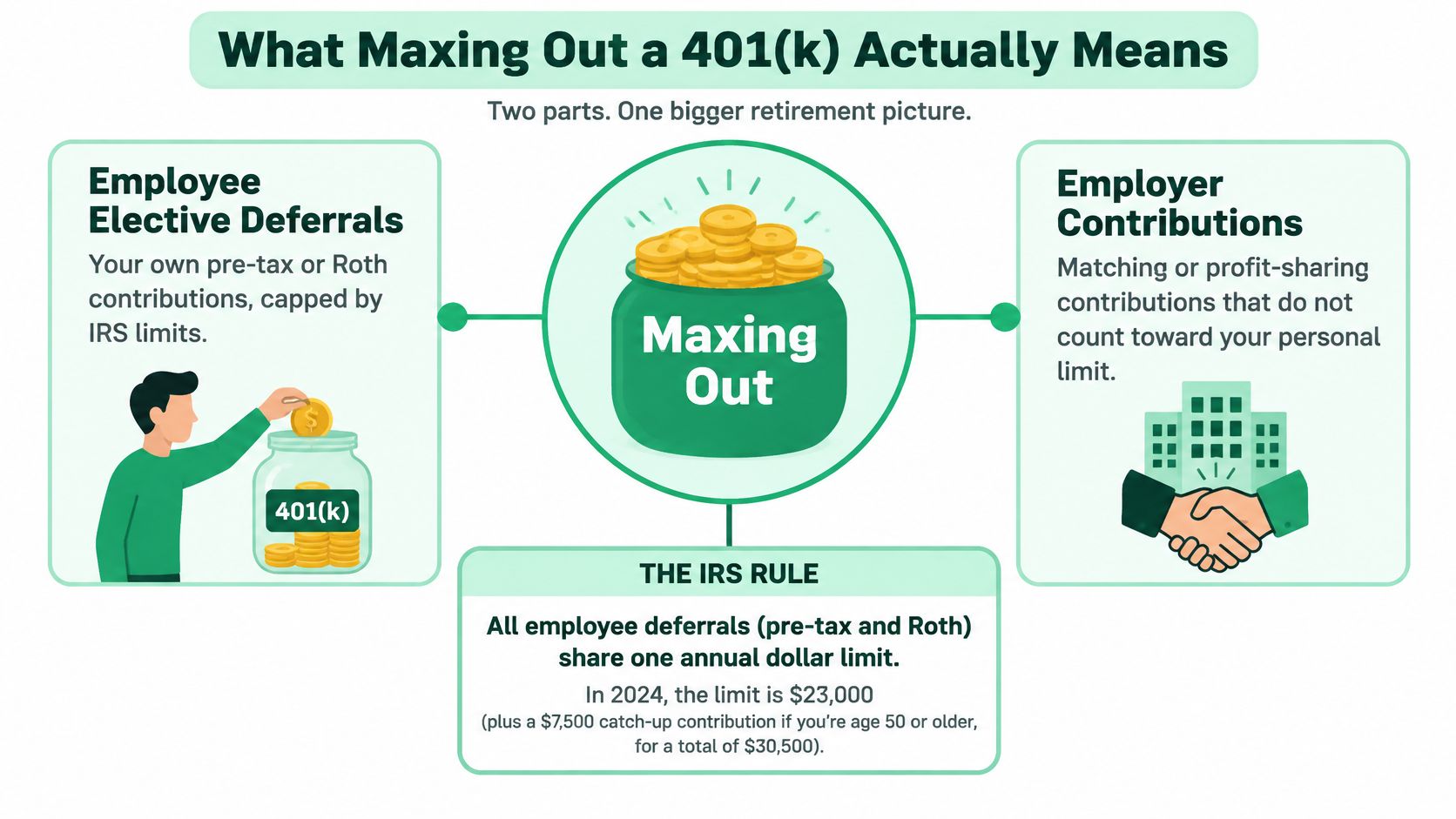
The IRS also limits employee deferrals to 100% of compensation, so the annual dollar ceiling doesn't create permission to contribute more than you earn. Employer contributions fall under a separate overall annual limit, as explained in the IRS guide to 401(k) and profit-sharing contribution limits.
For a broader introduction to the workplace-plan vocabulary you'll encounter during enrollment, Benely's 401k guide provides additional context.
Check the person's contributions, not just the account
Having multiple workplace accounts doesn't automatically multiply your employee allowance. If you've changed employers or participate in different kinds of workplace plans, ask the administrator which contributions must be coordinated before choosing your deduction.
Don't assume that every plan type follows identical aggregation rules. Give the administrator the actual plan names and your contribution history rather than asking a general question about “retirement accounts.”
Your personal check should distinguish:
- Contributions from balances. A large account balance doesn't establish that you reached this year's contribution ceiling.
- Employee money from employer money. Matching deposits don't substitute for employee deferrals.
- Contribution decisions from investment decisions. Reaching a contribution limit doesn't establish that your investments suit your goals or risk tolerance.
That gives “maxing out” a useful, precise meaning: you've reached the employee contribution ceiling that applies to you.
The 2026 Contribution Limits in Plain English
Your age can change your employee contribution ceiling. The basic allowance applies broadly, while eligible older workers can add catch-up contributions, which are extra employee contributions permitted above the basic amount.
The figures below come from the IRS announcement of the 2026 retirement contribution limits. Each total describes employee contributions, without adding employer matching money.
2026 401(k) Employee Contribution Limits at a Glance
| Age Group | 2026 Employee Limit | Catch-Up Allowance | Total Possible |
|---|---|---|---|
| Under age 50 | $24,500 | Not applicable | $24,500 |
| Ages 50–59 | $24,500 | $8,000 | $32,500 |
| Ages 60–63 | $24,500 | $11,250 | $35,750 |
| Age 64 or older | $24,500 | $8,000 | $32,500 |
The enhanced catch-up for the specified age group comes from SECURE 2.0. It replaces the regular catch-up allowance for eligible participants in that group; you don't add both catch-up amounts together.
The age categories matter when you translate an annual goal into a payroll election. Someone eligible for catch-up contributions needs to use their applicable total rather than the basic employee ceiling.
Confirm what payroll will actually allow
An IRS allowance and your payroll settings aren't quite the same thing. Before increasing your election, confirm how your plan handles catch-up contributions and whether you need to make a separate selection.
Keep a short written record of the answer:
- Your applicable limit. Save the current-year figure that matches your age and eligibility.
- Your payroll settings. Note how the plan processes regular and catch-up deductions.
- Your employer's separate rules. Record the match formula and any conditions attached to it.
Limits can change annually, so an election you copied from an older spreadsheet deserves another look. A familiar number can be an outdated number wearing comfortable shoes.
If you're also organizing a home purchase, keep your retirement questions separate from your mortgage broker call notes. Both belong in your household planning records, but a borrowing discussion won't establish your retirement-plan contribution allowance.
The practical goal is a current, plan-specific number you can confidently use when setting payroll deductions.
Traditional vs Roth 401(k) Inside the Same Limit
Choosing traditional or Roth contributions changes the tax treatment of your savings. It doesn't create another employee contribution allowance.
Traditional contributions generally reduce current taxable income. Designated Roth contributions are included in income now, while qualified distributions may be tax-free later. A split election lets you use both treatments within the shared employee limit.
Compare the tax timing
The IRS explanation of catch-up contributions describes the applicable limits and Roth catch-up requirements. Within the shared basic allowance, contributing $15,000 to a traditional account generally leaves $9,500 for Roth contributions in 2026, assuming no other relevant workplace-plan contributions.
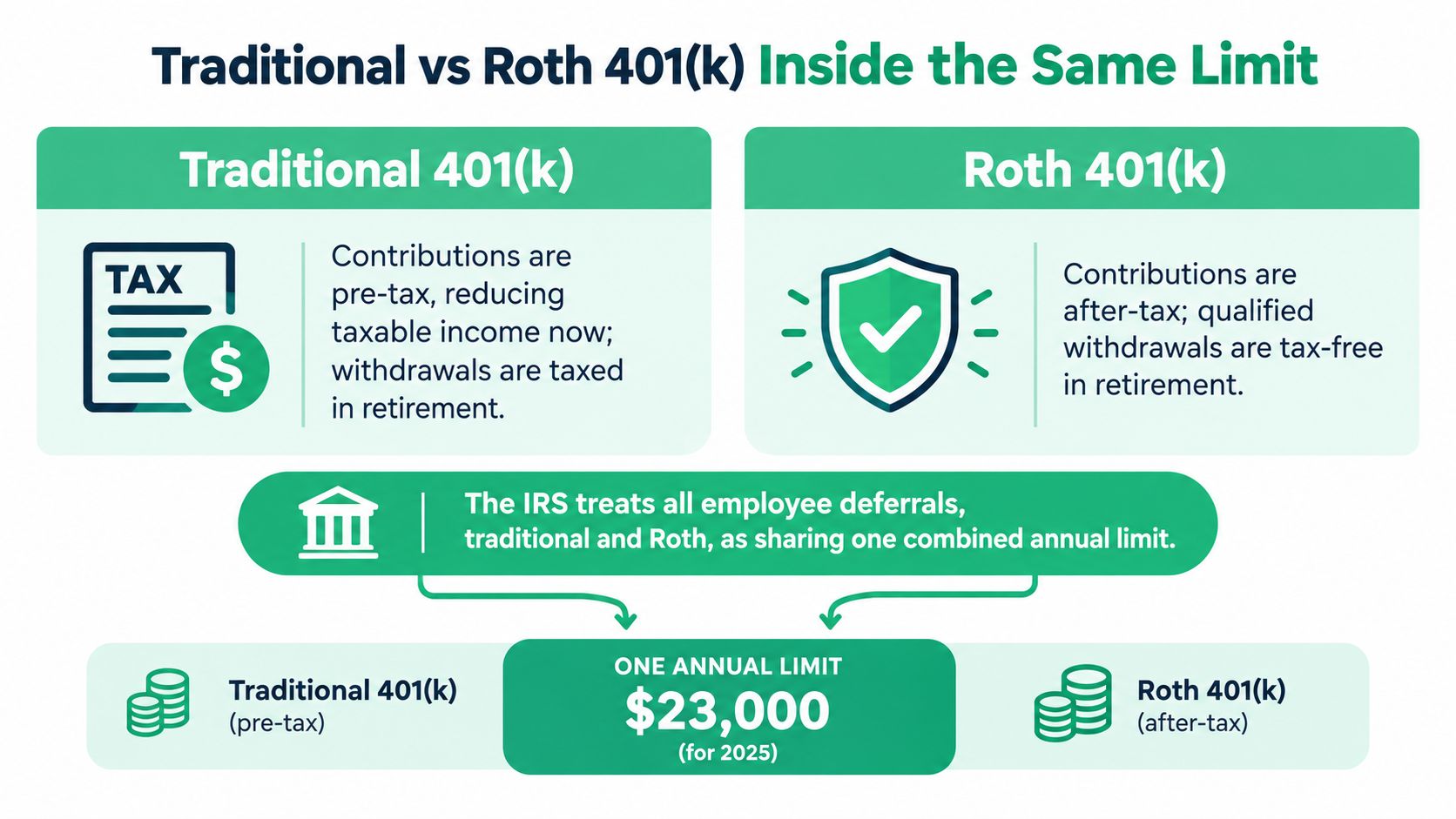
A traditional contribution may appeal when reducing current taxable income is valuable to you. Roth contributions may appeal when you're comfortable paying income tax now in exchange for the possibility of qualified tax-free distributions later.
Neither choice guarantees a better result. Your current tax position, future tax expectations, available plan options, and take-home-pay needs all matter.
For a fuller decision framework, use this traditional versus Roth 401(k) comparison alongside your own tax information.
Watch the high-earner catch-up requirement
Under the IRS guidance linked above, employees whose prior-year wages from the plan sponsor exceeded $150,000 generally must make 2026 catch-up contributions as Roth contributions when the plan offers a Roth feature.
That rule concerns catch-up contributions. It doesn't automatically require every regular employee deferral to become Roth.
Before choosing your election, ask payroll:
- Which wages apply? Confirm the prior-year wage figure used for this requirement.
- How are catch-ups processed? Find out whether payroll automatically directs affected contributions to Roth.
- What happens to take-home pay? Review the effect before assuming your previous deduction arrangement will feel the same.
Choosing a contribution amount and choosing its tax treatment are separate decisions. Give each one a deliberate answer.
How Employer Matching Actually Works
Employer matching depends on a formula in the plan. The match rate tells you how much the employer contributes, while the eligible-pay ceiling tells you how much of your own contribution can receive that match.
The wording matters. A generous-sounding match rate may apply to only a limited slice of pay.
Follow the formula through to dollars
In an IRS illustration of a 401(k) matching formula, an employer matches 50% of employee contributions up to 5% of salary. On a $60,000 salary, contributing 5%, or $3,000, earns a maximum regular match of $1,500; contributing 10% doesn't increase that match because the eligible contribution ceiling has already been reached.
The employee can still choose to save beyond the match threshold. Those additional employee contributions don't earn additional matching dollars under this particular formula.
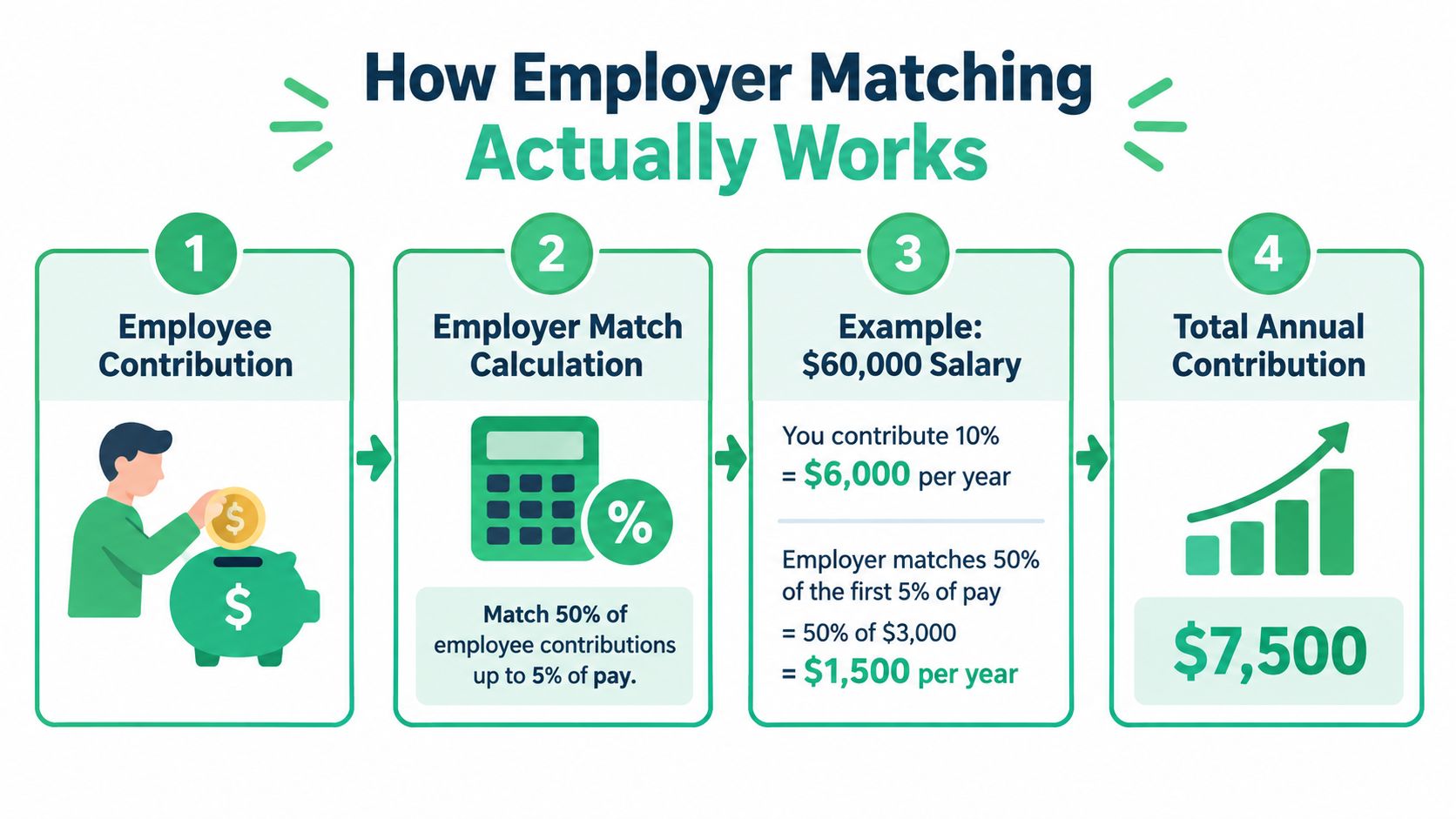
The important distinction is between the amount you contribute and the amount your employer agrees to match. Increasing the former doesn't necessarily increase the latter.
Read beyond the headline match rate
Your plan document should answer several questions that a benefits-enrollment summary may leave unclear:
- Eligible compensation. What pay does the employer use when calculating the match?
- Vesting. When do you gain ownership of employer contributions under the plan's schedule?
- Calculation period. Does the employer calculate the match using each paycheck or annual figures?
- True-up provisions. Does the plan reconcile an annual matching shortfall after uneven contributions?
A true-up is an adjustment that can make up a difference between matching contributions already credited and the amount due under the plan's annual calculation. Its availability and conditions depend on the plan.
Don't treat a coworker's experience as your plan document. They may have different pay, contribution timing, or eligibility circumstances.
Ask the administrator to explain your match using your planned payroll election. That's a more useful question than asking whether the employer “offers a match.” The formula establishes the opportunity; the plan's timing and eligibility rules determine what you receive.
Working Through Three Real Paycheck Examples
The paycheck calculation starts with your annual employee contribution goal, then works backward to the amount you need to defer from each paycheck.
For this comparison, assume evenly paid salaries, a full year of contributions, no catch-up allowance, and no relevant employee contributions elsewhere. The basic goal and payroll examples follow the IRS contribution-limit guidance discussed earlier; the figures below are arithmetic illustrations, not estimates of investment results.
Compare the same goal across different salaries
The annual goal is divided by the number of paychecks. To express it as a payroll percentage, divide the annual goal by eligible annual pay.
| Annual Salary | Pay Schedule | Approximate Employee Deferral per Paycheck | Required Share of Salary |
|---|---|---|---|
| $60,000 | 26 biweekly paychecks | $942.31 | $24,500 ÷ $60,000 |
| $100,000 | 26 biweekly paychecks | $942.31 | 24.5% |
| $200,000 | 26 biweekly paychecks | $942.31 | 12.25% |
These calculations use the $24,500 annual employee goal established in the earlier IRS guidance. The required dollar deduction stays the same across the examples, while the share of salary changes substantially.
For the lower-paid worker, that deduction demands a much larger commitment from each paycheck. That's why treating maximum contributions as a universal starting point misses an important cash-flow reality.
Adapt the calculation to your actual year
If you're starting after the year has begun, use this formula:
Remaining employee contribution goal ÷ remaining paychecks = target employee deduction per paycheck.
Subtract what you've already contributed before dividing. If payroll accepts only percentage elections, ask how rounding and eligible compensation affect the result.
Traditional contributions also require a tax calculation, but a responsible dollar estimate needs your applicable marginal income-tax rate. A rough estimate multiplies the traditional contribution by that rate, subject to your actual tax situation. Without that input, assigning a precise tax-savings figure would create false confidence.
Use a monthly investing framework to test the contribution against your budget. A payroll election should leave room for bills, debt obligations, and cash needs without requiring you to borrow just to keep the retirement deduction running.
Why Front-Loading Can Backfire
Front-loading means directing a large share of your annual contributions into the plan early. Reaching the employee ceiling quickly can feel efficient, but the matching rules deserve attention before you accelerate deductions.
The risk is straightforward: if you reach your personal ceiling before the year ends, later paychecks may have no employee contribution left to match.
The IRS overview of retirement-plan contributions provides the contribution framework. Your plan document supplies the match-calculation and true-up details that determine whether uneven timing can cost you employer money.
The question to ask before accelerating
Consider an employee whose plan calculates matching contributions paycheck by paycheck. They contribute heavily early, reach their employee limit, and then stop contributing for the remaining paydays.
If the plan doesn't provide an applicable annual true-up, later paychecks may produce no matching contribution. The employee can reach the personal contribution ceiling while receiving less employer money than a steadier contribution schedule could have produced.
Before you front-load: Get written confirmation of how the plan calculates matching contributions and whether its true-up provisions protect your proposed schedule.
Ask about:
- The computation period. Confirm whether each paycheck's match stands alone or contributes to an annual calculation.
- True-up eligibility. Find out what conditions apply to an adjustment.
- Payment timing. Ask when any adjustment would be credited.
- Your proposed election. Have the administrator assess the actual contribution pattern you're considering.
Prefer a match-preserving default
My default recommendation is steady contributions that preserve the full available match, followed by adjustments when pay or circumstances change.
Front-loading can still be a deliberate choice when you understand the plan and can afford the cash-flow effect. But contributing sooner doesn't guarantee better investment results, and a hoped-for market benefit shouldn't replace checking a known matching rule.
Treat the employee limit as an annual planning target. There's no prize for reaching it early if your contribution schedule leaves employer money behind.
Putting It All Together and Your Next Steps
So, what does max out 401(k) mean? It means reaching your applicable annual employee-deferral ceiling through your own contributions, with employer matching evaluated separately.
The more useful question is whether your payroll election, tax choice, and employer-match rules work together. A maximum contribution can be a meaningful milestone, but the label alone doesn't establish that you've made the strongest decision for your household.
Make your next portal visit productive
Use this checklist when you review your election:
- Confirm your personal ceiling. Check your age-based eligibility and account for relevant contributions made through other employers or plans.
- Read the match provisions. Locate the formula, calculation period, vesting terms, and true-up language.
- Set a sustainable pace. Divide your remaining contribution goal across remaining paychecks while preserving match eligibility.
- Choose the tax treatment deliberately. Consider current taxes, future expectations, take-home pay, and any Roth catch-up requirement.
Save the answers with your payroll records. If the plan language is unclear, send the administrator your proposed schedule and ask for a written explanation before changing it.
Model the goal without assuming the outcome
Alongside a household budget or a conversation with a financial professional, the publisher's monthly compound interest calculator offers a way to explore contribution scenarios. Treat any assumed return as a modeling input rather than a forecast or promise.
My judgment is simple: pursue the maximum when it fits your finances, but protect the employer match and make an intentional tax choice along the way. If the maximum isn't affordable, choose a contribution you can sustain and understand exactly what matching opportunity it captures.
Your next useful action is to compare your current payroll election with your plan's written matching rules. That comparison can reveal more than watching the account balance alone.
Get more posts like this
One short, useful email each Friday. Free, no spam, unsubscribe anytime.